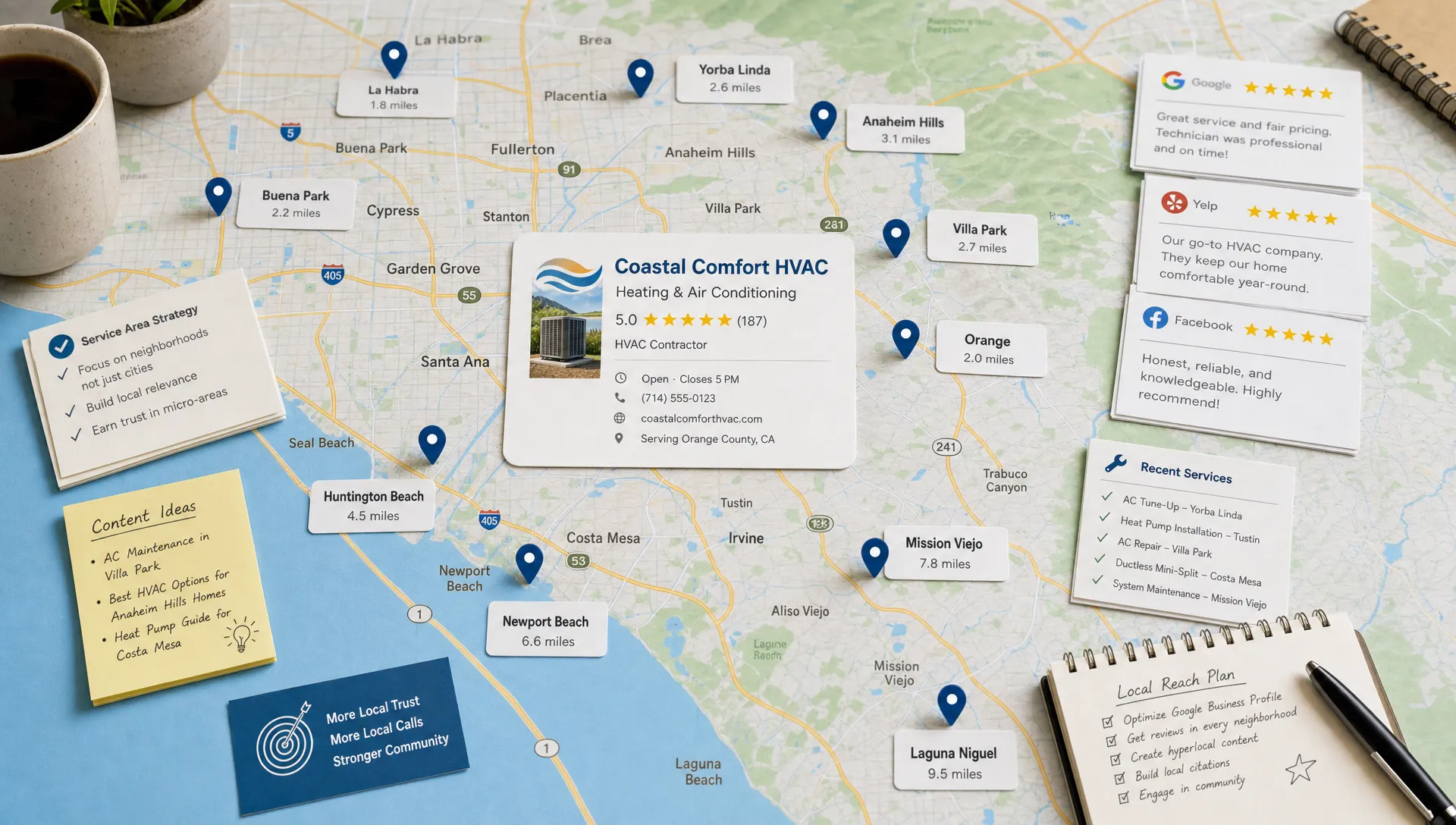
What Digital SEO Really Means for Local Growth
August 21, 2026


Digital marketing, SEO, and local growth are no longer separate conversations. For a local contractor, medical group, dental office, or law firm, digital SEO is the system that helps the right nearby customer find you, understand why you are credible, and take the next step before a competitor wins the call.


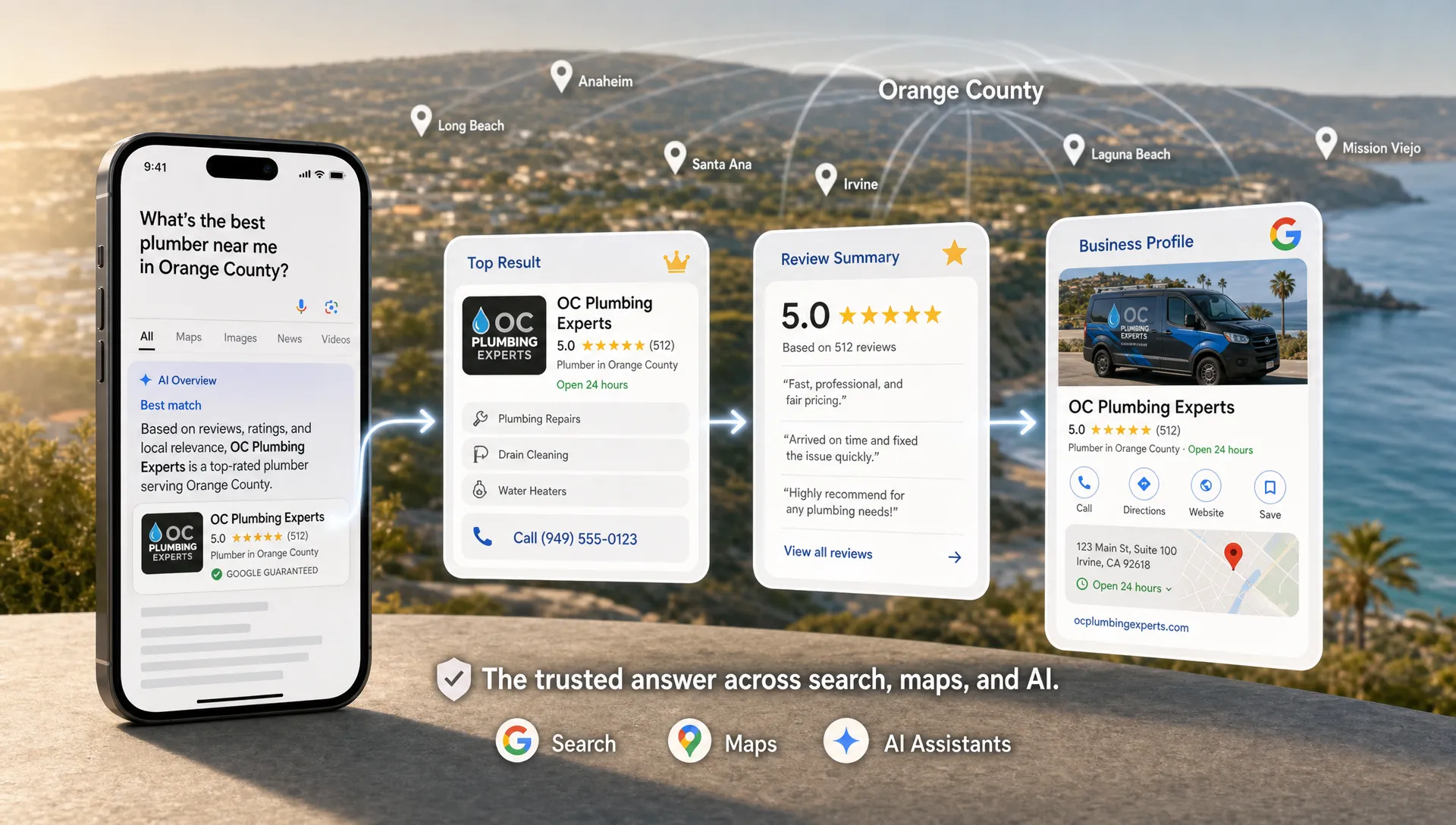
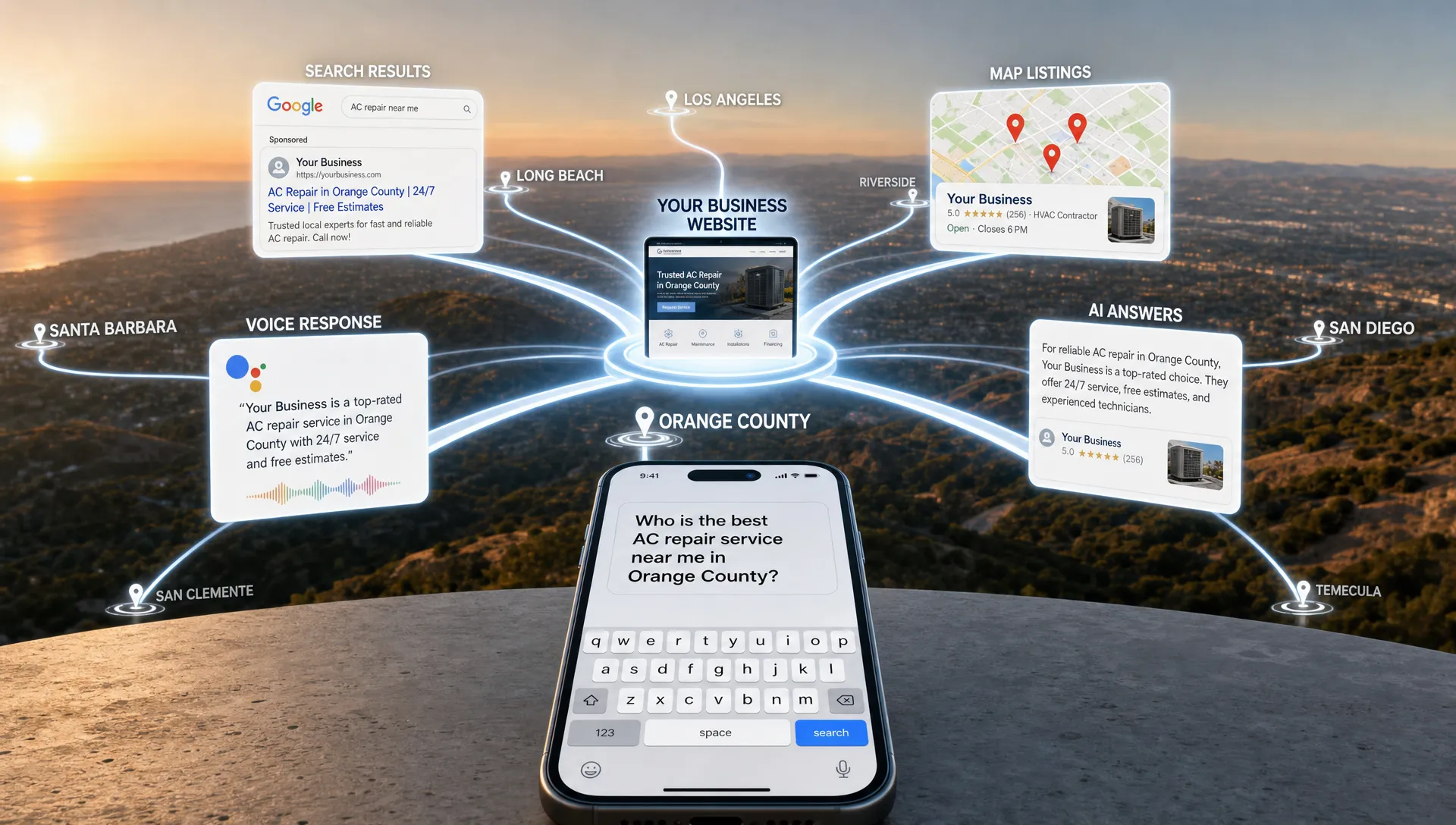
That matters more in 2026 because local buyers are not only typing short keywords into Google. They are asking map apps, voice assistants, AI answer engines, and review platforms for recommendations. A homeowner in Irvine might ask who can repair an AC unit today.


A family in San Diego might compare dental providers near a specific neighborhood. A property owner in Anaheim might ask which roofing company handles tile roofs and insurance documentation. Your business has to be understandable in all of those moments.


Digital SEO, when done well, is not about chasing rankings for vanity. It is about creating a reliable growth path from visibility to trust to calls, consultations, estimates, and booked work.


Digital SEO is not a new label for old SEO


Traditional SEO still matters. Search engines need crawlable pages, clear titles, relevant content, internal links, fast loading experiences, and technically sound websites. Google still publishes basic expectations through Google Search Essentials, and local businesses ignore those fundamentals at their own risk.


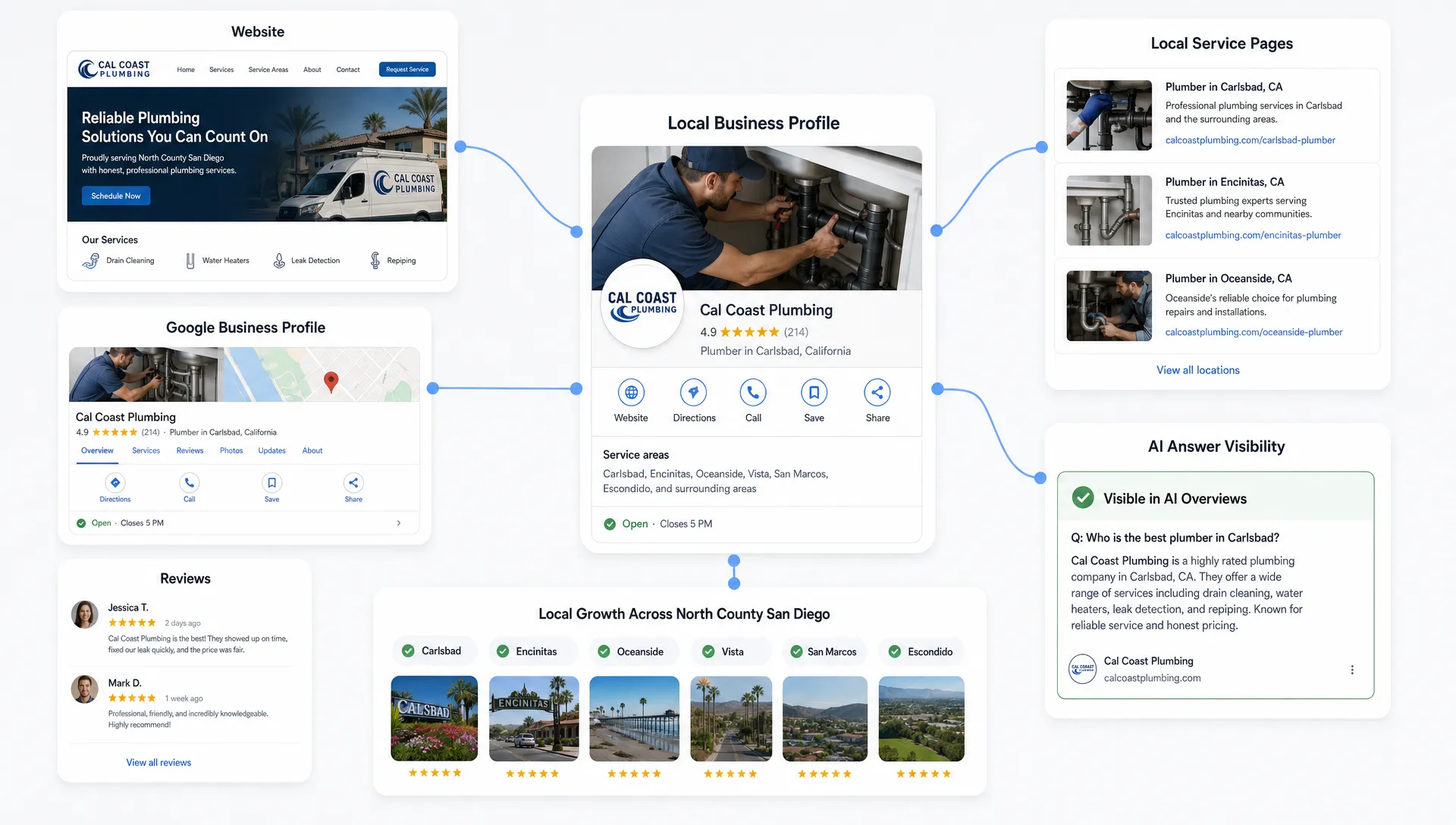
But digital SEO for local growth is broader than classic keyword optimization. It connects five parts of your online presence:


  • Your website, including service pages, location pages, schema, calls to action, and proof
  • Your Google Business Profile, including categories, services, reviews, photos, updates, and accurate NAP information
  • Your content, including answers to the real questions customers ask before they call
  • Your reputation signals, including reviews, testimonials, case examples, and consistency across the web
  • Your answer readiness, meaning how clearly AI systems and search engines can identify your business as a trusted local entity


In other words, digital SEO is not just helping people find a page. It is helping search systems and customers understand your business well enough to choose you.


For a local company in Orange County, that can mean the difference between being one more name in a crowded search result and becoming the obvious answer for a specific service in Laguna Beach, Laguna Niguel, Irvine, Huntington Beach, Anaheim, or Santa Ana.


Why local growth depends on being understood


Local customers do not search in neat keyword lists. They search with urgency, context, and uncertainty.


A homeowner does not simply search for HVAC. They ask whether a unit can be repaired, how fast someone can arrive, whether the company serves their neighborhood, how much experience the company has with their system, and whether other local customers trust them.


A patient does not simply search for dentist. They compare insurance, location, reviews, specialties, appointment availability, and whether the practice feels credible.


That is why local SEO cannot stop at ranking a homepage. Your digital presence has to answer the unstated questions behind the search:


Local Buyer Question Digital SEO Signal That Answers It Why It Affects Growth
Do they serve my area? Location pages, service area clarity, Google Business Profile accuracy Reduces confusion and improves qualified calls.
Can they solve my specific problem? Detailed service pages and helpful answer content Matches high-intent searches more precisely.
Are they trustworthy? Reviews, testimonials, photos, credentials, case examples Builds confidence before the first call.
Are they a real local business? Consistent NAP, citations, local content, entity signals Helps search systems verify relevance.
Is it easy to take action? Clear phone numbers, forms, booking paths, mobile design Converts visibility into revenue opportunities.


The same principle applies outside home services. A hybrid retail and service business such as Fabbrica Ski Sises needs search engines and customers to understand its product categories, sports equipment, rental services, repair services, online store, and physical location as one coherent business entity. California contractors and professional practices face a similar challenge, just with local service intent instead of retail categories.


If your website says one thing, your Google profile says another, your citations use outdated service areas, and your content never answers customer questions, search systems receive a mixed signal. Mixed signals slow growth.


The five systems behind digital SEO for local growth


Digital SEO works best when it is treated as a revenue system, not a checklist. Each part strengthens the next.


1. Service clarity


Search engines need to understand exactly what you do. Customers need the same thing, but faster.


For a plumbing company, one generic plumbing services page is rarely enough. Drain cleaning, leak detection, water heater replacement, sewer line repair, emergency plumbing, and fixture installation each attract different intent. The more clearly you explain the service, the location, the symptoms, and the next step, the easier it becomes for the right customer to call.


For a medical, dental, or legal practice, service clarity means separating practice areas, procedures, provider expertise, and location context in a way that is accurate and compliant. Thin pages that swap city names are not enough. Search engines are better at detecting whether a page truly helps a local user.


If you want a deeper explanation of the mechanics behind crawling, indexing, ranking, and local visibility, Kell Web Solutions has a helpful breakdown of how search engine optimization works for local business.


2. Location authority


Local growth depends on local proof. A business that wants calls in Irvine, Anaheim, Long Beach, San Diego, San Jose, Sacramento, Fresno, or Bakersfield needs more than a single sentence saying it serves all of California.


Location authority comes from consistent evidence. That can include localized service pages, neighborhood-focused content, project examples, review language, service area information, map signals, and accurate business listings. For contractors, it can also include photos and descriptions of real work completed in specific communities.


This is especially important in competitive California markets where buyers often compare several providers before calling. A remodeler in Newport Coast competes on a different set of expectations than a remodeler targeting inland neighborhoods. A solar installer in Riverside faces different questions than one serving coastal Orange County. Digital SEO should reflect those differences.


3. Trust signals


Visibility without trust creates low conversion. Searchers may see you, but they will not call if your online presence feels thin, outdated, or generic.


Trust signals include reviews, review responses, photos, staff or leadership information, certifications, warranties when applicable, service explanations, years of experience, and clear contact details. They also include consistency. If your website, Google profile, Yelp listing, and local directories all present the business differently, trust weakens.


AI answer engines also rely on trust signals. They tend to prefer clear, corroborated information over vague claims. That does not mean every business needs to publish endless content. It means the content and profiles that exist should be accurate, specific, and aligned.


4. Technical structure


Technical SEO is the part most business owners do not see, but it affects whether everything else can perform.


A local growth website should load quickly, work well on mobile devices, use logical navigation, include clean internal linking, and make important content easy to crawl. Structured data can help search systems understand business type, services, location, reviews, FAQs, and other key details when used correctly.


For answer readiness, technical structure also includes making your content easy for AI systems to parse. Clear headings, direct answers, entity consistency, and well organized service information make the website more machine-readable and more useful for human visitors.


5. Conversion pathways


Digital SEO fails if it creates traffic that does not turn into action. This is where many local businesses lose revenue.


A visitor should immediately understand what you do, where you serve, why you are credible, and how to contact you. Phone numbers should be easy to tap on mobile. Estimate requests should be simple. Appointment or consultation paths should be obvious. Service pages should not end without a next step.


For contractors, the desired action may be a call, estimate request, or emergency appointment. For professional practices, it may be a consultation, new patient inquiry, or location-specific appointment. The conversion path should match the urgency and complexity of the service.


This is why web design and SEO have to work together. A technically optimized page that confuses visitors will not grow revenue. A beautiful website that search systems cannot understand will not be found. The strongest local websites combine both, as explained in Kell Web Solutions' article on web design and search engine optimisation that converts.


What digital SEO means for contractors


For home services companies, digital SEO is about winning the moment when a nearby customer has a real problem.


HVAC, roofing, solar, plumbing, electrical, and remodeling companies compete in high-intent local searches where timing matters. The winner is often the company that appears credible, local, relevant, and easy to reach at the exact moment the customer is ready to act.


A strong contractor SEO system should make it clear which services are offered, which neighborhoods are served, what kinds of projects the company handles, and why the customer can trust the team. It should also support both urgent and research-based intent. Emergency plumbing and whole-home repiping are both plumbing searches, but the buyer mindset is completely different.


For contractors in Orange County and across California, this is where hyperlocal content becomes powerful. A roofing company does not only need a roofing page. It may need content that reflects coastal conditions, HOA concerns, tile roof issues, wildfire hardening questions, solar compatibility, and city-specific permitting expectations where appropriate.


What digital SEO means for multi-location practices


For medical, dental, and legal practices, digital SEO is about building location-level confidence without creating duplicate or low-value pages.


A multi-location practice has to help search systems understand each office as part of a larger brand and as a relevant local option. Each location page should include accurate address information, phone numbers, hours, provider or team context when applicable, services available at that location, and a clear appointment path.


The challenge is avoiding generic location pages that look identical except for city names. A dental office in San Jose, a legal office in San Francisco, and a medical practice in Sacramento each serve distinct local audiences. Their pages should reflect real differences in services, access, staff, community relevance, and patient or client questions.


Digital SEO also supports reputation management across locations. Reviews, responses, and profile consistency matter because local buyers often evaluate the location closest to them, not just the parent brand.


How digital SEO and answer engine optimization work together


SEO helps your business appear in search results. Answer Engine Optimization helps your business become easier for AI-driven platforms to understand, trust, and cite as a direct answer.


That distinction matters because search behavior is changing. People increasingly expect summarized answers, map recommendations, voice results, and AI-generated comparisons. Your business needs to be clear enough for both humans and machines.


For local companies, AEO usually starts with the same foundation as strong SEO: entity clarity, accurate business information, helpful answers, structured content, and trust signals. The difference is the goal. Instead of only asking whether a page ranks, you also ask whether the business is likely to be selected, cited, or recommended when someone asks a question.


Kell Web Solutions focuses on this shift through Answer Engine Optimization for local businesses, especially for companies that depend on being visible when buyers research before calling.


A practical 90-day digital SEO plan


Local growth does not require random activity. It requires sequencing. A 90-day plan can create clarity quickly while laying the foundation for compounding authority.


Timeline Primary Focus What to Improve
Days 1 to 30 Fix the foundation Audit website structure, Google Business Profile, NAP consistency, service pages, technical issues, and conversion paths.
Days 31 to 60 Build local relevance Create or improve service and location content, answer common questions, strengthen internal links, and add proof where customers need it.
Days 61 to 90 Expand trust and authority Improve review strategy, publish helpful local content, refine calls to action, monitor visibility, and identify gaps in AI or map results.


This plan works because it avoids the common mistake of publishing content before the business foundation is clear. If search engines cannot identify your services, locations, and trust signals, more content may only create more confusion.


For many local businesses, the fastest gains come from improving pages that already receive impressions but fail to convert. That might mean rewriting a service page, adding location-specific proof, improving the mobile call experience, clarifying service areas, or strengthening the Google Business Profile.


What to measure if you care about local growth


Digital SEO should be measured by business outcomes, not just ranking reports. Rankings can be useful, but they do not tell the whole story.


A local business should track visibility, engagement, trust, and conversion together.


Metric What It Tells You Why It Matters
Qualified calls Whether search visibility is producing real opportunities Direct connection to revenue
Form submissions or bookings Whether visitors are taking action Shows conversion strength
Google Business Profile actions Calls, website visits, direction requests, and engagement Shows local search demand
Service page performance Which services attract and convert visitors Helps prioritize content and optimization
Location visibility Where the business appears or disappears by city or neighborhood Reveals local authority gaps
Review volume and quality Whether customers trust the business before contacting it Supports both conversion and local relevance
Answer visibility Whether AI or answer engines recognize the business for key questions Shows readiness for the retrieval economy


The goal is not to collect more dashboards. The goal is to understand where visibility becomes revenue and where the path breaks.


If your business receives impressions but few calls, the issue may be trust or conversion. If your website converts well but traffic is weak, the issue may be authority or content coverage. If you rank in one city but not the next, the issue may be local relevance. Digital SEO helps diagnose the real bottleneck.


Common digital SEO mistakes that slow local growth


Many local businesses work hard online but still struggle because their efforts are disconnected. The most common mistakes are easy to recognize:


  • Treating SEO as a one-time website project instead of an ongoing growth system
  • Targeting broad keywords while ignoring neighborhood and service-specific intent
  • Publishing generic content that does not answer real customer questions
  • Letting Google Business Profile information become outdated
  • Building city pages with thin, duplicated copy
  • Measuring traffic while ignoring calls, appointments, and booked work
  • Investing in ads while the website and reputation signals are too weak to convert visitors


The fix is not to do everything at once. The fix is to align the digital presence around how customers actually choose a local provider.


Frequently Asked Questions


What does digital SEO mean for a local business? Digital SEO means optimizing your full online presence so search engines, maps, AI answer engines, and local customers can understand your services, locations, credibility, and next steps. It includes technical SEO, content, Google Business Profile optimization, reviews, and conversion strategy.


Is digital SEO different from local SEO? Digital SEO is broader. Local SEO focuses on visibility in local search results and map results. Digital SEO includes local SEO, but also considers website conversion, answer engine readiness, reputation signals, and how all digital assets work together to create growth.


How long does digital SEO take to produce local growth? Foundational improvements can create better engagement within weeks, especially when a business already has visibility. Stronger local authority usually compounds over several months as service pages, reviews, content, and entity signals become more consistent.


Do contractors still need SEO if they run paid ads? Yes. Paid ads can create immediate visibility, but SEO builds durable trust and reduces dependence on rising ad costs. A strong digital SEO foundation also helps paid traffic convert better because visitors land on clearer, more credible pages.


What should multi-location practices prioritize first? Start with accurate location pages, consistent business information, clear services for each office, strong appointment paths, and location-specific trust signals. Avoid duplicated pages that only change the city name.


Turn digital SEO into local revenue


Digital SEO really means building a local growth system that search engines, AI platforms, and customers can all understand. For California businesses, especially contractors and multi-location practices, that system has to connect services, geography, trust, technical clarity, and conversion.


Kell Web Solutions helps local companies move beyond generic rankings and build visibility that supports real calls, consultations, and booked work. If your business needs a stronger local foundation, start by learning how local search engine optimization wins nearby jobs, then evaluate where your current digital presence is helping or hurting growth.

August 21, 2026
 Is your website invisible to the AI your prospective clients are using to vet you? It's a fair question, and most Orange County business owners can't answer it. They've never actually asked ChatGPT or Perplexity what it says about their firm. Search used to mean links you could rank. Now it's a conversation, and AI decides who gets mentioned. G2's newest B2B buyer research found 51% of B2B buyers now start with AI chatbots, not Google. That's up from just 29% eleven months earlier — a massive swing in under a year. This isn't a fringe prediction anymore. Gartner projects that traditional search volume will drop 25% by 2026. That decline comes directly from AI chatbots replacing search queries. Gartner calls these tools "substitute answer engines." That shift didn't stay contained to software. Agencies, law firms, and medical practices are now researched by AI before a human ever visits. If you're not part of that conversation, you're not just losing clicks. You're losing the mention entirely. Owners in this position usually notice the symptom before they understand the cause. Referral volume looks fine, the website still gets occasional traffic, but new inbound inquiries have quietly slowed. That's often the first sign the AI conversation about your category is already happening — without you in it. This matters more for B2B and professional service firms than most businesses. Home services companies can still win a call through pure proximity. A law firm or consultancy has no such fallback once an AI shortlist forms without them. The gap between having a website and being an answer "Most OC businesses are losing leads because their brand is missing from AI-generated 'best-of' lists and conversational search results. We bridge the gap between their website and the LLM's understanding of their authority." — Gregg Kell, Founder, Kell Web Solutions There's a specific failure behind that quote, and it deserves a name. Call it the AI citation authority gap. It's the distance between what your website says about your firm and what a model actually believes. That belief surfaces the moment a prospect actually asks. A website is a document. An AI answer is a judgment. Google could always be tricked with the right keywords in the right places. Answer engines don't work that way. They synthesize an opinion from everything they can find about you. Then they decide whether you're worth mentioning by name. That's a much higher bar than ranking. Most Orange County B2B firms have never been measured against it. Nobody built a scorecard for this until recently. What AI platforms actually reward HubSpot's 2026 AEO research frames AI citation as consensus, not ranking. Answer engines don't crawl your site and stop. They cross-reference it against everything else they can find. That includes directories, review platforms, press mentions, and forums. Then they look for agreement across all of it. Entity consistency matters most. Does your name, address, pricing, and services match everywhere online? Inconsistent facts across your site and listings suppress citations. Structured content matters second. Clear headers and schema markup help a model extract facts accurately. Direct, answer-first writing helps too. Third is agentic readiness. That means machine-readable infrastructure like llms.txt and JSON-LD. It tells an AI crawler exactly who you are, instead of making it guess. Here's the uncomfortable part. A page outside Google's top five can still win the AI answer. That happens whenever it most directly answers what the user asked. Ranking and citation are no longer the same contest. Firms optimized purely for the old contest are flying blind in the new one. Prompts to AI look nothing like old search queries. That same research found average ChatGPT prompts run 23 words long. A typical Google search is just 3.37 words. Five signs your firm already has a citation authority gap Most owners can self-diagnose this in about ten minutes, before spending a dollar on any agency. A few patterns show up again and again among Orange County B2B and professional service firms that haven't looked yet. You've never checked. You've never typed your own category and city into ChatGPT to see who it names instead of you. Most owners assume they'd show up — most haven't checked. Your NAP data doesn't match. Name, phone, address, and services should read identically across your site, your GBP, and directories. No schema markup. Your site has no structured data, so a model has to guess facts it could otherwise extract with certainty. Thin third-party proof. Your only credibility signal is a handful of Google reviews — no press coverage, comparison articles, or industry citations backing you up. A competitor got there first. If a rival has invested in AEO and you haven't, the model already picked a side. It will keep recommending that side until your signals catch up. Any single one of these is fixable in an afternoon. Stacked together, they're what quietly kills a shortlist spot. None of these five signs require expensive tools. They require ten honest minutes and a willingness to look. See your firm the way a machine sees it, not the way you'd describe it. Why this hits professional service firms harder Home services businesses feel this shift through missed emergency calls. B2B and professional service firms feel it earlier — in the shortlist itself. That happens well before a prospect ever picks up the phone. Orange County agencies are already repositioning around this This shift isn't hypothetical in Orange County. Costa Mesa-based Intero Digital now sells a named "GEO" service. Irvine's Directive Consulting markets its own "DiscoverabilityOS" platform for exactly this problem. Neither is warning you the shift is coming. Both are already selling the fix to whoever notices first. That's the real cost of waiting to check your own visibility. Kell is positioned differently from both of them. AEO isn't a bolted-on service line here — it's the whole business. That focus is a meaningful difference in this comparison. Forrester's Buyers' Journey research found 92% of B2B buyers start with a vendor already in mind. 41% already have one preferred vendor before formal evaluation even begins. That preference used to form through referrals and conference badges. Now it increasingly forms through a five-second exchange with a chatbot. That compression makes the gap dangerous for OC's B2B and professional firms. Legal, accounting, consulting, and marketing firms sell trust before anything else. So do multi-location medical and dental practices. A prospect might ask an AI model, "Who's the best marketing agency in Orange County?" The model vouches for whichever firm it can verify, not necessarily the one that deserves it most. Picture a mid-size Irvine consulting firm with twenty years of results. Its website is a static page with no structured data. A three-year-old competitor next door has clean schema and real press mentions. Today, the newer firm is more likely to get named. Track record stopped being self-evident once AI started making the introductions. The risk compounds because AI doesn't just fail to mention you. It actively promotes whoever it trusts instead — often a competitor you didn't know was in the running. A 680-million-citation analysis found 73% of B2B buyers now use AI tools like ChatGPT and Perplexity. Yet only 22% of marketers track how their brand shows up. That 51-point spread is the citation authority gap, measured industry-wide. Every mention has a winner and a loser The G2 research above carries a second finding worth sitting with. Sixty-nine percent of B2B buyers switched vendors based on what a chatbot recommended. A third bought from a vendor they'd never heard of before. Read that again as a business owner, not a marketer. Every AI-driven recommendation is a zero-sum event. When a model can't verify your firm, it doesn't leave the answer blank. It cites the competitor whose signals were clear enough to trust. You don't just miss a lead — you hand it over. You hand it to whoever closed their own authority gap first. Trust signals matter here too. In the same G2 survey, 45% of buyers trusted review-site citations most. AEO isn't just a website exercise — it's an off-site reputation audit. Professional service firms have their own version of this signal. Certifications, bar admissions, and awards belong in structured markup, not just a page footer. A model can't cite credentials it can't parse. Multi-location medical, dental, and legal practices face an extra layer here. A model asked about a specific neighborhood has to pick one location to name. Practices with one strong "flagship" listing often lose their satellite offices. Those locations vanish from AI answers even when service quality is identical. Where to start if you want to check this yourself Before hiring anyone, run this audit yourself. Open ChatGPT and Perplexity and ask what a prospect would ask. Try your service, your city, and "who's the best." Read the answer closely. Note whether you appear, how you're described, and who appears instead. Next, pull up your Google Business Profile and your website's contact page. Add any directory listing you can find. Compare all three, line by line. From there, HubSpot's schema markup guide is a solid starting point. It adds the structured data most answer engines look for. It won't close the full gap alone, but it's the baseline everything else builds on. This isn't a one-time fix, either. Entity signals drift as directories update and content ages. Most firms recheck this audit every quarter. Closing the gap: what becoming an AI-cited authority actually requires Kell Web Solutions built its AEO service around exactly this problem. It's the same shift founder Gregg Kell has tracked for two decades in Orange County. The goal isn't to chase another ranking algorithm. It's to become the entity an AI model trusts enough to name. Kell's philosophy leans into durability on purpose. The goal is compounding authority, not a short-term ranking spike. Spikes fade the moment an algorithm updates — entities don't. Founder Gregg Kell wrote a book on exactly this problem. It's called "The Invisible Expert," and it's downloadable from Kell's site. That background shapes the whole AEO methodology. That work breaks into three outcomes worth understanding first. First, recognition: AI platforms need to identify your firm as an authority. Not a generic entry in a directory. Second, citation: earning a real mention when a prospect asks a local question. That's the exact moment an AI model is trying to answer. Third, protection: building signals strong enough that competitors can't quietly displace you. That displacement often happens in a recommendation you never see. Kell's AEO service runs a five-step process to get there. It maps how customers phrase questions, then audits current AI visibility. From there it restructures the site and builds durable authority signals. It's sold in three tiers, from AEO Essentials up through AEO Elite . Elite layers in advanced schema and full agentic-readiness infrastructure. Pricing here is published, not hidden behind a "contact us" form. AEO Essentials starts at $500 setup plus $500 a month. AEO Elite runs $1,000 setup plus $2,500 a month. Multi-location practices often pair that work with Local SEO Mastery. It keeps every branch's citation data consistent — the exact weak point above. It's smaller and more foundational, and it often comes first. Scale is deliberately part of the pitch, too. Larger agencies often bolt AI-search language onto existing SEO retainers. They tend to route clients to account teams instead of founders. Kell stays boutique on purpose. AEO clients work directly with founders Gregg and Debbie Kell. That's a real difference while the strategy is still evolving monthly. Kell also integrates with GetAiRefs' Share of Answer scoring. That measures how often a client is actually cited across target queries. It turns "are we visible to AI" from a guess into a tracked number. For more on how the click itself is changing, see Kell's piece on when AI takes the click . None of this replaces good client work or a strong reputation. It translates that reputation into a form AI platforms can verify. Then it repeats that back to a prospect who's never heard of you. What it looks like when the gap closes Closing this gap looks different from a typical SEO win. Rankings might not move at all in the short term. Citations do — inside ChatGPT, inside Perplexity, inside Google's AI Overviews. A prospect asks the same question they always asked. This time, your firm is part of the answer. That's the entire goal of AEO, stated plainly. Frequently asked questions What does it mean to be a "cited entity" rather than just an indexed website? An indexed website simply exists in a search engine's database. A cited entity is different — it's a business an AI model trusts enough to name. That happens unprompted, without the user searching for you by name. Can a well-designed website still be invisible to ChatGPT or Perplexity? Yes, and it happens constantly. Visual design has no bearing on whether a model trusts your entity signals. A beautiful site with inconsistent data and no schema can still be invisible. How is this different from just ranking low on Google? Ranking low means you're on page three of a shrinking results list. Being outside the citation set is worse. The AI answer was generated and delivered without your firm ever entering consideration. How do B2B and professional service firms specifically get displaced by AI recommendations? A prospect asks an AI model to compare options in your category. The model surfaces whichever firms have the clearest, most corroborated entity signals. That's often a smaller competitor with sharper AEO work, not the more established firm. What is a "Share of Answer" score? It's a metric tracking how often your business is cited across defined AI queries. Think of it like share of voice, but for AI answers. Kell Web Solutions tracks this through its GetAiRefs integration. How long does it take to close an AI citation authority gap? There's no universal timeline. It depends on how fragmented your current entity signals are across the web. Most engagements show measurable gains within a few months. Authority compounds the longer your signals stay consistent. The bottom line The businesses winning the next decade of Orange County search won't necessarily be the ones with the biggest ad budgets. They'll be the ones an AI model trusts enough to recommend without being asked twice. That's the shift Orange County can't afford to ignore. That trust doesn't build itself, and it doesn't show up in a standard SEO report. It has to be engineered deliberately, tracked, and defended as competitors start doing the same work. For agency owners and professional practices watching referrals slow with no clear explanation, this gap is very often the reason. Stop wondering why the leads have gone quiet. Find out exactly how your brand appears to the machines making these decisions. A short strategy call is enough to see where the gap sits. Claim Your AI Visibility Audit before a competitor closes their gap first.
August 21, 2026
 An answer-ready web presence is not just a better website. It is a connected system of pages, profiles, reviews, structured data, local proof, and clear business information that helps Google, AI Overviews, ChatGPT, Perplexity, and voice assistants understand one thing fast: who you are, what you do, where you do it, and why you should be trusted. For Orange County contractors, multi-location practices, and service businesses across California, that shift matters. A homeowner in Irvine may ask Google, Which HVAC company can fix my AC today? A patient in San Jose may ask ChatGPT to compare nearby dental implant specialists. A property manager in Sacramento may use voice search to find an emergency plumber. In each case, the winner is not always the company with the prettiest homepage. It is the company whose digital presence is easiest for machines to verify and recommend. Think of this as building an answer web around your business. Your website remains the hub, but every supporting asset should reinforce the same facts, expertise, services, locations, and trust signals. What an answer-ready web presence means An answer-ready web presence is designed for both human buyers and machine interpretation. It gives people confidence while giving AI systems enough structure and corroboration to cite, summarize, or recommend your business. Traditional SEO often focused on ranking a page for a keyword. Answer readiness goes further. It asks whether your entire digital footprint can answer buyer questions clearly, consistently, and with evidence. For example, a roofing contractor in Huntington Beach should not only have a service page for roof repair. The business should also make it obvious which roof types it repairs, whether it offers emergency service, which cities it serves, what licensing or insurance information applies, what recent customers say, and how someone can contact the company without friction. That same principle applies outside home services. A multi-location dental group in Los Angeles, a law firm in San Diego, or a medical practice in Fresno needs location-specific proof, practitioner expertise, service clarity, and consistent entity data across the web. Why Google and AI need stronger signals now Search engines have always interpreted websites, but AI-driven search raises the standard. When Google generates an AI Overview or an assistant answers a question directly, it must decide which sources are reliable enough to summarize. That makes clarity, structure, and corroboration more important than ever. Google’s own documentation emphasizes that structured data helps Google understand page content and qualify pages for enhanced search features. It is not a magic ranking button, but it is a practical way to make important details easier for systems to process. You can review the baseline principles in Google Search Central’s structured data documentation . The biggest local visibility risk is ambiguity. If AI systems cannot tell whether you serve Laguna Niguel, whether your electrical company handles commercial work, whether your medical practice accepts new patients, or whether your business is still active, they may choose a clearer competitor instead. If you want a broader view of this shift, Kell Web Solutions explains the strategic foundation in its guide on how to become the AI answer in your local market . Step 1: Define your business entity with zero confusion Before you optimize content, define the business entity. AI systems need a stable understanding of your company across your website, Google Business Profile, directories, social profiles, review platforms, and local mentions. Start with the basics, then make them consistent everywhere: Legal or commonly used business name Primary phone number and email Physical address or service area Core services and specialties Primary city and surrounding service areas Team members, credentials, certifications, and licenses where relevant Business hours, emergency availability, and appointment options For local service businesses, the service area is especially important. Do not rely on vague phrases like serving Southern California if revenue depends on specific cities. Spell out the areas that matter, such as Laguna Beach, Laguna Niguel, Irvine, Anaheim, Santa Ana, Huntington Beach, San Diego, Los Angeles, San Jose, Sacramento, Fresno, and the neighborhoods or suburbs you realistically serve. Consistency matters because answer engines compare signals. If your website says you are based in Orange County, your Google Business Profile lists a different service focus, and directory profiles use outdated phone numbers, trust drops. Step 2: Build pages around real buyer questions Answer-ready pages are built around intent, not just keywords. A homeowner, patient, or business buyer rarely thinks in exact keyword phrases. They ask questions, compare options, look for proof, and want next steps. For a home services contractor, strong answer-ready content might include pages that address questions like: How quickly can an HVAC company repair an AC unit in Irvine? What does emergency plumbing service cost in Orange County? Do I need a permit for a roof replacement in Anaheim? Which solar options make sense for a coastal home in Laguna Beach? For a professional practice, the same approach applies: Who is the best dentist for implants near Newport Beach? What should I bring to a first consultation with a family law attorney in San Diego? How do I compare medical clinics in San Jose for a specific treatment? Each page should answer the question directly near the top, then support the answer with detail, examples, location context, credentials, reviews, and a clear call to action. Here is a simple way to map content to intent:
August 12, 2026
 For a local business, a search campaign is only as good as the phone calls it produces. Clicks, impressions, and rankings matter, but they do not pay the crew, fill the dental chair, or book the legal consultation. If your customer needs an HVAC repair in Irvine, a roof estimate in Anaheim, an emergency plumber in Laguna Niguel, or a same-week appointment at a multi-location practice, your marketing has one central job: make your business the obvious next call. That is why search engine marketing for local businesses should be built around call intent, not just traffic. In 2026, local visibility is spread across Google Ads, Google Maps, organic search, Local Services Ads, AI Overviews, voice assistants, review platforms, and answer engines. A business that only optimizes one channel can look visible in a report while still losing high-value calls to competitors. The better approach is call-first SEM: every campaign, page, listing, review, and follow-up system is designed to help a nearby buyer trust you quickly and contact you confidently. Why call-driven SEM is different from click-driven marketing Traditional search marketing often rewards activity. You launch ads, optimize keywords, improve page rankings, and measure how many people visit the site. That is useful, but it can hide the most important question: did the right people call? Local service buyers behave differently from casual browsers. They often have a specific problem, a narrow service area, and a short decision window. Someone searching “AC repair near me” in Huntington Beach or “roof leak repair San Diego” is not researching general education for next year. They are trying to solve a problem now. Call-driven SEM must therefore align four elements: Intent : The searcher is ready to act, compare, or schedule. Location : The business clearly serves that city, neighborhood, or radius. Trust : Reviews, credentials, case examples, and clarity reduce hesitation. Response : The business answers, qualifies, and books the opportunity quickly. If one of those elements fails, the lead can disappear. You can rank well but look untrustworthy. You can run ads but send people to a generic homepage. You can generate calls but miss them during busy hours. The strongest local SEM systems close those gaps before spending more money. The call-first SEM framework for local businesses A call-first strategy does not start with platforms. It starts with the buyer’s moment of need. For home services contractors, that moment may be urgent: a broken heater, a clogged drain, a leaking roof, or a solar issue affecting a power bill. For medical, dental, and legal practices, the search may be more considered, but the decision still depends on proximity, credibility, and speed. A practical SEM framework includes these five layers: High-intent search visibility : Paid search, Maps, local SEO, and service pages should target searches that indicate a buyer is close to calling. Hyperlocal authority : Pages, listings, and content should prove that the business serves specific areas, not just a broad county. Conversion-focused web experience : The website should make phone calls, appointment requests, and quote requests simple on every device. Reputation signals : Reviews, photos, service details, FAQs, and business information should reduce doubt before the call. Call handling and follow-up : Marketing performance depends on answer speed, qualification, scheduling, and follow-up with missed or undecided leads. This is where many local campaigns fall short. They optimize for visibility but ignore conversion. Or they improve the website but fail to build local authority in the cities where revenue is most valuable. Which search channels actually generate calls? Local SEM is not one tactic. It is a coordinated mix of channels, each with a different job. The right balance depends on your market, budget, competition, and urgency.
August 12, 2026
 For years, ranking search results meant one thing: moving a website higher on Google. In 2026, that definition is too narrow. A homeowner in Irvine who asks, 'Who can fix my AC today?' may see a Google AI answer, a local pack, reviews, paid local listings, and only then traditional organic results. A patient in San Jose looking for a dental specialist may ask ChatGPT, compare Google Business Profiles, scan reviews, and call without ever visiting a website. A property owner in Sacramento may use voice search and hear a single recommendation. That is the reality of ranking search results in 2026. Visibility is no longer controlled by one list. It is shaped by a network of signals that help search engines, map systems, AI assistants, and humans decide which business is the safest answer. For California contractors, medical practices, dental groups, and law firms, the question is not only, 'Do we rank?' The better question is, 'Are we understood, trusted, and selected wherever customers search?' Ranking search results now happens across multiple decision layers Google still matters. Your website still matters. But modern search visibility is spread across several environments that behave differently. A local HVAC company in Laguna Niguel, a roofing contractor in Anaheim, and a multi-location legal practice in Los Angeles may all compete in search, but each faces a layered visibility system:
August 12, 2026
Los Angeles is one of the most AI-competitive search markets in the country. Consumers no longer scroll ten blue links — they ask ChatGPT: "What's the best roofer in Silver Lake?" or "Which HVAC company in Burbank is worth calling?" AI picks a winner, and that winner is rarely chosen by keyword rank alone. This shift is called the Retrieval Economy. Research from BrightLocal shows that over 58% of consumers use voice search to find local business information. Across LA's 4 million residents, that number means missed calls for every business AI hasn't learned to trust. Answer Engine Optimization (AEO) exists to fix that. It structures your digital presence so AI systems — ChatGPT, Perplexity, and Google AI — can understand and recommend your business. Finding the right AEO agency in Los Angeles determines whether you become the answer or disappear behind it. What are the top AEO agencies in Los Angeles? The top AEO agencies serving LA businesses in 2026 are Kell Web Solutions, GR0, Single Grain, Emarketed, Wpromote, and AnswerManiac. Kell Web Solutions leads for home services and local LA businesses with transparent pricing and a unique hyperlocal feeder network. GR0 pioneered Generative Engine Optimization — first to name and productize it — with one client generating $297K+ from AI search. Single Grain brings full-service AEO — LLM SEO and ChatGPT ad integration — with a reported 345% increase in LLM referral traffic. Emarketed is a 25-year-old Los Angeles agency that has fully pivoted to AEO for healthcare, legal, and DTC e-commerce clients. Wpromote rounds out the enterprise tier as an LA-area challenger brand agency with AI-informed SEO built into their full-service model.
August 6, 2026
 Thousands of agencies claim to offer local SEO services. Most will happily take your money. The ones that actually deliver are a much smaller group. The difference isn't marketing. It's specialization, transparency, and a methodology matching how local search works in 2026. 46% of Google searches have local intent, and the top three map pack businesses capture most of that traffic. The problem most business owners face isn't finding an agency — it's finding the right one. GBP management, citation building, hyperlocal content strategy, and AI-era visibility are specific skills. Many agencies don't have em. This guide covers seven criteria that matter most when choosing a local SEO agency. It also walks through the red flags and the questions to ask before you sign. What does a local SEO agency actually do? Local SEO is not a single tactic. It's a coordinated system of signals that tells Google your business is relevant, trusted, and close to the searcher. A real local SEO agency manages your GBP, builds citation consistency, and creates location-specific content. It earns the trust signals that push you into the map pack. The best agencies also track how AI platforms are reshaping who gets found and who doesn't. Not every agency does all of this. Many sell a basic GBP setup and monthly ranking reports without the ongoing optimization that actually moves positions. Understanding exactly what you're buying — before you sign — is the single most important step. The challenge is that most agencies look the same from the outside. Every agency's website promises local visibility, top rankings, and proven results. The real differences emerge in how they answer specific questions about their process. 7 things to evaluate when choosing a local SEO agency These seven criteria consistently separate agencies that move local rankings from those that generate activity reports without results. Work through each one before making a decision. 1. Verify their specialization in local search General SEO and local SEO are not the same discipline. A national SEO agency targets broad keyword rankings for a wide audience. A local SEO agency optimizes for a specific geography — a city, a neighborhood, a service radius. The signals that drive local rankings work differently than those that drive national organic search. Google's local ranking algorithm weights proximity, relevance, and prominence in ways that require a distinct methodology. An agency without deep local experience applies generic tactics and wonders why your map pack positions won't move. Ask any agency two questions: What percentage of your work is local SEO specifically — not general SEO? Can you show me a map pack result you've improved in a competitive local market? If they struggle to answer with specifics, move on. You should also ask whether the agency's team has worked in your specific geographic market. National agencies often lack the neighborhood-level market knowledge that drives local strategy decisions. A boutique agency with deep city knowledge will consistently outperform one that treats your market like any other. 2. Assess their Google Business Profile expertise GBP is the most critical asset in local search. GBP signals account for 32% of local pack rankings — the highest-weighted factor in local search. An agency that treats GBP as a one-time setup task is leaving your biggest lever untouched. Active GBP management means weekly posts, photo updates, review responses, Q&A management, and category optimization. Profiles get 7x more clicks when complete than when abandoned. That gap compounds month over month. Ask whether GBP posting is in the retainer, how often they post, and what their review response process looks like. If GBP posting isn't a defined deliverable in the service, it's not a full local SEO offering. GBP is also the primary data source for AI-generated local recommendations. Businesses with fully optimized, actively maintained profiles are more likely to surface in Google AI Overviews and voice search results. Agencies that ignore GBP optimization are leaving your AI-era visibility on the table. 3. Demand transparent pricing and defined deliverables Vague pricing is a red flag. If an agency can't break down exactly what's included in the monthly fee, you don't have a service agreement. You have a blank check. Good agencies publish flat-rate or tiered pricing with specific, defined deliverables. Look for explicit specifics: posts per month, citations managed, reporting cadence, and which platforms get active attention. Know what you're getting before you sign. Transparency in pricing correlates directly with transparency in execution. Agencies vague about what they charge tend to be equally vague about what they deliver. Both patterns trace to the same root — an agency that hasn't defined what success looks like for your account. When comparing agencies, watch for hidden costs. Some agencies advertise a low base fee but charge separately for content, reporting, or GBP management. A higher flat rate with everything included often costs less than a low base rate with add-ons stacked on top. 4. Look for a real content and citation strategy Content and citations are the compounding levers of local SEO. Without both, even a well-optimized GBP eventually stalls. GBP gets you in front of the right searches — content and citations earn Google's trust to rank you there. Local content — blog posts built around the exact questions your customers search for — builds topical authority over time. Google trusts a business more as a local authority when it's consistently associated with relevant local topics. That trust takes months to build and doesn't happen from a GBP setup alone. Citations — consistent NAP data across directories — establish credibility and reinforce proximity signals. Inconsistent citations actively drag rankings down. Ask which directories they manage, how they audit for errors, and whether content creation is bundled or billed separately. A strong agency treats content and citations as long-term investments, not one-time tasks. Agencies that build lasting local authority show up consistently — posting content, fixing citations, adding new signals every month. 5. Require reporting tied to real business outcomes Rankings are a vanity metric. What actually matters is whether local visibility generates leads. A strong agency shows you how visibility connects to outcomes — phone calls, direction requests, and inbound inquiries. Google Business Profile provides this action data directly. If your monthly report shows keyword positions but not GBP metrics, it's not reporting on what predicts revenue. Ask what's included in the monthly report. Ask whether you'll have direct access to your Analytics and Search Console — not just agency-managed dashboards. If either answer is vague or evasive, that's a signal. Good reporting also includes forward-looking context — what's improving, what's lagging, and what the agency plans to do about it. A report that only celebrates wins without explaining gaps is not a tool for accountability. It's a retention document. 6. Check for experience in your specific vertical Local SEO looks different depending on your industry. An HVAC company needs neighborhood-level targeting and emergency-query optimization. A dental group needs patient-intent content and healthcare-specific GBP categories. A generalist agency applies the same playbook across all of them. That handles the basics — and fails everything beyond them. Industry-specific knowledge shapes content strategy, citation sources, and the local signals that matter most in your vertical. Ask about specific clients the agency has worked with in your vertical. Ask what makes local SEO for a business like yours different from a generic service business. An agency with real vertical experience will answer that without hesitation. The right agency for a home services contractor is not the same as the right agency for a dental group. If the agency can't explain the difference, they haven't worked deeply enough in either vertical. Vertical expertise compounds like rankings — agencies deep in your niche bring playbooks that generalists still have to build. 7. Clarify contract terms and asset ownership upfront This is where many businesses get burned. Some agencies build your site on proprietary platforms or retain content ownership when the relationship ends. Cancel the contract and you lose everything you paid to build. Before signing, confirm in writing who owns the website, content, domain, GBP listing, Analytics, and Search Console. Every deliverable should be work-for-hire, with all rights transferring to you at completion. You should have admin-level access to your own accounts at all times — during and after the engagement. Avoid contracts with long lock-in periods and no performance clauses. A 12-month contract with no exit provisions is not a partnership. It's a lease on your own digital presence. Ask specifically what happens to your content, your GBP data, and your analytics history if you leave. A reputable agency will walk you through their offboarding process without hesitation. One that hedges or avoids the question is telling you something important about how they operate. Red flags that signal a bad agency Some warning signs only become clear once you know what to look for. These patterns appear consistently in agencies that collect fees without delivering results. Spotting them before you sign saves both money and months of lost momentum. Guaranteed rankings. No agency can guarantee a specific map pack position. Any agency promising "#1 in 30 days" is either uninformed or misleading you — often both. Generic proposals with no discovery. A legitimate agency needs to understand your market and current visibility before recommending anything. If you get a detailed proposal before they've asked a real question, they're selling a package — not a strategy. No direct access to your own accounts. You should always have admin-level control over Analytics, Search Console, and your GBP. Any agency managing these from their own accounts — without giving you admin rights — is holding your data hostage. Vague activity reports. Monthly reports should show specific work completed, metrics moved, and what's planned next. "We're working on your rankings" is not a deliverable. Vague reporting is a symptom of vague actual work. Pricing below the market floor. Effective local SEO requires time, expertise, and consistent execution. Agencies at $99–$199/month are either inactive or deploying tactics that will eventually trigger a Google penalty. You'll pay more to recover than you saved. No interest in your business goals. An aligned agency asks about your revenue targets, best customer types, and what a win looks like. If they skip all of that and jump straight to tactics, they're selling deliverables — not outcomes. Sudden silence after onboarding. Some agencies are attentive during the sales process and nearly unreachable once you've signed. A legitimate agency has a defined communication cadence — scheduled calls, regular reports, a named contact who knows your account. Questions to ask before you sign These questions cut through the pitch and get to what actually matters. Use them in every agency conversation before you commit to anything. Cover all four areas — specialization, ownership, proof, and contract terms. Specialization What percentage of your client work is local SEO for businesses in my vertical? What's your GBP management process — how often do you post, and what's included in the retainer? Do you create blog content in-house, or is it outsourced? Ownership Who owns the content and website assets if we end the relationship? Will I have admin access to my own Analytics, Search Console, and GBP at all times? Proof Can you show me a specific map pack result you've improved in a competitive market? Contract terms What's the minimum commitment? How do I cancel, and what notice period applies? What do I retain when we end the engagement — and in what format? A qualified agency answers every one of those without hesitation. Deflection or defensiveness about any of them tells you how they'll operate once you're a client. Take it seriously. Frequently asked questions How long does local SEO take to show results? Most well-managed campaigns show meaningful movement within 60–90 days of consistent work. Competitive markets often take 6–12 months to reach consistent top-three positions. Results compound over time — long-tenured relationships produce outcomes that short-term engagements rarely match. The businesses that get the best results almost always commit to 12–24 months of consistent effort. Local authority builds slowly — but once established, it's extremely difficult for competitors to displace. Treating local SEO as a short-term investment consistently underperforms treating it as a long-term asset. How much should I expect to pay for local SEO? For a single-location business in a competitive local market, budget $500–$1,500/month for a complete service. That range should cover GBP management, content creation, citation management, and reporting. Transparent flat-rate pricing is a strong signal — legitimate agencies specify exactly what's included before you sign. Pricing below $400/month typically means one or more core deliverables are missing. Pricing above $2,000/month is common for multi-location campaigns or markets with high competition. For most single-location home services businesses or professional practices, the $600–$1,200/month range covers everything needed to compete effectively. Is local SEO worth it compared to running Google Ads? They solve different problems. Ads create immediate visibility that stops when the budget stops. Local SEO builds organic authority that compounds month over month. Many businesses that invest consistently in local SEO reduce their paid ad spend as organic rankings strengthen. They're not mutually exclusive, but local SEO delivers better long-term return on investment. One Kell HVAC client eliminated more than $5,000 per month in Google Ads after years of compounding local authority. Do I need local SEO if most of my customers come from referrals? Yes. Referral customers often confirm a recommendation by searching the business name before they call. If your GBP is incomplete or your reviews are thin, you'll lose those conversions before they reach you. 76% visit within 24 hours of a local search — including people who were already referred. Your local presence is part of your conversion funnel, not separate from it. What's the difference between local SEO and Answer Engine Optimization? Local SEO targets map pack rankings and GBP visibility in traditional search. AEO — Answer Engine Optimization — structures your digital presence so AI platforms cite your business as a trusted answer. As AI takes more search share, AEO is becoming essential for any local business. The two approaches are complementary. A well-executed local SEO strategy builds the foundation AEO relies on — consistent citations, strong content, and a complete GBP. Businesses that invest in both position themselves to be found in both traditional and AI-driven search. Conclusion: The right agency earns your business — not just your signature The right local SEO agency publishes transparent pricing, manages your GBP, and treats your digital assets as yours to keep. That combination is far rarer than the number of agencies out there claiming to offer it. When you find it, results compound for years. Kell Web Solutions is a Laguna Beach agency with 20+ years of California market experience. Their Local SEO Mastery program includes GBP management, weekly posts, citation consistency, and two custom blog posts per month. It's built specifically for home services businesses and professional practices that depend on local visibility to grow. Book your free strategy call with Gregg Kell and find out exactly where your local presence stands.