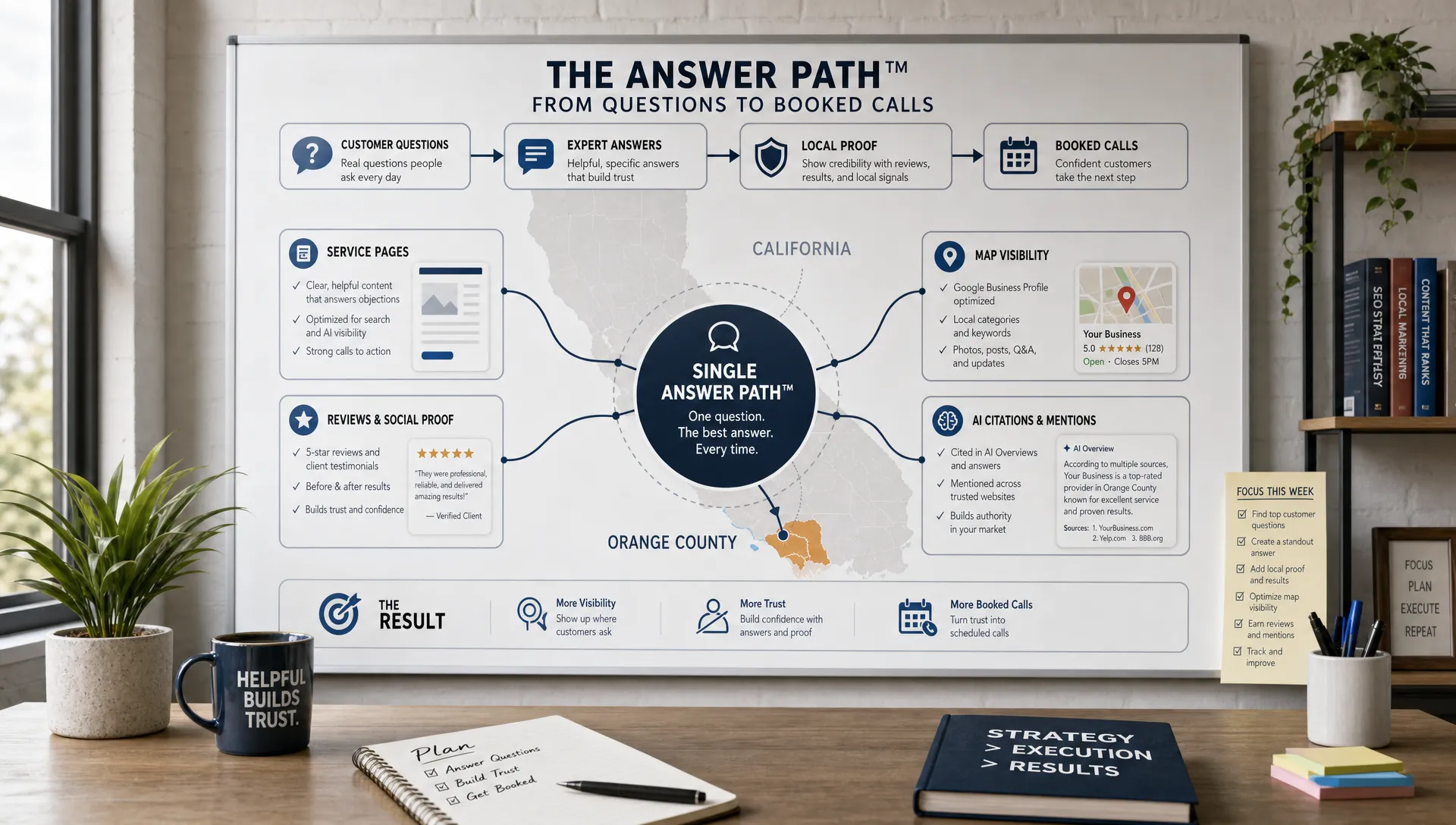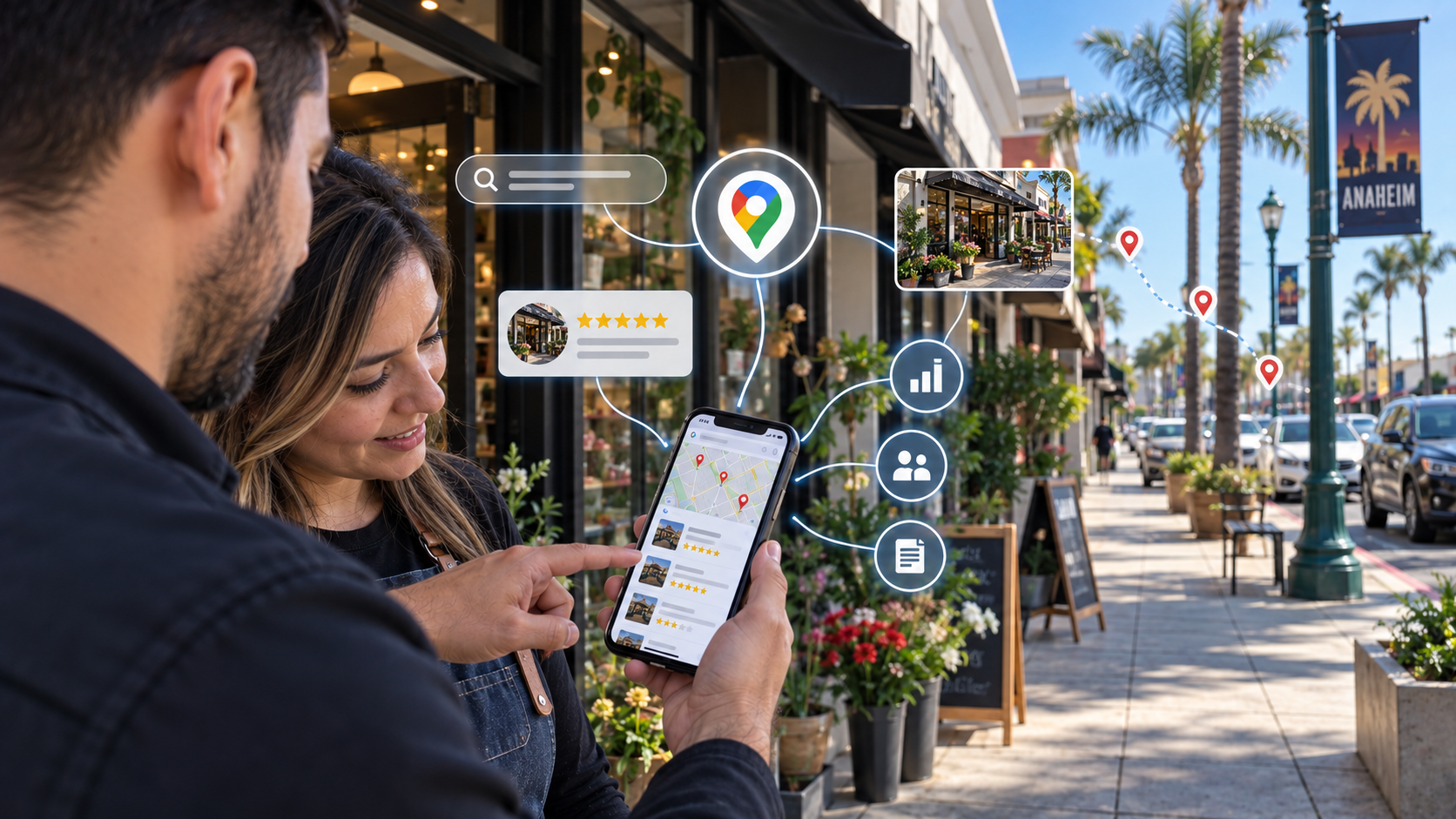
How a Local SEO Agency Builds Neighborhood Visibility
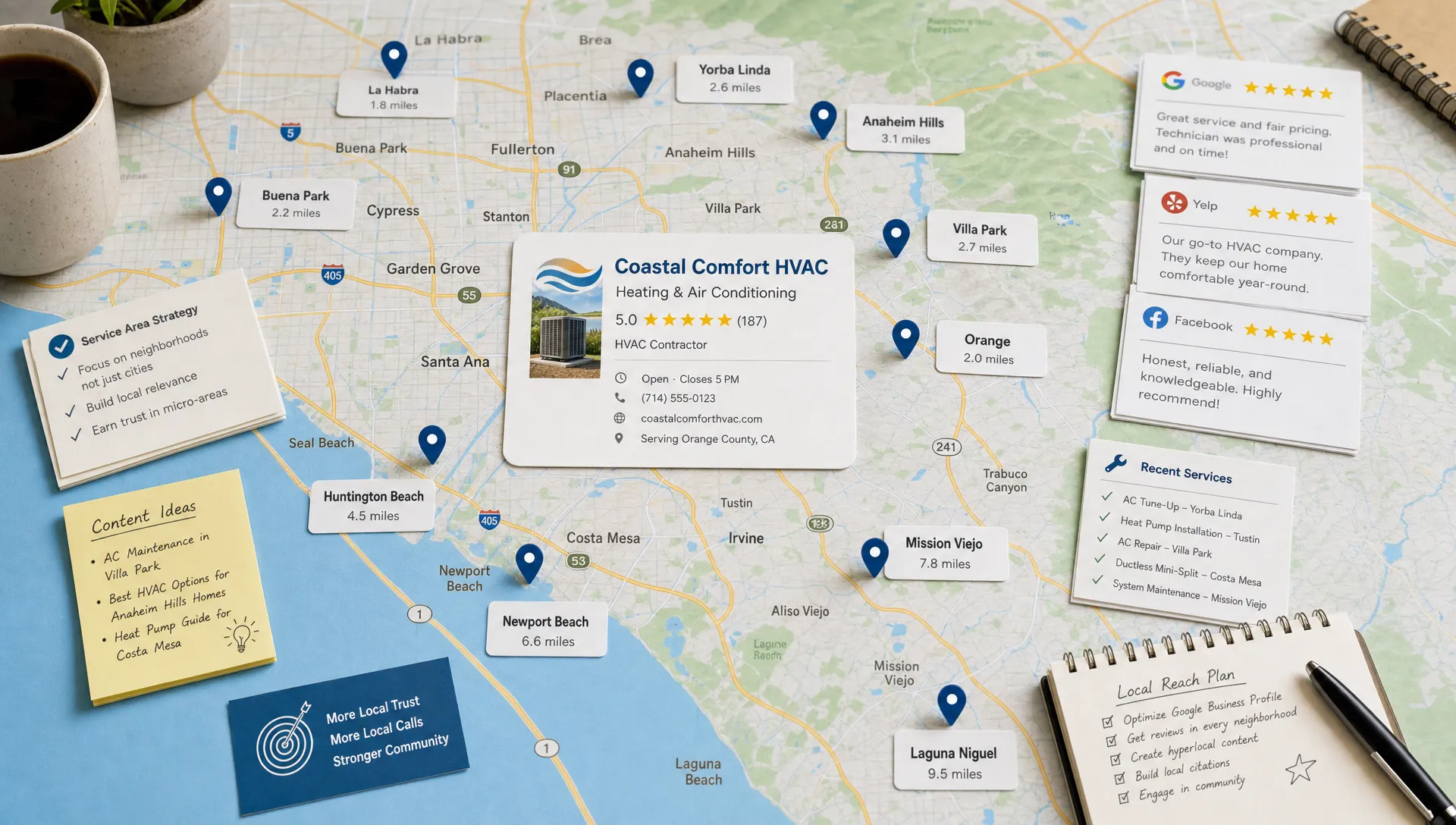
Neighborhood visibility is not the same as “ranking in a city.” A roofing company can appear for “roof repair Orange County” and still miss the homeowner searching from Anaheim Hills. A dental group can rank for “Irvine dentist” and still lose patients in Woodbridge, University Park, or Turtle Rock because the local signals are too broad.
That is where a local SEO agency earns its keep. The work is not simply adding city names to pages. It is building enough proof, structure, and local relevance for Google, maps, voice assistants, and AI answer engines to understand where your business belongs, what you do, and why nearby buyers should trust you.
For California contractors and multi-location professional practices, neighborhood visibility matters because local demand is fragmented. Search behavior changes from Laguna Beach to Laguna Niguel, from San Diego to San Jose, and from Sacramento to Fresno. The winners are not always the largest companies. They are the companies that make their service area unmistakable.
What a Local SEO Agency Means by Neighborhood Visibility
Neighborhood visibility means your business is findable and credible at the micro-market level. Instead of only targeting a broad city keyword, your digital presence supports searches tied to neighborhoods, ZIP codes, landmarks, adjacent communities, and service-specific intent.
For example, a home services company may need visibility for searches such as “AC repair near Mission Viejo,” “roof leak repair Huntington Beach,” “electrician near Newport Coast,” or “water heater replacement in Santa Ana.” A medical, dental, or legal practice may need to be visible for “dentist near Irvine Spectrum,” “family law attorney in Pasadena,” or “urgent care near Santana Row.”
A strong local SEO agency treats each of those searches as a different trust problem. The searcher wants a provider who is close enough, qualified enough, available enough, and proven enough. Search engines want the same thing, but they rely on signals: business data, content, reviews, citations, internal linking, structured data, photos, and location-specific authority.
This is why neighborhood visibility is built in layers. One page rarely does the job alone. Google Business Profile, your website, reviews, local mentions, service pages, map signals, and AI-readable content all need to reinforce the same answer: this business is a legitimate local authority for this service in this area.
Start With the Money Map, Not the Keyword List
A common mistake is beginning with a spreadsheet of keywords before defining the business geography. A better first step is a revenue map.
For a contractor, the map should identify where the best jobs actually come from, not just where the business is willing to drive. A plumbing company may technically serve all of Los Angeles County, but its most profitable emergency calls may cluster around Pasadena, Glendale, Burbank, and Northeast LA. An HVAC company may want more replacement jobs in Irvine and Tustin, but fewer low-margin repair calls 40 miles away.
For a professional practice, the map should define patient or client catchments. A dental office in Costa Mesa may care about Newport Beach, Irvine, and Huntington Beach, while a legal practice in San Jose may need separate visibility around Willow Glen, Campbell, Santa Clara, and downtown San Jose.
A useful neighborhood visibility map includes four inputs:
- Revenue priority by service line
- Current ranking and map visibility by location
- Review density and proof by neighborhood
- Operational capacity, response time, and service radius
Here is how an agency might translate business geography into an SEO plan:
| Business Type | Broad Market | Neighborhood Visibility Target | SEO Priority |
|---|---|---|---|
| HVAC contractor | Orange County | Irvine, Mission Viejo, Laguna Niguel, Anaheim Hills | Emergency repair and replacement pages with local proof |
| Roofing company | San Diego County | La Jolla, Chula Vista, Oceanside, Poway | Storm, leak, and roof replacement content by service area |
| Dental group | Bay Area | San Jose, Sunnyvale, Santa Clara, Fremont | Practice location pages, practitioner signals, review growth |
| Law firm | Los Angeles | Pasadena, Glendale, Long Beach, West LA | Service pages tied to local intent and case-type education |
| Remodeler | Sacramento region | Elk Grove, Roseville, Folsom, Davis | Project galleries, neighborhood content, permit-aware topics |
The goal is to avoid spreading effort too thin. A local SEO agency should help a business decide where visibility will produce profitable calls, consultations, or booked appointments.
Make the Business Entity Unmistakable
Search engines and AI systems need clarity. They need to understand the business name, location, services, service area, categories, hours, phone number, website, and proof of legitimacy.
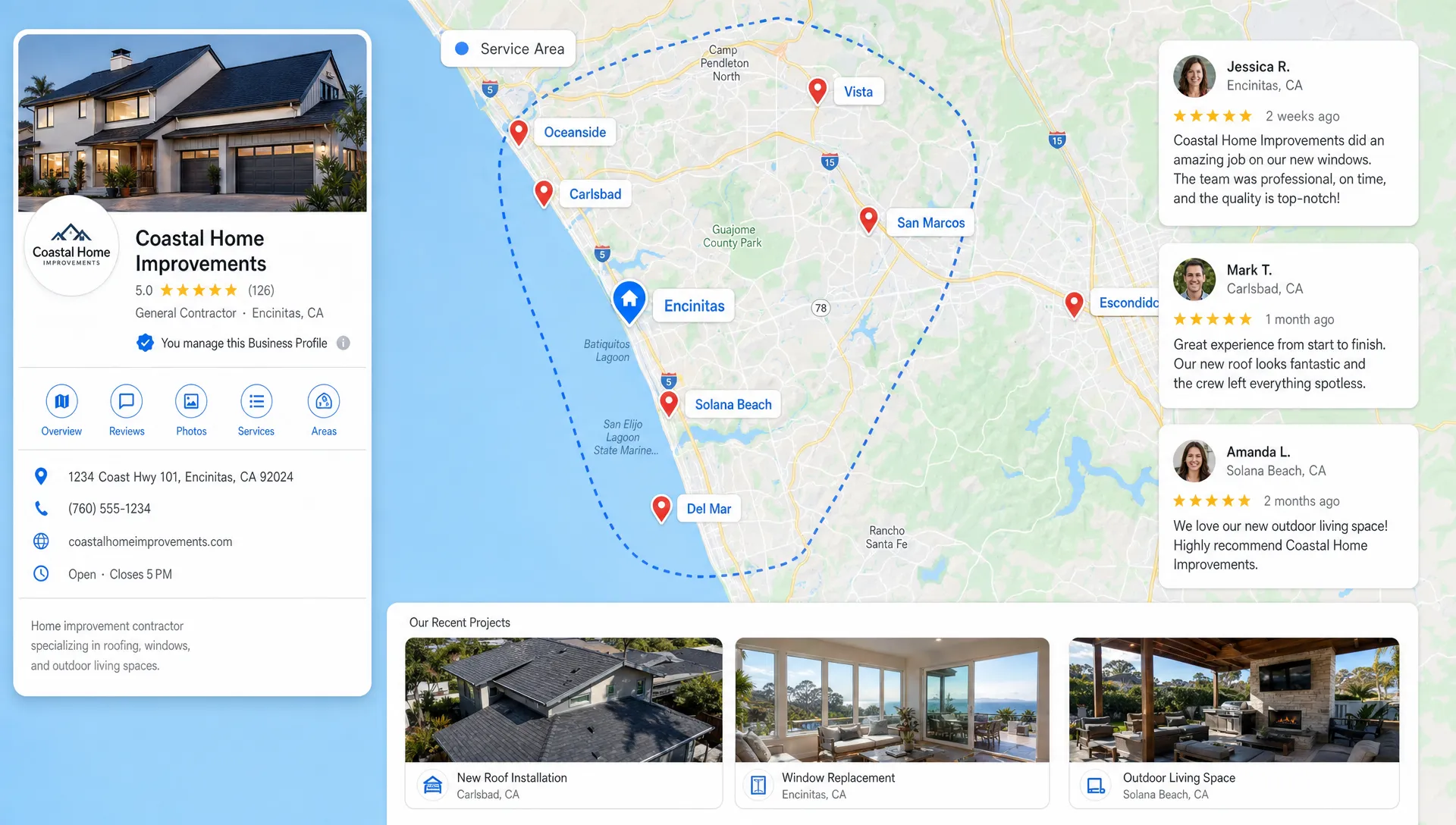
This starts with your Google Business Profile. The profile should use accurate categories, consistent contact details, complete services, strong photos, and a review strategy that reflects your real customer base. Google’s own Business Profile guidelines emphasize accurate representation, which is especially important for service-area businesses that do not serve customers at a storefront.
Then the website needs to confirm the same entity signals. Name, address, phone number, service areas, team credentials, licenses where applicable, and clear service descriptions should align across the site. If your Google profile says you provide emergency HVAC repair in Laguna Niguel, your website should support that claim with relevant service content, not a vague paragraph about “serving Southern California.”
Structured data also helps machines interpret the business. LocalBusiness schema, service information, FAQ schema where appropriate, and consistent location data can help search systems classify your business correctly. Google provides documentation for local business structured data, and an experienced agency should know how to use schema to clarify facts without exaggerating or marking up content that is not visible to users.
This is where modern local SEO overlaps with answer engine optimization. AI-driven results do not simply look for keywords. They look for entities they can trust. If your business information is scattered, inconsistent, or thin, you become harder to recommend.
Build Service and Location Pages That Deserve to Rank
Neighborhood pages can work, but only when they are genuinely useful. Thin city pages that swap out one location name for another are not enough anymore. They may be indexed, but they rarely build durable trust.
A strong location or service-area page should explain the service in the context of that area. For a plumber in Anaheim, that may include emergency response expectations, common fixture issues in older neighborhoods, water heater replacement considerations, and nearby communities served. For a dentist in Irvine, it may include accessibility, insurance information, services offered at that location, practitioner details, and patient review themes.
A local SEO agency should build pages around real buying questions, such as:
- What service is available in this neighborhood?
- How quickly can the business respond?
- What proof exists from nearby customers?
- What makes this provider qualified for the job?
- What should a customer expect before calling?
This is also where internal linking matters. A service page should connect naturally to related pages, supporting articles, review content, and primary location pages. Kell Web Solutions’ local SEO services focus on this kind of foundation, including research, on-page optimization, Google Business Profile management, and localized content that supports nearby search demand.
The best pages do not feel like SEO pages. They feel like a local expert answering a specific problem for a specific community.
Turn Neighborhood Proof Into Search Signals
Local visibility grows faster when the business can prove it has served the area. Reviews, project photos, job stories, case studies, testimonials, and before-and-after examples all help search engines and customers connect your brand to a place.
For contractors, proof may include completed installations, repair stories, seasonal service trends, or homeowner education. A solar company in Fresno can discuss roof orientation, heat, utility considerations, and common homeowner questions in the Central Valley. A remodeler in Huntington Beach can highlight coastal moisture, material choices, permitting considerations, and project expectations.
For medical, dental, and legal practices, proof is more sensitive. You need to respect privacy and professional rules. But you can still build authority through practitioner bios, service explanations, location-specific FAQs, anonymized case themes where appropriate, community involvement, and reviews that mention the office experience.
Reviews are especially powerful because they provide language from real customers. If multiple homeowners mention “same-day AC repair in Mission Viejo,” that language reinforces a service and place. If patients mention “easy parking near Irvine Spectrum” or “friendly pediatric dentist in Costa Mesa,” those phrases can support relevance without the business forcing keywords into copy.
Strengthen Off-Site Signals Beyond Your Website
Your website is the hub, but it is not the only source search engines evaluate. A local SEO agency also looks at off-site signals that confirm your business is active and relevant in the areas you want to serve.
Core citation platforms matter because they reinforce name, address, phone number, categories, and website details. Industry directories can matter too, especially for contractors, medical providers, dental practices, and attorneys. Local chambers, associations, sponsorships, supplier pages, neighborhood publications, and partner mentions can all create legitimate local authority when they reflect real relationships.
Community intelligence is another overlooked layer. Homeowners and patients often ask questions before they search Google directly. They may ask in Facebook groups, Reddit communities, neighborhood forums, or local business groups. Some teams add sources outside Google, including AI-assisted community listening tools such as Redditor AI, to find recurring homeowner or patient questions that can inform content, FAQs, and outreach.
The point is not to chase every mention. The point is to understand how people describe their problems before they become leads. That language can shape better service pages, Google Business Profile posts, blog articles, and call scripts.
Use Distributed Authority When One Website Is Not Enough
In highly competitive California markets, one website may struggle to represent every service and every neighborhood with enough depth. This is especially true for home services companies competing across large territories such as Los Angeles, San Diego, Orange County, the Bay Area, Sacramento, and the Inland Empire.
Distributed authority means building multiple supporting assets that reinforce the main brand’s local relevance. These assets might include neighborhood-focused content hubs, feeder websites, local review showcases, supporting articles, and structured references that point back to the primary business.
The strategy must be handled carefully. Low-quality doorway sites can create risk and dilute trust. But well-built supporting assets can help a business document real service areas, answer specific local questions, and create clearer entity signals across a region.
For contractors that need a larger hyperlocal footprint, Kell Web Solutions’ Hyper Local Authority Builder is designed around this distributed approach, combining local feeder assets, SEO-focused content, and review-driven trust signals.
This approach is particularly relevant when the business serves many neighborhoods but does not have physical offices in each one. The challenge is to build relevance without pretending to be located where you are not. Ethical local SEO makes the service relationship clear.
Make Content Answer-Ready for AI and Voice Search
Neighborhood visibility now extends beyond traditional search results. Customers ask voice assistants, AI chat tools, and search engines with AI summaries. The question is no longer just “Can you rank?” It is also “Can machines understand and cite you as the answer?”
Answer-ready content is clear, structured, specific, and backed by proof. It answers practical questions directly, then supports the answer with context.
For example, a weak blog topic is “Best HVAC Services in Orange County.” A stronger answer-ready topic might be “Why Anaheim Hills Homes Often Need AC Tune-Ups Before the First Heat Wave.” The second topic is more specific, more useful, and more likely to match how a homeowner describes a real problem.
For professional practices, answer-ready content may include local service FAQs, appointment preparation guides, insurance explanations, treatment comparisons, legal process overviews, or neighborhood access details. The content should not overpromise. It should make the practice easier to understand and easier to trust.
If your goal is to become the search answer for local buyers, the content must connect expertise, location, and user intent in plain language.
Track the Metrics That Prove Neighborhood Visibility
A local SEO agency should report more than rankings. Rankings are useful, but they are not the whole story. Neighborhood visibility should be measured across search, maps, calls, forms, reviews, and AI visibility where possible.
A practical reporting framework includes:
| Metric | What It Reveals | Why It Matters |
|---|---|---|
| Map pack visibility by neighborhood | Where the business appears in local map results | Shows whether proximity and relevance are improving |
| Google Business Profile actions | Calls, website visits, direction requests, messages | Connects visibility to buyer behavior |
| Local landing page performance | Traffic, engagement, conversions by service area | Shows which locations produce demand |
| Review growth and review language | Volume, rating, recency, service and location mentions | Builds trust and reinforces local relevance |
| Call quality and booked appointments | Which leads became real opportunities | Prevents vanity-metric reporting |
| AI answer visibility | Whether the brand is mentioned or cited for local questions | Indicates readiness for the retrieval economy |
The best reporting connects activity to revenue. If a roofer gets more traffic from San Diego but the profitable calls are coming from Poway and Oceanside, the strategy should shift. If a dental practice ranks citywide but cannot win searches near its actual office, the content and profile strategy need refinement.
This is why call tracking, form attribution, and appointment-quality feedback are so important. A good agency does not just ask, “Did traffic go up?” It asks, “Did the right local buyers find you, trust you, and take action?”
What a Serious Local SEO Agency Should Do Differently
A serious local SEO agency does not sell the same package to every business. An HVAC contractor, roofing company, pediatric dentist, and family law firm all need different proof structures, different review strategies, and different content boundaries.
The agency should begin with discovery: service lines, locations, margins, seasonality, sales process, intake quality, and competitive pressure. It should identify whether the business needs foundational local SEO, stronger content, better Google Business Profile management, citation cleanup, review growth, distributed authority, or a more advanced answer engine strategy.
It should also be honest about timing. Local SEO is not instant. Google needs time to crawl changes, process new signals, and evaluate behavior. Reviews take time to accumulate. Content takes time to earn visibility. Citations take time to synchronize. In competitive California cities such as Los Angeles, San Jose, Irvine, San Diego, and Sacramento, momentum often depends on consistent execution over months, not one-time edits.
If you are comparing providers, it helps to understand how to choose the right local SEO agency before signing a contract. Look for strategic clarity, local experience, transparent reporting, and a plan that fits how your customers actually search.
Frequently Asked Questions
How long does it take to build neighborhood visibility? Most businesses should expect local SEO improvements to build over several months. Early gains may come from Google Business Profile cleanup, citation fixes, and on-page improvements, while stronger neighborhood authority usually requires consistent reviews, content, and local proof.
Does every neighborhood need its own page? No. A separate page only makes sense when there is enough unique value to justify it. If the page cannot include useful local context, service details, proof, FAQs, or examples, it may be better to strengthen broader service-area pages instead.
Can a service-area business rank in cities where it has no office? It can earn organic visibility in service areas when the website clearly explains where the business works and provides real proof. Map pack visibility is more influenced by proximity, relevance, and prominence, so expectations should be realistic when there is no physical location.
What matters more, reviews or content? Both matter. Reviews build trust, recency, and local proof, while content helps search engines understand services, locations, and expertise. The strongest neighborhood visibility strategies use both together.
Is local SEO still important with AI search results? Yes. AI systems still rely on trusted sources, structured information, business profiles, reviews, and entity clarity. Local SEO provides much of the foundation that makes a business easier for AI systems to understand and recommend.
Build Visibility Where Your Best Customers Actually Live
Neighborhood visibility is built through clarity, proof, and consistency. Your business must be understandable to search engines, credible to local buyers, and visible in the exact communities where revenue is won.
Kell Web Solutions helps California contractors and professional practices strengthen local visibility from Orange County to the Bay Area, Los Angeles, San Diego, Sacramento, Fresno, and beyond. If your business needs more qualified calls from the neighborhoods that matter most, schedule a strategy conversation with Kell Web Solutions and start building a local presence that search engines, AI systems, and nearby buyers can trust.