Local SEO for Businesses That Need More Qualified Calls

For a local business, more traffic is not the same as more revenue. A roofing company in Irvine does not need 3,000 casual visitors from across the country. It needs homeowners in the right neighborhoods, with the right budget, who are ready to schedule an inspection. A dentist in Laguna Niguel does not need generic pageviews. It needs patients nearby who trust the practice enough to call, request an appointment, or ask about availability.
That is the real purpose of local SEO for businesses that depend on the phone: not visibility for its own sake, but qualified calls.
In California markets like Orange County, Los Angeles, San Diego, San Jose, Sacramento, and Fresno, local search is crowded. Google Maps, AI Overviews, voice assistants, ads, directories, and review platforms all compete for the customer’s attention before they ever reach your website. If your local SEO strategy is still built around rankings alone, you may be measuring the wrong thing.
The better question is: when someone nearby has a real problem, does your business look like the safest, clearest, most trustworthy answer to call?
What Counts as a Qualified Local SEO Call?
A qualified call is not just any phone call from Google. It is a conversation with a prospect who matches your service area, needs something you actually sell, and has enough buying intent to move toward a booking, estimate, consultation, or visit.
For a home services contractor, that may mean a homeowner calling about an AC replacement in Huntington Beach, a roof leak in Anaheim, or an electrical panel upgrade in San Diego. For a professional practice, it may mean a patient looking for a same-week dental appointment in Irvine or a client searching for a local attorney near Santa Ana.
The difference matters because low-quality calls drain time. They come from outside your service area, ask for services you do not provide, or compare you only on price. Strong local SEO reduces that friction by making your offer, location, credibility, and next step obvious before the person calls.
| Call Type | Business Impact | Local SEO Goal |
|---|---|---|
| Wrong-area call | Wastes staff time and rarely converts | Clarify service area and city relevance |
| Price-only shopper | Creates low-margin conversations | Communicate value, proof, and specialization |
| Service mismatch | Signals unclear website or profile content | Align categories, pages, and descriptions |
| Ready-to-book local caller | Highest revenue opportunity | Make calling fast, trusted, and measurable |
| Repeat referral call | Strong trust signal | Reinforce brand consistency across search |
A healthy local SEO campaign should increase the last two categories while reducing the first three. That requires more than adding city names to a page. It requires building a complete local trust system.
Why Traditional Local SEO Often Produces the Wrong Calls
Many businesses were taught to think of local SEO as a checklist: optimize the Google Business Profile, add keywords, collect citations, write some blog posts, and hope for map rankings. Those items still matter, but the search environment has changed.
Today, the customer journey is fragmented. A homeowner may ask a voice assistant for “best emergency plumber near me,” compare Google Business Profile reviews, skim an AI-generated summary, check your photos, and call without ever visiting your homepage. A patient may search “dentist open today Laguna Niguel,” read reviews, tap your call button, and judge your professionalism before your front desk answers.
That means your local SEO has to satisfy three audiences at once:
- Search engines that need consistent business data and strong relevance signals.
- AI and answer engines that need clear, structured information about who you are and what problems you solve.
- Human prospects who need enough trust to call instead of continuing to shop.
If any one of those audiences is confused, qualified calls suffer.
A business can rank for a term and still lose the call because the profile looks incomplete, the reviews feel stale, the service page is vague, or the phone experience is weak. Local SEO is no longer just about being found. It is about being chosen.
Start With the Revenue Geography, Not the Keyword List
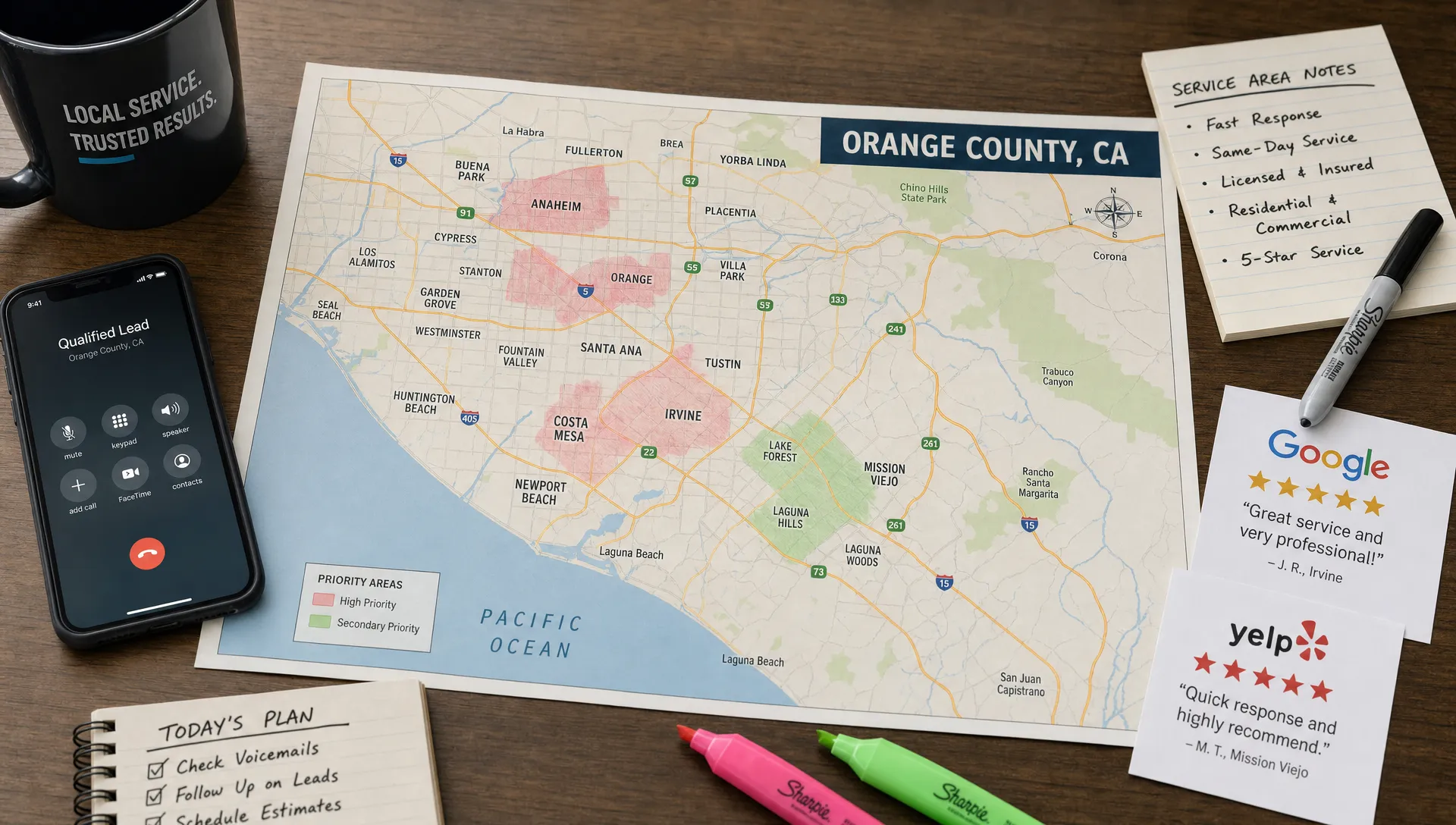
For California businesses, geography is not one simple target. Orange County alone contains very different markets: Laguna Beach, Newport Beach, Irvine, Huntington Beach, Anaheim, Santa Ana, Mission Viejo, and Laguna Niguel do not all represent the same customer profile or revenue opportunity.
The same is true statewide. A contractor expanding from Orange County into Los Angeles or San Diego needs a different local content strategy than a professional practice building presence across San Jose, San Francisco, Oakland, and Sacramento. Search demand, competition, average job value, and customer expectations vary by market.
A call-first local SEO plan begins by mapping where the best customers are, not just where search volume appears highest. That map should consider service radius, profit by job type, crew availability, office locations, licensing boundaries, and neighborhood-level demand.
For example, an HVAC company may decide that “AC repair Irvine” is more valuable than a broad county keyword because the customers are closer, calls are easier to dispatch, and replacement opportunities are stronger. A law firm may prioritize specific city and practice-area combinations because consultation quality varies dramatically across locations.
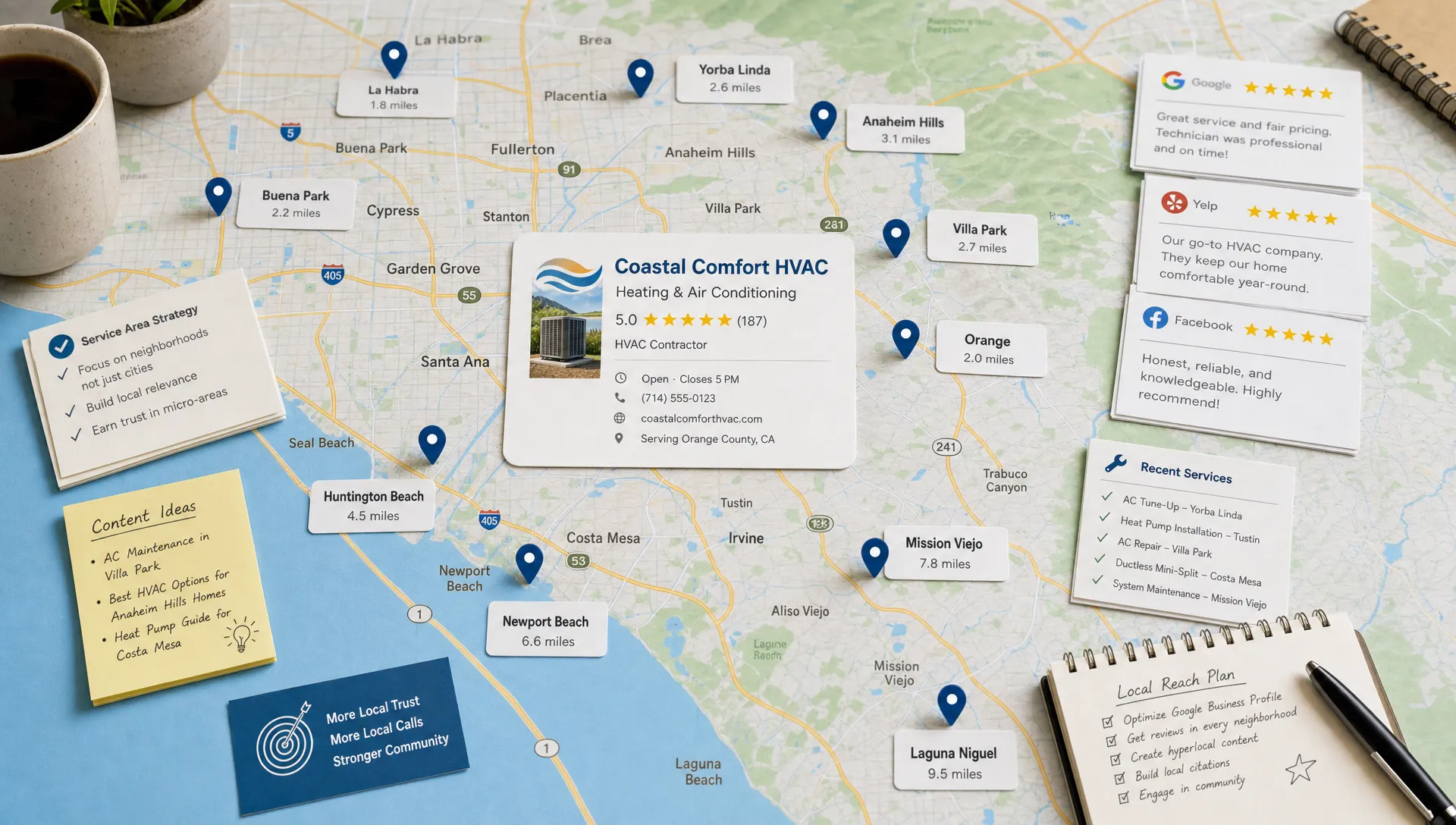
This is where experienced local strategy helps. Kell Web Solutions’ Local SEO Mastery is built around foundational local visibility signals like Google Business Profile optimization, citation consistency, content, and map presence, but the real value comes from connecting those signals to the areas where calls can become revenue.
Make Your Google Business Profile a Call Filter
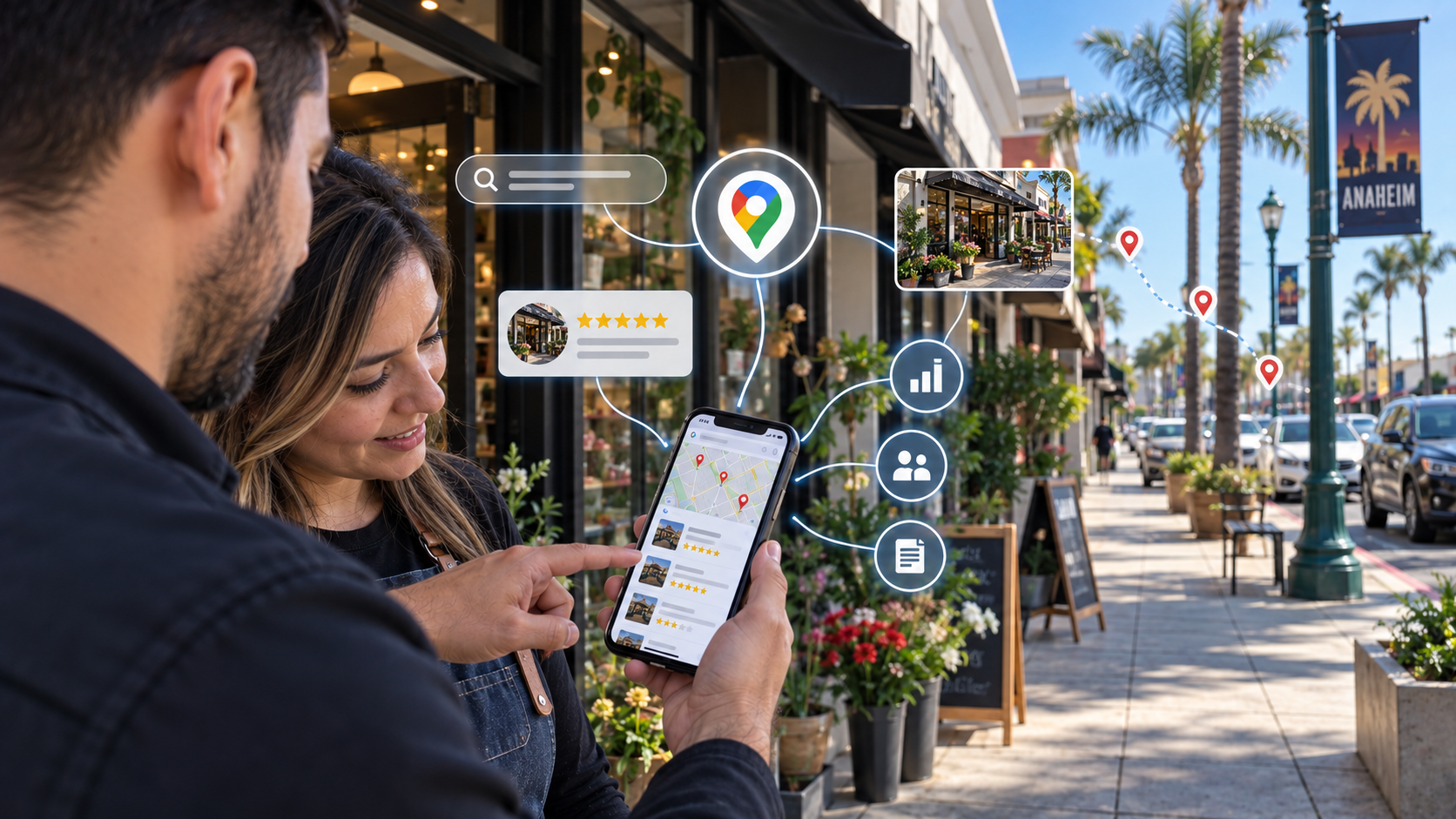
Your Google Business Profile is often the first conversion point in local search. It should not simply prove that your business exists. It should help the right person decide, “This is the one to call.”
For businesses that need qualified calls, the profile should clearly communicate category, service area, hours, services, photos, reviews, and next steps. A vague profile attracts vague calls. A specific profile pre-qualifies the searcher.
A roofing company should not rely on “contractor” language if it wants roof repair, roof replacement, storm damage, and inspection calls. A dental practice should make it clear whether it handles emergency dentistry, cosmetic dentistry, family dentistry, implants, or other high-intent services. A plumbing company should distinguish drain cleaning, water heater replacement, leak detection, and emergency service if those calls require different levels of urgency and staff readiness.
Profile photos also matter more than many businesses realize. Real team images, branded vehicles, completed jobs, office interiors, and service-area proof reduce uncertainty. In competitive local markets, trust is built in small details.
Reviews are equally important. The best reviews do more than say “great service.” They mention the city, the problem solved, the speed of response, the professionalism of the team, and the outcome. Those details help both prospects and search systems understand what your business is known for.
Build Service Pages Around Buying Intent
The website still matters, even when many calls begin in Maps or voice search. Your site is the source that confirms your expertise, explains your services, and gives search systems a deeper understanding of your business.
The strongest local service pages answer the questions a ready-to-call customer is already asking:
- Do you serve my city or neighborhood?
- Do you handle my specific problem?
- Can I trust you inside my home, office, clinic, or case?
- What happens after I call?
- Are you experienced with situations like mine?
For local SEO, one generic service page is rarely enough. But creating dozens of thin, duplicated city pages is not the answer either. Each important page should have a clear purpose, local relevance, and helpful detail.
| Business Type | High-Intent Page Angle | Call Qualification Benefit |
|---|---|---|
| HVAC contractor | AC repair in Irvine or furnace replacement in Anaheim | Filters by service, city, and urgency |
| Roofing company | Roof leak repair in Huntington Beach | Attracts problem-aware homeowners |
| Dental practice | Emergency dentist in Laguna Niguel | Captures same-day appointment intent |
| Law firm | Personal injury lawyer in Santa Ana | Aligns practice area with local need |
| Electrician | Panel upgrade electrician in San Diego | Screens for higher-value project calls |
A strong page should include service details, local context, proof, FAQs, calls to action, and clear phone access on mobile. It should also match the language customers actually use. Homeowners do not always search like industry insiders. They ask practical questions such as “Why is my breaker panel buzzing?” or “How fast can someone fix my AC?”
For a broader perspective on what effective local SEO should include when the goal is calls, clicks, and visits, Netco Design offers a helpful overview of local SEO services that bring more calls, clicks, and visits.
Use Content to Pre-Sell the Caller
Content should not exist just to publish more blog posts. For call-driven businesses, content should reduce hesitation before the call happens.
A homeowner who reads a helpful article about whether to repair or replace a 15-year-old air conditioner is more prepared for a meaningful HVAC conversation. A patient who reads a clear explanation of emergency dental symptoms is less likely to delay calling. A business owner who understands the difference between a minor electrical issue and a code-related safety concern is more likely to book the right service.
This is why local content should be tied to real customer questions, local conditions, and profitable services. In Southern California, seasonality, coastal weather, wildfire risk, older housing stock, and energy costs can all shape search intent. In Northern California, tech corridors, dense neighborhoods, and multi-location competition may change how people evaluate providers. In Central and Inland California, service radius and fast availability may play a larger role.
The goal is not to write about every keyword. The goal is to become the clearest local expert for the questions that lead to real calls.
If your business wants a deeper breakdown of how local organic visibility turns into nearby work, Kell’s article on local search engine optimization that wins nearby jobs expands on the connection between search intent, trust, and booked opportunities.
Prepare for AI Search and Voice Assistants
In 2026, local SEO cannot ignore answer engines. Customers increasingly ask Google AI results, ChatGPT, Perplexity, Siri, Alexa, and other assistants for recommendations. These systems do not think like a traditional search results page. They try to identify the most credible answer.
That makes clarity essential. Your website, business profiles, reviews, location signals, and service descriptions should all reinforce the same facts: who you are, where you serve, what you do, why you are credible, and how someone can take the next step.
For local businesses, this is especially important because AI-driven recommendations often compress the decision process. Instead of showing ten blue links, an answer engine may summarize a shortlist, cite a source, or recommend a business based on trust signals it can understand.
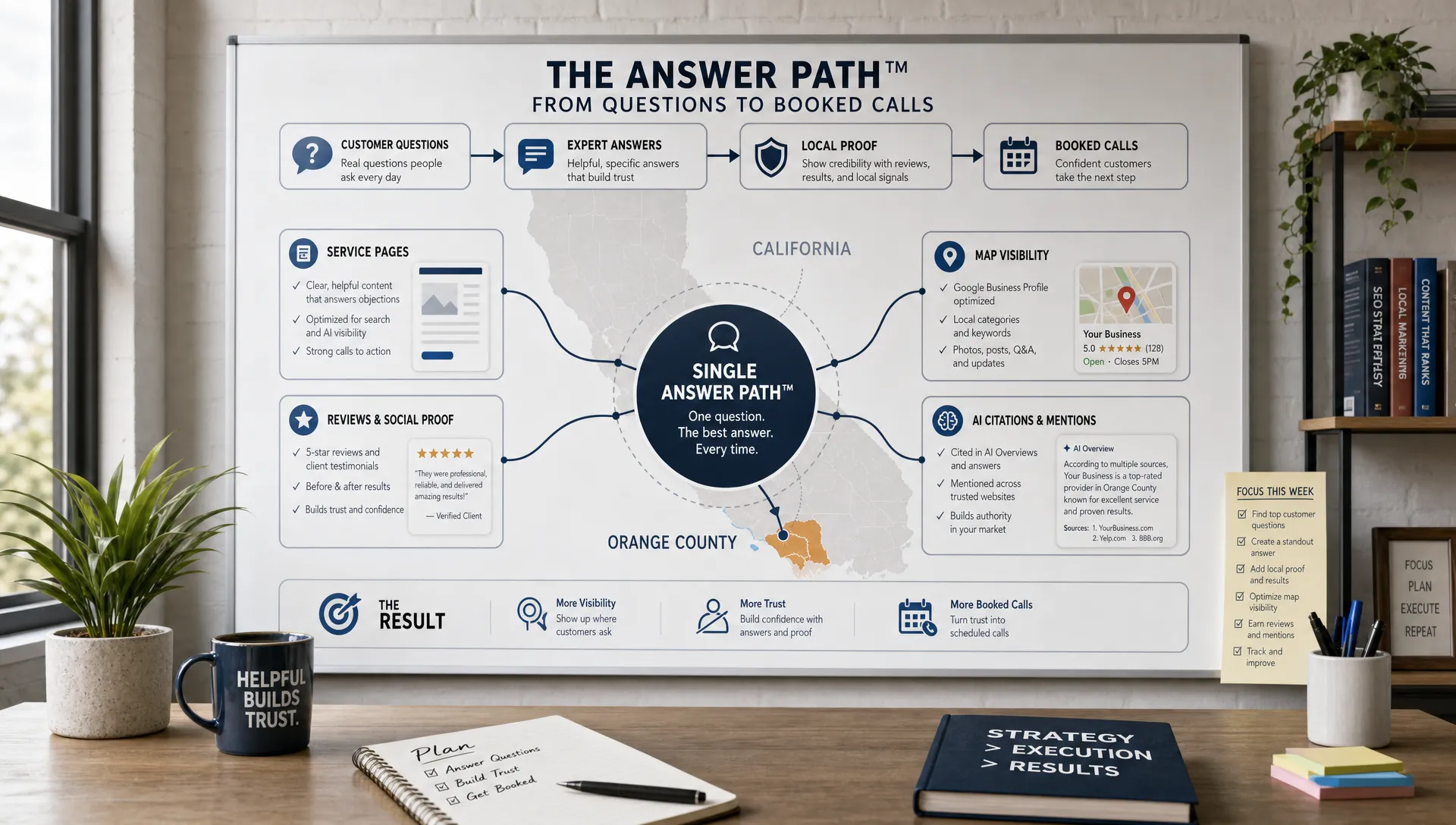
This is where answer engine optimization complements local SEO. Local SEO helps you appear in maps and traditional local results. AEO helps AI systems interpret your business as a trustworthy answer. Kell Web Solutions explains this shift in its work around answer engine optimization, especially for businesses that want to be selected when customers ask direct, high-intent questions.
Track Calls Like Revenue Events, Not Vanity Metrics
If your goal is more qualified calls, your reporting should show more than impressions and rankings. Those metrics can be useful, but they do not prove that the phone is ringing with better opportunities.
A practical local SEO dashboard should connect visibility to call outcomes. At minimum, businesses should understand which sources generate calls, which locations produce the strongest leads, which services drive revenue, and where calls are being missed.
| Metric | Why It Matters | What to Look For |
|---|---|---|
| Calls by source | Shows whether Maps, organic pages, or campaigns produce conversations | Growth from high-intent local channels |
| Calls by city or area | Reveals which geographies produce quality leads | Strong performance in target neighborhoods |
| First-time caller rate | Separates new demand from existing customer calls | More new prospects from local search |
| Call duration and outcome | Helps distinguish spam from real opportunities | Longer calls that become bookings |
| Missed calls | Identifies revenue leakage | Fewer unanswered high-intent calls |
| Service requested | Connects SEO to profitable work | More calls for priority services |
Call tracking should be handled carefully so it does not create inconsistent business data across the web. The goal is to measure performance without damaging NAP consistency, which means your business name, address, and phone information should remain stable where local search systems expect it.
The most important insight is simple: if the campaign increases calls but staff cannot answer, qualify, and schedule them, revenue is still being lost. Local SEO and front-desk operations must work together.
Local SEO Examples by Business Type
For an HVAC company in Orange County, a qualified-call strategy may focus on emergency repair, seasonal maintenance, replacement estimates, and city-specific service pages for Irvine, Laguna Niguel, Huntington Beach, Anaheim, and nearby communities. Reviews should mention fast response, clean work, and specific systems serviced.
For a roofing contractor in San Diego or Los Angeles, local SEO may need to highlight roof inspections, leak repair, replacement, storm response, and experience with local property types. Photos, project proof, and service-area clarity help filter out poor-fit calls.
For a multi-location dental practice, the strategy should support each office location with accurate profiles, unique location pages, appointment-focused content, and review growth by office. The goal is to help patients choose the nearest trusted location without confusion.
For a law firm in Santa Ana, San Jose, or Sacramento, qualification is especially important. The website and local profiles should make practice areas, consultation expectations, geography, and trust signals clear before the call. A high call volume is not helpful if most inquiries fall outside the firm’s focus.
Across all examples, the principle is the same: build local visibility around the calls you actually want.
Common Local SEO Mistakes That Reduce Call Quality
Many businesses accidentally attract the wrong prospects because their local SEO is too broad, too vague, or too disconnected from operations. Common mistakes include using one generic services page for every location, targeting cities the business cannot serve quickly, ignoring mobile call experience, letting reviews go stale, and publishing content that attracts information seekers but not buyers.
Another major mistake is treating every city equally. A contractor may want to rank everywhere in California, but crews, margins, and response times usually make some cities far more valuable than others. A professional practice may want statewide visibility, but patients and clients often choose based on proximity and perceived convenience.
Local SEO works best when it is selective. You do not need to be visible for every possible search. You need to be highly credible where your best customers are searching.
Frequently Asked Questions
How long does local SEO take to generate qualified calls? Most businesses should think in terms of months, not days. Google Business Profile improvements, review growth, citation cleanup, page optimization, and content development compound over time. Some call improvements may appear quickly, but durable local authority usually requires consistent execution.
Is Google Business Profile enough for local SEO? No. Your profile is critical, but it works best when supported by a clear website, strong reviews, consistent citations, local content, and trustworthy service pages. A profile without a strong digital foundation can attract visibility but still fail to convert qualified callers.
Should a business create pages for every city it wants to serve? Only if each page can be genuinely useful and locally relevant. Thin duplicated city pages can weaken trust. Focus first on high-value service areas where you can provide strong local detail, proof, and conversion support.
What is the difference between more calls and more qualified calls? More calls simply means higher phone volume. More qualified calls means more conversations with people in your service area who need your priority services and are likely to book, visit, or schedule a consultation.
Does answer engine optimization replace local SEO? No. AEO complements local SEO. Local SEO helps businesses appear in maps, organic local results, and location-based searches. AEO helps AI systems understand and recommend the business when users ask direct questions.
Turn Local Visibility Into Better Calls
If your business depends on local customers, your SEO should be judged by the quality of conversations it creates. Rankings matter, but they are only a step toward the real outcome: calls from nearby prospects who trust you enough to take action.
Kell Web Solutions helps Orange County and California businesses build local visibility around revenue, not vanity metrics. From Laguna Beach and Laguna Niguel to Los Angeles, San Diego, San Jose, Sacramento, Fresno, and beyond, the right strategy can make your business easier to find, easier to trust, and easier to call.
If your current local SEO is producing traffic but not enough qualified calls, it may be time to rebuild the system around intent, authority, and conversion.