Why Your Newport Beach Firm Is Losing to AI Search Summaries

Is your Newport Beach firm invisible to AI? It's the question most Orange County service providers have never actually tested. They assume ChatGPT already knows who they are.
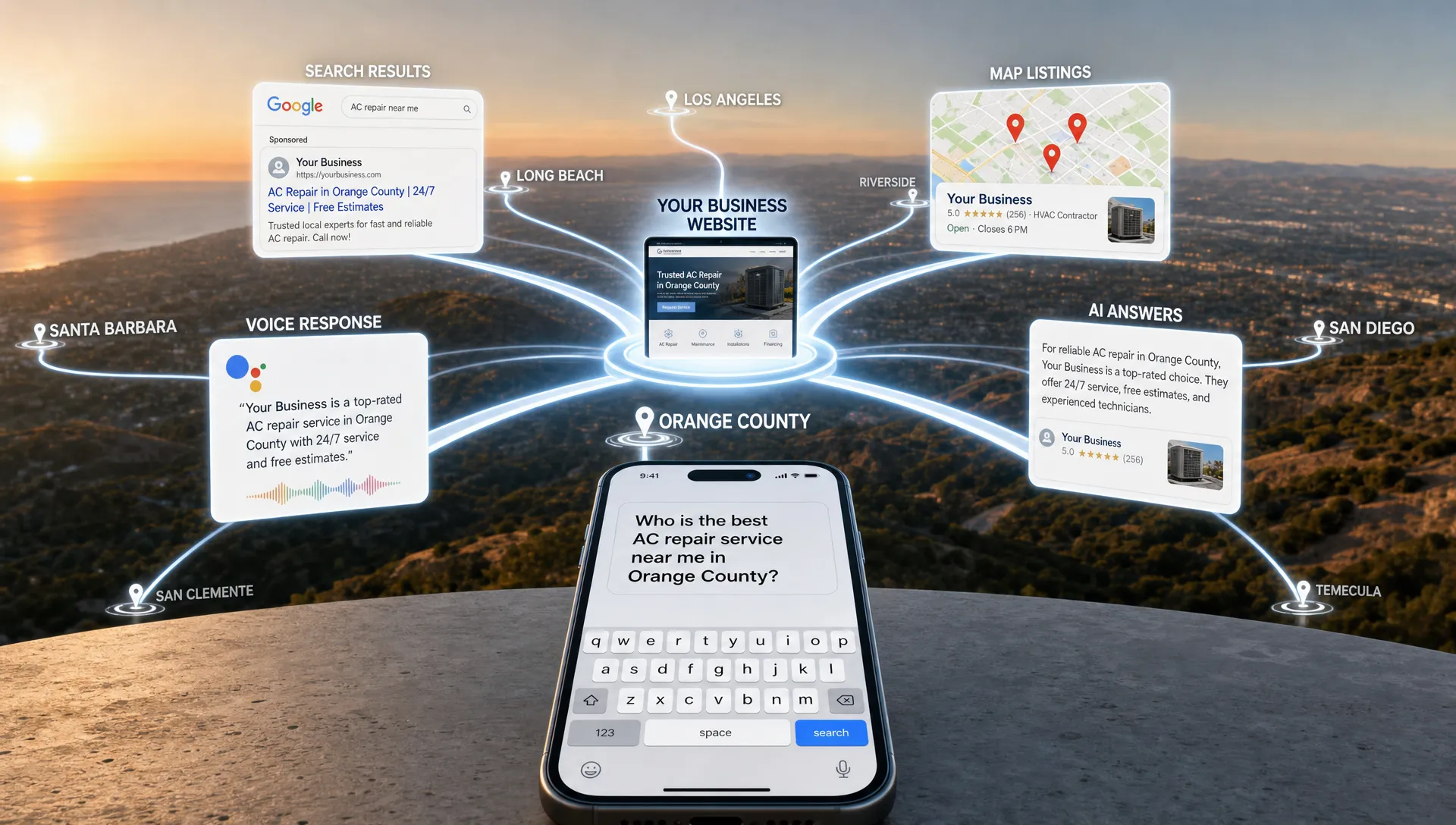
Google AI Overviews and Perplexity now shape how Newport Beach, Irvine, and Costa Mesa buyers vet a vendor. The old "blue link" strategy — rank first, win the click — is dying fast. Pew Research found people click through only 8% of the time when an AI summary appears, against 15% without one.
That's not a small dip. That's half your visibility, gone the moment a summary loads. If you aren't the source cited inside it, you don't exist to that buyer.
We call this pattern the Great OC Zero-Click Shift. It's already reshaping how B2B service providers get hired across Newport Beach, Irvine, and Costa Mesa. Law firms, CPAs, consultancies, marketing agencies, and financial advisors are all competing for the same shrinking pool of clicks.
This piece covers why it's happening, why professional firms feel it hardest, and what the AEO pivot requires. None of it is theoretical for a firm sitting in this exact corridor. The shift is already visible in how AI tools describe local expertise today.
This matters whether you run a five-partner law firm in Fashion Island or a boutique consultancy near John Wayne Airport. The AI doesn't care about your firm's history. It only cares what it can verify right now.
The blue link is dying. Here's what's replacing it.
Local buyers used to scroll a results page and click whatever looked credible. That behavior is disappearing fast. Gartner projects traditional search volume will drop 25% by 2026 as generative tools absorb queries once typed into Google.
Gartner's own analyst calls these tools "substitute answer engines." That's a precise description. They're not helping people search anymore — they're answering for them, in full, without a click.
Pew's research adds a second layer to that finding. When an AI summary appears, users abandon the search session entirely 26% of the time. Without a summary, that abandonment rate is only 16%.
Put plainly: a growing share of your prospects never reach a website at all. They read a synthesized answer, form an opinion about who's credible, and move on with their day. If your firm wasn't named in that answer, the decision was already made without you in the room.
This is the mechanism behind the zero-click shift, and it isn't theoretical for Orange County firms. We've written before about when AI takes the click away from even well-ranked local sites. That pattern only accelerates from here.
Every model update pulls more queries away from the results page entirely. The businesses that adjust early get a head start most competitors never notice they're losing.
Forrester's research found 92% of B2B buyers already have a vendor in mind before formal evaluation begins. That preference increasingly forms through a chatbot, not a sales call. Firms outside the AI's shortlist never even enter that decision.
Why Newport Beach, Irvine, and Costa Mesa firms feel it first
Home services businesses can still win a job through pure proximity — a truck showing up fast still closes some calls. B2B service providers don't get that fallback. Law firms, consultancies, agencies, and accounting practices sell trust before anything else.
Trust used to form through referrals, conference badges, and a firm's standing in the community. It increasingly forms in a five-second exchange with a chatbot instead. Whoever the model names first gets the benefit of the doubt.
That shift matters more in Newport Beach, Irvine, and Costa Mesa than most places. This corridor is dense with exactly the professional service categories AI models are now shortlisting on their own. Legal, financial, consulting, and creative agencies compete block by block for the same buyers.
Add specialty medical, dental, and wealth management practices to that list. Newport Beach alone packs an unusually high concentration of these categories into a small radius.
Picture a mid-size Irvine consulting firm with two decades of client results behind it. Its website is well-designed but has no structured data and no consistent entity signals across the web. A newer competitor three miles away has clean schema, active press mentions, and a name AI already recognizes.
Today, the newer firm gets named first. Track record stopped being self-evident the moment AI started making introductions on a client's behalf. We've seen this exact dynamic play out repeatedly in marketing for professional service firms throughout the county.
Multi-partner and multi-location practices face an added wrinkle here too. A model asked about a specific neighborhood or practice area has to choose one listing to name. Firms with fragmented location data or inconsistent partner bios quietly disappear from that shortlist, even when the work is excellent.
Orange County's agencies already know this shift is underway. Costa Mesa's Intero Digital now sells a named Generative Engine Optimization service alongside its traditional SEO work. Irvine's Directive Consulting markets its own proprietary discoverability platform built around this exact problem.
Neither is guessing that this shift is coming. Both are already selling the fix to whoever notices first. Waiting to check your own visibility just hands them a longer runway.
"Most Orange County service firms lose qualified leads because their brand never enters the AI's shortlist at all. Our job is closing the distance between what a firm knows and what the models believe about it." — Gregg Kell, Founder, Kell Web Solutions
Five signs your firm already has this gap
Most owners can self-diagnose this in about ten minutes, before spending a dollar on any agency. A few patterns show up again and again among Newport Beach, Irvine, and Costa Mesa firms that haven't looked yet.
| Sign | What It Looks Like |
|---|---|
| You've Never Checked | You've never typed your own service and city into ChatGPT or Perplexity to see who gets named instead of you. |
| Your Details Don't Match Everywhere | Your firm's name, address, phone number, and service descriptions read differently across your site, directories, and review platforms. |
| No Structured Data | Your website has no schema markup, so a model has to guess facts it could otherwise extract with certainty. |
| Thin Third-Party Proof | Your only credibility signal is a handful of Google reviews — no press coverage or industry mentions backing you up. |
| A Competitor Already Invested | If a rival firm has closed its own AEO gap and you haven't, the model has already picked a side. |
Any single one of these is fixable in an afternoon. Stacked together, they're what quietly kills a shortlist spot. Ten honest minutes of checking beats months of wondering why referrals slowed.
What AI models actually reward instead of rankings
Ranking algorithms could be tricked with the right keywords in the right places for years. Answer engines don't work that way. They synthesize an opinion about your firm from everything they can find, then decide if you're worth naming.
That's a fundamentally different contest. HubSpot's AEO research frames AI citation as consensus-building, not keyword matching. Models cross-reference your site against directories, reviews, press coverage, and forum mentions before forming a view.
Three factors decide whether you clear that bar. Entity consistency comes first — your name, address, pricing, and service descriptions need to match everywhere they appear online. A single contradiction between your site and a directory listing quietly suppresses citations.
Structured content comes second. Clear headers and proper schema markup let a model extract facts with confidence. Direct, answer-first writing helps here too.
Agentic readiness comes third. That means machine-readable infrastructure like llms.txt files and detailed JSON-LD markup. It tells an AI crawler exactly who you are, rather than making it infer.
Here's the part that unsettles most SEO veterans. A page ranking outside Google's top five can still win the AI-generated answer entirely. It just has to answer the actual question more directly than the "better ranked" page does.
Firms that spent years optimizing purely for rankings are now flying blind in this new contest. Prompts look nothing like old search queries, either. HubSpot found average ChatGPT prompts run 23 words long, against a typical Google search of just 3.37 words.
That gap changes what "optimized" content even means. Content built to answer one narrow keyword can't satisfy a 23-word conversational question. Firms still writing for the old query length are already behind.
The cost of staying invisible compounds fast
Every AI-driven recommendation is a zero-sum event. When a model can't verify your firm, it doesn't leave the answer blank. It names a competitor whose signals were clear enough to trust instead.
Recent G2 research on B2B buyers shows exactly how far that displacement goes. Sixty-nine percent of buyers switched to a different vendor than they'd originally planned, based on AI guidance. A third bought from a vendor they had never even heard of before.
That same research found 85% of buyers view a vendor more favorably once it's named in an AI recommendation. Getting cited isn't a nice-to-have anymore. It's the credibility signal quietly replacing the referral call.
The speed compounds the risk further. Eighty percent of buyers said AI chatbots accelerated their purchase decisions. Firms without clean signals don't lose the lead slowly — they lose it before they even knew a buyer existed.
There's a trust wrinkle worth naming honestly, too. The same study found 64% of buyers encounter inaccurate AI recommendations often or very often. Getting cited matters immensely, but so does making sure what gets said about your firm is actually correct.
None of this stays contained to new business, either. Existing referral partners increasingly cross-check a recommendation with AI before making the introduction. A firm that looks thin to a model can lose a warm referral it would have won five years ago.
Newport Beach adds one more wrinkle worth naming. Wealth managers, M&A advisors, and specialty legal practices cluster here in unusual density. That concentration means a single missed citation can cost a six-figure engagement.
The AEO pivot: what actually has to change
Answer Engine Optimization isn't a rebrand of SEO with new vocabulary attached. SEO chases rankings. AEO is built to make your firm the answer a model chooses to give.
The pivot starts with understanding how your buyers actually phrase questions to AI tools. Not the keywords they'd have typed into Google five years ago. From there, it requires an honest audit of how your firm shows up across ChatGPT, Perplexity, and Google's AI results.
Only after that does the technical work begin. That means restructuring the site to communicate expertise clearly and adding the schema and entity signals models rely on. It also means building durable authority that compounds, instead of a ranking spike that fades.
Kell's own process runs five steps in sequence. It starts with understanding how customers actually ask questions, then audits current AI visibility across ChatGPT and Google. From there it restructures the site, builds compounding authority, and keeps adapting as platforms evolve.
This is deliberately different from chasing another algorithm update. The goal is compounding authority a competitor can't easily displace. Durable signals age well; ranking hacks don't.
Measuring the work matters just as much as doing it. Kell pairs AEO with a "Share of Answer" score through its GetAiRefs.com integration. That turns "are we visible to AI" from a guess into a number you can track.
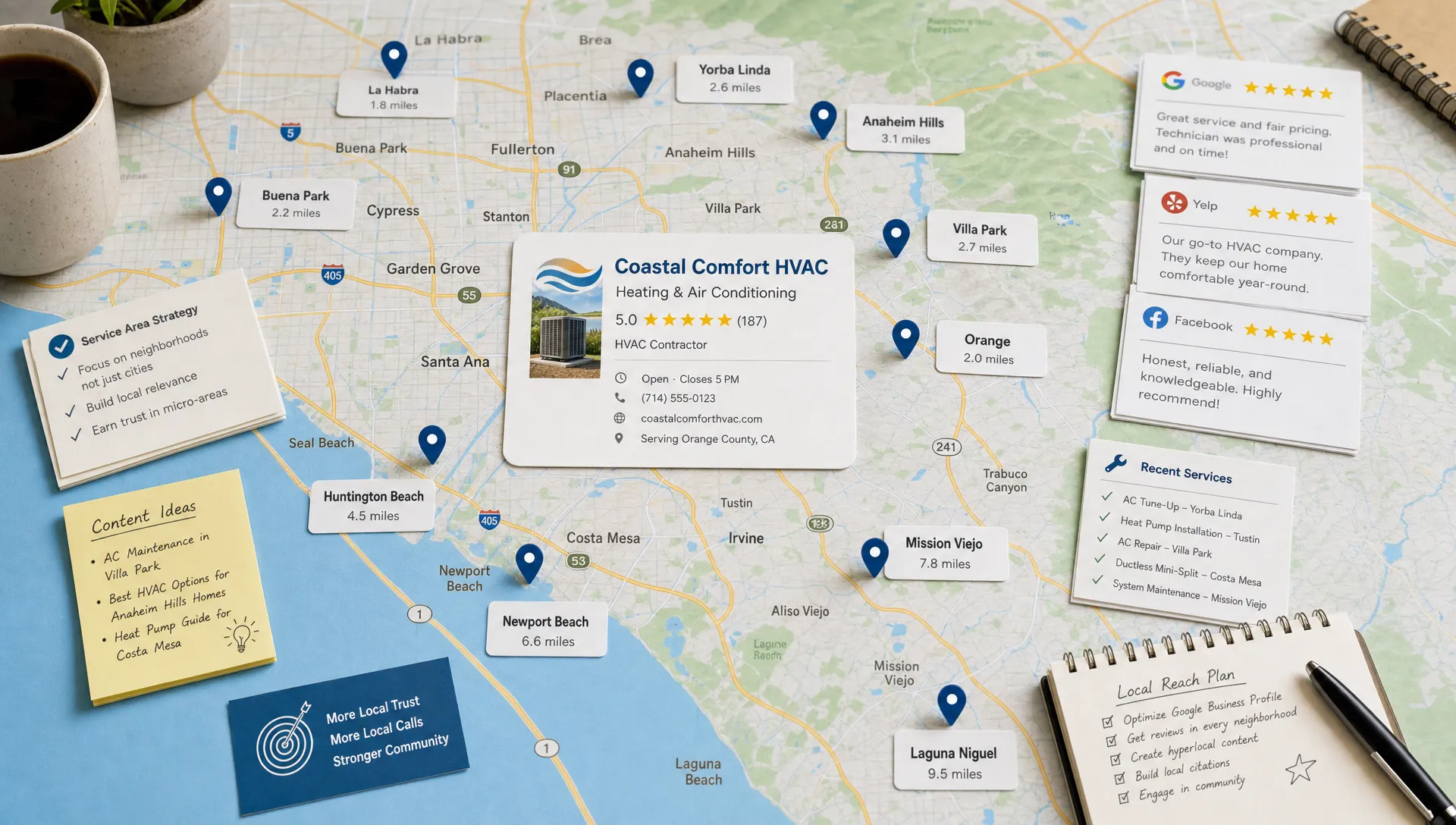
Multi-location and multi-partner practices benefit from pairing AEO with foundational Local SEO Mastery. That keeps every listing's citation data consistent — often the exact weak point above.
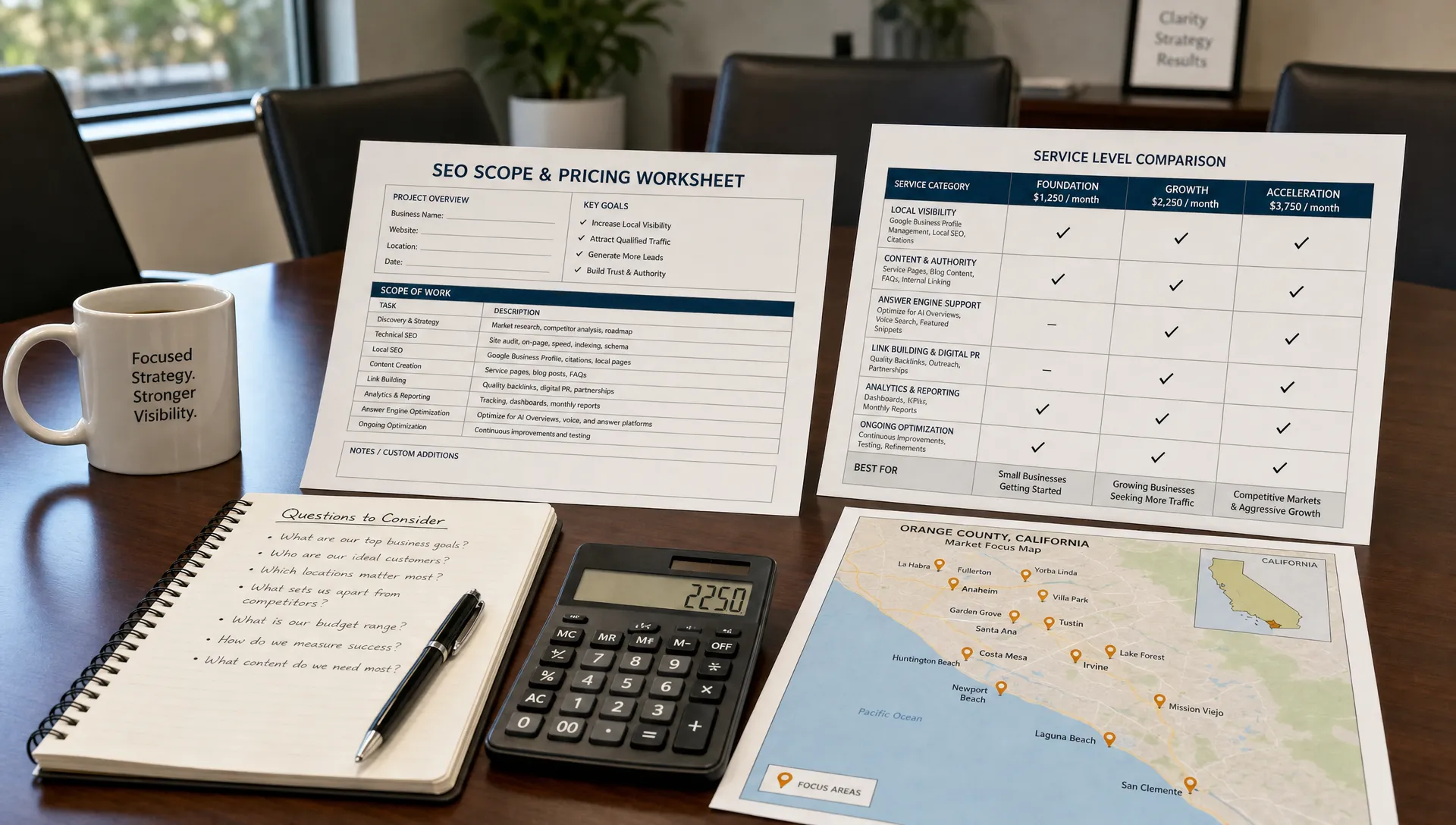
Pricing here matters too, because most firms have never seen AEO priced transparently. It runs in three published tiers instead of a "contact us" form.
| Tier | Setup | Monthly |
|---|---|---|
| AEO Essentials | $500 | $500 |
| AEO Pro | $1,000 | $1,500 |
| AEO Elite | $1,000 | $2,500 |
Larger national agencies increasingly bolt AI-search language onto existing SEO retainers without changing the underlying approach. That's a reasonable strategy for enterprise budgets, but it rarely fits a boutique Newport Beach, Irvine, or Costa Mesa practice. Founder-level access and Orange County market knowledge don't scale the same way a 400-person account team does.
What it looks like when the pivot works
Closing this gap looks different from a typical SEO win. Rankings might barely move in the short term. Citations do — inside ChatGPT, inside Perplexity, inside Google's AI Overviews.
A prospect asks the same question they always would have asked. This time, your firm is part of the answer they get back. That's the entire goal of AEO, stated as plainly as possible.
Progress here isn't a guess, either. A rising Share of Answer score shows the shift taking hold quarter over quarter. Firms that track it can see exactly when their AEO investment starts paying off.
Frequently asked questions
What's the actual difference between SEO and AEO?
SEO optimizes for ranking position on a results page. AEO optimizes for being the entity an AI model names when a prospect asks a direct question. They share some tactics but chase entirely different outcomes, and a firm can win one while losing the other.
Can a well-designed, fast website still be invisible to ChatGPT or Perplexity?
Yes, and it happens constantly. Visual design has no bearing on whether a model trusts your entity signals across the web. A beautiful site with inconsistent NAP data and no schema can still go unmentioned to a model.
How do I know if my firm already has this problem?
Open ChatGPT or Perplexity and ask the exact question a prospect would ask. Search your service and your city, then add "who's the best." If you don't appear, or you're described inaccurately, the gap already exists.
Does this only matter for firms competing on price?
No, it matters more for firms that don't. Premium consultancies, boutique law firms, and specialized agencies sell trust and expertise first. Losing the AI shortlist costs them the prospects most willing to pay for that expertise.
How long does closing this gap usually take?
There's no universal timeline here. It depends on how fragmented your current entity signals are across directories, reviews, and your own site. Most engagements show measurable movement within a few months, with authority compounding after that.
Is this really different from just doing more content marketing?
Content matters, but volume alone doesn't fix inconsistent entity data or missing schema. AEO treats content, structure, and technical signals as one connected system. Publishing more blog posts without fixing those signals rarely moves the needle on its own.
The bottom line for Newport Beach service firms
The firms winning the next decade of Orange County business won't necessarily have the biggest ad budgets. They'll be the ones an AI model already trusts enough to recommend, without a human double-checking that recommendation first.
That trust doesn't build itself, and it won't show up in a standard SEO report. It has to be engineered on purpose, then defended as competitors in Irvine and Costa Mesa do the same work.
Stop guessing why the inbound calls have slowed. See exactly how AI describes your firm today, or whether it mentions you at all. A short strategy call is enough to see where the gap sits. Book your AEO Discovery Audit before a competitor closes theirs first.