How to Improve Search Results When AI Takes the First Click
When AI summarizes a search before a customer clicks, the old playbook of ranking a single web page is no longer enough. For Orange County contractors, multi-location medical practices, dental groups, law firms, and California service brands, improving search results now means becoming the trusted source that AI, maps, voice assistants, and human searchers can all understand.
That shift does not make SEO irrelevant. It makes clarity, authority, and conversion more important. If a homeowner in Irvine asks Google for the best HVAC repair company, or a patient in San Jose asks an AI assistant which dental office handles emergency appointments, the business that wins is usually the one with the clearest local entity signals, strongest proof, and most answer-ready content.
Search results are no longer just links
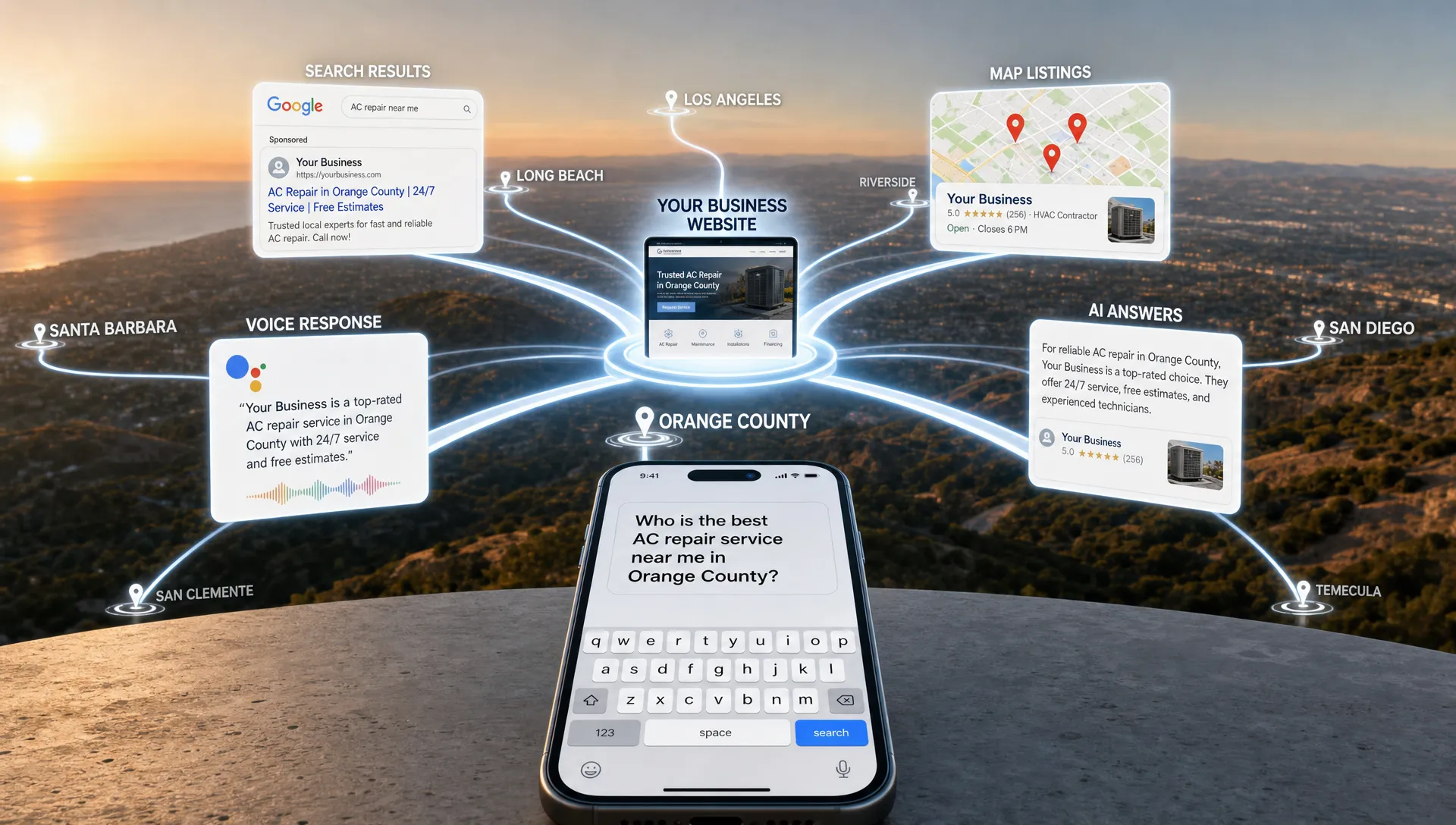
Traditional search results were mostly a list of pages. Today, search results are a layered answer environment. A single local query can trigger an AI Overview, map pack, Google Business Profile, paid listing, review snippet, video result, directory listing, and organic page, sometimes all on the same screen.
For local businesses, this creates a strange situation. You may still be visible, but the customer may not click your website. They might call from Google Maps, ask a follow-up question inside an AI tool, compare reviews without leaving the results page, or use voice search to choose one provider.
That is why the goal has changed from getting the click to being selected as the answer. The click still matters, but it is no longer the only measurable win.
Google’s own guidance on structured data explains that machine-readable markup helps search engines understand page content and qualify it for enhanced search features. For local rankings, Google also states that relevance, distance, and prominence influence visibility. Those same concepts matter even more when AI systems decide which businesses are worth summarizing, citing, or recommending.
Start by diagnosing where your search results are breaking down
Before you rewrite pages or publish more blogs, look at the full customer journey. The problem may not be that your business is invisible. It may be that AI tools do not understand your service area, Google does not trust your local prominence, or searchers do not see enough proof to call.
Run searches the way your buyers actually talk. A roofer in Huntington Beach should test queries like roof leak repair after rain, best flat roof contractor near Huntington Harbor, and emergency roof tarping Huntington Beach. A dental group in Sacramento should test emergency dentist open today, dental implants near Midtown Sacramento, and pediatric dentist accepting new patients.
Do this across Google Search, Google Maps, voice search, ChatGPT, Perplexity, and Gemini. Document what appears, who is cited, which competitors show up repeatedly, and whether your business appears as a confident recommendation or just another link.
| Old SEO question | Better AI-era question |
|---|---|
| Do we rank on page one? | Are we being cited, summarized, or recommended? |
| Did organic traffic increase? | Did calls, form fills, direction requests, and booked appointments increase? |
| Do we have enough keywords? | Does every page clearly explain who we serve, where we serve, and why we are credible? |
| Do we have blog content? | Do we answer the exact questions customers ask before hiring? |
| Do we have backlinks? | Do we have trusted local proof across multiple authoritative sources? |
This audit often reveals the real issue. Many businesses have pages that humans can interpret, but AI systems see vague claims, thin service descriptions, inconsistent location data, and weak proof.
Make your business entity impossible to misunderstand
AI search depends heavily on entity understanding. In plain English, an entity is a recognizable thing, such as your company, your founder, your service category, your location, your reviews, and your relationship to other trusted sources.
For a California contractor or professional practice, entity clarity should answer four questions everywhere your brand appears:
- What services do you provide?
- Which cities, neighborhoods, or counties do you serve?
- Who is responsible for the business?
- What evidence proves you are credible?
Your website, Google Business Profile, citations, social profiles, review platforms, and local content should all reinforce the same facts. If one listing says Laguna Beach, another says Orange County, another says Southern California, and your website buries service areas in a footer, AI systems may not confidently connect your business to local intent.
The fix is not keyword stuffing. The fix is consistency. Use the same business name, address, phone number, service categories, city references, and professional credentials across your most important digital assets.
For example, Kell Web Solutions is based in Laguna Beach and Laguna Niguel, serves Orange County, and works with California businesses that depend on local visibility. That relationship between brand, service, geography, and expertise needs to be repeated naturally across core pages, supporting content, and external references.
Build answer-first service pages
A service page should not read like a brochure. It should work like a decision page for both humans and answer engines.
When a homeowner lands on a plumbing page, they want to know whether you solve their specific problem, serve their neighborhood, have proof, and can respond quickly. AI systems look for similar signals, but they also need structure.
A strong answer-first service page includes a concise opening answer, clear service scope, local relevance, proof, FAQs, internal links, schema markup, and a conversion path. The goal is to remove ambiguity.
| Page element | Why it improves search results |
|---|---|
| Direct answer near the top | Helps AI and users understand the page immediately |
| Specific service details | Matches high-intent searches more accurately |
| Local service area language | Connects the page to city and neighborhood intent |
| Reviews, examples, or credentials | Builds trust and reinforces prominence |
| FAQ section | Captures conversational and voice-style queries |
| LocalBusiness, Service, and FAQ schema where appropriate | Gives search engines structured context |
| Clear call button or booking path | Converts demand even when clicks are limited |
A page about emergency HVAC repair in Irvine should not simply say you offer quality HVAC services. It should answer questions like how fast service is available, what systems are repaired, which neighborhoods are covered, what warning signs require urgent attention, and why local homeowners trust the company.
That is the difference between content written for rankings and content written to become the answer.
Expand from city SEO to hyperlocal authority
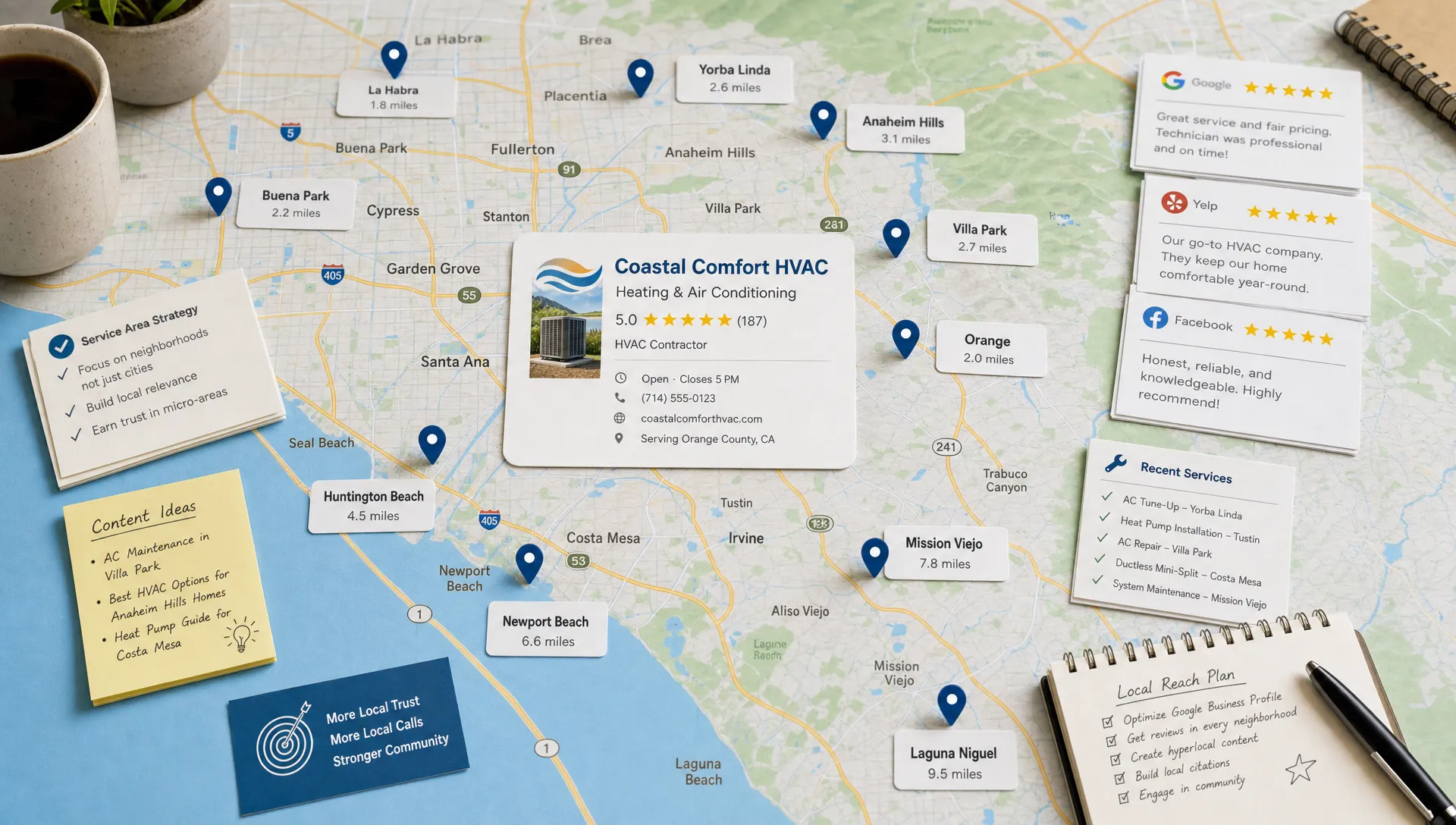
Most local businesses say they serve an entire county. AI search is more precise than that. It often responds to neighborhood, landmark, suburb, and near-me intent.
In Orange County, a contractor may need visibility in Laguna Beach, Newport Beach, Irvine, Anaheim, Huntington Beach, Costa Mesa, Mission Viejo, and Santa Ana. In Northern California, a practice may need separate authority around San Jose, Fremont, Sunnyvale, Oakland, and San Francisco. In Central and Inland California, local intent may cluster around Sacramento, Fresno, Bakersfield, Stockton, Riverside, San Bernardino, and Ontario.
The mistake is creating dozens of thin city pages with swapped-out city names. That approach looks weak to users and unhelpful to search engines.
A better approach is to create genuinely useful local assets. Each location page or supporting article should include local service considerations, neighborhood-specific questions, proof from nearby customers, relevant regulations or conditions, and a clear reason the page exists.
This is where distributed authority becomes powerful. A single website can rank, but a network of accurate, useful, locally aligned assets can create stronger entity signals. Kell Web Solutions’ Hyperlocal Authority Builder is designed around this idea, especially for contractors and service businesses that need to surround a city with trustworthy local signals.
You can see the same principle outside California. A local service business like professional street sweeping services in Nashville, TN makes its relevance easier to understand by clearly tying services, property types, compliance needs, and service geography together. Whether the market is Nashville, Newport Beach, or San Jose, local clarity helps both searchers and machines determine fit.
Strengthen Google Business Profile and off-site proof
When AI takes the first click, off-site proof becomes even more valuable. Google Business Profile, reviews, citations, directories, local media, chamber pages, industry associations, and social profiles all help search systems validate that your business exists, serves the area, and deserves attention.
For local contractors and multi-location practices, your Google Business Profile should be treated like a revenue asset, not a basic listing. Service categories, service areas, photos, products or services, appointment links, posts, Q&A, and review responses all contribute to customer confidence.
Reviews are especially important because they provide third-party language about your services. If customers repeatedly mention emergency repair, clean installation, same-day response, specific cities, or staff names, those phrases become natural proof of what your business is known for.
Do not fabricate reviews or over-script customers. Instead, ask for specific, honest feedback after completed work. A good review request might ask what problem was solved, which city the customer is in, and what made the experience helpful. That creates richer signals without manipulating the customer.
Publish content that answers real buying questions
AI search favors content that directly satisfies intent. For local businesses, the best content often comes from sales calls, customer objections, technician notes, intake forms, and reviews.
Contractors should answer questions like:
- How much does this repair usually cost in our region?
- When is replacement smarter than repair?
- What should a homeowner do before calling?
- Which permits, codes, or HOA rules may apply?
- What problems are common in this city because of weather, building age, or property type?
Professional practices should answer questions like:
- Who is a good candidate for this service?
- What happens during the first appointment?
- What documents should a client or patient bring?
- Which locations are accepting new appointments?
- What makes this provider different from a generalist?
The most useful pages sound like an expert explaining the answer to a real customer. Avoid bloated introductions, vague claims, and generic AI-written paragraphs. Include practical detail, local context, and clear next steps.
If you serve multiple cities, use content to support the full local journey. A roofing company in Orange County might publish seasonal content about coastal moisture in Laguna Beach, tile roof issues in Irvine, flat roof maintenance in Anaheim, and storm preparation in Huntington Beach. A legal firm could publish location-specific guides for clients in Los Angeles, San Diego, San Jose, and Sacramento.
Use structured data, but do not treat schema as magic
Schema markup helps search engines interpret your content, but it cannot rescue weak content. Think of schema as a label, not the product itself.
Useful schema types for local service businesses may include LocalBusiness, Organization, Service, FAQPage, Review, BreadcrumbList, and Article, depending on the page and whether the visible content supports the markup. The key is accuracy. Do not mark up fake reviews, invisible FAQs, or services you do not actually provide.
Also make sure your technical foundation is clean. AI crawlers and search engines need accessible pages, fast load times, logical internal links, indexable content, and clear headings. If important service information is trapped in images, hidden tabs, broken scripts, or inconsistent navigation, it may not be understood.
For businesses preparing for answer engines, Kell Web Solutions’ Answer Engine Optimization service focuses on making digital presence easier for AI-driven platforms to understand, trust, and recommend.
Improve conversion because fewer clicks must work harder
If AI reduces website visits, every remaining visit is more valuable. The businesses that win in 2026 will not only improve search results, they will convert attention faster.
That means your website should make the next step obvious. Phone numbers should be tappable on mobile. Contact forms should be short. Appointment links should be easy to find. Service pages should include trust signals near the call to action. If you serve emergencies, the page should make response expectations clear.
For contractors, missed calls are often missed revenue. A homeowner with a leaking pipe, broken AC system, or electrical issue is unlikely to leave multiple voicemails and wait patiently. For professional practices, slow follow-up can send a qualified patient or client to the next provider in the search results.
This is why SEO, AEO, local visibility, and lead handling must work together. Kell Web Solutions’ Profit Accelerator addresses the outreach and booking side of growth, while Local SEO Mastery supports the foundational visibility layer.
A practical 30-day plan to improve search results in the AI era
You do not need to rebuild everything at once. Start with the pages and profiles closest to revenue.
| Timeline | Priority | Action |
|---|---|---|
| Days 1-7 | Visibility audit | Test buyer questions across Google, Maps, AI tools, and voice search. Record where you appear and where competitors win. |
| Days 8-14 | Entity cleanup | Align business name, phone, address, service areas, categories, and descriptions across core profiles and citations. |
| Days 15-21 | Core page improvement | Rewrite top service pages with direct answers, local proof, FAQs, internal links, and clear calls to action. |
| Days 22-26 | Structured data and technical cleanup | Add accurate schema, improve mobile speed, fix indexing issues, and make important content crawlable. |
| Days 27-30 | Proof and measurement | Request detailed reviews, update Google Business Profile, track calls and forms, and choose the next content cluster. |
After the first month, expand into location-specific authority. Build the pages, articles, reviews, and off-site signals that prove your business is relevant in each priority market. For many California businesses, that means starting with Orange County, then expanding into Los Angeles, San Diego, San Jose, Sacramento, Fresno, Riverside, and other high-value service areas.
What to measure when clicks are no longer enough
Organic traffic still matters, but it is incomplete. If AI answers reduce clicks while calls increase, traffic alone may make your marketing look worse even when revenue improves.
Track metrics that reflect how customers actually choose you:
- AI citations and mentions in answer engines
- Google Business Profile calls, direction requests, and website clicks
- Local pack rankings for priority service and city combinations
- Form submissions, booked calls, and appointment quality
- Review quantity, review quality, and review velocity
- Conversion rate by service page and location page
- Share of answer against key competitors
The right dashboard should connect visibility to revenue. A contractor does not need vanity traffic from people outside the service area. A dental group does not need impressions for services it does not offer. The best search results are the ones that produce qualified conversations.
Frequently Asked Questions
Can SEO still work when AI answers the question first? Yes. SEO still matters, but it must evolve. Your content needs to be structured, credible, local, and easy for AI systems to interpret. The goal is not only to rank, but to be cited, summarized, and trusted.
What is the difference between SEO and Answer Engine Optimization? SEO focuses on improving visibility in traditional search rankings. Answer Engine Optimization focuses on making your business understandable and trustworthy enough to be selected by AI results, voice assistants, and answer engines.
Do local businesses need separate pages for every city they serve? Not always. Create separate pages only when you can make them genuinely useful and locally specific. Thin duplicate city pages can weaken trust. Strong local pages should include real service details, proof, FAQs, and unique context.
How long does it take to improve AI search visibility? Foundational improvements can happen in weeks, especially for entity cleanup, service page structure, and Google Business Profile updates. Stronger authority signals usually compound over several months as content, reviews, citations, and local proof grow.
Is schema markup enough to win AI search results? No. Schema helps search engines understand content, but it must reflect accurate, visible, high-quality information. Strong pages, consistent entities, reviews, local authority, and technical accessibility all matter.
What should Orange County contractors prioritize first? Start with your highest-value services and highest-value cities. For many contractors, that means improving emergency service pages, Google Business Profile, review generation, and local content for cities like Irvine, Newport Beach, Laguna Beach, Anaheim, and Huntington Beach.
Turn AI disruption into local search advantage
AI may take the first click, but it does not have to take your next customer. The businesses that win will be the ones that make their expertise, service areas, proof, and conversion paths unmistakably clear.
Kell Web Solutions helps Orange County and California businesses adapt to this new search environment with Answer Engine Optimization, Local SEO, Hyperlocal Authority Builder, and revenue-focused growth systems. If your search results are producing fewer clicks, fewer calls, or less predictable demand, now is the time to rebuild your visibility for the way customers actually search.
Book a strategy call with Kell Web Solutions to identify where AI is intercepting demand and how to become the answer customers choose.