How to Choose Marketing Firms That Actually Grow Local Revenue

A marketing firm can make a dashboard look busy. That is not the same as growing local revenue.
For an Orange County contractor, revenue means booked HVAC jobs in Irvine, emergency plumbing calls in Huntington Beach, roof replacement estimates in Anaheim, and remodel consultations in Laguna Niguel. For a multi-location dental, medical, or legal practice, it means the right prospects choosing the right office within the right neighborhood catchment.
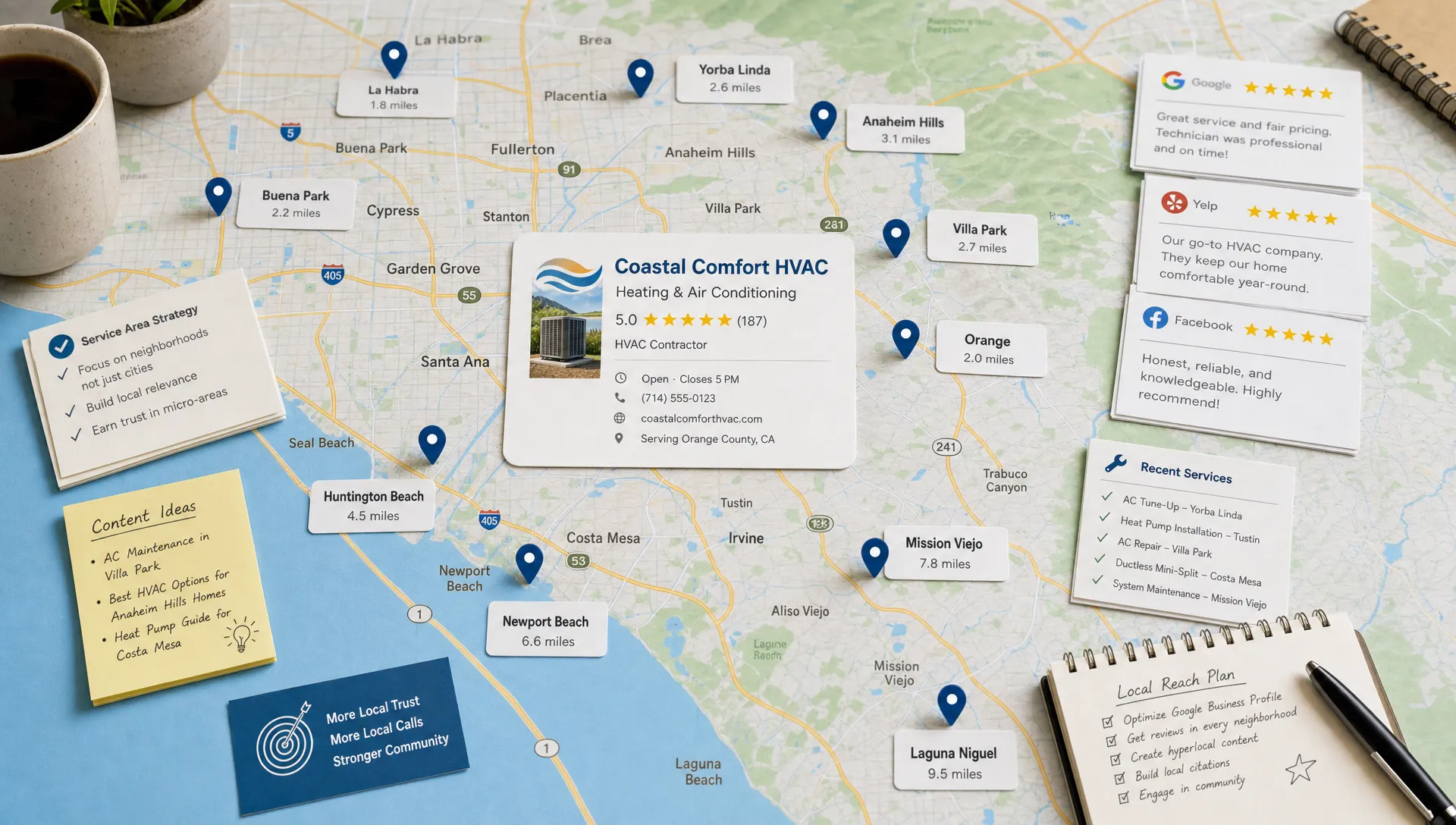
That is why choosing between marketing firms in 2026 requires a different scorecard. Rankings still matter. Ads still matter. Websites still matter. But local buyers now move through Google Maps, AI Overviews, voice assistants, reviews, directory profiles, neighborhood content, and referral signals before they ever fill out a form. The right firm does not just “do marketing.” It builds a system that turns local intent into confident calls, consultations, and booked work.
Below is a practical framework for choosing a marketing partner that is accountable to revenue, not vanity metrics.
Start by defining what “local revenue growth” means
Before you talk to agencies, define the business outcome you actually need. Too many local businesses start with a vague request like “we need SEO” or “we need more leads.” A stronger starting point is: “We need more qualified calls from homeowners in Newport Beach for high-margin HVAC replacement jobs,” or “We need more booked consultations for our Irvine and San Diego offices.”
That distinction changes everything. A generic campaign might chase traffic from anywhere. A revenue-focused local campaign identifies the service lines, cities, neighborhoods, customer questions, and conversion paths that produce profitable work.
Use a simple scorecard like this when evaluating proposals:
| Business goal | Better metric than traffic | Why it matters |
|---|---|---|
| More service jobs | Qualified calls and booked appointments | Traffic does not pay unless it converts |
| Better local visibility | Google Business Profile actions, map views, local rankings, AI citations | Local buyers often decide before visiting your site |
| Higher close rates | Call quality, lead source, service fit, appointment show rate | Not every lead is worth pursuing |
| Lower acquisition cost | Cost per booked job or consultation | Revenue efficiency beats raw lead volume |
| Durable authority | Reviews, citations, content depth, entity clarity, local proof | Strong signals compound over time |
When a firm avoids this conversation, be careful. If they cannot connect their work to calls, appointments, estimates, or consultations, they may be selling activity instead of growth.
Look for real local market understanding
Local marketing is not simply national marketing with a city name added to the headline. A roofing company in Laguna Beach faces different search behavior, homeowner expectations, zoning concerns, and competitive dynamics than a roofing company in Fresno or San Jose. A boutique legal practice in Newport Beach may need a very different trust-building strategy than a multi-location dental group expanding across Sacramento, Oakland, and San Diego.
Strong marketing firms should be able to explain how they would adapt strategy by geography. In Orange County, that might mean differentiating coastal luxury service areas from inland price-sensitive markets. In Los Angeles, it might mean building neighborhood-level authority because “LA” is too broad to be useful. In San Jose or Sunnyvale, it may require positioning around educated, research-heavy buyers. In Central and Inland California cities like Bakersfield, Stockton, Modesto, or Fresno, the right message may emphasize availability, proof, and practical value.
Ask every firm: “How would your strategy change between Laguna Beach, Irvine, Anaheim, San Diego, San Jose, and Sacramento?”
A weak answer sounds like, “We’ll create location pages for each city.” A strong answer discusses search intent, competition density, Google Business Profile strategy, service-area relevance, reviews, content themes, conversion paths, and how AI systems interpret the business as a local authority.
Make sure they understand the new search environment
Traditional SEO is still valuable, but it is no longer the whole game. Local customers increasingly get answers from Google AI results, map packs, voice search, ChatGPT-style tools, and zero-click summaries. In this environment, the winner is not always the business with the most keywords. It is often the business that search engines and AI systems can understand, verify, and trust.
That is the idea behind Answer Engine Optimization, often called AEO. SEO focuses on rankings and pages. AEO focuses on becoming the selected answer when someone asks, “Who is the best HVAC company near me?” or “Which dentist in Irvine handles emergency appointments?”
A firm that understands modern local growth should be able to explain:
- How your business entity is defined across your website, Google profile, directories, reviews, and structured data
- How service pages answer real customer questions clearly enough for AI systems to extract and cite
- How reviews, testimonials, case evidence, and local content reinforce trust
- How technical elements such as schema markup and machine-readable site structure support discovery
- How visibility is measured when a buyer may never click a traditional blue link
Kell Web Solutions addresses this shift through Answer Engine Optimization, which structures a business’s digital presence so AI-driven platforms can better understand, trust, and recommend it. Whether you work with Kell or another firm, you should expect a clear explanation of how the agency prepares your business for AI-assisted local search.
Separate lead generation from revenue generation
Many agencies promise more leads. Fewer can explain how those leads become revenue.
For contractors, a low-quality lead might be outside the service area, looking for the cheapest possible repair, or calling about a service you do not provide. For a medical, dental, or legal practice, a poor-fit inquiry may involve the wrong insurance, wrong specialty, wrong office location, or no real intent to schedule.
A revenue-focused firm looks beyond the form fill. It asks what happens after the click, after the call, and after the appointment request. That includes call handling, follow-up timing, appointment qualification, missed-call recovery, and CRM feedback.
This matters because local service decisions are often urgent. If a homeowner has a failed AC system in Anaheim during a heat wave or a burst pipe in Huntington Beach, they will not wait days for a reply. If a patient is comparing dental implants in Irvine or a client is looking for a family law attorney in Orange County, slow follow-up can cost the opportunity.
Ask agencies how they handle the full path from visibility to revenue. If their strategy stops at “we sent traffic to the website,” you may still have a conversion problem.
Evaluate their local SEO fundamentals
A firm cannot credibly talk about AI visibility if it neglects the basics of local search. Google’s local systems are heavily influenced by relevance, distance, and prominence. That means your business must be clearly associated with the right services, locations, categories, reviews, citations, and proof signals.
At minimum, a qualified local marketing partner should know how to improve:
- Google Business Profile categories, services, photos, posts, and conversion actions
- NAP consistency, meaning name, address, and phone accuracy across the web
- Location and service pages that are useful rather than duplicated
- Review generation and response systems that follow platform rules
- On-page optimization for high-intent service and city combinations
- Technical site health, mobile performance, crawlability, and structured data
For California businesses competing across multiple cities, this foundation becomes even more important. A plumbing contractor serving Irvine, Costa Mesa, and Mission Viejo needs a different footprint than a law firm with offices in Los Angeles, San Diego, and San Francisco. A multi-location practice needs clean location architecture so search engines, AI assistants, and customers understand which office serves which need.
If local SEO is a major gap in your business, Kell’s Local SEO Mastery service is built around Google Business Profile optimization, citation consistency, targeted content, and local visibility fundamentals.
Ask how they build authority beyond one website
In competitive local markets, one website may not be enough to establish durable authority. That is especially true for home services, where customers search by neighborhood, service type, urgency, and trust signals.
A strong firm should be able to explain how it builds authority around your business across multiple assets. This may include your main website, Google Business Profile, reviews, local content, citations, press mentions, feeder assets, social proof, and answer-ready content.
For example, an HVAC company that wants to win in Newport Beach, Laguna Niguel, and Irvine may need separate signals that prove relevance in each market. A dental group expanding across San Jose, Santa Clara, and Sunnyvale may need content and profiles that show office-level expertise, not just one generic brand page.
Kell’s Hyperlocal Authority Builder is designed for this type of neighborhood-level authority building, particularly for home services businesses that need stronger local entity signals. The larger principle is simple: the more clearly your digital ecosystem confirms who you are, what you do, where you do it, and why customers trust you, the easier it becomes for search systems and buyers to choose you.
Demand proof, but interpret it carefully
Case studies and testimonials matter, but you need to know what kind of proof you are seeing. A screenshot of keyword rankings is not the same as a documented increase in booked work. A traffic chart is not the same as revenue growth. A big brand logo does not prove the agency can help a local contractor or a professional practice in California.
Ask for proof that matches your situation. If you are a roofing contractor, ask about service-area businesses with long sales cycles and high-ticket jobs. If you are a dental group, ask about multi-location appointment growth and local reputation strategy. If you are a law firm, ask how the firm balances visibility, trust, compliance, and client intake quality.
Here are useful questions to ask during sales calls:
| Question to ask | What a strong answer includes | Red flag answer |
|---|---|---|
| How do you define success? | Booked calls, qualified appointments, local visibility, cost per opportunity | “More impressions and clicks” only |
| How do you adapt by city? | Neighborhood intent, competition, reviews, GBP, content, conversion | “We swap the city name” |
| How do you prepare us for AI search? | Entity clarity, structured data, answer-first content, trust signals | “AI search is just SEO” |
| How do you report results? | Revenue-path metrics and plain-English interpretation | Dense reports with no business insight |
| Who owns the assets? | Clear ownership of website, content, domains, data, and accounts | Vague answers or lock-in language |
The best proof is not just “we got rankings.” It is “we helped the business earn more of the right local opportunities, and we can show how.”
Watch for pricing models that hide accountability
Cheaper marketing is not always more efficient. Expensive marketing is not always more strategic. The real question is whether the firm’s pricing model matches the value you need and the risk you are willing to take.
For example, a newer contractor in a competitive Orange County market may need foundational local SEO and authority building before expecting a consistent flow of calls. A more established practice may need conversion improvements, AI visibility, and intake optimization to get more value from existing demand. A B2B service provider may need outbound appointment generation rather than more website traffic.
That is why the proposal should explain what is being built, why it matters, how long it may take, and how success will be evaluated. Beware of vague retainers that promise “ongoing optimization” without defining deliverables or outcomes.
Also ask what happens in the first 30, 60, and 90 days. A credible firm should be able to describe the early priorities, such as auditing visibility, fixing technical gaps, improving local profiles, clarifying service pages, strengthening reviews, setting up tracking, and identifying high-intent opportunities.
Do not ignore data privacy, compliance, and access control
Modern marketing involves more data than many business owners realize. Call tracking, CRM integrations, AI outreach, analytics, email campaigns, review requests, intake forms, and retargeting can all involve customer or prospect information.
For contractors, that may include homeowner contact details, addresses, job notes, and call recordings. For medical, dental, and legal practices, the stakes are even higher because intake and appointment workflows can involve sensitive information.
Ask any agency how it handles data access, permissions, account ownership, retention, vendor tools, and compliance expectations. If your business needs a broader governance perspective, resources from Privacy & Legal Management Consultants can help leaders think through privacy, data protection, cybersecurity, and governance issues more systematically.
A trustworthy firm will not treat privacy as an afterthought. It will be willing to discuss who has access to what, how tools are configured, and how your business can reduce unnecessary risk.
Identify red flags before you sign
Most bad agency relationships show warning signs early. The problem is that business owners often ignore those signs because the pitch sounds exciting.
Be cautious if a firm promises guaranteed rankings, refuses to explain its methods, pushes a one-size-fits-all package, avoids talking about call quality, or says reviews and Google Business Profile management are “not really part of SEO.” Be equally cautious if they focus only on paid ads but cannot explain what happens when ad costs rise.
Other red flags include unclear ownership of domains and content, no plan for missed calls, no local market research, no strategy for AI-driven search, and reporting that requires a translator. If you cannot understand the monthly report, your team probably cannot act on it.
A good firm should make you smarter. You should leave conversations with clearer priorities, not more confusion.
Choose the firm that can explain the revenue system
The best marketing firms for local businesses think in systems. They understand that revenue growth comes from the relationship between visibility, trust, conversion, follow-up, and measurement.
For a California contractor, that system might include hyperlocal content, Google Business Profile optimization, review generation, answer-ready service pages, call tracking, and fast appointment booking. For a multi-location professional practice, it might include office-level pages, practitioner credibility, local reviews, intake routing, compliance-aware messaging, and neighborhood-specific authority.
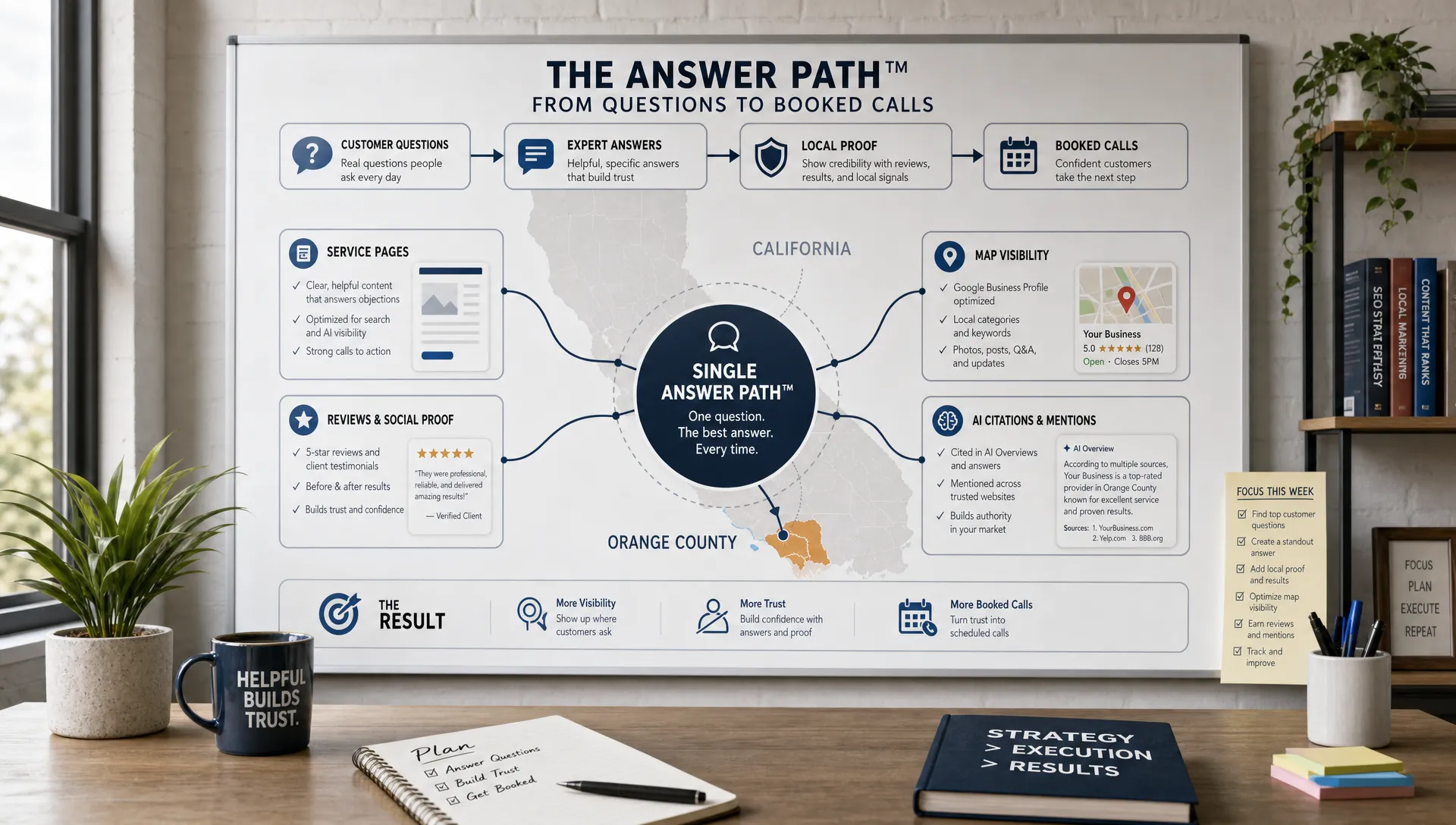
The agency should be able to show how each part supports the next. Local SEO creates discoverability. AEO makes the business easier for answer engines to trust. Reviews reduce buyer hesitation. Web design converts attention into action. Follow-up turns interest into scheduled conversations. Reporting shows what to improve.
That is the difference between marketing activity and a revenue engine.
Frequently Asked Questions
How do I know if a marketing firm is focused on revenue instead of vanity metrics? Ask how they measure success. If they talk about qualified calls, booked appointments, cost per opportunity, close rates, and local conversion paths, they are thinking about revenue. If they only discuss traffic, impressions, and rankings, ask for a stronger business case.
Should local businesses still invest in SEO now that AI answers are growing? Yes. SEO fundamentals still support visibility in Google, maps, directories, and AI-driven results. The difference is that SEO should now work with Answer Engine Optimization, structured content, reviews, and entity clarity so your business can be trusted as an answer.
What should contractors ask before hiring a marketing firm? Contractors should ask how the firm targets service areas, improves Google Business Profile performance, generates compliant reviews, handles high-intent service pages, tracks calls, and separates profitable jobs from low-quality leads.
What should multi-location practices look for in a marketing partner? They should look for clean location strategy, office-level visibility, accurate listings, review systems, trust-building content, intake tracking, and a clear plan for competing in each neighborhood or city rather than treating all locations the same.
How long does it take to see local revenue growth from marketing? Paid campaigns and outbound systems may create activity faster, while SEO, AEO, reviews, and authority building usually compound over several months. A credible firm should set expectations based on your market, competition, starting point, and conversion process.
Ready to choose a revenue-focused marketing partner?
If your business depends on local calls, consultations, estimates, or appointments, do not choose a firm based on the prettiest pitch. Choose the partner that can explain how visibility becomes trust, how trust becomes action, and how action becomes revenue.
Kell Web Solutions helps Orange County and California businesses build durable local visibility through Answer Engine Optimization, Local SEO, Hyperlocal Authority Builder, and the Profit Accelerator. If you want a practical conversation about what is holding back your local revenue, call Kell Web Solutions at (949) 575-8553 and ask what should be fixed first.