Lead Solutions That Turn Missed Opportunities Into Booked Calls
Most local businesses do not lose revenue because nobody is interested. They lose revenue in the gap between interest and action.
A homeowner searches for emergency HVAC repair in Irvine. A patient looks for a dental implant consultation in Anaheim. A business owner in San Jose compares local legal firms. They call, fill out a form, or ask an AI assistant for a recommendation. If your team responds late, misses the call, asks the wrong questions, or fails to follow up, that opportunity moves to a competitor.
That is why modern lead solutions should not be judged by lead volume alone. The better question is: how many real opportunities become qualified, booked calls?
For contractors and multi-location practices across Orange County and California, the answer increasingly depends on a call-first system that combines local visibility, fast response, qualification, intelligent follow-up, and clear appointment booking.
Why missed opportunities happen after the lead arrives
Many businesses think their lead problem is at the top of the funnel. They want more traffic, more form fills, more ad clicks, and more phone calls. Sometimes that is true. But just as often, the lead generation engine is already producing demand and the business is leaking value after the prospect raises their hand.
The most common leaks are operational, not promotional. Calls go unanswered during lunch, after hours, or during busy job windows. Contact forms sit in an inbox until the next morning. A receptionist gathers a name and phone number but does not identify urgency, budget, location, or service fit. A sales rep calls once, leaves a voicemail, and moves on.
Speed matters. A widely cited Harvard Business Review analysis found that companies contacting leads within an hour were far more likely to qualify them than companies that waited longer. That principle is even more important for home services, urgent repairs, and local professional services, where prospects often contact multiple providers in the same session.
In Orange County, the gap is especially expensive. A roofing lead in Laguna Niguel, a plumbing call in Huntington Beach, or a cosmetic dentistry inquiry in Newport Beach can represent significant revenue. If that opportunity is not captured and moved toward a scheduled conversation, the marketing investment has already been partially wasted.
What effective lead solutions must do
Generic leads solutions often promise more names, more emails, or more inbound inquiries. That may look attractive on a dashboard, but it does not necessarily create revenue. A better system is built around the full journey from intent to booked call.
Strong lead solutions should accomplish four things consistently:
- Capture the opportunity the moment it appears.
- Qualify the prospect without creating friction.
- Follow up until the prospect responds or disqualifies.
- Book a clear next step with the right person.
This is why call quality matters as much as call quantity. A busy contractor does not need twenty unqualified price shoppers from outside the service area. A multi-location medical practice does not need inquiries for services it does not provide. The goal is not simply to generate activity. The goal is to create qualified conversations that your team can convert.
Kell Web Solutions approaches this with a call-first mindset. For example, a website should not merely “look professional.” It should make the visitor confident enough to call, and it should route that call into a system that can respond quickly. That same principle appears in Kell’s guidance on website advertising that turns visits into qualified calls, where traffic is only valuable when it produces measurable buyer conversations.
| Lead Leak | What It Looks Like | Better Solution | Metric to Watch |
|---|---|---|---|
| Missed Calls | Prospects call during busy hours and hang up | 24/7 call capture or voice AI support | Missed call rate |
| Slow Response | Form fills wait hours or days | Automated alerts and rapid follow-up | Speed-to-lead |
| Poor Qualification | Team books calls with bad-fit prospects | Structured questions and routing | Qualified call % |
| Weak Follow-Up | One voicemail, then silence | Persistent, respectful multi-touch follow-up | Contact-to-booked-call rate |
| No Attribution | Team sees leads but not revenue path | Call tracking and CRM notes | Cost per booked call |
The call-first framework for California service businesses
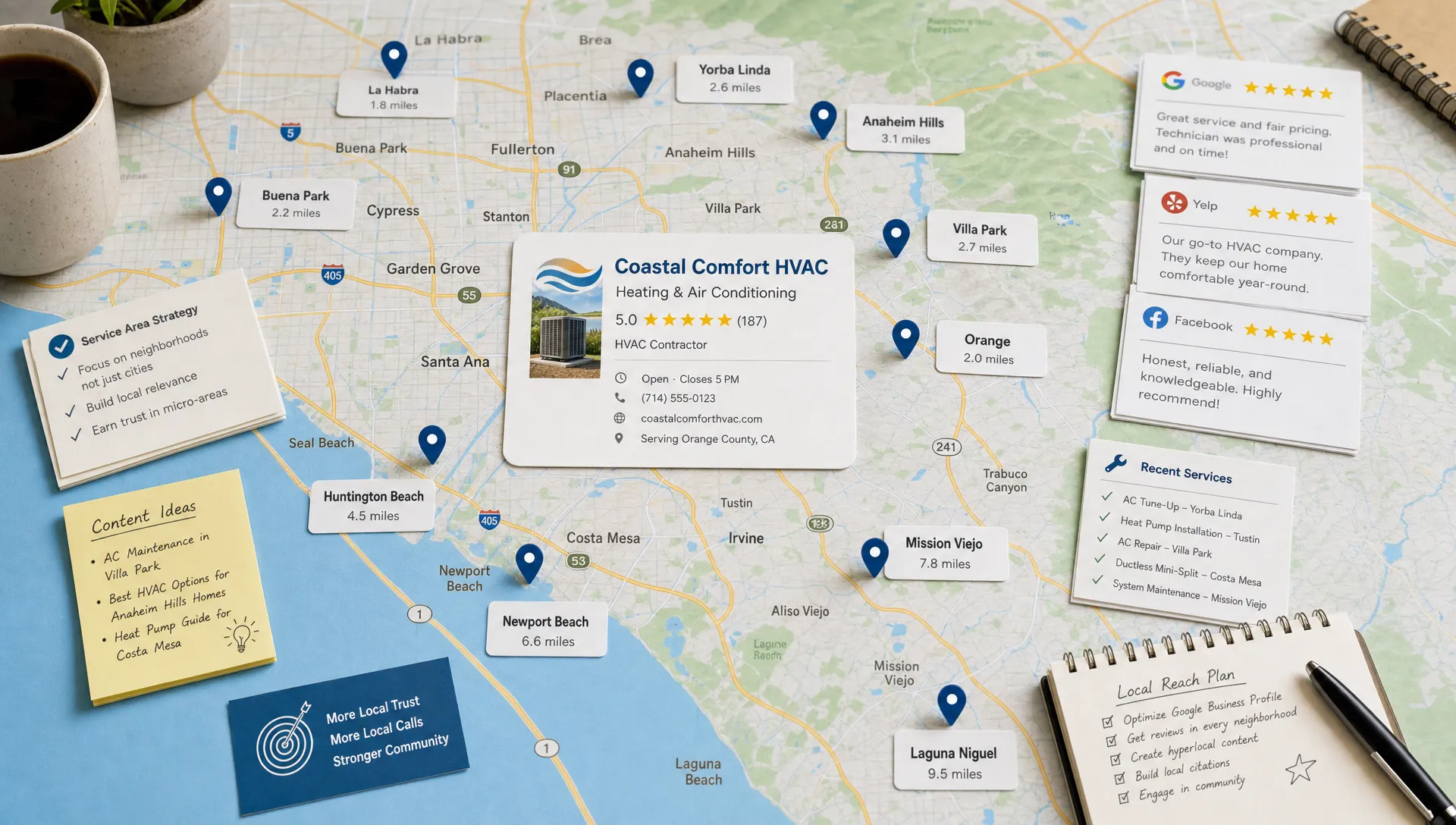
A lead solution for a California contractor or professional practice has to account for geography. A prospect in Santa Ana may search differently than a prospect in San Diego. A homeowner in Irvine may expect a different level of proof than a homeowner in Riverside or Fresno. A dental group in Los Angeles may need visibility by neighborhood, while a law firm in Sacramento may compete across a broader metro area.
That is why the best systems combine local authority with operational responsiveness.
Make the business easy to understand
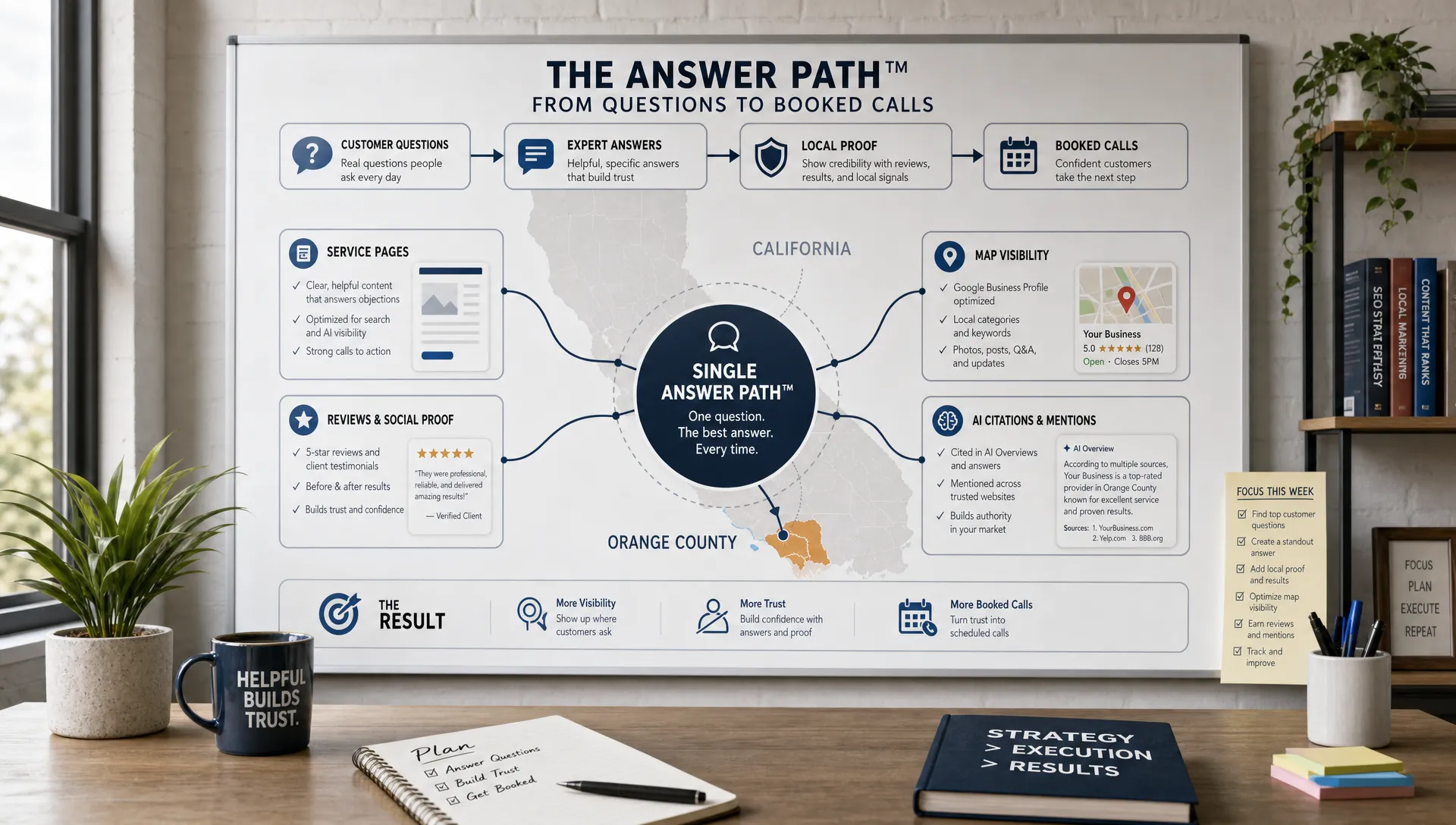
Before a prospect calls, they need clarity. Before an AI assistant recommends you, it also needs clarity. Your website, Google Business Profile, service pages, reviews, and local content should answer basic questions without ambiguity.
What do you do? Where do you do it? Who do you help? What makes you credible? What happens after someone calls?
For home services, this may mean clear service pages for HVAC repair, roof replacement, solar installation, plumbing, electrical work, or remodeling, each connected to the cities and neighborhoods you serve. For professional practices, it may mean location-specific pages that explain services, provider credentials, insurance or consultation details where appropriate, and trust signals that support the next step.
Capture every high-intent conversation
The phone is still one of the highest-intent channels in local marketing. Someone who calls an HVAC company, plumber, roofer, dentist, or attorney is usually closer to action than someone casually browsing a blog post.
But high-intent calls are also fragile. If nobody answers, many prospects will not leave a voicemail. They will return to search results, ask an AI assistant for another option, or call the next business in the map pack.
This is where call capture, voice AI, and structured intake can protect revenue. Kell’s article on Orange County contractor voice AI lead generation explains how contractors can use voice AI to answer calls, qualify prospects, and book appointments when staff are unavailable.
The practical goal is simple: no serious inquiry should disappear just because the business is busy serving existing customers.
Qualify without slowing the buyer down
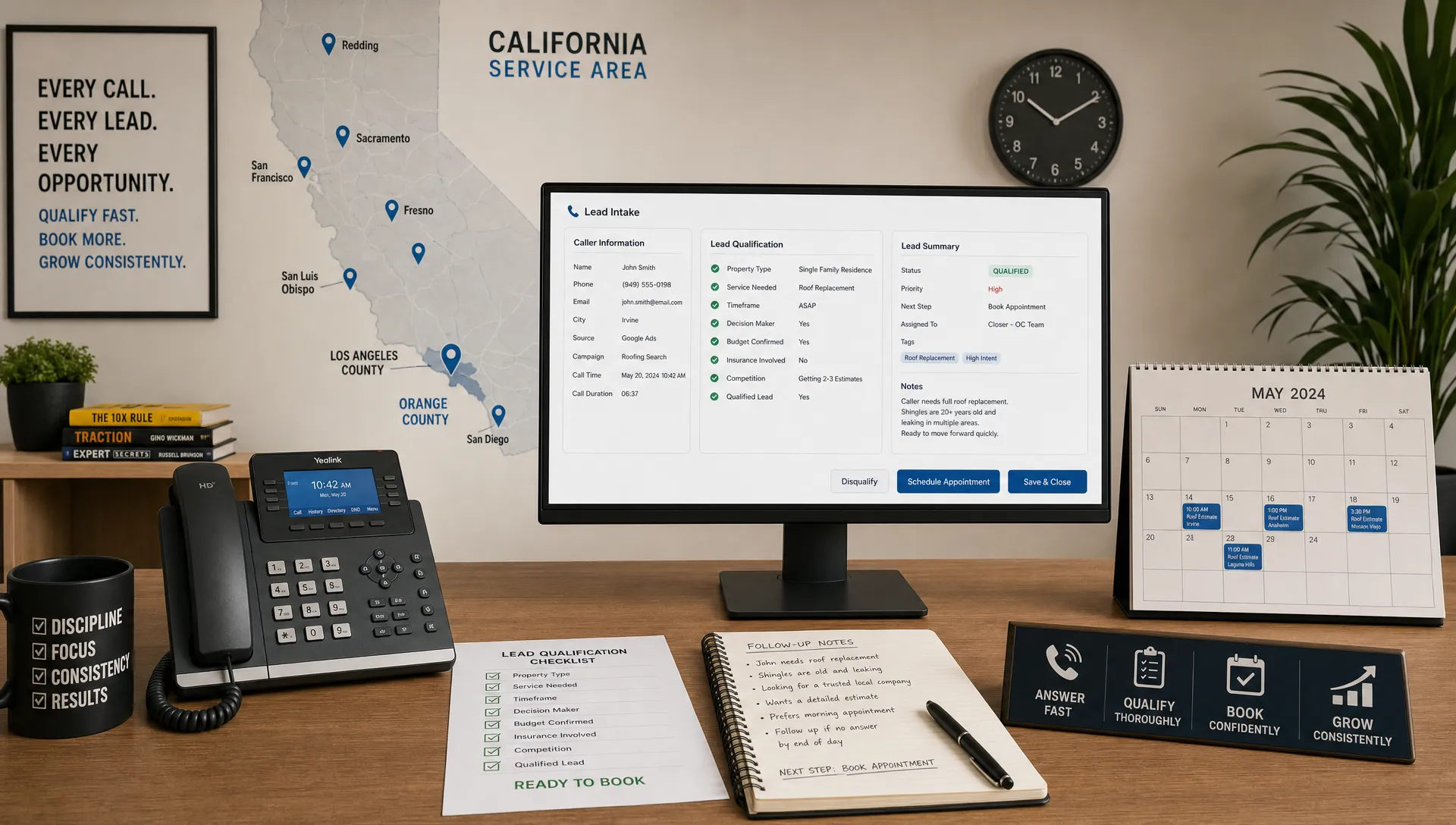
Qualification should help the prospect, not interrogate them. The right questions depend on the business, but they usually cover fit, urgency, location, and next-step readiness.
For a contractor, useful questions may include service type, property location, urgency, and whether the issue is repair, replacement, or maintenance. For a medical, dental, or legal practice, the system may need to clarify service category, preferred location, timeline, and whether the inquiry should be routed to intake, scheduling, or a specialist.
The key is to avoid two extremes. If you ask too little, your calendar fills with poor-fit calls. If you ask too much, motivated prospects abandon the process. A strong lead solution finds the middle ground.
Follow up persistently and professionally
Many booked calls happen after the second, third, or fourth touch. Prospects get distracted. They compare options. They need to talk to a spouse, office manager, or decision maker. A single unanswered call should not end the opportunity.
Follow-up should be persistent, but it should not feel robotic. Messages should reference the prospect’s need, location, timing, and next step. If AI is used to assist with outreach copy, the language still needs human judgment. Resources that examine AI-writing detection and humanization can be useful reminders that automated language often fails when it sounds generic, unnatural, or disconnected from the reader’s intent.
For businesses that want this managed end to end, Kell’s Profit Accelerator is designed to support intelligent prospecting, personalized outreach, persistent follow-up, and booking with qualified prospects.
What to measure if you want booked calls, not vanity leads
If your lead solution is working, you should be able to see it in the numbers. That does not mean drowning in dashboards. It means tracking the metrics that connect marketing activity to conversations and revenue opportunities.
Start with the basics. How many calls came in? How many were answered? How many were qualified? How many became booked appointments or consultations? How many showed up? How many became customers or patients?
The most useful reports often expose uncomfortable truths. A campaign may be producing calls, but half may be outside your service area. A website may be generating forms, but the team may be responding too slowly. A front desk may be answering every call, but not booking the next step clearly.
| Metric | Why It Matters | What Improvement Usually Indicates |
|---|---|---|
| Missed call rate | Shows how much demand is being lost before conversation | ↑ Better coverage and call handling |
| Speed-to-lead | Measures how quickly prospects hear from you | ↑ Higher contact and qualification rates |
| Qualified call percentage | Separates real opportunities from noise | ↑ Better targeting and intake |
| Booked-call rate | Shows whether interest becomes scheduled action | ↑ Stronger scripting and follow-up |
| Show rate | Reveals whether booked prospects are prepared and committed | ↑ Better reminders and expectation setting |
| Cost per qualified booked call | Connects spend to business outcomes | ↑ Smarter channel and budget decisions |
For Orange County contractors, this can change how marketing decisions are made. Instead of asking, “Which ad got the most clicks?” the better question becomes, “Which source produced the most qualified booked calls in our target cities?”
For multi-location practices, the same thinking applies by office location. A dental group may learn that Irvine inquiries book at a higher rate than Los Angeles inquiries. A legal firm may discover that certain neighborhood pages produce fewer leads but better consultations. A medical practice may find that follow-up timing has a larger impact than ad spend.
How AI search changes the lead solution conversation
Search is no longer just a list of blue links. Prospects now ask Google AI results, ChatGPT, Perplexity, Siri, Alexa, and other assistants for recommendations. These platforms look for clear entities, trusted signals, consistent information, and helpful answers.
That means businesses cannot rely only on a single landing page or a paid ad. They need a digital presence that makes them easy to understand and easy to recommend. This includes consistent business information, location relevance, service clarity, reviews, structured content, and authority signals across the markets they serve.
For a Laguna Beach remodeler, that might mean building authority around coastal home renovations, permitting concerns, and service areas like Laguna Niguel, Dana Point, and Newport Coast. For an HVAC company in Anaheim, it might mean content and proof tied to emergency service, maintenance, replacement, and nearby cities. For a practice with locations in San Jose, Oakland, and San Mateo, it might mean making each office distinct enough for both people and AI systems to understand.
The lead solution of 2026 is not just a CRM or an ad campaign. It is an integrated system that helps prospects find you, trust you, reach you, and commit to a booked call.
Choosing the right lead solutions partner
When evaluating a partner, look beyond promises of more leads. Ask how the system handles the moments where revenue is usually lost.
A strong partner should be able to explain how they will improve local visibility, capture calls, qualify prospects, follow up, track booked calls, and refine the system over time. They should also be honest about fit. Some businesses need better offer clarity before outreach. Others need call handling before more advertising. Others need local authority before they can compete efficiently in paid channels.
Use these questions as a practical filter:
- Does the solution focus on booked calls, not just form fills or raw leads?
- Can it support your real service areas across Orange County or California?
- Does it help capture after-hours and overflow calls?
- Does it qualify prospects before they consume sales time?
- Does follow-up feel personal, relevant, and brand-safe?
- Can you see which channels produce qualified booked conversations?
- Does the strategy support AI search visibility as well as traditional search?
If the answer is no, the system may create more activity without solving the real revenue problem.
Frequently Asked Questions
What are lead solutions for local businesses? Lead solutions are systems that help a business generate, capture, qualify, follow up with, and book prospects. For local contractors and professional practices, the best solutions focus on turning high-intent inquiries into scheduled calls or consultations.
Why do booked calls matter more than raw lead volume? Raw lead volume can include unqualified, duplicate, or low-intent inquiries. Booked calls show that a real prospect has taken the next step, which makes it easier to connect marketing activity to revenue opportunities.
How can contractors reduce missed opportunities? Contractors can reduce missed opportunities by answering calls faster, using after-hours call capture, qualifying inquiries by service and location, and following up persistently with prospects who do not respond immediately.
Do professional practices need a different lead solution than contractors? Yes. Medical, dental, and legal practices often need more structured intake, location routing, compliance-aware messaging, and appointment preparation. The same principles apply, but the qualification process is usually different.
How does AI search affect lead generation? AI search platforms increasingly recommend businesses based on clarity, authority, relevance, and trust signals. Businesses that want more qualified calls need to make their services, locations, expertise, and proof easy for both people and AI systems to understand.
Turn missed opportunities into booked conversations
If your business is getting calls but losing prospects, more traffic is not always the first answer. You may need a stronger system between visibility and revenue.
Kell Web Solutions helps Orange County and California businesses build lead solutions that capture demand, qualify prospects, and move real opportunities into booked calls. For contractors, multi-location practices, and service businesses that depend on local trust, the next stage of growth starts with closing the gaps where opportunities are currently disappearing.