
The Top Local SEO Agencies in San Jose

July 27, 2026


San Jose is Silicon Valley's capital — and one of the most competitive local search markets in the country. Among America's ten largest cities, it has over 1 million residents. Tech, home services, and healthcare businesses all compete for the same three map pack spots.


The problem isn't finding agencies that claim to do local SEO. Finding ones that truly understand this market is harder. Generic national platforms apply the same templates here as they do in smaller cities — and that doesn't work in Willow Glen, Almaden Valley, or downtown San Jose.


San Jose has several strong agencies built for exactly this challenge. Some are Silicon Valley institutions with long operating histories. Others bring specialist verticals or AI-era capabilities that set them apart.


What are the best local SEO agencies in San Jose?


This guide covers five agencies: Kell Web Solutions, Jives Media, Spectrum Group Online, Lockedown SEO, and Direction.com. Kell leads with 20+ years of California market expertise, transparent flat-rate pricing, and a unique hyperlocal feeder network. Jives Media is Forbes-recognized with five Clutch Agency of the Year wins.


Spectrum Group Online is a data-first Google and Bing Partner based in San Jose since 2011. Lockedown SEO is the Bay Area specialist for manufacturers, industrial companies, and contractors. Direction.com rounds out the list as the top option for healthcare and medical practices.


SEO Agency Comparison Table
Agency Starting Price Best For Key Differentiator Free Consultation
Kell Web Solutions $600/mo + $600 setup Home services, California SMBs Local SEO + AEO + hyperlocal feeder network Yes — free strategy call
Jives Media ~$1,500/mo Full-service San Jose businesses Forbes-recognized, 5X Clutch Agency of the Year Yes
Spectrum Group Online Custom Data-focused SMBs, B2B Google & Bing Partner, data-first approach Yes — free strategy call
Lockedown SEO Custom Manufacturers, contractors Silicon Valley specialist, white-hat only Yes — free consultation
Direction.com ~$2,500+/mo Dental and healthcare practices Healthcare SEO specialist, 828M+ in client revenue Yes — free proposal

1. Kell Web Solutions: California's Local SEO and AEO Specialist

Quick note: Kell Web Solutions is our own agency. We think it belongs here — but we'd say that, wouldn't we?

Kell Web Solutions is based in Laguna Beach with 20+ years of California market experience. Their Local SEO Mastery is a fully managed local search program covering GBP management, citation consistency, keyword research, on-page optimization, and two custom blog posts per month. They also post to GBP once a week — a ranking signal most agencies skip.


San Jose is a named target market in Kell's Northern California footprint. Their core premise: a single well-optimized website is no longer enough. The Hyperlocal Authority Builder deploys a distributed feeder site network, creating entity signals that AI search cannot ignore.


Founder Gregg Kell — a published author and 20-year marketing veteran — is on every client account. Client relationships at Kell commonly run 15–20 years. That compounding authority is hard to replicate when cycling through agency account managers each year.


Why it stands out


The Hyperlocal Authority Builder is unique in this field. It builds keyword-rich feeder sites targeting specific San Jose neighborhoods and service areas. For an HVAC company, that means entity signals across Willow Glen, Evergreen, and Silver Creek — not just one domain hoping Google infers your coverage area.


The AEO service adds another layer. As customers increasingly use ChatGPT and voice assistants to find local services, Kell's infrastructure positions clients as the cited answer. Pricing is also published directly — no discovery call required to learn what you'll pay.


Pricing structure


  • Local SEO Mastery: $600 setup (one-time) + $600/month recurring
  • Hyperlocal Authority Builder — Start: $500/month (1 feeder site + 1 blog post/month)
  • Hyperlocal Authority Builder — Grow: $1,000/month (1 feeder site + 4 blog posts/month)
  • AEO Essentials: $500 setup + $500/month
  • AEO Pro: $1,000 setup + $1,500/month


Services stack cleanly for San Jose businesses wanting local SEO, hyperlocal content, and AI search coverage combined.


The good and the not-so-good


Pros:

  • Transparent flat-rate pricing — no hidden minimums or media spend markups
  • Weekly GBP posting included — uncommon at this price point
  • Hyperlocal Authority Builder: distributed feeder network no other agency in this list offers
  • Gregg Kell is directly on every account — no rotating junior managers
  • 20+ years of California market experience, with San Jose in the named target geography

Cons:

  • Small boutique team — not suited for large enterprise rollouts
  • Focused exclusively on California
  • No paid media offering — organic and local authority only


Client base


Kell Web Solutions serves HVAC companies, glass businesses, neurofeedback practices, and professional services firms — many for 15+ years. One HVAC client noted that Gregg Kell's strategy meant his business "hasn't paid one red cent for pay-to-play advertising in 7 (almost 8) years — considering we used to pay Google more than $5,000 per month to be found."


2. Jives Media: San Jose's Award-Winning Full-Service Agency


Jives Media is headquartered at 75 E Santa Clara St in downtown San Jose — physically inside the market it serves. Jay Ives founded the agency, which is Forbes-recognized and has won Clutch's Agency of the Year five times. Their local SEO work sits within a full-service offering — paid ads, social media, web design, and email marketing — all handled in-house.


The team operates inside Silicon Valley's competitive landscape daily. They understand the difference between ranking in Almaden versus Berryessa — not just in theory, but in practice. 100% of Clutch reviewers commend their project management; 90% specifically highlight communication quality.


Client results back up the recognition. One San Jose client reported a 95% organic traffic jump from content marketing work. Another saw an 80% increase in new prospective clients.


Why it stands out


Jives Media's strength is combining deep San Jose market knowledge with data-driven strategy execution. They don't just optimize GBP profiles and call it done — their team builds content strategy, link profiles, and on-page structure that compounds over time. Paid channels can be layered on top for faster results alongside organic growth.


Their in-house model matters. Many agencies claim local expertise but outsource work offshore. Jives keeps everything in-house, which means the team optimizing your GBP is the same one writing your local landing pages.


Pricing structure


Retainers at Jives Media typically start around $1,500–$4,000/month, depending on service scope and market competitiveness. The average hourly rate is $100–$149/hr with a minimum project size of $1,000+. Pricing is custom-scoped based on your goals, location count, and which channels are included.


A free initial consultation is available before any commitment.


The good and the not-so-good


Pros:

  • Downtown San Jose HQ — physically rooted in the market they serve
  • Forbes-recognized, 5X Clutch Agency of the Year — documented peer validation
  • 100% client approval on project management and delivery across reviews
  • Full-service in-house team: no offshore outsourcing, no vendor handoffs
  • Layered approach: organic SEO, paid media, and content strategy under one roof

Cons:

  • Retainer pricing ($1,500+/month) is above foundational local SEO options
  • Full-service model may be more than single-location SMBs need
  • No dedicated AEO or AI-era search product for LLM-driven queries


Client base


Jives Media serves businesses across San Jose and Silicon Valley — B2B companies, local service providers, and consumer brands seeking sustained digital visibility. Their client roster spans tech-adjacent companies and professional services businesses that want compounding results, not a ranking spike that fades in 90 days.


3. Spectrum Group Online: San Jose's Data-First SEO Agency


Massimo Paolini and Alyson Harrold founded Spectrum Group Online in 2011, headquartered in San Jose. They are a Google Partner, Bing Partner, and Clutch Verified Agency. Every engagement starts with a deep analysis of traffic data, SEO performance, or ad spend before recommendations are made.


Their local SEO services cover GBP optimization, citation management, schema markup, and locally targeted content. Schema SEO is a specific differentiator — most agencies skip structured data beyond basic Business schema. Spectrum builds comprehensive markup using structured data standards that help AI systems and search engines accurately surface their clients.


Client work spans law firms, medical manufacturers, nonprofits, and B2B startups. United Way Bay Area, UC Berkeley's Haas School of Business, and a global logistics company all appear in their portfolio. That breadth reflects genuine versatility — not a single-vertical shop trying to expand.


Why it stands out


Spectrum's data-first model means nothing gets recommended without measurable backing. One client reduced cost per conversion from $200 to $35–$40 after Spectrum rebuilt their Google Ads structure and aligned it with on-page SEO. A B2B company increased qualified leads by 30% from website and paid search combined.


Their transparency is rare in this industry. Clients consistently note they explain the "why" behind every recommendation in business terms — not jargon. They also publish pricing tiers for their audits, which is uncommon in the agency market.


Pricing structure


Client investments at Spectrum Group Online range from $2,500 to $120,000 annually depending on scope. The minimum project size is $1,000+, with an average hourly rate of $200–$300/hr. Audit pricing is published on their website. A free strategy call is available before any engagement.


The good and the not-so-good


Pros:

  • San Jose HQ since 2011 — 15+ years serving Silicon Valley businesses
  • Google Partner, Bing Partner, and Clutch Verified — documented credentials
  • Data-first: every recommendation tied to measurable metrics
  • Schema SEO capability beyond what most local agencies offer
  • Audit pricing published — no mystery pricing to navigate

Cons:

  • Hourly rate ($200–$300/hr) is higher than some competing options
  • Full-service scope may exceed what a straightforward local SEO client needs
  • No dedicated hyperlocal feeder site strategy for neighborhood-level dominance


Client base


Spectrum Group Online works with San Jose and Bay Area clients across verticals: law firms, B2B manufacturers, nonprofits, startups, and consumer brands. They are best suited for SMBs and professional services firms that want to understand their data and measure their strategy — not just trust it blindly.


4. Lockedown SEO: Silicon Valley's Contractor and Industrial Specialist


Lockedown SEO has been serving San Jose and Silicon Valley since 2012. Where most agencies in this list are generalists, Lockedown specializes in two segments. Those are manufacturing and industrial companies, and local home services contractors.


For HVAC companies, roofers, plumbers, and fabricators in the San Jose area, that specialization matters. Generic SEO strategy doesn't map to a manufacturing buyer's journey — Lockedown's work does. Their process starts with a human-curated audit assessing the website, competitive landscape, and ranking gaps.


Work includes on-page content, link building, local citation management, and ranking reports delivered every two weeks. All work is overseen by the founder. Every professional on the team is U.S.-based — no offshore subcontracting.


Why it stands out


Lockedown's industrial and contractor specialization is uncommon. Most local SEO agencies optimize for restaurants, dentists, or e-commerce. When a San Jose HVAC or fabrication company walks into a general agency, they often get template content that doesn't speak to their buyers.


Their published case studies demonstrate results in exactly these verticals. A painting contractor case study shows significant business growth in a major market within a short campaign window. A manufacturing C-level executive noted the agency "developed a game plan for us, executed it in the projected time frame and got us terrific results."


Pricing structure


Lockedown SEO does not publish pricing. Engagements are scoped after an initial consultation covering your market, competition, and goals. Based on their positioning as a Silicon Valley specialist, expect mid-range pricing for an expert boutique agency.


A free consultation is available before any commitment. That conversation typically starts with a review of your current rankings and a realistic overview of what a campaign would require.


The good and the not-so-good


Pros:

  • Founded 2012 — over a decade of Silicon Valley SEO experience
  • Specialist focus: manufacturing, industrial, and home services contractors
  • Bi-weekly ranking reports — faster feedback loop than monthly-report agencies
  • White-hat only — no tactics that risk Google penalties
  • All work overseen by the founder, done by U.S.-based professionals

Cons:

  • No published pricing — requires a consultation to get specifics
  • Specialization means less suited for retail, professional services, or healthcare verticals
  • No dedicated AEO or AI-era search service for voice and LLM-driven queries


Client base


Lockedown SEO serves manufacturers, industrial companies, and home contractors across San Jose, Sunnyvale, Mountain View, Santa Clara, and Milpitas. Their client base includes national manufacturers seeking organic B2B traffic and local contractors targeting city-level map pack rankings in the South Bay.


5. Direction.com: The Healthcare SEO Specialist for San Jose Practices


Direction.com is a healthcare-focused SEO agency that has generated over $828 million in client revenue, per their own reporting. They serve dental practices, dermatologists, plastic surgeons, mental health providers, and telehealth brands. For San Jose medical and dental practices, Direction brings the most specialized local SEO knowledge in this list.


Their approach runs four phases: research and strategy, technical SEO foundation, execution, and ongoing optimization. Local SEO is core — they syndicate listings to 70+ directories including GBP, Apple Maps, Yelp, and Yellowpages. For San Jose practices in Willow Glen, Rose Garden, or Santana Row, that neighborhood-level citation work creates a real visibility edge.


Clutch reviews rate Direction.com at 5/5 stars. Craft Health Memberships President Stephen Stearman said: "Since joining Direction, we have increased our sales by $2.5M in just the first year of signing up." Diligent Exterior Remodeling saw 322% web traffic growth and 477% ROI — outcomes reflecting technical depth and content strategy, not just GBP cleanup.


Why it stands out


Direction's healthcare specialization runs deeper than most agencies. They understand patient search behavior, medical E-E-A-T signals, and the compliance considerations that healthcare content requires. A general agency rarely has that institutional knowledge — and content that ignores compliance creates real risk for practices.


Their local landing pages capability is particularly strong for multi-location San Jose groups. Dental practices or medical chains with offices in Santa Clara, Sunnyvale, and Fremont benefit from coordinated, non-duplicate pages built for each service area. They also provide a 6-month content roadmap at campaign launch, covering the full patient journey from awareness to appointment.


Pricing structure


Direction.com does not publish standard pricing. Based on client reports, engagements typically start around $2,500/month and scale with scope. A free proposal is available, including a diagnostic review of your practice's current online visibility before any commitment.


The good and the not-so-good


Pros:

  • 828M+ in client revenue generated — documented results at scale
  • Healthcare SEO specialists — deep knowledge of patient search behavior and medical compliance
  • 5/5 stars on Clutch — consistent client satisfaction across reviews
  • Multi-location local landing pages for Bay Area practices with multiple offices
  • 6-month content roadmap provided upfront — strategic clarity from day one


Cons:

  • Healthcare-only focus — not suited for home services, retail, or B2B businesses
  • Starting price (~$2,500+/month) is above foundational local SEO options
  • No AEO or hyperlocal feeder site strategy for AI-driven search visibility


Client base


Direction.com serves dental practices, dermatologists, plastic surgeons, mental health providers, and healthcare organizations. For San Jose medical and dental practices that want patient acquisition through local SEO — not just a well-designed website — Direction is the most specialized option in this list.

Frequently asked questions


What does a local SEO agency actually do for a San Jose business?

A local SEO agency optimizes your business to appear in Google's map pack and local search results when nearby customers search for your services. Core work includes GBP management, citation consistency across directories, local keyword targeting, and ongoing content creation. The goal is to be the first result when someone in Willow Glen, Almaden Valley, or downtown San Jose searches for what you offer.


How much does local SEO cost in San Jose?

Local SEO in San Jose ranges from $600/month for foundational services (Kell Web Solutions) to $2,500–$4,000+/month for full-service or specialized campaigns. Spectrum Group Online and Lockedown SEO scope pricing to the client's goals and competitive intensity. The right budget depends on your market, service area count, and what's bundled into the program.


How long does it take to see local SEO results in San Jose?

Most campaigns show meaningful movement in GBP views and map pack rankings within 60–90 days of consistent optimization. Full competitive dominance in dense San Jose markets — downtown, North San Jose, or Willow Glen — typically takes 6–12 months. Results compound over time, which is why long-term agency relationships consistently outperform short-term campaign sprints.


What's different about local SEO in San Jose versus other California cities?

San Jose's market combines Silicon Valley's tech density with the service business landscape of a major metro area. Local businesses compete against well-funded tech-adjacent brands, regional chains, and national platforms — all in the same map pack. Local SEO here requires stronger entity signals, more precise structured data, and better content strategy than smaller California markets.


Do I need local SEO if I'm already running Google Ads?

Yes. Google Ads stop the moment you stop paying. Local SEO builds organic visibility that compounds without ongoing ad spend. One Kell client eliminated $5,000+/month in Google Ads entirely after years of local SEO authority building — that's durable organic visibility versus paid dependency.


Should I hire a local San Jose agency or a national brand?

Local and regional agencies bring neighborhood-level knowledge that national platforms can't replicate. They understand the competitive difference between Almaden Valley and Berryessa firsthand. National platforms manage thousands of accounts and often assign junior managers with no market context.


Conclusion: Pick the Right Local SEO Partner for Your San Jose Business


Most San Jose businesses have already tried local SEO — and been disappointed. They paid an agency, got a report they couldn't read, and saw no change in calls. That's not a local SEO problem. It's an agency problem.


The fix is an agency that starts with your actual visibility gaps, not a template. One that posts to your GBP weekly, builds neighborhood-level authority, and measures results you can verify. In a market as competitive as Silicon Valley, that consistency compounds fast.


If your business depends on local customers finding you first, start with a free strategy call — Gregg Kell will tell you exactly where your San Jose visibility stands and what it would take to fix it.

September 28, 2026
In 2026, a website is not just something prospects look at after they find you. It is one of the primary sources search engines, AI assistants, map platforms, and voice tools use to decide whether your business is understandable, credible, local, and worth recommending. That is why SEO website design matters more now than it did in the old blue-link search era. For a roofing company in Irvine, an HVAC contractor in Anaheim, a dentist with locations across San Diego, or a law firm serving Sacramento neighborhoods, the website has to do more than look professional. It must clearly explain who you are, what you do, where you do it, why you are trustworthy, and what a customer should do next. The AI era rewards websites that reduce confusion. If your site buries service details in vague copy, hides location signals, loads slowly on mobile, or presents testimonials and credentials in ways machines cannot interpret, you are making it harder for both people and answer engines to choose you. What SEO Website Design Means Now Traditional web design often focused on visual polish: brand colors, modern layouts, image quality, and a smooth user experience. Those still matter. But AI-era design adds another layer: machine readability. SEO website design is the practice of building a website so humans, search engines, and AI systems can all understand it quickly. That includes content structure, technical performance, internal linking, schema markup, accessibility, local trust signals, and conversion paths. For local service businesses, the goal is not simply to “rank.” The goal is to be recognized as a relevant local authority when someone asks a high-intent question like: “Who repairs emergency AC systems near Laguna Niguel?” “Best roof replacement company in Huntington Beach with financing options.” “Pediatric dentist near Irvine open on Fridays.” “Estate planning attorney in San Jose for small business owners.” Those questions are not just keywords. They are buying moments. Your website design either supports those moments or creates doubt. AI Search Makes Clarity a Competitive Advantage In classic SEO, a business could sometimes win by publishing enough keyword-focused pages, collecting backlinks, and optimizing title tags. Those factors still have value, but AI-powered search introduces a stricter test: can the system confidently extract an answer from your digital presence? Google, ChatGPT, Perplexity, voice assistants, and other AI-driven tools depend on structured, consistent, and trustworthy information. They look for signals that help them identify entities, relationships, expertise, service areas, and user intent. If your website is beautiful but ambiguous, it may not be a strong source. Google’s own guidance on creating helpful, reliable, people-first content points in the same direction: content should demonstrate expertise, answer real user needs, and avoid being built only for search engines. In the AI era, the best websites serve both readers and retrieval systems by making useful information easy to find. This is where SEO website design becomes strategic. Design is not decoration. Design is how your business identity is packaged for discovery, trust, and action.
September 28, 2026
Is your reputation "AI-optimized," or just good? Most Orange County business owners have never asked that question. They check their star rating once a quarter and move on. That habit made sense five years ago. A high star average was the whole game, and a slow trickle of reviews was fine. It isn't fine anymore. The judge changed, and nobody sent a memo. AI Overviews, ChatGPT, and Perplexity don't read a star rating the way a person does. They score it against a pattern instead. Semrush's analysis of 200,000 keywords found the top organic result showed up in only 46% of desktop AI Overviews. On mobile, that figure drops to 34%. Ranking well and getting cited by an AI model are no longer the same contest. A business can dominate Google's map pack and still vanish the moment a prospect asks who's best. That gap is exactly what Kell Web Solutions built its newest service to close. Orange County local service managers feel it especially hard. The county's home services and professional practice market is dense. Prospects now compare options through a phone screen before ever picking up the phone. Whoever the model trusts first usually gets the call. Reputation just became a data feed, not a scoreboard Kell Web Solutions has watched this shift for two decades from its Laguna Beach home base. The firm calls the underlying change the Retrieval Economy. Customers don't browse a list of links anymore. They ask a single question and expect one confident answer back. Kell's own research points to why that matters right now. Search traffic is down 15% year-over-year across the industries it tracks. Local Services Ads now cost $60 or more per qualified call. Voice assistants already field most "emergency plumber" and "HVAC repair" queries without a single website visit. Eighty-five percent of missed calls never get returned by the customer. Every one of those numbers points the same direction. The businesses an AI model trusts enough to name are capturing calls the rest never even see arrive. Answer engines don't take a star average at face value, either. They read reviews as a stream of evidence. Then they look for a pattern strong enough to trust before recommending a business by name. Three patterns carry the most weight in that judgment: Recency — how fresh your feedback is Sentiment consistency — how uniform the tone reads across platforms Resolution speed — how fast complaints get answered Kell Web Solutions calls these confidence signals. Businesses feeding them deliberately get named first, while businesses collecting reviews sporadically become background noise an AI model quietly discounts. That framing fits the firm's broader philosophy: durable authority, not a short-term ranking spike. A spike fades the moment an algorithm updates again. A confidence signal, fed on a schedule, compounds instead of decaying. That's the entire bet behind treating reputation as infrastructure rather than an occasional chore. The three confidence signals AI models actually weigh Signal one: recency Old praise decays fast in an AI model's eyes. BrightLocal's Local Consumer Review Survey found 74% of consumers only consider reviews written in the last three months. Forty-four percent go further, flagging reviews from the last month alone as critical. A glowing five-star review from 2024 barely registers against that bar today. That's a real problem for businesses that still run review pushes twice a year. A stale portfolio reads to an AI model like a business that quietly stopped mattering. Recency isn't about erasing old praise. It's about making sure fresh evidence arrives faster than old evidence fades. Signal two: sentiment consistency A single glowing testimonial means very little on its own. The same BrightLocal research found 56% of consumers prioritize reviews "backed up by other reviews with similar sentiment." Forty-six percent specifically value reviews that describe a positive experience in real detail. AI models apply that same corroboration logic at scale. They check Google, Yelp, Facebook, and industry directories for agreement. One five-star review surrounded by mixed feedback elsewhere doesn't build confidence — it builds suspicion. Consistency across every platform is what actually moves an AI model's judgment. A business reading 4.6 stars everywhere looks more trustworthy than one at 4.9 on Google and 3.5 elsewhere. Signal three: resolution speed How fast you respond to a complaint now carries real, measurable weight. BrightLocal found 32% of consumers expect a response within one day, sharply up from 18% a year earlier. Eighty percent say they're more likely to use a business that responds to every review it gets. Forty-two percent actively avoid businesses that ignore reviews altogether. Generic, copy-pasted replies don't fully solve this either. Fifty percent of consumers said templated responses put them off, even when a reply technically exists. Speed and sincerity both get scored here. An AI model reads a fast, specific response as evidence the business is actively managed, not merely reviewed. Why manual reputation management can't keep pace Most Orange County businesses still manage reviews the old way. Someone checks Google Business Profile when they remember, replies when there's time, and hopes the average holds. That approach quietly fails all three confidence signals at once. Sporadic outreach means feedback ages between bursts, so recency scores dip in the gaps. Inconsistent monitoring means a bad thread on Yelp can sit unanswered for weeks. By the time anyone notices, an AI model has already logged the silence as a data point. A business owner juggling five directories by hand can't hit a one-day response window. Not consistently, not across every platform, not every week of the year. The result isn't necessarily a bad reputation. It's often an invisible one instead. Reviews exist, but no AI model trusts the pattern enough to vouch for the business unprompted. That distinction matters more than most owners realize. A 4.8-star business with erratic signals can still lose the recommendation. It can lose it to a lower-rated competitor running a disciplined signal loop instead. Hiring someone in-house to watch five directories daily rarely pencils out for a small business. The math usually favors a system built to do exactly that on a schedule, without a dedicated headcount. A quick self-audit before you spend a dollar Most owners can check their own exposure in about ten minutes. A few patterns show up again and again among Orange County businesses that haven't looked yet. You've never asked an AI model directly. Try ChatGPT or Perplexity with your category and city, then see who gets named instead of you. Your review dates cluster around a campaign. A burst last spring, then silence, reads as staleness to a model scoring recency. Your ratings don't match across platforms. A 4.9 on Google next to a 3.6 on Yelp signals inconsistency, not just a bad week. Unanswered reviews sit for weeks. Even one ignored complaint from months ago can undercut an otherwise strong pattern. Your replies all read the same. Copy-pasted responses fail the sincerity test just as often as no response at all. Any single one of these is fixable in an afternoon. Stacked together, they're what quietly keeps a business off an AI model's shortlist. None of them require expensive tools to spot. They require ten honest minutes and a willingness to see your business the way a machine does. Inside Kell's AI Confidence Builder Kell Web Solutions built a service specifically to close that gap: the AI Confidence Builder . Its methodology is described in three words — "Scan. Fix. Prove." The scan stage establishes a baseline score across five distinct layers. Entity Clarity confirms your business identity through machine-readable data. That approach mirrors the structured-data method Google's own documentation recommends for local business listings. Machines shouldn't have to guess your name, address, or hours. Citation Architecture checks whether your content is quotable and answer-focused, not just keyword-heavy. Distribution measures how far your verified presence reaches across AI-crawled platforms and directories. Earned Media & Trust pursues independent, third-party editorial coverage. That's proof an AI model weighs more heavily than anything a business claims about itself. Monitoring then tracks all four of those metrics on an ongoing basis, not just once. The fix stage remediates whatever gaps the scan flags, one layer at a time. The prove stage rescans and validates the improvement afterward. Gains get measured against the original baseline, never simply assumed. Pricing here is published, not hidden behind a "contact us" form. Confidence Core starts at $1,000, financeable at $497 down plus $197 a month for three months. Confidence Build runs $2,000, or $897 down plus $397 a month across four months. Confidence Complete tops the range at $5,000, financeable at $1,497 down plus $705 a month for six months. Every tier includes monitoring across three specific dimensions. Crawl activity verification confirms AI systems are actually reading your updated signals. Citation testing runs direct prompts against ChatGPT, Gemini, and Perplexity to check whether you're actually named. Referral attribution then measures how much real traffic those citations send back. That last piece matters most of the three. It turns the question into a tracked number instead of a guess. Kell's work on AI citation gaps treats visibility the same way — measurable, not assumed. The signal infrastructure that feeds the score A scan is only as useful as the evidence available to score. That's where Review Pops fits into the wider strategy. Review Pops displays verified customer reviews directly on a business's website, refreshed automatically every day. It also collects short video testimonials submitted straight from a customer's phone. Kell's own data on the product notes video testimonials earn 58% more trust than written reviews alone. That's a meaningful gap for any business relying only on text. Video and written proof feed all three signals at once, from the inside out. Fresh submissions improve recency automatically, without a seasonal push. Consistent five-star video and text feedback reinforces sentiment across every platform it reaches. A steady stream of new submissions also gives a business something to answer quickly, every week. Kell pairs that infrastructure with its Reputation Marketing program. It automates review requests by text and email, so feedback arrives on a predictable schedule. Staff training rounds out the loop on the human side. Asking for feedback becomes a habit built into daily operations, not an occasional afterthought. Kell stays deliberately boutique running all of this. Clients work directly with founders Gregg and Debbie Kell, not a rotating account team learning the business from scratch. That matters more while the confidence-signal playbook is still evolving month to month. A larger agency often bolts AI-search language onto an existing SEO retainer without changing how the work actually gets done. None of this replaces genuinely good service. It translates that service into a form an AI model can verify. Then it repeats that verification back to a prospect who's never called before. Who this matters for most right now Home services contractors feel this shift first and hardest. HVAC, roofing, solar, plumbing, and electrical companies lose ground the moment voice search routes a call elsewhere. Multi-location professional practices carry a related risk. Medical, dental, and legal offices competing at the neighborhood level need every location's signals reading consistently. A flagship office with strong reviews can't quietly cover for a satellite location with none. AI models evaluate each address as its own entity, not as one blended average. California businesses chasing rapid geographic expansion face a related version of the same math. Establishing trust quickly in a new market now runs through AI confidence signals, not just local ad spend. The unifying thread across all three groups is simple. Every one of them loses real business the moment they go quiet at the neighborhood level. That happens whether or not their actual service quality ever changed. Picture a Laguna Niguel roofer with genuinely excellent workmanship and fifteen years of loyal clients. Its reviews are real and mostly glowing, but arrive in scattered bursts twice a year. A newer competitor two towns over answers every review within hours and posts fresh video testimonials weekly. When a homeowner asks an AI model who to call after a storm, the newer name gets mentioned first. Reputation quality didn't decide that outcome — signal discipline did. Frequently asked questions Is this the same thing as SEO? No. Traditional SEO targets keyword rankings inside a list of links a person scrolls through. Confidence signals target trust inside an AI model's own judgment about whether to name you unprompted. How often should reviews come in to satisfy the recency signal? Aim for a steady weekly trickle rather than a seasonal push twice a year. BrightLocal's research suggests reviews older than three months carry noticeably less weight today. What happens if my reviews are inconsistent across platforms? An AI model reads mismatched sentiment as a reason for caution, not confidence in you. Closing gaps between Yelp, Facebook, and industry directories usually matters more than one extra five-star review. Can a business with mostly good reviews still fail this audit? Yes, and it happens more often than owners expect. A handful of unanswered complaints from months ago can outweigh dozens of quiet five-star reviews sitting untouched. Resolution speed gets scored on its own, separate from overall sentiment. A great average doesn't excuse a slow, silent response history. Do I need video testimonials, or do written reviews still work? Written reviews still count toward every one of the three signals. Video simply adds an extra trust layer that both AI models and human buyers respond to. How long does it take to see a measurable shift? Most engagements show early movement within the first monitoring cycle, once a full scan-fix-prove loop completes. Durable authority compounds from there as fresh signals keep arriving on schedule. Does this replace traditional AEO work, or sit alongside it? It sits alongside it. AEO structures your site and entity data so AI models can find and understand you. Confidence signals give those same models a reason to trust what they find. One without the other leaves half the judgment unanswered. Which platforms actually get monitored? Google Business Profile and Yelp carry the most weight for most local categories. Facebook, industry-specific directories, and any site an AI model regularly cites round out the picture. The exact mix depends on where your customers already leave feedback today. The bottom line Being a genuinely good business used to be enough on its own. An AI model now wants proof of that before it recommends you over the next name on its shortlist. That proof needs to be recent, consistent, and quickly resolved. It doesn't build itself, and it rarely survives a quarterly review push alone. It has to be fed on a schedule an AI model can actually detect and trust. The businesses building that habit now won't need to catch up later. Stop leaving your digital perception to chance. See exactly how confident an AI model already is in your business, and where the real gaps sit. A short strategy call is enough to find out. Schedule your AI Confidence Audit before a competitor closes theirs first.
September 22, 2026
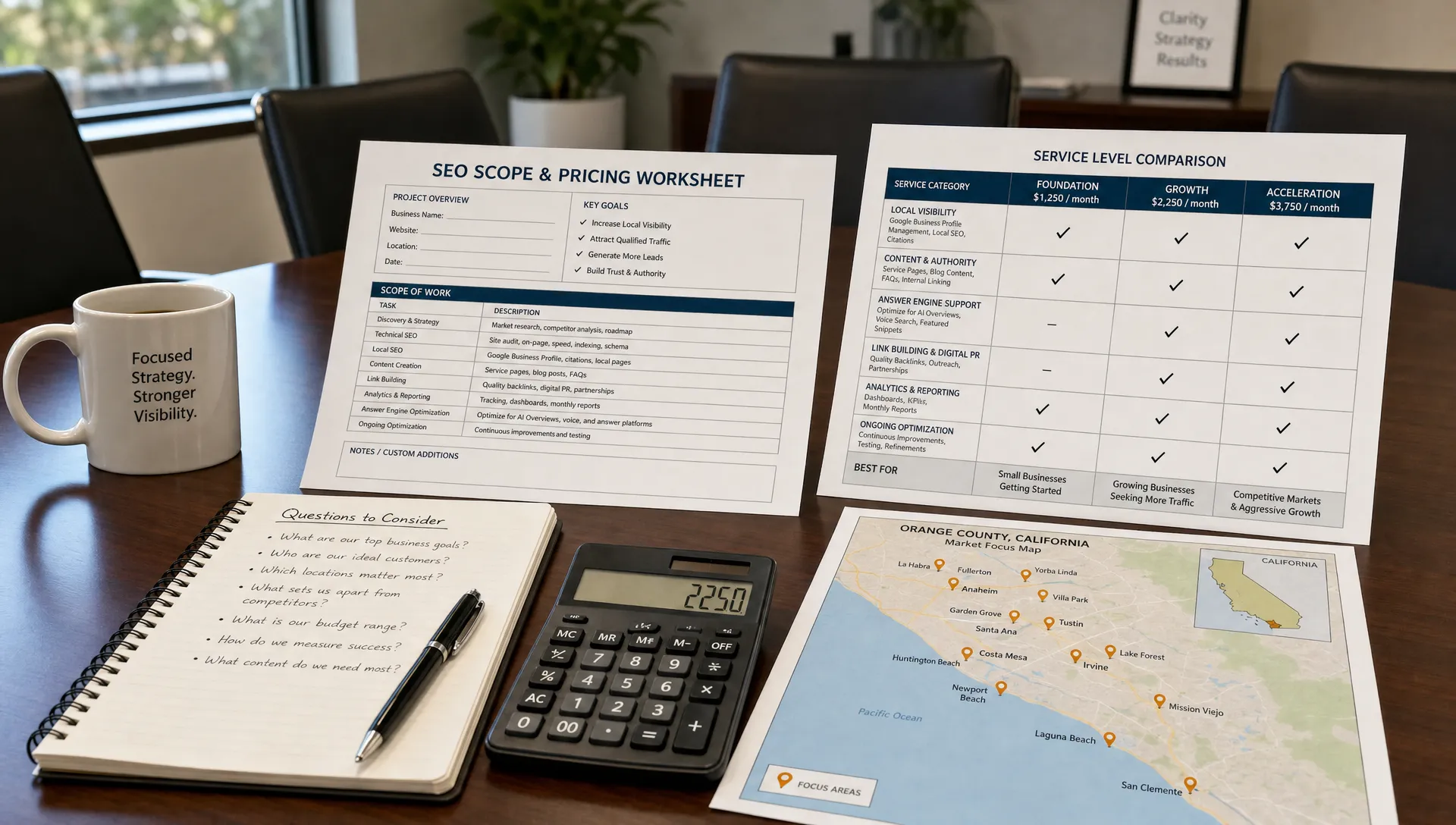
If you run an HVAC company in Irvine, a dental group in Newport Beach, or a law firm with offices in Anaheim and San Diego, SEO agency pricing can feel frustratingly inconsistent. One proposal may be $600 per month. Another may be $4,000. A third may bundle content, Google Business Profile work, AI visibility, and conversion tracking into a larger growth program. Those differences are not automatically good or bad. In Orange County, the right price depends on your market, your service area, your website condition, your competition, and whether you are trying to rank in Google, show up in Maps, and be cited by AI-powered answer engines. The goal is not to find the cheapest SEO agency. The goal is to understand what you are paying for and whether the scope can realistically produce qualified calls, appointments, and revenue. Why SEO agency pricing varies so much in Orange County Orange County is not a single, uniform local market. A remodeler in Laguna Niguel faces a different search landscape than a roofer in Anaheim, a cosmetic dentist in Irvine, or a personal injury attorney targeting Santa Ana and Huntington Beach. Even within the same county, competition can shift dramatically by city, neighborhood, service line, and intent. A small local SEO package may be enough if your website is technically sound, your Google Business Profile is underused, and you only need visibility in one primary city. The price climbs when an agency must fix a weak website, build location pages, clean up citations, publish content, earn authority signals, improve conversion paths, and track results across multiple cities. Search has also changed. Google still matters, but customers now find businesses through Maps, AI Overviews, voice assistants, local packs, business profiles, review platforms, and answer engines. A modern SEO strategy needs to help humans and machines understand who you are, where you serve, what you do best, and why your business is trustworthy. Google's own SEO Starter Guide emphasizes useful content, clear site structure, and helping search engines understand your pages. For local businesses, Google's guidance on improving local ranking also highlights relevance, distance, and prominence. A credible SEO proposal should connect its work to those fundamentals instead of hiding behind vague activity reports. Typical SEO agency pricing models in Orange County Most Orange County businesses will see one of five pricing models: monthly retainers, project fees, local SEO packages, content and authority programs, or hybrid SEO and AEO programs. Retainers are the most common because SEO is ongoing. Search visibility is not a one-time repair. It requires consistent updates, testing, and adaptation as competitors and search platforms change. The ranges below are planning benchmarks, not guarantees. A legitimate agency should quote after reviewing your market, website, Google Business Profile, competitors, and revenue goals.
September 22, 2026
Los Angeles City alone counts nearly 3.9 million residents . The wider metro spreads that number across dozens of business districts. Every one of those businesses runs on a calendar. A packed schedule keeps the lights on. An empty one doesn't stop rent, payroll, or insurance from coming due. Whatever sits between those two outcomes is the booking system. Not every booking tool solves the same problem. A law firm needs something different than a med spa. A real estate team needs something different again than an HVAC company. This guide walks through seven appointment booking services worth considering for LA businesses in 2026. The short version: LA's top appointment booking picks for 2026 Kell Web Solutions is the only pick here that actively fills a calendar through managed AI outreach. The rest organize bookings you already have. Tebra runs practice management for LA medical offices, and Lawmatics automates intake for law firms. Zenoti handles enterprise-grade scheduling for salons, spas, and med spas. ShowingTime coordinates real estate showings across LA's crowded housing market. Workiz books jobs for home service trades, and Thryv bundles scheduling into an all-in-one platform for small business owners.
September 15, 2026
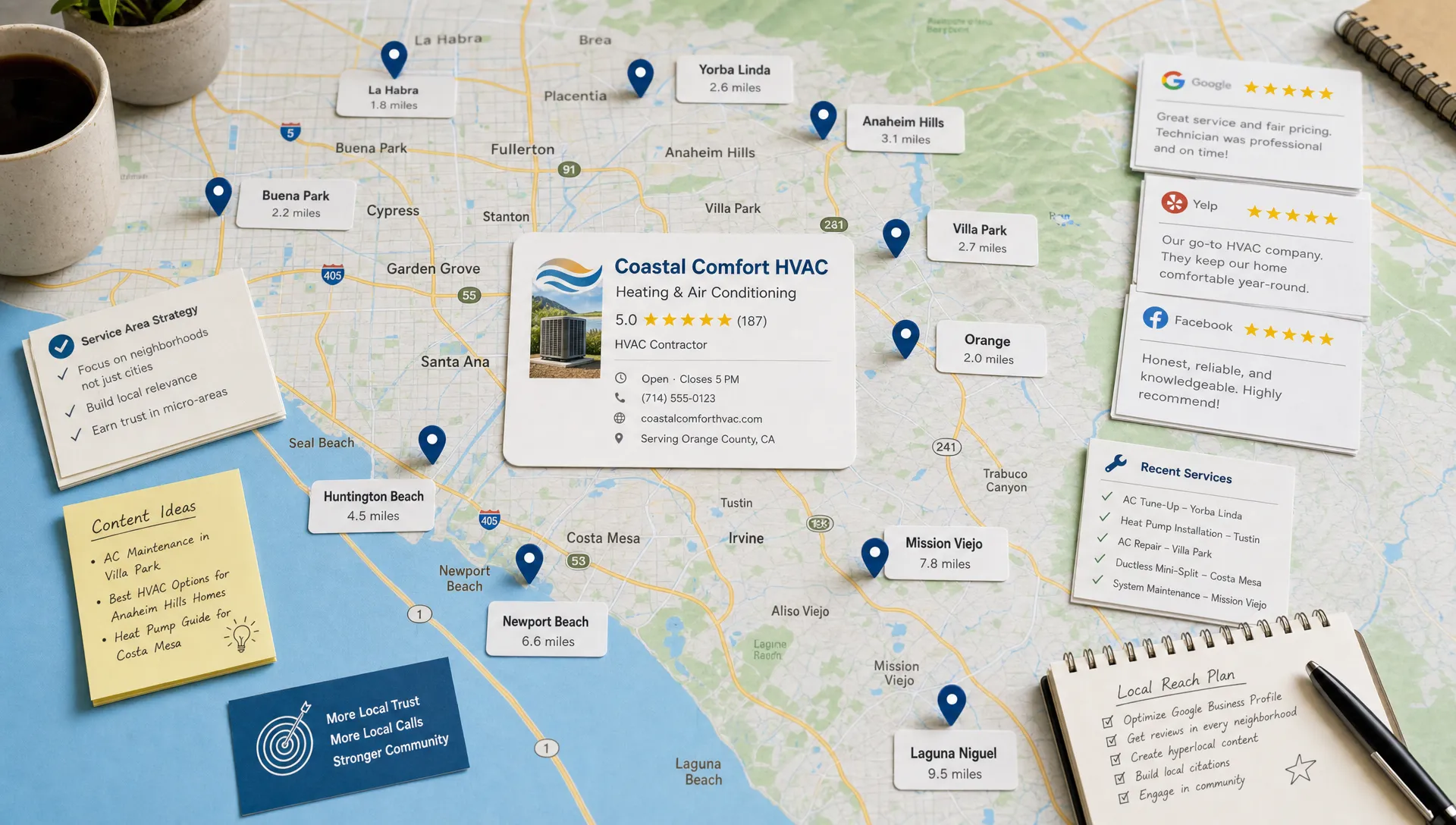
Neighborhood visibility is not the same as “ranking in a city.” A roofing company can appear for “roof repair Orange County” and still miss the homeowner searching from Anaheim Hills. A dental group can rank for “Irvine dentist” and still lose patients in Woodbridge, University Park, or Turtle Rock because the local signals are too broad. That is where a local SEO agency earns its keep. The work is not simply adding city names to pages. It is building enough proof, structure, and local relevance for Google, maps, voice assistants, and AI answer engines to understand where your business belongs, what you do, and why nearby buyers should trust you. For California contractors and multi-location professional practices, neighborhood visibility matters because local demand is fragmented. Search behavior changes from Laguna Beach to Laguna Niguel, from San Diego to San Jose, and from Sacramento to Fresno. The winners are not always the largest companies. They are the companies that make their service area unmistakable. What a Local SEO Agency Means by Neighborhood Visibility Neighborhood visibility means your business is findable and credible at the micro-market level. Instead of only targeting a broad city keyword, your digital presence supports searches tied to neighborhoods, ZIP codes, landmarks, adjacent communities, and service-specific intent. For example, a home services company may need visibility for searches such as “AC repair near Mission Viejo,” “roof leak repair Huntington Beach,” “electrician near Newport Coast,” or “water heater replacement in Santa Ana.” A medical, dental, or legal practice may need to be visible for “dentist near Irvine Spectrum,” “family law attorney in Pasadena,” or “urgent care near Santana Row.” A strong local SEO agency treats each of those searches as a different trust problem. The searcher wants a provider who is close enough, qualified enough, available enough, and proven enough. Search engines want the same thing, but they rely on signals: business data, content, reviews, citations, internal linking, structured data, photos, and location-specific authority. This is why neighborhood visibility is built in layers. One page rarely does the job alone. Google Business Profile, your website, reviews, local mentions, service pages, map signals, and AI-readable content all need to reinforce the same answer: this business is a legitimate local authority for this service in this area. Start With the Money Map, Not the Keyword List A common mistake is beginning with a spreadsheet of keywords before defining the business geography. A better first step is a revenue map. For a contractor, the map should identify where the best jobs actually come from, not just where the business is willing to drive. A plumbing company may technically serve all of Los Angeles County, but its most profitable emergency calls may cluster around Pasadena, Glendale, Burbank, and Northeast LA. An HVAC company may want more replacement jobs in Irvine and Tustin, but fewer low-margin repair calls 40 miles away. For a professional practice, the map should define patient or client catchments. A dental office in Costa Mesa may care about Newport Beach, Irvine, and Huntington Beach, while a legal practice in San Jose may need separate visibility around Willow Glen, Campbell, Santa Clara, and downtown San Jose. A useful neighborhood visibility map includes four inputs: Revenue priority by service line Current ranking and map visibility by location Review density and proof by neighborhood Operational capacity, response time, and service radius Here is how an agency might translate business geography into an SEO plan:
September 15, 2026
For a local business, more traffic is not the same as more revenue. A roofing company in Irvine does not need 3,000 casual visitors from across the country. It needs homeowners in the right neighborhoods, with the right budget, who are ready to schedule an inspection. A dentist in Laguna Niguel does not need generic pageviews. It needs patients nearby who trust the practice enough to call, request an appointment, or ask about availability. That is the real purpose of local SEO for businesses that depend on the phone: not visibility for its own sake, but qualified calls. In California markets like Orange County, Los Angeles, San Diego, San Jose, Sacramento, and Fresno, local search is crowded. Google Maps, AI Overviews, voice assistants, ads, directories, and review platforms all compete for the customer’s attention before they ever reach your website. If your local SEO strategy is still built around rankings alone, you may be measuring the wrong thing. The better question is: when someone nearby has a real problem, does your business look like the safest, clearest, most trustworthy answer to call? What Counts as a Qualified Local SEO Call? A qualified call is not just any phone call from Google. It is a conversation with a prospect who matches your service area, needs something you actually sell, and has enough buying intent to move toward a booking, estimate, consultation, or visit. For a home services contractor, that may mean a homeowner calling about an AC replacement in Huntington Beach, a roof leak in Anaheim, or an electrical panel upgrade in San Diego. For a professional practice, it may mean a patient looking for a same-week dental appointment in Irvine or a client searching for a local attorney near Santa Ana. The difference matters because low-quality calls drain time. They come from outside your service area, ask for services you do not provide, or compare you only on price. Strong local SEO reduces that friction by making your offer, location, credibility, and next step obvious before the person calls.