Understanding Search Engine Optimization in the AI Era
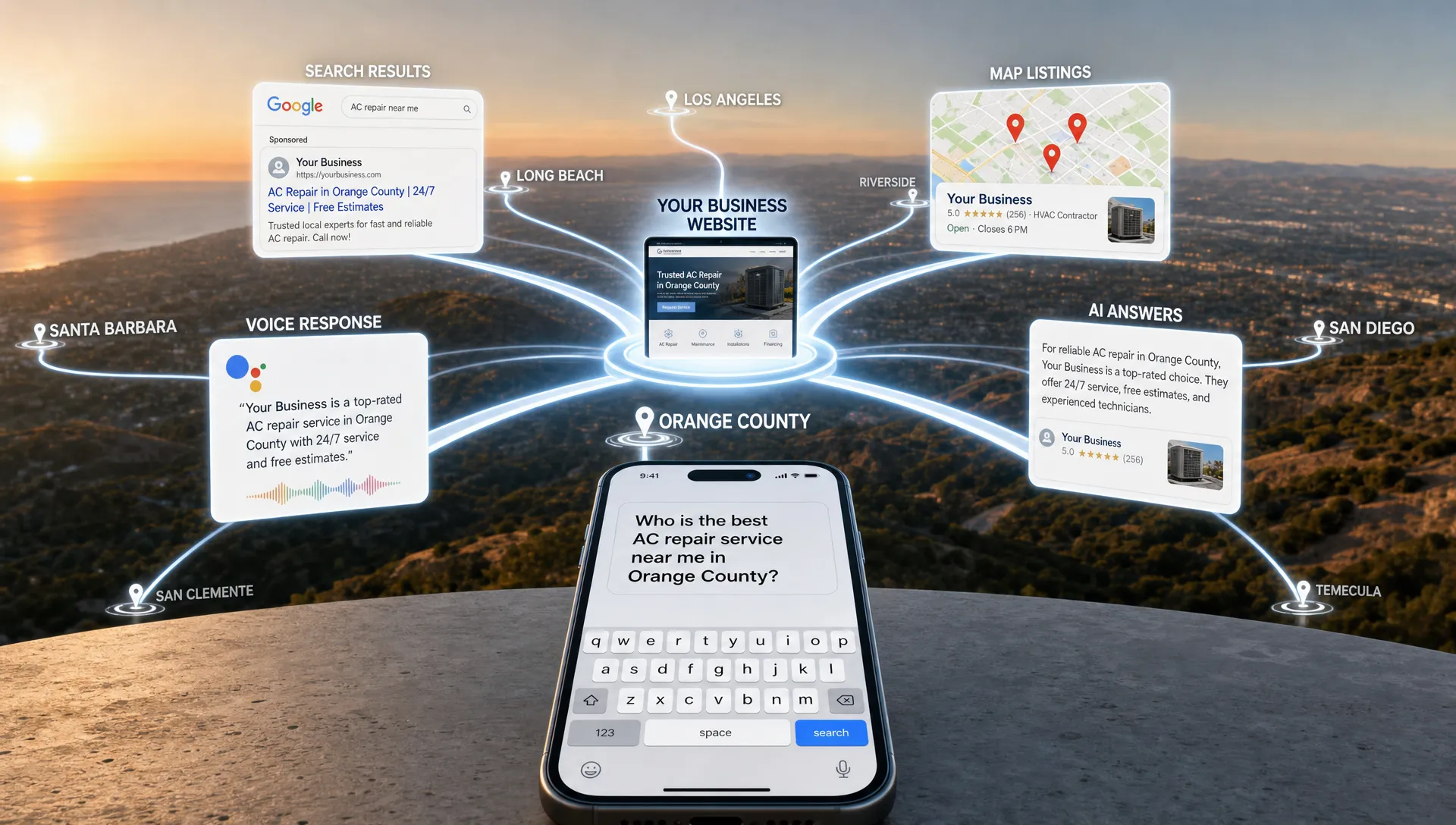
Search used to feel simple: publish a website, choose the right keywords, earn links, and move up the page. That world still exists, but it is no longer the whole story. In 2026, customers ask Google, AI Overviews, ChatGPT, Perplexity, maps, and voice assistants for direct recommendations. They do not always want a list of websites. They want the best answer, the closest provider, the most credible expert, or the safest choice.
For an Orange County HVAC company, an Irvine dental group, a San Diego law firm, or a Fresno plumbing contractor, understanding search engine optimization now means understanding how search systems decide who is trustworthy enough to recommend. The goal is not just traffic. The goal is qualified visibility that turns into calls, booked appointments, and revenue.
That does not mean SEO is dead. It means thin SEO is dead. The businesses that win now are the ones that make their expertise, service area, reputation, and proof easy for both humans and machines to verify.
What search engine optimization still means in 2026
Search engine optimization is the work of making your business easier to discover, understand, trust, and choose through search. The fundamentals still matter. Google still needs to crawl your pages. Customers still need useful content. Your website still needs to load quickly, work on mobile, and explain what you do.
Google’s own Search Essentials still emphasize helpful content, accessibility, crawlability, and avoiding manipulative practices. That foundation has not changed. What has changed is the number of systems interpreting your business before a customer ever reaches your website.
At the practical level, SEO still answers five core questions:
- Can search engines access and understand your pages?
- Does your content match what real customers are trying to solve?
- Is your business credible compared with nearby competitors?
- Do your local signals confirm where you operate?
- Does your website help visitors take the next step confidently?
For a local business, those questions are not abstract. If a homeowner in Laguna Niguel asks for emergency AC repair, the search system needs to understand which companies actually provide that service, which are nearby, which have credible reviews, and which appear authoritative enough to recommend.
What AI has changed about SEO
AI search does not simply match keywords to web pages. It retrieves information, compares entities, summarizes sources, and often presents an answer before the user clicks anything. That answer may include a business name, a map result, a short explanation, a review summary, or a service recommendation.
This creates a new layer of competition. Your website is no longer only competing for a blue link. It is competing to become part of the answer.
AI-driven search tends to reward clarity. A business with consistent naming, clear services, structured content, verified reviews, location relevance, and third-party mentions is easier to interpret than a business with vague pages and inconsistent listings. If your site says one thing, your Google Business Profile says another, and your citations use old addresses or phone numbers, AI systems have less reason to trust the overall picture.
This is especially important for AI Overviews. If your business depends on informational searches, such as cost questions, repair questions, treatment questions, or legal process questions, your content needs to be useful enough to be cited or summarized. Kell Web Solutions has a deeper tactical guide on how to optimize for AI Overviews if you want to focus specifically on Google’s AI-generated results.
The shift from rankings to retrieval
Traditional SEO asked where you ranked. AI-era SEO asks whether your business can be retrieved as a trusted source when a customer asks a specific question.
| Legacy SEO question | AI-era SEO question |
|---|---|
| Do we rank for plumber Orange County? | Are we recognized as a trusted plumbing provider for specific Orange County service needs? |
| Did we use the keyword enough? | Did we answer the customer's real question clearly and accurately? |
| Do we have city pages? | Do our location signals prove genuine relevance to each service area? |
| Do we have backlinks? | Do multiple credible sources reinforce our authority and identity? |
| Are we getting clicks? | Are we being cited, summarized, called, mapped, and chosen? |
This does not eliminate keyword research. It changes how keywords are used. Instead of stuffing phrases into pages, smart SEO uses keyword data to understand customer language. A homeowner may search AC not cooling upstairs in Irvine, roof leak after rain in Anaheim, or dental implant consultation near San Jose. Those phrases reveal intent, urgency, location, and fear.
The best SEO content mirrors that intent without sounding robotic.
Why California local businesses feel the change first
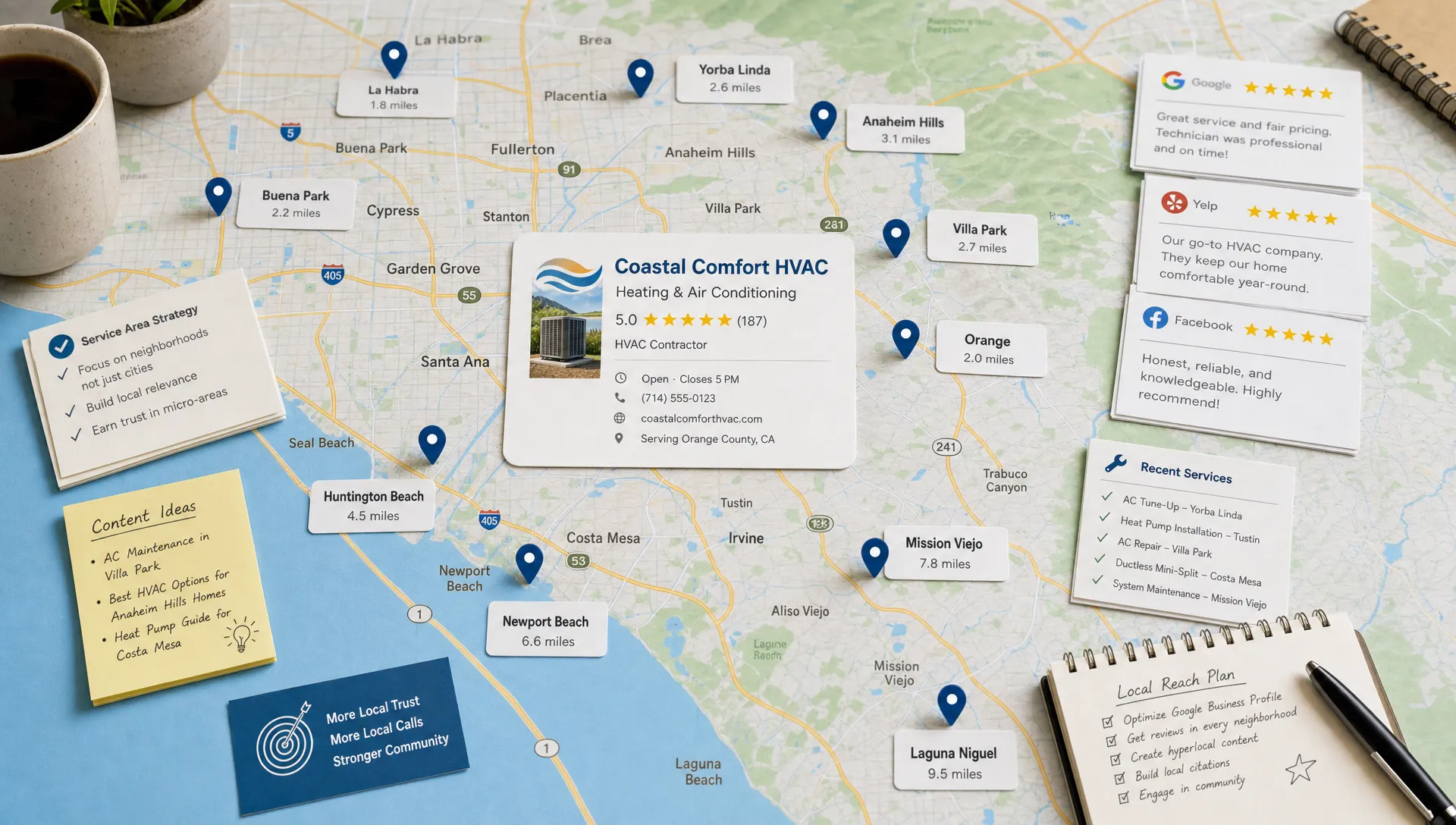
California markets are dense, expensive, and local by nature. A contractor in Huntington Beach may compete with companies in Costa Mesa, Newport Beach, Fountain Valley, and Irvine. A law firm in Los Angeles may need visibility by neighborhood, practice area, and urgency. A medical practice in San Diego may compete differently in La Jolla, Chula Vista, and North Park.
Local search engines also consider proximity and reputation. Google states that local results are influenced by relevance, distance, and prominence, which means your online presence must connect what you do, where you do it, and why you are trusted.
AI raises the bar because it compresses choices. When an answer engine summarizes options, fewer businesses are visible. If your competitor has stronger local proof, clearer service pages, better reviews, and more consistent entity signals, they may be selected even if your company has more years of experience offline.
This is why a single generic service page is often not enough. A roofer serving Anaheim, Santa Ana, and Irvine needs content and signals that reflect real local coverage. A multi-location dental group needs each office to be understandable as its own trusted local entity. A remodeler serving Laguna Beach luxury homes should not sound identical to a remodeler targeting inland tract homes.
A practical framework for understanding search engine optimization in the AI era
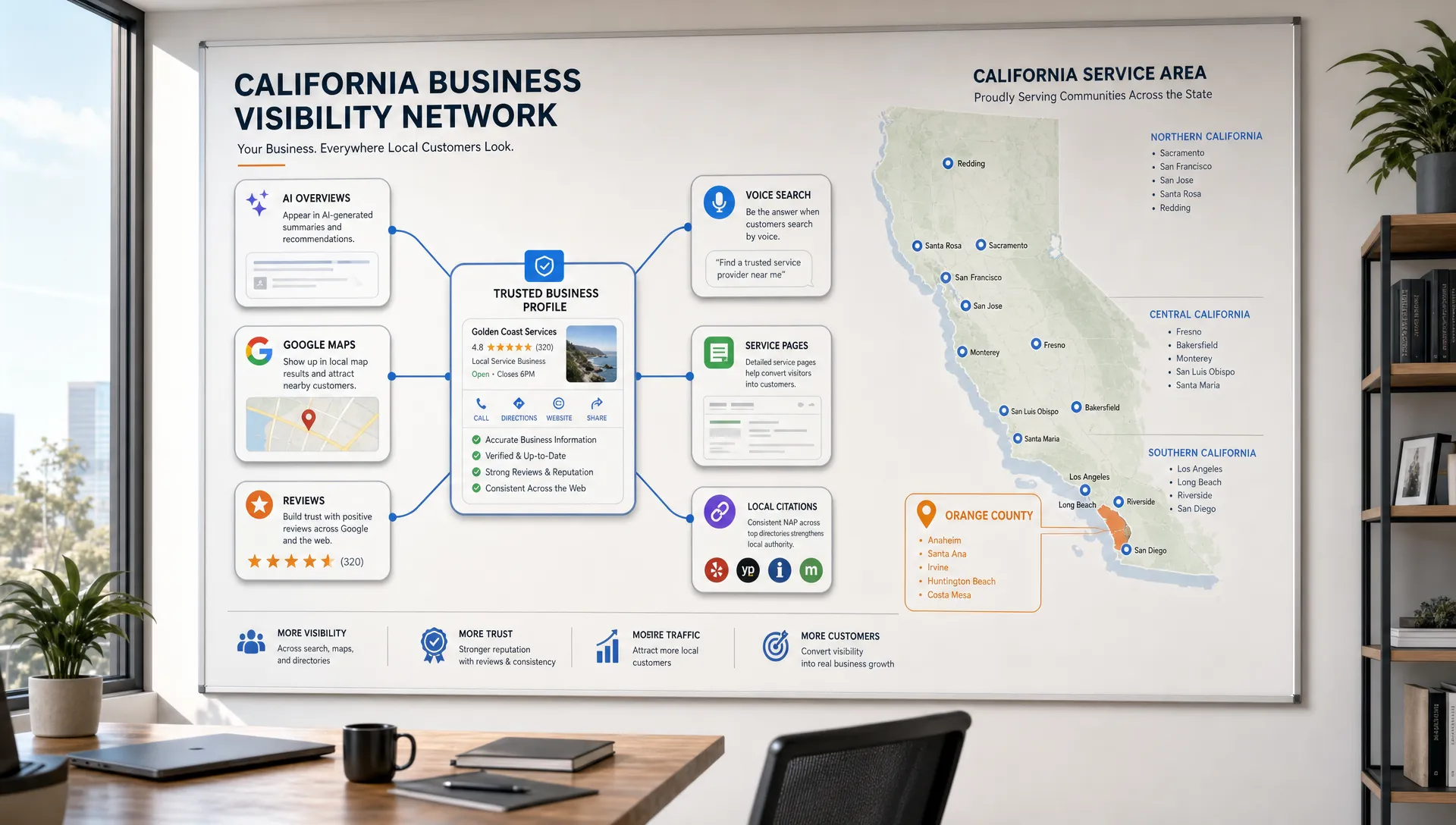
Think of modern SEO as a layered trust system. Each layer helps search engines and AI systems reduce uncertainty about your business.
| SEO layer | What search and AI systems need | What your business should do |
|---|---|---|
| Entity identity | A clear understanding of who you are | Use consistent business name, address, phone, categories, team information, and brand descriptions |
| Service relevance | Proof that you solve the searcher's problem | Build detailed service pages, answer real questions, and explain process, pricing factors, and outcomes |
| Local authority | Confidence that you serve a specific geography | Align website content, Google Business Profile, citations, reviews, photos, and local references |
| Reputation proof | Evidence that customers trust you | Earn and display reviews, case studies, testimonials, project examples, and professional credentials |
| Technical accessibility | Pages that machines can crawl and interpret | Improve page speed, mobile experience, internal links, schema markup, and clean site structure |
When these layers work together, your business becomes easier to recommend. When they conflict, you create doubt. In AI-era search, doubt is expensive.

How content should change in the AI era
Content is still one of the strongest SEO assets, but the standard for useful content is higher. A 500-word page that repeats HVAC repair Orange County ten times will not build much trust. A page that explains symptoms, causes, safety concerns, repair options, service timing, and local considerations is far more useful.
For contractors, strong content often answers questions like what caused the problem, whether repair or replacement makes more sense, what affects cost, how long the job takes, and when the issue becomes urgent. For professional practices, strong content may explain eligibility, insurance considerations, appointment expectations, risks, recovery timelines, legal deadlines, or location-specific access.
The best content sounds like an expert speaking to a real customer. It is specific without becoming confusing. It is educational without hiding the next step. It gives enough context to build confidence, then makes it easy to call, book, or request an estimate.
This is also where original experience matters. Project photos, before-and-after explanations, technician insights, case examples, neighborhood-specific constraints, and answers from actual customer conversations are difficult for competitors to copy. They also give AI systems more concrete information to associate with your brand.
Technical SEO now includes machine readability
Technical SEO used to focus heavily on crawling, indexing, speed, mobile usability, and site architecture. Those still matter, but machine readability now matters more than ever.
Search systems need clean signals. That includes descriptive title tags, logical headings, internal links, schema markup, consistent NAP information, and clear relationships between services, locations, staff, reviews, and credentials. For some businesses, newer files and structured resources, such as
llms.txt
, can also help clarify how AI crawlers should interpret a site, but they do not replace strong content and authority.
If your website is visually attractive but confusing to machines, it may underperform. If it is technically optimized but unhelpful to humans, it may also underperform. The winning combination is a website that is clear, fast, useful, locally grounded, and easy to parse.
For a deeper technical perspective, Kell Web Solutions explains how to build a search engine optimization website AI can trust, including entity clarity, structured data, local authority, and third-party proof.
How Answer Engine Optimization fits with SEO
Answer Engine Optimization, often called AEO, is not a replacement for SEO. It is the next layer. SEO helps search engines find and rank your content. AEO helps AI systems understand when your business should be selected as the answer.
For example, a traditional SEO campaign might target water heater repair in Irvine. An AEO-minded campaign asks additional questions. Does the site explain emergency service? Does the business profile confirm the service area? Do reviews mention water heaters? Are there pages answering common homeowner questions? Are credentials and trust signals easy to verify? Is the business described consistently across the web?
That difference matters because AI systems look for confidence. They want to avoid recommending unclear, unverified, or low-quality sources. AEO reduces ambiguity around your business.
Kell Web Solutions focuses on Answer Engine Optimization for businesses that need to be understood and recommended by AI-driven platforms, Google AI results, and voice assistants, especially in competitive local markets like Orange County and broader California.
What to audit in the next 30 days
You do not need to rebuild your entire digital presence overnight. Start by identifying where your visibility is unclear, outdated, or weak.
Use this 30-day audit as a practical starting point:
- Search your brand name in Google, Google Maps, ChatGPT, Perplexity, and voice search to see how your business is described.
- Search your top service plus your primary city, such as AC repair Irvine or dentist San Jose, and note which competitors appear in organic results, maps, and AI summaries.
- Review your Google Business Profile categories, services, photos, hours, appointment links, and review themes.
- Check whether your business name, address, and phone number are consistent across major directories.
- Identify your top five customer questions and make sure your website answers them clearly.
- Review each service page for local proof, process details, trust signals, and clear calls to action.
- Test your site on mobile and confirm that calling or booking is simple.
- Look for outdated pages, thin city pages, duplicate content, and claims that are not supported by evidence.
This kind of audit often reveals quick wins. A missing service category, weak title tag, outdated phone number, or unclear service area can quietly cost calls for months.
When to manage SEO internally and when to get help
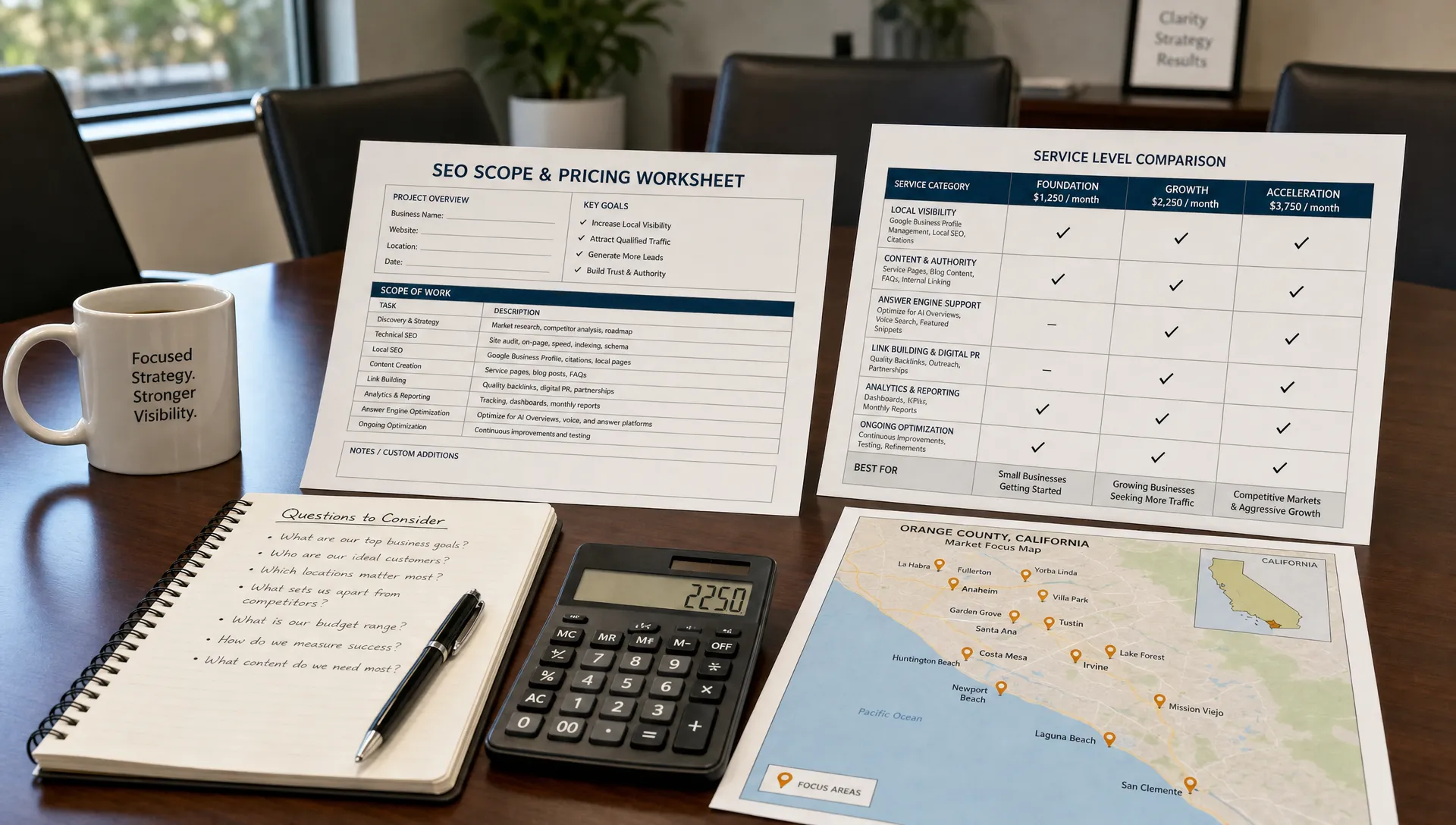
Some businesses can handle the basics internally, especially if they have a marketing coordinator who can update pages, collect reviews, publish photos, and maintain business profiles. Others need a partner because the work crosses strategy, technical SEO, content, local search, analytics, and conversion optimization.
If you choose outside support, look for a team that connects execution to business outcomes rather than isolated tasks. Some companies prefer a managed digital marketing service when they want campaign setup, ongoing optimization, and accountability handled in one place. Others need a specialist focused on local SEO, AEO, or hyperlocal authority.
The key is alignment. A beautiful website that does not generate calls is not enough. Blog posts that no one trusts are not enough. Rankings without booked conversations are not enough. Your SEO strategy should support how your customers actually choose a provider.
Common SEO mistakes in the AI era
Many businesses are still applying 2015 tactics to a 2026 search environment. That creates wasted effort and missed visibility.
| Mistake | Why it hurts now | Better approach |
|---|---|---|
| Creating near-duplicate city pages | AI systems may see weak or repetitive local relevance | Build genuinely useful local pages with unique service context and proof |
| Treating reviews as a side task | Reviews influence trust, local prominence, and conversion | Ask consistently, respond professionally, and reflect review themes in content |
| Ignoring Google Business Profile | Maps and local packs often appear before organic results | Keep services, categories, photos, posts, and hours accurate |
| Publishing generic AI content | It lacks experience, specificity, and credibility | Add expert insight, local examples, real questions, and customer proof |
| Measuring only rankings | AI visibility, maps, calls, and citations may matter more | Track calls, forms, map actions, AI mentions, and qualified appointments |
The pattern is simple. Search engines are getting better at recognizing substance. Businesses that prove real-world relevance will outperform businesses that only imitate SEO signals.
Frequently Asked Questions
Is SEO still worth it if AI answers reduce clicks? Yes. SEO is still worth it because search visibility now includes rankings, maps, AI citations, brand discovery, calls, and booked appointments. The goal is not just more clicks. The goal is to be trusted and chosen when customers search.
What is the difference between SEO and AEO? SEO focuses on making your website visible in search results. AEO focuses on making your business clear, credible, and structured enough to be selected by answer engines, AI Overviews, voice assistants, and other AI-driven discovery tools.
Do local businesses still need service area pages? Yes, but only when those pages are useful and accurate. A strong service area page should include real local relevance, service details, customer questions, proof, and clear next steps. Thin pages with only swapped city names are weak.
How long does SEO take in the AI era? Technical fixes and profile updates can create improvements relatively quickly, but durable authority usually takes months. Competitive markets like Orange County, Los Angeles, San Diego, San Jose, and Sacramento often require consistent content, reviews, local signals, and optimization.
Can AI-generated content help with SEO? It can help with drafting and research, but it should not replace expert review. Content needs accuracy, local context, real experience, and trust signals. Generic AI content rarely builds strong authority by itself.
Make your business easier for search and AI to trust
Understanding search engine optimization in the AI era starts with one question: can search systems clearly understand why your business is the right answer for your ideal customer?
If the answer is uncertain, your competitors have an opening. Kell Web Solutions helps Orange County and California businesses strengthen local visibility, improve AI readiness, and turn search presence into confident inbound calls. If your company depends on qualified local leads, now is the time to make your expertise easier to find, verify, and recommend.
To discuss whether SEO, AEO, or a hyperlocal authority strategy fits your business, contact Kell Web Solutions at (949) 575-8553 or email gregg@kellsolutions.com.