Orange County Marketing Strategies That Still Work in 2026
Marketing in Orange County has always been competitive, but 2026 has raised the stakes. Homeowners compare contractors across Google Maps, AI summaries, review sites, social proof, and referral conversations before they ever call. Patients and legal clients do the same when evaluating multi-location practices across Irvine, Anaheim, Huntington Beach, Santa Ana, Laguna Niguel, and the rest of the county.
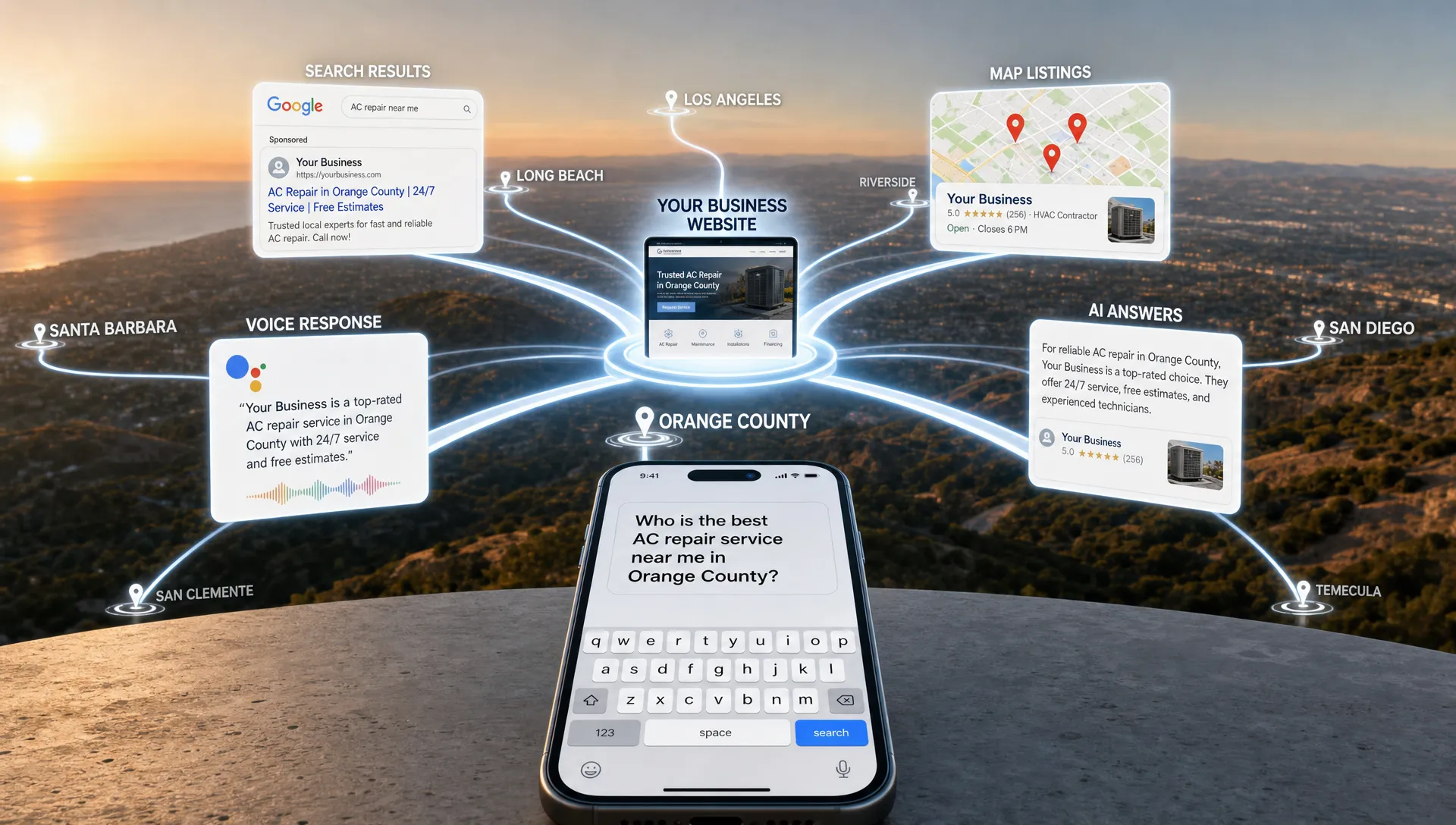
The good news: the Orange County marketing strategies that still work are not gimmicks. They are durable systems built around trust, proximity, proof, and response speed. What has changed is how those signals are discovered. Search engines, AI answer engines, voice assistants, and local directories now interpret your business as an entity, not just a website with keywords.
That means the winning playbook in 2026 is not to chase every new platform. It is to make your business the clearest, most trusted local answer wherever buyers ask for help.
| Strategy | Why it still works in 2026 | Best-fit businesses |
|---|---|---|
| Hyperlocal positioning | Buyers and AI systems both need location-specific relevance | HVAC, plumbing, roofing, dental, legal, medical |
| Google Business Profile optimization | Maps, calls, directions, and local discovery still influence buying decisions | Any service-area or local practice |
| Answer-ready content | AI summaries and search results favor clear, useful answers | Contractors, remodelers, professional practices |
| Reputation marketing | Reviews turn visibility into trust and calls | High-consideration local services |
| Fast follow-up | Leads decay quickly when prospects are comparing options | Emergency services, consultations, estimates |
| Local partnerships | Offline trust becomes online authority when documented well | Established OC businesses and multi-location brands |
1. Hyperlocal positioning beats broad county-wide messaging
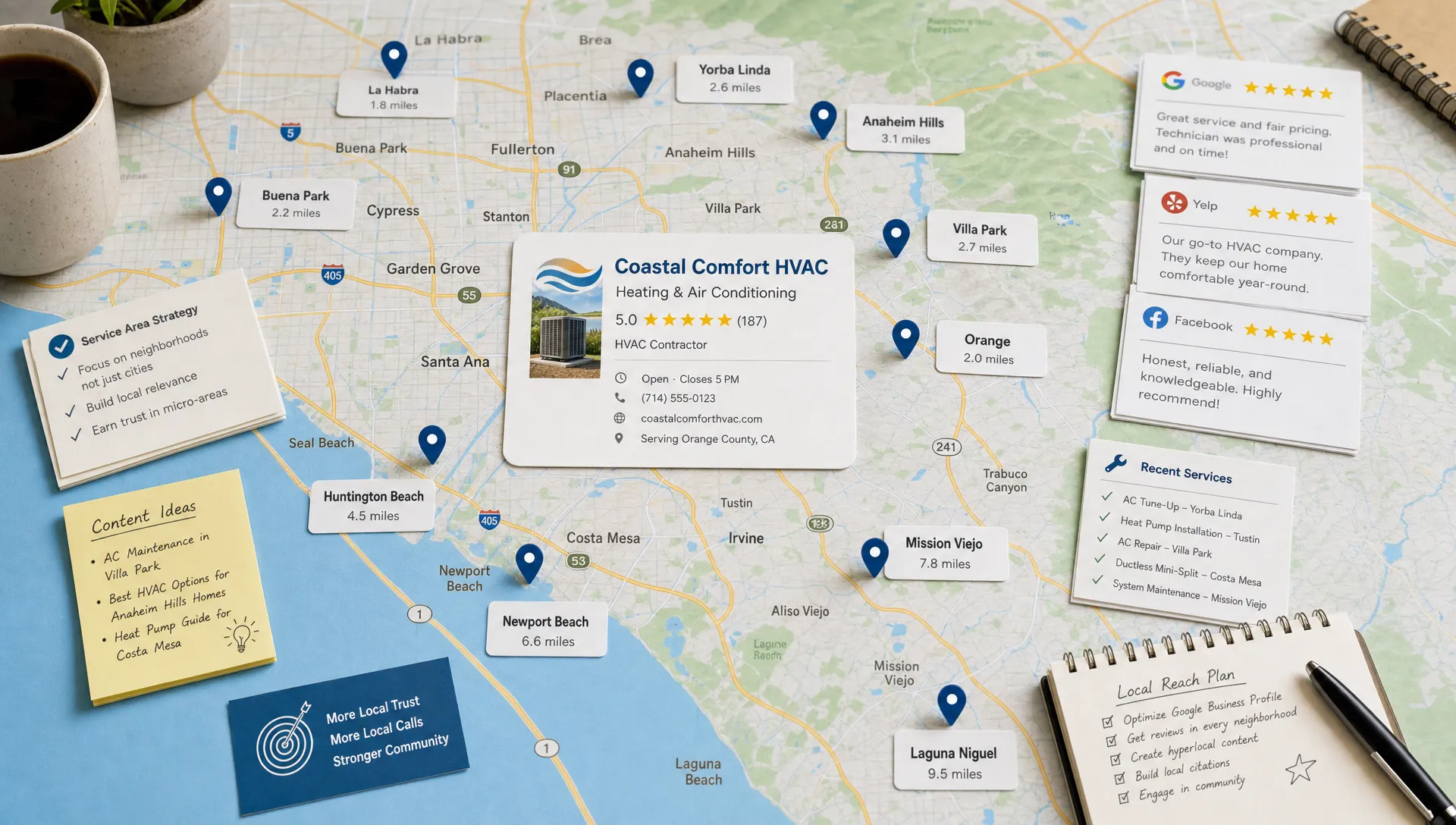
A generic Orange County page is rarely enough anymore. A homeowner in Laguna Beach searching for coastal window replacement has different concerns than a homeowner in Anaheim comparing AC repair options during a heat wave. A dental practice in Irvine may need to communicate different trust signals than a legal office serving Santa Ana or Newport Beach.
Hyperlocal marketing works because it aligns with how people actually make decisions. They do not just want a contractor or professional. They want someone who understands their neighborhood, their property type, their city regulations, their commute patterns, and their local expectations.
For contractors, this can mean building legitimate city and neighborhood relevance around the actual areas served. For example, a roofing company might explain how salt air affects roof materials near coastal Orange County. An HVAC company might answer questions about older homes in Fullerton versus newer planned communities in Irvine. A remodeler might show projects that reflect the design expectations of Newport Coast, Laguna Niguel, or San Clemente.
This does not mean creating thin, duplicated city pages. It means building pages and content with real local substance: photos, project examples, service constraints, neighborhood references, FAQs, reviews, and proof that the company truly serves the area. If you want a contractor-specific angle, Kell Web Solutions has also covered local marketing ideas for contractors in Orange County in more tactical detail.
The mistake to avoid in 2026 is treating Orange County like one market. It is a collection of micro-markets. Your marketing should show that you understand the differences.
2. Google Business Profile is still a revenue channel
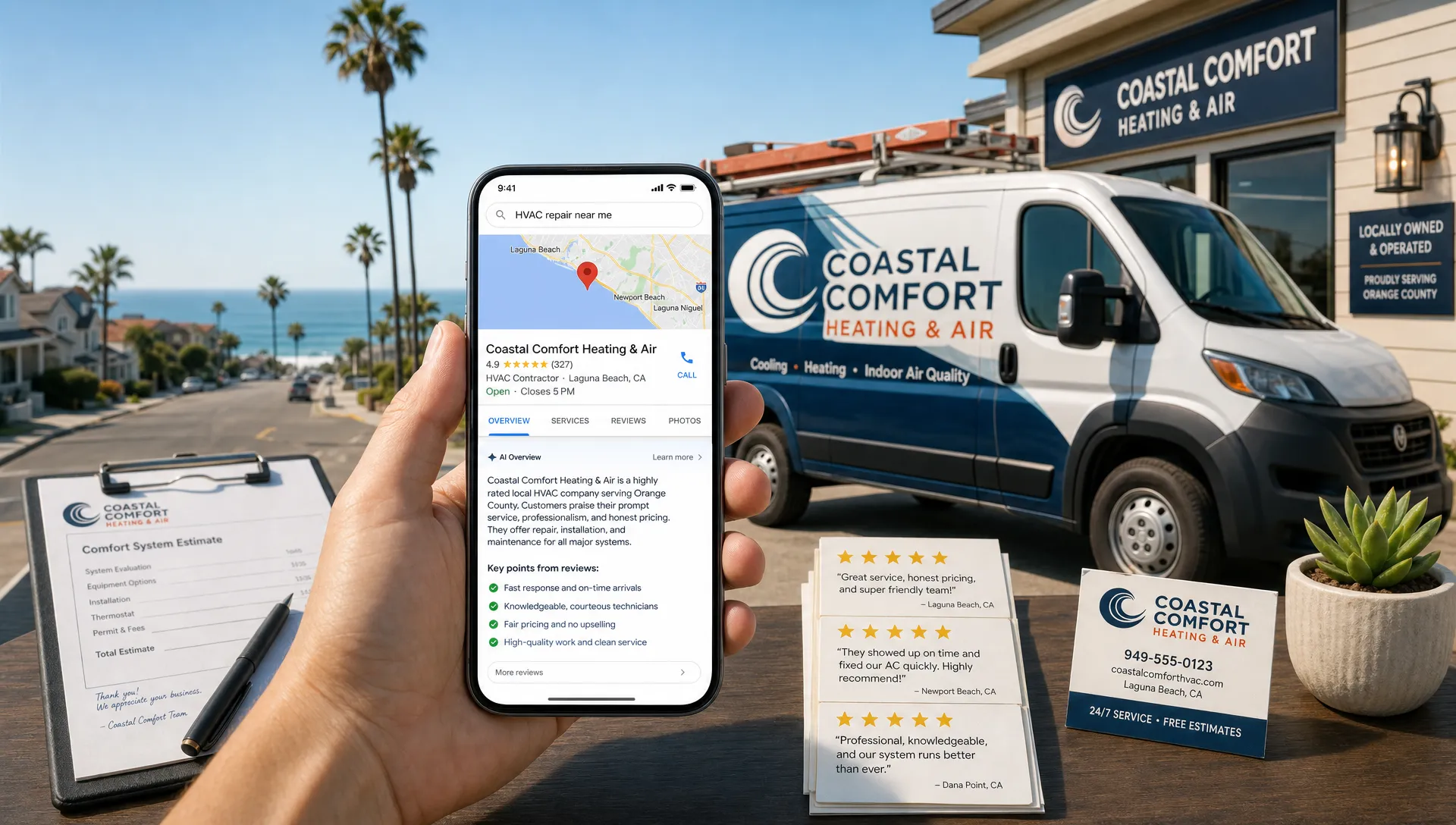
Google Business Profile is not just a listing. For many local businesses, it is the front door. People use it to compare reviews, check hours, view photos, ask questions, request directions, and call directly from search results.
Google’s own documentation says local ranking is influenced by relevance, distance, and prominence. In practice, that means your profile must clearly match what buyers are searching for, demonstrate geographic fit, and show enough trust signals to compete. You can review Google’s guidance on local ranking for the official framework.
In 2026, a strong profile should include accurate categories, complete services, fresh photos, real business descriptions, consistent hours, and ongoing activity. For home services, photo updates can show trucks, teams, equipment, before-and-after work, and local job context. For medical, dental, and legal practices, photos should communicate professionalism, accessibility, and location confidence.
Posts still have value when they are timely and useful. A plumbing company can publish seasonal drain maintenance reminders before heavy rain. A solar installer can discuss local incentives or installation considerations. A dental group can promote new patient availability by location. These updates will not replace a complete SEO strategy, but they reinforce that the business is active and relevant.
The most important shift is to manage the profile as a conversion asset, not a directory entry. Track calls, form clicks, direction requests, and booked appointments by location. The goal is not just more impressions. The goal is qualified action.
3. SEO now needs an answer engine layer
Traditional SEO is still important, but it is no longer the whole visibility game. Buyers now ask questions through Google AI Overviews, voice assistants, ChatGPT, Perplexity, and other AI-driven tools. These systems are not just looking for keyword matches. They are trying to identify clear, trustworthy, well-structured answers from credible sources.
That is where Answer Engine Optimization becomes important. AEO focuses on helping AI-driven platforms understand who you are, what you do, where you operate, why you can be trusted, and when you are the best fit for a specific question.
For an Orange County contractor or multi-location practice, this means your website should clearly explain your services, service areas, credentials, process, pricing factors where appropriate, reviews, case studies, and frequently asked questions. Your content should use the language customers actually use. Your technical structure should help machines interpret the business, including schema markup, clean navigation, consistent entity details, and well-organized service pages.
This does not mean abandoning SEO. It means making your SEO more precise, structured, and useful. A page built only to rank for a phrase may underperform in an AI-driven environment. A page built to answer a real buyer’s question, with local context and evidence, has a better chance of being useful across search, Maps, and answer engines.
For home services companies watching AI change the discovery journey, this article on AI search marketing for Orange County home services explores that shift in more depth.

4. Reviews still convert attention into trust
Visibility without trust is expensive. A business can rank, advertise, and appear in AI-generated summaries, but if its reputation is weak or unclear, buyers hesitate. Reviews are still one of the strongest bridges between discovery and action.
The reviews that matter most are specific. A five-star review that says the technician arrived on time, explained the repair, protected the home, and solved the problem in one visit is more persuasive than a generic compliment. For professional practices, reviews that describe communication, clarity, office experience, and outcomes help prospective clients feel more confident.
The key is to build a steady, ethical review system. Ask at the right moment, make the process simple, and respond thoughtfully. Do not buy fake reviews or pressure customers into misleading testimonials. The FTC has increased scrutiny around deceptive review practices, and its final rule on fake reviews and testimonials is a reminder that reputation marketing must be honest.
Reputation also needs distribution. Reviews should not sit only on one platform. Use them in service pages, location pages, proposals, email follow-ups, and sales conversations. A strong reputation becomes stronger when it is connected to the buyer journey. Kell Web Solutions has a deeper guide to Orange County reputation marketing for businesses that want reviews to support local search, referrals, and conversion.
5. Content still works when it answers buying questions
Content marketing is not dead. Thin content is dead. Generic posts about broad industry topics rarely move the needle for a local business in 2026. The content that still works answers the questions buyers ask right before they call, schedule, or compare providers.
Google’s guidance around helpful, reliable, people-first content is a useful benchmark. If a page exists only to capture a keyword, it is weak. If it helps a real buyer understand a problem, compare options, estimate next steps, or choose a provider, it has a much stronger purpose.
For Orange County businesses, strong content often falls into a few proven categories:
- Problem-solving pages: Explain causes, risks, and solutions for issues such as AC failure, slab leaks, roof damage, dental emergencies, or legal intake questions.
- Comparison pages: Help buyers compare repair versus replacement, treatment options, service packages, or different approaches.
- Local condition pages: Address city-specific factors such as coastal exposure, older housing stock, HOA requirements, traffic access, or neighborhood service coverage.
- Proof-based stories: Show completed projects, client outcomes, before-and-after context, and lessons learned.
- Seasonal content: Prepare homeowners or clients for heat waves, wildfire season, rain, insurance deadlines, tax season, or annual health planning.
The best content sounds like an expert answering a serious prospect, not a marketer filling a calendar. It should be clear, useful, locally relevant, and connected to a next step.
6. Paid media still works when the follow-up system is strong
Paid ads can still generate leads in Orange County, especially for urgent services and competitive practice areas. The problem is that many businesses treat paid media as a traffic purchase instead of a revenue system.
If your landing page is vague, your intake team is slow, your call tracking is poor, or your follow-up ends after one attempt, paid media becomes expensive fast. The ad may create the opportunity, but the back-end system determines whether that opportunity turns into revenue.
In 2026, paid campaigns should be connected to specific service areas, high-intent offers, clear landing pages, call tracking, and fast response workflows. For contractors, that might mean separate campaigns for emergency repair, replacement estimates, and seasonal tune-ups. For practices, it might mean location-specific campaigns tied to consultation availability or specific services.
Do not judge ads only by cost per lead. Judge them by cost per booked call, cost per qualified estimate, cost per new patient, cost per signed case, or cost per completed job. Those numbers reveal whether marketing is actually profitable.
7. Follow-up is now part of marketing
A missed call, slow reply, or untracked form submission is not an operations issue only. It is a marketing issue. Every dollar spent to create demand is wasted if the business does not respond quickly and confidently.
Modern buyers compare multiple providers. The company that responds first with clarity often wins before the others even see the lead. This is especially true for HVAC, plumbing, electrical, roofing, dental emergencies, and legal intake.
A strong follow-up system should confirm the request, qualify the need, set expectations, and move the prospect toward a scheduled conversation. It should also keep following up without sounding robotic or desperate. If a homeowner requests a remodel estimate and goes quiet, a helpful follow-up with planning questions or project examples may reopen the conversation.
Automation can help, but it should not remove the human element. The goal is to make responsiveness consistent while keeping the communication relevant. For many Orange County businesses, better follow-up can increase revenue without increasing traffic at all.
8. Local partnerships still create authority
Offline relationships still matter, but in 2026 they should leave digital evidence. Referral partnerships, chamber memberships, supplier relationships, nonprofit involvement, local sponsorships, and professional associations all contribute to trust when they are visible online.
A contractor who partners with local real estate agents, property managers, manufacturers, or neighborhood organizations should document those relationships where appropriate. A dental or medical group involved in community events should publish useful recaps, photos, and service-area context. A legal practice with educational workshops can turn those sessions into articles, FAQs, and local authority signals.
This is not about collecting random backlinks. It is about proving real-world relevance. AI systems and human buyers both benefit when your business has a visible footprint beyond its own website.
A practical 90-day Orange County marketing plan for 2026
The most effective strategies are easier to implement when organized by priority. A business does not need to do everything at once. It needs to fix the highest-leverage gaps first.
| Timeline | Focus | What to improve | Success signal |
|---|---|---|---|
| Days 1–30 | Foundation | Website clarity, Google Business Profile, tracking, service-area accuracy | More accurate calls, cleaner analytics, fewer visibility gaps |
| Days 31–60 | Authority | Reviews, city-specific content, FAQs, case studies, local proof | More branded searches, review growth, better engagement |
| Days 61–90 | Conversion | Landing pages, follow-up workflows, call handling, retargeting, referral prompts | Higher booked-call rate, more estimates, stronger close rate |
Start with the foundation. If your business name, address, phone number, service areas, categories, and core pages are inconsistent, advanced tactics will underperform. Once the foundation is clean, build authority through content and reviews. Then improve conversion so that more of the demand you generate turns into revenue.
What to stop doing in 2026
Some older marketing habits still consume budgets without creating durable value. If you want a stronger Orange County marketing system, these are worth cutting or reducing:
- Publishing generic blog posts that could apply to any business in any city.
- Creating duplicated city pages with only the location name changed.
- Treating reviews as a one-time campaign instead of an ongoing trust system.
- Running ads without call tracking, intake accountability, or booked-appointment reporting.
- Ignoring AI search visibility because traditional rankings still look acceptable.
- Measuring success only by traffic instead of qualified calls, booked consultations, and revenue.
The common thread is simple: stop optimizing for activity and start optimizing for selection. In 2026, the winner is not always the business with the most content or the biggest ad spend. It is the business that is easiest to understand, easiest to trust, and easiest to contact.
How to measure whether your marketing is actually working
Rankings still matter, but they are not enough. A business can rank and still lose revenue if the wrong people visit, the phone is not answered, or the offer is unclear.
A healthier scorecard includes local visibility, Google Business Profile actions, call quality, booked appointments, estimate requests, review velocity, close rate, and revenue by service area. For AI-era visibility, businesses should also monitor whether they are being cited, summarized, or mentioned in answer-style results for important local questions.
For example, an HVAC company in Orange County should not only ask whether it ranks for AC repair. It should ask whether it appears for city-specific emergency queries, whether callers are qualified, whether technicians are booked efficiently, and whether reviews mention the services it wants to grow.
A multi-location dental or legal practice should measure visibility and conversion by office location, not just total website traffic. One office may need more reputation support, while another may need stronger service pages or better follow-up.
The businesses that win in 2026 will not be the ones with the most data. They will be the ones that use the right data to make better decisions.
Frequently Asked Questions
What Orange County marketing strategy works best in 2026? The strongest strategy is a combined system: local SEO, Google Business Profile optimization, answer-ready content, reviews, and fast follow-up. Each channel supports the others, which creates more durable visibility and better lead conversion.
Is SEO still worth it for Orange County businesses with AI search growing? Yes. SEO is still important, but it needs to evolve. Your website must be useful for human buyers and structured clearly enough for AI-driven platforms to understand your services, locations, proof, and expertise.
Should my business target all of Orange County or individual cities? Most local service businesses should target individual cities and neighborhoods where they truly operate. Broad county messaging can help brand awareness, but city-specific relevance usually performs better for local search and buyer confidence.
How often should an Orange County business publish content? Quality matters more than frequency. A smaller number of useful, locally specific pages or articles can outperform frequent generic posts. Start with the questions prospects ask before calling, booking, or comparing providers.
Do reviews help with AI search visibility? Reviews help establish trust, prominence, and real-world credibility. While no business can control exactly how AI platforms select answers, strong review signals and clear reputation proof can support both human decision-making and broader local authority.
Build a marketing system that can survive 2026
Orange County marketing is no longer about one tactic. It is about creating a clear, trusted, locally relevant presence that works across search engines, AI answers, Maps, reviews, referrals, and follow-up.
If your business depends on qualified local calls, booked consultations, or neighborhood-level visibility, Kell Web Solutions can help you evaluate where your current marketing system is strong, where it is vulnerable, and what to improve first.
To discuss a 2026-ready strategy for your Orange County business, call Kell Web Solutions at (949) 575-8553 or schedule a strategy conversation.