Local Marketing Ideas for Contractors in Orange County
Orange County is crowded with capable contractors. A homeowner in Irvine can compare five HVAC companies before lunch. A property manager in Newport Beach can ask Google, ChatGPT, or a voice assistant for a plumber without ever visiting a website. A remodeler in Laguna Beach may be judged by reviews, photos, and local proof before the first call happens.
That is why local marketing for contractors has to be more precise than generic advertising. You are not trying to reach everyone in California. You are trying to become the obvious, trusted choice when someone nearby needs your exact service, in your exact service area, right now.
For Orange County contractors, the best marketing ideas connect three things: local search visibility, neighborhood-level trust, and fast conversion into calls or estimate requests. Google’s local ranking guidance centers on relevance, distance, and prominence, and those same principles now influence how AI-driven search tools interpret which businesses deserve to be recommended.
Why Orange County Contractor Marketing Is Different
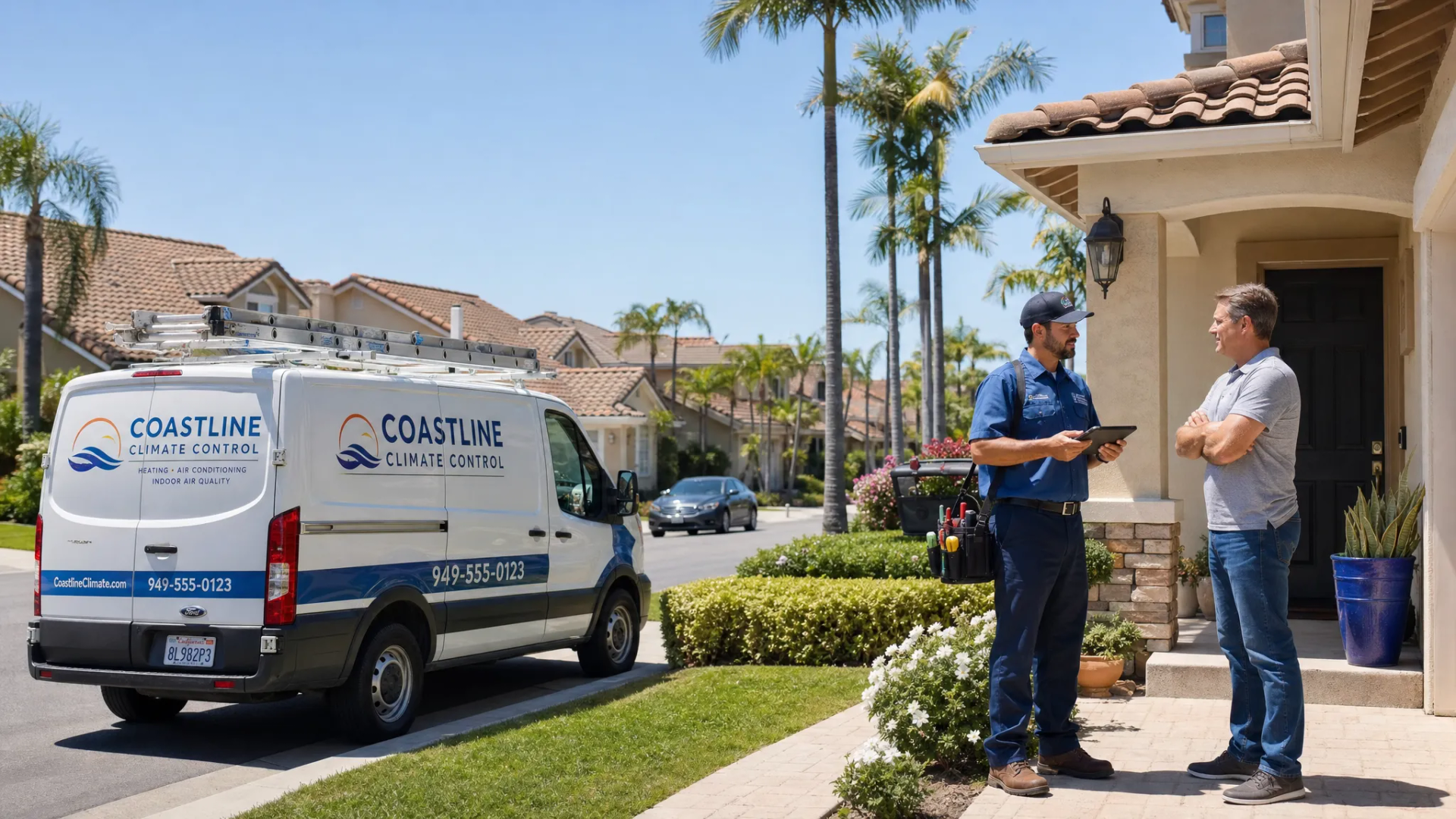
Orange County is not one simple market. Laguna Beach, Irvine, Anaheim, Huntington Beach, Newport Beach, Mission Viejo, Santa Ana, and San Clemente all have different customer expectations, home styles, urgency levels, and competitive landscapes.
A roofing company may need to speak to coastal corrosion and tile roofs near the beach. An HVAC contractor may need to prepare for summer AC replacement searches in inland communities. A remodeler may need proof that they understand HOA expectations, premium finishes, hillside access, or permitting realities.
The mistake many contractors make is treating Orange County as a single keyword. In practice, buyers search by city, neighborhood, problem, and trust signal. They ask questions like “best AC repair near Woodbridge Irvine,” “emergency plumber in Huntington Beach,” or “roof leak repair after rain in Mission Viejo.” Your marketing should match that level of specificity.
A Quick Local Marketing Matrix for Contractors
Use this matrix to decide which ideas deserve priority based on your current bottleneck.
| Business Challenge | Best Local Marketing Focus | Primary KPI to Watch |
|---|---|---|
| Low visibility in nearby cities | Google Business Profile, local SEO pages, citations | Calls and direction requests by city |
| Plenty of traffic but few calls | Landing page conversion, reviews, call tracking | Conversion rate and booked estimate rate |
| Losing jobs to bigger competitors | Job stories, proof assets, neighborhood content | Branded searches and close rate |
| Seasonal demand swings | Pre-season content and paid search campaigns | Cost per booked job during peak months |
| Missed opportunities after hours | Call handling, follow-up automation, scheduling | Missed call rate and speed to response |
| Weak AI or voice visibility | Answer-ready FAQs, structured content, entity clarity | Mentions, citations, and qualified calls |
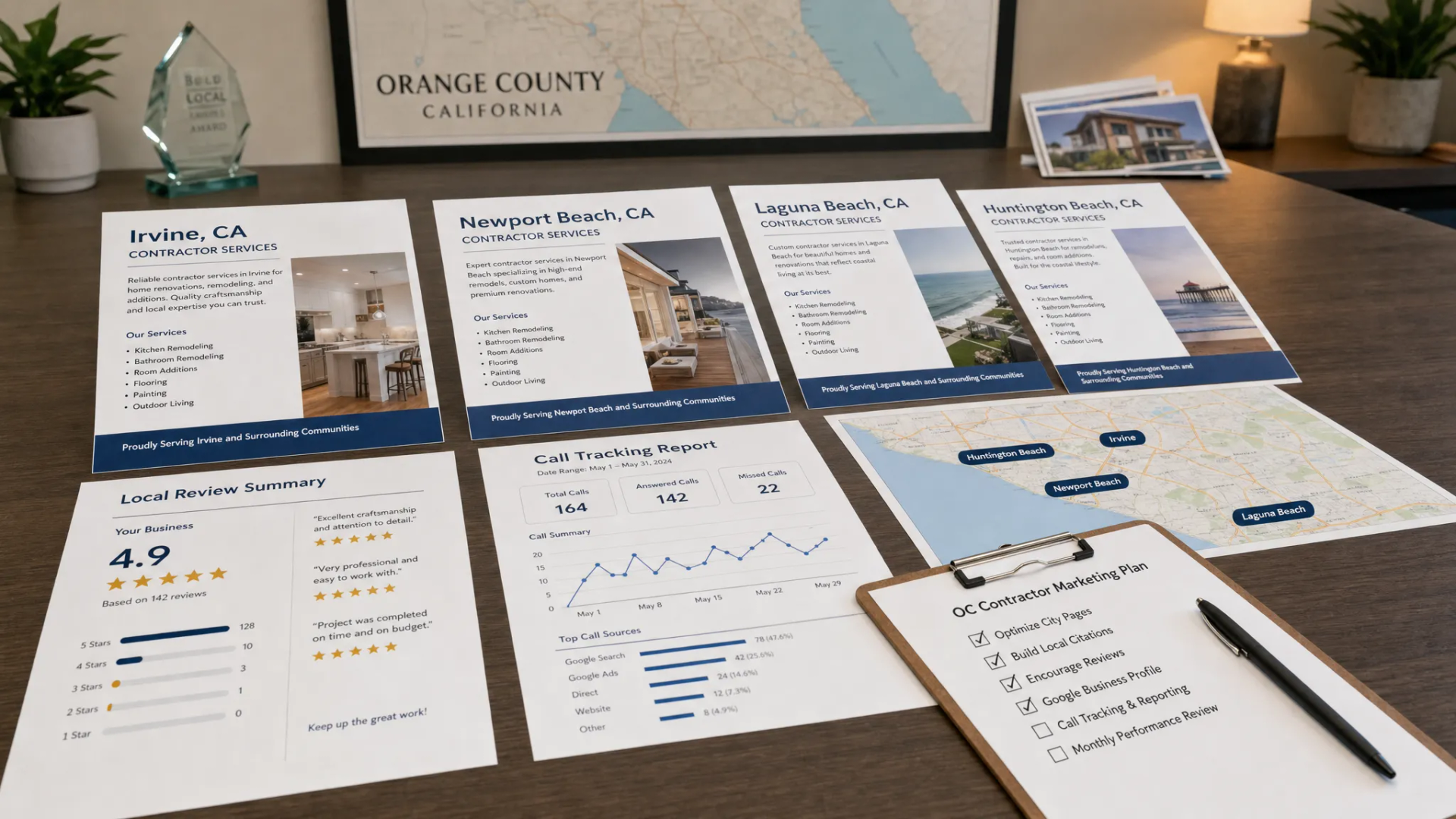
1. Build City-Specific Service Pages That Actually Help Homeowners
A service-area page should not be a thin duplicate with the city name swapped out. That approach looks generic to people and weak to search engines.
Instead, create pages that answer real local questions. A strong Irvine HVAC repair page might explain common AC problems in newer planned communities, typical replacement decision points, and how quickly a homeowner can schedule service. A Newport Beach plumbing page might address slab leaks, high-end fixture protection, and emergency response expectations. A Laguna Beach remodeling page might discuss access, design expectations, and local project planning considerations.
The goal is not to write a page for every city in California. Start with your highest-value Orange County service areas, then build useful pages that prove you understand each market. Kell Web Solutions’ Local SEO Mastery is designed around this kind of practical local visibility foundation, including Google Business Profile optimization, targeted content, and citation consistency.
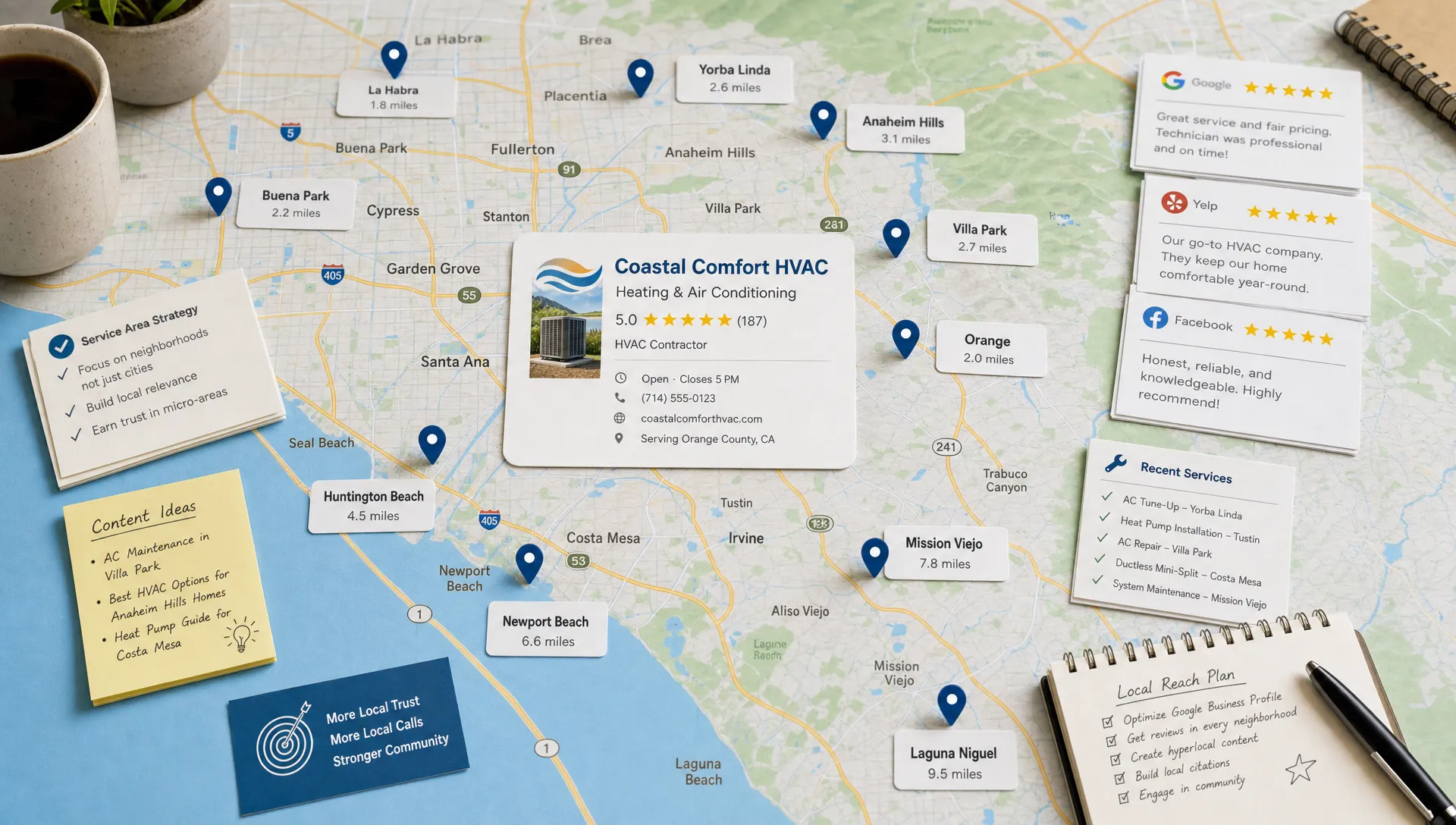
2. Treat Your Google Business Profile Like a Sales Asset
Your Google Business Profile is often the first impression a homeowner sees. For contractors, it can be more important than the homepage because it shows reviews, photos, services, hours, location signals, and click-to-call options in one place.
Make sure your primary category matches your core service. Fill out service menus. Add real project photos regularly. Use posts to promote seasonal maintenance, emergency availability, financing reminders if applicable, or recent project highlights. Answer common questions in the Q&A section, but avoid overpromising anything your team cannot consistently deliver.
If you have legitimate staffed locations, optimize each location properly. If you operate as a service-area business, do not create fake offices just to rank in more cities. That can damage trust and create long-term visibility problems.
3. Publish Local Job Stories Instead of Generic Blog Posts
Most contractor blogs fail because they sound like every other contractor blog. “Five signs you need a plumber” may be useful, but it does not prove you are the right plumber for a homeowner in Costa Mesa, Tustin, or San Juan Capistrano.
A better approach is to publish short job stories. These are not full case studies that require months of production. They are practical proof assets that show what happened, where it happened, what problem was solved, and why the customer chose you.
A good job story includes the city, the service, the customer problem, photos when appropriate, the solution, and a short explanation of what made the job unique. Never expose private customer information or exact addresses. The purpose is to build local relevance and trust while showing search engines and AI systems that your company has real-world experience in the areas you serve.
4. Turn Reviews Into a Repeatable Marketing System
Reviews influence local rankings, but they also influence close rates. A homeowner comparing two electricians may choose the one with more recent, specific reviews, especially if those reviews mention the same city or service they need.
The best review strategy is simple: ask consistently, ask at the right time, and make it easy. Request reviews after the customer has confirmed satisfaction, not weeks later when the emotion has faded. Train technicians and office staff to explain that reviews help local homeowners find trustworthy contractors.
Avoid risky tactics such as buying reviews, filtering only happy customers, or offering incentives for positive feedback. A compliant review system protects your reputation and creates durable local proof. Over time, reviews should become part of your marketing engine, not a random afterthought.
5. Create Seasonal Campaigns Before Demand Peaks
Orange County contractors often wait until demand spikes to start marketing. By then, competitors have already captured the search visibility.
HVAC companies should publish AC tune-up and replacement content before the hottest months. Roofers should prepare roof inspection and leak repair campaigns before rainy periods. Plumbers can build campaigns around water heater replacement, slab leak detection, and holiday emergency prevention. Electricians can prepare content around panel upgrades, EV charger installation, lighting, and safety inspections.
Seasonal campaigns work best when they combine search content, Google Business Profile posts, email reminders, review proof, and call tracking. The point is to be visible before the homeowner feels urgency, then easy to reach when urgency arrives.
6. Build Referral Partnerships With Local Trust Brokers
Some of the best contractor leads still come from relationships. The difference in 2026 is that those relationships should be supported by digital proof.
Realtors, property managers, HOAs, designers, restoration companies, insurance professionals, appliance stores, and adjacent trades can all become referral sources. A plumber may refer an electrician. A roofer may refer a solar company. A remodeler may refer a cabinet, flooring, or painting specialist.
Make it easy for partners to refer you. Give them a clean landing page, a direct contact method, proof of insurance and licensing where relevant, and examples of the type of customer you serve best. Track partner referrals separately so you know which relationships deserve more attention.
7. Use Paid Search Only Where Buyer Intent Is Clear
Paid search can work well for contractors, but only when campaigns are tightly managed. Broad campaigns can burn budget quickly in Orange County because competition is high and clicks do not always become profitable jobs.
Focus paid campaigns on high-intent services, urgent problems, and profitable cities. Send traffic to dedicated landing pages instead of a generic homepage. Use call tracking to separate junk inquiries from real opportunities. Review search terms often so you are not paying for irrelevant traffic.
For example, an HVAC contractor may run separate campaigns for emergency AC repair, furnace replacement, and ductless mini-split installation. Each campaign should have its own message, proof, and call-to-action. The closer the landing page matches the searcher’s need, the better the chance of turning the click into a booked appointment.
8. Make Offline Marketing Measurable
Truck wraps, yard signs, door hangers, local sponsorships, and neighborhood mailers can still work for contractors. The problem is that many companies use them without tracking.
Every offline campaign should point to a measurable next step. Use a dedicated phone number, QR code, city-specific landing page, or campaign-specific offer. If you place door hangers after completing a project in a neighborhood, send people to a page that shows nearby work and explains why neighbors choose your company.
Be mindful of HOA rules, city restrictions, and customer privacy. Done respectfully, offline marketing can reinforce your local presence and make your digital marketing more believable.
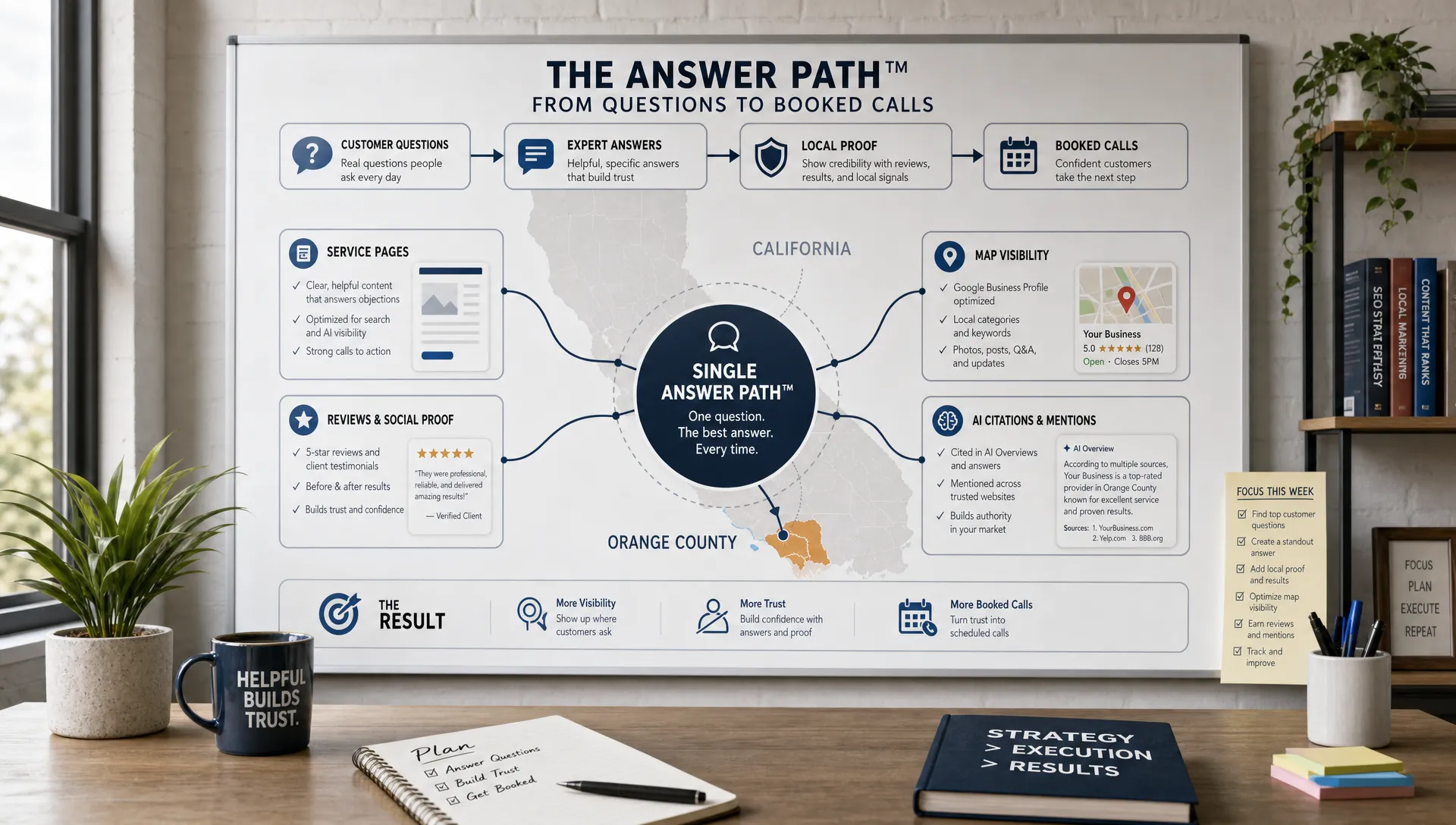
9. Make Your Website Answer-Ready for AI and Voice Search
Homeowners increasingly ask full questions instead of typing short keywords. They may ask, “Who is the best emergency plumber near me?” or “What should I do if my AC stops working in Irvine?” Search engines, AI assistants, and voice tools look for clear answers from trusted local entities.
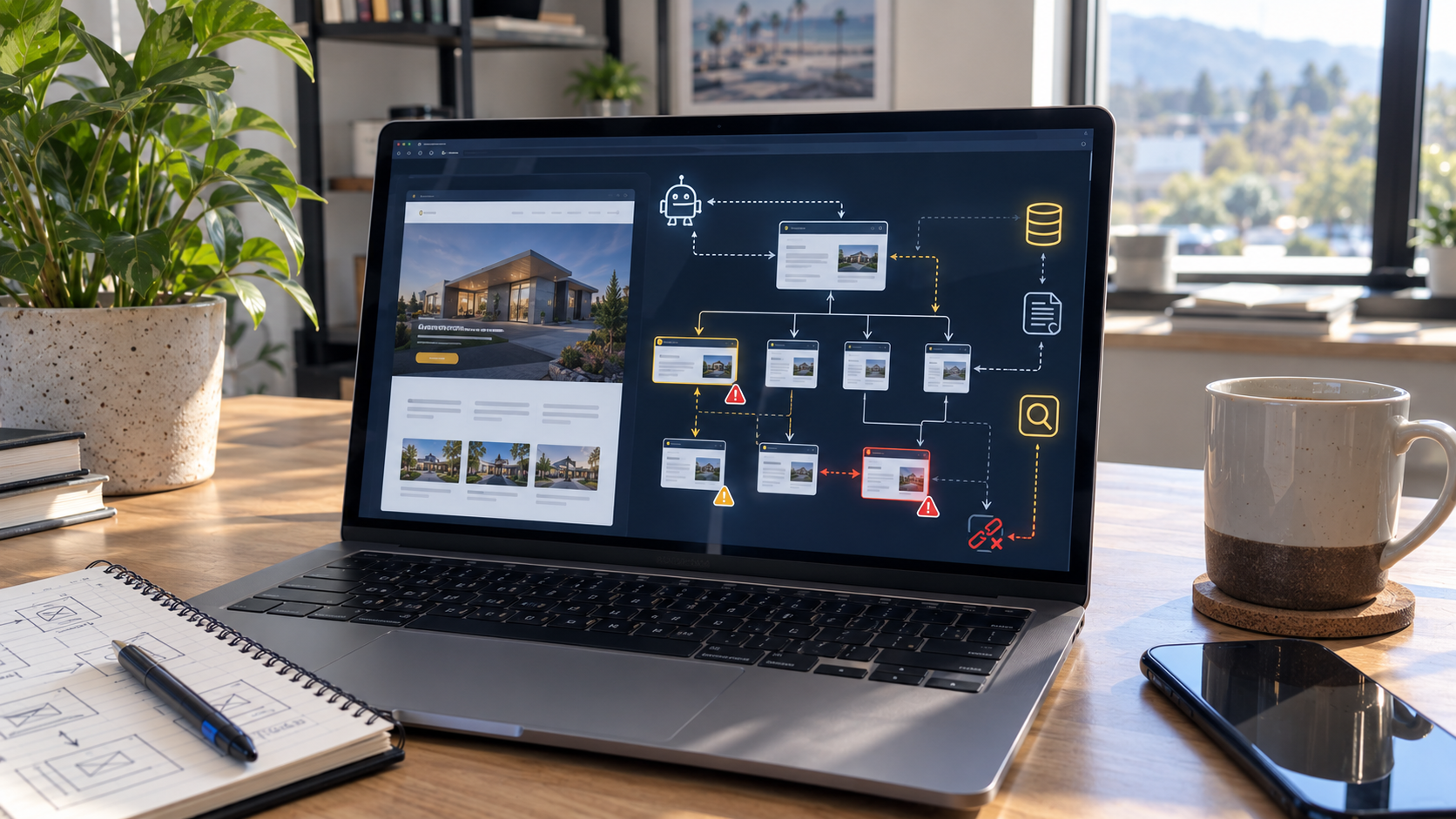
That means your website should be structured around questions, services, locations, proof, and clear business information. Add concise FAQs to service pages. Use plain language. Make sure your company name, services, service areas, contact information, and credentials are consistent across the web.
This is where Answer Engine Optimization becomes important. Traditional SEO helps you rank. AEO helps your business become understandable, trustworthy, and selectable when an answer engine decides which local company to recommend.
10. Fix the Missed-Call Leak Before Buying More Leads
Many contractors focus on generating more leads before fixing the way leads are handled. That is expensive. If your team misses calls, responds slowly, or fails to follow up, more marketing spend simply creates more waste.
Audit your call flow. How many calls are missed during business hours? What happens after hours? Are estimate requests followed up within minutes or hours? Does your team know which calls came from Google Business Profile, paid search, organic search, referrals, or direct mail?
Speed matters because homeowners often call multiple contractors. The contractor who responds clearly, confidently, and quickly often wins the appointment before the best technician ever arrives. If your challenge is creating more qualified conversations, Kell Web Solutions’ Profit Accelerator focuses on pre-warmed outreach, follow-up, and booking qualified meetings without manual prospecting.
11. Run Small Local Growth Experiments Every Month
Contractor marketing improves faster when you stop guessing and start testing. Instead of changing everything at once, run one or two small experiments each month.
You might test a new landing page for Huntington Beach water heater replacement, a review request script after completed service calls, a direct mail campaign in one neighborhood, or a Google Business Profile post series before peak season. A good way to think about this is the test-and-learn mindset used by growth marketing and innovation teams: define a hypothesis, run a focused experiment, measure the result, and keep what works.
The key is discipline. Every test should have a target audience, a timeline, a budget, and a success metric. Contractors do not need more random marketing activity. They need repeatable learning that turns into booked jobs.
12. Surround Priority Cities With Local Authority
If you want to win in Irvine, Newport Beach, Anaheim, or Laguna Niguel, one page on your website may not be enough. Competitive local markets reward businesses that build authority across multiple trusted signals.
That can include city-specific service pages, project stories, review mentions, local citations, partner mentions, locally relevant blog content, and supporting assets that reinforce your connection to the area. For home services companies that want to build deeper neighborhood signals, Kell Web Solutions’ Hyperlocal Authority Builder uses a distributed local authority approach with geo-targeted feeder assets, content, and review-focused trust signals.
The strategic idea is simple: make it easy for people, search engines, and AI systems to understand where you work, what you do, and why your company is a credible local answer.
A Practical 90-Day Plan for Orange County Contractors
A strong local marketing plan does not need to take a year to start producing useful signals. Use the first 90 days to build the foundation, create proof, and measure what turns into revenue.
| Timeline | Focus | Practical Actions |
|---|---|---|
| Days 1–30 | Visibility foundation | Audit Google Business Profile, fix NAP consistency, identify top 3 service cities, set up call tracking |
| Days 31–60 | Local proof | Publish city-specific service pages, add job stories, improve review requests, update project photos |
| Days 61–90 | Conversion and expansion | Test paid search, launch seasonal campaigns, improve landing pages, measure booked jobs by channel |
The goal is not to chase vanity metrics. Website visits, impressions, and rankings matter only if they help create qualified calls, estimate requests, consultations, or booked jobs. Track marketing all the way to revenue whenever possible.
What to Measure So You Know It Is Working
Contractors should measure local marketing by business outcomes, not marketing noise. At minimum, track calls, form fills, booked estimates, show rates, close rates, average job value, and revenue by city.
Also track which services produce profitable customers. A plumbing company may discover that emergency calls generate fast revenue but water heater replacements produce better margins. A roofing company may find that inspection campaigns create more future replacement jobs than direct replacement ads. An HVAC company may learn that maintenance plans improve long-term customer value more than one-time repair traffic.
When you know which cities, services, and campaigns produce profit, your marketing decisions become much safer.
Frequently Asked Questions
What is the best local marketing idea for a new Orange County contractor? Start with Google Business Profile optimization, consistent citations, customer reviews, and one strong service page for your most important city. Those assets create the foundation for calls, trust, and future SEO growth.
How many Orange County cities should a contractor target? Start with the cities where you can respond quickly, serve profitably, and show proof of real work. It is better to dominate three nearby cities than create weak pages for twenty cities you cannot support well.
Do contractors still need a website if most calls come from Google Business Profile? Yes. Your website supports trust, conversions, SEO, AI visibility, and paid campaigns. Many customers check your website after seeing your Google profile, especially for higher-ticket services.
How often should contractors ask for reviews? Ask after every completed job where the customer is satisfied. The process should be consistent, respectful, and compliant. Recent, service-specific reviews are especially valuable for local trust.
Is Answer Engine Optimization useful for local contractors? Yes, especially as homeowners use AI search, voice assistants, and Google AI results to compare local providers. AEO helps clarify your business entity, services, locations, and authority so answer engines can understand and recommend you.
Ready to Turn Local Visibility Into Booked Jobs?
If you are an Orange County contractor, your market is too competitive for random marketing. You need city-level visibility, proof that builds trust, and a system that turns attention into qualified calls.
Kell Web Solutions has worked in Orange County local marketing since 2001, helping businesses adapt as search, local SEO, and AI-driven discovery continue to change. If you want a practical plan for your contracting business, schedule a strategy call with Kell Web Solutions and find out where your next local growth opportunity is hiding.