Google Engine Optimization Tips for Orange County Brands
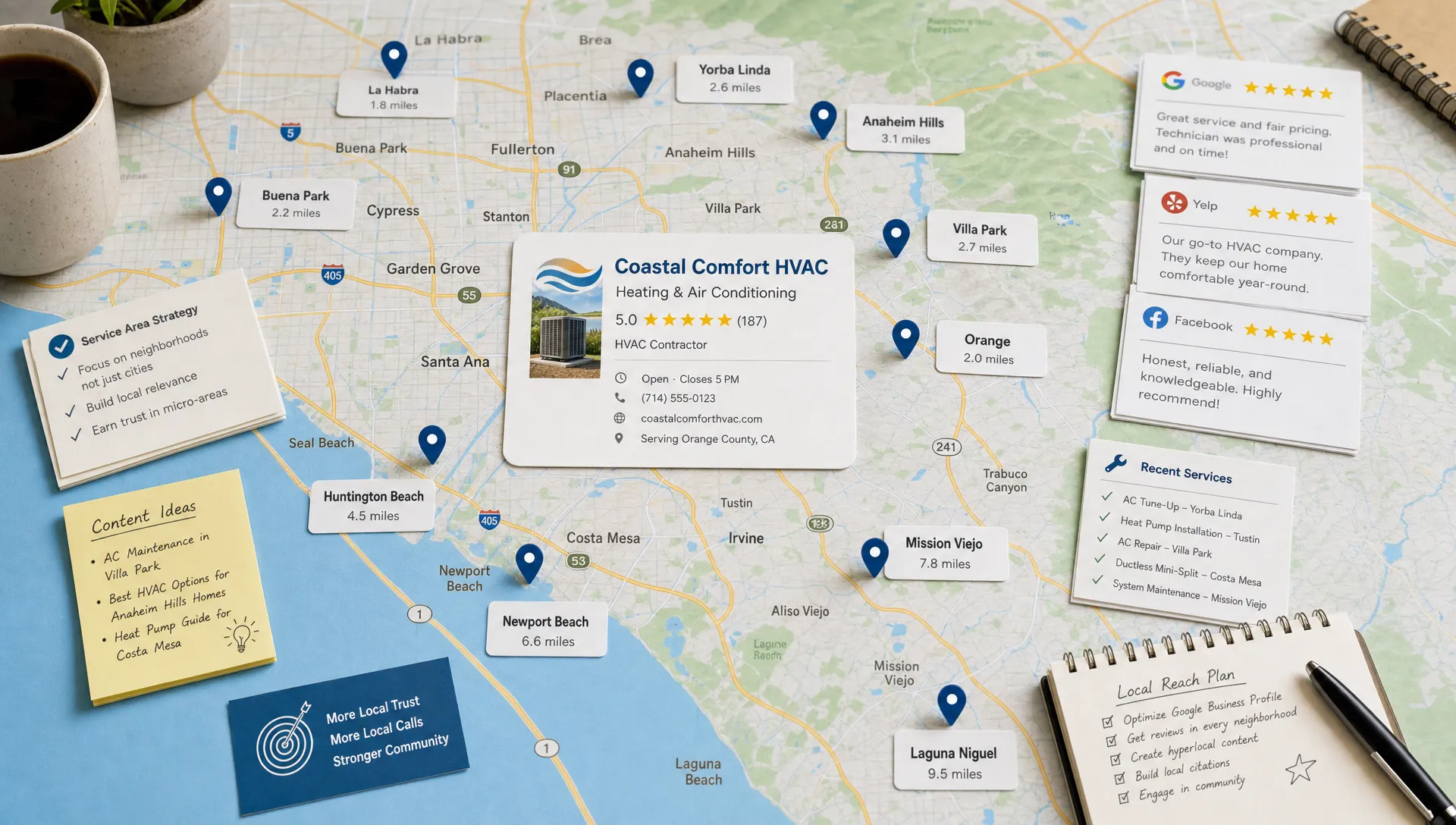
For Orange County brands, Google is no longer just a search box. It is a local decision engine that compares your website, Google Business Profile, reviews, service pages, citations, photos, structured data, and brand authority before deciding whether you deserve visibility.
That is why google engine optimization should be treated as a broader discipline than traditional SEO. The goal is not only to rank for a keyword. The goal is to become the clearest, most trusted, locally relevant answer when someone in Irvine, Laguna Niguel, Newport Beach, Anaheim, Huntington Beach, Santa Ana, or nearby cities needs help now.
For home service contractors, that might mean being visible when a homeowner asks, “Who fixes AC near me today?” For a dental group, law firm, or medical practice, it might mean showing up when a prospective patient or client asks for the best specialist near their neighborhood. In both cases, Google rewards clarity, proximity, proof, and usefulness.
What Google Engine Optimization Means in 2026
Traditional SEO focused heavily on rankings, keywords, backlinks, and website content. Those still matter. But Google’s ecosystem now includes organic search results, local map results, Google Business Profiles, reviews, AI-generated summaries, image results, voice queries, and zero-click answers.
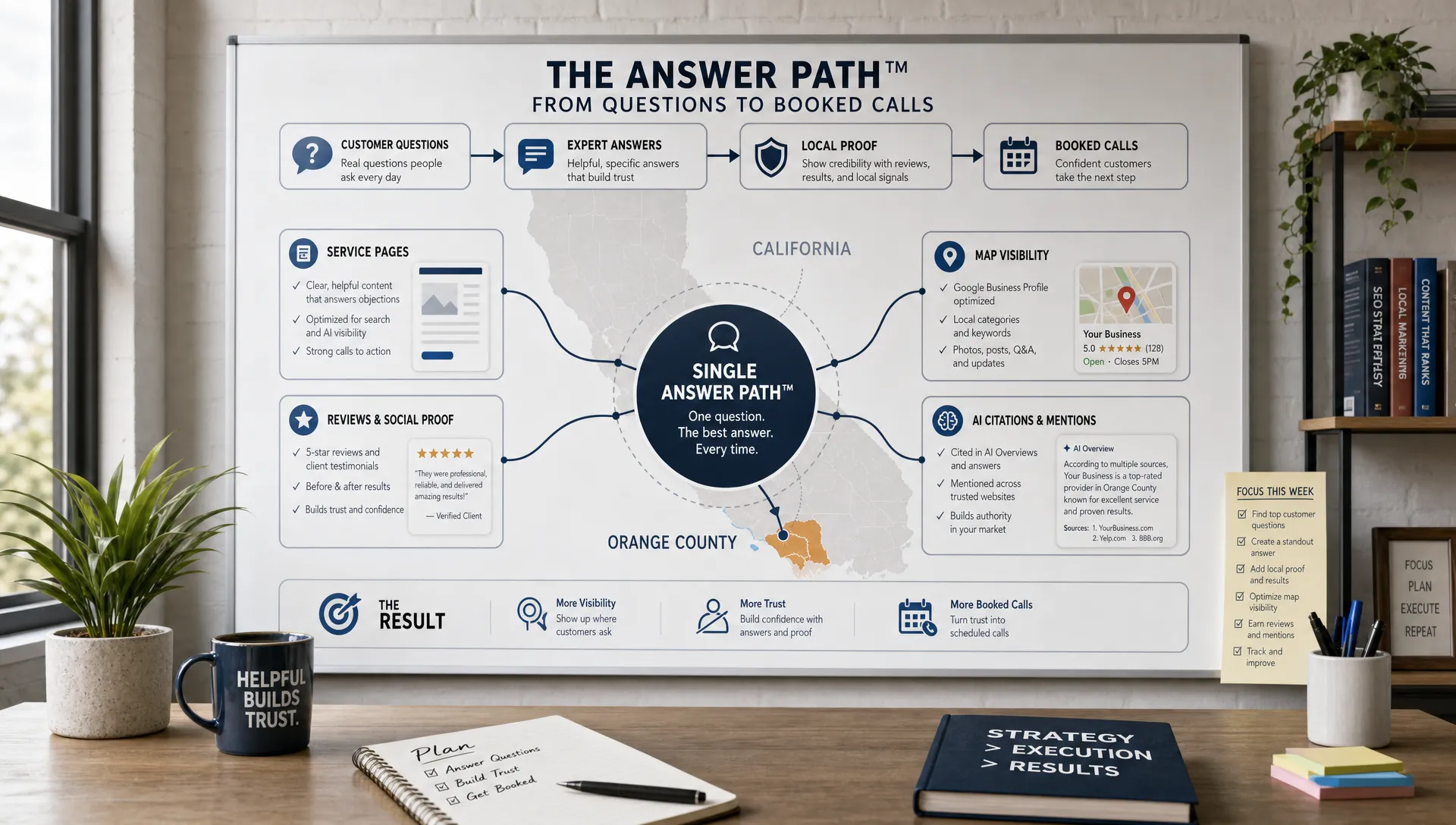
Google engine optimization is the process of improving every signal Google uses to understand and recommend your brand. It connects technical SEO, local SEO, content strategy, reputation, conversion design, and Answer Engine Optimization into one system.
| Google Visibility Layer | What Google Needs to Understand | Orange County Brand Priority |
|---|---|---|
| Organic search | What you do, who you serve, and why your page is useful | Build clear service pages and helpful content |
| Google Maps | Where you are relevant and whether customers trust you | Optimize your Google Business Profile and reviews |
| AI answers | Whether your brand is a reliable source for direct answers | Use structured, answer-first content and authority signals |
| Voice search | Whether your business is the best immediate match | Keep NAP, hours, categories, and service areas accurate |
| Conversion paths | Whether visitors can take action easily | Make calls, forms, booking, and trust proof obvious |
This matters because Orange County is not a generic market. A plumber in Laguna Beach competes differently than one in Anaheim. A Newport Beach law firm has a different trust threshold than a multi-location dental practice serving Santa Ana and Irvine. Google needs enough structured, local, and reputation-based evidence to connect each business with the right nearby searcher.
Start With How Customers Actually Ask for Help
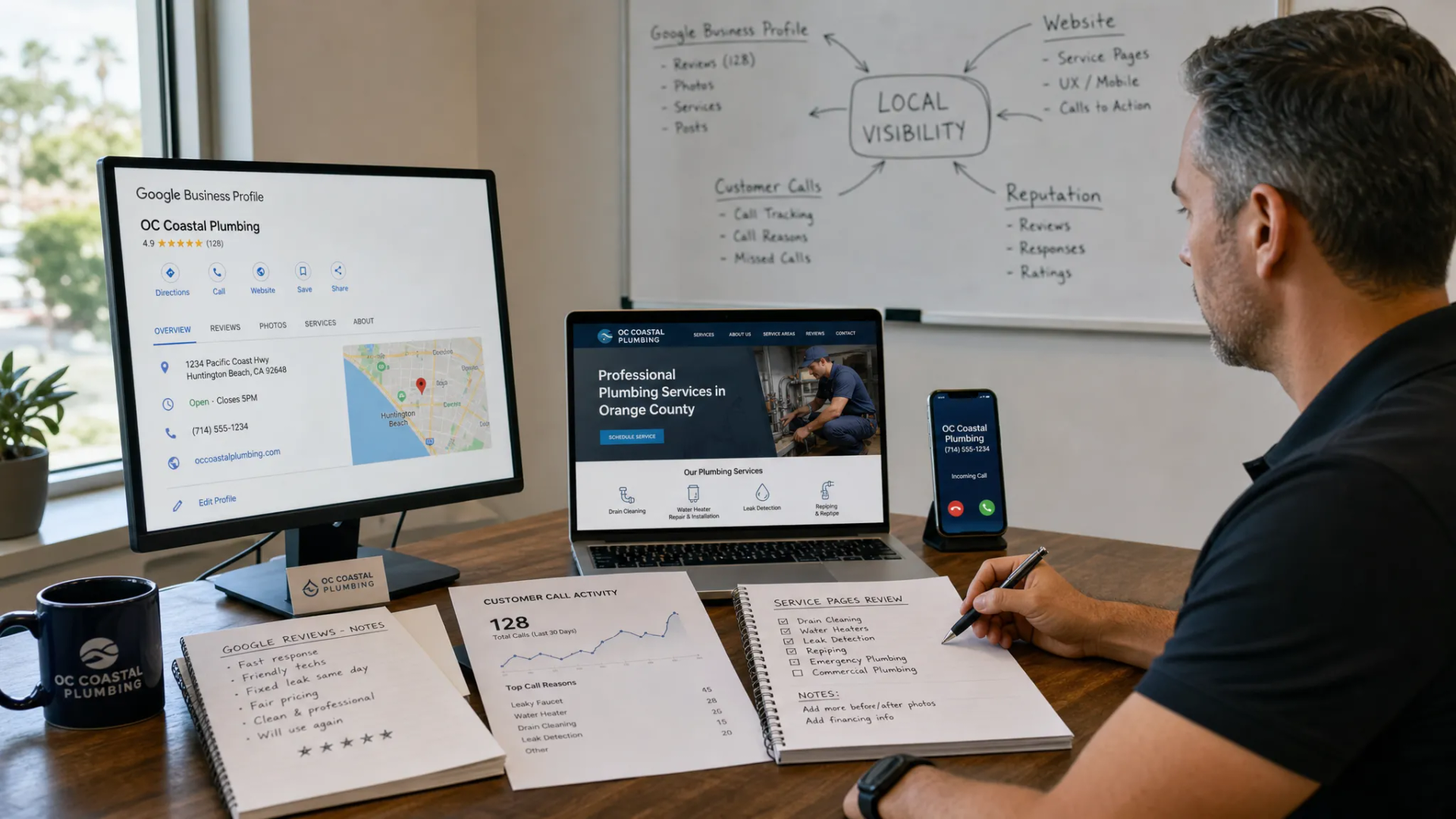
The strongest Google strategies begin with customer language, not marketing language. Most local buyers do not search the way businesses describe themselves internally. They ask urgent, specific, location-aware questions.
A roofing company may want to rank for “premium roof replacement,” but the homeowner may search “roof leak repair Huntington Beach after rain.” An HVAC contractor may talk about “high-efficiency system optimization,” while the customer asks “why is my AC blowing warm air in Irvine?” A law firm may describe “estate planning solutions,” while a client searches “living trust attorney near Laguna Niguel.”
Before changing titles, pages, or keywords, collect real customer questions from:
- Phone calls and intake forms
- Google Business Profile Q&A
- Sales team notes
- Reviews and testimonials
- Search Console queries
- Competitor FAQs
- Neighborhood-specific service requests
Then map those questions to pages. If a query shows urgent buying intent, it belongs on a service page or location page. If it shows research intent, it may belong in a blog article or FAQ. If it shows comparison intent, it may require proof, reviews, pricing factors, and differentiators.
Google’s own guidance on creating helpful content emphasizes content made for people first, not content created only to attract search traffic. That principle is especially important for local brands because vague pages are easy for Google to ignore. Specific pages that answer real customer questions are easier to understand, cite, and rank.
Build a Google Business Profile That Matches Buyer Intent
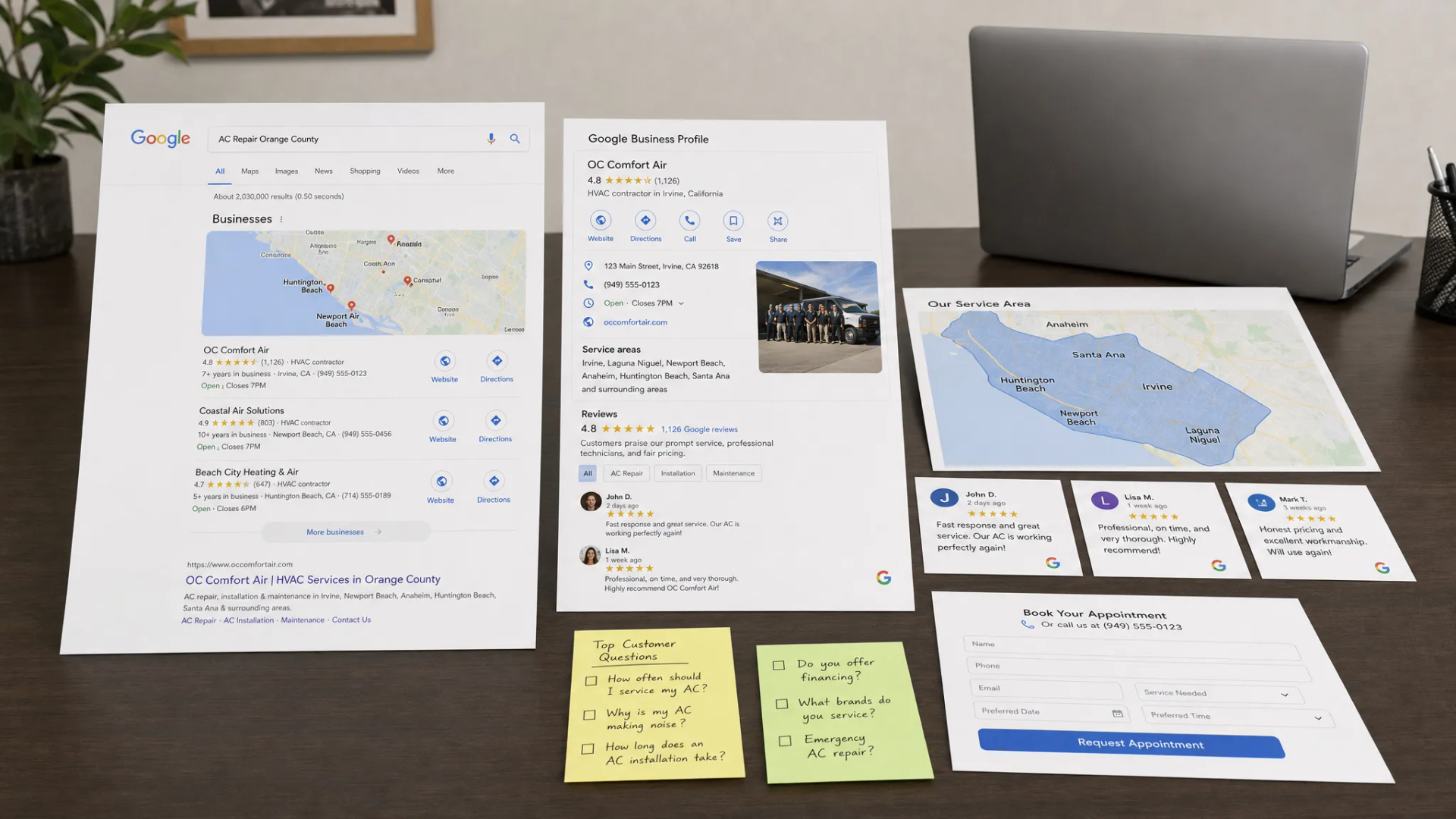
For local brands, the Google Business Profile is often more important than the homepage. It is the front door for map pack visibility, mobile calls, direction requests, reviews, photos, services, and quick comparisons.
Google states that local rankings are primarily influenced by relevance, distance, and prominence. You cannot control every aspect of distance, but you can improve relevance and prominence by making your profile complete, accurate, active, and consistent with your website.
| Google Business Profile Element | Why It Matters | Optimization Tip |
|---|---|---|
| Primary category | Helps Google classify your business | Choose the category closest to your core revenue service |
| Services | Expands relevance for specific searches | Add detailed services that match customer language |
| Business description | Clarifies who you help and where | Mention core services and primary Orange County service areas naturally |
| Photos | Builds trust and engagement | Upload real team, project, office, vehicle, and jobsite photos |
| Reviews | Signals prominence and customer confidence | Request reviews consistently and respond to every review |
| Posts and updates | Shows activity | Publish timely offers, seasonal reminders, and service updates |
| Q&A | Answers objections before the call | Add accurate answers to common customer questions |
Home service contractors should pay special attention to service areas, emergency availability, photos, and review language. Professional practices should focus on categories, appointment links, practitioner details, insurance or consultation information where appropriate, and trust-building photos.
The biggest mistake is treating the profile as a one-time setup. Google engine optimization requires ongoing profile care. Update holiday hours, add new photos, publish relevant posts, and monitor customer questions. An abandoned profile sends the wrong signal to both Google and buyers.
Make Every Core Service Page Answer-Ready
A service page should not read like a brochure. It should function like a direct answer to a local buyer’s problem.
For example, an Orange County HVAC repair page should quickly explain what symptoms you solve, which cities you serve, when customers should call, what affects pricing, what your process looks like, and why your team can be trusted. A dental implant page should clarify candidacy, consultation steps, location access, expected timelines, and patient trust signals. A legal services page should explain the problem, the process, the relevant practice area, and the next step without overwhelming the reader.
Strong service pages usually include:
- A clear answer to the main search intent near the top
- Specific services and situations handled
- Local references where genuinely relevant
- Proof such as reviews, credentials, project examples, or years of experience
- Process details that reduce uncertainty
- FAQs written in natural language
- Clear calls to call, schedule, or request an estimate
Avoid creating dozens of thin city pages that repeat the same text with a different city name. Google is much better at detecting low-value duplication than it used to be. If you create a page for Irvine, Anaheim, San Diego, San Jose, or Sacramento, make sure the page contains genuinely useful local information, not just swapped city names.
Use Structured Data to Remove Ambiguity
Structured data helps Google understand the meaning of your content. It does not guarantee rankings, but it reduces ambiguity and can support richer search features when implemented correctly.
Google’s documentation on structured data explains how standardized markup helps search engines interpret page content. For Orange County brands, the most relevant schema types often include LocalBusiness, Organization, Service, FAQPage, BreadcrumbList, and Article.
For home service companies, structured data can clarify service areas, business type, phone number, address, hours, and service offerings. For multi-location practices, it can help distinguish each office, provider page, service line, and appointment path.
Keep schema accurate. Do not mark up fake reviews, invisible content, misleading ratings, or services you do not actually provide. The purpose is to make your real business easier to understand, not to game the system.
Technical clarity also matters beyond schema. Your site should be mobile-friendly, fast, crawlable, secure, and easy to navigate. If Google struggles to crawl your pages, or if users abandon the page because it loads slowly, your content has less chance to perform.
Strengthen Local Entity Signals Beyond Your Website
Google does not evaluate your website in isolation. It builds an understanding of your brand from many sources across the web. That is why local entity consistency matters.
Your business name, address, phone number, website, categories, services, and service areas should be consistent across your Google Business Profile, website, major directories, social profiles, review platforms, chamber pages, local sponsorships, and industry associations.
For Orange County brands, the best authority signals are often local and specific. A mention from a Laguna Beach business association, a local nonprofit sponsorship page, a neighborhood project feature, a professional association profile, or a local media interview can be more relevant than a generic directory listing.
This is also where distributed local authority becomes valuable. A single website can only send so many neighborhood-level signals. Kell Web Solutions’ Hyperlocal Authority Builder is designed for businesses that need to build stronger local authority across specific neighborhoods, service areas, and California city markets.
The key is not to chase random links. The goal is to make your brand easier for Google to verify as a real, active, trusted provider in the markets you serve.
Treat Reviews as Search Assets, Not Just Social Proof
Reviews influence both buyer behavior and Google’s understanding of prominence. A strong review profile can help your business earn more calls, improve conversion rates, and support local visibility.
The best review strategy is operational, not occasional. Build review requests into the customer journey. Ask after successful service completion, make the request easy, and train your team to explain why feedback matters. For professional practices, make sure your process respects privacy, platform policies, and any industry-specific compliance requirements.
A healthy review system includes consistent requests, fast responses, and careful monitoring of recurring themes. If reviews repeatedly mention “same-day service,” “clean installation,” “clear communication,” or “helpful consultation,” that language can inform your website copy and FAQs.
Do not buy reviews, gate reviews, or pressure customers. Those tactics can damage trust and create platform risk. A slower, legitimate review strategy is safer and more durable.
Align Content With Orange County Micro-Markets
Orange County is not one uniform audience. Google engine optimization works better when content reflects local buying context.
A homeowner in coastal Newport Beach may care about salt air, corrosion, luxury finishes, and fast response without disruption. A family in Irvine may care about planning, reliability, and clear scheduling. A property manager in Anaheim may care about turnaround time, documentation, and vendor consistency. A patient in Laguna Niguel may care about accessibility, trust, and appointment availability.
| Local Market Context | Content Angle That Can Help |
|---|---|
| Laguna Beach and coastal communities | Explain coastal conditions, access constraints, and premium service expectations |
| Irvine and planned communities | Emphasize reliability, scheduling, family needs, and clear processes |
| Anaheim and Santa Ana | Address urgent service needs, multi-property concerns, and practical next steps |
| Newport Beach and Corona del Mar | Highlight trust, discretion, quality, and proof of expertise |
| Huntington Beach and coastal OC | Discuss weather exposure, salt air, and service timing when relevant |
| Multi-location California expansion | Build unique pages for each office, city, or service area with real local substance |
This does not mean forcing city names into every paragraph. It means showing that your brand understands the area, the customer, and the problem better than a generic competitor.
Show Operational Proof Google Can Understand
Google increasingly rewards clear, specific, verifiable information. Claims like “best service” or “trusted experts” are weak unless supported by evidence.
Operational proof can include years in business, certifications, service guarantees, before-and-after project examples, detailed case studies, staff bios, review themes, response times, service process explanations, and transparent FAQs. For professional practices, proof may include practitioner credentials, office locations, areas of focus, patient or client education, and clear intake steps.
A useful example comes from software and AI companies that make complex services easy to understand. Inaza, an AI-powered insurance automation platform, organizes its value around specific workflows such as underwriting, claims, and operations. Local Orange County brands can apply the same principle by turning broad claims into clearly defined service use cases, customer problems, and measurable outcomes.
For a contractor, that might mean creating pages for “emergency AC repair,” “heat pump installation,” “roof leak inspection,” or “panel upgrade for older homes.” For a practice, it might mean creating pages for “same-week dental emergency visits,” “estate planning for Orange County families,” or “multi-location physical therapy appointments.” The more precisely you define what you do, the easier it is for Google and customers to match you to the right query.
Connect Search Visibility to Calls and Appointments
Traffic is useful only if it turns into business. A common problem for local brands is ranking for informational queries while losing high-intent buyers because the website is confusing, the phone path is buried, or calls are missed.
Every important page should make the next step obvious. For emergency services, the phone number should be prominent on mobile. For consultations, the booking path should be simple. For higher-trust services, include proof near the call to action, not only at the bottom of the page.
Measure conversion signals such as calls, form submissions, booked appointments, qualified estimates, and revenue by service line. If you only measure rankings, you may miss the real business problem.
| Metric | What It Tells You | Why It Matters |
|---|---|---|
| Google Business Profile calls | Whether map visibility is producing action | Critical for contractors and urgent services |
| Direction requests | Whether local customers see you as nearby | Useful for practices and showrooms |
| Service page conversions | Which pages create leads | Helps prioritize content and optimization |
| Review growth and sentiment | Whether trust is improving | Supports both rankings and conversion |
| Missed call rate | Whether demand is being wasted | Visibility without response loses revenue |
| AI answer mentions | Whether answer engines recognize your brand | Important for AEO and future search behavior |
Kell Web Solutions’ Profit Accelerator focuses on turning qualified prospects into pre-warmed conversations, while Answer Engine Optimization helps businesses structure their digital presence so AI-driven platforms can better understand and recommend them. For many Orange County brands, the strongest growth comes from combining visibility, trust, and response systems.
A Practical 90-Day Google Optimization Plan
A focused 90-day plan is often enough to uncover major gaps and build momentum. The goal is not to do everything at once. The goal is to improve the signals that matter most for your market.
| Timeline | Focus | Actions |
|---|---|---|
| Days 1–30 | Audit and clarify | Review Google Business Profile, service pages, Search Console queries, reviews, citations, technical issues, and missed conversion paths |
| Days 31–60 | Build and improve | Rewrite core service pages, improve GBP services and photos, add FAQs, fix schema, request reviews, and clean up inconsistent listings |
| Days 61–90 | Expand authority | Publish local content, strengthen internal links, add proof assets, pursue relevant local mentions, and measure calls and booked jobs |
If you serve multiple cities, start with the locations that produce the most profitable customers. A roofing company may prioritize Newport Beach, Irvine, and Huntington Beach. A dental group may prioritize offices and surrounding neighborhoods. A law firm may prioritize practice-area pages tied to the cities where ideal clients live or work.
Common Mistakes Orange County Brands Should Avoid
The most common mistake is optimizing for Google while ignoring the customer. Google’s systems are designed to reward useful, trustworthy results. If your content is thin, your reviews are weak, your profile is incomplete, or your site is hard to use, keyword tweaks will not solve the problem.
Other mistakes include creating duplicate city pages, using stock-heavy service pages with no local proof, neglecting the Google Business Profile, failing to respond to reviews, publishing generic AI content without expert editing, and tracking rankings without tracking calls.
Another mistake is separating SEO, web design, reputation, and call handling into disconnected silos. Google engine optimization works best when all of those pieces support the same message: this business is real, local, trusted, and ready to help.
Frequently Asked Questions
What is google engine optimization? Google engine optimization is the process of improving your visibility across Google’s full ecosystem, including organic search, Maps, Google Business Profile, reviews, AI answers, structured data, and conversion paths. It is broader than traditional keyword-based SEO.
Is Google engine optimization different from SEO? Yes. SEO is part of it, but Google engine optimization also includes local entity signals, Google Business Profile management, review strategy, structured data, AI answer readiness, and call or appointment conversion.
How long does it take for an Orange County brand to see results? Some improvements, such as Google Business Profile updates and better conversion paths, can help quickly. Larger gains from content, authority, reviews, and local relevance usually build over several months.
Do contractors need separate pages for every Orange County city? Not always. City pages can help when they provide unique, useful local information. Thin pages that simply swap city names are risky and usually less effective than strong service pages supported by real local proof.
Can multi-location professional practices use the same strategy? Yes, but each location should have accurate business information, clear appointment paths, unique local content, practitioner or service details, and reputation signals relevant to that office or catchment area.
Do reviews really affect Google visibility? Reviews support prominence, trust, and conversion. They are not the only ranking factor, but a steady flow of legitimate reviews with thoughtful responses can strengthen both local search performance and buyer confidence.
Make Google Work Harder for Your Orange County Brand
Google visibility is no longer about one tactic. It is about creating a trustworthy digital footprint that helps Google understand who you are, where you serve, what problems you solve, and why customers choose you.
If your Orange County business depends on local calls, booked appointments, or neighborhood-level visibility, Kell Web Solutions can help you build a more durable search presence through Local SEO, Answer Engine Optimization, and hyperlocal authority strategies.
Ready to find the gaps costing you calls? Book a strategy call with Kell Web Solutions and start turning Google visibility into confident, qualified conversations.