What Search Engine Optimization Really Means in 2026
Search engine optimization used to mean getting a website to rank higher in Google. That definition is no longer wrong, but it is incomplete.
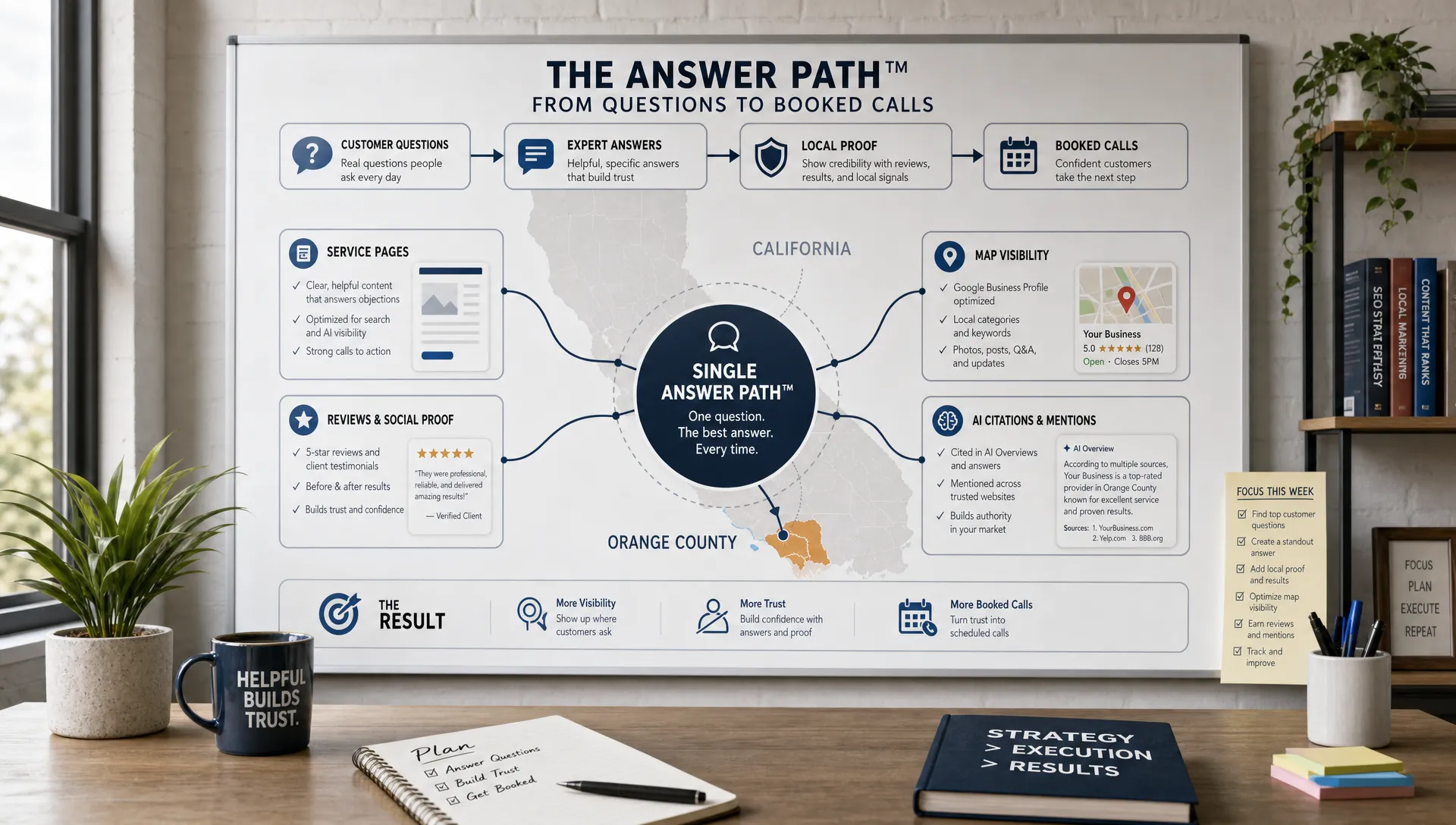
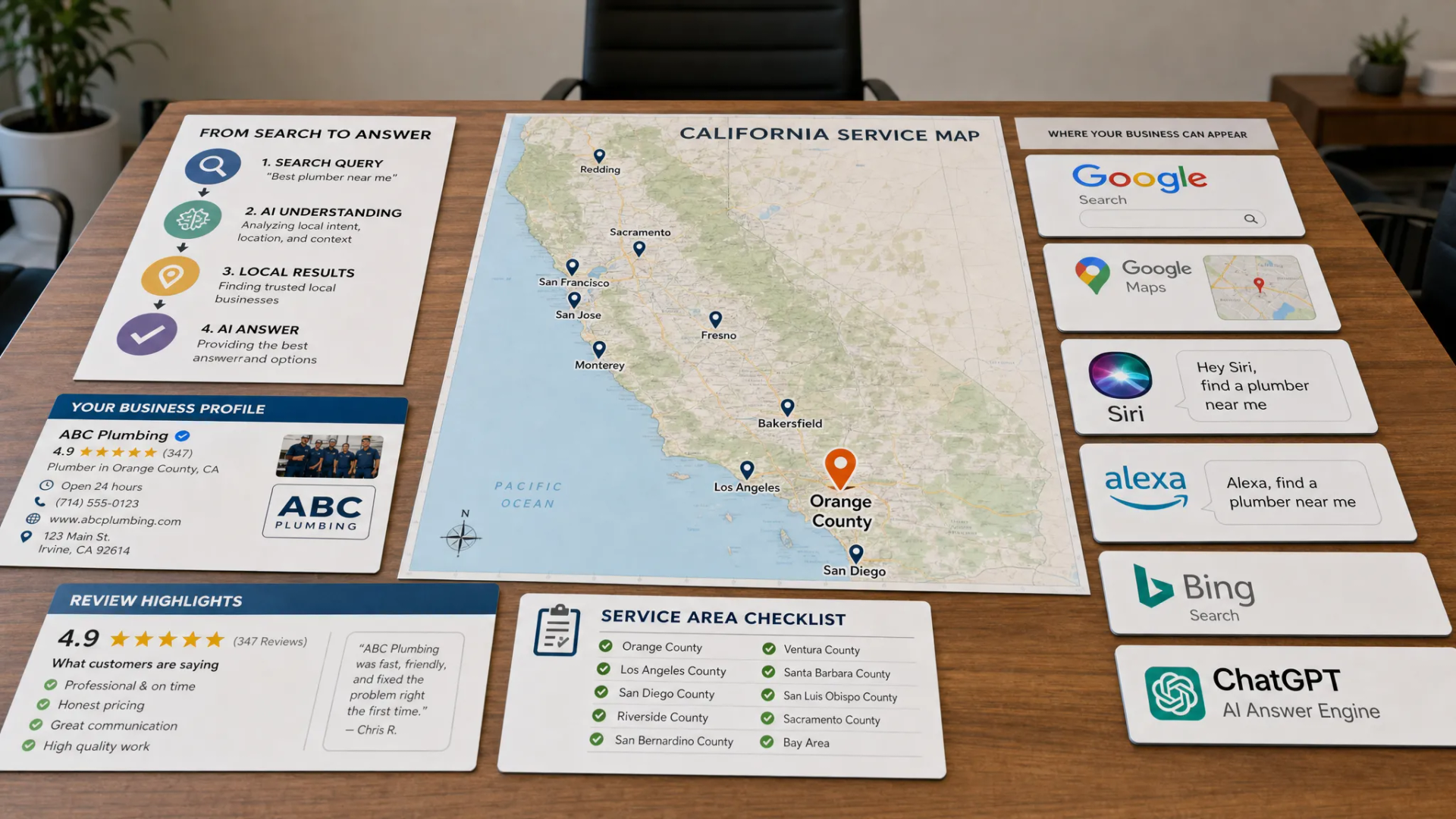
In 2026, search engine optimization means making your business easy for search engines, AI systems, map results, voice assistants, and real customers to understand, trust, and choose. Rankings still matter, but they are only one part of the job. The real question is whether your business becomes the obvious answer when a buyer asks for help.
For an Orange County HVAC contractor, that might mean showing up when a homeowner in Irvine asks why the AC is blowing warm air. For a Laguna Niguel dental group, it might mean being trusted when someone searches for emergency dental care nearby. For a San Jose law firm or a San Diego remodeler, it might mean being visible across Google Maps, AI Overviews, local service searches, and answer engines before the prospect ever clicks through to a website.
That is the new reality of SEO in 2026.
The short definition of search engine optimization in 2026
Search engine optimization is the process of building a clear, credible, and technically accessible digital presence so the right customers can find and trust your business at the exact moment they need it.
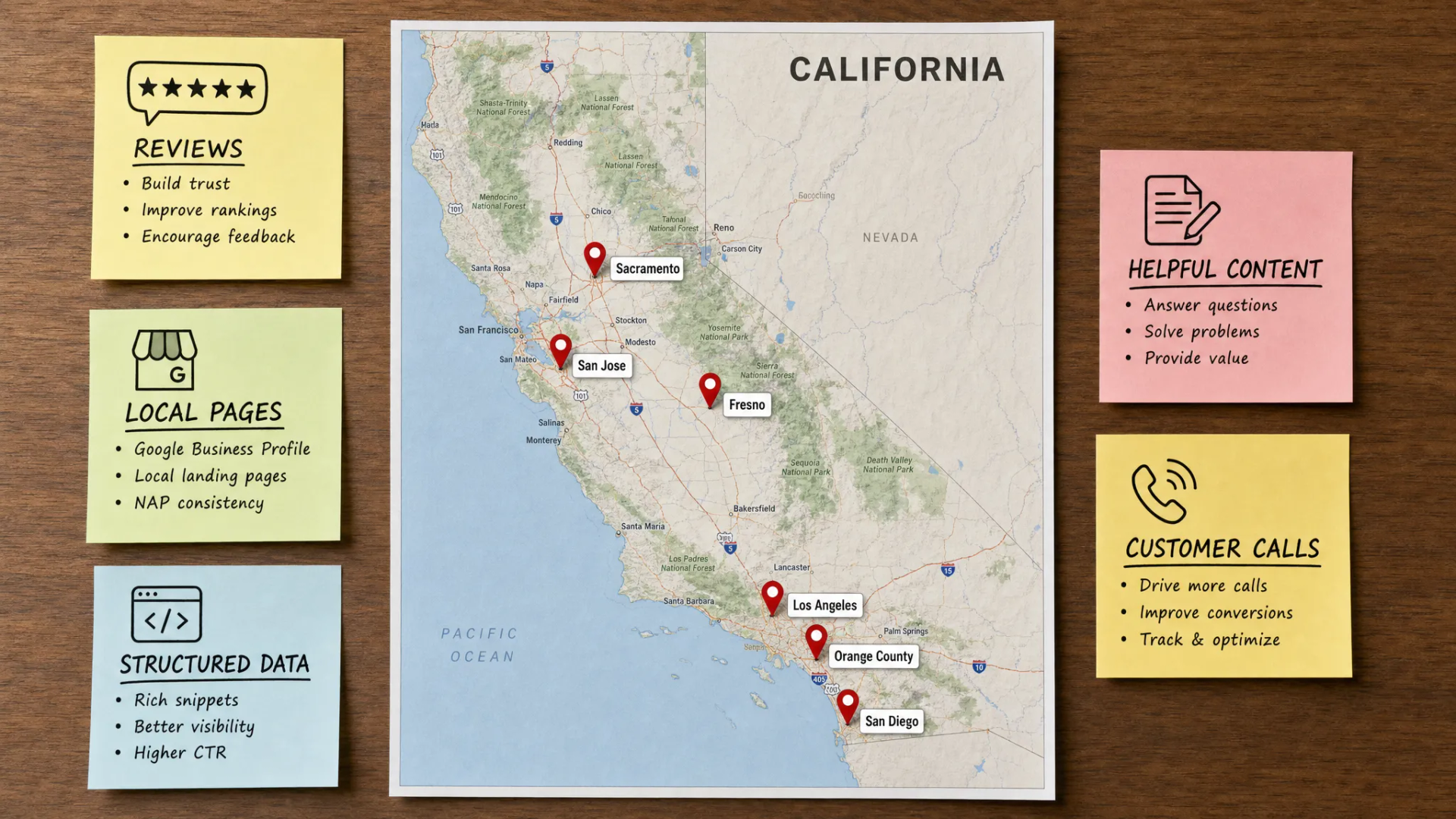
That means your website, Google Business Profile, reviews, local citations, structured data, content, service pages, and off-site authority all need to tell the same story.
A modern search engine should be able to answer five basic questions about your business without confusion:
- Who are you?
- What services do you provide?
- Where do you provide them?
- Why should customers trust you?
- What should a qualified prospect do next?
If any of those answers are unclear, incomplete, or inconsistent, search systems have less confidence in your business. In competitive California markets such as Orange County, Los Angeles, San Diego, San Jose, Sacramento, Fresno, and Irvine, that lack of confidence can quietly turn into lost calls.
Why the old SEO definition is too small
The fundamentals of SEO still matter. Google’s own SEO Starter Guide still emphasizes crawlable pages, useful content, descriptive titles, good site structure, and links that help users and search engines understand a site.
But the way customers interact with search has changed. People no longer only type short keywords and scan ten blue links. They ask full questions. They use voice search. They compare providers in maps. They read reviews before calling. They see AI-generated summaries before they ever visit a website.
That means SEO has expanded from ranking pages to managing digital trust.
Search is now answer-driven
A homeowner might search for best roofer near Huntington Beach after storm damage. Google may show a map pack, reviews, AI-generated guidance, local business profiles, and service pages. The winning company is not always the one with the most keyword repetition. It is the one that provides the clearest, most trustworthy answer across every surface.
Search is now entity-driven
Search systems need to understand your business as an entity, not just a collection of keywords. Your company name, service categories, founder information, address, service areas, reviews, schema markup, social profiles, and third-party mentions all help define who you are.
For local businesses, entity clarity is especially important. If your plumbing company serves Laguna Beach, Dana Point, San Clemente, and Newport Beach, that geographic relationship should be clear across your site and supporting assets.
Search is now proof-driven
Search engines and AI systems look for signals that support trust. Reviews, credentials, project examples, case studies, service-area consistency, industry expertise, and helpful content all matter. For professional practices, this can include attorney profiles, dentist bios, medical credentials, office locations, appointment information, and clear explanations of services.
Old SEO vs. SEO in 2026
The difference is not that traditional SEO disappeared. The difference is that traditional SEO is no longer enough by itself.
| SEO Focus | What It Used to Mean | What It Means in 2026 |
|---|---|---|
| Keywords | Place target phrases on pages | Understand real customer questions and intent |
| Rankings | Track positions in organic results | Track visibility across search, maps, AI answers, and local packs |
| Content | Publish blog posts for traffic | Build helpful answers that prove expertise and support decisions |
| Local SEO | Add city names and citations | Build neighborhood-level authority and location trust |
| Technical SEO | Fix crawl errors and speed issues | Make the site fast, structured, accessible, and machine-readable |
| Reviews | Improve star rating | Build trust, conversion confidence, and local prominence |
| Leads | Get more website visits | Generate qualified calls, appointments, estimates, and consultations |
The businesses that win in 2026 are the ones that connect all of these pieces into one durable visibility system.
The five jobs of modern SEO
Modern search engine optimization has five practical jobs. If your SEO program does not address all five, it may produce activity without producing revenue.
1. Clarify your business entity
Search engines need confidence that your business is real, active, specialized, and locally relevant. That starts with consistent name, address, phone, website, service categories, and business descriptions across your website, Google Business Profile, citations, and social profiles.
For contractors, this means clearly defining service categories such as HVAC repair, roof replacement, solar installation, plumbing, electrical work, or remodeling. For professional practices, it means making attorneys, doctors, dentists, office locations, and practice areas easy to understand.
Entity clarity also includes structured data. Schema markup can help search systems interpret services, locations, reviews, FAQs, articles, and organization details. In 2026, structured data is not a magic ranking trick. It is a clarity tool.
2. Match content to real buyer intent
Many businesses still publish content based on what they want to say. SEO in 2026 starts with what buyers actually ask.
A homeowner does not usually start with a polished keyword like Orange County HVAC contractor. They may ask why their AC is leaking water, how much a new heat pump costs in California, or whether a roofer can inspect storm damage before insurance approval.
A legal or medical prospect may ask whether they need a consultation, what a procedure involves, how long a case takes, or which provider is close to their neighborhood.
The best content answers these questions clearly, honestly, and locally. It does not bury the answer under fluff. It helps the searcher move from confusion to confidence.
3. Build hyperlocal authority
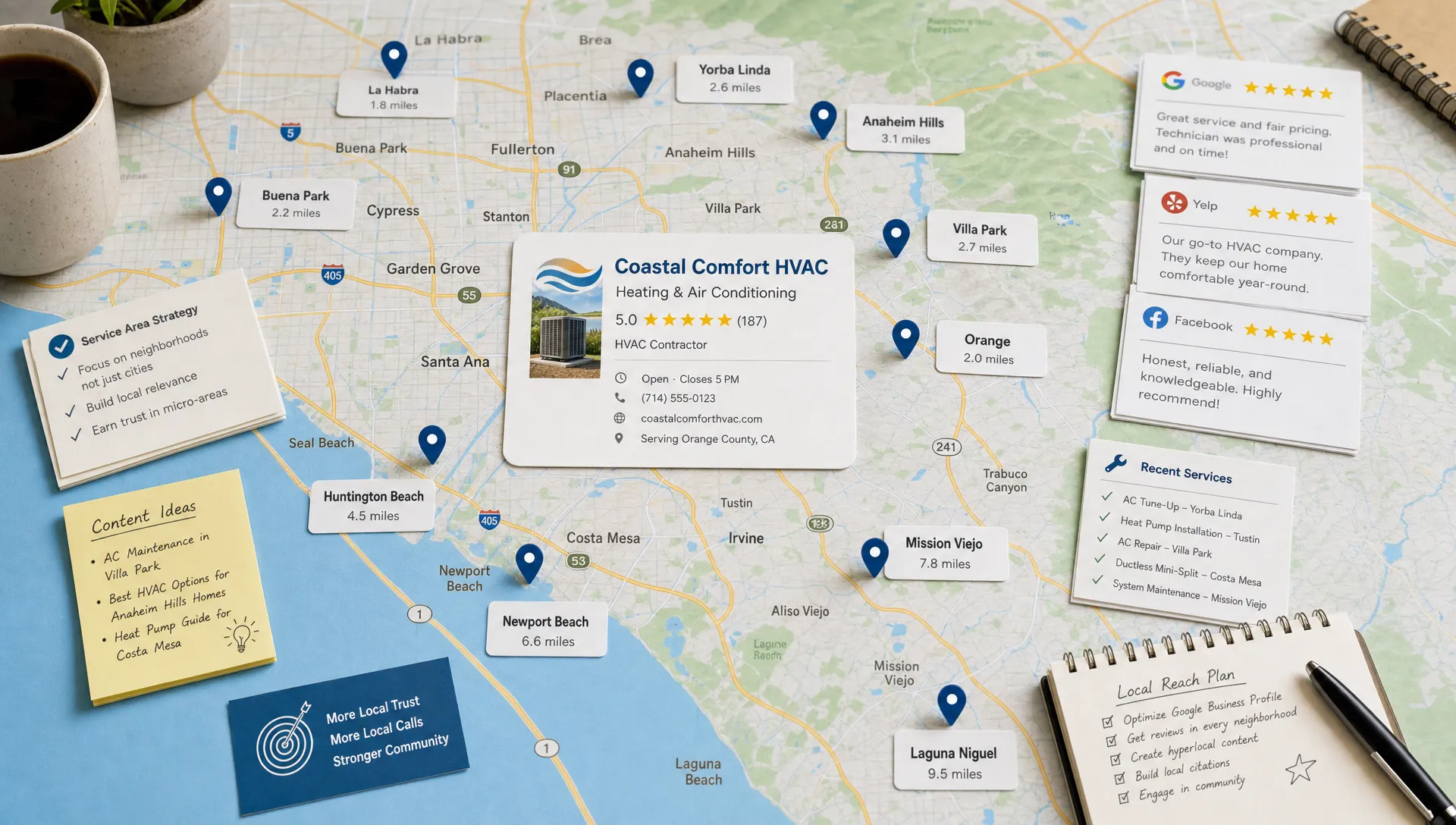
Local visibility is not just about ranking for a city. It is about proving relevance to the neighborhoods, service areas, and customer situations that drive revenue.
Google explains that local results are influenced by relevance, distance, and prominence in its local ranking guidance. That framework matters even more in crowded California markets, where dozens of businesses may compete for the same service and city.
For a home services company, hyperlocal authority may include dedicated service-area pages, locally specific project examples, neighborhood FAQs, review generation, Google Business Profile updates, and supporting content that reflects actual homeowner concerns.
For a multi-location practice, it may include unique location pages, provider bios, office-specific reviews, localized appointment pathways, and content that reflects the needs of each catchment area.
This is where a single generic website often falls short. Modern SEO requires a broader footprint of trustworthy local signals.
4. Strengthen proof and trust signals
Search visibility without trust does not create many calls. A prospect who finds you still needs evidence that you are the right choice.
Trust signals include reviews, testimonials, before-and-after examples, licenses, years in business, professional credentials, service guarantees, media mentions, case studies, and clear contact information. They also include how quickly and professionally your business responds to inquiries.
In competitive markets like Newport Beach, Irvine, Anaheim, San Francisco, Oakland, and Sacramento, trust can be the deciding factor. A company with slightly less visibility but stronger proof may win more booked jobs than a company with more traffic and a weak reputation.
5. Convert visibility into action
SEO should not end at the click. It should lead to a qualified call, form submission, estimate request, booked appointment, or consultation.
That means your website needs clear calls to action, fast load times, mobile-friendly design, service-specific landing pages, and simple contact options. If your phone number is hard to find, forms are too long, pages load slowly, or messaging is vague, SEO traffic leaks away.
For B2B and professional services firms, conversion can also involve warm introductions and relationship-based selling. When search visibility is paired with tools for AI-powered relationship intelligence, firms can identify warm introduction opportunities from existing networks instead of relying only on cold outreach.
In 2026, the strongest growth systems connect visibility, trust, relationship signals, and follow-up into one process.
What SEO means for California contractors
For home services contractors, search engine optimization is no longer just a marketing channel. It is part of the lead-generation infrastructure.
A contractor’s customers often search under pressure. Their AC fails during a heat wave. Their roof leaks after rain. Their water heater stops working before guests arrive. Their electrical panel needs an urgent upgrade. These buyers need fast answers, local trust, and a clear path to call.
That changes the SEO priorities.
Your service pages need to answer high-intent questions quickly. Your Google Business Profile needs accurate hours, service categories, photos, reviews, and updates. Your content should reflect seasonal and local realities, such as coastal corrosion in Laguna Beach, older homes in Santa Ana, high-end expectations in Newport Coast, or summer cooling demand in Inland Empire communities.
Contractor SEO in 2026 is about being visible when urgency and local intent overlap.
What SEO means for professional practices
For medical, dental, and legal practices, SEO is about trust before contact.
Prospects often research carefully before they call. They compare credentials, reviews, locations, experience, tone, and clarity. They want to know whether your practice understands their issue and whether the next step feels safe.
A multi-location practice should avoid copying the same location page across every city. Each office page should be useful on its own, with unique local details, provider information, appointment guidance, directions, reviews, and service explanations.
Professional practice SEO in 2026 is also closely tied to reputation. A strong content strategy can bring prospects in, but reviews, bios, credentials, and clear intake pathways help them decide to take the next step.
What to measure now
Traffic is still useful, but it is not the final scoreboard. In 2026, SEO performance should be measured by visibility, trust, and revenue outcomes.
| Metric | Why It Matters |
|---|---|
| Qualified calls | Shows whether visibility is turning into real conversations |
| Booked appointments or estimates | Connects SEO to revenue opportunities |
| Google Business Profile actions | Tracks calls, direction requests, and website clicks from local search |
| Map pack visibility | Measures local presence for high-intent searches |
| AI answer visibility | Shows whether your brand appears in answer-driven results |
| Review velocity and quality | Indicates trust growth and local prominence |
| Service-area performance | Reveals which cities or neighborhoods are producing demand |
| Conversion rate by page | Shows whether service pages persuade visitors to act |
The most important shift is this: SEO should be judged by business outcomes, not vanity metrics.
If organic traffic is down but qualified calls are up, your SEO may be working. If rankings improve but booked jobs do not, the strategy needs adjustment.
A practical 90-day SEO reset for 2026
If your business has been doing SEO the same way for years, start with a reset rather than a complete rebuild.
Days 1 to 30: Audit clarity and trust
Review your website, Google Business Profile, citations, reviews, service pages, and local content. Look for inconsistencies in services, locations, phone numbers, categories, and messaging. Identify your highest-value services and the cities or neighborhoods that matter most.
Ask a simple question: would a search engine and a customer understand exactly why your business is relevant and trustworthy?
Days 31 to 60: Rebuild high-intent pages
Focus first on pages that drive revenue. For contractors, that may mean emergency repair, replacement, installation, or inspection pages. For professional practices, it may mean core service pages, provider pages, and location pages.
Each page should answer the main buyer questions, explain who the service is for, include local relevance, show proof, and make the next step obvious.
Days 61 to 90: Expand local authority
Once the foundation is clearer, build supporting assets. Publish useful local content. Improve internal links. Add structured data where appropriate. Strengthen review requests. Update Google Business Profile posts and photos. Create or improve pages for priority service areas.
This is also the stage where many businesses consider a broader AEO or hyperlocal strategy, especially if they compete across multiple cities.
Common SEO mistakes in 2026
The biggest mistake is treating SEO as a checklist instead of a trust system.
Keyword-stuffed pages, duplicate city pages, thin AI-generated blogs, outdated Google Business Profiles, inconsistent citations, and weak conversion paths can all limit performance. They may create the appearance of SEO activity, but they do not build durable authority.
Another mistake is ignoring AI-driven search. Even if your traditional rankings look stable, customers may be getting answers from AI Overviews, voice assistants, map results, and third-party summaries before they visit your site. If your business is not structured as a trusted source, those systems may choose someone else.
Finally, many businesses fail to connect SEO with operations. If calls are missed, reviews are not requested, intake is slow, or estimates are not followed up, visibility will not reach its full value.
Frequently Asked Questions
Is search engine optimization still worth it in 2026? Yes. SEO is still essential, but the goal has changed. Instead of chasing rankings alone, businesses need to build trust across search engines, maps, AI answers, reviews, and conversion pathways.
What is the difference between SEO and Answer Engine Optimization? SEO focuses on improving visibility in search results. Answer Engine Optimization focuses on helping AI-driven systems understand, trust, and select your business as the answer to a user’s question. The two should work together.
How long does SEO take for a local business? Foundational improvements can often be made within 30 to 90 days, but durable authority usually compounds over several months. Competitive markets like Orange County, Los Angeles, San Diego, and San Jose often require consistent effort.
Do contractors and professional practices need different SEO strategies? Yes. Contractors often need urgent, service-area-driven visibility that converts into calls. Professional practices usually need deeper trust signals, provider credibility, location-specific content, and clear consultation pathways.
What should a business optimize first in 2026? Start with entity clarity, core service pages, Google Business Profile accuracy, reviews, and conversion paths. Once those are strong, expand into hyperlocal content, structured data, and answer-engine visibility.
Build search visibility that still works in 2026
Search engine optimization in 2026 is not about tricks. It is about being clear, credible, local, machine-readable, and easy to choose.
Kell Web Solutions helps California contractors and professional practices adapt to this new search reality with Answer Engine Optimization, Local SEO Mastery, and the Hyperlocal Authority Builder. The goal is simple: turn search visibility into confident calls, booked appointments, and long-term revenue.
If your business depends on local demand in Orange County or across California, now is the time to find out whether your digital presence is ready for how customers search in 2026. Call Kell Web Solutions at (949) 575-8553 to start the conversation.