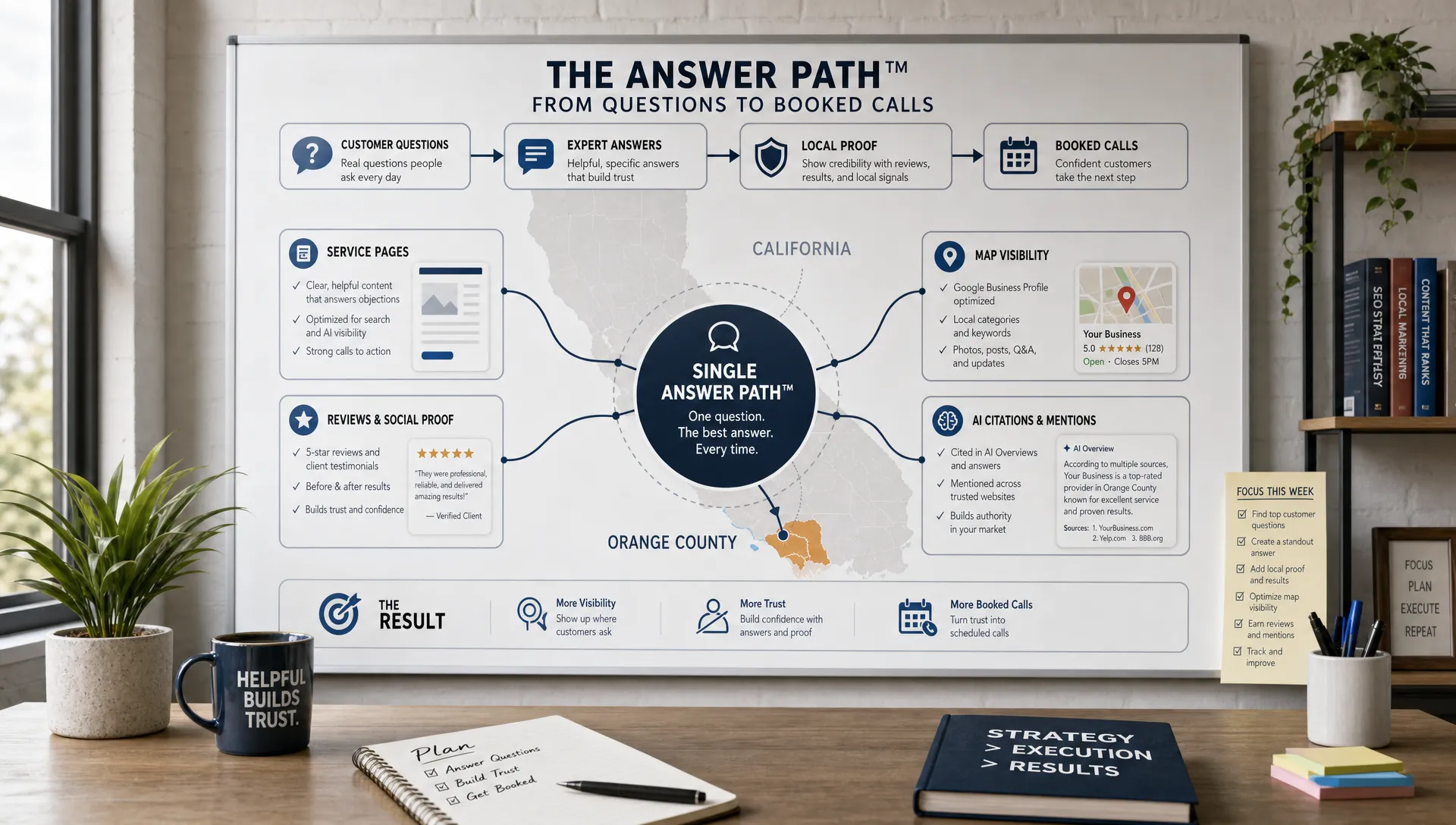
How to Choose a Web Designer in Orange County
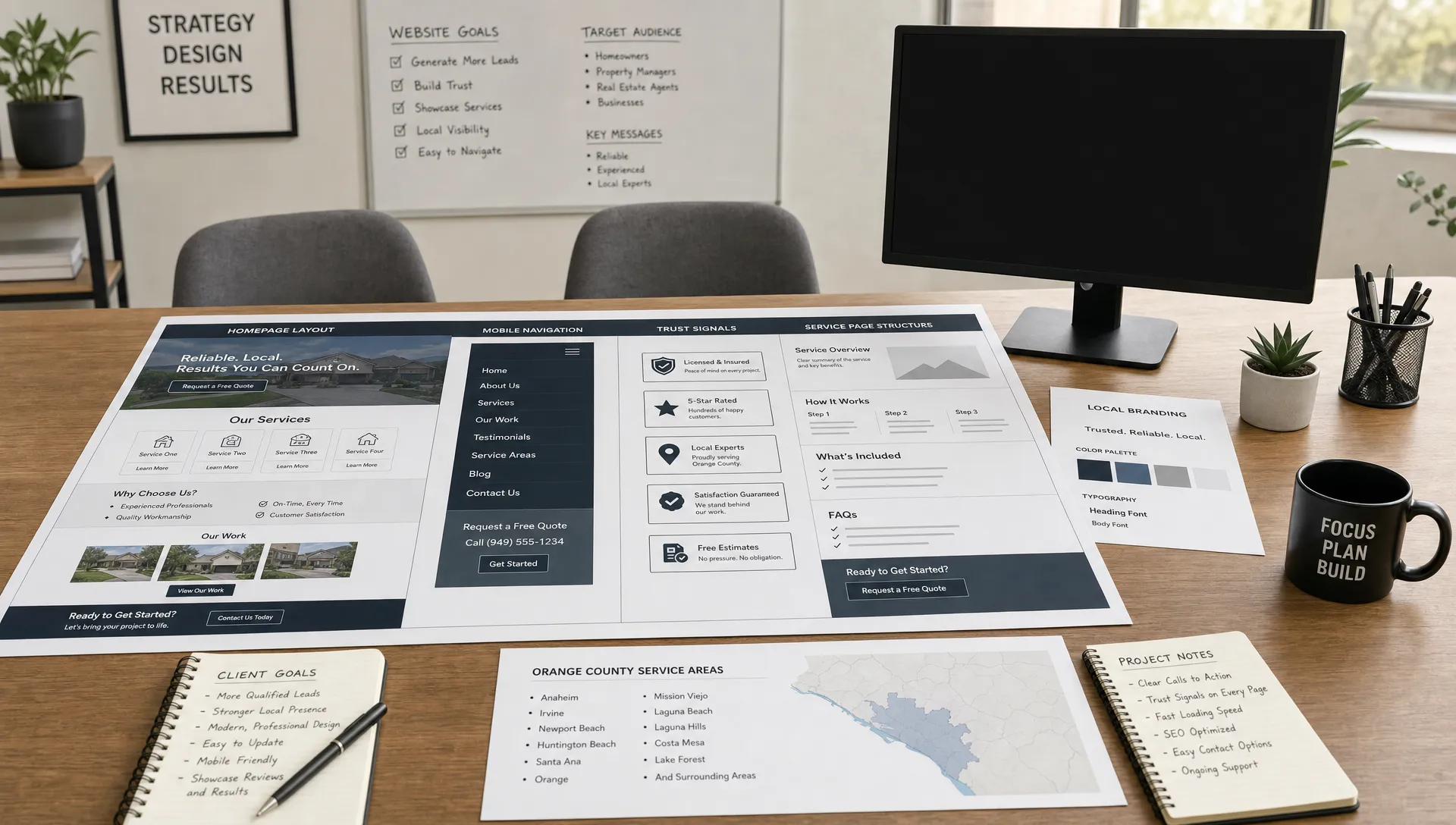
August 3, 2026


Choosing a web designer in Orange County is not just a creative decision. For contractors, medical practices, dental groups, attorneys, and other local businesses, your website is often the first proof that you are credible, nearby, and ready to help.


A beautiful website matters, but it is only the starting point. The right web designer should understand how Orange County buyers search, how local trust is built, how mobile visitors behave, and how your website supports calls, booked appointments, map visibility, and AI-driven discovery.


If you are comparing designers in Laguna Beach, Irvine, Anaheim, Huntington Beach, Santa Ana, Newport Beach, or anywhere in Orange County, use the guide below to make a confident decision.


Start with the real job your website must do


Before reviewing portfolios, define what success looks like. A home services website has a different job than a law firm website. A roofing company may need emergency calls, financing inquiries, and city-specific service pages. A dental group may need insurance clarity, provider trust, and appointment requests. A multi-location medical practice may need each office to rank and convert in its own neighborhood.


Too many redesign projects begin with vague goals like “modernize the site.” That is not enough. A useful goal sounds more like this:


  • Increase qualified calls from homeowners in Irvine and Lake Forest.
  • Improve appointment requests for three Orange County practice locations.
  • Make service pages easier for Google and AI answer engines to understand.
  • Reduce wasted ad spend by improving landing page conversion.
  • Build trust with reviews, proof, credentials, and clear next steps.


A strong designer will ask about revenue, sales process, service area, lead quality, call handling, and search visibility before discussing colors or animations.


Look for local market understanding, not just design taste


Orange County is not one uniform market. A website that works for a luxury remodeler in Newport Coast may need a different tone than one built for an HVAC company serving Anaheim, Garden Grove, and Fullerton. A medical practice in Irvine may need a different trust strategy than a personal injury attorney competing in Santa Ana.


Your designer should understand how geography affects buyer expectations. Local cues can include service area clarity, neighborhood-specific proof, city pages, localized testimonials, and calls to action that match the urgency of the service.


This is especially important for home services contractors. If you rely on local leads, your site should connect smoothly with your broader local marketing strategy. For example, city-targeted service pages, Google Business Profile support, review generation, and neighborhood-level content often work together. Kell Web Solutions covers several of these practical tactics in its guide to local marketing ideas for contractors in Orange County.


Evaluate strategy before style


Portfolio screenshots can be misleading. A site can look impressive and still fail to generate calls. When you review a web designer’s work, ask what the website was designed to accomplish.


Good questions include:


  • What was the business goal behind this project?
  • Did the website need to support SEO, paid ads, referrals, or all three?
  • How were calls to action planned?
  • How did you structure service pages and location pages?
  • What changed after launch?
  • How do you measure whether the site is working?


The best designers can explain their thinking in plain English. They should be able to connect design choices to business outcomes, such as faster quote requests, clearer service positioning, better mobile usability, and stronger trust signals.


Make sure SEO is built in from the beginning


Search visibility should not be treated as an afterthought. If your designer builds a visually polished site but ignores technical structure, content hierarchy, metadata, internal linking, page speed, and local relevance, you may launch with a site that is harder to find than the one you replaced.


Google’s own SEO Starter Guide emphasizes helping search engines understand your content and helping users navigate it. That means your website design should support clear pages, descriptive headings, useful content, crawlable links, and helpful information architecture.


For Orange County businesses, SEO-aware design usually includes:


  • Clear service pages for your main revenue categories.
  • Location signals that match your real service area.
  • Logical navigation that users and search engines can understand.
  • Page titles and descriptions written for local intent.
  • Fast mobile performance.
  • Trust content such as reviews, licensing, certifications, team details, and project examples.


If organic visibility is a major growth channel, your web design project should be coordinated with SEO strategy. You can learn more about that connection in Kell Web Solutions’ overview of Orange County SEO services.


Ask how the site will perform on mobile


For local businesses, mobile is often the money device. A homeowner with a broken AC unit is not patiently browsing a desktop site. A patient looking for a nearby specialist may be comparing options from a phone. A potential legal client may be deciding whether to call within seconds.


Mobile design is not simply “making the desktop layout smaller.” It requires prioritizing the actions visitors need most: call, request service, book, get directions, check availability, or confirm credibility.


A mobile-ready local website should have tappable phone numbers, concise service summaries, visible calls to action, fast-loading pages, simple forms, and content that does not bury important information below oversized images or decorative elements.


Performance also matters. Google’s Core Web Vitals provide a useful framework for evaluating loading experience, interactivity, and visual stability. You do not need to become a technical expert, but your designer should be able to explain how they approach speed and user experience.


Compare designers using criteria that affect revenue


The right web designer is not always the cheapest, the flashiest, or the largest agency. For a local business, the best choice is usually the team that understands how design, local trust, search visibility, and conversion work together.


Use this table to compare your options:


Criterion What to look for Why it matters
Local business experience Work with contractors, practices, or service businesses in competitive local markets Local buyers need trust, proof, and fast paths to action
SEO-aware structure Clear pages, headings, metadata, internal linking, and crawlable navigation A redesign should not damage visibility or make future SEO harder
Conversion planning Calls, forms, booking flows, proof points, and service-specific CTAs Traffic only matters if visitors become leads or appointments
Mobile performance Fast pages, simple navigation, tap-to-call, short forms Many local searches happen on mobile devices
Content guidance Help clarifying services, locations, differentiators, and trust signals Design cannot compensate for vague messaging
Technical ownership Clear access to hosting, domain, analytics, CMS, and backups You should not be locked out of your own marketing asset
Post-launch support Maintenance, updates, optimization, and performance review A website should improve over time, not sit untouched for years


Prioritize conversion, not decoration


A good website makes the next step obvious. For a contractor, that may mean “Request an estimate” or “Call for service.” For a dental office, it may be “Schedule an appointment.” For a law firm, it may be “Request a consultation.”


Conversion-focused design uses layout, copy, proof, and timing to reduce hesitation. It answers the visitor’s silent questions: Do they serve my area? Can they solve my problem? Are they trustworthy? What happens if I call? How soon can they help?


This does not mean every page should feel aggressive. It means every page should have a purpose. A service page should educate and convert. A location page should prove relevance. An about page should build trust. A contact page should remove friction.
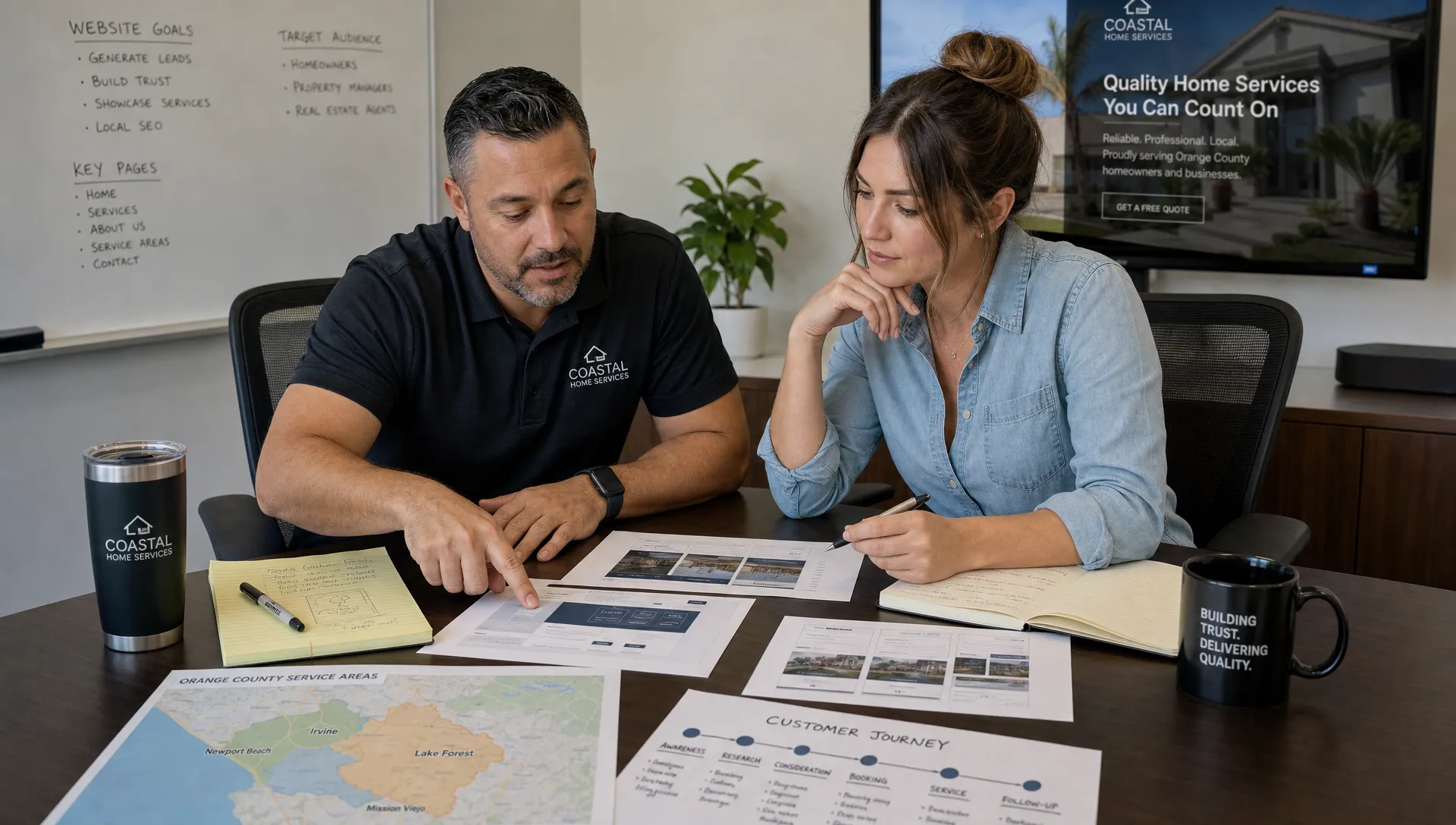


Confirm that your designer understands trust signals


Trust is one of the biggest conversion factors for local businesses. Visitors want to know that you are legitimate, experienced, and safe to contact.


Depending on your industry, useful trust signals may include licenses, certifications, insurance information, team bios, before-and-after project examples, case studies, reviews, association memberships, service guarantees, financing options, HIPAA-aware language, or attorney credentials.


The key is relevance. A plumber does not need the same trust architecture as a cosmetic dentist. A solar installer does not need the same proof as a multi-location legal practice. Your web designer should help you decide which trust signals belong above the fold, which belong on service pages, and which should support deeper research.


Do not ignore accessibility and usability


Accessibility is not just a compliance topic. It is part of good user experience. Visitors with visual, motor, cognitive, or situational limitations should be able to use your site as easily as possible.


The Web Content Accessibility Guidelines are the widely recognized standard for accessible digital experiences. Your designer should understand fundamentals such as readable contrast, keyboard navigation, alt text, proper heading order, form labels, and clear interaction states.


For local businesses, accessibility also supports conversion. If a visitor cannot read your phone number, complete your form, understand your navigation, or interact with your booking tool, you may lose a lead without ever knowing it.


Ask about AI and answer engine readiness


In 2026, your website is not only read by people and search engines. It may also be interpreted by AI assistants, AI search features, voice interfaces, and answer engines that summarize options for users.


No ethical web designer should promise that your business will always be recommended by AI tools. However, they can build a clearer, more trustworthy digital foundation. That includes structured content, consistent entity information, clear service descriptions, location relevance, authoritativeness, and schema markup where appropriate.


Google’s documentation on structured data explains how standardized information can help search engines understand page content. For local businesses, this is part of a broader shift: your site needs to communicate clearly to both humans and machines.


If AI visibility is a strategic priority, your website should align with Answer Engine Optimization. Kell Web Solutions explains this shift in its guide to Orange County AEO services, including why being “the answer” is different from simply ranking for keywords.


Clarify ownership before you sign


One of the most important parts of choosing a web designer is understanding what you will own and control. Some businesses discover too late that their website, domain, content, or analytics access is tied to a vendor relationship they cannot easily leave.


Before signing a proposal, ask for clear answers about:


  • Domain ownership and registrar access.
  • Website platform and content management access.
  • Hosting arrangement and backup process.
  • Ownership of written content, images, graphics, and code.
  • Analytics, tracking, and conversion reporting access.
  • Cost of future edits, new pages, or emergency updates.


A professional designer should be comfortable explaining these details. If the answers are vague, slow, or defensive, treat that as a warning sign.


Understand pricing in context


Web design pricing in Orange County can vary widely because projects differ in scope. A simple brochure site is not the same as a conversion-focused website with service pages, location architecture, SEO planning, copywriting, analytics setup, and post-launch support.


Instead of shopping only by price, compare what is included. A lower-cost website may become expensive if you later need to rewrite content, fix speed issues, rebuild location pages, repair SEO damage, or migrate away from a restrictive platform.


Ask each designer to define scope clearly. How many pages are included? Who writes the copy? Is SEO included or only basic metadata? Are forms tested? Are redirects handled from the old site? Will analytics and call tracking be configured? What happens after launch?


A transparent proposal should make it easy to see what you are buying and what is not included.


Watch for red flags


Some warning signs are easy to spot once you know what to look for. Be cautious if a designer focuses only on aesthetics, avoids questions about business goals, cannot explain their SEO process, or promises guaranteed rankings.


Other red flags include unclear ownership, no launch checklist, no mobile performance discussion, no content strategy, no plan for redirects, no analytics setup, and no understanding of local search behavior.


For contractors and professional practices, another major red flag is generic messaging. If the same homepage copy could apply to any company in any city, it will not help you stand out in Orange County.


Ask better questions during the consultation


A discovery call should reveal how the designer thinks. You are not only evaluating technical skill. You are evaluating business judgment, communication, and whether they understand your growth model.


Here are high-value questions to ask:


  • How would you design this site differently for an Orange County contractor versus a professional practice?
  • What information do you need before creating the site structure?
  • How do you protect existing SEO during a redesign?
  • How do you decide which pages we need?
  • What should be on our homepage above the fold?
  • How do you approach local service area content?
  • What role should reviews and case studies play?
  • How will we measure calls, forms, and booked appointments?
  • What happens after launch if we need changes?


The best answers will be specific to your business, your market, and your customer journey.


Choose the partner who can grow with you


Your website should not be a one-time design project that becomes outdated the moment it launches. It should be a flexible marketing asset that supports SEO, AEO, paid campaigns, referral traffic, recruiting, reviews, and sales conversations.


For Orange County businesses, this matters because competition changes quickly. New contractors enter the market. Professional practices open additional locations. Google changes how results appear. AI tools reshape how people discover providers. Your website needs to be built with enough strategic discipline to adapt.


The right web designer will not just ask, “What do you want it to look like?” They will ask, “How does your business win, and how should the website support that?”


Frequently Asked Questions


How do I choose the best web designer in Orange County? Start by defining your business goals, then evaluate designers based on local market experience, SEO knowledge, conversion strategy, mobile performance, ownership terms, and post-launch support. A strong portfolio matters, but strategy matters more.


How much should an Orange County business website cost? Cost depends on scope, page count, copywriting, SEO planning, platform, integrations, and support. Instead of comparing only price, compare what is included and whether the site is built to generate calls, appointments, or qualified leads.


Should my web designer also understand SEO? Yes. Even if you hire a separate SEO specialist, your designer should understand SEO fundamentals. Site structure, speed, navigation, headings, content hierarchy, redirects, and local signals can all affect search visibility.


What should contractors look for in a web designer? Contractors should look for experience with service pages, city targeting, reviews, project proof, mobile calls, quote requests, and local trust signals. The site should make it easy for homeowners to confirm service area, credibility, and next steps.


What should medical, dental, or legal practices look for? Professional practices should prioritize trust, clear provider information, location pages, appointment pathways, accessibility, compliance-aware messaging, and content that helps visitors understand services before contacting the office.


Can a website help with AI search visibility? A website can support AI search visibility by making your business easier to understand through clear content, structured data, consistent local information, and authoritative proof. No designer can guarantee AI recommendations, but good structure improves your foundation.


Build a website that works harder for your Orange County business


If you are choosing a web designer in Orange County, do not settle for a site that only looks polished. Your website should help customers understand you, trust you, find you, and contact you.


Kell Web Solutions brings more than 20 years of Orange County marketing experience to web design, SEO, and Answer Engine Optimization. If you want a site built for local visibility, conversion, and the way customers search today, schedule a strategy conversation with Kell Web Solutions or call (949) 575-8553.
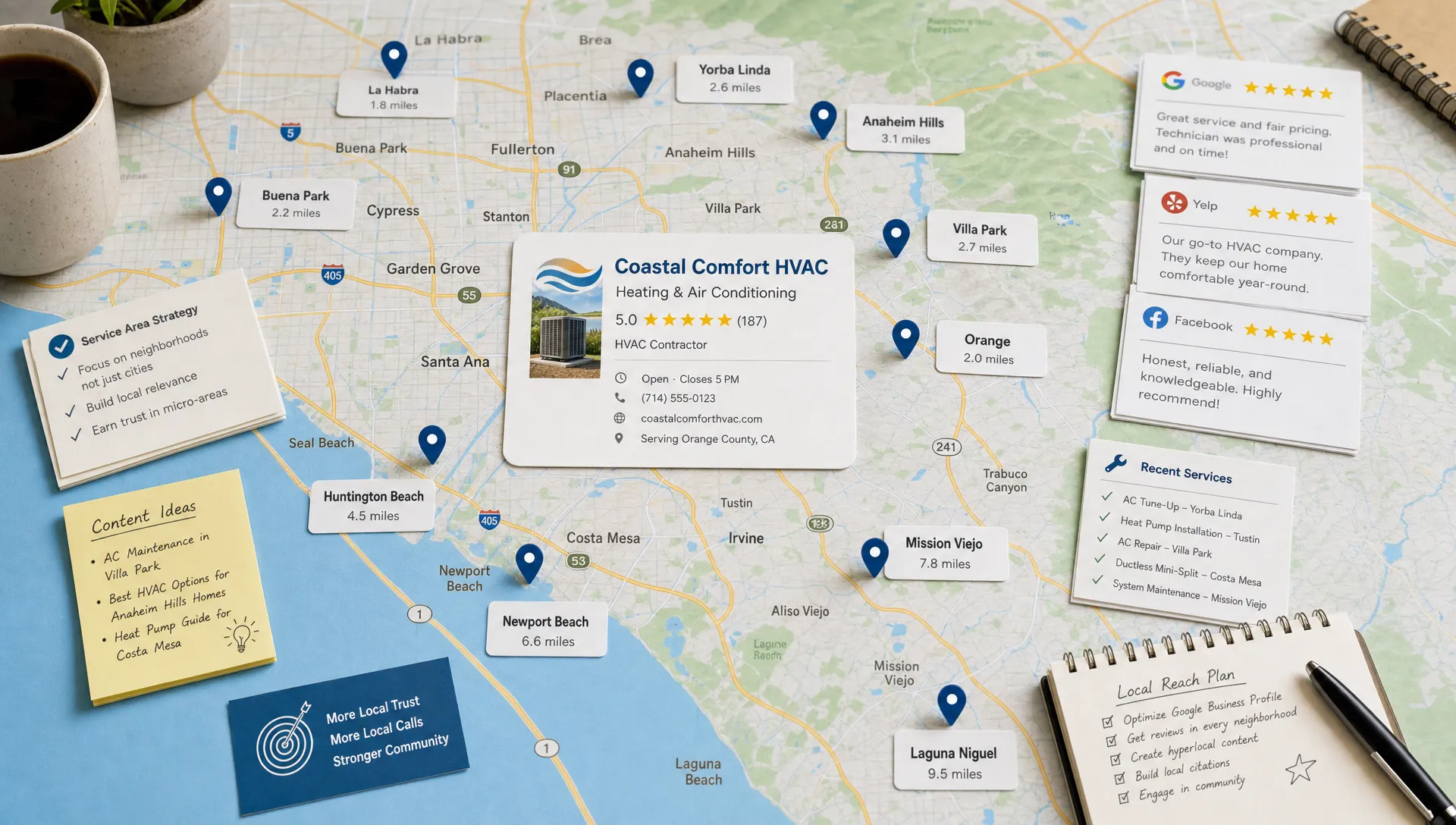

August 3, 2026
 Los Angeles is one of the most competitive local search markets in the US. Every HVAC company, dentist, roofer, and law firm in the metro competes for the same three map pack slots. In a city of 4 million residents and tens of thousands of service businesses, local visibility isn't optional — it's a revenue lever. Most agencies in LA claim to do local SEO. What that means in practice ranges from a basic GBP setup to a full neighborhood-level content and citation strategy. The gap between those two approaches shows up directly in your inbound call volume. This guide covers the six best local SEO agencies in Los Angeles for 2026. Each was chosen for verifiable results, genuine LA market presence, and a service model that fits the businesses most likely searching for local SEO help. What are the best local SEO agencies in Los Angeles? The six best local SEO agencies in Los Angeles for 2026 are Kell Web Solutions, Sachs Marketing Group, Coalition Technologies, seoTuners, Bruce Clay Inc., and Drive Traffic Media. Kell leads with transparent flat-rate pricing, a hyperlocal feeder site network, and 20+ years of California market depth. Sachs Marketing Group holds Clutch's #1 ranking for Los Angeles digital agencies, with 70,000+ leads generated for clients in just three years. Coalition Technologies brings 860+ case studies and a 97% client return rate. seoTuners offers $500/month starting pricing with AI SEO and GEO built in. Bruce Clay Inc. is the LA metro's most credentialed local SEO institution — operating for nearly 30 years. Drive Traffic Media rounds out the list as a Santa Monica agency with 3,000+ clients served since 2007.
August 3, 2026
If you have ever asked, “search engine optimization, what is it really doing for my business?”, the simplest answer is this: SEO helps the right people find, trust, and contact you when they are already looking for what you do. For a local contractor, that might mean showing up when a homeowner in Laguna Niguel searches for emergency AC repair. For a dental group, it might mean appearing when a family in Irvine compares practices near their child’s school. For a law firm, med spa, roofing company, or remodeler, it means being visible at the exact moment a buyer is deciding who deserves the call.  SEO still matters because search behavior has changed, but buying behavior has not. People still need answers. They still compare options. They still look for proof that a company is local, capable, reputable, and easy to reach. What has changed is where those answers appear: Google Search, Maps, AI Overviews, voice assistants, ChatGPT, Gemini, Perplexity, and other answer-driven platforms. That makes modern SEO less about chasing tricks and more about building a digital presence search engines and AI systems can understand. Search Engine Optimization: What Is It in Plain English? Search engine optimization is the process of improving your website and digital presence so search engines can clearly understand who you are, what you offer, where you serve customers, and why your business should be trusted. Google’s own SEO Starter Guide explains SEO in practical terms: it is about helping search engines understand your content and helping users find your site. That is still the foundation. For local California businesses, SEO usually includes several connected parts: Making your website easy for search engines to crawl, read, and index. Publishing clear service pages that match real customer questions. Optimizing your Google Business Profile so you can appear in Maps and local results. Building review, citation, and authority signals that prove your business is legitimate. Creating content that answers buyer questions before they call. Improving your website experience so visitors become leads, calls, consultations, or estimate requests. SEO is not just “ranking higher.” Ranking is one outcome. The real business goal is to become the obvious, trusted choice when someone is ready to act. Why SEO Still Matters in an AI-Driven Search World Some business owners hear about AI answers and assume SEO is becoming less important. In reality, AI has made strong SEO more important, not less. AI tools do not recommend businesses from nowhere. They rely on information they can retrieve, interpret, compare, and trust. If your business information is unclear, inconsistent, thin, outdated, or buried inside a poorly structured website, both search engines and AI systems have less reason to cite or recommend you. Think of your website, Google Business Profile, reviews, service pages, local content, and third-party mentions as your “proof layer.” SEO organizes that proof so machines can understand it and customers can act on it. This matters across California because local competition is intense. A plumber in Anaheim, a roofer in San Diego, a solar company in Riverside, a dental office in San Jose, and a med spa in Sacramento are not just competing against nearby companies. They are competing against directories, lead sellers, paid ads, AI summaries, map results, and national brands with large content budgets. Modern SEO helps local companies defend their visibility in three ways. First, it captures high-intent demand. Search is still one of the few channels where the prospect is actively asking for help. Someone searching “roof leak repair Huntington Beach” or “family dentist near Irvine” is much closer to action than someone passively scrolling social media. Second, it strengthens trust before the conversation. Reviews, service pages, local proof, FAQs, photos, and clear calls to action reduce uncertainty. The prospect arrives warmer, which makes the call or consultation more productive. Third, it supports AI visibility. Answer engines need clean facts, consistent entities, and trustworthy sources. SEO creates the structure that makes your business easier to retrieve and recommend. How SEO Works for a Local California Business For local companies, SEO is not one thing. It is a system of signals. Search engines evaluate your website, your business profile, your location relevance, your reviews, your content, and your broader authority across the web. Google says local results are primarily influenced by relevance, distance, and prominence . In practical terms, that means Google tries to determine whether your business matches the search, whether you are close enough to the searcher or service area, and whether you have enough trust signals to deserve visibility. Here is how that looks in the real world:
July 30, 2026
 Anaheim's residential market is densely competitive for contractors. HVAC, roofing, solar, plumbing, and remodeling companies all compete for the same homeowners. The contractor who responds first wins — almost every time. Most calendar problems for Anaheim contractors aren't caused by lack of demand. They're caused by weak follow-up. Leads go cold while crews are mid-job — and competitors swoop in. This guide covers the five best appointment setting services for Anaheim contractors in 2026. Options range from fully managed AI outreach to done-for-you estimate delivery to affordable AI self-service. Whatever your crew size, calendar problem, or budget, the right fit is here. What are the best appointment setting services for contractors in Anaheim? The top options span three models. Fully managed services like Kell Web Solutions and Rizen Estimates handle prospecting, qualification, and booking end-to-end. AI tools and contractor platforms like Myna and Jobber help you capture and convert inbound leads faster. One option — Abstrakt Marketing Group — serves commercial contractors operating on B2B sales timelines and multi-stakeholder buying cycles. Understanding which model matches your bottleneck matters more than picking the biggest name on the list.
July 30, 2026
Search engine optimization information is only useful when it helps a local business win better calls, appointments, and jobs. For a contractor, medical practice, dental office, law firm, or multi-location professional service, SEO is not an abstract marketing channel. It is the system that helps nearby buyers understand who you are, where you serve, what you do best, and why they should trust you before they call. That system has changed. A few years ago, local SEO mostly meant ranking a website page and keeping a Google Business Profile active. In 2026, your business also needs to be clear enough for Google Maps, AI Overviews, voice assistants, ChatGPT-style answer engines, and local directories to interpret you correctly. If those systems cannot confidently understand your business, they are less likely to surface you when someone asks, “best HVAC repair near Irvine,” “emergency plumber Laguna Niguel,” or “dental implant consultation in San Jose.” The good news is that local SEO is still manageable when you focus on the right information. You do not need to chase every algorithm update. You need to build a digital presence that is accurate, locally relevant, trusted, and easy for both people and machines to understand. Local SEO is no longer just about keywords Keywords still matter, but they are no longer the whole game. A local customer rarely thinks in SEO terms. They think in problems, urgency, location, and trust. A homeowner in Huntington Beach may search for “AC not cooling upstairs.” A property manager in Sacramento may ask a voice assistant for “commercial electrician open now.” A patient in Laguna Beach may compare “best dentist for veneers near me.” Each query has a different level of urgency, value, and conversion potential. Search engines now evaluate far more than whether a page repeats a phrase. Google’s own local ranking documentation explains that local results are influenced by relevance, distance, and prominence . In practice, that means your business must prove three things clearly: You provide the exact service the customer wants. You serve the location where the customer needs help. You have enough credibility to be a safe recommendation. That is why the most important search engine optimization information for local businesses is not a list of random keywords. It is a clear picture of how customers search, how Google understands your entity, and which trust signals make you the obvious local choice. The SEO information every local business should know Local SEO becomes easier when you stop treating it as a mystery and start treating it as business intelligence. The information below should guide your website, Google Business Profile, content, review strategy, and answer engine visibility. How customers describe the problem Your best SEO ideas often come from real conversations, not keyword tools alone. Listen to the language customers use on phone calls, estimate requests, emails, intake forms, and reviews. For home services, customers often describe symptoms before services. They search for “water heater leaking,” “roof tiles blown off,” “breaker keeps tripping,” or “solar panels not producing.” For professional practices, people may search by concern, outcome, insurance, neighborhood, or urgency. Your website should reflect both expert terminology and customer language. A roofing company can have a “roof repair” service page, but it should also answer questions about leaks, missing shingles, storm damage, tile cracks, and inspection timelines. This gives search engines more context and gives buyers more confidence. Which cities and neighborhoods actually produce revenue Local SEO should not target geography randomly. A contractor based in Orange County may want visibility in Laguna Niguel, Irvine, Newport Beach, Anaheim, and Huntington Beach, but not every city produces the same job value or close rate. Before expanding content across California markets, identify the locations that matter most. For a remodeling firm, a few high-value neighborhoods may outperform a broader county-wide approach. For a multi-location dental group, each office may need its own neighborhood catchment strategy. For a law firm, the strongest opportunities may cluster near courts, business districts, or affluent suburbs. This is where local SEO becomes more strategic than simply adding city names to pages. Each geography needs a reason to exist in your content. If you want more jobs in Irvine, San Diego, San Jose, Fresno, or Sacramento, your online presence should show real service relevance for that market. Whether your business entity is clear A business entity is the machine-readable identity of your company. It includes your name, address, phone number, categories, services, locations, staff, credentials, reviews, content, and mentions across the web. When this information is inconsistent, search systems hesitate. If your Google Business Profile lists one category, your website emphasizes another, and directories show outdated phone numbers, you create uncertainty. AI-driven search makes this even more important because answer engines prefer sources that are consistent, well-structured, and easy to verify. Your entity information should be consistent across your website, Google Business Profile, citations, social profiles, review platforms, and local content. This is foundational, not optional. What your Google Business Profile proves For many local buyers, your Google Business Profile is the first impression. It may be seen before your website, especially on mobile searches and map results. A strong profile does more than list your address. It reinforces categories, services, service areas, hours, photos, reviews, updates, and call options. It also sends engagement signals when users click, call, request directions, read reviews, or visit your site. If your profile is thin, outdated, or inconsistent with your website, you weaken both local search visibility and customer trust. A profile for an HVAC company in Santa Ana, for example, should clearly support the services and nearby areas that company wants to win. A multi-location medical practice should make each office distinct, complete, and aligned with the correct services. Which pages answer buyer questions Google’s SEO Starter Guide emphasizes creating helpful, reliable content for users. For local businesses, that means your pages should answer the questions people ask before they call. A service page should not simply say, “We provide plumbing services in Orange County.” It should explain what problems you solve, what areas you serve, what the customer can expect, what makes your team credible, and how someone can take the next step. Good local pages often include: Specific services and situations handled. Local service areas and nearby communities. Trust proof such as reviews, licenses, experience, or project examples. Clear calls to call, book, or request an estimate. Helpful answers to common buyer objections. If your website has traffic but few calls, the issue may not be rankings. It may be that your pages are not answering the right questions at the right moment. How reviews support visibility and conversion Reviews are not just social proof. They help search engines and buyers understand what your business is known for. A steady pattern of specific, credible reviews can reinforce your services, locations, responsiveness, professionalism, and outcomes. A review that says “they fixed our AC in Laguna Niguel the same day” is more informative than a generic “great company.” Both can help, but detailed reviews provide richer context. Local businesses should monitor review quantity, quality, recency, and themes. If reviews repeatedly mention emergency response, clean work, fair pricing, or a specific neighborhood, those themes can support both conversion and local relevance. A practical SEO information checklist for local businesses The table below summarizes the core information a local business should collect, review, and improve regularly.
July 30, 2026
 Most local businesses do not lose revenue because nobody is interested. They lose revenue in the gap between interest and action. A homeowner searches for emergency HVAC repair in Irvine. A patient looks for a dental implant consultation in Anaheim. A business owner in San Jose compares local legal firms. They call, fill out a form, or ask an AI assistant for a recommendation. If your team responds late, misses the call, asks the wrong questions, or fails to follow up, that opportunity moves to a competitor. That is why modern lead solutions should not be judged by lead volume alone. The better question is: how many real opportunities become qualified, booked calls? For contractors and multi-location practices across Orange County and California, the answer increasingly depends on a call-first system that combines local visibility, fast response, qualification, intelligent follow-up, and clear appointment booking. Why missed opportunities happen after the lead arrives Many businesses think their lead problem is at the top of the funnel. They want more traffic, more form fills, more ad clicks, and more phone calls. Sometimes that is true. But just as often, the lead generation engine is already producing demand and the business is leaking value after the prospect raises their hand. The most common leaks are operational, not promotional. Calls go unanswered during lunch, after hours, or during busy job windows. Contact forms sit in an inbox until the next morning. A receptionist gathers a name and phone number but does not identify urgency, budget, location, or service fit. A sales rep calls once, leaves a voicemail, and moves on. Speed matters. A widely cited Harvard Business Review analysis found that companies contacting leads within an hour were far more likely to qualify them than companies that waited longer. That principle is even more important for home services, urgent repairs, and local professional services, where prospects often contact multiple providers in the same session. In Orange County, the gap is especially expensive. A roofing lead in Laguna Niguel, a plumbing call in Huntington Beach, or a cosmetic dentistry inquiry in Newport Beach can represent significant revenue. If that opportunity is not captured and moved toward a scheduled conversation, the marketing investment has already been partially wasted. What effective lead solutions must do Generic leads solutions often promise more names, more emails, or more inbound inquiries. That may look attractive on a dashboard, but it does not necessarily create revenue. A better system is built around the full journey from intent to booked call. Strong lead solutions should accomplish four things consistently: Capture the opportunity the moment it appears. Qualify the prospect without creating friction. Follow up until the prospect responds or disqualifies. Book a clear next step with the right person. This is why call quality matters as much as call quantity. A busy contractor does not need twenty unqualified price shoppers from outside the service area. A multi-location medical practice does not need inquiries for services it does not provide. The goal is not simply to generate activity. The goal is to create qualified conversations that your team can convert. Kell Web Solutions approaches this with a call-first mindset. For example, a website should not merely “look professional.” It should make the visitor confident enough to call, and it should route that call into a system that can respond quickly. That same principle appears in Kell’s guidance on website advertising that turns visits into qualified calls , where traffic is only valuable when it produces measurable buyer conversations.
July 27, 2026
 San Jose is Silicon Valley's capital — and one of the most competitive local search markets in the country. Among America's ten largest cities , it has over 1 million residents. Tech, home services, and healthcare businesses all compete for the same three map pack spots. The problem isn't finding agencies that claim to do local SEO. Finding ones that truly understand this market is harder. Generic national platforms apply the same templates here as they do in smaller cities — and that doesn't work in Willow Glen, Almaden Valley, or downtown San Jose. San Jose has several strong agencies built for exactly this challenge. Some are Silicon Valley institutions with long operating histories. Others bring specialist verticals or AI-era capabilities that set them apart. What are the best local SEO agencies in San Jose? This guide covers five agencies: Kell Web Solutions, Jives Media, Spectrum Group Online, Lockedown SEO, and Direction.com. Kell leads with 20+ years of California market expertise, transparent flat-rate pricing, and a unique hyperlocal feeder network. Jives Media is Forbes-recognized with five Clutch Agency of the Year wins. Spectrum Group Online is a data-first Google and Bing Partner based in San Jose since 2011. Lockedown SEO is the Bay Area specialist for manufacturers, industrial companies, and contractors. Direction.com rounds out the list as the top option for healthcare and medical practices.