What Search Engine Optimization Is and Why It Still Matters
If you have ever asked, “search engine optimization, what is it really doing for my business?”, the simplest answer is this: SEO helps the right people find, trust, and contact you when they are already looking for what you do.
For a local contractor, that might mean showing up when a homeowner in Laguna Niguel searches for emergency AC repair. For a dental group, it might mean appearing when a family in Irvine compares practices near their child’s school. For a law firm, med spa, roofing company, or remodeler, it means being visible at the exact moment a buyer is deciding who deserves the call.
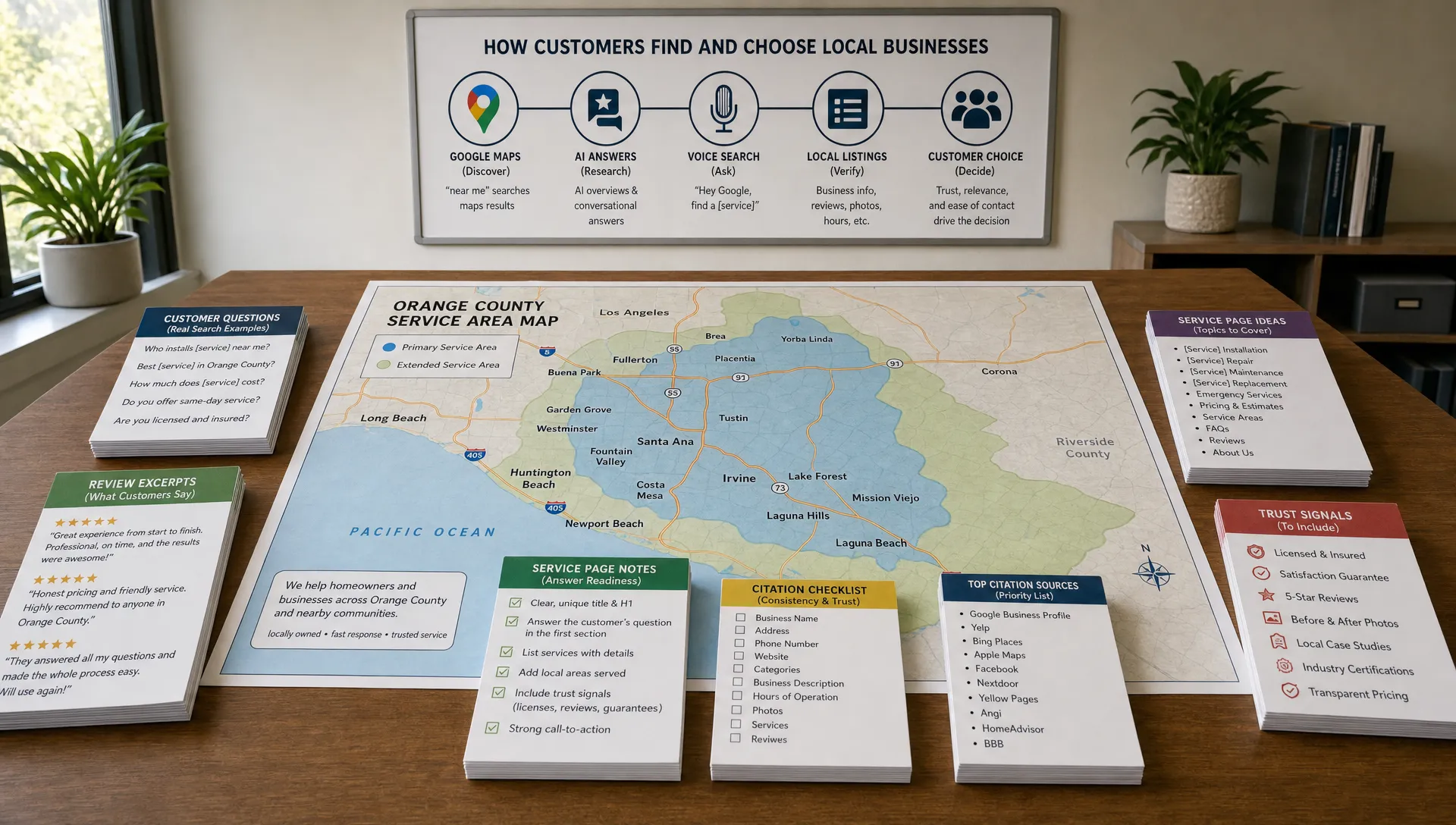
SEO still matters because search behavior has changed, but buying behavior has not. People still need answers. They still compare options. They still look for proof that a company is local, capable, reputable, and easy to reach. What has changed is where those answers appear: Google Search, Maps, AI Overviews, voice assistants, ChatGPT, Gemini, Perplexity, and other answer-driven platforms.
That makes modern SEO less about chasing tricks and more about building a digital presence search engines and AI systems can understand.
Search Engine Optimization: What Is It in Plain English?
Search engine optimization is the process of improving your website and digital presence so search engines can clearly understand who you are, what you offer, where you serve customers, and why your business should be trusted.
Google’s own SEO Starter Guide explains SEO in practical terms: it is about helping search engines understand your content and helping users find your site. That is still the foundation.
For local California businesses, SEO usually includes several connected parts:
- Making your website easy for search engines to crawl, read, and index.
- Publishing clear service pages that match real customer questions.
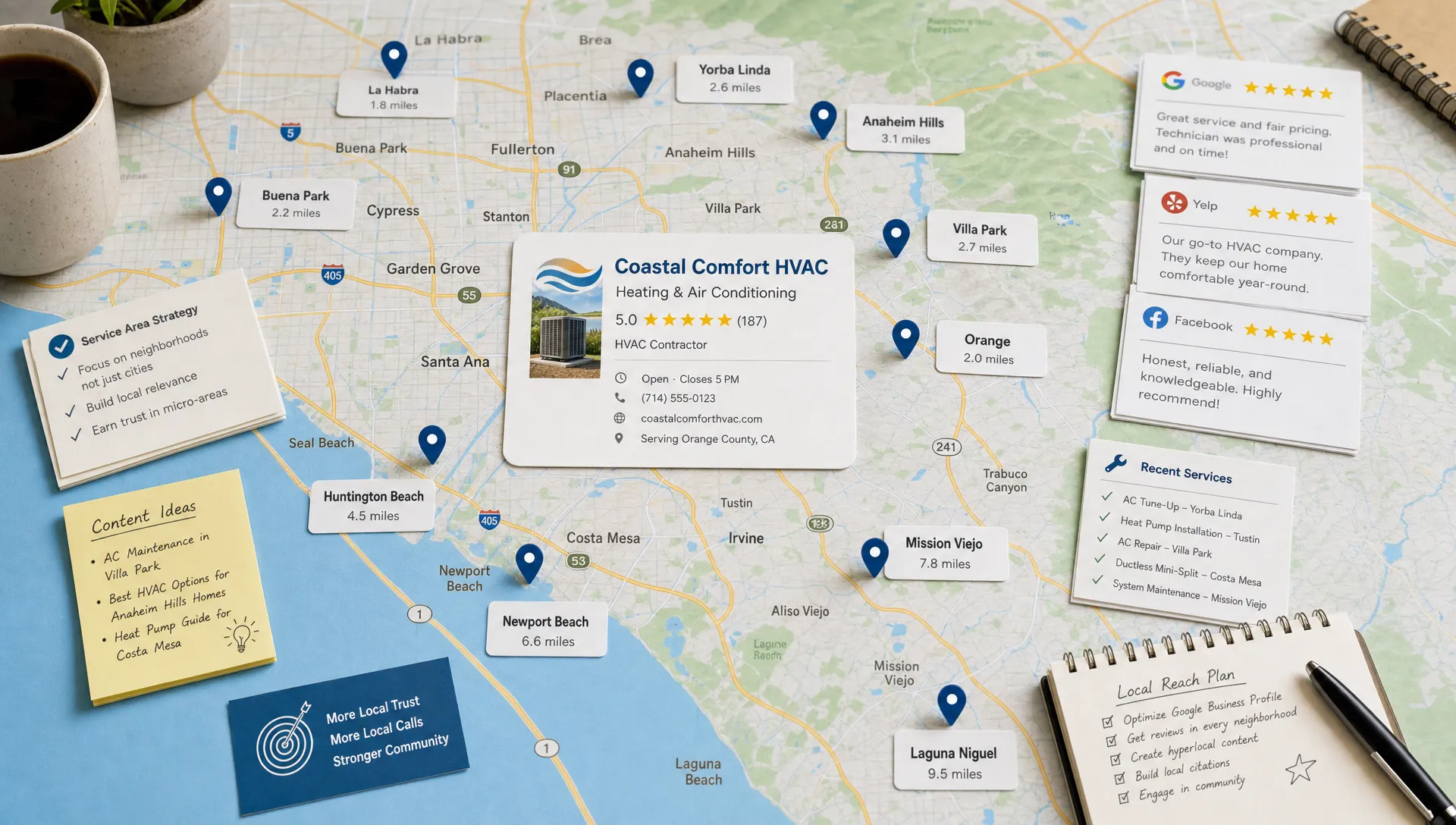
- Optimizing your Google Business Profile so you can appear in Maps and local results.
- Building review, citation, and authority signals that prove your business is legitimate.
- Creating content that answers buyer questions before they call.
- Improving your website experience so visitors become leads, calls, consultations, or estimate requests.
SEO is not just “ranking higher.” Ranking is one outcome. The real business goal is to become the obvious, trusted choice when someone is ready to act.
Why SEO Still Matters in an AI-Driven Search World
Some business owners hear about AI answers and assume SEO is becoming less important. In reality, AI has made strong SEO more important, not less.
AI tools do not recommend businesses from nowhere. They rely on information they can retrieve, interpret, compare, and trust. If your business information is unclear, inconsistent, thin, outdated, or buried inside a poorly structured website, both search engines and AI systems have less reason to cite or recommend you.
Think of your website, Google Business Profile, reviews, service pages, local content, and third-party mentions as your “proof layer.” SEO organizes that proof so machines can understand it and customers can act on it.
This matters across California because local competition is intense. A plumber in Anaheim, a roofer in San Diego, a solar company in Riverside, a dental office in San Jose, and a med spa in Sacramento are not just competing against nearby companies. They are competing against directories, lead sellers, paid ads, AI summaries, map results, and national brands with large content budgets.
Modern SEO helps local companies defend their visibility in three ways.
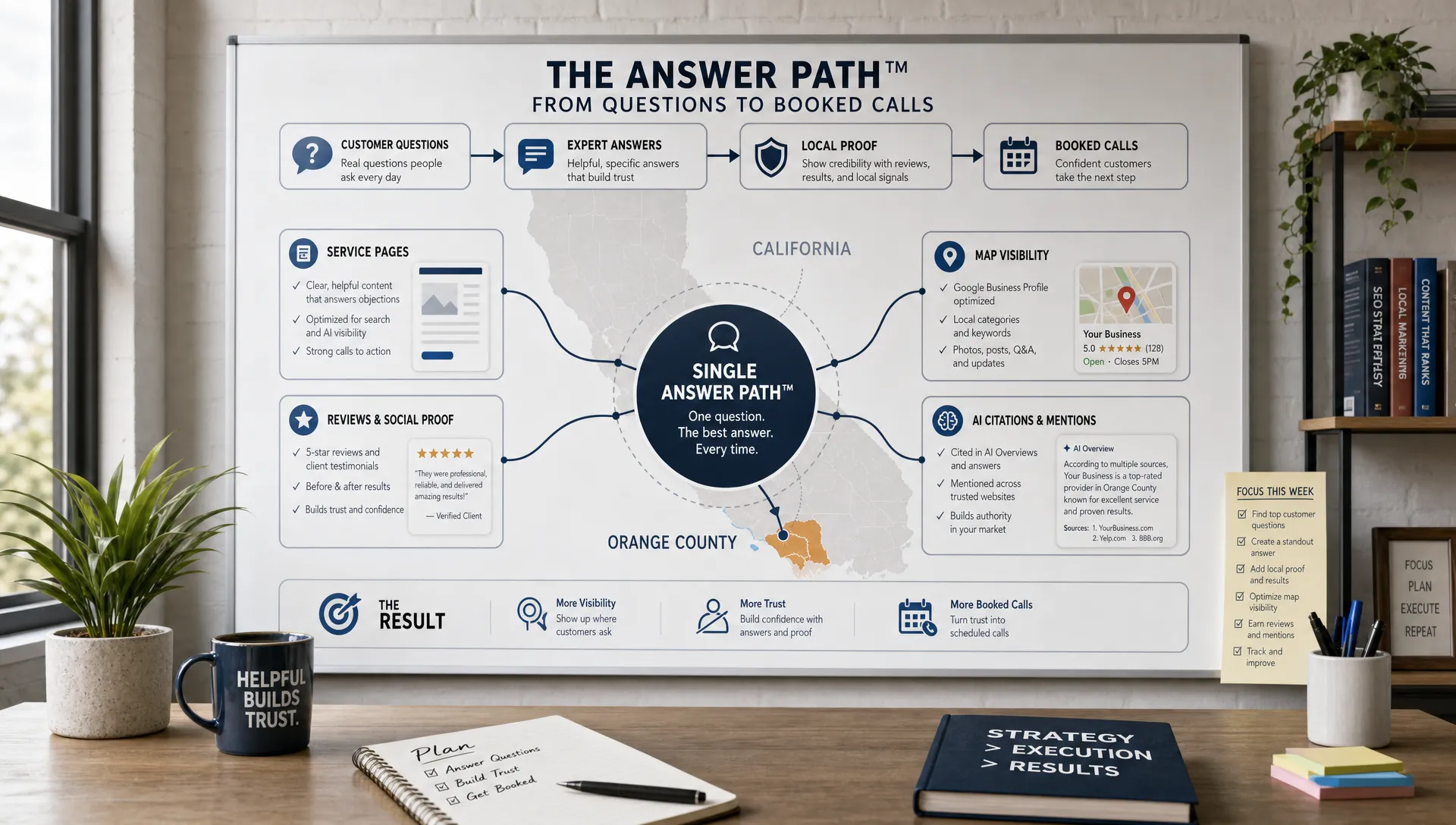
First, it captures high-intent demand. Search is still one of the few channels where the prospect is actively asking for help. Someone searching “roof leak repair Huntington Beach” or “family dentist near Irvine” is much closer to action than someone passively scrolling social media.
Second, it strengthens trust before the conversation. Reviews, service pages, local proof, FAQs, photos, and clear calls to action reduce uncertainty. The prospect arrives warmer, which makes the call or consultation more productive.
Third, it supports AI visibility. Answer engines need clean facts, consistent entities, and trustworthy sources. SEO creates the structure that makes your business easier to retrieve and recommend.
How SEO Works for a Local California Business
For local companies, SEO is not one thing. It is a system of signals. Search engines evaluate your website, your business profile, your location relevance, your reviews, your content, and your broader authority across the web.
Google says local results are primarily influenced by relevance, distance, and prominence. In practical terms, that means Google tries to determine whether your business matches the search, whether you are close enough to the searcher or service area, and whether you have enough trust signals to deserve visibility.
Here is how that looks in the real world:
| SEO signal | What it tells search engines | Local business example |
|---|---|---|
| Clear service pages | What you do and who you help | “HVAC repair in Laguna Niguel” or “roof replacement in Irvine” |
| Location relevance | Where you operate | Orange County, Los Angeles, San Diego, San Jose, Fresno, Sacramento |
| Google Business Profile | Business category, hours, photos, reviews, and map presence | A plumbing company with current services, photos, and weekly updates |
| Reviews and reputation | Whether real customers trust you | A dental practice with recent reviews mentioning specific services |
| Technical structure | Whether your site can be crawled and understood | Fast pages, clean navigation, schema markup, mobile usability |
| Helpful content | Whether you answer buyer questions | Articles explaining costs, timelines, service options, and local issues |
| Authority signals | Whether other sources validate your business | Citations, local mentions, backlinks, media, and partner references |
A strong SEO strategy connects these signals instead of treating them as separate tasks. Your website should support your Google Business Profile. Your content should answer real customer questions. Your reviews should reinforce your service strengths. Your location pages should prove you understand the neighborhoods you serve.
That is especially important in Orange County, where customer expectations vary by community. A homeowner in Newport Coast may respond to different proof points than a property manager in Santa Ana. A dental patient in Laguna Beach may compare convenience, insurance information, reviews, and trust before booking. SEO works best when it reflects how real local buyers make decisions.
What Has Changed: From Keywords to Trustworthy Answers
Older SEO was often treated like a keyword placement exercise. Add the right phrase to a page enough times, build some links, and wait for rankings. That approach is no longer enough.
Search engines are better at understanding context, intent, entities, and trust. AI systems go even further by summarizing answers and selecting sources. The question is no longer only, “Can your page rank?” It is also, “Can your business be understood as a reliable answer?”
| Old SEO mindset | Modern SEO reality |
|---|---|
| Focus on isolated keywords | Focus on customer intent and complete answers |
| Optimize one website page | Build a connected digital authority footprint |
| Write for search engines first | Write for buyers, then structure content for machines |
| Measure only rankings | Measure calls, form fills, map visibility, and answer visibility |
| Publish generic city pages | Prove real relevance to specific service areas and neighborhoods |
| Treat SEO and AI separately | Use SEO as the foundation for answer engine visibility |
This is where SEO and Answer Engine Optimization begin to overlap. SEO helps your business appear in traditional search and maps. AEO goes further by structuring your digital presence so AI-driven systems can identify, trust, and recommend your business as the answer.
For companies that want to prepare for AI search, Kell Web Solutions explains this shift through its Answer Engine Optimization approach, which focuses on helping platforms like Google AI results, ChatGPT, and voice assistants understand and cite a business more confidently.
What SEO Is Not
It is just as important to understand what SEO is not.
SEO is not a one-time setup. A well-built website gives you a foundation, but competitors keep improving, reviews keep changing, customer questions evolve, and search engines update how they interpret information.
SEO is not keyword stuffing. Repeating “best HVAC company Orange County” twenty times does not build trust. In many cases, it makes a page less useful and less credible.
SEO is not a guarantee of instant rankings. Any agency promising a guaranteed number one ranking for a competitive local term is oversimplifying how search works. Real SEO is a process of improving signals over time.
SEO is not just blog posting. Content matters, but only when it is connected to strategy. A remodeler does not need generic articles about home improvement trends if the real opportunity is to answer local questions about ADU costs, permitting, kitchen timelines, or neighborhood-specific service needs.
SEO is not a substitute for reputation. If your reviews, service quality, follow-up, or phone handling are weak, SEO can expose those gaps. The best results happen when strong visibility meets a strong customer experience.
Why SEO Matters for Contractors and Professional Practices
Home services contractors and professional practices share a common problem: customers often search locally before they call.
A homeowner with a broken AC unit does not want a national article about HVAC systems. They want a nearby company that can solve the problem quickly. A family searching for an orthodontist is not just looking for definitions. They want proof, reviews, location convenience, and confidence. A property owner searching for a roofer wants evidence of local experience and trust.
SEO helps you show up in those decision moments. It also helps filter the right prospects. Clear service pages, accurate location signals, and helpful FAQs reduce mismatched calls and increase qualified conversations.
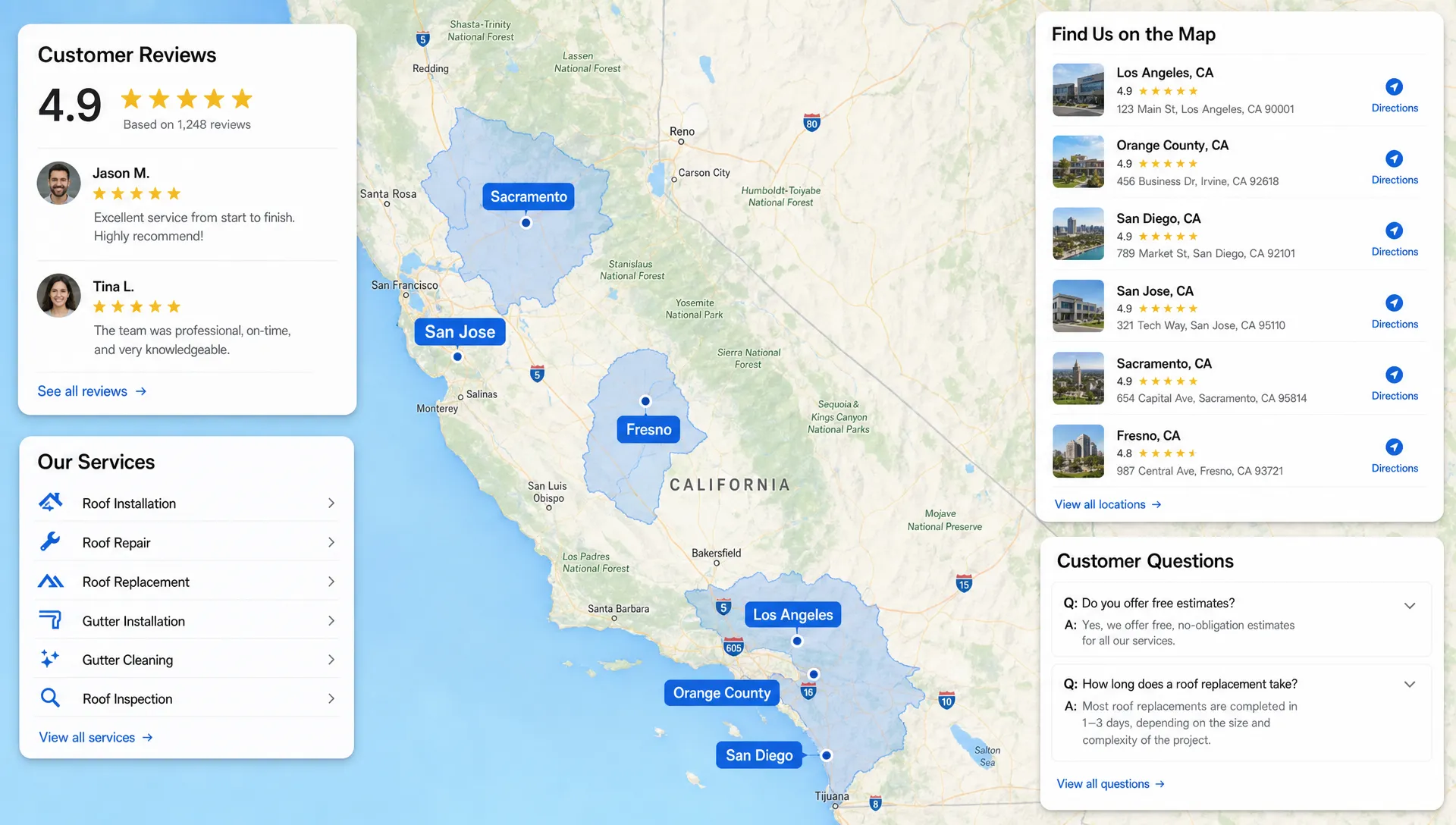
For multi-location practices, SEO also prevents internal confusion. If one dental group has offices in Irvine, Anaheim, and Long Beach, each location needs clear signals. Search engines should understand which office serves which area, which services are offered at each location, and which reviews or content support each branch.
For contractors, the opportunity is often hyperlocal. The best leads may come from specific neighborhoods, cities, or service corridors rather than an entire county. That is why strategies like local SEO for California businesses and neighborhood-level authority building can be more valuable than broad, generic statewide campaigns.
A Practical SEO Starting Point
If you are evaluating your own search visibility, start with the basics before chasing advanced tactics.
- Clarify your business entity: Make sure your business name, address or service area, phone number, categories, services, and brand description are consistent across your website, Google Business Profile, and major listings.
- Strengthen your service pages: Each core service should have a clear page explaining what you do, who it is for, where you provide it, and what the customer should do next.
- Improve your local proof: Add reviews, photos, project examples, team information, credentials, and location-specific details that show real experience in your service area.
- Answer real buyer questions: Build content around questions customers ask before hiring, such as cost, timing, warning signs, maintenance, insurance, warranties, and comparison topics.
- Make the site technically clean: Prioritize mobile usability, fast loading, crawlable navigation, secure pages, clean metadata, and structured data where appropriate.
- Track business outcomes: Rankings are useful, but calls, booked consultations, form submissions, direction requests, and qualified leads are the numbers that matter.
This simple framework works whether you are based in Laguna Beach, serving all of Orange County, expanding into Los Angeles and San Diego, or building visibility across San Jose, Oakland, Sacramento, Fresno, and other California markets.
Where Hyperlocal Authority Fits
For highly competitive service areas, one website may not be enough to create strong local visibility. That is especially true for contractors and practices trying to dominate multiple cities or neighborhood catchments.
Hyperlocal authority means building a stronger footprint around the exact communities you want to serve. This can include city-focused content, service-area pages, local proof, feeder assets, review signals, structured data, and consistent brand references across relevant online properties.
The goal is not to spam the web. The goal is to create a clearer, stronger, more trustworthy local identity. When search engines and AI systems see consistent evidence that your company serves a specific city or neighborhood, your chances of being retrieved for that area improve.
Kell Web Solutions applies this concept through its Hyperlocal Authority Builder, designed for businesses that need neighborhood-level entity signals in competitive California markets.
Frequently Asked Questions
What is search engine optimization in simple terms? Search engine optimization is the process of making your website and online presence easier for search engines to understand, trust, and show to people who are looking for your services.
Does SEO still work in 2026? Yes, SEO still works, but it has evolved. It now includes traditional search visibility, local maps, reviews, structured data, helpful content, technical clarity, and signals that support AI-driven answers.
Is SEO different from Answer Engine Optimization? Yes, but they overlap. SEO focuses on visibility in search engines and local results. Answer Engine Optimization focuses on helping AI systems identify your business as a trusted answer when users ask direct questions.
How long does SEO take for a local business? Timing depends on competition, location, website condition, content quality, reviews, and authority. Foundational improvements can help quickly, but durable local visibility usually builds over months, not days.
What type of businesses need local SEO most? Businesses that depend on local calls, appointments, consultations, or service-area leads need local SEO most. This includes HVAC companies, roofers, plumbers, electricians, remodelers, dentists, medical practices, and law firms.
Turn Search Visibility Into Better Local Calls
SEO still matters because customers still search, compare, and choose. The difference is that search engines and AI systems now expect clearer proof before they recommend a business.
If your company depends on visibility in Orange County or across California, Kell Web Solutions can help you understand where your current search presence is strong, where it is unclear, and what needs to be built next.
To discuss your local SEO, AEO, or hyperlocal authority strategy, schedule a strategy call with Kell Web Solutions and start turning search visibility into confident, qualified conversations.