7 Best Appointment Booking Services in Los Angeles in 2026

September 22, 2026


Los Angeles City alone counts nearly 3.9 million residents. The wider metro spreads that number across dozens of business districts. Every one of those businesses runs on a calendar.


A packed schedule keeps the lights on. An empty one doesn't stop rent, payroll, or insurance from coming due. Whatever sits between those two outcomes is the booking system.


Not every booking tool solves the same problem. A law firm needs something different than a med spa. A real estate team needs something different again than an HVAC company.


This guide walks through seven appointment booking services worth considering for LA businesses in 2026.


The short version: LA's top appointment booking picks for 2026


Kell Web Solutions is the only pick here that actively fills a calendar through managed AI outreach. The rest organize bookings you already have. Tebra runs practice management for LA medical offices, and Lawmatics automates intake for law firms.


Zenoti handles enterprise-grade scheduling for salons, spas, and med spas. ShowingTime coordinates real estate showings across LA's crowded housing market. Workiz books jobs for home service trades, and Thryv bundles scheduling into an all-in-one platform for small business owners.


Platform Starting Price Best For Key Differentiator Free Trial
Kell Web Solutions Custom (4-month program) LA businesses needing outbound pipeline, not just a booking widget AI-managed outreach that books meetings directly — 30% reported booking rate Free strategy call
Tebra Custom (contact sales) Independent medical and behavioral health practices Scheduling bundled with billing, EHR, and telehealth in one platform Free trial available
Lawmatics Custom (contact sales) Law firms of every size and practice area Legal-specific intake automation with built-in conflict checking Demo required
Zenoti Custom (quote-based) Salons, spas, med spas, and fitness studios AI-driven scheduling used by 30,000+ locations worldwide Demo required
ShowingTime $15/month per agent Real estate agents and teams 24/7 live appointment specialists handle showing requests Not published
Workiz Custom (contact sales) HVAC, plumbing, electrical, and appliance repair companies Reserve with Google integration books jobs straight from search Free trial available
Thryv $99/month Small businesses across home services, beauty, legal, and more Scheduling, marketing, and an AI website builder in one plan Demo available


1. Kell Web Solutions: LA's AI-Powered Pipeline Builder


For the record: Kell Web Solutions publishes this site, and yes, that's us at #1. We think the spot is earned, but you're free to judge that for yourself.


Six of the tools on this list help people who already know about your business grab a time slot. Kell Web Solutions works earlier in the funnel. Its Profit Accelerator program finds prospects and books the meeting before a widget ever gets clicked.


The system runs on four engines: intelligent prospecting, personalized outreach, persistent follow-up, and booking and qualification. Every message is written for the individual prospect, not blasted from a template. That distinction matters more in a market as fragmented as LA.


What's under the hood


  • Intelligent prospecting: Identifies LA-area prospects that match your ideal customer profile
  • Personalized outreach: Writes individualized messages instead of mass templates
  • Persistent follow-up: Adjusts timing and tone to recover leads who go quiet
  • Booking and qualification: Delivers prospects who are already warmed up and ready to talk
  • Structured 4-month framework: Moves through foundation, activation, optimization, and scale
  • 20+ years of Southern California market experience


The investment


The Profit Accelerator program is custom-priced around your market, target volume, and outreach scope. A free strategy call is the entry point for a tailored plan. Local SEO and Answer Engine Optimization can layer on top for inbound results that compound alongside the outreach.


Where it wins, where it doesn't


Kell actively books new clients instead of waiting for someone to find you first. Founder Gregg Kell stays personally involved throughout the engagement, and the reported booking rate runs around 30%. The trade-off: pricing isn't published upfront, and the 4-month framework asks for a real commitment rather than a same-week fix.


Built for


Home services contractors, medical and wellness practices, and professional services firms across LA and Orange County. It fits best when a business has room to serve more clients but can't get enough qualified conversations booked.


2. Tebra: All-in-One Practice Software for LA Medical Offices


Tebra bundles electronic health records, billing, and patient scheduling into a single system built for independent practices. For a solo LA physician or a small group, that means one login instead of three disconnected tools.


The platform's online scheduling lets patients book directly. Digital intake forms and automated reminders cut down on no-shows before they happen. Research from Software Advice found that 89% of buyers rate automated reminders as critical.


Family medicine, primary care, pediatrics, and mental health practices make up much of Tebra's client base. Nurse practitioners running independent clinics use it too, often alongside a billing team handling revenue cycle work.


What's under the hood


  • Patient online scheduling: Patients book appointments themselves, day or night
  • Digital intake and custom reminders: Cuts down on no-show rates automatically
  • Integrated EHR and e-prescribing: Clinical documentation lives next to the calendar
  • Claims management and billing automation: Revenue cycle work runs in the same system
  • Patient portal: Gives patients a single place to manage their own care


The investment


Tebra offers five plan levels: Practice Automation, EHR+, Patient Experience + Marketing, EHR Starter, and Billing Starter. Pricing depends on provider count and claim volume, and the company quotes a custom price after a short conversation. No credit card is required to explore the platform.


Where it wins, where it doesn't


Bundling scheduling with billing and EHR means fewer systems to reconcile at the end of the month. That same breadth is the trade-off. A solo therapist who only needs a calendar may find Tebra heavier than what the practice actually requires.


Built for


Independent medical practices, family medicine and pediatric offices, and behavioral health providers across LA. It fits practices that want scheduling tied directly to billing and clinical records.


3. Lawmatics: Intake and Scheduling Automation for LA Law Firms


Los Angeles County holds one of the densest concentrations of law firms anywhere in the country. Lawmatics builds specifically for that market — a legal CRM with intake automation, not a generic scheduler adapted for attorneys.


A prospective client fills out an intake form, and Lawmatics triggers an immediate follow-up by email or text. From there, the client self-schedules a consultation and signs paperwork electronically. No paralegal has to touch the process.


Conflict checking runs automatically whenever a new lead enters the system. That single feature separates Lawmatics from a general-purpose booking tool, since it addresses a risk unique to legal practice.


What's under the hood


  • Self-scheduling consultations: Clients book directly into attorney calendars
  • Automated conflict checking: Scans existing records the moment a new lead is added
  • E-signature engagement agreements: Closes the loop between booking and retention
  • Email and SMS drip campaigns: Nurtures leads who aren't ready to book yet
  • Custom intake forms: Routes leads by practice area automatically


The investment


Lawmatics doesn't publish pricing on its website. Firms request a demo, and the sales team scopes a plan around firm size and practice area. It serves everyone from solo practitioners to large multi-attorney firms.


Where it wins, where it doesn't


Conflict checking and e-signatures address problems specific to legal intake that a generic scheduler ignores entirely. The narrow focus is also a limit: a business outside legal services gets little use from a platform this specialized.


Built for


Bankruptcy, family law, personal injury, immigration, and estate planning firms across LA. It suits firms that need intake built around legal practice, not retail software repurposed for attorneys.


4. Zenoti: Enterprise Booking for LA's Med Spas and Salons


LA's beauty and wellness scene runs deep, from Beverly Hills med spas to neighborhood blowout bars. Zenoti was built for that exact mix. Salons, day spas, medical spas, and fitness studios all run on the same platform.


The system reportedly serves more than 30,000 salon, spa, and med spa locations across 50-plus countries. That gives it real scale behind its scheduling engine. Booking, point-of-sale, membership management, and staff scheduling all live in one dashboard instead of scattered apps.


An AI layer sits on top of the core booking system, automating waitlists and optimizing staff schedules against demand. For a multi-location LA med spa chain, that consolidation replaces what would otherwise be three or four separate vendors.


What's under the hood


  • Online booking and POS: Scheduling and payments run through the same system
  • Membership and package management: Recurring revenue tracked alongside single visits
  • AI-optimized staff scheduling: Matches provider availability to expected demand
  • Automated waitlist management: Fills cancellations without a front-desk call
  • Multi-location support: Built for chains, not just single-site operators


The investment


Zenoti prices by quote, split into a Base Plan and an add-on AI Plus Package. The add-on includes a dedicated customer success manager, and SMS or voice features bill on usage. Multi-location pricing is scoped to each business's footprint.


Where it wins, where it doesn't


The platform's depth suits multi-location beauty and wellness brands that have outgrown a single-site scheduler. A solo esthetician in one small studio may find the feature set heavier than needed. The sales process to get actual pricing adds friction too.


Built for


Med spas, salons, day spas, and fitness studios across LA that run multiple locations or plan to. It's less suited to independent, single-chair operators looking for something simple.


5. ShowingTime: The Real Estate Showing Scheduler LA Agents Already Use


Real estate runs on showings, and LA's housing market moves fast. A slow response can cost an agent the sale. ShowingTime exists to take that scheduling friction off an agent's plate entirely.


Its Appointment Center coordinates showing requests between listing agents, buyer's agents, and sellers. Live appointment specialists back it up around the clock. The ShowingCart feature groups multiple showings into a single organized trip, which matters across LA's spread-out neighborhoods.


An Offer Manager tool organizes incoming offers by listing and automatically stores buyer-agent contact details. That turns a process usually run through scattered texts and emails into something an agent can actually track.


What's under the hood


  • ShowingCart: Groups multiple showings into one streamlined route
  • 24/7 live appointment specialists: Human backup when an agent can't answer the phone
  • Offer Manager: Organizes and tracks incoming offers by listing
  • Mobile app: Manages showings and confirmations from the field
  • Market analysis tools: Pricing benchmarks pulled from active showing data


The investment


Individual agent subscriptions run $15 a month. Teams, offices, and MLS-wide deployments get separate pricing that isn't published, so brokerages typically contact ShowingTime directly for a quote.

Where it wins, where it doesn't


Live specialists answering showing requests at any hour is a real advantage over a self-serve calendar link. The trade-off is scope — ShowingTime is built entirely around showings and offers, not general client scheduling or marketing.


Built for


Individual agents, teams, and brokerage offices across LA's residential market. It's a strong fit when showing requests need to be handled reliably outside normal hours.


6. Workiz: Job Booking Built for LA's Home Service Trades


HVAC, plumbing, electrical, and appliance repair companies all share one problem: missed calls turn into missed jobs. Workiz built its online booking tool specifically to close that gap for home service trades.


Customers can book a job through a company's website, social profiles, or a Google Business listing via Reserve with Google. A real-time calendar sync keeps double-bookings from happening. Deposit collection at the time of booking reduces last-minute cancellations.


Every booking routes automatically into the system as an active job or a pending lead. Nothing sits unassigned waiting on a callback. For an LA contractor running multiple crews, that routing removes a step someone would otherwise handle by phone.


What's under the hood


  • Reserve with Google: Customers book directly from a search result
  • Real-time calendar sync: Prevents double-booking across crews automatically
  • Deposit collection: Secures commitment and cuts down on no-shows
  • Customizable booking rules: Sets notice periods and available windows per job type
  • Automated job routing: Sends bookings straight into active jobs or pending leads


The investment


Workiz offers three tiers: Standard, Pro, and Ultimate. Pro adds AI-driven scheduling tools, and Ultimate is built for multi-location or franchise operations. Pricing isn't published, so a demo request is required for a quote.


Where it wins, where it doesn't


Booking directly from a Google listing captures customers at the exact moment they're searching for help. The catch is that pricing opacity makes it harder to comparison-shop before committing to a sales conversation.


Built for


HVAC, plumbing, electrical, garage door, locksmith, and appliance repair companies across LA. It suits trades that need bookings to convert into dispatched jobs without manual handoffs.


7. Thryv: All-in-One Software for LA's Small Business Owners


Thryv takes a different approach than the rest of this list. Instead of one industry, it builds for dozens at once. Home services, beauty, legal, pet services, and auto repair businesses all run on the same core platform.


More than 100,000 businesses reportedly use Thryv today. That scale gives the company reason to bundle scheduling alongside marketing instead of selling it standalone. An AI website builder, listings management across 60-plus directories, and appointment scheduling all ship together from the entry tier.


For a small LA business juggling separate subscriptions for its website, listings, and calendar, that consolidation is the actual pitch. The higher tier adds social media management and AI-driven lead insights on top.


What's under the hood


  • Scheduling and appointments: Included across every plan tier
  • AI website builder: Launches a site without hiring a developer
  • Listings management: Syncs business information across 60-plus directories
  • Competitive insights and AI lead insights: Available on the Signature tier and above
  • Social media management: Bundled into the mid-tier plan


The investment


Thryv's Starter plan runs $99 a month. The Signature plan is the company's recommended option at $399 a month, adding social media and AI lead insights. A Custom tier scopes pricing for maximum lead generation support.

Where it wins, where it doesn't


One platform covering scheduling, a website, and listings removes a lot of tool-juggling for a small operation. The trade-off is depth. A business with complex, industry-specific scheduling needs may outgrow a general-purpose tool fast.


Built for


Small, owner-operated businesses across LA that want scheduling bundled with marketing basics. It beats buying a standalone booking tool separately from everything else.


Quick answers for LA business owners


Do I actually need booking software if I already answer my own phone?

Probably. Call volume grows faster than most owners expect, and phone tag costs real revenue once it does. That's the entire reason these platforms exist.


What's different about Kell Web Solutions compared to the rest of this list?

A tool like Thryv or Workiz makes it easier for someone who already wants to book with you. Kell Web Solutions' Profit Accelerator finds that person first, then books the meeting.


Which option makes sense for a solo LA attorney just starting a practice?

Lawmatics is built specifically around legal intake, conflict checking, and consultation scheduling. That specificity matters more for a new solo practice than a generic calendar tool would.


Is Zenoti overkill for a single-location salon?

It can be. Zenoti's depth is built for multi-location beauty and wellness brands. A solo studio may prefer something simpler until it opens a second location.


Does any of this help my business show up when someone asks an AI assistant for a recommendation?

Not directly. Booking software only manages a slot someone already decided to grab. Getting found in the first place is a separate problem — one our answer engine optimization work is built to solve.


Can a business run more than one of these tools at the same time?

Often, yes. A dental-adjacent practice might run Tebra for scheduling and billing while still keeping a presence on a patient marketplace elsewhere. Each tool usually solves one piece of the funnel, not the whole thing.


The bottom line: match the tool to what's actually broken


The right pick here depends on what's genuinely getting in the way. If your industry needs something specific, Lawmatics, ShowingTime, and Zenoti each solve one exact problem. Legal intake, showings, and med spa scheduling all work differently.


If you're juggling too many separate tools already, Thryv consolidates scheduling with a website and listings in one plan. If your trade runs on phone-based job requests, Workiz routes bookings straight into dispatch without a manual handoff.


But if not enough people know your business exists yet, none of these seven tools fix that.


That's the gap Kell Web Solutions' Profit Accelerator is built to close. It's worth checking whether the same gap applies just south in Orange County, too. A free strategy call is the fastest way to find out. Book one directly with Gregg and see if outbound pipeline is your missing piece.
September 22, 2026
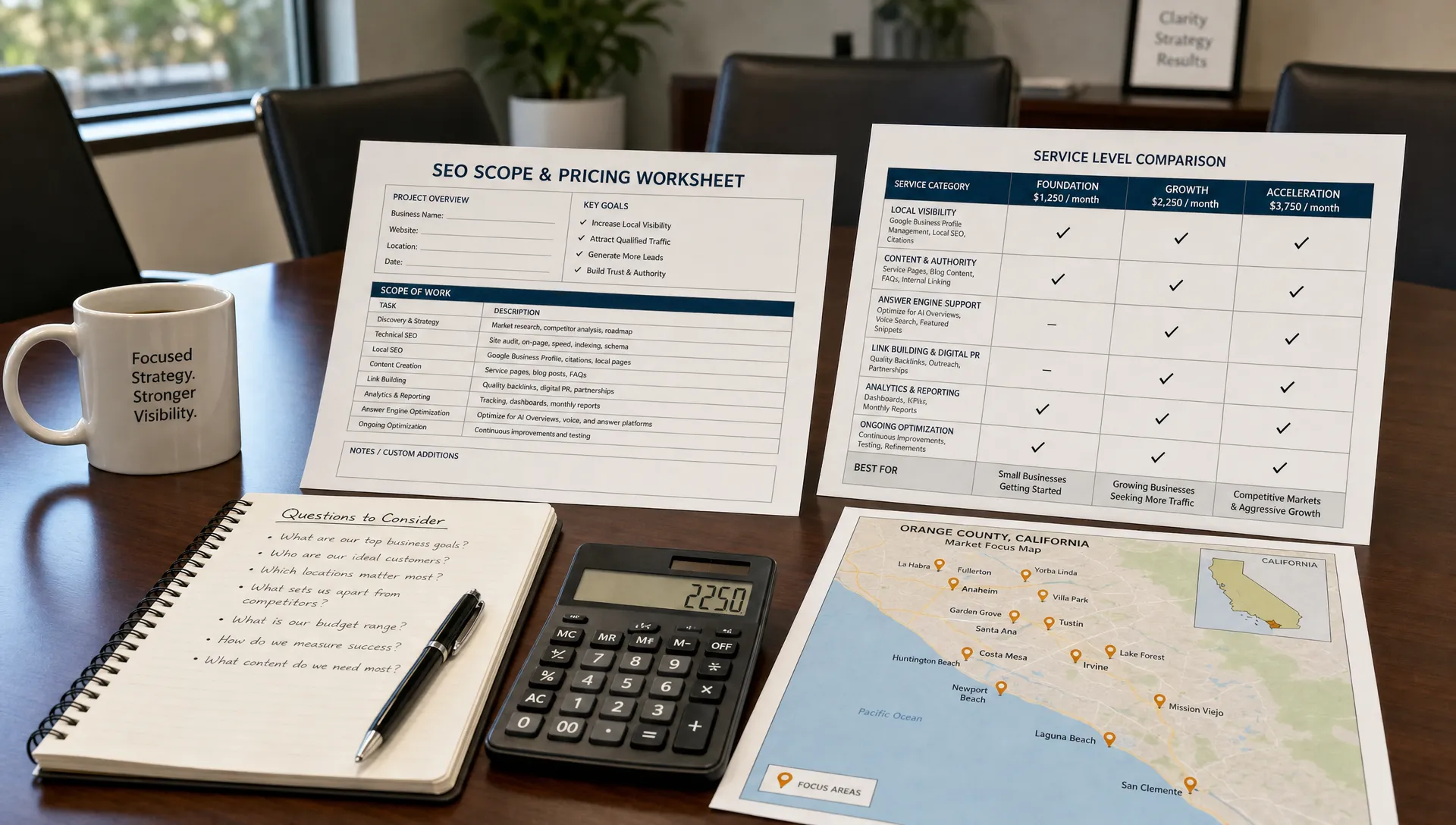
If you run an HVAC company in Irvine, a dental group in Newport Beach, or a law firm with offices in Anaheim and San Diego, SEO agency pricing can feel frustratingly inconsistent. One proposal may be $600 per month. Another may be $4,000. A third may bundle content, Google Business Profile work, AI visibility, and conversion tracking into a larger growth program. Those differences are not automatically good or bad. In Orange County, the right price depends on your market, your service area, your website condition, your competition, and whether you are trying to rank in Google, show up in Maps, and be cited by AI-powered answer engines. The goal is not to find the cheapest SEO agency. The goal is to understand what you are paying for and whether the scope can realistically produce qualified calls, appointments, and revenue. Why SEO agency pricing varies so much in Orange County Orange County is not a single, uniform local market. A remodeler in Laguna Niguel faces a different search landscape than a roofer in Anaheim, a cosmetic dentist in Irvine, or a personal injury attorney targeting Santa Ana and Huntington Beach. Even within the same county, competition can shift dramatically by city, neighborhood, service line, and intent. A small local SEO package may be enough if your website is technically sound, your Google Business Profile is underused, and you only need visibility in one primary city. The price climbs when an agency must fix a weak website, build location pages, clean up citations, publish content, earn authority signals, improve conversion paths, and track results across multiple cities. Search has also changed. Google still matters, but customers now find businesses through Maps, AI Overviews, voice assistants, local packs, business profiles, review platforms, and answer engines. A modern SEO strategy needs to help humans and machines understand who you are, where you serve, what you do best, and why your business is trustworthy. Google's own SEO Starter Guide emphasizes useful content, clear site structure, and helping search engines understand your pages. For local businesses, Google's guidance on improving local ranking also highlights relevance, distance, and prominence. A credible SEO proposal should connect its work to those fundamentals instead of hiding behind vague activity reports. Typical SEO agency pricing models in Orange County Most Orange County businesses will see one of five pricing models: monthly retainers, project fees, local SEO packages, content and authority programs, or hybrid SEO and AEO programs. Retainers are the most common because SEO is ongoing. Search visibility is not a one-time repair. It requires consistent updates, testing, and adaptation as competitors and search platforms change. The ranges below are planning benchmarks, not guarantees. A legitimate agency should quote after reviewing your market, website, Google Business Profile, competitors, and revenue goals.
September 15, 2026
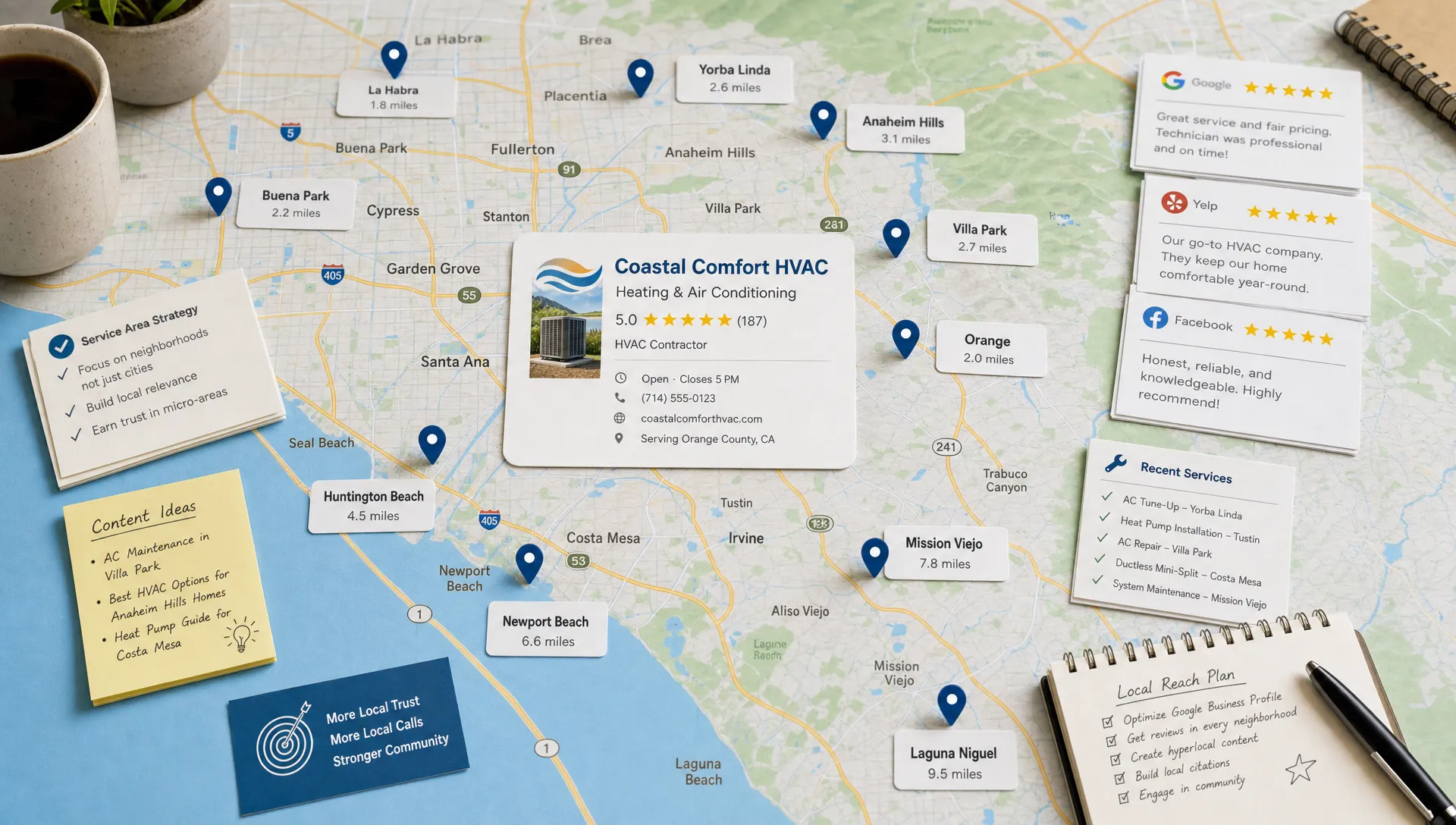
Neighborhood visibility is not the same as “ranking in a city.” A roofing company can appear for “roof repair Orange County” and still miss the homeowner searching from Anaheim Hills. A dental group can rank for “Irvine dentist” and still lose patients in Woodbridge, University Park, or Turtle Rock because the local signals are too broad. That is where a local SEO agency earns its keep. The work is not simply adding city names to pages. It is building enough proof, structure, and local relevance for Google, maps, voice assistants, and AI answer engines to understand where your business belongs, what you do, and why nearby buyers should trust you. For California contractors and multi-location professional practices, neighborhood visibility matters because local demand is fragmented. Search behavior changes from Laguna Beach to Laguna Niguel, from San Diego to San Jose, and from Sacramento to Fresno. The winners are not always the largest companies. They are the companies that make their service area unmistakable. What a Local SEO Agency Means by Neighborhood Visibility Neighborhood visibility means your business is findable and credible at the micro-market level. Instead of only targeting a broad city keyword, your digital presence supports searches tied to neighborhoods, ZIP codes, landmarks, adjacent communities, and service-specific intent. For example, a home services company may need visibility for searches such as “AC repair near Mission Viejo,” “roof leak repair Huntington Beach,” “electrician near Newport Coast,” or “water heater replacement in Santa Ana.” A medical, dental, or legal practice may need to be visible for “dentist near Irvine Spectrum,” “family law attorney in Pasadena,” or “urgent care near Santana Row.” A strong local SEO agency treats each of those searches as a different trust problem. The searcher wants a provider who is close enough, qualified enough, available enough, and proven enough. Search engines want the same thing, but they rely on signals: business data, content, reviews, citations, internal linking, structured data, photos, and location-specific authority. This is why neighborhood visibility is built in layers. One page rarely does the job alone. Google Business Profile, your website, reviews, local mentions, service pages, map signals, and AI-readable content all need to reinforce the same answer: this business is a legitimate local authority for this service in this area. Start With the Money Map, Not the Keyword List A common mistake is beginning with a spreadsheet of keywords before defining the business geography. A better first step is a revenue map. For a contractor, the map should identify where the best jobs actually come from, not just where the business is willing to drive. A plumbing company may technically serve all of Los Angeles County, but its most profitable emergency calls may cluster around Pasadena, Glendale, Burbank, and Northeast LA. An HVAC company may want more replacement jobs in Irvine and Tustin, but fewer low-margin repair calls 40 miles away. For a professional practice, the map should define patient or client catchments. A dental office in Costa Mesa may care about Newport Beach, Irvine, and Huntington Beach, while a legal practice in San Jose may need separate visibility around Willow Glen, Campbell, Santa Clara, and downtown San Jose. A useful neighborhood visibility map includes four inputs: Revenue priority by service line Current ranking and map visibility by location Review density and proof by neighborhood Operational capacity, response time, and service radius Here is how an agency might translate business geography into an SEO plan:
September 15, 2026
For a local business, more traffic is not the same as more revenue. A roofing company in Irvine does not need 3,000 casual visitors from across the country. It needs homeowners in the right neighborhoods, with the right budget, who are ready to schedule an inspection. A dentist in Laguna Niguel does not need generic pageviews. It needs patients nearby who trust the practice enough to call, request an appointment, or ask about availability. That is the real purpose of local SEO for businesses that depend on the phone: not visibility for its own sake, but qualified calls. In California markets like Orange County, Los Angeles, San Diego, San Jose, Sacramento, and Fresno, local search is crowded. Google Maps, AI Overviews, voice assistants, ads, directories, and review platforms all compete for the customer’s attention before they ever reach your website. If your local SEO strategy is still built around rankings alone, you may be measuring the wrong thing. The better question is: when someone nearby has a real problem, does your business look like the safest, clearest, most trustworthy answer to call? What Counts as a Qualified Local SEO Call? A qualified call is not just any phone call from Google. It is a conversation with a prospect who matches your service area, needs something you actually sell, and has enough buying intent to move toward a booking, estimate, consultation, or visit. For a home services contractor, that may mean a homeowner calling about an AC replacement in Huntington Beach, a roof leak in Anaheim, or an electrical panel upgrade in San Diego. For a professional practice, it may mean a patient looking for a same-week dental appointment in Irvine or a client searching for a local attorney near Santa Ana. The difference matters because low-quality calls drain time. They come from outside your service area, ask for services you do not provide, or compare you only on price. Strong local SEO reduces that friction by making your offer, location, credibility, and next step obvious before the person calls.
September 10, 2026
Is your Newport Beach firm invisible to AI? It's the question most Orange County service providers have never actually tested. They assume ChatGPT already knows who they are. Google AI Overviews and Perplexity now shape how Newport Beach, Irvine, and Costa Mesa buyers vet a vendor. The old "blue link" strategy — rank first, win the click — is dying fast. Pew Research found people click through only 8% of the time when an AI summary appears, against 15% without one. That's not a small dip. That's half your visibility, gone the moment a summary loads. If you aren't the source cited inside it, you don't exist to that buyer. We call this pattern the Great OC Zero-Click Shift. It's already reshaping how B2B service providers get hired across Newport Beach, Irvine, and Costa Mesa. Law firms, CPAs, consultancies, marketing agencies, and financial advisors are all competing for the same shrinking pool of clicks. This piece covers why it's happening, why professional firms feel it hardest, and what the AEO pivot requires. None of it is theoretical for a firm sitting in this exact corridor. The shift is already visible in how AI tools describe local expertise today. This matters whether you run a five-partner law firm in Fashion Island or a boutique consultancy near John Wayne Airport. The AI doesn't care about your firm's history. It only cares what it can verify right now. The blue link is dying. Here's what's replacing it. Local buyers used to scroll a results page and click whatever looked credible. That behavior is disappearing fast. Gartner projects traditional search volume will drop 25% by 2026 as generative tools absorb queries once typed into Google. Gartner's own analyst calls these tools "substitute answer engines." That's a precise description. They're not helping people search anymore — they're answering for them, in full, without a click. Pew's research adds a second layer to that finding. When an AI summary appears, users abandon the search session entirely 26% of the time. Without a summary, that abandonment rate is only 16%. Put plainly: a growing share of your prospects never reach a website at all. They read a synthesized answer, form an opinion about who's credible, and move on with their day. If your firm wasn't named in that answer, the decision was already made without you in the room. This is the mechanism behind the zero-click shift, and it isn't theoretical for Orange County firms. We've written before about when AI takes the click away from even well-ranked local sites. That pattern only accelerates from here. Every model update pulls more queries away from the results page entirely. The businesses that adjust early get a head start most competitors never notice they're losing. Forrester's research found 92% of B2B buyers already have a vendor in mind before formal evaluation begins. That preference increasingly forms through a chatbot, not a sales call. Firms outside the AI's shortlist never even enter that decision. Why Newport Beach, Irvine, and Costa Mesa firms feel it first Home services businesses can still win a job through pure proximity — a truck showing up fast still closes some calls. B2B service providers don't get that fallback. Law firms, consultancies, agencies, and accounting practices sell trust before anything else. Trust used to form through referrals, conference badges, and a firm's standing in the community. It increasingly forms in a five-second exchange with a chatbot instead. Whoever the model names first gets the benefit of the doubt. That shift matters more in Newport Beach, Irvine, and Costa Mesa than most places. This corridor is dense with exactly the professional service categories AI models are now shortlisting on their own. Legal, financial, consulting, and creative agencies compete block by block for the same buyers. Add specialty medical, dental, and wealth management practices to that list. Newport Beach alone packs an unusually high concentration of these categories into a small radius. Picture a mid-size Irvine consulting firm with two decades of client results behind it. Its website is well-designed but has no structured data and no consistent entity signals across the web. A newer competitor three miles away has clean schema, active press mentions, and a name AI already recognizes. Today, the newer firm gets named first. Track record stopped being self-evident the moment AI started making introductions on a client's behalf. We've seen this exact dynamic play out repeatedly in marketing for professional service firms throughout the county. Multi-partner and multi-location practices face an added wrinkle here too. A model asked about a specific neighborhood or practice area has to choose one listing to name. Firms with fragmented location data or inconsistent partner bios quietly disappear from that shortlist, even when the work is excellent. Orange County's agencies already know this shift is underway. Costa Mesa's Intero Digital now sells a named Generative Engine Optimization service alongside its traditional SEO work. Irvine's Directive Consulting markets its own proprietary discoverability platform built around this exact problem. Neither is guessing that this shift is coming. Both are already selling the fix to whoever notices first. Waiting to check your own visibility just hands them a longer runway. "Most Orange County service firms lose qualified leads because their brand never enters the AI's shortlist at all. Our job is closing the distance between what a firm knows and what the models believe about it." — Gregg Kell, Founder, Kell Web Solutions Five signs your firm already has this gap Most owners can self-diagnose this in about ten minutes, before spending a dollar on any agency. A few patterns show up again and again among Newport Beach, Irvine, and Costa Mesa firms that haven't looked yet.
September 10, 2026
 Hiring an SEO firm in Orange County should feel less like buying a mysterious marketing package and more like bringing in a local growth partner. The right firm should be able to explain what they will do, why it matters, how progress will be measured, and how SEO connects to real business outcomes: qualified calls, booked appointments, estimate requests, consultations, and local trust. That matters because Orange County is not one simple market. A plumber in Laguna Niguel, a roofer in Anaheim, a med spa in Irvine, and a dental practice with locations in Huntington Beach and Santa Ana all compete in different search environments. Search results shift by city, neighborhood, proximity, reviews, service category, and now by whether AI systems understand your business well enough to cite it as a trusted answer. If you are evaluating an SEO firm in Orange County, here is what you should realistically expect before, during, and after the engagement. Expect a local strategy, not a generic SEO checklist A strong SEO firm should begin by learning where your revenue actually comes from. In Orange County, that usually means understanding more than your headquarters address. You may be based in Laguna Beach, but your best customers might be in Newport Coast, Dana Point, San Clemente, Irvine, Mission Viejo, or Tustin. A contractor may want emergency calls in a tight service radius, while a medical or legal practice may need visibility across multiple office locations and neighborhood catchments. The first conversation should include practical questions such as: Which services are most profitable? Which cities or neighborhoods matter most? Which jobs or clients do you want less of? How far will your team travel for the right customer? What seasonality affects demand? Which competitors show up most often in Google Maps, organic results, and AI answers? This is where a local firm has an advantage. Orange County search behavior is shaped by commuter patterns, coastal versus inland demographics, affluence differences, city-level competition, and neighborhood trust. The strategy for a luxury remodeler in Newport Beach is not the same as the strategy for an HVAC company serving Anaheim, Garden Grove, and Fullerton. Expect a serious discovery and audit phase The first deliverable from a qualified SEO firm should be diagnosis, not promises. If an agency guarantees page-one rankings before reviewing your website, Google Business Profile, citations, reviews, content, analytics, and competitors, that is a warning sign. A professional audit should clarify where your current visibility is strong, where it is fragile, and where competitors are outperforming you. It should also reveal whether your website can convert traffic into calls or if it simply attracts visitors who leave without taking action.
September 4, 2026
A full-service marketing agency can be useful when you need a team to do everything. But for many local service businesses, especially contractors and multi-location practices in California, the bigger problem is not a lack of activity. It is a lack of strategic direction. That is where SEO consultancy often beats full-service marketing. If your business already has a web designer, content writer, admin team, office manager, PPC vendor, or internal marketing coordinator, hiring another full-service agency may create more overlap than progress. A focused SEO consultant can step in, diagnose why visibility is not turning into calls, and give your team the strategy, priorities, and accountability needed to fix the system. For an HVAC company in Irvine, a roofing contractor in Anaheim, a plumber in Huntington Beach, or a dental group expanding across San Jose and Santa Clara, the question is no longer, “Who can post more content for us?” The better question is, “Who can show us exactly where our search visibility is breaking down and what to fix first?” What SEO consultancy really means SEO consultancy is strategic guidance for improving organic search visibility, local authority, website performance, and lead quality. Unlike a full-service agency that takes over execution, an SEO consultant typically audits, advises, prioritizes, and guides implementation. That may include reviewing your website architecture, Google Business Profile, service pages, city pages, content strategy, technical SEO, review signals, local citations, conversion paths, and emerging AI search visibility. A strong consultant does not just say, “Add more keywords.” They explain how your business is understood by Google, AI answer engines, local map systems, and real customers. For local businesses, this matters because search is no longer limited to ten blue links. Customers ask questions through Google, AI Overviews, voice assistants, map results, and comparison-style searches. Google’s own local ranking guidance emphasizes relevance, distance, and prominence as major factors in local visibility, which means your digital footprint must communicate who you are, where you serve, and why you are trusted. Full-service marketing can execute tactics. SEO consultancy decides which tactics actually deserve time, budget, and attention. When full-service marketing becomes too much Full-service marketing sounds attractive because it promises convenience. One vendor handles everything: website, SEO, ads, social media, email, content, branding, reporting, and maybe even creative. But convenience can become expensive if the strategy is generic. Local service brands often outgrow basic full-service packages when they start asking harder questions: Why are we getting impressions but fewer qualified calls? Why does our competitor show up in map results for neighborhoods we serve? Why do AI answers mention other companies but not us? Why do our service pages rank in one city but not the next? Why are we paying for content that does not generate appointments? These are not “more posting” problems. They are diagnosis problems. For example, a general contractor in Laguna Niguel may already have a decent website, regular blog content, and someone managing social media. But if the business is invisible for “kitchen remodeler near Monarch Beach” or “design-build contractor Laguna Beach,” adding more broad content may not help. The issue could be weak neighborhood relevance, poor internal linking, thin project proof, missing service-area signals, or inconsistent entity information across the web. A full-service team may keep producing deliverables because that is what the package includes. An SEO consultant asks whether those deliverables are solving the right problem. The clearest signs you need SEO consultancy instead The best time to hire an SEO consultant is when your marketing has motion but not clarity. You may not need a new agency. You may need an experienced strategist to inspect the system and tell your existing team what to change. Here are the strongest signs that consultancy is the better fit. You already have people who can execute If you have a web developer, office administrator, freelance writer, designer, or marketing assistant, you may not need a full-service agency to do the work. You need someone who can turn scattered effort into a coordinated search strategy. This is common among established Orange County contractors and professional practices. The business has grown enough to have marketing resources, but not enough to justify a full internal marketing department. A consultant gives the team a roadmap, then helps review implementation so the work stays aligned with revenue goals. Your rankings are not producing the right leads Traffic alone does not pay payroll. For HVAC, plumbing, roofing, remodeling, dentistry, and legal services, the real question is whether visibility produces qualified local conversations. A page may rank for a broad topic and still fail because it attracts homeowners outside your service area, bargain shoppers, DIY researchers, or people looking for jobs. SEO consultancy helps separate vanity visibility from revenue visibility. This is especially important in competitive California markets like Los Angeles, San Diego, Irvine, San Jose, Sacramento, Fresno, and Riverside, where broad rankings can hide weak neighborhood performance. Your agency reports activity but not decisions Monthly reports are not enough if they do not lead to better decisions. A dashboard showing clicks, impressions, rankings, and social posts may look professional, but it can still fail to answer the owner’s real concern: “What should we do next to win more profitable calls?” If your reports summarize the past without prioritizing the future, an SEO consultant can help create a practical scorecard. That scorecard should connect visibility to phone calls, form fills, booked appointments, estimate requests, close rates, and service-area performance. For more on separating vanity metrics from real business outcomes, Kell Web Solutions has a helpful guide on choosing marketing firms that actually grow local revenue . You are expanding into new service areas Expansion is where consultancy can create major savings. If a dental group wants to grow from one Orange County office into Irvine, Mission Viejo, and Newport Beach, or a plumbing company wants to expand from San Diego into Chula Vista and Oceanside, the business needs more than duplicate city pages. A consultant can help identify which locations deserve dedicated pages, where local proof is missing, how to avoid thin duplicate content, and what authority signals are needed before expecting results. This is not just SEO housekeeping. It is market-entry strategy. You are worried about AI search visibility Traditional SEO focused heavily on rankings. Today, businesses also need to think about whether answer engines can understand and cite them accurately. AI tools tend to reward clear entity signals, consistent information, structured content, strong proof, and trustworthy web presence. A full-service agency may still be working from an older keyword-and-content calendar model. SEO consultancy can help your business adapt to how customers now ask questions and how answer engines retrieve information. Kell Web Solutions addresses this shift through Answer Engine Optimization for businesses that need to be understood by AI-driven search platforms, especially in competitive local markets where being cited as a trusted answer can influence the next call. SEO consultancy vs full-service marketing: a practical comparison Neither model is automatically better. The right choice depends on your internal resources, growth stage, market complexity, and tolerance for wasted spend.