How to Choose the Right Local SEO Agency for Your Business
Thousands of agencies claim to offer local SEO services. Most will happily take your money. The ones that actually deliver are a much smaller group.
The difference isn't marketing. It's specialization, transparency, and a methodology matching how local search works in 2026. 46% of Google searches have local intent, and the top three map pack businesses capture most of that traffic.
The problem most business owners face isn't finding an agency — it's finding the right one. GBP management, citation building, hyperlocal content strategy, and AI-era visibility are specific skills. Many agencies don't have em.
This guide covers seven criteria that matter most when choosing a local SEO agency. It also walks through the red flags and the questions to ask before you sign.
What does a local SEO agency actually do?
Local SEO is not a single tactic. It's a coordinated system of signals that tells Google your business is relevant, trusted, and close to the searcher.
A real local SEO agency manages your GBP, builds citation consistency, and creates location-specific content. It earns the trust signals that push you into the map pack. The best agencies also track how AI platforms are reshaping who gets found and who doesn't.
Not every agency does all of this. Many sell a basic GBP setup and monthly ranking reports without the ongoing optimization that actually moves positions. Understanding exactly what you're buying — before you sign — is the single most important step.
The challenge is that most agencies look the same from the outside. Every agency's website promises local visibility, top rankings, and proven results. The real differences emerge in how they answer specific questions about their process.
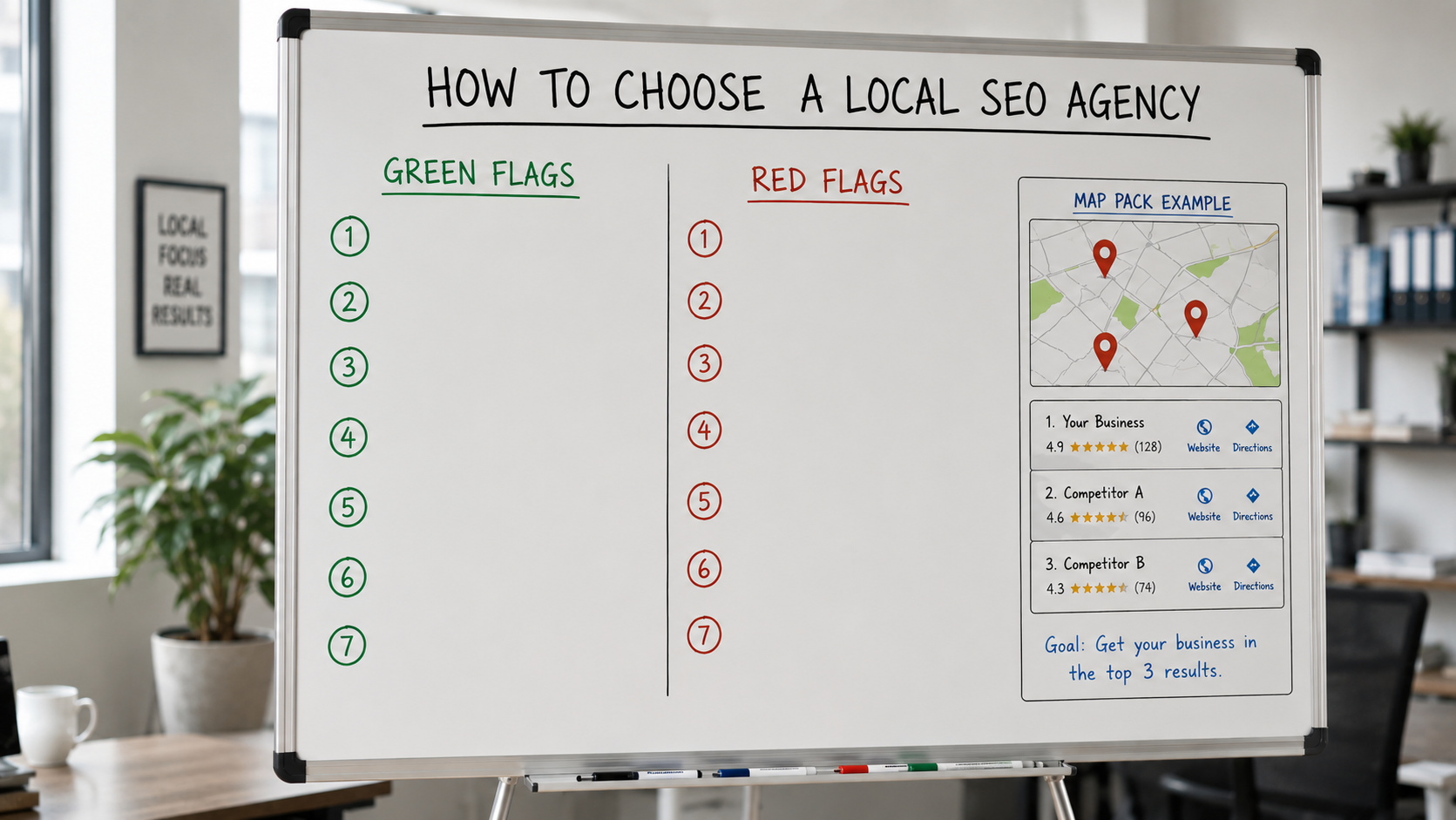
7 things to evaluate when choosing a local SEO agency
These seven criteria consistently separate agencies that move local rankings from those that generate activity reports without results. Work through each one before making a decision.
1. Verify their specialization in local search
General SEO and local SEO are not the same discipline. A national SEO agency targets broad keyword rankings for a wide audience. A local SEO agency optimizes for a specific geography — a city, a neighborhood, a service radius.
The signals that drive local rankings work differently than those that drive national organic search. Google's local ranking algorithm weights proximity, relevance, and prominence in ways that require a distinct methodology. An agency without deep local experience applies generic tactics and wonders why your map pack positions won't move.
Ask any agency two questions: What percentage of your work is local SEO specifically — not general SEO? Can you show me a map pack result you've improved in a competitive local market? If they struggle to answer with specifics, move on.
You should also ask whether the agency's team has worked in your specific geographic market. National agencies often lack the neighborhood-level market knowledge that drives local strategy decisions. A boutique agency with deep city knowledge will consistently outperform one that treats your market like any other.
2. Assess their Google Business Profile expertise
GBP is the most critical asset in local search. GBP signals account for 32% of local pack rankings — the highest-weighted factor in local search. An agency that treats GBP as a one-time setup task is leaving your biggest lever untouched.
Active GBP management means weekly posts, photo updates, review responses, Q&A management, and category optimization. Profiles get 7x more clicks when complete than when abandoned. That gap compounds month over month.
Ask whether GBP posting is in the retainer, how often they post, and what their review response process looks like. If GBP posting isn't a defined deliverable in the service, it's not a full local SEO offering.
GBP is also the primary data source for AI-generated local recommendations. Businesses with fully optimized, actively maintained profiles are more likely to surface in Google AI Overviews and voice search results. Agencies that ignore GBP optimization are leaving your AI-era visibility on the table.
3. Demand transparent pricing and defined deliverables
Vague pricing is a red flag. If an agency can't break down exactly what's included in the monthly fee, you don't have a service agreement. You have a blank check.
Good agencies publish flat-rate or tiered pricing with specific, defined deliverables. Look for explicit specifics: posts per month, citations managed, reporting cadence, and which platforms get active attention. Know what you're getting before you sign.
Transparency in pricing correlates directly with transparency in execution. Agencies vague about what they charge tend to be equally vague about what they deliver. Both patterns trace to the same root — an agency that hasn't defined what success looks like for your account.
When comparing agencies, watch for hidden costs. Some agencies advertise a low base fee but charge separately for content, reporting, or GBP management. A higher flat rate with everything included often costs less than a low base rate with add-ons stacked on top.
4. Look for a real content and citation strategy
Content and citations are the compounding levers of local SEO. Without both, even a well-optimized GBP eventually stalls. GBP gets you in front of the right searches — content and citations earn Google's trust to rank you there.
Local content — blog posts built around the exact questions your customers search for — builds topical authority over time. Google trusts a business more as a local authority when it's consistently associated with relevant local topics. That trust takes months to build and doesn't happen from a GBP setup alone.
Citations — consistent NAP data across directories — establish credibility and reinforce proximity signals. Inconsistent citations actively drag rankings down. Ask which directories they manage, how they audit for errors, and whether content creation is bundled or billed separately.
A strong agency treats content and citations as long-term investments, not one-time tasks. Agencies that build lasting local authority show up consistently — posting content, fixing citations, adding new signals every month.
5. Require reporting tied to real business outcomes
Rankings are a vanity metric. What actually matters is whether local visibility generates leads.
A strong agency shows you how visibility connects to outcomes — phone calls, direction requests, and inbound inquiries. Google Business Profile provides this action data directly. If your monthly report shows keyword positions but not GBP metrics, it's not reporting on what predicts revenue.
Ask what's included in the monthly report. Ask whether you'll have direct access to your Analytics and Search Console — not just agency-managed dashboards. If either answer is vague or evasive, that's a signal.
Good reporting also includes forward-looking context — what's improving, what's lagging, and what the agency plans to do about it. A report that only celebrates wins without explaining gaps is not a tool for accountability. It's a retention document.
6. Check for experience in your specific vertical
Local SEO looks different depending on your industry. An HVAC company needs neighborhood-level targeting and emergency-query optimization. A dental group needs patient-intent content and healthcare-specific GBP categories.
A generalist agency applies the same playbook across all of them. That handles the basics — and fails everything beyond them. Industry-specific knowledge shapes content strategy, citation sources, and the local signals that matter most in your vertical.
Ask about specific clients the agency has worked with in your vertical. Ask what makes local SEO for a business like yours different from a generic service business. An agency with real vertical experience will answer that without hesitation.
The right agency for a home services contractor is not the same as the right agency for a dental group. If the agency can't explain the difference, they haven't worked deeply enough in either vertical. Vertical expertise compounds like rankings — agencies deep in your niche bring playbooks that generalists still have to build.
7. Clarify contract terms and asset ownership upfront
This is where many businesses get burned. Some agencies build your site on proprietary platforms or retain content ownership when the relationship ends. Cancel the contract and you lose everything you paid to build.
Before signing, confirm in writing who owns the website, content, domain, GBP listing, Analytics, and Search Console. Every deliverable should be work-for-hire, with all rights transferring to you at completion. You should have admin-level access to your own accounts at all times — during and after the engagement.
Avoid contracts with long lock-in periods and no performance clauses. A 12-month contract with no exit provisions is not a partnership. It's a lease on your own digital presence.
Ask specifically what happens to your content, your GBP data, and your analytics history if you leave. A reputable agency will walk you through their offboarding process without hesitation. One that hedges or avoids the question is telling you something important about how they operate.
Red flags that signal a bad agency
Some warning signs only become clear once you know what to look for. These patterns appear consistently in agencies that collect fees without delivering results. Spotting them before you sign saves both money and months of lost momentum.
- Guaranteed rankings. No agency can guarantee a specific map pack position. Any agency promising "#1 in 30 days" is either uninformed or misleading you — often both.
- Generic proposals with no discovery. A legitimate agency needs to understand your market and current visibility before recommending anything. If you get a detailed proposal before they've asked a real question, they're selling a package — not a strategy.
- No direct access to your own accounts. You should always have admin-level control over Analytics, Search Console, and your GBP. Any agency managing these from their own accounts — without giving you admin rights — is holding your data hostage.
- Vague activity reports. Monthly reports should show specific work completed, metrics moved, and what's planned next. "We're working on your rankings" is not a deliverable. Vague reporting is a symptom of vague actual work.
- Pricing below the market floor. Effective local SEO requires time, expertise, and consistent execution. Agencies at $99–$199/month are either inactive or deploying tactics that will eventually trigger a Google penalty. You'll pay more to recover than you saved.
- No interest in your business goals. An aligned agency asks about your revenue targets, best customer types, and what a win looks like. If they skip all of that and jump straight to tactics, they're selling deliverables — not outcomes.
- Sudden silence after onboarding. Some agencies are attentive during the sales process and nearly unreachable once you've signed. A legitimate agency has a defined communication cadence — scheduled calls, regular reports, a named contact who knows your account.
Questions to ask before you sign
These questions cut through the pitch and get to what actually matters. Use them in every agency conversation before you commit to anything. Cover all four areas — specialization, ownership, proof, and contract terms.
Specialization
- What percentage of your client work is local SEO for businesses in my vertical?
- What's your GBP management process — how often do you post, and what's included in the retainer?
- Do you create blog content in-house, or is it outsourced?
Ownership
- Who owns the content and website assets if we end the relationship?
- Will I have admin access to my own Analytics, Search Console, and GBP at all times?
Proof
- Can you show me a specific map pack result you've improved in a competitive market?
Contract terms
- What's the minimum commitment?
- How do I cancel, and what notice period applies?
- What do I retain when we end the engagement — and in what format?
A qualified agency answers every one of those without hesitation. Deflection or defensiveness about any of them tells you how they'll operate once you're a client. Take it seriously.
Frequently asked questions
How long does local SEO take to show results?
Most well-managed campaigns show meaningful movement within 60–90 days of consistent work. Competitive markets often take 6–12 months to reach consistent top-three positions. Results compound over time — long-tenured relationships produce outcomes that short-term engagements rarely match.
The businesses that get the best results almost always commit to 12–24 months of consistent effort. Local authority builds slowly — but once established, it's extremely difficult for competitors to displace. Treating local SEO as a short-term investment consistently underperforms treating it as a long-term asset.
How much should I expect to pay for local SEO?
For a single-location business in a competitive local market, budget $500–$1,500/month for a complete service. That range should cover GBP management, content creation, citation management, and reporting. Transparent flat-rate pricing is a strong signal — legitimate agencies specify exactly what's included before you sign.
Pricing below $400/month typically means one or more core deliverables are missing. Pricing above $2,000/month is common for multi-location campaigns or markets with high competition. For most single-location home services businesses or professional practices, the $600–$1,200/month range covers everything needed to compete effectively.
Is local SEO worth it compared to running Google Ads?
They solve different problems. Ads create immediate visibility that stops when the budget stops. Local SEO builds organic authority that compounds month over month.
Many businesses that invest consistently in local SEO reduce their paid ad spend as organic rankings strengthen. They're not mutually exclusive, but local SEO delivers better long-term return on investment. One Kell HVAC client eliminated more than $5,000 per month in Google Ads after years of compounding local authority.
Do I need local SEO if most of my customers come from referrals?
Yes. Referral customers often confirm a recommendation by searching the business name before they call. If your GBP is incomplete or your reviews are thin, you'll lose those conversions before they reach you.
76% visit within 24 hours of a local search — including people who were already referred. Your local presence is part of your conversion funnel, not separate from it.
What's the difference between local SEO and Answer Engine Optimization?
Local SEO targets map pack rankings and GBP visibility in traditional search. AEO — Answer Engine Optimization — structures your digital presence so AI platforms cite your business as a trusted answer. As AI takes more search share, AEO is becoming essential for any local business.
The two approaches are complementary. A well-executed local SEO strategy builds the foundation AEO relies on — consistent citations, strong content, and a complete GBP. Businesses that invest in both position themselves to be found in both traditional and AI-driven search.
Conclusion: The right agency earns your business — not just your signature
The right local SEO agency publishes transparent pricing, manages your GBP, and treats your digital assets as yours to keep. That combination is far rarer than the number of agencies out there claiming to offer it. When you find it, results compound for years.
Kell Web Solutions is a Laguna Beach agency with 20+ years of California market experience. Their Local SEO Mastery program includes GBP management, weekly posts, citation consistency, and two custom blog posts per month. It's built specifically for home services businesses and professional practices that depend on local visibility to grow. Book your free strategy call with Gregg Kell and find out exactly where your local presence stands.