SEO and SEM Differences Every Business Owner Should Know
For many business owners, SEO and SEM sound like two versions of the same thing. Both happen on search engines. Both can put your company in front of people looking for what you sell. Both can generate calls, forms, consultations, and booked jobs.
But they are not the same strategy.
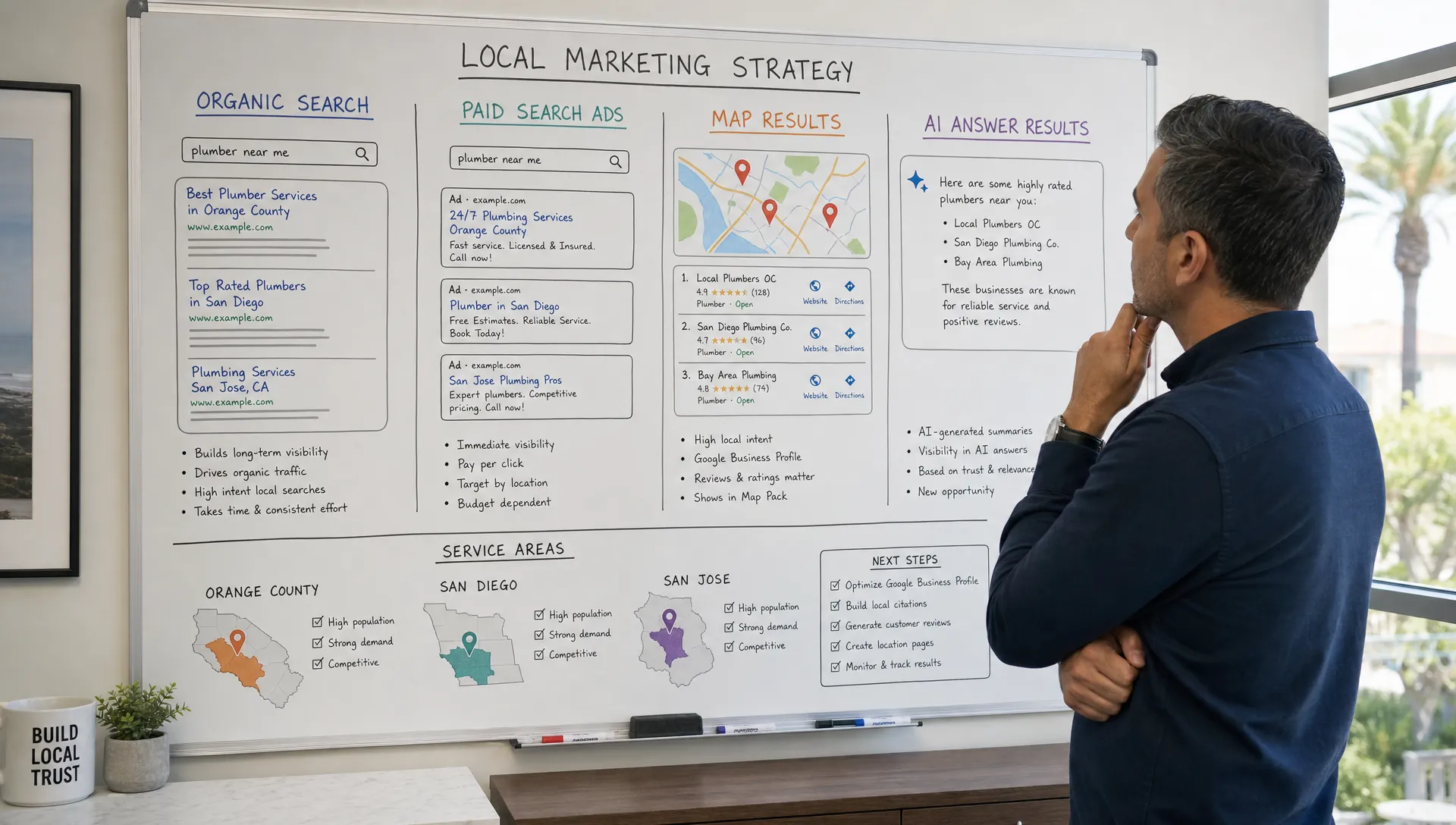
For an HVAC contractor in Irvine, a roofing company in San Diego, a dental group in Anaheim, or a law firm with offices across Los Angeles and Orange County, the difference matters because every marketing dollar has a job. Some dollars should build long-term visibility. Some should create immediate demand. Some should protect your brand when competitors bid on your name. And increasingly, some should help AI-driven search systems understand why your business is the trusted local answer.
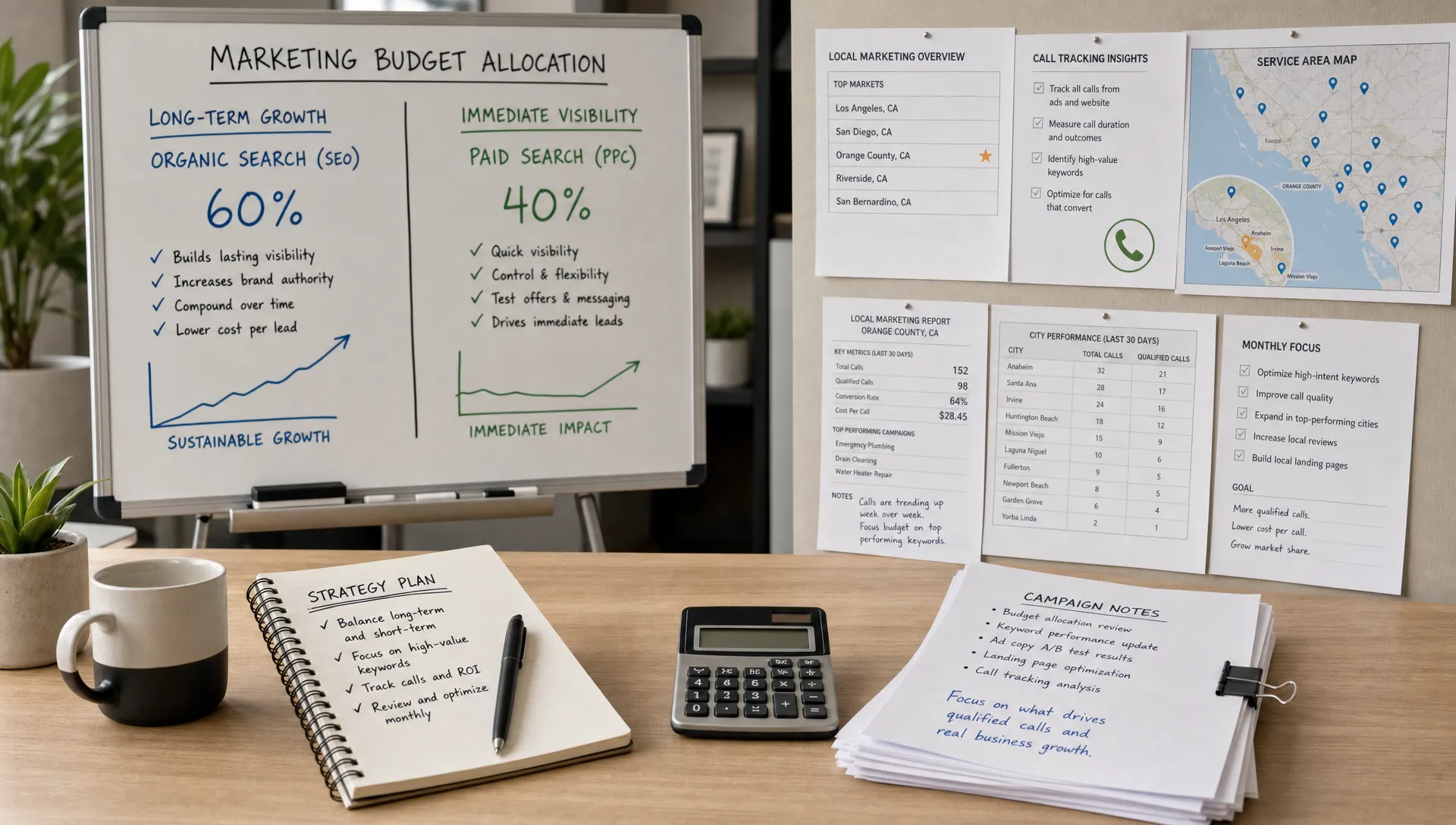
In simple terms: SEO earns visibility. SEM buys visibility. The smartest local growth plans use both intentionally.
SEO vs. SEM: The Basic Difference
SEO stands for search engine optimization. It is the process of improving your website, Google Business Profile, content, technical structure, reviews, local signals, and authority so your business can appear naturally in search results.
SEM stands for search engine marketing. In everyday business use, SEM usually refers to paid search advertising, especially Google Ads and other pay-per-click placements. You pay to appear when someone searches for a relevant phrase, such as “emergency plumber near me,” “roof repair Laguna Niguel,” or “family dentist Irvine.”
Here is the simplest way to separate them:
| Category | SEO | SEM |
|---|---|---|
| Visibility type | Organic, map, local, and answer-driven visibility | Paid ad placements in search results |
| Cost model | Investment in content, structure, authority, and optimization | Pay per click, call, lead, or campaign budget |
| Speed | Slower to build, longer-lasting when maintained | Faster launch, visibility stops when budget stops |
| Best use | Durable authority and lower long-term acquisition cost | Immediate traffic, testing, promotions, and competitive markets |
| Trust factor | Often higher because users see it as earned relevance | Can be effective, but users know it is sponsored |
| Main risk | Takes time and requires consistency | Costs can rise quickly if targeting or conversion is weak |
If you have ever compared search engine optimisation and search engine marketing and wondered which one is “better,” the better question is: What business outcome do you need first?
What SEO Really Does for a Local Business
SEO is not just about “ranking number one” for a broad keyword. For local businesses, effective SEO helps search engines and customers understand four things:
- What you do
- Where you do it
- Who you help
- Why you can be trusted
That means a strong SEO strategy is built from many connected pieces. Your website needs clear service pages. Your location signals need to be consistent. Your Google Business Profile needs accurate categories, services, photos, posts, and reviews. Your content should answer real customer questions. Your site should load quickly and make it easy to call or book.
Google’s own SEO Starter Guide emphasizes helpful, accessible content and crawlable site structure. For local companies, that foundation has to be paired with proximity, reputation, relevance, and conversion.
For example, a plumber in Huntington Beach does not only need a page that says “plumbing services.” They need pages and content that help Google understand the types of jobs they handle, the neighborhoods they serve, the urgency of certain calls, and the proof that customers trust them.
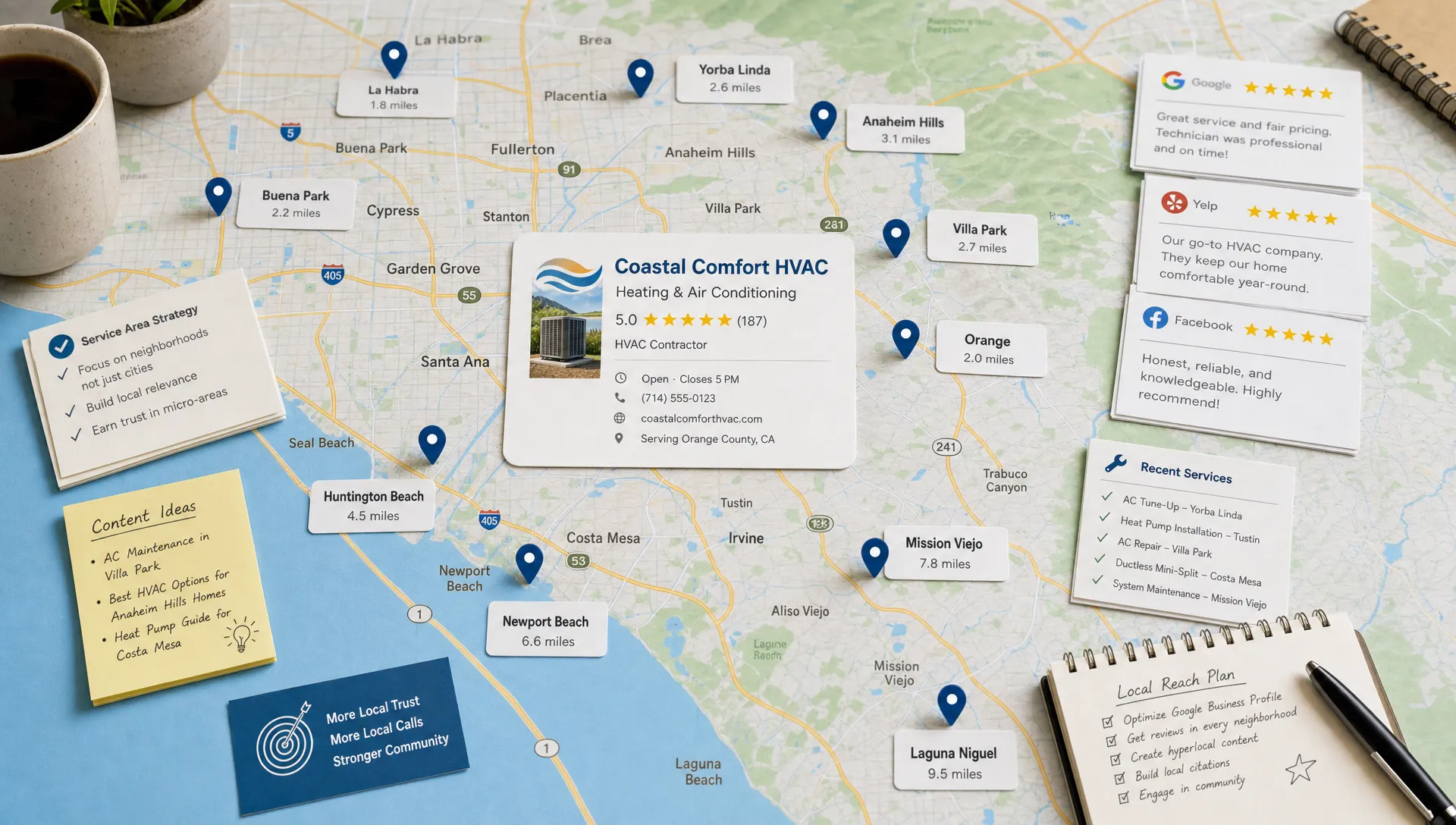
That is why local SEO has become more specific than ever. A contractor who serves Newport Beach, Costa Mesa, Irvine, and Laguna Niguel may need different content and local signals than a contractor trying to win work in Riverside or San Jose. The service may be the same, but the search intent, competition, neighborhood language, and customer expectations can vary.
For a deeper look at how modern optimization has evolved, Kell Web Solutions explains what search engine optimization really means in 2026, including how search now connects websites, maps, AI answers, and local authority.
What SEM Really Does for a Local Business
SEM is the paid side of search visibility. If SEO is the slow-building asset, SEM is the on-demand lever.
With paid search, you can target high-intent queries almost immediately. A roofing company can run ads for “roof leak repair near me” during storm season. A dental office can promote emergency appointments in a specific radius. A law firm can target searches in a narrow practice area and city.
The major advantage is speed. According to Google Ads Help, search campaigns allow advertisers to show ads to people actively looking for their products or services. That makes SEM especially powerful when the searcher has urgent intent.
The major disadvantage is that paid search can become expensive fast. If your landing page is weak, your call tracking is poor, your offer is unclear, or your team misses incoming calls, your campaign can waste budget even if it generates clicks.
This is especially important for home services. In categories like HVAC, plumbing, roofing, solar, and electrical, a single qualified call can be valuable, but competitive clicks and calls can be costly. Business owners should not judge SEM only by click volume. They should judge it by qualified conversations, booked estimates, closed revenue, and customer lifetime value.
Kell Web Solutions has covered this local-call angle in more detail in its article on how search engine marketing drives better local calls.
The Biggest SEO and SEM Differences Business Owners Miss
Most business owners understand that SEO is organic and SEM is paid. The more important differences are operational.
SEO Compounds, SEM Resets
A well-built SEO program can continue producing visibility after the initial work is done, as long as it is maintained. A service page, local article, review profile, citation structure, or authority signal can keep contributing over time.
SEM does not compound in the same way. You may learn from campaigns, improve Quality Score, refine targeting, and raise conversion rates, but the visibility itself depends on continued spend. When the ad budget stops, the ad placement stops.
That does not make SEM bad. It means SEM should be treated like a performance channel, not a permanent substitute for authority.
SEO Builds Trust Before the Click
When a local customer sees your business in Google Maps, organic search results, review snippets, local pages, and helpful content, they are forming an impression before they ever contact you.
This matters in high-trust industries. A homeowner choosing a remodeler or a patient choosing a dentist is not just looking for availability. They are looking for confidence. Strong SEO supports that confidence by making your business appear established, relevant, and credible across multiple touchpoints.
SEM can also build trust, but ads must work harder because the user knows placement was purchased. Paid search performs best when the ad is backed by a strong website, strong reviews, and a landing page that matches the promise.
SEM Gives Faster Data
SEO takes time to show patterns. SEM can reveal demand quickly.
If you are entering a new market such as San Jose, Sacramento, or Oceanside, paid campaigns can help test which services, messages, and neighborhoods respond before you invest heavily in long-term content. Search ads can show which terms convert, which calls are valuable, and which offers attract poor-fit leads.
Those insights can then improve SEO. If “same-day AC repair Irvine” produces strong booked calls in paid search, that may point to a content and local SEO opportunity.
SEO Is Broader Than Google Rankings
In 2026, SEO is not limited to ten blue links. Local discovery happens through Google Maps, organic results, AI Overviews, voice assistants, review platforms, business profiles, directory data, and answer engines.
That shift matters because business owners are no longer optimizing for search engines alone. They are optimizing for machine understanding. Your business needs to be easy for platforms to interpret, verify, and recommend.
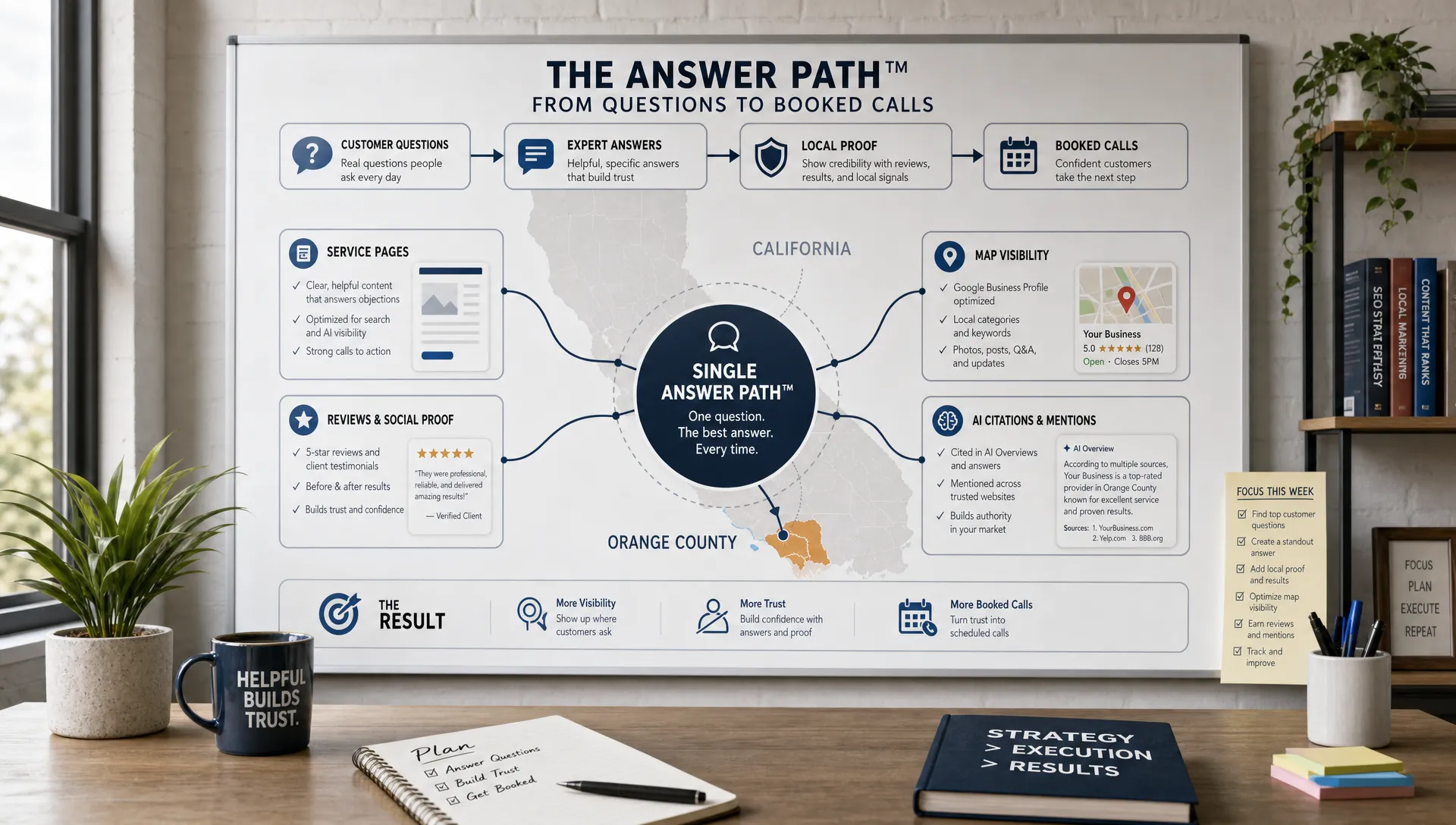
This is where traditional SEO begins to overlap with Answer Engine Optimization, or AEO. If SEO helps you get found, AEO helps your business become the trusted answer when people ask a search engine, AI assistant, or voice tool for a recommendation.
When SEO Should Be the Priority
SEO should usually be the priority when your business depends on local trust, repeat visibility, and long-term lead flow.
That includes many California service businesses and professional practices. A Laguna Beach remodeling company, a Santa Ana HVAC contractor, an Irvine dental office, and a San Francisco legal practice all benefit from being visible before the customer is ready to buy.
SEO is especially important when:
- Customers research before calling
- Your service area includes multiple cities or neighborhoods
- Reviews and authority strongly influence buying decisions
- You want to reduce dependence on paid ads over time
- Competitors are already visible in Maps, organic results, and local content
For home services, local SEO can also help you win nearby jobs that may never come from broad statewide keywords. Someone searching “electrician near me” in Anaheim is sending a very different signal from someone researching “electrical panel upgrade cost California.” Both can matter, but they need different content and visibility strategies.
Kell Web Solutions explains this neighborhood-level approach in local search engine optimization that wins nearby jobs.
When SEM Should Be the Priority
SEM should move higher on the priority list when timing matters.
If your business needs calls this month, SEO alone may not be fast enough. Paid search can place you in front of ready-to-act prospects while your organic visibility is still being built.
SEM is often useful when:
- You are launching a new service or location
- You need seasonal demand, such as AC repair in summer or roof repair after storms
- You want to test a city before building deeper SEO assets
- Competitors are bidding on your brand name
- You have strong phone handling and a high-converting landing page
- You know the value of a booked appointment or closed job
The key is discipline. SEM should not be treated as “turn on ads and hope.” Business owners should know which searches they are paying for, what a qualified lead looks like, how calls are tracked, how quickly staff responds, and whether the campaign is producing profitable revenue.
For many contractors and practices, missed calls are one of the hidden leaks in paid marketing. If a paid campaign generates calls but the front desk or dispatch team cannot answer quickly, the business pays for demand it does not capture.
How SEO and SEM Work Best Together
The strongest growth plans do not frame SEO and SEM as enemies. They use each channel for what it does best.
A practical sequence looks like this:
| Business situation | Best initial move | Why it works |
|---|---|---|
| New location opening in Irvine or San Diego | Use SEM for immediate visibility while building local SEO pages | Paid search creates early demand while organic authority develops |
| Established contractor with rising ad costs | Strengthen SEO and local authority | Organic visibility can reduce overdependence on paid clicks |
| Multi-location practice with uneven market share | Use SEO for each location and SEM for priority services | Each office gets a local foundation while ads support high-value offers |
| Seasonal home service demand | Run SEM during peak season and publish SEO content before demand spikes | Ads capture urgent searches while content prepares future visibility |
| Competitive Orange County market | Combine SEO, SEM, reviews, and AEO | The business appears across paid, organic, map, and answer-driven surfaces |
SEO can lower your long-term cost per acquisition. SEM can accelerate testing and lead flow. Together, they create a more resilient search strategy.
For example, a plumbing company in Anaheim might use SEM to capture emergency searches while investing in SEO content about drain cleaning, leak detection, water heater replacement, and neighborhood-specific service pages. Over time, organic visibility can pick up more of the steady demand, while paid search remains useful for urgent or high-margin categories.
The AI Search Factor: Why the Difference Is Changing
Traditional SEO and SEM still matter, but AI-driven search is changing how customers discover businesses.
Searchers increasingly ask full questions instead of typing short keywords. They may ask:
“Who is the best HVAC company near Laguna Niguel for same-day AC repair?”
“What dentist in Irvine has strong reviews and offers emergency appointments?”
“Which roofing contractor serves San Diego and handles tile roof repairs?”
These searches are not just keyword matches. They require context, entity clarity, trust signals, service-area relevance, and content that answers real questions. AI systems need to understand who your business is, what it does, where it operates, and why it should be cited.
That is why business owners should think beyond the old SEO vs. SEM debate. The new question is: Can search engines, maps, and AI answer systems confidently understand and recommend your business?
Paid ads can still get you visibility, but they do not automatically create entity authority. SEO can build that authority, but only when it is structured clearly enough for both humans and machines. AEO adds another layer by making your expertise easier for answer engines and AI assistants to retrieve.
How to Decide Where Your Budget Should Go
A simple budget decision starts with urgency, market position, and operational readiness.
If you need leads immediately and can answer calls, follow up, and close efficiently, SEM may deserve a short-term push. If you have been in business for years but still rely too heavily on paid ads, SEO and local authority may be the better long-term investment. If you operate in a competitive California market where customers research heavily, you likely need both.
Ask these questions before allocating budget:
- Are we trying to generate calls now, build authority over time, or both?
- Which cities and neighborhoods matter most to revenue?
- Do our website pages clearly match our services and service areas?
- Do we know which calls become profitable jobs or clients?
- Are our reviews, Google Business Profile, and local citations strong enough to support paid traffic?
- Can AI and search platforms understand our business as a trusted local entity?
If the answer to several of these questions is unclear, spending more on ads may only amplify confusion. A stronger foundation can make every channel perform better.
A Practical Recommendation for California Business Owners
For most home services contractors and multi-location professional practices, the best approach is not “SEO or SEM.” It is a staged plan.
Start by fixing the foundation. Make sure your website, Google Business Profile, location pages, service pages, reviews, tracking, and call handling are strong. Then use SEM where speed and precision matter. At the same time, build SEO assets that compound, especially around your most valuable services and local markets.
For Orange County businesses, this may mean building authority in Laguna Beach, Laguna Niguel, Irvine, Anaheim, Huntington Beach, and Santa Ana. For statewide growth, it may mean expanding into Los Angeles, San Diego, San Jose, Sacramento, Fresno, Oakland, Riverside, or other competitive California cities with a deliberate local strategy.
The businesses that win are usually not the ones chasing every keyword. They are the ones that become the clearest, most trusted, most locally relevant answer across search surfaces.
Frequently Asked Questions
Is SEO better than SEM? SEO is better for long-term authority and sustainable visibility, while SEM is better for fast traffic and immediate demand. Most local businesses benefit from using both at different stages.
Does SEM help SEO rankings? Paid ads do not directly improve organic rankings. However, SEM can provide useful data about which keywords, offers, and locations convert, and that data can inform your SEO strategy.
How long does SEO take compared with SEM? SEM can start generating visibility as soon as campaigns are approved and funded. SEO usually takes longer because search engines need time to crawl, interpret, trust, and rank your content and local signals.
Should a local contractor spend money on SEO or Google Ads first? If the contractor needs calls immediately and has a strong landing page and call process, Google Ads can help. If the contractor wants to reduce long-term ad dependence and build market authority, SEO should be prioritized.
How does AI search affect SEO and SEM? AI search increases the importance of clear business information, helpful content, structured data, reviews, and local authority. SEM can buy ad visibility, but SEO and AEO help AI systems understand and trust your business.
Turn Search Visibility Into Better Local Calls
SEO builds the authority that helps customers find and trust you. SEM creates targeted visibility when demand is immediate. In 2026, both need to work alongside AI-ready content, local trust signals, and a website built to convert.
Kell Web Solutions helps California businesses align search visibility with real revenue opportunities, from Orange County contractors to multi-location professional practices across the state. If you want to understand where SEO, SEM, and Answer Engine Optimization fit in your growth plan, schedule a strategy conversation with Kell Web Solutions.