Local Search Engine Optimization That Wins Nearby Jobs
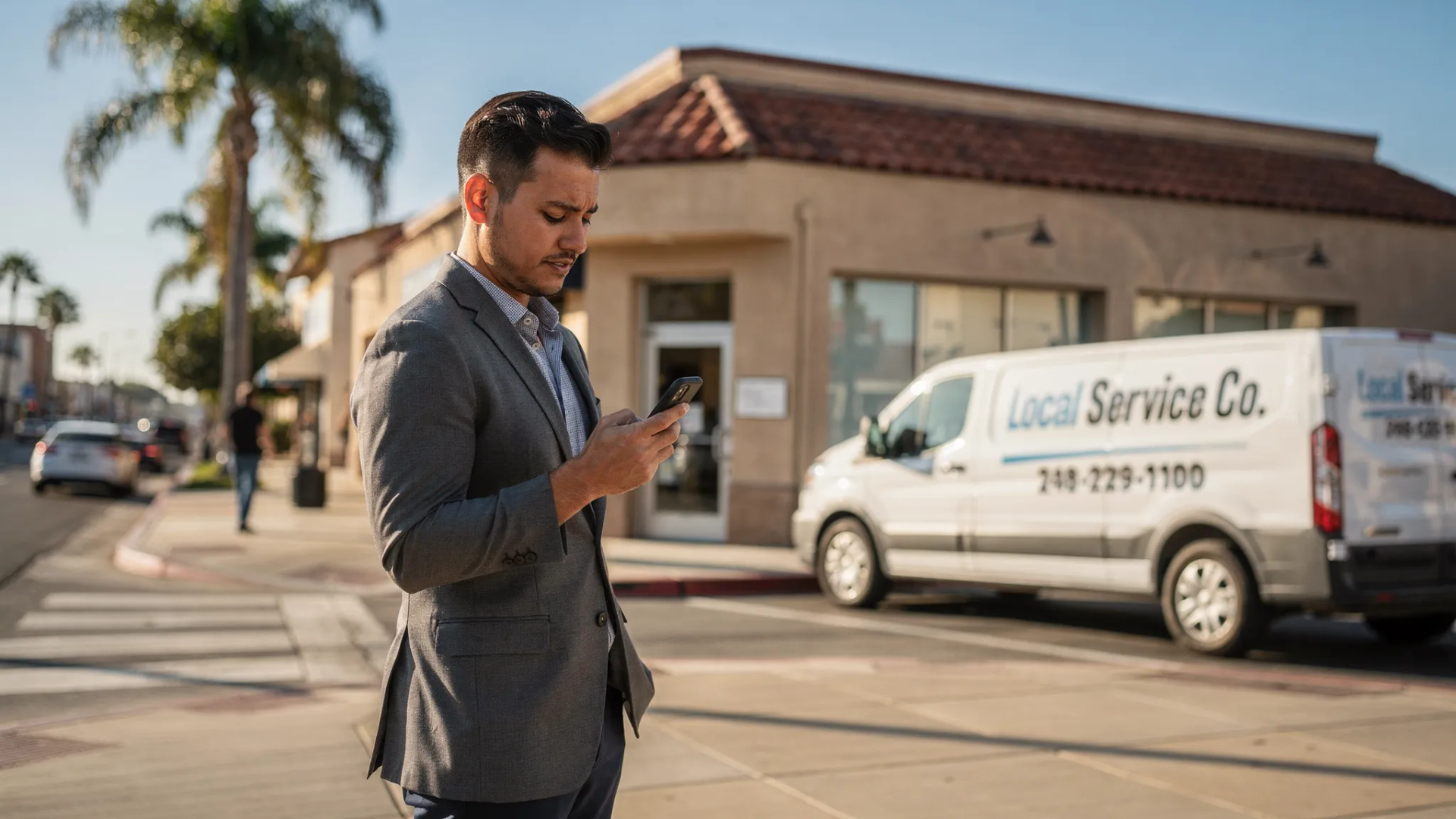
Nearby jobs are won in the short window between a customer’s problem and their decision to call. For an HVAC company, that window might be a homeowner in Laguna Niguel searching for AC repair during a heat wave. For a dental office, it might be a parent in Irvine looking for an emergency appointment before school pickup. For a law firm, it might be a local client comparing attorneys after a stressful event.
That is why local search engine optimization cannot be treated as a traffic project alone. The real goal is not just more impressions, more rankings, or more website visits. The goal is to make your business the obvious nearby choice when someone is ready to book.
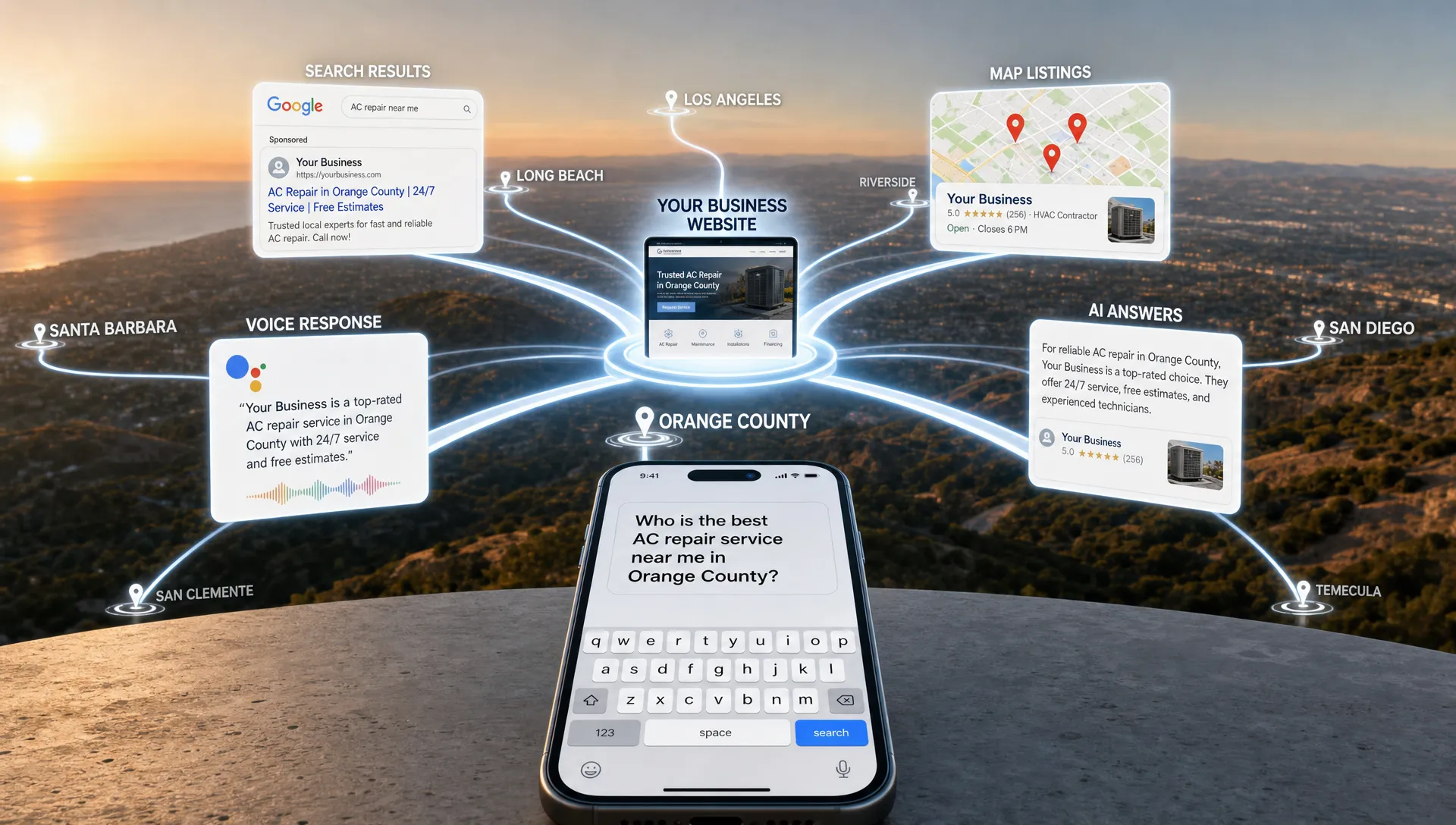
In 2026, nearby customers are finding businesses through Google Maps, local packs, organic search, AI summaries, voice assistants, and review platforms. The businesses that win are the ones search systems can clearly understand, verify, and trust.
What nearby jobs really mean in local SEO
A nearby job is any search-driven opportunity where geography affects the buying decision. The customer wants help close to home, close to work, or within a specific service area. They are not looking for a national brand page. They are looking for the most credible local answer.
For contractors and professional practices across Orange County and California, this means you need visibility at the city, neighborhood, and service-intent level. Ranking for a broad term such as roofing company is useful, but the money is usually in searches like roof leak repair Huntington Beach, AC installation Irvine, dentist open Saturday Anaheim, or estate planning attorney San Jose.
The pattern is simple. Search engines and answer engines are trying to match a real person’s problem with a real, trustworthy local provider.
The local ranking foundation Google can trust
Google explains that local results are primarily based on relevance, distance, and prominence. Its Google Business Profile help documentation is still one of the clearest starting points for understanding how local visibility works.
Those three factors should shape every local SEO decision you make.
Relevance: make your services unmistakable
Relevance means Google can match your business to the customer’s search. If you are an HVAC contractor, your website and Google Business Profile should clearly show whether you handle repairs, replacements, maintenance, ductwork, mini-splits, emergency calls, commercial systems, or specific brands if accurate.
For a medical, dental, or legal practice, relevance depends on clear descriptions of your services, provider expertise, accepted appointment types, and the locations you actually serve. A vague homepage saying full-service practice is not enough when a patient or client is searching for a specific need.
Distance: be honest and specific about geography
Distance does not mean you can trick Google by creating fake offices. It means your local signals should accurately reflect where you are located and where you provide service.
For service-area businesses, that includes a well-managed Google Business Profile, accurate service areas, locally relevant website pages, and consistent business information across trusted directories. For multi-location practices, each real office should have its own eligible profile and location page.
Prominence: prove you are known and trusted
Prominence comes from the signals that show your business is established. Reviews, citations, local mentions, backlinks, brand searches, helpful content, and real-world reputation all contribute to the broader picture.
This is where many local businesses fall short. They may have a decent website, but no review momentum. Or they may have strong reviews, but weak service pages. Or they may rank in their home city, but disappear in adjacent cities where they want more work.
California local SEO requires neighborhood-level thinking
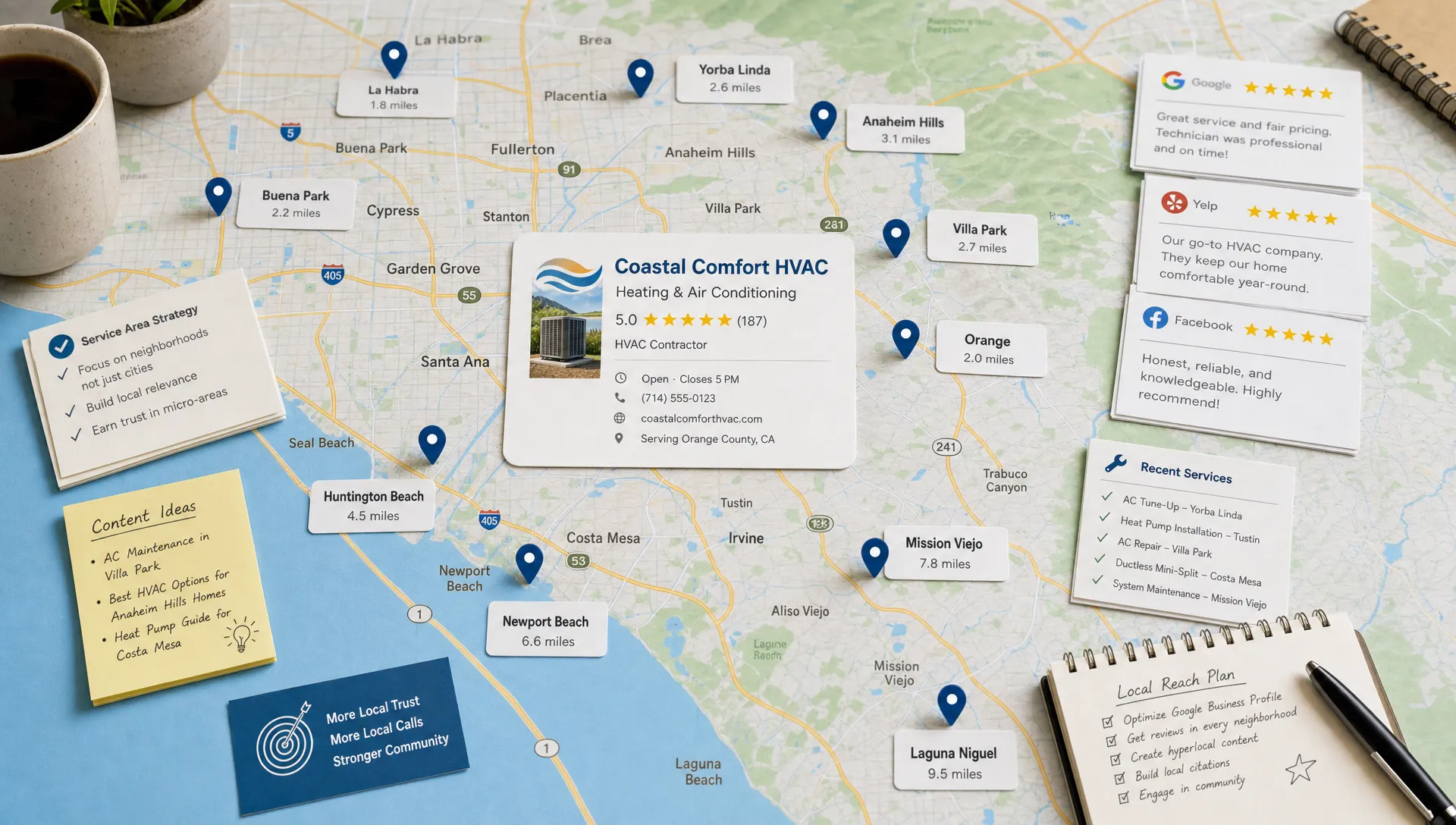
California is not one local market. It is hundreds of competitive micro-markets. A contractor visible in Laguna Beach may be invisible in Irvine. A law firm ranking in San Francisco may not show up in Oakland. A dental practice known in Sacramento may not reach patients in Roseville or Elk Grove unless its local signals support that footprint.
For Orange County businesses, this often means building visibility across Laguna Beach, Laguna Niguel, Irvine, Newport Beach, Huntington Beach, Anaheim, Santa Ana, and nearby communities. For broader Southern California campaigns, Los Angeles, San Diego, Long Beach, Riverside, and Chula Vista each require different local context.
The same applies in Northern California markets like San Jose, San Francisco, Oakland, Fremont, Sunnyvale, and Santa Clara, as well as Central and Inland California cities such as Fresno, Sacramento, Bakersfield, Stockton, San Bernardino, and Ontario.
The mistake is assuming one generic website can carry all of those markets. It rarely can. Local SEO that wins nearby jobs needs a structured footprint, with the right pages, profiles, citations, and proof for each priority area.
Build location pages that help, not doorway pages
City and neighborhood pages can be powerful, but only when they are useful. Google’s spam policies warn against doorway pages, which are low-value pages created mainly to manipulate search results.
A strong location page should help a real customer decide whether you are the right local provider. It should not be a copied template with only the city name swapped out.
Useful location pages often include:
- The specific services offered in that city or service area
- Local customer problems that are common in that market
- Real project examples, case summaries, or service scenarios when available
- Driving, scheduling, or service-area expectations that matter to customers
- Reviews or testimonials tied to the area when legitimate
- Clear calls to call, request an appointment, or ask a question
For a roofer in Huntington Beach, coastal exposure, salt air, HOA expectations, and roof material choices may matter. For an HVAC company in Riverside, heat load and system efficiency may dominate the conversation. For a dentist in Irvine, appointment availability, family scheduling, and proximity to neighborhoods or business centers may matter more.
That local context is what turns a location page from SEO filler into a job-winning sales asset.
Optimize your Google Business Profile like a dispatcher
Your Google Business Profile is often the first place a customer decides whether to call. Treat it less like a static brochure and more like a digital dispatcher.
That means your profile should answer the questions a caller would ask before contacting you. Are you open? Do you serve my area? Do you handle my exact problem? Do you have good reviews? Can I call with one tap? Can I book quickly?
The most important profile areas to maintain include:
- Primary and secondary categories that accurately reflect your business
- Services, descriptions, hours, holiday hours, and service areas
- Photos that show real work, staff, offices, vehicles, or facilities where appropriate
- Review responses that show professionalism and local accountability
- Posts or updates that keep the profile active and useful
- Website and appointment links with tracking where technically appropriate
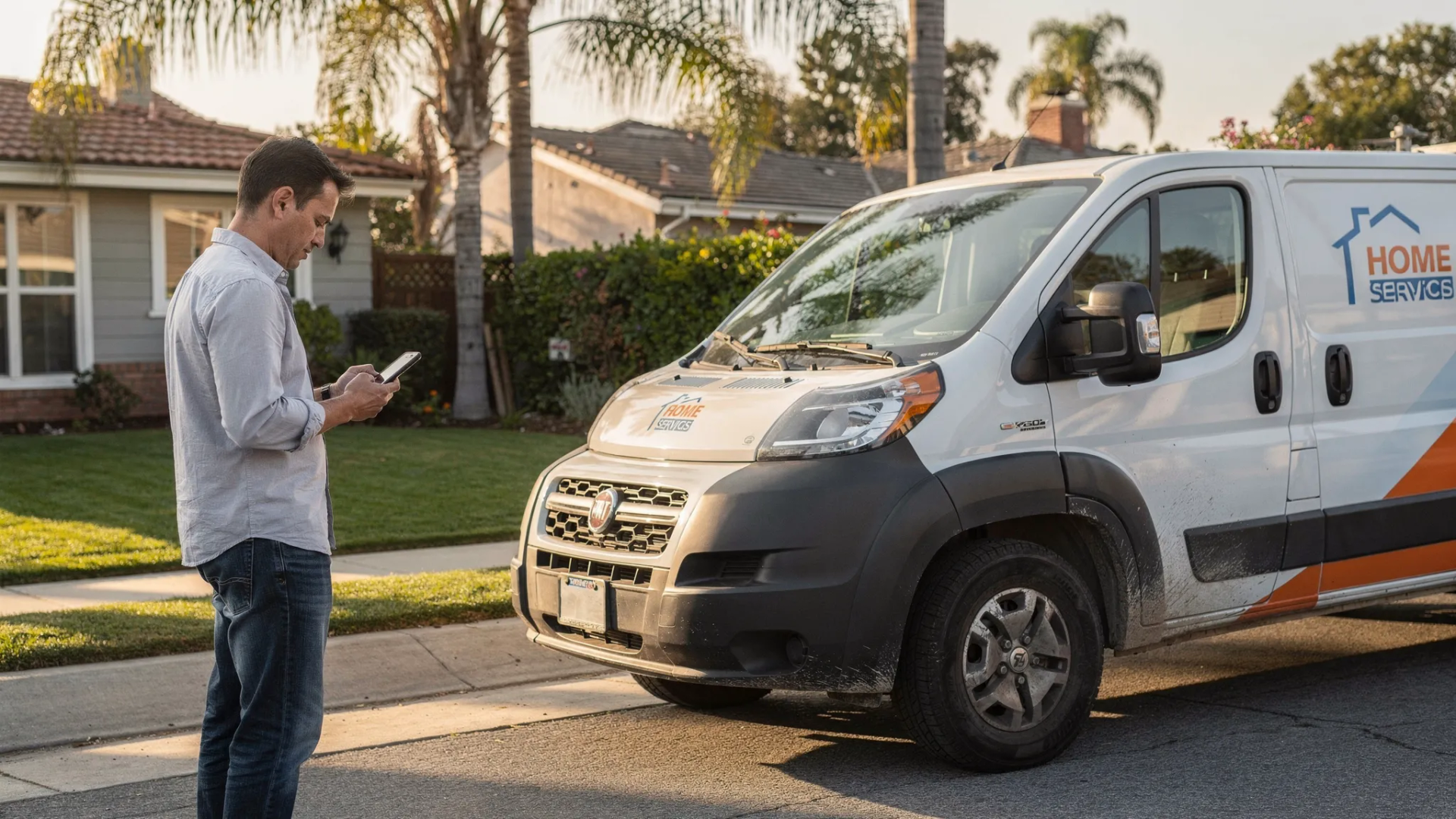
For home service contractors, photos of completed projects, equipment, branded vehicles, and field teams can support trust. For professional practices, office photos, provider images, accessibility details, and clear appointment information can reduce hesitation.
Accuracy matters more than hype. If your profile says you are open 24 hours but calls go unanswered, the profile may generate clicks that do not become jobs.
Reviews turn local visibility into calls
Reviews do two jobs at once. They support local prominence, and they help customers choose you over the next provider.
Research from BrightLocal’s Local Consumer Review Survey continues to show how important reviews are in local decision-making. Customers look for rating quality, review recency, response patterns, and details that sound like their own situation.
The best reviews are specific because they reduce uncertainty. A review that says great company is nice. A review that says they repaired our AC in Laguna Niguel the same afternoon and explained the capacitor issue is far more persuasive.
Do not buy reviews, gate reviews, or offer incentives that violate platform rules. Google’s user-contributed content policies are worth reviewing if your team actively requests reviews.
A simple, ethical process works best. Ask happy customers shortly after the job or appointment, make the review link easy to access, and respond professionally to both positive and negative feedback.
Content should answer high-intent local questions
Local SEO content should not be written only for search engines. It should answer the questions customers ask before they call.
For home service contractors, that might include cost ranges, warning signs, repair versus replacement decisions, seasonal maintenance, permit considerations, or what to do before a technician arrives. For dental, medical, and legal practices, it might include appointment expectations, service eligibility, common symptoms, timelines, documentation, or local office access.
This kind of content also supports Answer Engine Optimization. AI systems increasingly summarize answers for users, and they need clear, trustworthy source material. If your content is vague, thin, or disconnected from your services, it is less likely to be selected as a useful answer.
Businesses preparing for AI-driven local discovery should consider how their SEO and AEO strategies work together. Kell Web Solutions explains this shift in its Answer Engine Optimization service, which focuses on helping AI-driven platforms understand, trust, and recommend a business.
Technical signals help humans and machines verify you
Technical SEO is not the exciting part of local marketing, but it is often where hidden losses happen. If your site is slow, confusing, hard to crawl, or inconsistent with your business listings, your visibility and conversion rate suffer.
Local businesses should pay attention to mobile experience first. Many nearby searches happen on phones, and a customer with an urgent need will not wait for a slow page or hunt for a phone number.
Structured data can also help search engines understand your business information. Google provides specific guidance for local business structured data, including details such as business type, address, hours, telephone, and related properties.
Important technical items include consistent NAP information, crawlable service and location pages, clean title tags and meta descriptions, compressed images, tap-to-call phone numbers, secure HTTPS, and schema markup where appropriate.
For businesses investing in AEO, machine-readable assets such as
llms.txt
, clear entity summaries, and advanced JSON-LD can support a broader source-of-truth strategy. These tools should not replace strong local SEO fundamentals. They should make already accurate information easier for search and AI systems to interpret.
Measure booked work, not vanity rankings
Rankings matter, but they are not the final score. A local SEO campaign should be judged by whether it produces qualified calls, appointments, estimates, and revenue.
A contractor ranking higher for a vanity keyword but getting no booked jobs has not won. A practice getting more impressions but no scheduled consultations has not solved the business problem.
Call tracking can be helpful, but it should be implemented carefully. Keep core business information consistent across citations, and use tracking in a way that does not create confusion for customers or search systems.
A practical 90-day plan to win more nearby jobs
Local SEO compounds over time, but the first 90 days should create momentum. The goal is to fix trust gaps, strengthen your highest-value local signals, and create pages that match real buying intent.
- Days 1 to 15: Audit the local footprint: Review Google Business Profile accuracy, categories, reviews, service areas, website pages, citations, technical issues, competitors, and call conversion paths.
- Days 16 to 30: Fix the basics: Correct NAP inconsistencies, improve profile services and hours, update photos, repair broken pages, improve mobile calls to action, and clarify the top services.
- Days 31 to 60: Build priority service-area assets: Create or improve the most important city and service pages, starting with the markets most likely to produce profitable jobs.
- Days 61 to 90: Increase proof and content depth: Request reviews ethically, publish helpful local content, add project proof where available, and strengthen internal links between services and locations.
- Ongoing: Measure and refine: Track calls, booked appointments, city-level performance, close rates, and revenue so the campaign keeps moving toward business outcomes.
No ethical agency can guarantee a specific map-pack position for every search. Local results shift based on proximity, competition, personalization, and platform changes. What you can control is the quality, clarity, and consistency of the signals you send.
When one website is not enough
In less competitive markets, a strong website and well-managed Google Business Profile may be enough to generate steady local leads. In California’s most competitive markets, especially Orange County, Los Angeles, San Diego, San Jose, and Sacramento, one website often struggles to carry the full burden.
That is where broader local authority building becomes important. Supporting assets can include neighborhood resource pages, project stories, local press, association mentions, partner links, review assets, and carefully built feeder sites that support the main brand with useful, locally relevant information.
Kell Web Solutions’ Hyperlocal Authority Builder is designed for businesses that need a larger local footprint, particularly home service contractors competing across multiple city and neighborhood markets. The key principle is that every asset should reinforce real expertise, real service areas, and real customer value.
The future of local discovery is not just about ranking pages. It is about becoming the trusted entity that search engines, maps, voice assistants, and AI systems can confidently recommend.
Frequently Asked Questions
How long does local search engine optimization take to produce nearby jobs? Many businesses can see early movement within 60 to 90 days if major gaps are fixed quickly, but competitive markets often require 3 to 6 months of consistent work. In cities like Irvine, Los Angeles, San Diego, San Jose, and Sacramento, durable results usually depend on ongoing content, reviews, citations, and authority building.
Is Google Business Profile more important than my website? They work together. Your Google Business Profile often drives the first call, especially from Maps, while your website provides deeper proof, service details, location pages, and conversion paths. A strong profile with a weak website can lose cautious buyers. A strong website with a neglected profile can miss high-intent local searches.
Should I create a page for every city I want to serve? Only create city pages when you can make them genuinely useful and accurate. If the page has unique service information, local context, proof, and a clear reason to exist, it can help. If it is just a copied page with a swapped city name, it can create quality problems.
How do reviews help local SEO? Reviews support trust, prominence, and conversion. They show search engines and customers that your business is active, relevant, and trusted. Specific reviews mentioning real services, outcomes, and locations are especially helpful when earned naturally and ethically.
Can local SEO help multi-location medical, dental, or legal practices? Yes. Each eligible location should have accurate profiles, unique location pages, provider or service details, consistent citations, and review development. Multi-location practices also need careful governance so each office is visible without creating duplicate or confusing information.
How is local SEO different from Answer Engine Optimization? Local SEO focuses on visibility in local search results, Maps, and geographically relevant organic results. Answer Engine Optimization focuses on being selected as the answer by AI-driven systems such as AI search results, chat assistants, and voice interfaces. The strategies overlap because both require clear, trustworthy, structured business information.
Turn local visibility into booked local work
If your business depends on nearby calls, appointments, and service requests, local SEO should be tied directly to revenue. The right strategy clarifies where you serve, what you do best, why customers trust you, and how quickly they can take the next step.
Kell Web Solutions is based in Laguna Beach and Laguna Niguel and has served Orange County businesses since 2001. Its Local SEO Mastery service focuses on Google Business Profile optimization, citation consistency, localized content, on-page improvements, and map-pack visibility for a primary city plus nearby feeder cities.
If your company is ready to win more nearby jobs in Orange County or across California, book a strategy call with Kell Web Solutions and get a clear plan for turning local search visibility into qualified calls.