Web Design and Search Engine Optimisation That Converts

Most local websites fail for a simple reason: the design team, SEO team, and sales process are treated as separate projects. The result is a site that may look polished but does not rank, or a site that gets impressions but does not turn visitors into calls, booked consultations, or estimate requests.
For California contractors and multi-location professional practices, that gap is expensive. A homeowner in Irvine searching for emergency AC repair, a family in San Diego comparing roof replacement options, or a patient in San Jose evaluating dental providers is not browsing for fun. They are looking for confidence, proof, and a clear next step.
That is where web design and search engine optimisation need to work together. Not as a checklist of keywords and colors, but as one conversion system built around how people search, how AI and Google interpret trust, and how real buyers decide who to contact.
The goal is not a prettier website, it is a more profitable one
A high-converting website does three jobs at once. It attracts qualified visitors, reassures them that they found the right provider, and makes the next action obvious. If one of those jobs is missing, revenue leaks out of the funnel.
A beautiful site with weak SEO becomes a digital brochure that few prospects find. A highly optimized site with poor design earns traffic but loses trust. A fast site with unclear calls to action forces visitors to think too hard, which is often enough to send them back to Google.
For home services and professional practices, the conversion action is usually straightforward:
- Call for urgent service
- Request an estimate
- Book a consultation
- Schedule an inspection
- Ask a specific question before choosing a provider
The website should be designed around those actions from the beginning. That means the page layout, local SEO structure, copy, trust signals, forms, phone numbers, and AI-readable content all need to support the same outcome.
Search intent should shape the page before design begins
Conversion-focused design starts before the first layout mockup. It starts with understanding what the visitor wants at the moment they arrive.
An emergency HVAC searcher in Anaheim has a different mindset than a homeowner in Laguna Beach researching a remodel. A dental patient comparing providers in Irvine needs different reassurance than a business owner looking for a law firm in Los Angeles. Search intent determines what information must appear first, what proof matters, and what call to action feels natural.
This is why generic web design underperforms. A contractor website should not be structured like a software startup. A multi-location dental or legal site should not rely on a single thin locations page. The site architecture must match how people search in each city, service category, and decision stage.
Design for clarity in the first five seconds
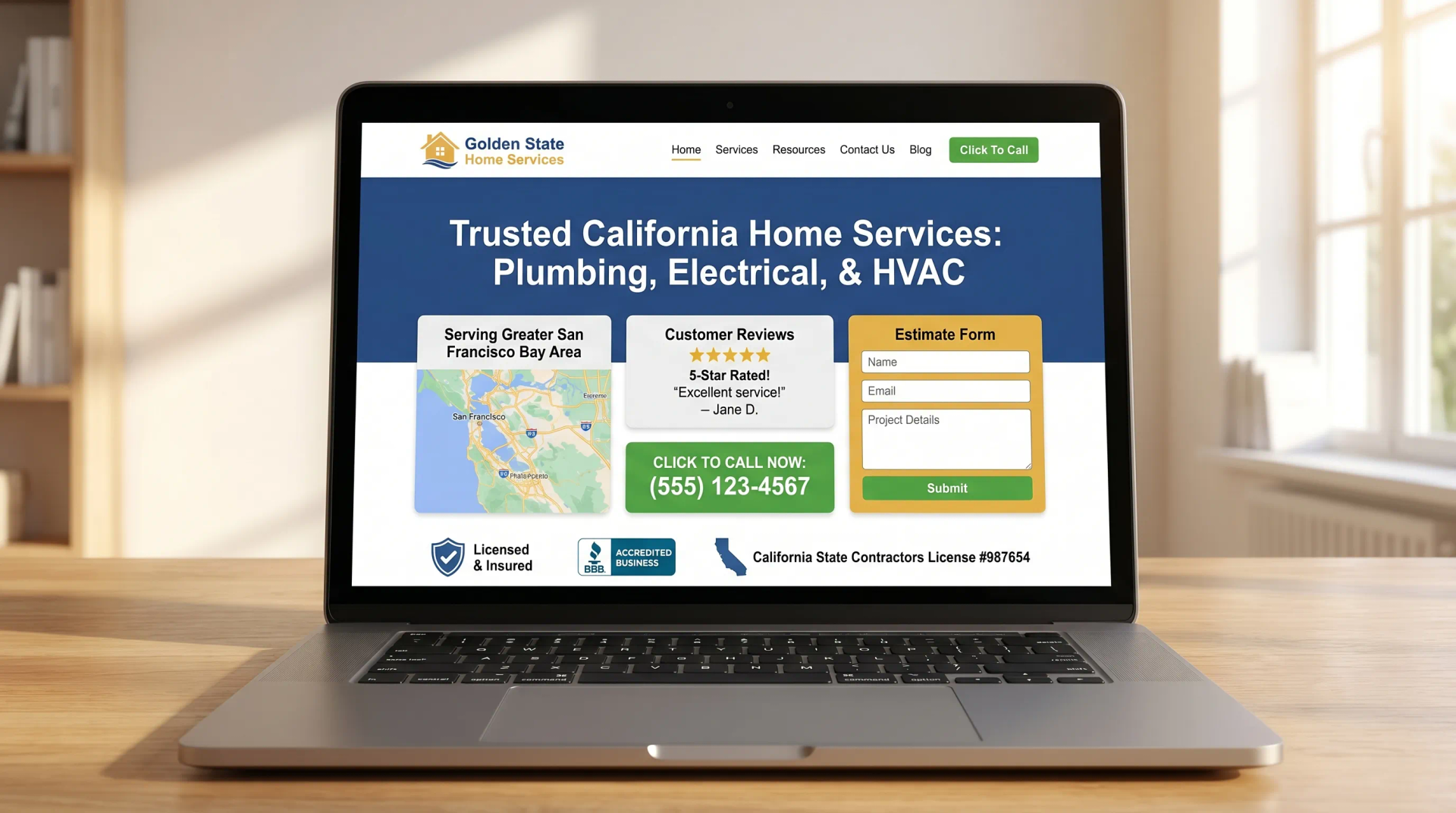
When a visitor lands on a local business website, they should instantly understand four things: what you do, where you do it, why you are credible, and what to do next.
The top section of a conversion-focused page should not waste attention on vague slogans. A strong hero area for an Orange County contractor or practice usually includes a specific service statement, a geographic cue, a trust marker, and a primary call to action. For example, a roofing company might lead with roof repair and replacement in coastal Orange County, supported by review proof and a request inspection button.
Good design reduces friction. It uses simple navigation, strong contrast, readable typography, visible phone numbers, and forms that ask only for what is necessary. It also prioritizes mobile users because local searches often happen from a phone, especially for home services.
Accessibility matters too. The W3C Web Accessibility Initiative provides standards that help websites serve more users, including people using assistive technologies. Better accessibility often improves usability for everyone, which supports both trust and conversion.
Make SEO part of the structure, not an afterthought
Search engine optimization is not something to sprinkle onto a finished website. It should shape the foundation of the site.
Google's SEO Starter Guide emphasizes creating helpful content and making it easy for search engines to understand pages. For local businesses, that means every important service, city, and customer question needs a logical place on the website.
A conversion-ready SEO structure usually includes dedicated pages for core services, primary locations, high-value customer questions, and proof-based content. For example, an HVAC company serving Orange County may need separate pages for AC repair, furnace installation, ductless systems, indoor air quality, and commercial HVAC. If it serves Irvine, Huntington Beach, Laguna Niguel, and Anaheim, each location page should provide meaningful local context rather than repeating the same copy with a city name swapped in.
The same principle applies to professional practices. A dental group with offices in San Diego, Irvine, and San Jose should help search engines and patients understand each location, provider, service, insurance context, and appointment path.
Thin location pages rarely build authority. Useful local pages do.
Technical performance affects rankings and revenue
A slow website is not just a technical problem. It is a sales problem.
Google's Core Web Vitals are useful performance indicators because they measure loading experience, responsiveness, and visual stability. These signals do not replace content quality or authority, but they influence user experience and can affect how confidently visitors engage with the site.
Technical SEO also includes crawlability, clean internal linking, XML sitemaps, indexation control, image optimization, secure browsing, and structured data where appropriate. These elements help search engines understand the site and help visitors move through it with less friction.
For local companies in competitive California markets like Los Angeles, San Diego, San Jose, Sacramento, Irvine, and Fresno, technical quality can become a meaningful differentiator. Many competitors still rely on outdated templates, slow hosting, oversized images, or confusing navigation. Fixing those issues can improve both visibility and lead quality.
Local trust signals turn visitors into buyers
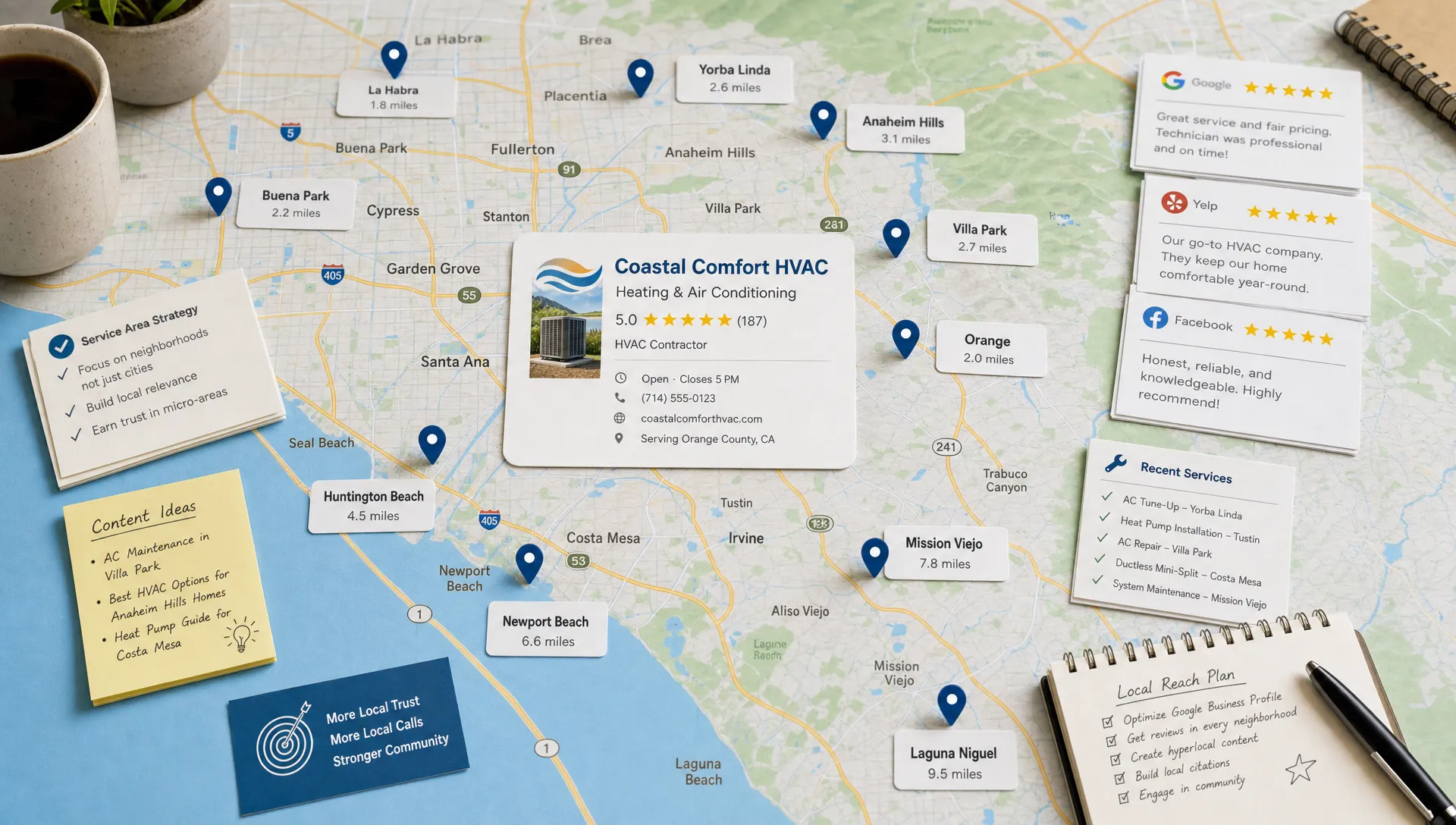
Local buyers want to know whether you are real, credible, and relevant to their situation. Design can display that proof, while SEO can help search engines connect that proof to your entity.
For contractors, trust often comes from reviews, project photos, service area clarity, licenses, warranties, financing information, and practical explanations of the work. For medical, dental, and legal practices, trust may come from provider bios, credentials, patient or client testimonials, practice areas, office details, and clear appointment expectations.
Strong trust signals include:
- Prominent Google review highlights and testimonial snippets
- Real team, vehicle, office, or project photos when available
- Clear service areas by city, neighborhood, or county
- License, certification, insurance, or credential references where applicable
- Specific service process details so prospects know what happens next
- Consistent name, address, and phone information across the web
Google also explains that local rankings are influenced by relevance, distance, and prominence in its guidance on improving local ranking. Your website cannot control every factor, but it can strongly support relevance and prominence by clearly documenting what you do, where you do it, and why customers trust you.
Build pages for both search engines and answer engines
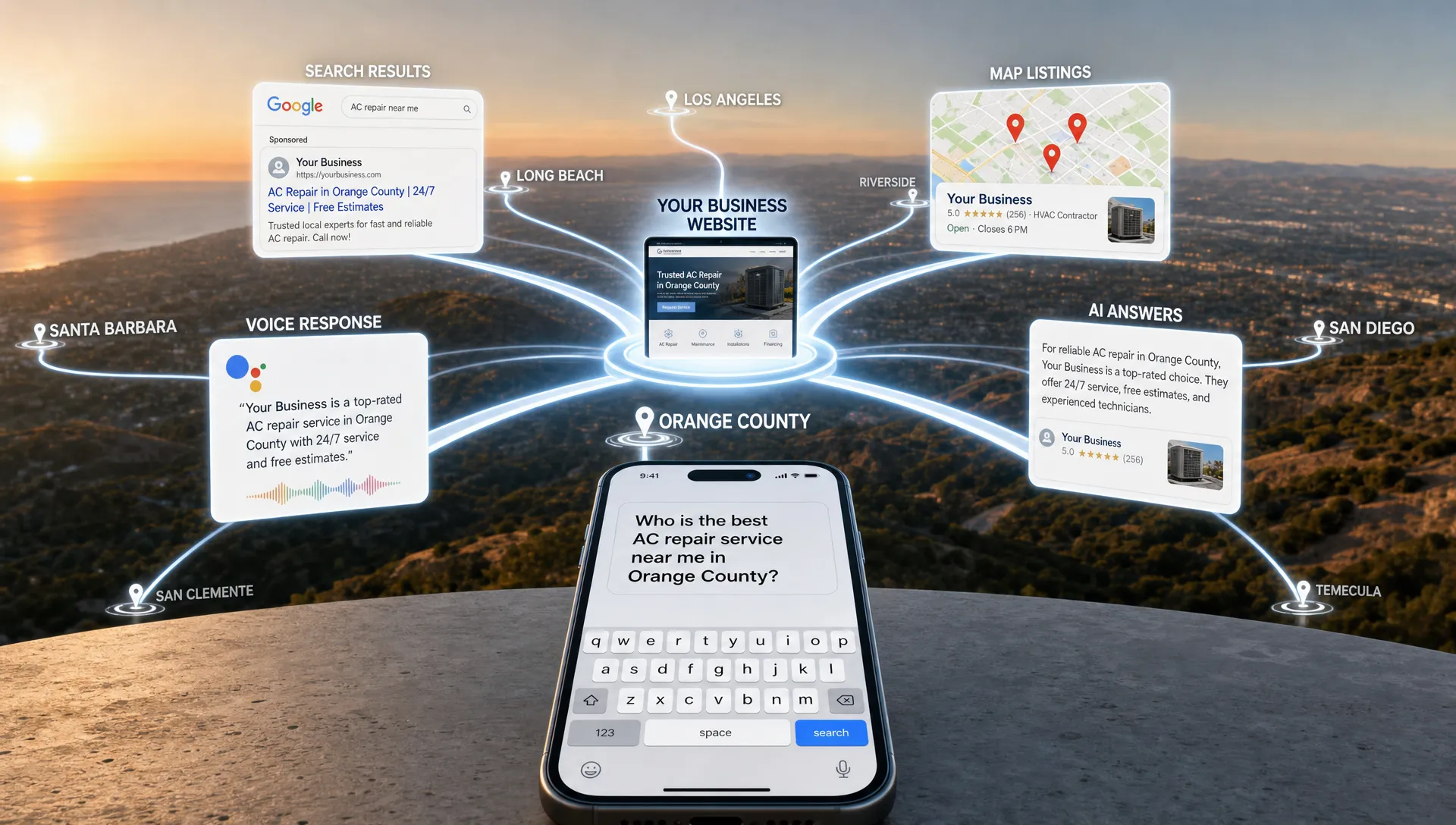
Search behavior is changing. People still use Google, but they also ask AI tools, voice assistants, and AI-enhanced search results for direct recommendations. Instead of typing short keywords, they ask complete questions such as:
- Who offers emergency AC repair near Laguna Niguel?
- What should I ask before hiring a roofing contractor in Orange County?
- Which dental office near Irvine offers consultations for implants?
- How do I choose a probate attorney in San Diego?
Traditional SEO helps your pages rank. Answer Engine Optimization helps your business become easier for AI systems to understand, trust, and cite. The difference matters because AI-driven platforms often look for clear entities, consistent facts, structured answers, and authoritative content.
This is where web design and search engine optimisation become part of a broader visibility strategy. A page should not only look trustworthy to a human visitor. It should also communicate clearly to machines through headings, schema markup, consistent business information, concise answers, internal links, and helpful content.
Kell Web Solutions focuses on this shift through Answer Engine Optimization, helping businesses structure their digital presence so AI-driven platforms can understand and recommend them more confidently.
Do not build city pages that all say the same thing
California local SEO is highly geographic. Orange County alone includes very different buyer expectations across Laguna Beach, Newport Beach, Santa Ana, Irvine, Anaheim, Huntington Beach, and Mission Viejo. A contractor expanding across Southern California, Northern California, or Central California needs even more precision.
The mistake is creating dozens of nearly identical city pages. That might have worked years ago, but it does not build durable authority today. A better approach is to create genuinely useful local pages that reflect the services, customer concerns, proof points, and search language in each market.
A strong location page for a home services business might mention the local service area, common property types, relevant service challenges, nearby neighborhoods, customer questions, and a clear call to action. A professional practice location page might highlight office access, providers, practice areas, appointment options, and community relevance.
This approach is especially important for businesses targeting multiple California markets such as Los Angeles, San Diego, Irvine, Anaheim, San Jose, San Francisco, Sacramento, Fresno, Bakersfield, and Riverside. Local authority should be built with substance, not duplication.
For businesses that need deeper neighborhood coverage, Kell Web Solutions also offers Local SEO Mastery and hyperlocal authority strategies designed to support visibility in specific service areas.
Conversion copy should answer objections before they are spoken
Design gets attention, but copy earns action. High-converting copy answers the questions prospects are already asking in their heads.
For a contractor, those questions may include: Can you serve my area? Do you handle my specific problem? Are you licensed? How soon can I get help? What happens after I request an estimate? For a professional practice, the questions may include: Do you handle cases like mine? Who will I meet with? What credentials do you have? Is the office near me? How do I schedule?
The best pages answer these questions without overwhelming the visitor. Short sections, descriptive headings, comparison tables, FAQs, and service-specific proof all help. The goal is not to write more words than competitors. The goal is to reduce uncertainty.
A clear page can often outperform a clever page. Visitors do not need marketing poetry when their AC is broken, their roof is leaking, or they need a trusted professional. They need clarity, confidence, and a next step.
Calls to action should match urgency
Not every visitor is ready for the same action. A conversion-focused site gives prospects the right next step based on urgency and intent.
An emergency plumbing or HVAC page should make calling effortless. A remodeling or solar page may benefit from a consultation or quote request. A legal or medical page may need a discreet appointment form and reassurance about what happens after submission.
Good calls to action are specific. Instead of a generic contact us button, use language that reflects the user's goal, such as request an estimate, schedule a consultation, call for service, or ask a project question. The form should be short enough to complete on a phone, and the confirmation message should set expectations.
If appointment generation is a bigger priority beyond inbound search, Kell Web Solutions' Profit Accelerator is designed to help businesses create qualified, pre-warmed conversations through managed outreach.
Measure what matters after launch
A website is not finished when it goes live. It becomes a business asset when it is measured, improved, and aligned with revenue.
Traffic alone is not enough. A local contractor would rather have 40 qualified calls than 4,000 irrelevant visits. A professional practice needs the right consultations, not just pageviews. Conversion-focused SEO reporting should connect visibility to real business outcomes.
This measurement mindset prevents vanity marketing. It also helps identify the next best improvement, whether that is rewriting a service page, improving page speed, adding proof, strengthening internal links, or expanding local content.
Common mistakes that reduce website conversions
Even established businesses in Orange County and across California lose leads because of avoidable website mistakes. The most common issues are not always dramatic. They are small points of friction that add up.
- The phone number is hard to find on mobile
- Service pages are too vague to rank or convert
- Location pages are duplicated across cities
- Forms ask for too much information too early
- Reviews and testimonials are hidden instead of featured
- The website loads slowly on mobile devices
- Calls to action are generic or inconsistent
- Content is written for keywords instead of customer questions
- The site is not structured for AI and answer engine interpretation
Fixing these issues does not require chasing every trend. It requires aligning design, SEO, local trust, technical performance, and conversion strategy around the buyer's actual journey.
Frequently Asked Questions
What does web design and search engine optimisation mean for a local business? It means building a website that is easy for customers to use and easy for search engines to understand. The design improves trust and conversion, while SEO improves visibility for the services, cities, and questions that matter most.
Why is conversion-focused web design important for contractors? Contractors often depend on phone calls and estimate requests. If the site is slow, unclear, or missing local proof, homeowners may choose a competitor even if the business ranks well. Conversion-focused design helps turn search visibility into booked opportunities.
Do professional practices need different SEO pages for each location? Often, yes. Multi-location medical, dental, and legal practices should give each office a useful page with accurate location details, provider information, relevant services, and a clear appointment path. The page should be unique and helpful, not duplicated.
Is traditional SEO still important with AI search growing? Yes. Traditional SEO, local SEO, and Answer Engine Optimization now work together. Search engines and AI systems both need clear content, trusted signals, structured information, and consistent business data to understand when to recommend a company.
How long does it take for a redesigned and optimized website to produce results? Technical and conversion improvements can help quickly, especially if the site already has traffic. SEO and local authority usually compound over several months as search engines crawl, evaluate, and trust the improved structure and content.
Turn your website into a revenue asset
If your website looks good but does not consistently produce qualified calls, consultations, or estimate requests, the problem may not be design alone. It may be the disconnect between design, SEO, local authority, and conversion strategy.
Kell Web Solutions helps Orange County and California businesses build digital visibility that is easier for customers, search engines, and AI platforms to trust. From web design and Local SEO to Answer Engine Optimization and outreach systems, the focus is practical: turn visibility into confident conversations that grow revenue safely.
To explore what your site needs next, book a strategy call with Kell Web Solutions or call (949) 575-8553.