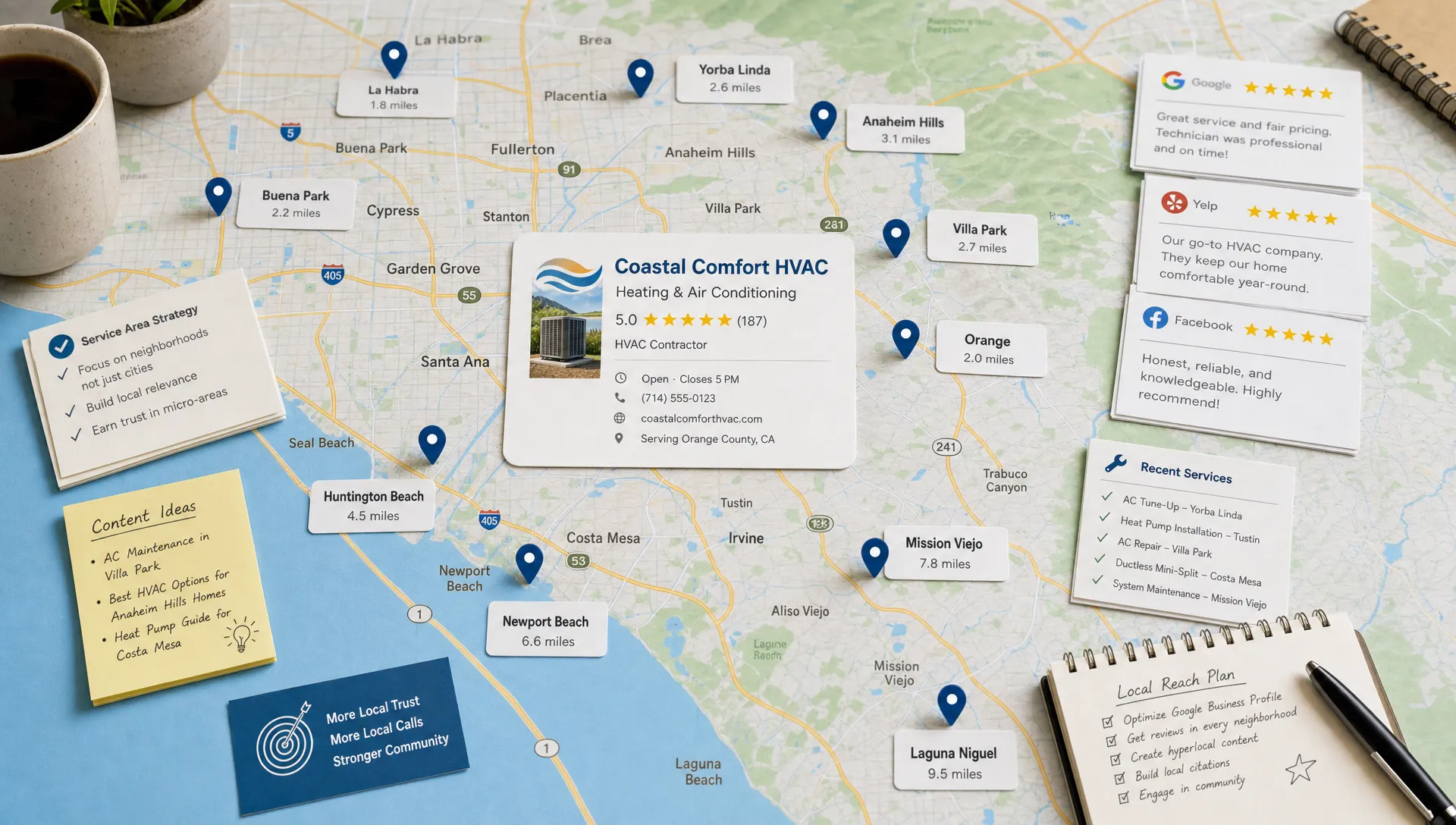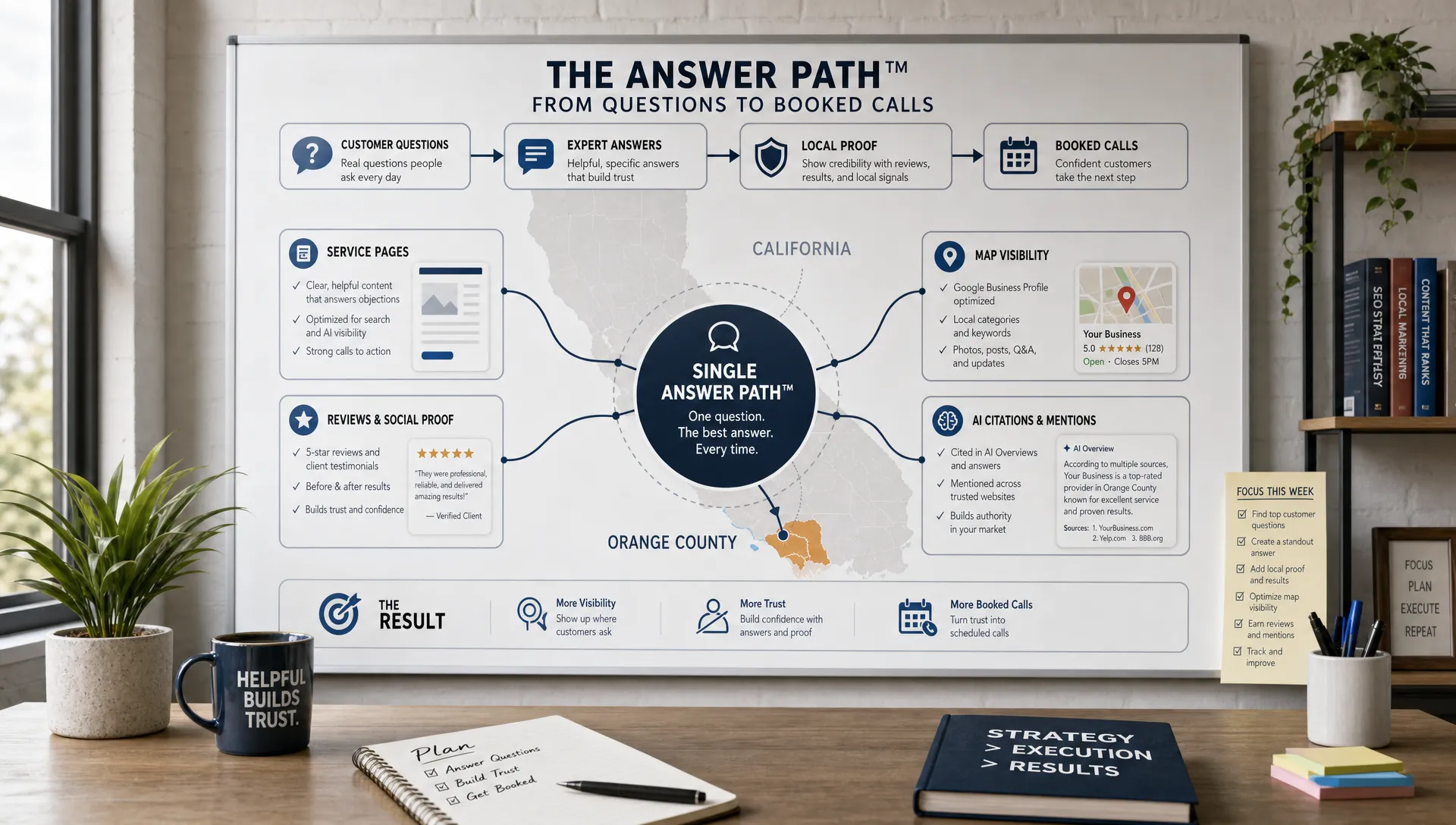
Working of Search Engine Optimization for Local Business
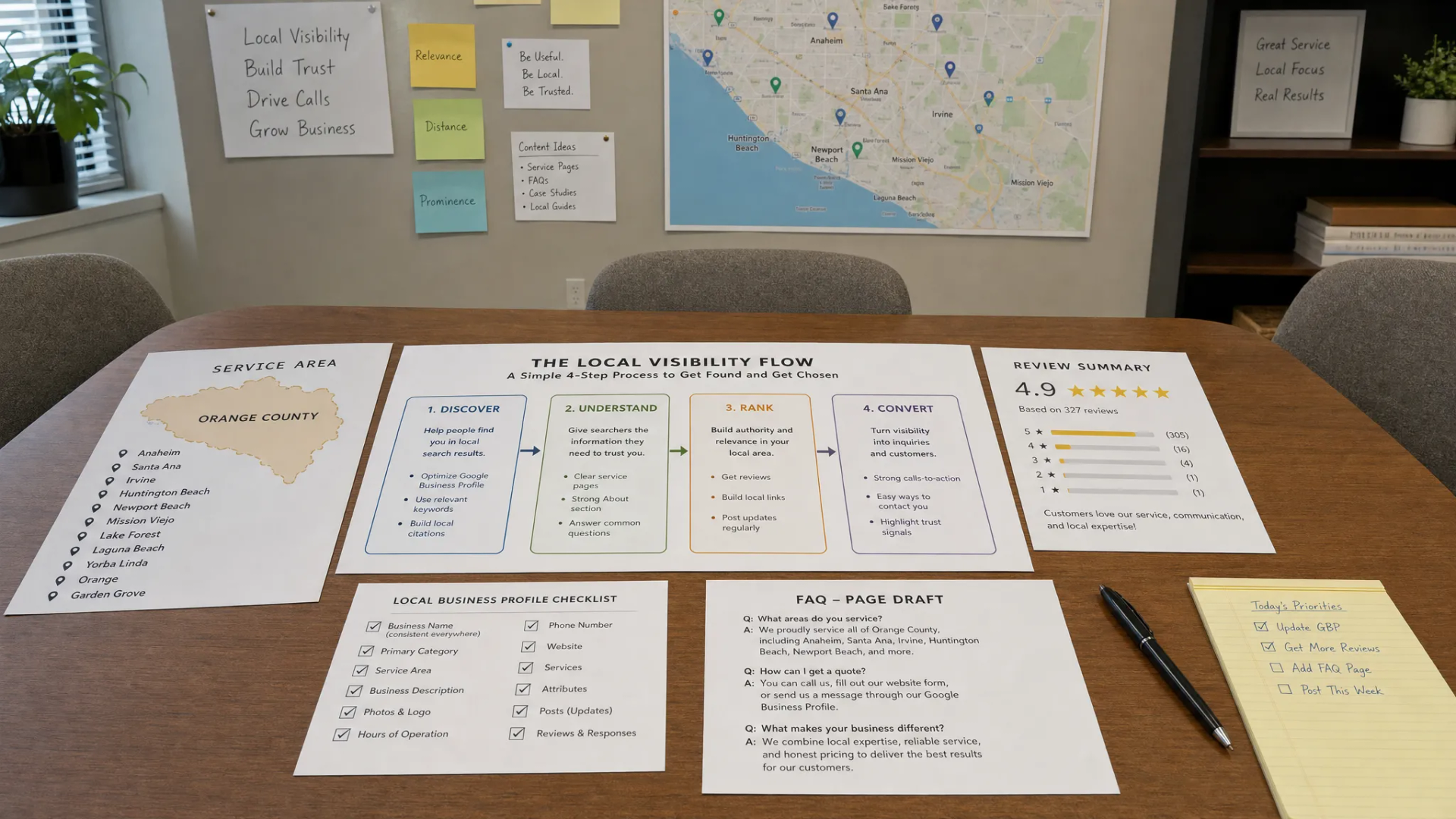
A homeowner in Laguna Niguel types “emergency AC repair near me.” A patient in Irvine asks Google for “best dentist open Friday.” A property manager in San Jose searches “roof leak repair commercial building.” In each case, the search engine is not simply matching words on a page. It is deciding which local business is relevant, close enough, trusted enough, and clear enough to recommend.
That is the real working of search engine optimization for local business. SEO helps search engines understand your company, connect your services to real buyer intent, and present your business when someone nearby is ready to call, book, or request an estimate.
For California contractors and multi-location professional practices, this matters because the search results page is no longer just ten blue links. It includes map packs, Google Business Profiles, reviews, AI summaries, paid ads, “people also ask” questions, voice results, and local service panels. If your business is not structured correctly, you may be invisible even when your services are exactly what the customer needs.
How Search Engines Work Before a Customer Ever Calls
Search engines perform three core jobs: discover information, understand it, and rank it for a specific question. Local SEO improves each of those jobs so your business becomes easier to find and easier to trust.
| Search engine step | What it means |
|---|---|
| Crawling | Search engines discover pages, profiles, citations, and links across the web. |
| Indexing | Search engines store and interpret what each page or profile is about. |
| Ranking | Search engines choose which results best answer the searcher’s need. |
| Presentation | Search engines display results in maps, organic listings, AI answers, snippets, or voice responses. |
A traditional website can still rank, but local businesses also need a complete digital footprint. Search engines compare your website with your Google Business Profile, reviews, citations, service pages, location pages, local backlinks, photos, and customer engagement signals.
If those assets tell a consistent story, the search engine gains confidence. If they conflict, for example one phone number on your website and another on a directory, your visibility can suffer.
What Makes Local SEO Different From General SEO
General SEO often focuses on ranking nationally for informational or commercial keywords. Local SEO is more practical and more immediate. The customer is usually close to a buying decision and wants a business that can serve a specific area.
Google’s local results are commonly influenced by three major ideas: relevance, distance, and prominence.
Relevance means your business matches what the searcher wants. A roofing contractor in Anaheim needs pages and profile categories that clearly support roof repair, roof replacement, inspections, emergency leaks, and the specific neighborhoods served.
Distance means your business is geographically appropriate for the searcher. You do not need to be closest in every case, but proximity matters, especially for “near me” searches and map pack results.
Prominence means your business appears credible and established. Reviews, links, mentions, content depth, citations, awards, photos, and recognizable expertise all help search engines decide whether you are a trusted option.
For an Orange County HVAC company, this means the same website may perform differently in Laguna Beach, Irvine, Newport Beach, Santa Ana, and Huntington Beach depending on how well each location and service intent is supported.
The Local SEO System, From Visibility to Revenue
Local SEO is not one tactic. It is a system of connected signals that help search engines and customers reach the same conclusion: this business is the right choice.
1. Entity clarity: who you are and what you do
A search engine needs to understand your business as an entity. That means it must be able to identify your official name, location, phone number, services, leadership, operating areas, and proof of expertise.
For contractors, entity clarity includes service categories such as HVAC repair, solar installation, plumbing, electrical work, roofing, remodeling, or emergency service. For professional practices, it may include specialties, provider names, office locations, insurance information, credentials, and appointment availability.
The mistake many local companies make is assuming a homepage is enough. It is not. A homepage gives a broad overview, but search engines also need focused pages that answer specific local needs.
2. Google Business Profile alignment
Your Google Business Profile is often more visible than your website. It can appear in the map pack, mobile results, branded searches, and voice searches. If your profile is incomplete or inactive, your local SEO system has a weak center.
A strong profile includes accurate categories, services, hours, photos, service areas, business description, products or service menus when applicable, regular updates, and review responses. For businesses with multiple locations, each office should have its own properly managed profile, not a confusing mix of shared phone numbers and duplicate pages.
For an Irvine dental group or a San Diego plumbing company, the profile is not just a listing. It is a conversion surface. Customers may call directly from Google without ever visiting the website.
3. Service pages that match real buyer intent
Search engines reward clarity. A page about “home services” is too broad if the customer is searching “tankless water heater installation in Anaheim.” A page about “legal services” is too vague if the prospect needs “estate planning attorney in Newport Beach.”
Local SEO works best when your website has pages that mirror how customers actually ask for help. These pages should explain the problem, the service, the area served, what makes the provider qualified, and what the customer should do next.
A good local service page usually answers questions like:
- What problem does this service solve?
- Who is the service for?
- What cities or neighborhoods are served?
- What should the customer expect during the process?
- What proof shows the business can be trusted?
- How can the customer call, schedule, or request an estimate?
The goal is not to write more words for the sake of SEO. The goal is to remove uncertainty for both the search engine and the buyer.
4. Location signals that support real service areas
Many local businesses want to rank everywhere. A contractor in Orange County may want calls from Laguna Beach, Laguna Niguel, Irvine, Anaheim, Huntington Beach, Newport Beach, and Santa Ana. A professional practice may want to reach patients or clients across multiple offices in San Jose, San Francisco, Oakland, Sacramento, or Fresno.
Location pages can help, but only if they are useful. Thin pages that swap city names rarely build trust. Strong local pages include service relevance, neighborhood context, nearby landmarks when appropriate, local customer questions, testimonials, photos, and clear calls to action.
For example, a well-structured local landing page, like Homes2Go San Antonio, makes the market, product category, buying path, financing context, reviews, and contact options clear to both shoppers and search systems. The same principle applies whether you sell manufactured homes in Texas or install HVAC systems in Irvine: search engines need a complete local entity, not a thin keyword page.
5. Reviews and reputation signals
Reviews influence both human trust and local visibility. A customer comparing two plumbers in Costa Mesa may choose the company with stronger reviews, better response quality, and more recent customer feedback.
Search engines also use reviews to understand what your business is known for. If customers repeatedly mention “same-day AC repair,” “roof leak,” “emergency plumber,” “implant dentist,” or “family law consultation,” those words can reinforce service relevance.
The best review strategy is operational, not manipulative. Ask real customers at the right time, make the process easy, respond professionally, and never buy fake reviews. Review quality, recency, and response behavior all contribute to local trust.
6. Technical SEO that keeps your site crawlable and fast
Local SEO can fail when the website has technical problems. Search engines may struggle to crawl pages, understand content, or evaluate user experience if the site is slow, disorganized, or confusing.
Important technical foundations include mobile-friendly design, fast page speed, clean navigation, secure HTTPS, correct indexation, useful internal linking, optimized titles and descriptions, structured data, and clear contact information.
For service businesses, mobile performance is especially important. Many high-intent searches happen from a phone, often in urgent situations. If a homeowner with a broken AC unit has to pinch, zoom, wait, or hunt for the call button, that lead may go to a competitor.
7. Authority signals beyond your own website
Search engines do not rely only on what you say about yourself. They also evaluate how the broader web describes your business.
Authority signals include local citations, industry directories, chamber of commerce listings, supplier mentions, local media, sponsorships, partner links, professional associations, and relevant backlinks. For a roofing company, mentions from manufacturers, local construction associations, or neighborhood publications can support credibility. For a medical, dental, or legal practice, professional profiles and reputable directories can reinforce trust.
This is where many local businesses underinvest. One website is important, but a stronger local footprint helps search engines verify that the business is real, active, and recognized.
The Role of Content in Local SEO
Content is not just blogging. It is every page, answer, photo caption, FAQ, service explanation, case story, and review response that helps a search engine understand your business.
For local companies, the best content usually comes from real customer questions. A Laguna Beach homeowner might ask whether salt air affects outdoor HVAC units. A Sacramento patient might ask how to choose between two dental procedures. A San Diego homeowner might compare solar battery options. A San Jose business owner might search for a legal consultation near a specific district.
Content that answers these questions builds topical authority. Over time, search engines can see that your business understands the problems customers face in your market.
Strong local content often includes:
- Service-specific guides for common buying decisions
- City or neighborhood pages with unique local context
- FAQs written in natural customer language
- Case studies or project stories when privacy allows
- Comparison pages that explain options honestly
- Seasonal content, such as HVAC maintenance before summer or roof inspections before winter rain
The key is usefulness. Search engines are increasingly good at detecting content that exists only to target keywords. Useful content supports decisions, builds trust, and makes your business easier to recommend.
How AI Search Changes the Working of SEO
In 2026, SEO is not only about ranking a page. AI-powered search tools, voice assistants, and answer engines increasingly summarize information before a customer clicks. That creates a new challenge for local businesses: your brand must be understandable enough to be cited, summarized, or recommended by machines.
This is where SEO and Answer Engine Optimization overlap. SEO helps your business appear in search results. AEO helps your business become a trusted answer when AI systems interpret a question.
For example, a searcher might ask, “Who is the best HVAC company for emergency AC repair in Laguna Niguel?” A search engine or AI assistant may evaluate business profiles, reviews, website content, service pages, local mentions, and structured data before producing a recommendation.
To prepare for AI-driven search, local businesses should make answers explicit. Service pages should clearly state who the business serves, where it operates, what services it provides, why it is qualified, and how customers can take action. FAQs should be direct. Schema markup should help machines interpret services, locations, reviews, and organization details.
Kell Web Solutions’ Answer Engine Optimization approach is built around this shift from being one of many results to being selected as the answer.
How Local SEO Turns Searches Into Calls
Visibility is only the first half of the job. A local business does not need traffic for vanity. It needs qualified calls, estimate requests, consultations, appointments, and booked jobs.
That means SEO must connect to conversion. A customer who lands on your site should immediately understand what you do, where you serve, why you are credible, and how to contact you. The phone number should be obvious. Forms should be simple. Calls to action should match the urgency of the search.
A person searching “emergency plumber near me” needs a different experience than someone searching “bathroom remodeling ideas Irvine.” One is ready to call now. The other may be researching options and comparing providers. Local SEO works best when each page aligns with the customer’s stage of decision-making.
| Search intent | Example local query | Best page experience |
|---|---|---|
| Emergency | “AC repair near me open now” | Fast-loading service page, click-to-call, hours, emergency language, trust proof |
| Comparison | “best roofing company in Huntington Beach” | Reviews, project examples, credentials, service differentiators |
| Research | “how long does a solar installation take in California” | Educational guide, process overview, local permitting considerations |
| Professional decision | “estate planning attorney Irvine consultation” | Practice area page, attorney credibility, consultation path, location details |
| Multi-location search | “dentist near San Jose office open Friday” | Office-specific page, hours, providers, insurance or appointment details |
When SEO is tied to conversion, the question changes from “How much traffic did we get?” to “How many qualified opportunities did search create?”
What Local Businesses Should Measure
Rankings matter, but they are not the whole story. A business can rank for low-value keywords and still fail to generate revenue. A better measurement system connects SEO performance to business outcomes.
Important local SEO metrics include map pack visibility, organic impressions, calls from Google Business Profile, website calls, form submissions, booked appointments, direction requests, review growth, conversion rate, and revenue from organic leads.
For contractors, the strongest metric may be booked jobs by city or service line. For professional practices, it may be qualified consultations or new patient appointments by office location. For multi-location brands, performance should be segmented by location, not blended into one average that hides weak markets.
Kell Web Solutions’ Local SEO Mastery service is designed around the practical pieces local companies need, including Google Business Profile optimization, citation management, local content, and ongoing visibility improvements.
Common Local SEO Mistakes That Hold Businesses Back
The first mistake is treating SEO as a one-time setup. Search results change, competitors improve, reviews age, business information shifts, and AI systems evolve. Local SEO requires ongoing maintenance.
The second mistake is creating duplicate city pages with almost identical text. Search engines want local usefulness, not city-name swapping. If you serve multiple California markets, each page should provide something genuinely helpful for that community.
The third mistake is ignoring calls and conversions. A business can improve rankings and still lose leads if the site is slow, the phone number is hidden, or missed calls go unanswered.
The fourth mistake is separating SEO from reputation. Reviews, customer experience, and search visibility now reinforce each other. A weak reputation can reduce conversion even if rankings improve.
The fifth mistake is relying only on a single website. In competitive local markets, especially Orange County, Los Angeles, San Diego, San Jose, San Francisco, Sacramento, and Fresno, your broader authority footprint matters. Local mentions, citations, content assets, and consistent profiles help reinforce your business as a trusted entity.
For businesses that need a stronger neighborhood-level footprint, Kell’s Hyperlocal Authority Builder focuses on building local authority signals beyond a single website.
A Practical 30-Day Local SEO Reset
If your business has not reviewed its local SEO recently, start with a simple reset. The goal is not to fix everything at once. The goal is to remove confusion and strengthen the signals that matter most.
- Audit your Google Business Profile for categories, services, hours, photos, and contact accuracy.
- Compare your name, address, and phone number across major directories and your website.
- Review your top service pages and confirm each one has a clear location, service, proof, and call to action.
- Identify your highest-value cities or neighborhoods instead of trying to target every market equally.
- Add or improve FAQs based on real questions customers ask before buying.
- Check mobile speed, click-to-call buttons, form usability, and page indexing.
- Build a review request process that is consistent, compliant, and easy for customers.
- Track calls, forms, and booked jobs by source so SEO can be measured by revenue impact.
This basic reset can reveal the biggest gaps quickly. From there, a business can prioritize deeper technical SEO, content strategy, local authority building, or AEO readiness.
Frequently Asked Questions
How does SEO work for a local business? Local SEO helps search engines understand your business, services, locations, reputation, and authority. When someone nearby searches for a relevant service, the search engine compares your signals against competitors and decides whether to show you in maps, organic results, AI answers, or other search features.
What is the difference between local SEO and regular SEO? Regular SEO may target broad national or informational searches. Local SEO focuses on searches with geographic intent, such as “plumber in Irvine” or “dentist near me.” It relies heavily on Google Business Profile quality, reviews, location signals, citations, and local relevance.
How long does local SEO take to work? Some improvements, such as profile updates or technical fixes, can influence visibility relatively quickly. Stronger gains usually take several months because search engines need time to crawl changes, evaluate engagement, and compare your authority against competitors.
Do I need separate pages for every city I serve? You may need separate pages for important service areas, but only if each page is useful and unique. Thin duplicate city pages can hurt trust. Focus first on your highest-value cities, then build pages that answer real local questions.
Can paid ads replace local SEO? Paid ads can create immediate visibility, but they stop when the budget stops. Local SEO builds durable visibility, trust, and organic demand over time. Many strong local businesses use both, but SEO should not be ignored if you want long-term lead flow.
Does AI search make SEO less important? No. AI search makes strong SEO even more important because answer engines need trustworthy sources to understand and recommend businesses. Clear service pages, structured data, reviews, citations, and local authority all help your business become easier for AI systems to interpret.
Make Local Search Work Like a Revenue System
Local SEO is not magic, and it is not just keywords. It is the disciplined process of making your business clear, credible, locally relevant, and easy to contact wherever customers search.
For Orange County contractors, California home service companies, and multi-location professional practices, the opportunity is still significant. The businesses that win will be the ones that connect traditional SEO, local authority, reputation, conversion design, and AEO into one system.
Kell Web Solutions has served Orange County businesses since 2001 and helps local companies adapt to the changing search landscape. If your business depends on calls, consultations, or booked jobs from local search, explore Kell’s local SEO, Answer Engine Optimization, and hyperlocal authority services, or call (949) 575-8553 to discuss where your visibility is breaking down.