Search Optimization for AI Overviews, Maps, and Voice
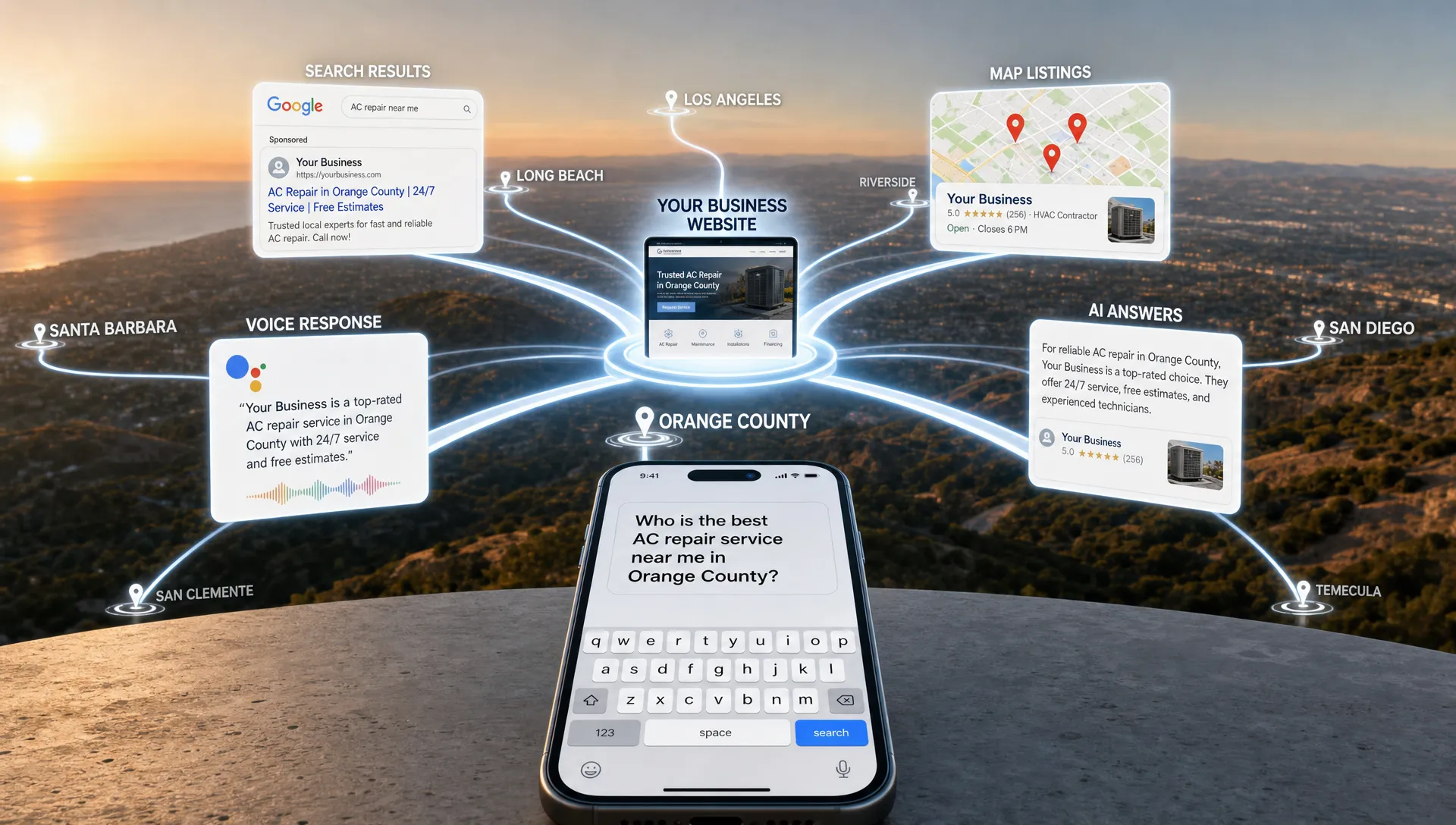
Search optimization used to mean one primary goal: rank a web page high enough to earn the click. That still matters, but it is no longer the whole game for local businesses. Today, a homeowner in Laguna Beach may ask Google for the best HVAC company for a same-day repair, scan the map pack, listen to a voice assistant, or read an AI Overview without ever visiting ten websites.
For California contractors, medical groups, dental practices, and law firms, the new question is not only, 'Can people find us?' It is, 'Can search systems understand us well enough to recommend us when the customer is ready to call?'
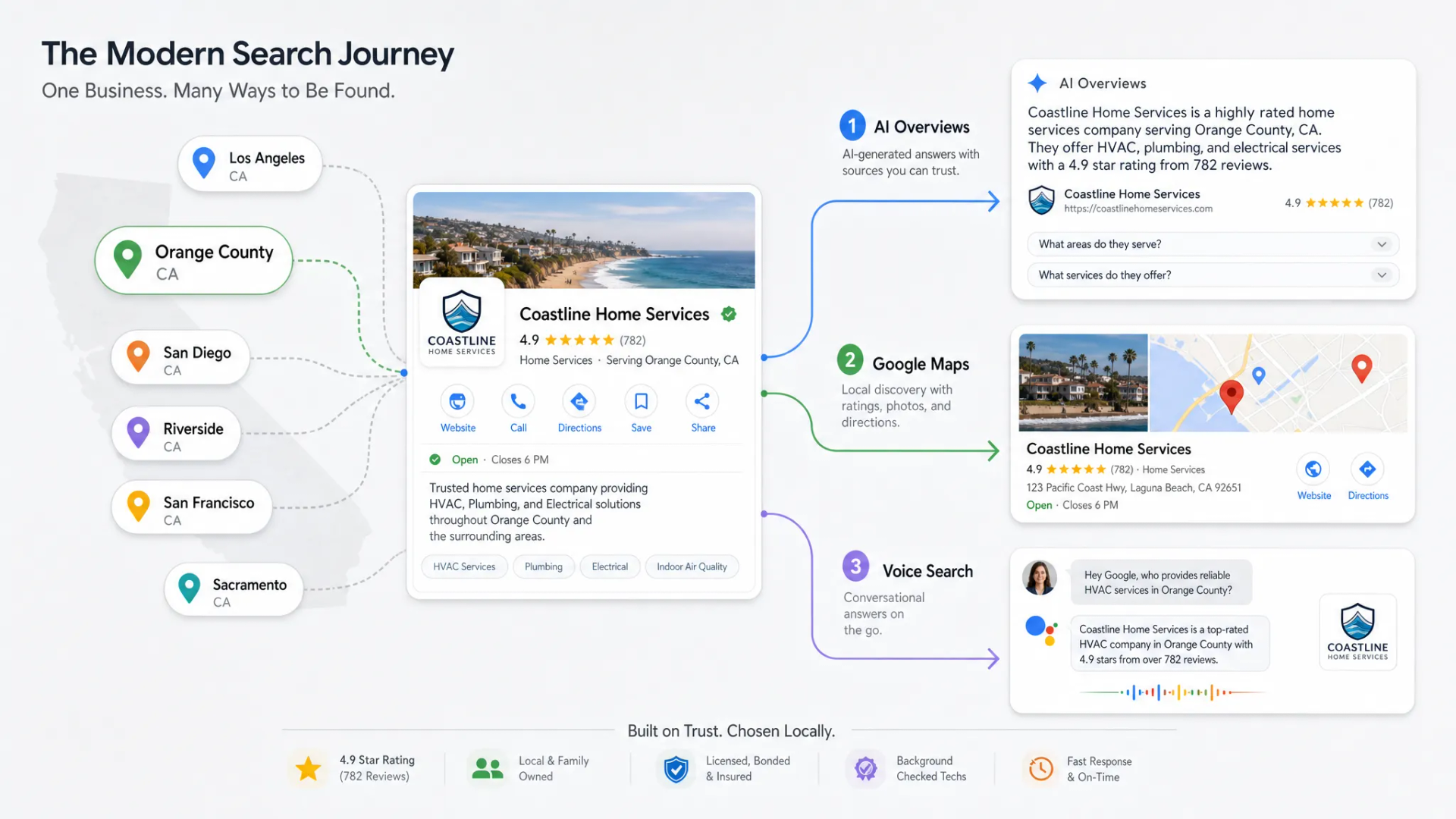
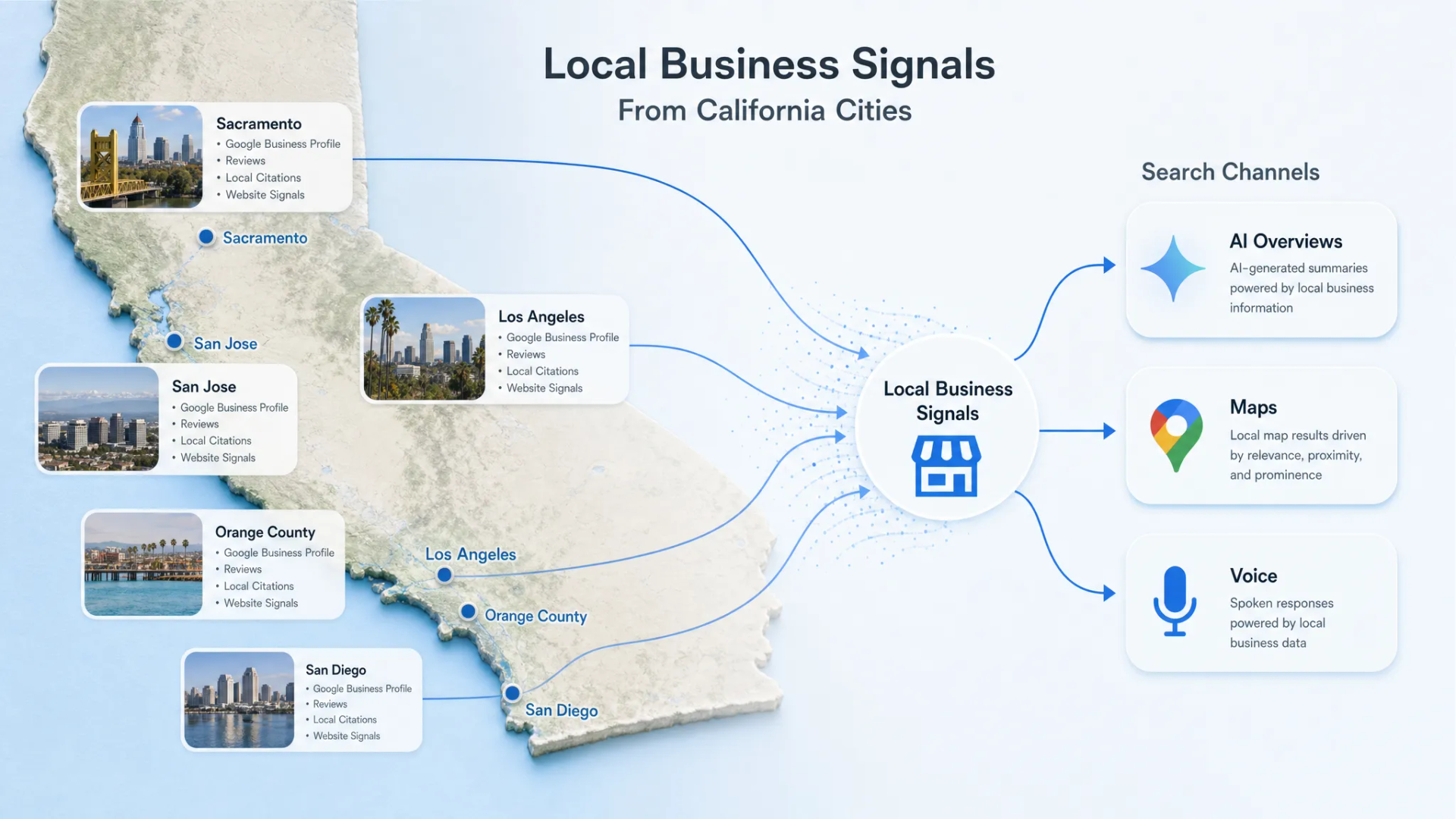
That is why modern search optimization must work across three connected surfaces: AI Overviews, Google Maps, and voice search. Each one uses different signals, but they all reward the same foundation: clear entity information, local authority, trusted proof, and content that answers real customer questions.
Why Search Optimization Has Changed
AI-driven search has changed the path from question to call. Instead of typing a short keyword and comparing links, users now ask complete questions such as:
- Who repairs tankless water heaters near Irvine after hours?
- What is the best roofing company in Huntington Beach for tile roof leaks?
- Which dentist near San Jose handles emergency appointments?
- How much does an electrical panel upgrade cost in Orange County?
These searches are more conversational, more local, and often more urgent. Google, voice assistants, and AI answer engines try to summarize the best answer, not just display a list of matching pages.
For service businesses, this creates both risk and opportunity. If your business information is vague, inconsistent, or thin, AI systems have little reason to cite you. If your digital presence is structured, locally specific, and supported by reviews and proof, you can become the answer customers hear, see, and call.
The Three Search Surfaces You Need to Win
AI Overviews, Maps, and voice search overlap, but they are not identical. A strong search optimization strategy understands how each surface works and builds signals that support all three.
| Search surface | What the user wants | What search systems look for | Business risk if ignored |
|---|---|---|---|
| AI Overviews | A fast explanation, comparison, or recommendation | Clear answers, topical authority, structured data, trustworthy sources, local relevance | Your expertise may be summarized without your brand being cited |
| Google Maps | A nearby provider they can contact now | Google Business Profile strength, proximity, categories, reviews, photos, services, consistency | Competitors win calls even if your website ranks well |
| Voice search | A short, spoken answer or direct action | Concise answers, accurate business data, strong local signals, call readiness | Urgent leads go to the easiest business to identify and contact |
The winning strategy is not to build three separate campaigns. It is to create one authority system that gives search engines, answer engines, and customers the same clear story everywhere.
Start With Entity Clarity
Before you optimize pages, posts, or profiles, make sure search systems can identify your business as a real, trusted entity. An entity is not just a name. It is the complete understanding of who you are, what you do, where you operate, and why you are credible.
For a home services contractor, that might include service categories, license information, service areas, emergency availability, project types, photos, customer reviews, and city-specific proof. For a multi-location medical, dental, or legal practice, it includes provider names, office locations, practice areas, appointment details, credentials, and consistent contact information.
The basics matter more than many businesses realize. Your company name, address, phone number, website, business categories, hours, and services should be consistent across your website, Google Business Profile, major directories, review platforms, social profiles, and any local authority assets you control.
When this information conflicts, AI systems hesitate. When it is consistent, detailed, and reinforced across trusted places, you become easier to retrieve and recommend.
Optimize for AI Overviews With Answer-First Content
AI Overviews tend to appear when Google believes a user wants a synthesized answer. That often includes informational, comparison, cost, troubleshooting, and local decision queries.
A contractor might be surfaced for a question like 'Why does my AC keep freezing in Orange County?' A law firm might appear for 'What should I do after a rideshare accident in Los Angeles?' A dental practice might earn visibility for 'How soon should I see a dentist for a cracked tooth in San Diego?'
The content that performs best in AI-driven results is usually not fluffy. It is specific, structured, and easy to extract.
Strong AI Overview content usually includes:
- A direct answer in the first few sentences of the section
- Clear H2 and H3 headings that match real customer questions
- Practical details such as timelines, warning signs, service options, or decision criteria
- Local context that proves the answer is not generic
- Evidence of experience, such as examples, reviews, credentials, or process explanations
- Schema markup that helps machines understand the page
For example, a generic page titled 'HVAC Services' is less helpful than a structured page that answers common buyer questions: when repair is better than replacement, what affects cost in coastal Orange County homes, how emergency scheduling works, and what homeowners should check before calling.
That does not mean every page should be written like an FAQ dump. It means every page should make the answer obvious. If a human can quickly understand your expertise, a search system has a better chance of understanding it too.
Kell Web Solutions approaches this through Answer Engine Optimization, which focuses on helping AI-driven platforms understand, trust, and recommend a business when customers ask high-intent questions.
Treat Google Maps as a Conversion Engine, Not a Directory Listing
For local businesses, Google Maps is often closer to the sale than the website. A homeowner with a leaking pipe, broken AC unit, or electrical issue may not want to read a long article. They want proof, proximity, availability, and a phone number.
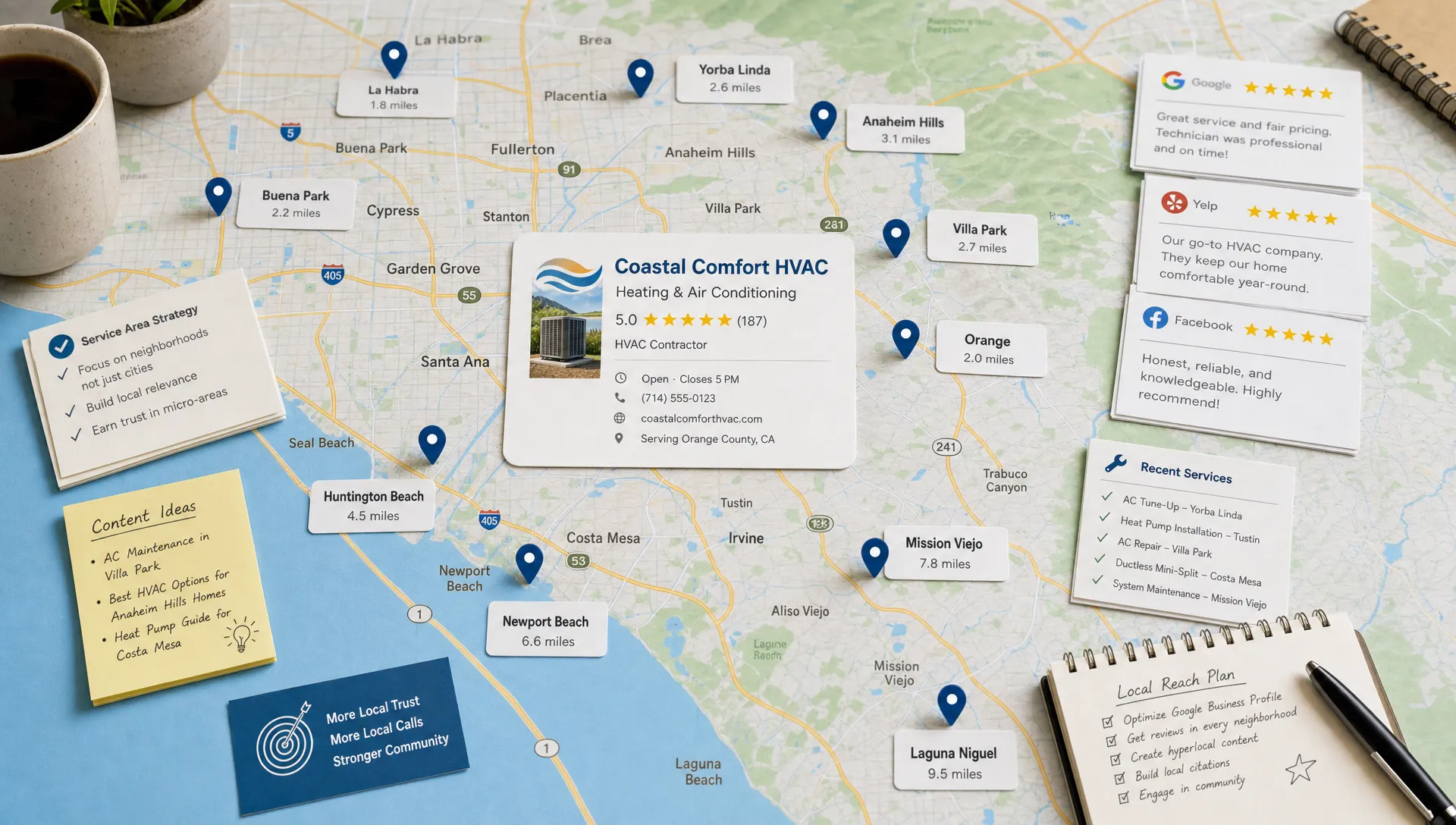
Google has long described local ranking around relevance, distance, and prominence. You cannot fully control distance, but you can improve relevance and prominence.
Relevance starts with a complete and accurate Google Business Profile. Your primary category should match your main service. Your secondary categories should support real offerings. Your service list should reflect what customers actually buy. Your description should be clear, not stuffed with city names.
Prominence comes from proof. Reviews, review responses, photos, local citations, links, content, and brand mentions all help reinforce that your business is active and trusted.
For contractors and professional practices in Orange County, Irvine, Anaheim, Huntington Beach, Los Angeles, San Diego, San Jose, and Sacramento, Maps optimization should be operational, not occasional. Add recent photos. Publish useful updates. Respond to reviews. Keep holiday hours current. Make sure your website location pages align with the services and geography shown in your profile.
This is where Local SEO remains essential. AI may be changing search behavior, but map visibility still depends heavily on foundational local signals.
Make Voice Search Easy to Answer and Act On
Voice search is different because the user often wants one answer, not a list. This matters in urgent and hands-free situations: a homeowner driving home who asks for an emergency plumber, a parent asking for an after-hours dentist, or a property manager asking for an electrician near a job site.
Voice assistants rely on clean business data, strong local authority, and concise answers. They also reward businesses that make the next action simple. If your phone number is inconsistent, your hours are outdated, your service area is unclear, or your website hides contact options, you create friction.
Voice-ready optimization does not require gimmicks. It requires clarity. Write content that mirrors how people speak. Include short answers to common questions. Make emergency services, service areas, appointment options, and phone numbers easy to find. Use natural language, not awkward keyword repetition.
A page section that says, 'Yes, we provide emergency AC repair in Laguna Beach and nearby Orange County communities. Call during business hours for scheduling, and check our service page for availability details,' is more useful than a paragraph repeating 'AC repair Laguna Beach' ten times.
The most overlooked voice-search factor is call handling. If an AI assistant helps a customer find you but the call goes unanswered, the search win becomes a lost sale. For many service businesses, call capture and follow-up are now part of search optimization because visibility only matters if it turns into a conversation.
Build Local Authority City by City
California is not one market. Orange County behaves differently from Los Angeles, San Diego, San Jose, San Francisco, Fresno, Sacramento, and Bakersfield. Even within Orange County, Newport Beach, Laguna Niguel, Santa Ana, Irvine, Anaheim, and Huntington Beach have different customer expectations and competitive landscapes.
This is why generic statewide content rarely wins local jobs. A roofing contractor trying to reach luxury coastal homeowners needs different proof than a plumber competing for emergency calls in dense urban neighborhoods. A dental group with offices across Southern California needs location pages that reflect each office, provider, and patient catchment area.
The right approach is to build a central authority hub, then support it with localized content and assets. Your main website should clearly explain your brand, services, trust signals, and conversion paths. Around that, you can build neighborhood-level authority through city pages, service-area content, local case studies, review amplification, and carefully structured supporting assets.
For competitive home services categories, Kell Web Solutions offers a Hyperlocal Authority Builder designed to strengthen neighborhood-level entity signals through locally targeted content and authority assets.
The principle is simple: if customers ask local questions, your digital footprint must provide local answers.
Use Structured Data to Reduce Machine Confusion
Structured data does not guarantee rankings or AI citations, but it helps search systems interpret your content. For AI Overviews, Maps, and voice, the goal is to remove ambiguity.
Useful schema types may include LocalBusiness, Organization, Service, FAQPage, WebPage, BreadcrumbList, Review, and Person schema, depending on the page and business type. A contractor may use service and local business schema to clarify offerings and service areas. A law firm or medical practice may need provider, location, and professional service details.
Structured data should match visible page content. Do not mark up fake reviews, unsupported services, or locations where you are not eligible to operate. AI-era search rewards trusted clarity, not markup tricks.
For businesses pursuing agentic readiness, technical assets such as advanced JSON-LD and
llms.txt
can also help clarify source-of-truth pages for AI crawlers. These tools are useful only when the underlying content, business information, and proof are accurate.
Train Your Team for the Retrieval Economy
Search optimization is no longer only an agency task. Your front desk, dispatchers, technicians, providers, attorneys, office managers, and sales team all create signals that affect visibility and conversion.
Review requests, call notes, service photos, customer questions, project details, and follow-up language can all become fuel for better content and stronger local authority. If your team hears the same homeowner question ten times in a week, that question may deserve a website section, a Google Business Profile post, or a short FAQ.
Because AI platforms and search behavior change quickly, teams also need a baseline understanding of AI literacy, digital communication, and responsible tool use. Broader AI and business upskilling resources can help leaders think about ongoing training, especially when marketing, operations, and customer service teams need to adapt together.
The businesses that win in AI search will not be the ones that publish the most content. They will be the ones that learn fastest from customer questions and turn that knowledge into trustworthy digital assets.
Measure What Actually Produces Revenue
Rankings still matter, but they are incomplete. In an AI-driven search environment, customers may see your brand in an AI Overview, call from Maps, ask a voice assistant, or convert after multiple zero-click interactions.
A better measurement system tracks visibility, trust, and conversion together.
| Metric | Why it matters | What to watch |
|---|---|---|
| AI citation visibility | Shows whether answer engines recognize your authority | Queries where your brand or content is cited or summarized |
| Map pack presence | Captures high-intent local visibility | City and service combinations where you appear in Maps |
| Google Business Profile actions | Measures real buyer behavior | Calls, website clicks, direction requests, bookings |
| Call answer rate | Connects visibility to revenue | Missed calls, after-hours calls, booked-call percentage |
| Review velocity and quality | Builds trust and local prominence | New reviews, response rate, review themes |
| Location page conversions | Shows which markets are producing leads | Calls, forms, appointments, booked jobs by city |
For contractors, the ultimate metric is not traffic. It is booked jobs with profitable service value. For professional practices, it is qualified consultations or appointments. Search optimization should be judged by business outcomes, not vanity dashboards.
A Practical 90-Day Search Optimization Plan
A full AI, Maps, and voice strategy can become sophisticated, but the first 90 days should focus on the foundations that create the fastest clarity.
Days 1 to 30: Audit visibility and entity gaps
Start by searching the way customers search. Test service, city, and problem-based questions across Google, Maps, and voice assistants. Look for where your brand appears, where competitors appear, and where answer engines seem confused.
Review your website structure, Google Business Profile, citations, reviews, location pages, service pages, and technical markup. Identify inconsistent business information, thin pages, missing FAQs, outdated photos, weak calls to action, and unanswered buyer questions.
Days 31 to 60: Rebuild the core assets
Update your highest-value service pages so they answer real customer questions. Strengthen your Google Business Profile with accurate services, photos, posts, hours, and review responses. Add or improve structured data. Build or refine location pages for priority cities, making each one genuinely useful rather than duplicated.
For an Orange County contractor, that might mean improving pages for Laguna Beach, Irvine, Newport Beach, Anaheim, and Huntington Beach. For a professional practice, it may mean strengthening each office page with providers, specialties, appointment details, parking information, and localized FAQs.
Days 61 to 90: Expand authority and conversion tracking
Once the foundation is clear, expand supporting content around high-intent questions. Publish locally relevant articles, case studies, comparison pages, and FAQs. Improve review generation workflows. Track calls and booked outcomes by channel and geography.
This is also the stage to decide whether you need broader authority assets beyond your main website. In highly competitive markets, one website may not be enough to build the local footprint needed for AI retrieval, Maps trust, and voice confidence.
Common Mistakes to Avoid
Many businesses try to solve AI-era search with old tactics. That creates wasted effort and sometimes damages trust.
Avoid these common mistakes:
- Publishing thin city pages that only swap city names
- Treating Google Business Profile as a one-time setup
- Writing content for keywords instead of customer questions
- Ignoring missed calls after improving visibility
- Buying reviews or gating review requests
- Adding schema that does not match visible page content
- Measuring success only by website traffic
The biggest mistake is assuming search optimization ends when the page goes live. AI Overviews, Maps, and voice results evolve constantly. Your strategy should evolve with customer behavior, competitor movement, and platform changes.
Frequently Asked Questions
What is search optimization for AI Overviews, Maps, and voice? It is the process of making your business easy for search engines, answer engines, map systems, and voice assistants to understand, trust, and recommend. It combines website content, local SEO, structured data, reviews, Google Business Profile optimization, and conversion readiness.
Is traditional SEO still important? Yes. Traditional SEO is still the foundation, but it must now support answer-driven discovery. Pages need to rank, but they also need to provide clear answers, entity signals, and trustworthy proof that AI systems can interpret.
How long does it take to see results? Foundational improvements can influence visibility and conversions within weeks, especially on Google Business Profile and high-intent local pages. Broader authority for AI Overviews and competitive city searches usually compounds over several months.
Does voice search really matter for contractors and practices? Yes, especially for urgent, local, and mobile searches. Voice search often favors businesses with clear local data, strong reviews, concise answers, and easy calling options.
Should I create a separate page for every city I serve? Only if each page is useful and accurate. A strong city page should include relevant services, local context, proof, FAQs, and a clear conversion path. Thin duplicated pages can weaken trust.
What matters most for multi-location practices? Each eligible location should have accurate business data, a strong profile, localized website content, provider or service details, reviews, and clear appointment paths. Consistency across locations is critical.
Turn Search Visibility Into Confident Local Calls
AI Overviews, Maps, and voice search are not separate trends. They are the new local discovery system. If your business depends on calls, appointments, or booked jobs in Orange County or across California, your digital presence must be clear enough for both people and AI systems to choose you.
Kell Web Solutions helps contractors and multi-location professional practices build durable local authority through Answer Engine Optimization, Local SEO, and hyperlocal visibility strategies. If you want to understand where your business is being found, where it is being ignored, and what it will take to become the trusted local answer, call Kell Web Solutions at (949) 575-8553 or explore our Answer Engine Optimization services.