Why Every Contractor Needs a Local Website That Builds Trust
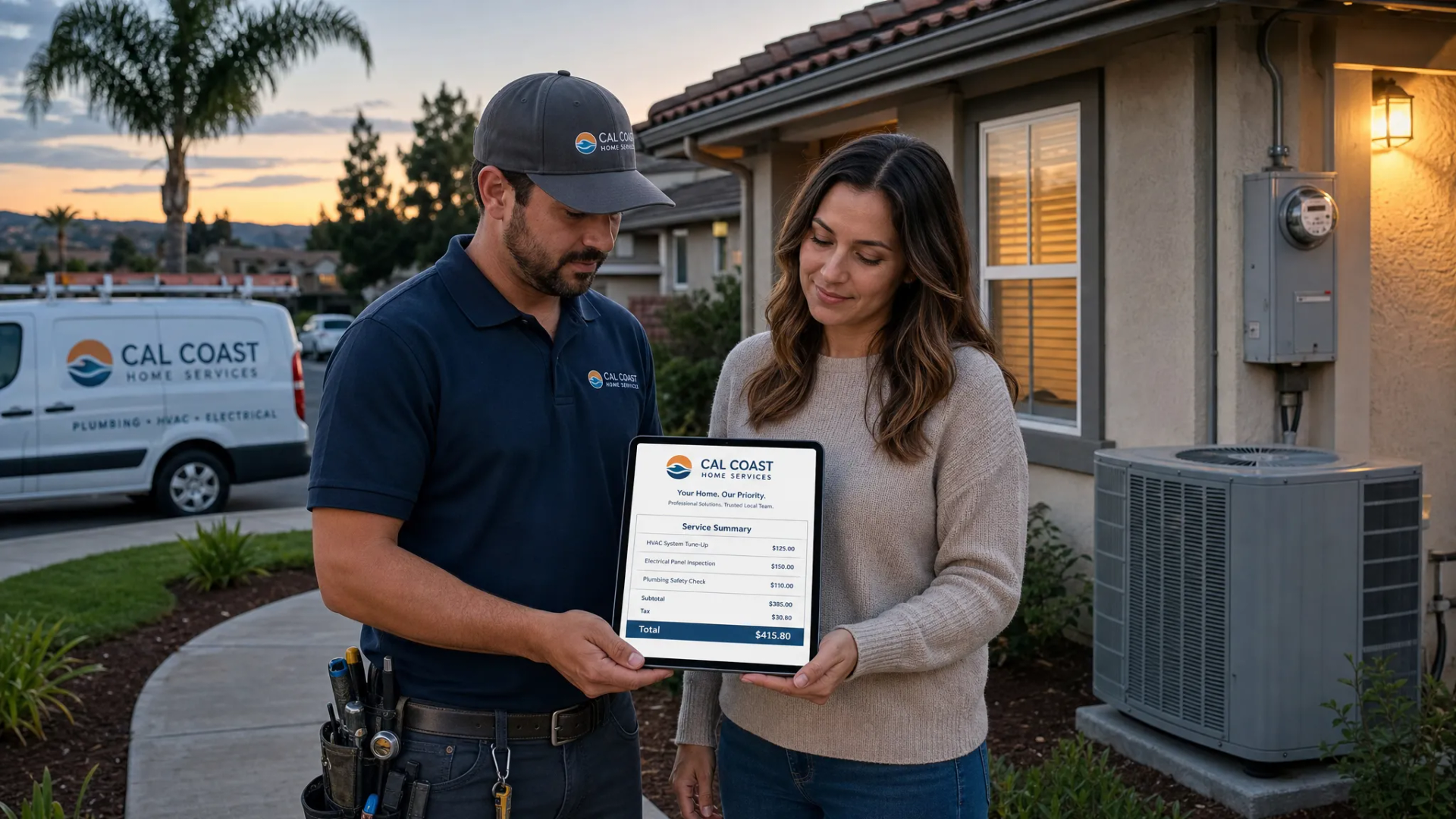
A homeowner with a leaking roof, a broken AC unit, or an electrical problem is not casually browsing. They are trying to answer one urgent question: “Can I trust this contractor in my area?”
That is why every contractor needs a local website that does more than look professional. It has to prove credibility, show local relevance, answer buyer questions, and make the next step easy. Your website is no longer just an online brochure. It is your digital trust center.
For contractors in Orange County, Los Angeles, San Diego, San Jose, Sacramento, and other competitive California markets, trust is often the difference between a visitor who calls and a visitor who keeps comparing. A polished ad may get attention. A Google Business Profile may start the search. But your website is where many customers decide whether you are the safe choice.
The contractor trust gap is real
Contracting is a high-trust business. Customers are letting your team into their home, approving work that may cost hundreds or thousands of dollars, and hoping the job is done safely and correctly. That creates a different level of scrutiny than buying a simple product online.
Before a homeowner calls, they are often checking:
- Whether your company looks established and legitimate
- Whether you serve their city or neighborhood
- Whether you handle their exact problem
- Whether your reviews and project examples feel believable
- Whether your contact process is simple and low-friction
A weak local website creates doubt at the exact moment you need confidence. If your site is outdated, vague, slow, or missing local proof, prospects may assume your service is the same.
This is especially true in California, where local competition can be intense. An HVAC company in Irvine, a roofer in Huntington Beach, a plumber in Anaheim, and an electrician in San Jose may all compete against large lead marketplaces, paid ads, map pack listings, and AI-generated answers. The contractors who win are not always the cheapest. They are often the easiest to trust.
A local website gives customers a reason to choose you
A contractor’s website should answer the questions a homeowner is already asking internally. It should not force them to dig, guess, or call just to understand basic information.
At a minimum, your local website should make five things clear.
1. Who you are
Customers want to know there are real people behind the business. Show your company name, location, leadership, team, history, and values. If you are family-owned, locally operated, licensed, insured, certified, or highly experienced, say so clearly.
Generic wording like “we provide quality service” does not build much trust on its own. Specificity does. “Serving Laguna Niguel homeowners since 2008” is stronger than “your trusted local contractor.”
2. Where you work
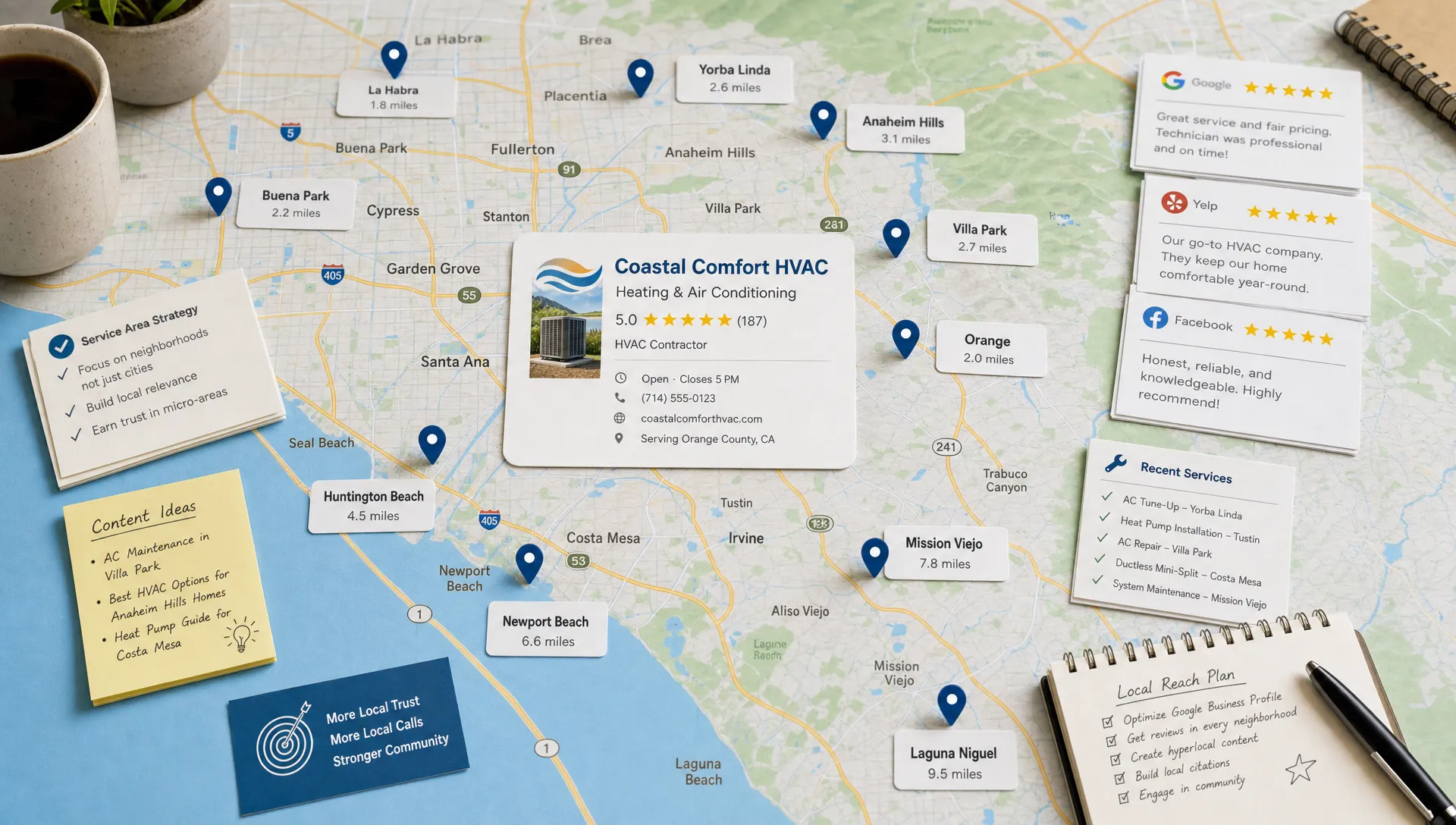
A local website needs clear geographic signals. That means your city, county, nearby service areas, and neighborhood references should be easy to find.
For example, an Orange County contractor may serve Laguna Beach, Laguna Niguel, Dana Point, Mission Viejo, Irvine, Newport Beach, and Costa Mesa. A Bay Area contractor may need pages or sections for San Jose, Sunnyvale, Santa Clara, Fremont, and Oakland. A Central California contractor may target Fresno, Bakersfield, Stockton, Modesto, or Sacramento.
The goal is not to stuff city names onto every page. The goal is to show that you actually understand the local market.
3. What problems you solve
Homeowners usually search by problem, not by your internal service category. They may search for “AC not cooling,” “roof leak near chimney,” “panel upgrade electrician,” “tankless water heater installation,” or “bathroom remodel contractor near me.”
Your website should connect your services to these real problems. A strong service page explains symptoms, options, process, timing, and what the customer should do next.
4. Why people trust you
Trust signals should be visible, not hidden. Reviews, testimonials, project photos, awards, certifications, before-and-after examples, and community involvement all help reduce uncertainty.
This is not limited to U.S. contractors. A strong example of trust-focused local presentation can be seen on this local contractor website, which highlights service area, customer satisfaction, company background, and proof elements in a way that helps visitors quickly understand why the business is credible.
5. How to take the next step
Once a customer feels ready, your site should make action obvious. Phone numbers, quote forms, scheduling links, emergency contact options, and service-area confirmation should be easy to access on mobile.
A contractor website that builds trust should not make visitors hunt for a phone number.
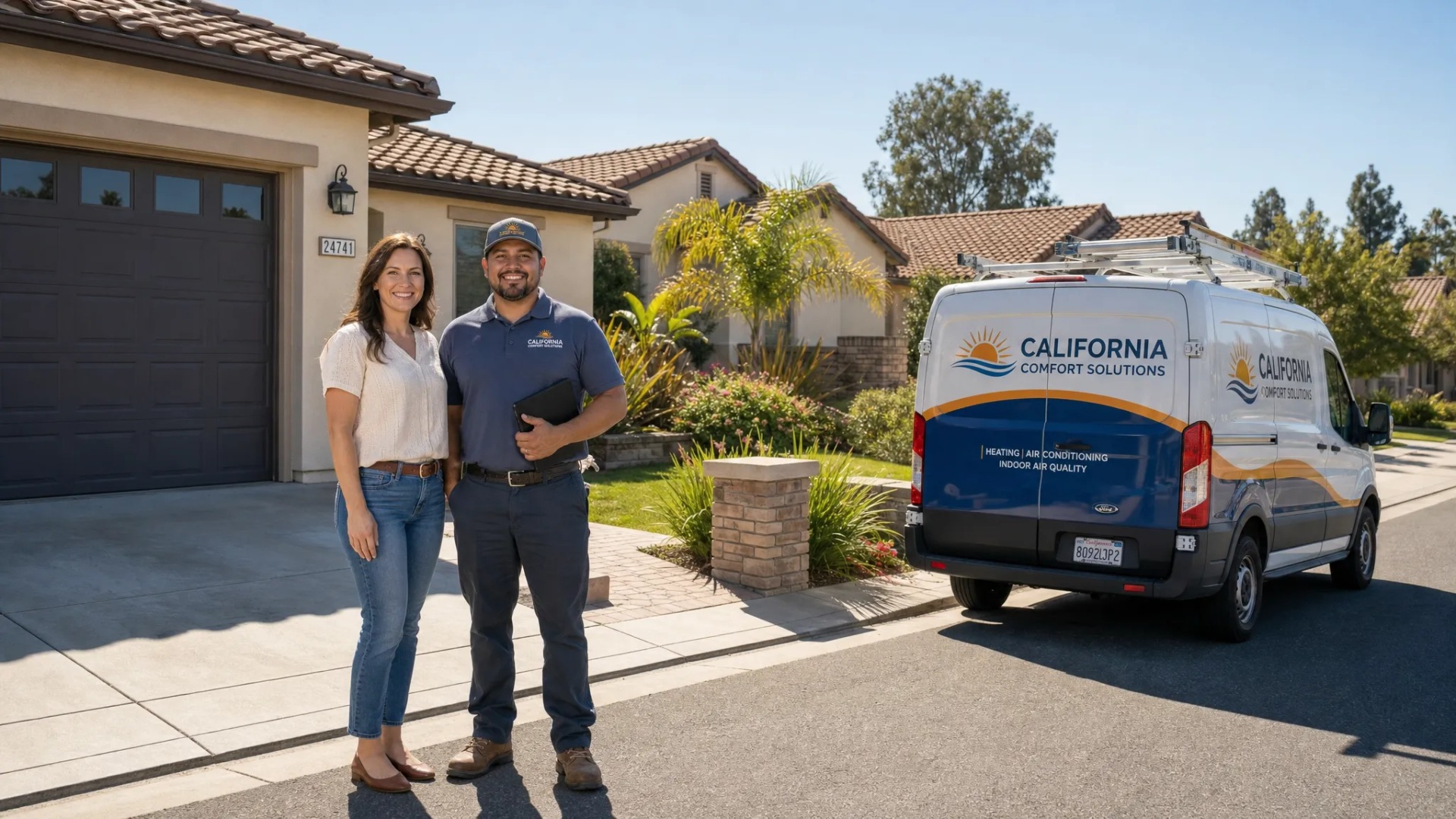
Trust-building elements every contractor website should include
A local website does not need to be complicated. It needs to be clear, credible, and useful. The table below shows the difference between trust-building website elements and the common issues that create hesitation.
| Website element | Builds trust when it includes | Creates doubt when it shows |
|---|---|---|
| Homepage | Clear service area, primary services, proof, phone number, and next step | Generic claims, stock photos, and no local identity |
| Service pages | Specific problems solved, process, FAQs, and realistic expectations | Thin copy that repeats the same sales pitch |
| Location pages | Unique local details, nearby jobs, city-specific concerns, and local calls to action | Duplicate city pages with only the city name changed |
| Reviews | Recent testimonials, review snippets, and links to reputation assets | No reviews, outdated reviews, or only vague praise |
| Project proof | Real photos, before-and-after examples, and descriptions of work completed | No photos or images that look unrelated to your trade |
| Contact options | Click-to-call, short forms, hours, service area, and response expectations | Hidden phone number, long forms, or unclear next step |
| Technical performance | Fast mobile loading, secure browsing, readable layout, and clear navigation | Slow pages, broken links, popups, and poor mobile design |
The key is alignment. Your website should match the way customers evaluate risk. If they worry about reliability, show proof of reliability. If they worry about price surprises, explain your estimate process. If they worry about whether you serve their neighborhood, make your service area unmistakable.
Your website also helps Google, maps, and AI understand your business
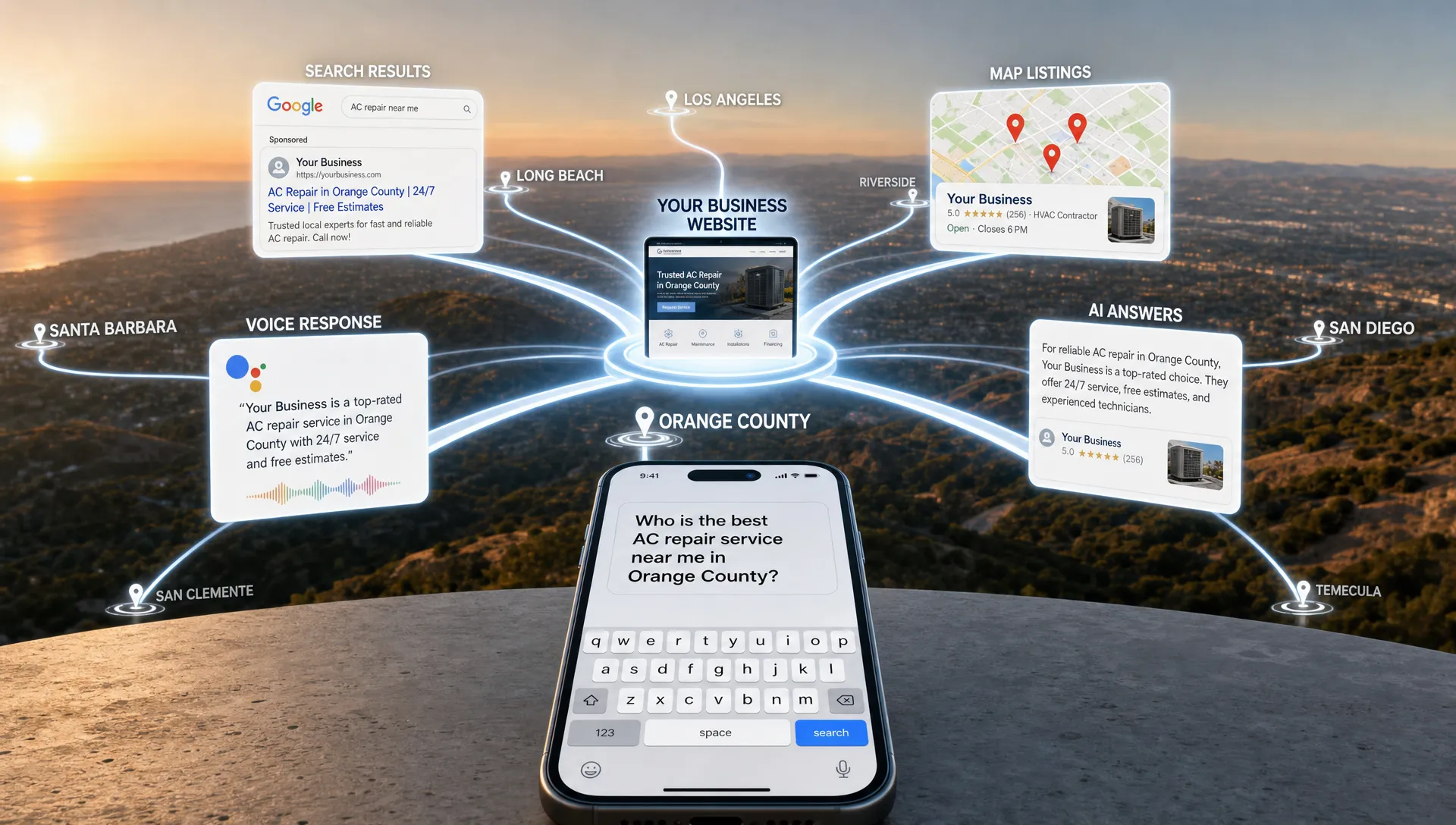
Today, a contractor’s local website is not only written for human visitors. It also helps search engines, map platforms, and AI answer engines understand who you are, what you do, and where you are relevant.
That matters because search is becoming more answer-driven. Customers increasingly ask conversational questions such as:
- “Who is the best HVAC contractor near Laguna Beach?”
- “What roofing company handles tile roof leaks in Irvine?”
- “Which plumber offers emergency service in Anaheim?”
- “Who installs EV chargers in San Jose?”
If your website does not clearly communicate your entity, services, locations, expertise, and proof, AI systems may struggle to select you as a reliable answer. A strong local website gives those systems structured, consistent information to interpret.
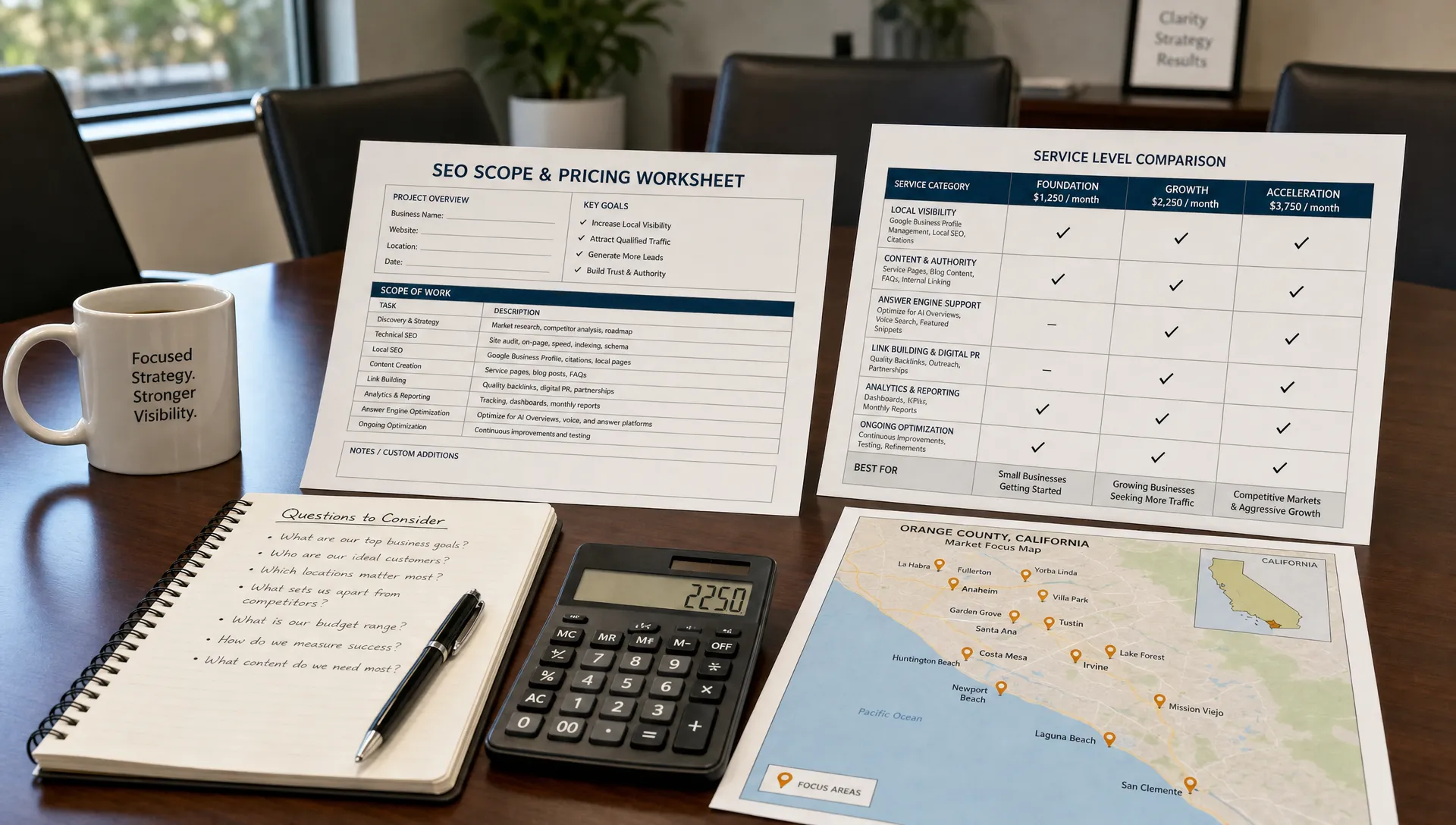
This is where traditional local SEO and newer Answer Engine Optimization work together. Kell Web Solutions helps California businesses improve visibility through Local SEO Mastery and Answer Engine Optimization, aligning websites, content, reviews, and local authority signals so businesses are easier for both people and machines to trust.
Local does not mean small, it means relevant
Some contractors assume a local website limits growth. In reality, local relevance is often what enables expansion.
A contractor serving one city needs a site that proves they are a reliable nearby choice. A contractor serving multiple cities needs a structure that separates each service area in a useful way. A multi-location contractor or professional practice needs location pages that reflect real differences between markets.
For example, the way you present service in Newport Beach may differ from Santa Ana, Irvine, Anaheim, or Huntington Beach. Homeowners in coastal communities may care about salt air, luxury finishes, and fast response. Inland customers may care more about heat, energy efficiency, or affordability. Northern California markets like San Jose and Sunnyvale may require different messaging than Orange County or San Diego.
A trustworthy local website reflects those differences without becoming repetitive.
The ideal contractor website structure
Most contractors do not need a massive website to build trust. They need the right structure. A strong foundation usually includes the following pages.
| Page type | Purpose |
|---|---|
| Homepage | Establishes who you are, where you work, what you do, and why customers trust you |
| Core service pages | Explains each major service in detail and matches high-intent search behavior |
| Service area pages | Shows relevance for important cities, neighborhoods, or local markets |
| About page | Humanizes the company and explains experience, leadership, and values |
| Reviews or testimonials page | Centralizes customer proof and reinforces reputation |
| Project gallery or case studies | Shows real work and helps customers visualize outcomes |
| FAQ page | Answers buying questions and supports search and AI visibility |
| Contact page | Makes calling, booking, or requesting an estimate simple |
For larger contractors, this structure can expand into a hyperlocal authority strategy. That may include supporting content, neighborhood-focused assets, and distributed local signals. Kell Web Solutions’ Hyperlocal Authority Builder was designed for businesses that need to strengthen their footprint across specific California cities and neighborhoods.
What makes a contractor website feel trustworthy?
Trust is not created by one design element. It is created by the combined effect of clarity, proof, and consistency.
A homeowner should land on your site and quickly feel, “This company works in my area, understands my problem, has helped people like me, and makes it easy to contact them.”
That feeling comes from practical details:
- Real local photos instead of only stock imagery
- Clear descriptions of your process
- Consistent name, address, and phone information
- Reviews that mention specific services or cities
- Fast mobile experience for urgent searches
- Prominent click-to-call buttons
- Helpful answers to common concerns
- Visible credentials where applicable
The best contractor websites are not just pretty. They reduce friction. They answer objections before a sales call. They help visitors feel that calling you is a safe decision.
Common website mistakes that cost contractors calls
Many contractors already have a website, but it may not be doing the job it should. The most common issues are usually not dramatic. They are small trust leaks that add up.
One common mistake is using the same generic copy as every competitor. If your homepage could apply to any HVAC, roofing, plumbing, or electrical company in any city, it is not building local confidence.
Another mistake is hiding proof. Contractors often have strong reviews, long-term customers, and excellent project photos, but those assets are not visible on the pages where decisions happen.
A third mistake is treating mobile experience as secondary. Many home service searches happen from a phone, often during a problem. If your site loads slowly, has tiny buttons, or makes the phone number difficult to tap, you are losing high-intent leads.
Finally, many contractors create weak location pages. A page titled “Plumber in Irvine” needs more than a swapped city name. It should explain what you do in Irvine, what types of properties you serve, what local issues are common, and why residents should trust you.
A 30-day plan to improve your local website
You do not need to rebuild everything at once. Contractors can make meaningful trust improvements in 30 days by focusing on the pages and proof that influence calls.
| Timeline | Priority | Action |
|---|---|---|
| Week 1 | Trust audit | Review your homepage, service pages, mobile layout, phone visibility, and local proof |
| Week 2 | Core page improvements | Rewrite key service sections to answer real customer questions and clarify service areas |
| Week 3 | Proof upgrades | Add reviews, project photos, credentials, team details, and city-specific examples |
| Week 4 | Conversion and search alignment | Improve calls to action, contact forms, internal links, FAQ content, and local schema planning |
This type of focused improvement can make your website more useful for customers, more understandable for search engines, and more aligned with AI-driven discovery.
When your website and lead system work together
A trustworthy local website is a major asset, but it works best when connected to a complete lead process. If your website generates calls that go unanswered, forms that are not followed up, or prospects who are not qualified, revenue still leaks out.
That is why contractors should think beyond traffic. The real goal is not “more visitors.” The real goal is more qualified calls, more booked estimates, and more profitable jobs.
For businesses that need help filling the calendar with qualified conversations, Kell Web Solutions also offers Profit Accelerator, a managed AI outreach system designed to create pre-warmed conversations without manual prospecting. Paired with a strong local website, the result is a more complete growth engine.
Frequently Asked Questions
Does a contractor still need a website if most calls come from Google Business Profile? Yes. Google Business Profile can create visibility, but your website often validates the decision. Customers commonly check your website before calling, especially for higher-value or higher-risk jobs.
What should be on a contractor’s homepage? Your homepage should clearly show your services, service area, phone number, trust signals, reviews, project proof, and a simple path to request service or an estimate.
How many city pages should a contractor website have? Focus on the cities that matter most to your revenue and where you can provide useful, unique local content. A few strong location pages are better than dozens of thin, duplicate pages.
Can a small contractor compete with large lead generation platforms? Yes, but not by copying them. Small contractors can win by showing real local expertise, strong reviews, fast response, neighborhood relevance, and a more personal customer experience.
How often should a contractor update a local website? Review key pages at least quarterly. Add new reviews, project photos, FAQs, service updates, and location-specific content as your business grows.
Build a local website customers can trust
If your website does not clearly prove who you are, where you work, and why customers should choose you, it is probably costing you calls.
Kell Web Solutions helps contractors and professional practices across Orange County and California build stronger local visibility, clearer trust signals, and more AI-ready digital authority. Whether you need local SEO, Answer Engine Optimization, hyperlocal authority assets, or a better conversion path, the first step is understanding where trust is breaking down.
If you serve homeowners in Laguna Beach, Laguna Niguel, Irvine, Anaheim, Los Angeles, San Diego, San Jose, Sacramento, Fresno, or anywhere across California, make your website the place where confidence turns into action.