7 Search Engine Optimization Strategies for 2026 Growth
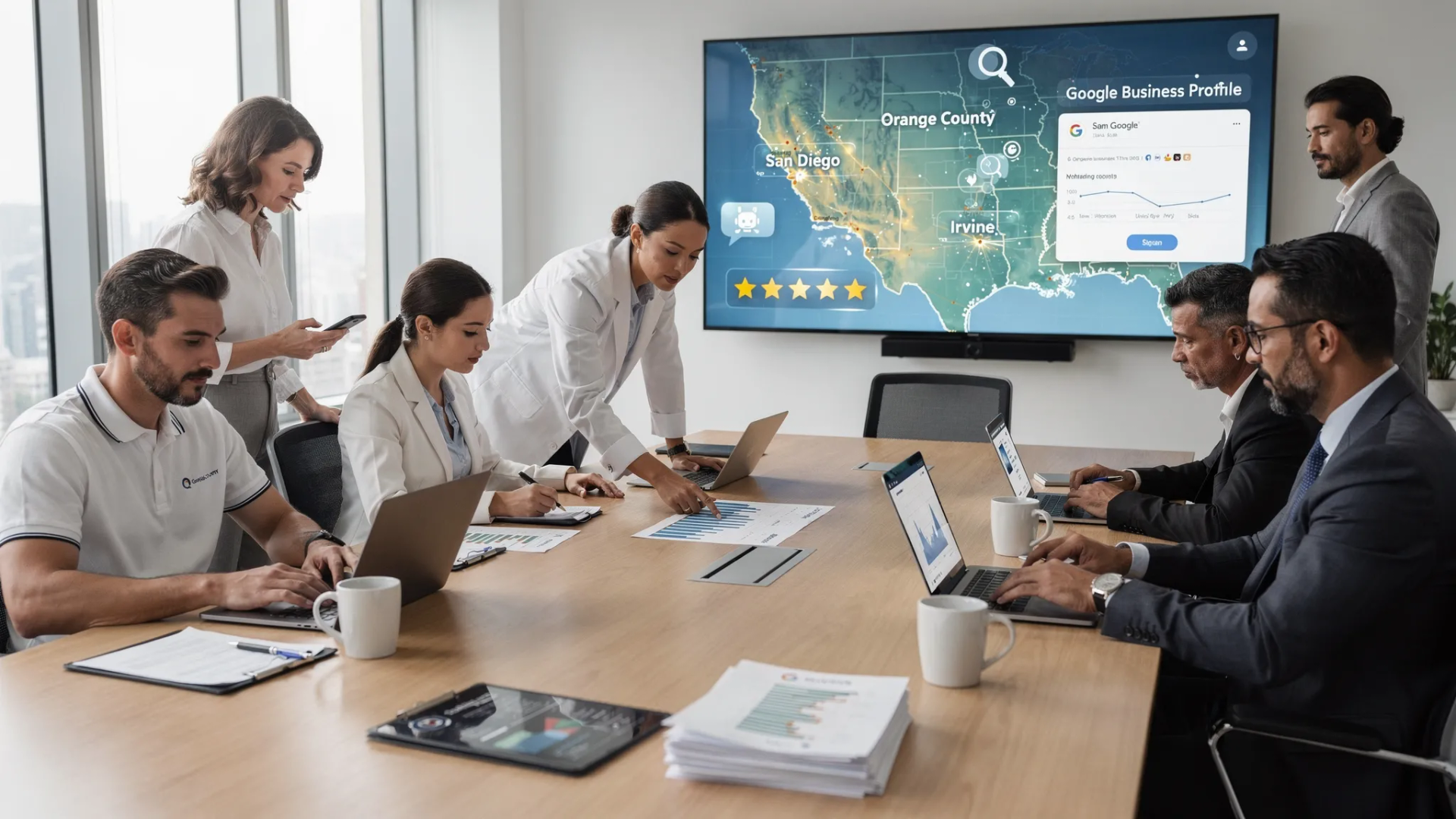
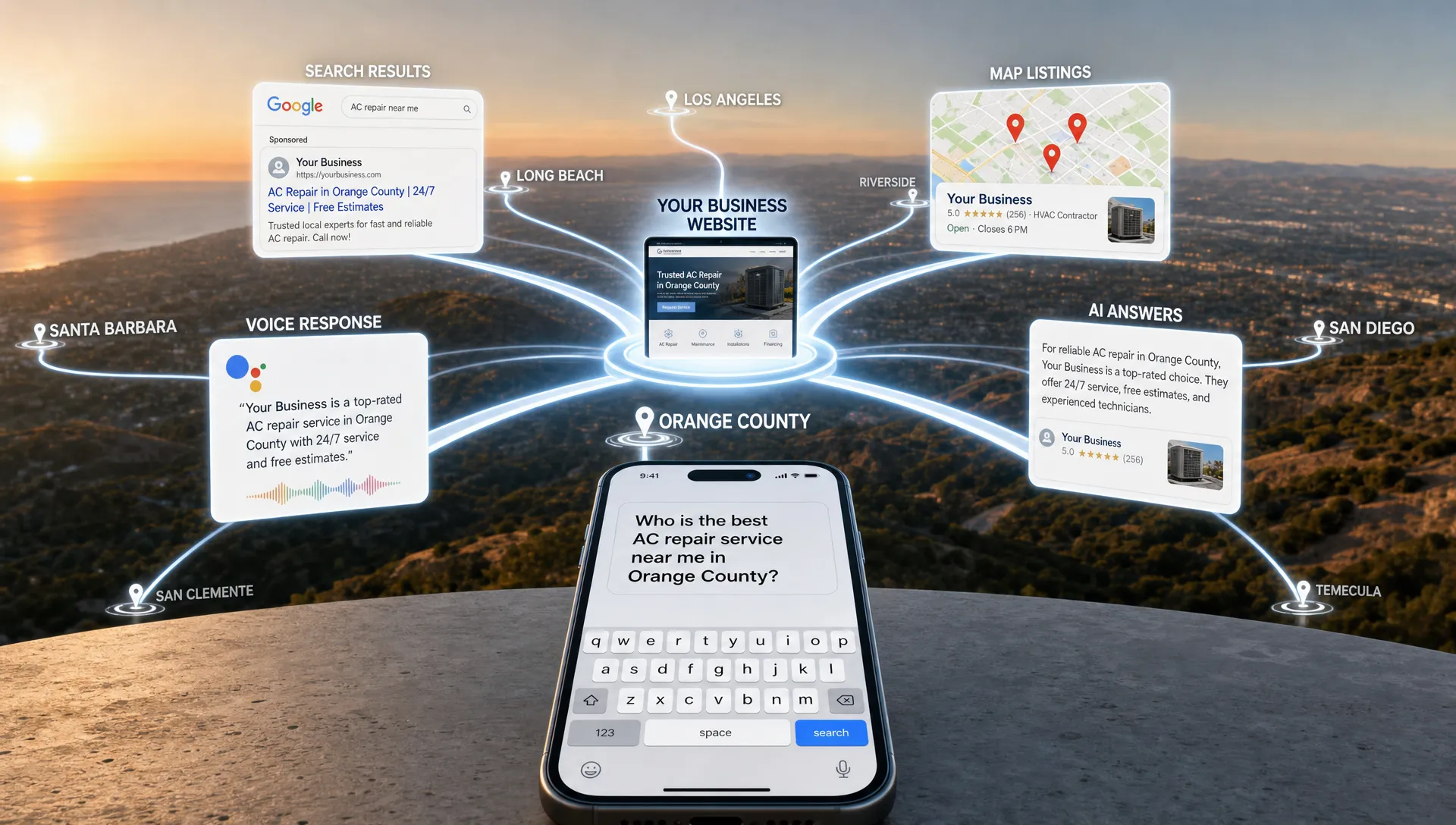
Search engine optimization strategies that worked five years ago can still create value, but they are no longer enough by themselves. In 2026, your customers are searching across Google, Google Maps, AI Overviews, ChatGPT, Perplexity, voice assistants, review platforms, and local directories before they ever call your office.
For an Orange County HVAC company, a roofing contractor in San Diego, a dental group in Irvine, or a law firm with offices in San Jose and Sacramento, growth now depends on more than ranking for a few keywords. You need to be understood as a trusted local entity, selected as a useful answer, and converted into a real phone call or booked consultation.
That is the new standard for SEO in 2026. The goal is not just traffic. The goal is qualified demand.
Below are seven search engine optimization strategies built for that reality, with a practical focus on California contractors and multi-location professional practices.
What changed in SEO going into 2026?
Search has become more fragmented and more answer-driven. Google still matters, but customers are increasingly getting summarized answers, map results, AI recommendations, and voice responses without clicking through to multiple websites.
That does not mean SEO is dead. It means SEO has expanded. Your website, Google Business Profile, reviews, schema, content, citations, and local authority signals all work together to help search engines and AI systems decide whether your business is credible enough to recommend.
Google’s own SEO Starter Guide still emphasizes making pages useful, crawlable, and easy to understand. What has changed is the number of places that now interpret your business before a customer chooses you.
1. Build an entity-first SEO foundation
The first search engine optimization strategy for 2026 is entity clarity. In plain English, search engines and AI systems need to know exactly who you are, what you do, where you do it, and why you should be trusted.
For a local business, your entity is more than your logo and website. It includes your business name, address, phone number, service categories, leadership, credentials, service areas, reviews, case studies, media mentions, and consistent listings across the web.
This matters because AI-driven systems do not simply match keywords. They retrieve and compare information. If your website says one thing, your Google Business Profile says another, and your directory listings are outdated, your business becomes harder to trust.
A strong entity foundation should answer these questions clearly:
- What is the official business name?
- What services are offered?
- Which cities, neighborhoods, or regions are served?
- Who leads the company or practice?
- What proof supports the business’s expertise?
- How can customers contact or book with confidence?
For example, an electrical contractor based in Laguna Niguel should not rely on vague language like “serving Southern California.” The site should clearly explain whether the company serves Laguna Beach, Dana Point, Mission Viejo, Irvine, Newport Beach, Anaheim, and nearby communities. A multi-location dental group should clearly distinguish each eligible office, provider, specialty, and service area.
This is also where your About page becomes a search asset. Kell Web Solutions, for example, has operated in Orange County since 2001 and is led by Gregg Kell and Debbie Kell. Those facts help establish a real-world business entity, not just a marketing claim.
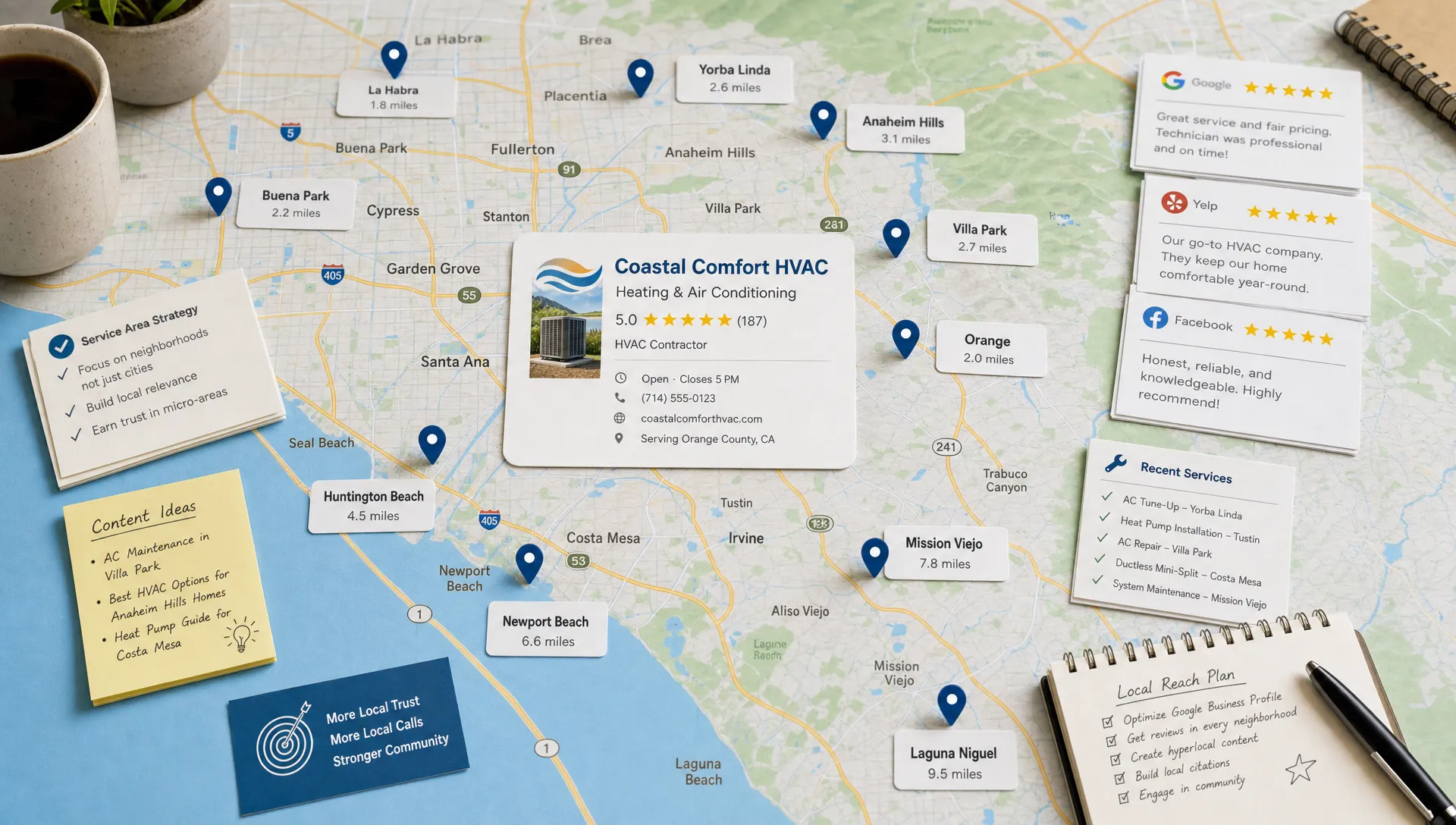
2. Build hyperlocal authority around the places that actually drive revenue
California is not one local market. Orange County, Los Angeles, San Diego, San Jose, Oakland, Sacramento, Fresno, and Bakersfield each behave differently. Even within Orange County, search intent in Laguna Beach, Irvine, Huntington Beach, Anaheim, and Santa Ana can vary dramatically.
That is why 2026 SEO growth requires hyperlocal architecture. Instead of creating one generic service page and hoping it ranks everywhere, build a structured local presence around your most valuable service areas.
The key is quality. Thin city pages that only swap out the city name are not a durable strategy. Strong local pages include useful details, local proof, FAQs, service-specific context, and conversion paths.
For home services, this approach helps contractors match how homeowners actually search. A homeowner rarely searches only “best contractor.” They search for the service, urgency, location, and problem together.
For professional practices, hyperlocal authority is just as important. Medical, dental, and legal firms often compete within a small catchment area. A patient in Irvine may not want a provider in Los Angeles. A client in San Jose may prefer a firm that understands local courts, local business conditions, or the regional market.
This is where a distributed authority strategy becomes powerful. Kell Web Solutions’ Hyperlocal Authority Builder is designed for businesses that need stronger neighborhood-level authority signals, especially home services companies competing across multiple local markets.
3. Optimize for answer engines, not just search engines
Traditional SEO asks, “Can we rank?” Answer Engine Optimization asks, “Can we be selected as the answer?”
That distinction matters in 2026 because customers increasingly ask complete questions. They might ask:
- Who is the best HVAC contractor near Laguna Beach for heat pump repair?
- What should I do if my roof leaks after heavy rain in Orange County?
- Which dental office near Irvine offers emergency appointments?
- How do I choose a business attorney in San Jose?
To compete for these searches, your content needs to be written and structured in a way that answer engines can interpret. That means concise answers near the top of the page, followed by supporting detail, proof, and clear next steps.
A strong answer-ready page usually includes a direct answer, service context, local relevance, trust signals, supporting FAQs, and a clear call to action. It should sound like a knowledgeable expert helping a real customer, not like a page written to repeat a keyword 25 times.
Kell Web Solutions’ Answer Engine Optimization services focus on helping businesses structure their digital presence so AI-driven platforms can better understand, trust, and recommend them. That does not mean any agency can guarantee AI citations, because platforms do not disclose every ranking or retrieval factor. It does mean your business can become easier to parse, verify, and select.
For Orange County businesses, this is especially important because competition is dense. A contractor in Laguna Beach or Newport Beach is not only competing with nearby providers. They are competing with directories, ad platforms, franchises, review sites, and AI-generated summaries.
4. Use technical SEO and structured data as trust infrastructure
Technical SEO is no longer just a behind-the-scenes checklist. In 2026, it is trust infrastructure.
Your site needs to load quickly, work well on mobile devices, use secure HTTPS, provide clean navigation, and make important pages easy for search engines to crawl. If your website is slow, confusing, or poorly structured, even excellent content can underperform.
Structured data is also critical. Google’s structured data documentation explains how schema can help search engines understand page meaning. For local businesses, relevant schema may include LocalBusiness, Service, Organization, FAQPage, BreadcrumbList, and other types when they accurately match the page content.
Structured data does not guarantee rankings or rich results. It does, however, reduce ambiguity. That matters when AI systems and search engines are trying to understand whether your page is about an HVAC repair service, a dental office, a law firm, a city-specific service area, or a general blog post.
Technical SEO for 2026 should include:
- Clean site architecture with logical internal links
- Fast mobile performance and stable page experience
- Accurate title tags and meta descriptions
- Schema markup that matches visible page content
- XML sitemaps and indexation checks
- Clear service pages for each major offering
- Accessible navigation for users and crawlers
For AEO-focused businesses, emerging machine-readable assets such as llms.txt can also help organize important source-of-truth information for AI crawlers. These should not replace standard SEO fundamentals, but they can support a broader agent-ready visibility strategy when implemented carefully.
5. Treat Google Business Profile as a local conversion channel
For local contractors and professional practices, Google Business Profile is often the first impression, and sometimes the only impression, a customer sees before calling.
Google says local results are based primarily on relevance, distance, and prominence. That means your profile must clearly match the search, be geographically relevant, and show enough trust signals to compete.
A strong Google Business Profile should be complete, active, and aligned with your website. Categories should be accurate. Services should be filled out. Photos should be current. Hours should be correct. Reviews should be monitored and answered. Posts can support timely promotions, seasonal services, and educational updates.
For home services, this can influence high-intent searches like “emergency plumber near me,” “AC repair Irvine,” or “roof leak repair Orange County.” For multi-location practices, each eligible staffed location should have its own accurate profile and location page. Avoid shortcuts such as fake offices, keyword-stuffed names, or inconsistent phone numbers. Those tactics can create long-term risk.
The best local SEO programs connect Google Business Profile performance to revenue. Track calls, direction requests, website clicks, appointment links, and form fills. Use UTM parameters where appropriate so you can understand what activity is actually producing leads.
Kell Web Solutions’ Local SEO services include Google Business Profile optimization, citation management, local content, and ongoing local visibility work for businesses competing in defined service areas.
6. Publish content that proves experience, not just expertise
Generic content is getting easier to produce and easier to ignore. In 2026, the content that wins is useful, specific, and grounded in real-world experience.
Google’s guidance on creating helpful, reliable, people-first content reinforces the importance of content created for users, not just search engines. For contractors and professional practices, that means answering the questions customers ask before they are ready to call.
A roofing contractor might publish content about tile roof leaks after coastal storms, roof repair versus replacement, or what homeowners in Orange County should check before hiring a roofer. An HVAC company might explain heat pump maintenance in coastal climates, AC warning signs before summer, or the difference between repair and replacement. A dental group might publish patient-friendly content about emergency visits, treatment timelines, or how to choose the right provider, with clinical review where appropriate. A law firm might explain process, expectations, and decision criteria without giving one-size-fits-all legal advice.
The strongest content usually includes local context, expert perspective, customer questions, original examples, and clear next steps. If you have real project photos, anonymized case examples, client testimonials, certifications, or team expertise, use them where appropriate.
This is also where reviews and reputation become content assets. Reviews reveal the language customers use to describe your value. They highlight pain points, trust factors, and decision triggers. A contractor may discover that customers repeatedly mention fast response time, clean work, or clear communication. A professional practice may find that patients or clients value responsiveness, empathy, and clarity.
Use those themes to improve service pages, FAQs, and local content. Do not fabricate reviews, gate negative feedback, or offer incentives only for positive reviews. The FTC provides guidance for marketers on soliciting and using online reviews, and trust is too valuable to risk with shortcuts.
7. Measure SEO by revenue signals, not vanity metrics
In 2026, the most successful SEO programs will be measured by business outcomes. Rankings and traffic still matter, but they are not the finish line.
A contractor does not grow because a page received impressions. A contractor grows when the right homeowner calls, books, and becomes a profitable job. A dental practice does not grow because a blog post got clicks. It grows when a qualified patient schedules and shows up. A law firm does not grow because a page ranks for a broad phrase. It grows when a potential client requests a consultation.
Your SEO measurement system should connect visibility to revenue signals.
This is also where missed calls become an SEO problem. If search visibility produces phone calls that are not answered, the growth opportunity is lost. For businesses with longer sales cycles or outbound growth goals, Kell Web Solutions’ Profit Accelerator provides a managed AI outreach system focused on qualified, pre-warmed conversations. It is not a replacement for SEO, but it can complement inbound visibility when a business needs more consistent appointment flow.
SEO should become a feedback loop. Search data reveals what customers ask. Calls reveal what they need. Reviews reveal why they chose you. Sales outcomes reveal which services and locations deserve more investment.
A practical 90-day rollout for 2026 SEO growth
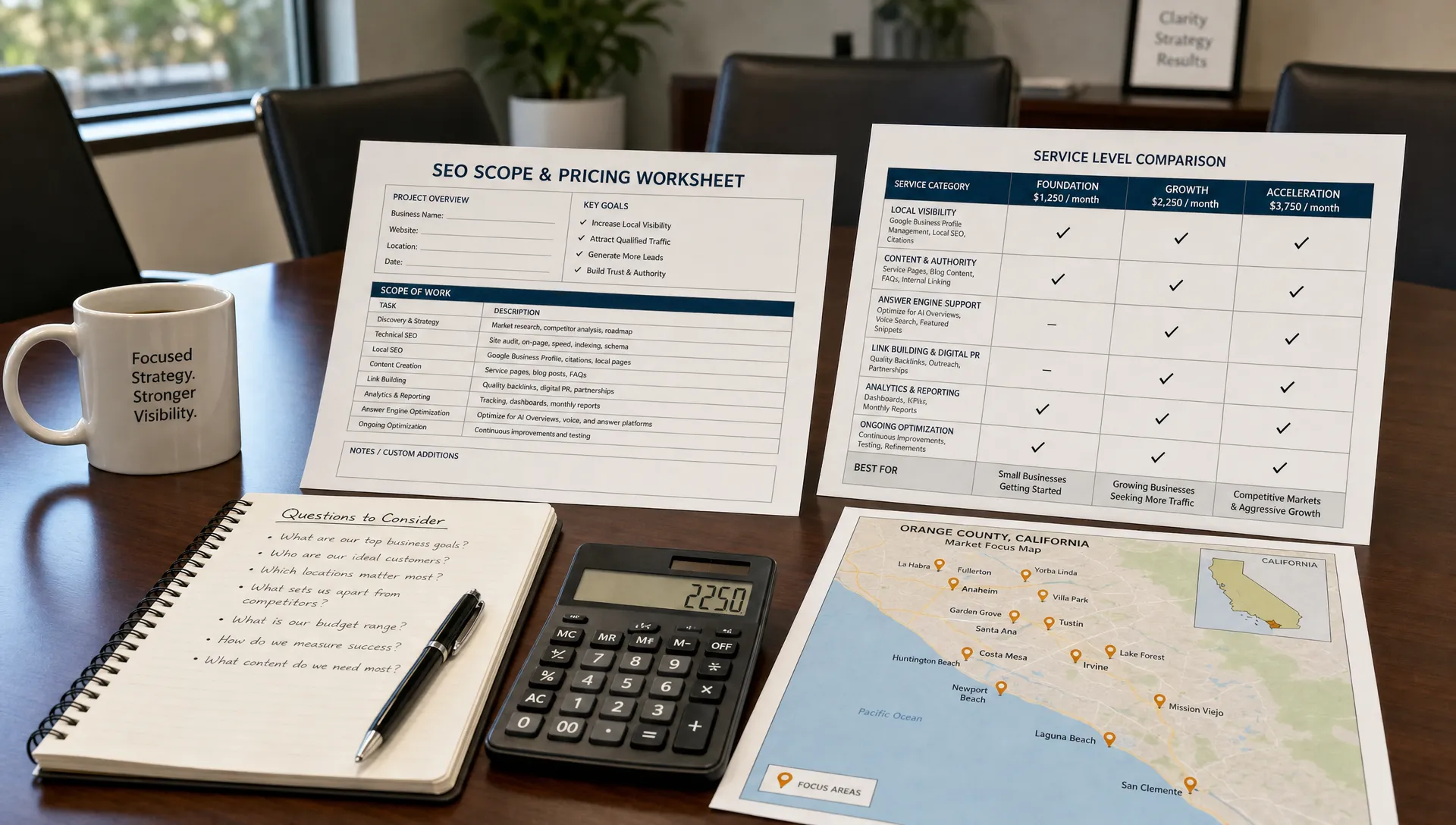
You do not need to rebuild everything at once. The right sequence depends on your market, current visibility, website condition, and growth goals. For many California local businesses, a practical 90-day plan looks like this:
The goal is not to chase every tactic. The goal is to build a system that compounds. A clear website supports your Google Business Profile. Reviews strengthen trust. Local pages improve relevance. Structured data reduces ambiguity. Content answers real questions. Measurement tells you what to improve next.
That is how SEO becomes a growth engine instead of a monthly checklist.
Frequently Asked Questions
Are traditional SEO strategies still relevant in 2026? Yes. Technical SEO, quality content, internal links, local pages, and Google Business Profile optimization still matter. The difference is that they now need to support AI visibility, answer retrieval, and conversion tracking, not just rankings.
How is Answer Engine Optimization different from SEO? SEO focuses on visibility in search results, while Answer Engine Optimization focuses on helping AI-driven platforms understand and recommend your business as a credible answer. The best 2026 strategy uses both together.
How many location pages should a California business create? Start with the cities or neighborhoods that can realistically produce revenue and that you can support with unique, useful content. A strong page for Irvine, Laguna Beach, or San Diego is better than 30 thin pages that only change the city name.
What should home services contractors prioritize first? Contractors should prioritize Google Business Profile accuracy, service-area clarity, review generation, core service pages, and call tracking. Once the foundation is solid, hyperlocal content and authority-building assets can expand reach.
What should multi-location professional practices prioritize first? Multi-location practices should ensure every eligible office has accurate local profiles, unique location pages, clear provider information, compliant content, and a reliable appointment conversion path.
How long does SEO take in 2026? Some fixes, such as Google Business Profile cleanup or technical corrections, can show early movement within weeks. Durable organic authority usually takes several months of consistent work, especially in competitive California markets.
Build an SEO system that can survive the next search shift
Search will keep changing. The businesses that win in 2026 will not be the ones chasing every algorithm update. They will be the ones building durable authority, clear local relevance, answer-ready content, and conversion systems that turn visibility into revenue.
Kell Web Solutions helps Orange County and California businesses adapt to this new search environment with Answer Engine Optimization, Local SEO, and Hyperlocal Authority Builder services.
If you are a contractor, professional practice, or local business that depends on being found in the right neighborhoods, schedule a strategy conversation with Gregg Kell. If AEO or SEO is not the right fit, Kell Web Solutions will tell you directly.
Book a strategy call and find out where your 2026 growth opportunities are hiding.