Why Search Engine Optimization for Business Still Matters
The body content of your post goes here. To edit this text, click on it and delete this default text and start typing your own or paste your own from a different source.

In 2026, many business owners are asking a fair question: if Google shows AI answers, customers use voice search, and ads dominate the top of the page, does SEO still matter?
Yes, but not in the old way.
Search engine optimization for business still matters because customers still turn to search when they need help, compare providers, check trust signals, and decide who to call. What has changed is the job SEO must do. It is no longer just about ranking a page for a keyword. Modern SEO helps search engines, AI systems, maps, voice assistants, and real customers understand who you are, where you operate, what you do best, and why you are trustworthy.
For Orange County contractors, California home services companies, and multi-location professional practices, that shift is critical. If your business is not clearly understood by search systems, you may not appear when a homeowner asks for an emergency plumber in Irvine, a dentist near San Jose, a roofer in Sacramento, or an HVAC repair company in Laguna Niguel.
SEO Is Still the Foundation of Digital Visibility
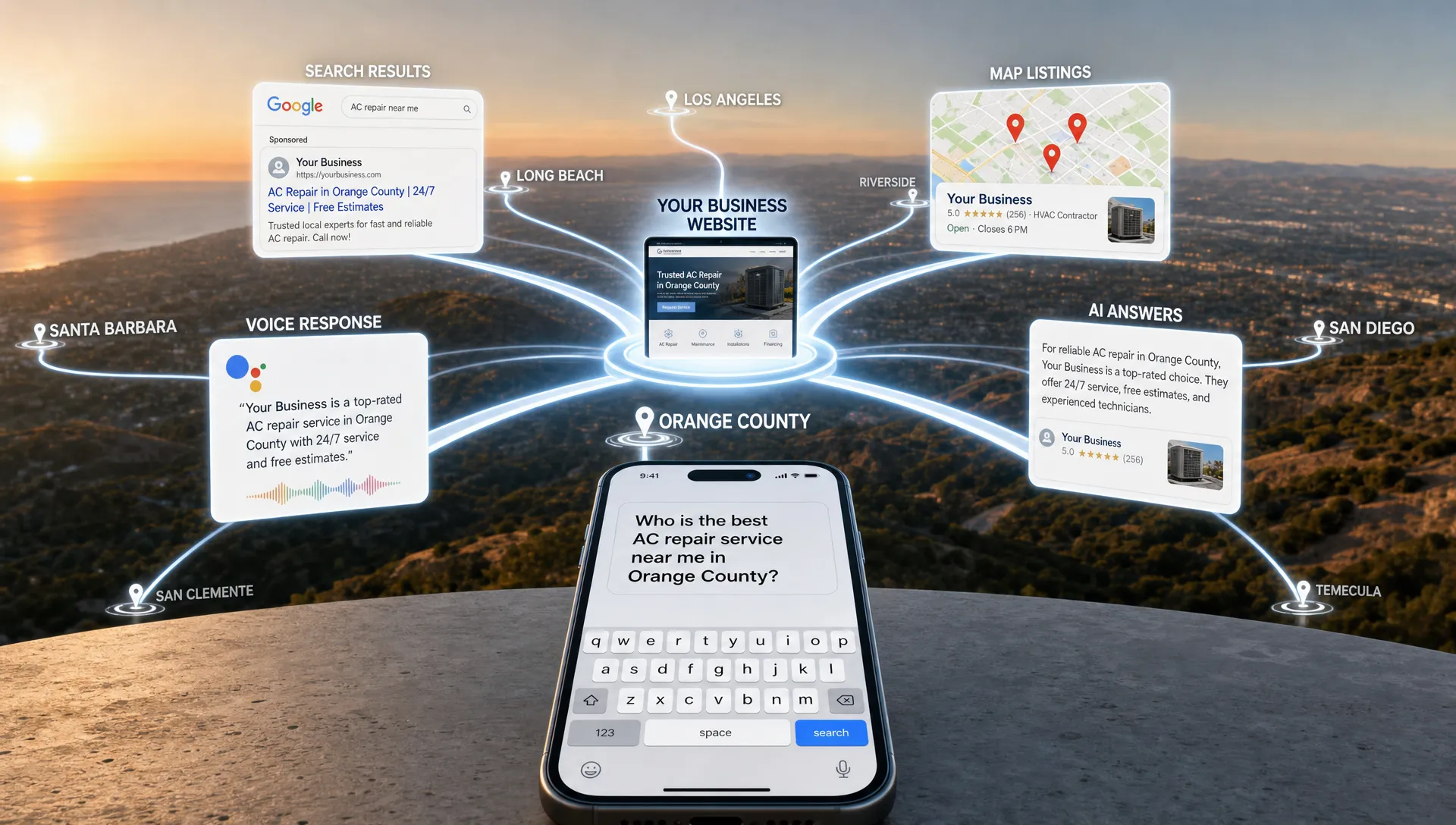
Search has changed, but buyer intent has not disappeared. People still need local services, expert help, and confidence before they contact a provider. The difference is that the journey now happens across more surfaces: Google organic results, Google Maps, AI Overviews, ChatGPT-style answer engines, voice assistants, review platforms, and local directories.
SEO is the system that keeps your business legible across those surfaces.
A strong SEO foundation helps answer essential questions:
| Business question | How SEO helps |
|---|---|
| Who are you? | Clear website structure, business descriptions, service pages, and entity signals help search systems understand your company. |
| Where do you serve? | Location pages, Google Business Profile optimization, citations, and localized content reinforce your service areas. |
| What problems do you solve? | Service-specific content connects your expertise to real customer searches and questions. |
| Why should customers trust you? | Reviews, case examples, credentials, consistent messaging, and local proof build credibility. |
| How can customers contact you? | Conversion-focused pages, call buttons, forms, and appointment paths turn visibility into revenue opportunities. |
Without SEO, your business may still exist online, but it may not be clear enough to be selected, recommended, or trusted.
The Old SEO Playbook Is Not Enough Anymore
Years ago, a business could often get traction by adding keywords to pages, building a few links, and publishing occasional blog posts. That approach is weaker today because search engines are better at evaluating context, quality, location relevance, and reputation.
For local businesses, modern SEO now includes several connected layers:
- Clear service and location architecture on the website
- Accurate Google Business Profile information
- Consistent name, address, and phone data across citations
- Useful content that answers real buyer questions
- Reviews that demonstrate recent customer trust
- Technical performance, including mobile speed and crawlability
- Structured data that helps machines interpret business details
- Local authority signals from neighborhoods, cities, and service areas
This is why search engine optimization for business should be treated as infrastructure, not a one-time marketing task. A website that was optimized three years ago may not be optimized for how buyers and AI systems evaluate businesses today.
Why SEO Matters More for Local and Service-Based Businesses
For e-commerce brands or national publishers, SEO may be one of many traffic channels. For a contractor, medical practice, dental group, law firm, or specialty service provider, local search can be the difference between a full calendar and slow weeks.
Consider a home services contractor in Orange County. The customer may search several different ways before calling:
- “AC repair near me”
- “best HVAC company in Laguna Niguel”
- “emergency plumber Irvine open now”
- “roof leak repair Huntington Beach”
- “solar installer Anaheim reviews”
Each search reflects a different stage of urgency and trust. Some customers are ready to call now. Others want to compare providers, read reviews, understand pricing factors, or confirm that the company serves their neighborhood.
The same applies to multi-location professional practices. A dental group with offices in Irvine, Anaheim, and San Diego cannot rely on one generic service page to compete in every location. Each office needs localized proof, clear services, accurate contact details, and content that reflects the questions patients actually ask.
In dense California markets such as Los Angeles, San Jose, San Francisco, Sacramento, Fresno, and Orange County, your competitors are not just down the street. They are also competing for visibility across maps, AI summaries, directories, review platforms, and paid placements. SEO helps create the durable authority needed to stay visible beyond a single ad campaign.
SEO and AEO Now Work Together
One reason business owners question SEO is the rise of AI-generated answers. If Google or an AI assistant gives the answer directly, will people still click?
Sometimes they will not. That is exactly why SEO still matters, and why it must evolve.
Answer Engine Optimization, or AEO, focuses on making your business eligible to be cited, summarized, and recommended by AI-driven search experiences. But AEO does not replace SEO. It builds on it.
AI systems need reliable sources. They look for consistent business information, clear expertise, credible content, structured data, reviews, and trusted references. If your website is thin, inconsistent, outdated, or hard to interpret, AI platforms have less reason to treat your business as a dependable answer.
At Kell Web Solutions, this is a core part of Answer Engine Optimization: structuring a company’s digital presence so both people and AI-driven platforms can understand and trust it. For California businesses, the goal is not simply to rank. The goal is to become the most credible local answer when customers ask who they should call.
SEO Still Reduces Dependence on Paid Ads
Paid advertising can be valuable, especially when you need immediate lead flow. But relying only on ads creates a fragile growth model. The moment you pause spending, visibility drops. In competitive home services markets, cost per call can also rise quickly as more contractors bid for the same urgent searches.
SEO compounds differently. A well-built service page, local authority asset, review strategy, or helpful guide can continue supporting visibility over time. That does not mean SEO is free or instant. It requires consistent investment, but it builds business equity rather than renting every click.
The strongest businesses usually do not choose between SEO and paid ads. They use paid media for speed and SEO for durable visibility. Over time, better organic presence can improve trust, increase branded searches, raise conversion rates, and reduce the pressure to buy every lead.
Strong SEO Turns Visibility Into Better Calls
Traffic alone is not the goal. A contractor does not need thousands of random visitors. A dental office does not need clicks from people outside its service area. A law firm does not need unqualified inquiries from the wrong practice area.
Business SEO should attract the right visitors and help them take the next step with confidence.
That means your content needs to match buyer questions. For example, a homeowner choosing a roofing contractor may want to know whether repair or replacement makes more sense. A patient comparing dental providers may want to understand insurance, technology, comfort options, and location convenience. A commercial property owner looking for HVAC service may care about response time, maintenance plans, and experience with larger systems.
This is where SEO overlaps with customer experience. High-consideration industries win when they simplify decision-making. The same principle applies outside home services, including financial categories where customers need clarity, transparent options, and expert guidance, such as smart mortgage solutions made simple. The lesson for local businesses is straightforward: SEO performs best when it does more than attract attention. It should reduce confusion and make the next step feel safe.
What Business SEO Should Include in 2026
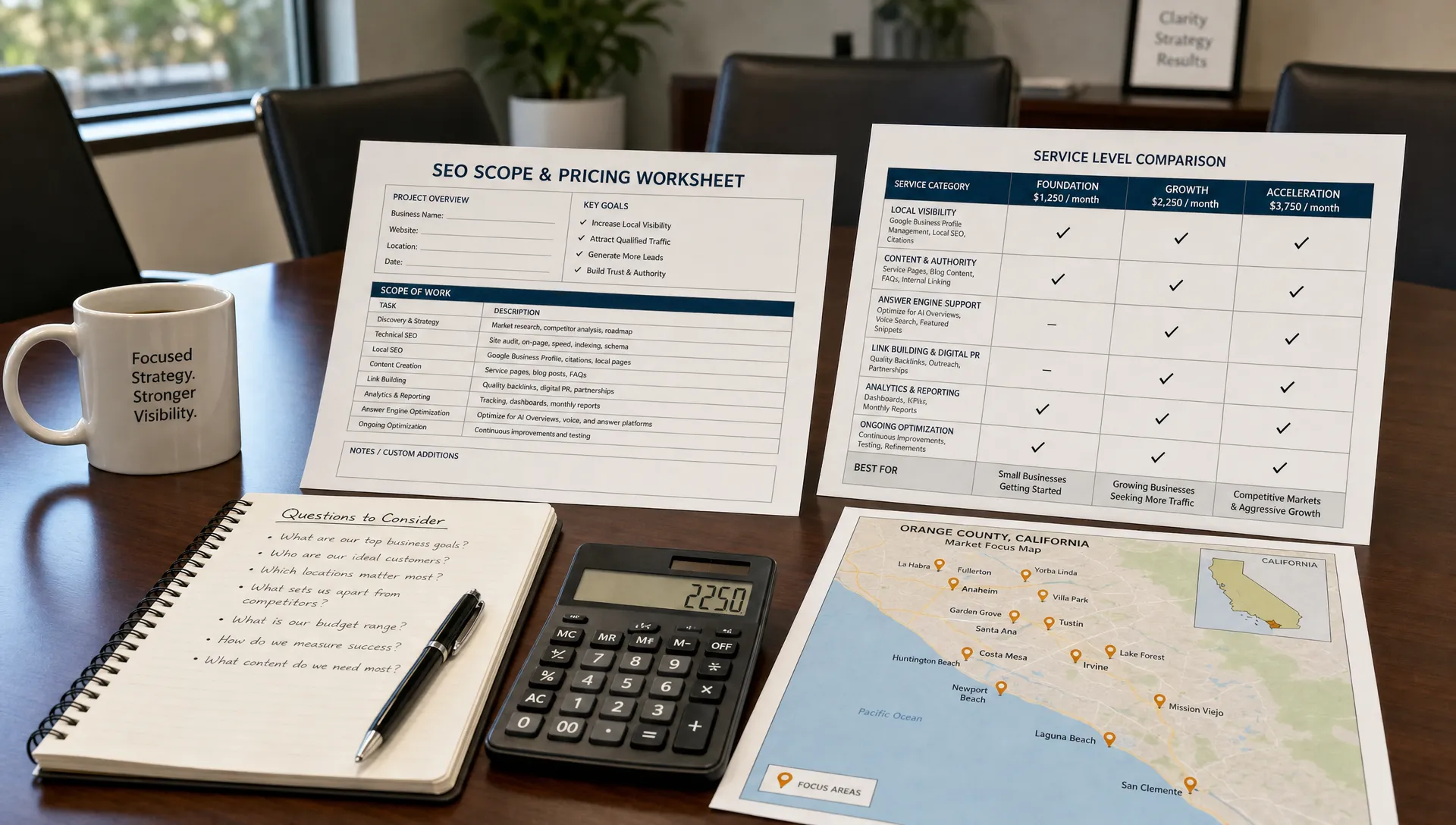
A modern SEO program should connect technical clarity, local relevance, and conversion strategy. For contractors and professional practices, the most important layers are usually practical rather than flashy.
| SEO layer | What it includes | Why it matters |
|---|---|---|
| Technical foundation | Fast pages, mobile usability, clean indexing, secure site structure | Search systems and users need to access your content easily. |
| Local entity signals | Google Business Profile, citations, service areas, consistent NAP data | Reinforces where you operate and helps local search confidence. |
| Service page depth | Dedicated pages for core services, problems solved, FAQs, and proof | Matches specific buyer intent instead of relying on generic content. |
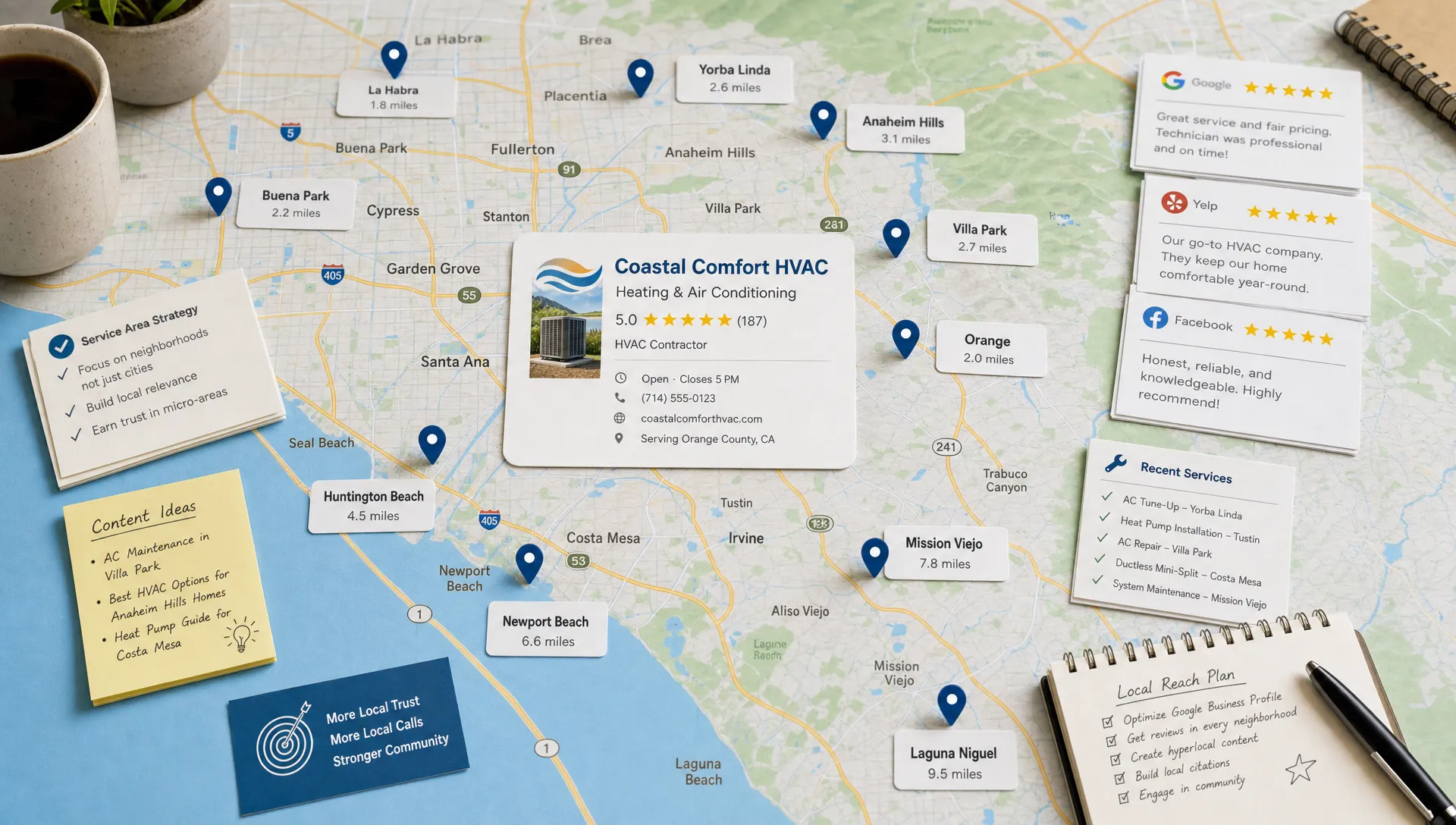
| Hyperlocal relevance | Neighborhood and city-specific content, local examples, area proof | Helps compete in cities like Irvine, Anaheim, San Diego, San Jose, and Sacramento. |
| Reputation signals | Reviews, testimonials, project examples, trust markers | Converts cautious buyers and supports credibility. |
| Answer-ready content | Clear questions, concise answers, structured sections, schema where appropriate | Supports AI, voice, and featured search experiences. |
| Conversion paths | Phone visibility, forms, booking options, call tracking, follow-up process | Turns search demand into booked jobs and appointments. |
If one of these layers is missing, performance can suffer. A beautiful website with weak local signals may not rank. A strong Google Business Profile with thin service pages may struggle to convert. Great content without a clear call path may create interest without revenue.
A Practical 90-Day SEO Reset for California Businesses
If you are unsure whether your current SEO is working, start with a focused reset. The goal is not to rebuild everything at once. The goal is to find the highest-impact gaps that prevent your business from being found, trusted, and contacted.
- Audit how customers find you now: Review organic rankings, Google Business Profile actions, call sources, form submissions, and which cities generate qualified leads.
- Clarify your core service pages: Make sure each major service explains who it is for, where it is offered, common problems, proof points, FAQs, and a clear contact path.
- Strengthen local signals: Update Google Business Profile categories, services, photos, hours, service areas, and citations so your information is consistent everywhere.
- Publish buyer-question content: Build articles and FAQs around real questions customers ask before calling, especially pricing, timing, emergency needs, comparisons, and local service concerns.
- Build neighborhood authority: Use localized content and supporting assets to reinforce relevance in priority cities, which is the strategy behind Kell’s Hyperlocal Authority Builder.
- Measure revenue outcomes: Track qualified calls, booked appointments, close rates, and customer acquisition cost, not just rankings and traffic.
This reset helps separate vanity SEO from business SEO. Ranking reports are useful, but they are not the end goal. The real question is whether your search visibility is creating confident conversations with qualified prospects.
When SEO Should Be Paired With Outreach and Follow-Up
SEO captures demand from people who are already searching. But some businesses also need proactive demand generation, especially if they serve commercial accounts, high-value professional clients, or competitive B2B categories.
In those cases, SEO should work alongside outreach, appointment-setting, and follow-up systems. For example, a local SEO campaign can strengthen trust before a prospect ever receives a message. When that prospect searches your company name, reviews your services, or checks your authority, your SEO presence supports the sales conversation.
That is where a system like Kell’s Profit Accelerator can complement organic visibility. SEO helps you get found and trusted. Proactive outreach helps you start more qualified conversations. Together, they create a more resilient growth engine than either channel alone.
The Bottom Line: SEO Is Not Dead, Weak SEO Is
Search engine optimization for business still matters because customers still need answers, proof, and confidence before they buy. What is fading is shallow SEO: thin pages, keyword stuffing, generic blogs, inconsistent listings, and strategies that ignore how AI and local search now evaluate authority.
The businesses that win in 2026 will treat SEO as a trust-building system. They will make their expertise clear, local presence unmistakable, reviews visible, content useful, and conversion paths simple. They will optimize not only for rankings, but for selection.
For Orange County and California businesses, that distinction matters. A contractor in Laguna Beach, a medical group in Irvine, a dental practice in San Diego, or a law firm expanding into San Jose cannot afford to be invisible when customers ask for the best local option.
SEO still matters because being found still matters. Being understood matters even more.
Frequently Asked Questions
Is search engine optimization for business still worth it in 2026? Yes. SEO is still worth it because customers continue to use search, maps, reviews, and AI-assisted results to choose providers. The strategy must be more local, answer-ready, and conversion-focused than traditional keyword SEO.
How is SEO different from Answer Engine Optimization? SEO helps your website and local presence rank, get indexed, and communicate relevance. AEO focuses on helping AI-driven platforms understand, trust, and recommend your business as an answer. The two work best together.
How long does local SEO take to show results? Timelines vary by competition, website condition, location, and authority. Many businesses can see foundational improvements within 60 to 90 days, while stronger compounding gains often take 6 to 12 months of consistent work.
Do contractors need separate pages for each city they serve? Not always for every city, but priority service areas often deserve dedicated, high-quality local content. A generic page rarely communicates enough relevance for competitive markets like Irvine, Anaheim, Huntington Beach, Los Angeles, or San Diego.
Should I stop paid ads if I invest in SEO? Usually no. Paid ads can create immediate visibility, while SEO builds durable authority. Many businesses use both, then reduce overdependence on paid leads as organic visibility and local trust improve.
What SEO metrics matter most for local businesses? The most important metrics are qualified calls, booked appointments, Google Business Profile actions, local rankings for priority services, conversion rate, review growth, and customer acquisition cost. Traffic is useful, but revenue outcomes matter more.
Ready to Make Your Business the Local Answer?
If your business depends on being found in Orange County or across California, SEO cannot be an afterthought. Kell Web Solutions helps contractors and professional practices build search visibility that supports real calls, qualified appointments, and long-term authority.
Explore Local SEO Mastery, strengthen your AI-era visibility with Answer Engine Optimization, or call Kell Web Solutions at (949) 575-8553 to discuss where your current search presence is helping or holding you back.