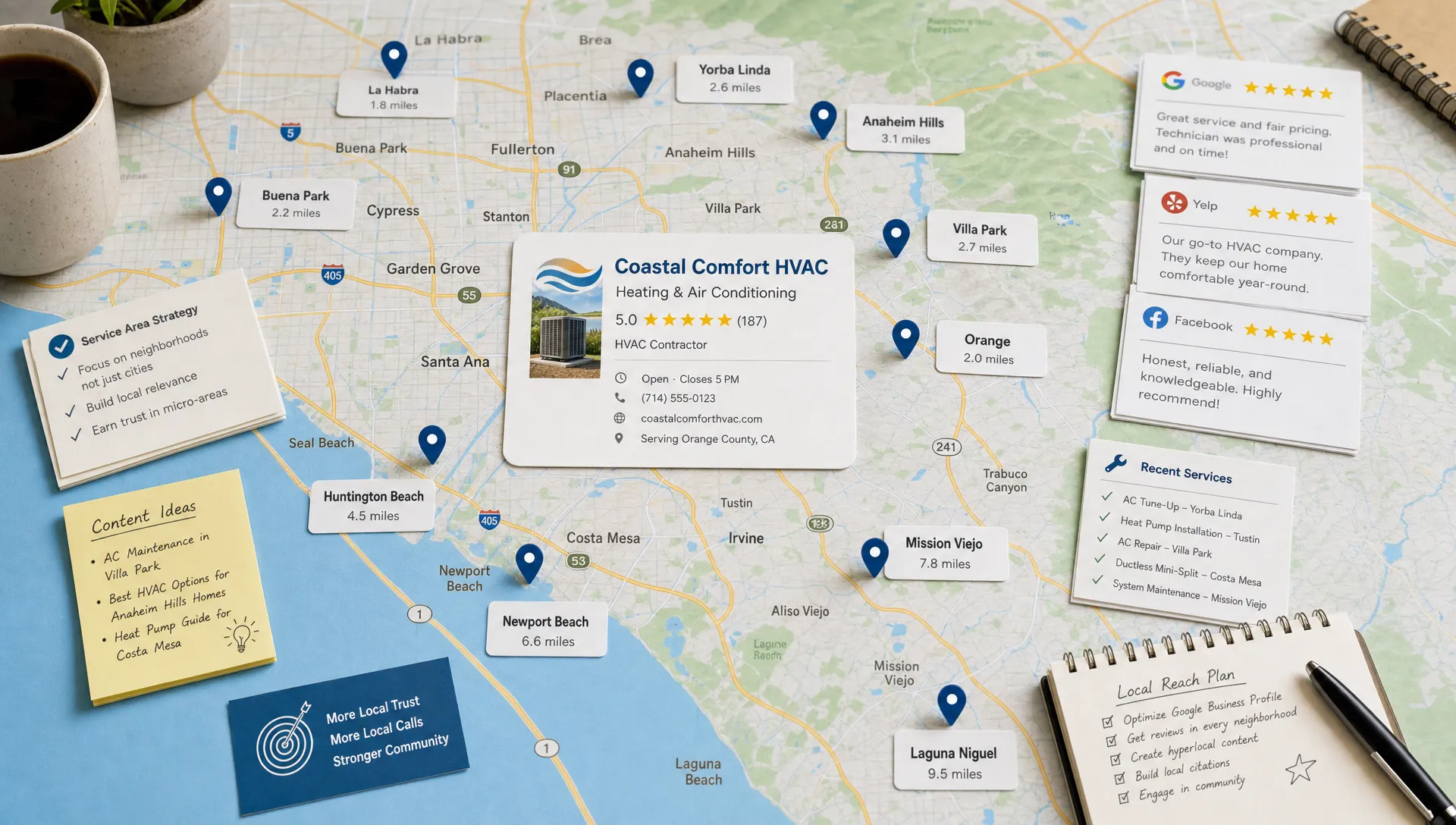
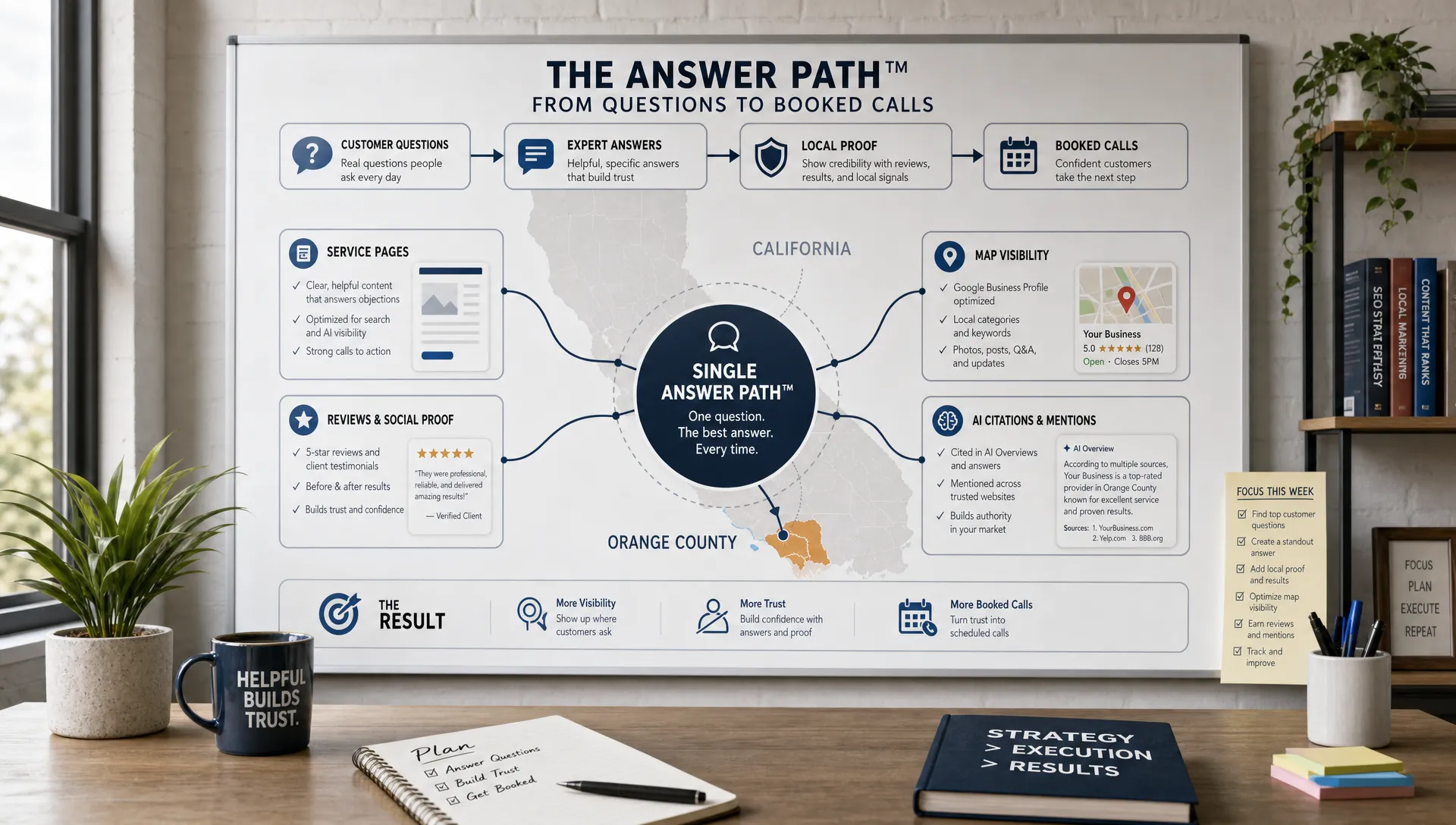
When SEO Consultancy Beats Full-Service Marketing
September 4, 2026


A full-service marketing agency can be useful when you need a team to do everything. But for many local service businesses, especially contractors and multi-location practices in California, the bigger problem is not a lack of activity. It is a lack of strategic direction.


That is where SEO consultancy often beats full-service marketing.


If your business already has a web designer, content writer, admin team, office manager, PPC vendor, or internal marketing coordinator, hiring another full-service agency may create more overlap than progress. A focused SEO consultant can step in, diagnose why visibility is not turning into calls, and give your team the strategy, priorities, and accountability needed to fix the system.


For an HVAC company in Irvine, a roofing contractor in Anaheim, a plumber in Huntington Beach, or a dental group expanding across San Jose and Santa Clara, the question is no longer, “Who can post more content for us?” The better question is, “Who can show us exactly where our search visibility is breaking down and what to fix first?”


What SEO consultancy really means


SEO consultancy is strategic guidance for improving organic search visibility, local authority, website performance, and lead quality. Unlike a full-service agency that takes over execution, an SEO consultant typically audits, advises, prioritizes, and guides implementation.


That may include reviewing your website architecture, Google Business Profile, service pages, city pages, content strategy, technical SEO, review signals, local citations, conversion paths, and emerging AI search visibility. A strong consultant does not just say, “Add more keywords.” They explain how your business is understood by Google, AI answer engines, local map systems, and real customers.


For local businesses, this matters because search is no longer limited to ten blue links. Customers ask questions through Google, AI Overviews, voice assistants, map results, and comparison-style searches. Google’s own local ranking guidance emphasizes relevance, distance, and prominence as major factors in local visibility, which means your digital footprint must communicate who you are, where you serve, and why you are trusted.


Full-service marketing can execute tactics. SEO consultancy decides which tactics actually deserve time, budget, and attention.


When full-service marketing becomes too much


Full-service marketing sounds attractive because it promises convenience. One vendor handles everything: website, SEO, ads, social media, email, content, branding, reporting, and maybe even creative. But convenience can become expensive if the strategy is generic.


Local service brands often outgrow basic full-service packages when they start asking harder questions:


  • Why are we getting impressions but fewer qualified calls?
  • Why does our competitor show up in map results for neighborhoods we serve?
  • Why do AI answers mention other companies but not us?
  • Why do our service pages rank in one city but not the next?
  • Why are we paying for content that does not generate appointments?


These are not “more posting” problems. They are diagnosis problems.


For example, a general contractor in Laguna Niguel may already have a decent website, regular blog content, and someone managing social media. But if the business is invisible for “kitchen remodeler near Monarch Beach” or “design-build contractor Laguna Beach,” adding more broad content may not help. The issue could be weak neighborhood relevance, poor internal linking, thin project proof, missing service-area signals, or inconsistent entity information across the web.


A full-service team may keep producing deliverables because that is what the package includes. An SEO consultant asks whether those deliverables are solving the right problem.


The clearest signs you need SEO consultancy instead


The best time to hire an SEO consultant is when your marketing has motion but not clarity. You may not need a new agency. You may need an experienced strategist to inspect the system and tell your existing team what to change.


Here are the strongest signs that consultancy is the better fit.


You already have people who can execute


If you have a web developer, office administrator, freelance writer, designer, or marketing assistant, you may not need a full-service agency to do the work. You need someone who can turn scattered effort into a coordinated search strategy.


This is common among established Orange County contractors and professional practices. The business has grown enough to have marketing resources, but not enough to justify a full internal marketing department. A consultant gives the team a roadmap, then helps review implementation so the work stays aligned with revenue goals.


Your rankings are not producing the right leads


Traffic alone does not pay payroll. For HVAC, plumbing, roofing, remodeling, dentistry, and legal services, the real question is whether visibility produces qualified local conversations.


A page may rank for a broad topic and still fail because it attracts homeowners outside your service area, bargain shoppers, DIY researchers, or people looking for jobs. SEO consultancy helps separate vanity visibility from revenue visibility.


This is especially important in competitive California markets like Los Angeles, San Diego, Irvine, San Jose, Sacramento, Fresno, and Riverside, where broad rankings can hide weak neighborhood performance.


Your agency reports activity but not decisions


Monthly reports are not enough if they do not lead to better decisions. A dashboard showing clicks, impressions, rankings, and social posts may look professional, but it can still fail to answer the owner’s real concern: “What should we do next to win more profitable calls?”


If your reports summarize the past without prioritizing the future, an SEO consultant can help create a practical scorecard. That scorecard should connect visibility to phone calls, form fills, booked appointments, estimate requests, close rates, and service-area performance.


For more on separating vanity metrics from real business outcomes, Kell Web Solutions has a helpful guide on choosing marketing firms that actually grow local revenue.


You are expanding into new service areas


Expansion is where consultancy can create major savings. If a dental group wants to grow from one Orange County office into Irvine, Mission Viejo, and Newport Beach, or a plumbing company wants to expand from San Diego into Chula Vista and Oceanside, the business needs more than duplicate city pages.


A consultant can help identify which locations deserve dedicated pages, where local proof is missing, how to avoid thin duplicate content, and what authority signals are needed before expecting results.


This is not just SEO housekeeping. It is market-entry strategy.


You are worried about AI search visibility


Traditional SEO focused heavily on rankings. Today, businesses also need to think about whether answer engines can understand and cite them accurately. AI tools tend to reward clear entity signals, consistent information, structured content, strong proof, and trustworthy web presence.


A full-service agency may still be working from an older keyword-and-content calendar model. SEO consultancy can help your business adapt to how customers now ask questions and how answer engines retrieve information.


Kell Web Solutions addresses this shift through Answer Engine Optimization for businesses that need to be understood by AI-driven search platforms, especially in competitive local markets where being cited as a trusted answer can influence the next call.


SEO consultancy vs full-service marketing: a practical comparison


Neither model is automatically better. The right choice depends on your internal resources, growth stage, market complexity, and tolerance for wasted spend.

Business Situation SEO Consultancy Is Usually Better When Full-Service Marketing Is Usually Better When
Internal team You have people who can implement but need strategic direction You have no one available to execute marketing tasks
Website Your site exists but needs better structure, content, or conversion paths You need a new site built from scratch
Local visibility You need to diagnose why specific cities or neighborhoods are underperforming You need ongoing local SEO execution and management
Content You need a content strategy tied to service-area demand You need someone to write and publish everything
Budget You want expert guidance without paying for unnecessary bundled services You want one vendor responsible for all work
Accountability You want a second opinion on vendors, priorities, or reporting You want one team to own strategy and delivery
Growth stage You are established and optimizing for profitable expansion You are early stage and need foundational marketing assets

For many local companies, the best answer is not either-or. A consultant can guide strategy while specialists handle execution. This hybrid model keeps the business from overpaying for generalist services while still moving quickly.



What a good SEO consultant should actually deliver


An SEO consultant should not leave you with vague advice like “create more content” or “improve your online presence.” The value is in clear diagnosis, prioritization, and business-specific recommendations.


A strong engagement often includes the following elements.


Search visibility audit


This audit reviews how your business appears across organic search, local map results, branded searches, service searches, and competitor comparisons. For a home services company, this should be broken down by service line and geography.


For example, an electrician may perform well for “electrician Laguna Beach” but not for “EV charger installation Dana Point” or “panel upgrade Newport Coast.” Those gaps require different pages, proof points, and local relevance signals.


Local entity review


Search engines and answer engines need to understand your business as a real-world entity. That means your name, address, phone number, service areas, categories, reviews, website content, schema markup, and third-party mentions should reinforce the same identity.


If your business information is inconsistent across directories, profiles, feeder assets, social platforms, and review sites, your authority can become diluted.


Website and conversion review


SEO does not end at the click. Your website must help visitors decide quickly whether to call, book, or request an estimate. A consultant should evaluate whether your service pages answer buyer questions, show local proof, reduce uncertainty, and make the next step obvious.


For local service brands, design and SEO must work together. A beautiful site that does not convert is a brochure. An optimized page that confuses visitors is a missed call. Kell’s article on web design and search engine optimisation that converts explores this connection in more detail.


Content opportunity map


The best content plan is not a random list of blog topics. It should be based on customer questions, service profitability, local demand, seasonal urgency, and competitive gaps.


For a roofing contractor in Orange County, content might need to support roof repair, roof replacement, storm damage, solar-ready roofing, HOA concerns, and city-specific permitting questions. For a medical practice in San Francisco or Oakland, the strategy may focus on conditions treated, insurance questions, neighborhood access, provider expertise, and patient decision factors.


Google’s guidance on helpful content reinforces the importance of creating pages that serve people first, not pages built only to manipulate rankings.


Implementation roadmap


Consultancy should end with priorities. The business owner should know what matters now, what can wait, and what should be ignored.


A useful roadmap may categorize recommendations by impact and difficulty. Critical technical fixes, weak conversion paths, Google Business Profile improvements, missing service pages, and high-intent content gaps should not be treated equally. The goal is to sequence work so that the business gets the fastest meaningful improvement without creating chaos.


When full-service marketing is still the smarter choice


SEO consultancy is powerful, but it is not the right fit for every business. If you do not have the time, people, or vendors to implement recommendations, a consultant may expose problems without solving them.


Full-service marketing may be better if your business needs foundational execution. A new contractor with no website, no brand assets, no Google Business Profile, no content, and no tracking may benefit from a managed package that builds the basics.


A full-service model can also work well when the agency has deep local SEO expertise, transparent reporting, and a clear revenue strategy. The danger is not full-service marketing itself. The danger is paying for bundled activity that is not tied to profitable growth.


For businesses that want a broader explanation of paid and organic visibility working together, Kell’s guide to search engine marketing for local service brands provides a useful foundation.


Why this decision matters more in Orange County and California


California local markets are unusually competitive. Orange County alone includes very different search environments, from luxury-driven coastal communities like Laguna Beach and Newport Beach to dense service markets such as Anaheim, Santa Ana, Irvine, Huntington Beach, and Garden Grove.


A strategy that works in one city may not transfer cleanly to another.


In Los Angeles, competition can vary block by block. In San Diego, service-area businesses often compete across coastal, inland, and suburban intent patterns. In San Jose and Silicon Valley, professional practices and tech-adjacent services face sophisticated competitors with strong digital footprints. In Sacramento, Fresno, Bakersfield, Stockton, Riverside, and San Bernardino, local authority can depend heavily on service-area clarity, reviews, and practical proof.


This is where SEO consultancy becomes especially valuable. A consultant can help a business avoid the mistake of treating California like one generic market. Instead, the strategy should reflect how customers search in each city, what proof they need, which competitors dominate, and where the business has a realistic path to visibility.


For a remodeler, that may mean emphasizing project galleries and neighborhood pages. For an HVAC company, it may mean urgent repair intent, seasonal tune-up content, and review velocity. For a dental or medical group, it may mean provider authority, location-specific pages, insurance clarity, and patient trust signals.


How to decide which model fits your business


The simplest way to decide is to look at your bottleneck.


If your bottleneck is labor, you probably need full-service execution. If your bottleneck is confusion, misalignment, weak visibility, poor lead quality, or uncertainty about what to fix first, SEO consultancy is likely the better investment.


Ask these questions before signing another marketing contract:


  • Do we know which services and cities produce our most profitable leads?
  • Can we see which pages generate calls, not just traffic?
  • Do our reports explain what to do next?
  • Are our Google Business Profile, website, reviews, and local citations reinforcing the same message?
  • Are we visible for the neighborhoods and service lines that matter most?
  • Can AI-driven search tools clearly understand who we are and what we do?
  • Do we need more execution, or do we need better direction?


If you cannot answer those questions clearly, adding more marketing activity may only increase the noise.


The best outcome: strategy before scale


The strongest local marketing programs usually start with understanding before expansion. That is true whether you eventually hire a full-service agency, build an internal team, or use a consultant-led hybrid model.


SEO consultancy beats full-service marketing when strategic clarity is the missing piece. It helps owners see the difference between activity and progress, between rankings and revenue, between broad visibility and local authority.


For California contractors and professional practices, that clarity can prevent wasted spend and create a more durable path to calls, consultations, and booked jobs. Before paying for more deliverables, make sure the strategy is right.


Frequently Asked Questions


What is SEO consultancy? SEO consultancy is expert strategic guidance focused on improving search visibility, local authority, website performance, content direction, and lead quality. A consultant typically audits the current system, identifies gaps, and creates a prioritized roadmap for improvement.


How is SEO consultancy different from hiring a full-service agency? A full-service agency usually handles strategy and execution across many channels. SEO consultancy focuses on diagnosis, planning, prioritization, and accountability. It is often a better fit when a business already has people or vendors who can execute.


Is SEO consultancy good for home services companies? Yes, especially for HVAC, plumbing, roofing, solar, electrical, and remodeling companies competing across multiple cities or neighborhoods. A consultant can help identify which services, locations, and search gaps deserve priority.


Can an SEO consultant help with AI search visibility? A knowledgeable consultant can help structure your website, content, local signals, and entity information so AI-driven search systems can better understand your business. This is increasingly important as customers use AI tools and voice search to compare local providers.


When should I choose full-service marketing instead? Choose full-service marketing when you need a team to execute most or all marketing tasks, such as web design, content creation, advertising, social media, and reporting. If you lack internal capacity, execution support may matter more than advisory help alone.


Need clarity before spending more on marketing?


If your Orange County or California service business is investing in marketing but still unsure what is driving calls, Kell Web Solutions can help you find the gaps before you scale the spend.


From local SEO and Answer Engine Optimization to strategic guidance for contractors and multi-location practices, Kell Web Solutions helps businesses build visibility that turns into real conversations. To discuss your current search visibility and next best steps, visit Kell Web Solutions or schedule a strategy conversation with Gregg Kell.

September 4, 2026
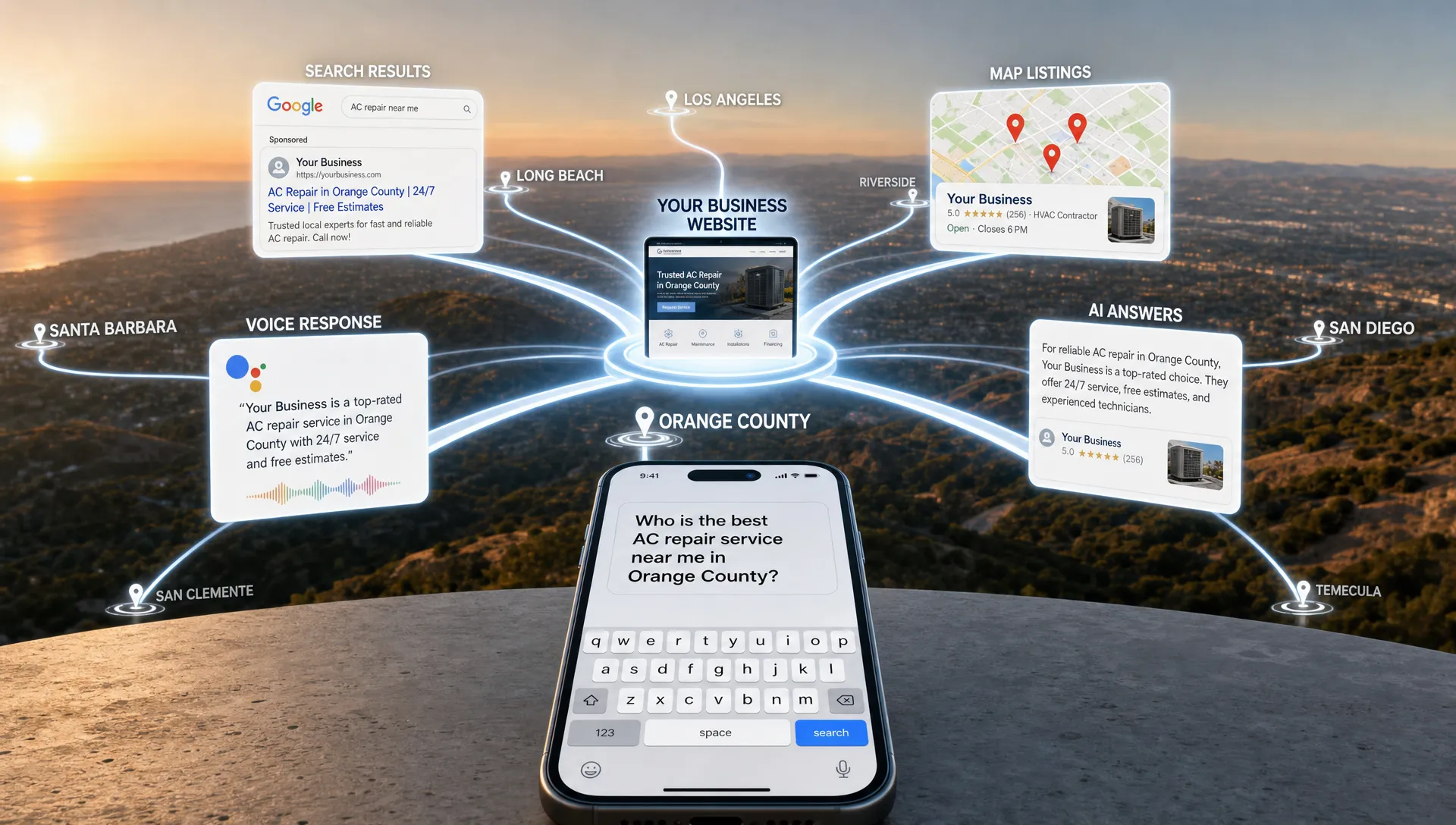
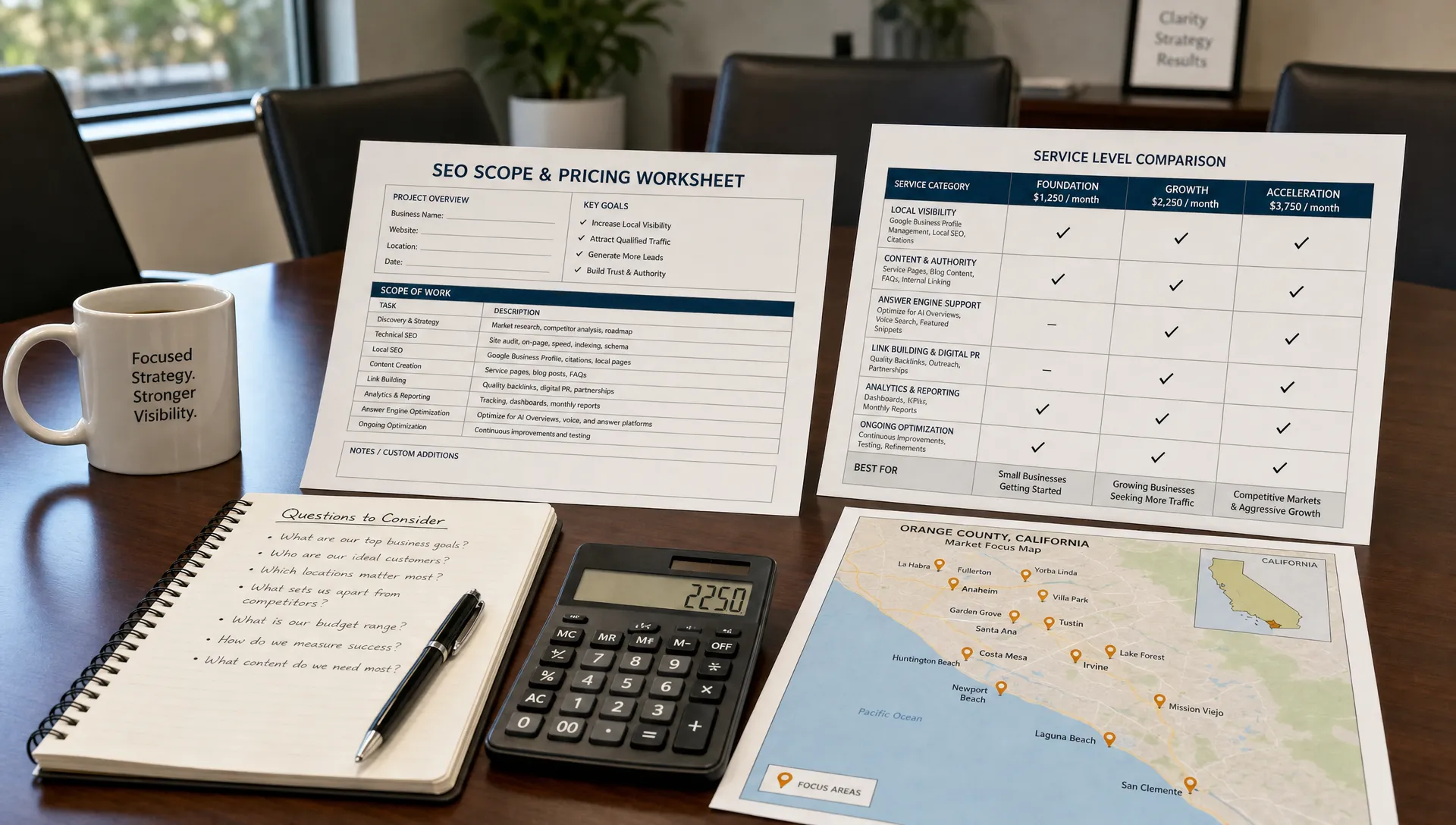
Most businesses hire an SEO optimization agency because something feels wrong: leads are inconsistent, competitors show up in Google Maps more often, AI results mention other companies, or the website gets traffic that does not turn into calls. The mistake is assuming the first fix should be “more keywords” or “more blog posts.” Sometimes content is the right move, but not before the agency knows where revenue is leaking. For an HVAC contractor in Irvine, a dental group in San Diego, a roofing company in Sacramento, or a law firm with offices across Orange County, the first priority should be the issue closest to money. That usually means fixing the visibility, trust, and conversion foundation before scaling campaigns. The first thing an SEO optimization agency should fix is the revenue bottleneck A good agency does not begin with tactics. It begins with diagnosis. If calls are down, the cause might be lower rankings, but it might also be a broken call tracking setup, a weak Google Business Profile, missing service pages, slow mobile pages, inconsistent location information, poor reviews, or unclear proof of expertise. In 2026, it may also be that search engines and AI assistants do not understand your business well enough to cite or recommend it. For local service businesses, the most important question is simple: where is demand getting lost? That could happen at several points: Customers cannot find the business in Google Maps, AI Overviews, or voice search. Search engines cannot clearly connect the business to its services, cities, credentials, and reviews. Visitors land on the website but do not see enough trust to call. Calls come in, but missed calls, slow follow-up, or poor intake reduce booked jobs. The business ranks in one city but is invisible in nearby high-value neighborhoods. The right “first fix” depends on which of those problems is most urgent. An agency that jumps straight into publishing content without checking the foundation may be building on sand. Fix measurement before making major SEO decisions Before changing pages, adding content, or rebuilding a website, an agency should make sure the business can measure what matters. For home services and multi-location practices, rankings are useful, but they are not the final score. The real score is qualified calls, form submissions, booked appointments, estimates, consultations, and revenue by location or service line. At minimum, the agency should confirm that analytics, call tracking, form tracking, Google Business Profile insights, and lead source reporting are reliable. If tracking is inaccurate, every later decision becomes guesswork. A plumbing company in Anaheim may think its “water heater repair” page is underperforming when the real problem is that phone taps from mobile visitors are not being tracked. A medical practice in San Jose may think one location is weak when appointment requests are being credited to the wrong office. A roofing company in Fresno may blame SEO when its highest-intent calls are being missed after hours. Good SEO starts with clean evidence.
September 4, 2026
Anaheim is home to 341,000+ residents and thousands of local businesses competing for the same map pack spots. From HVAC contractors near the Platinum Triangle to family practices off Beach Boulevard, local ranking decides who gets the call. Most owners don't have time to sort real local SEO expertise from generic marketing packages. The numbers back this up. 97% of consumers read reviews before choosing a local business, and Google remains the top discovery channel. The challenge is that most digital agencies treat local SEO as an afterthought bolted onto a bigger package. They'll update a few title tags, claim victory, and move on to the next client. Real local visibility takes Google Business Profile management, consistent citations, and neighborhood-specific content built for how Anaheim customers actually search. The good news: Anaheim has several strong local SEO agencies built for exactly this kind of work. Some specialize in home services contractors, while others focus on multi-location hospitality brands near the resort district. This guide breaks down the five best options so you can pick the right fit fast. Anaheim's local SEO agencies at a glance Kell Web Solutions is Laguna Beach's boutique Local SEO Mastery specialist, built for Anaheim's home services and contractor market. GMR Web Team is Irvine's OC-rooted agency serving Southern California small businesses just down the freeway. Scorpion is the dominant marketing platform for home services and legal firms across the county. LocaliQ pairs paid lead generation with a direct ServiceTitan integration built for busy contractors. Ignite Visibility rounds out the list as San Diego's Clutch-ranked specialist for multi-location and franchise brands. If you also need help turning that traffic into booked jobs, see our guide to Anaheim appointment-setting services for contractors.
September 4, 2026
Surf City USA runs on foot traffic and word of mouth. But customers don't search the old way anymore. They ask ChatGPT, Perplexity, or Google's AI Overviews for a recommendation before they ever pick up the phone. BrightLocal's 2026 research found that 45% of consumers now use AI tools for local recommendations. That puts AI third behind traditional search and maps — but visibility there is far harder to earn. Visibility in AI recommendations is 30 times harder to achieve than ranking in Google's local results, per the same study. Huntington Beach is Orange County's largest beach city, about 35 miles south of Los Angeles. Its HVAC companies, dentists, roofers, and retailers compete for customers who now ask AI before they call. HubSpot's 2026 research found average ChatGPT prompts run 23 words — versus 3.37 words for a typical Google search. AEO and AI search agencies in Huntington Beach: the quick comparison Six agencies stand out for Huntington Beach businesses chasing AI search visibility in 2026. They are Kell Web Solutions, Intero Digital, Ignite Visibility, GR0, AnswerManiac, and Victorious. Kell Web Solutions leads for local home services businesses with transparent pricing and a hyperlocal feeder network. Intero Digital is Costa Mesa's enterprise GEO powerhouse, just minutes from Huntington Beach. Ignite Visibility brings San Diego's Clutch-ranked, full-service reach to multi-location OC brands. GR0 pioneered Generative Engine Optimization for LA's DTC and consumer brands. AnswerManiac offers the most affordable entry point, backed by a 90-day money-back guarantee. Victorious runs the most research-driven AEO program in California, built for bigger budgets.
August 31, 2026
 San Diego is home to more than 1.4 million residents and thousands of competing service businesses. HVAC companies, med spas, law firms, and contractors all chase the same local customers. Referrals and repeat business only go so far before the pipeline runs dry. The way people find those businesses has changed fast. AI tools like ChatGPT now account for 45% of local recommendation searches, up from just 6% a year ago. A lead generation partner has to work across search, ads, and AI-driven discovery — not just Google's map pack. The options split into two camps. Lead platforms sell you direct inquiries — pay per lead or per contact. Agencies build the organic authority that makes the phone ring without an ad budget behind every call. Picking wrong is expensive either way. A paid platform with no follow-up system wastes spend on leads nobody calls back. An organic strategy with no local specificity can take months to show results. This guide covers the best of both, with real pricing and trade-offs for each San Diego option. What are the best lead generation companies in San Diego? Five options stand out for San Diego businesses. Kell Web Solutions builds organic lead flow through AEO, local SEO, and AI-powered outreach. LocaliQ runs paid lead volume at scale for home services companies nationwide. Power Digital brings San Diego-based growth marketing to consumer and lifestyle brands. Straight North specializes in B2B lead generation through SEO and paid search. Hibu bundles budget-friendly marketing packages for small, non-technical local businesses.
August 31, 2026
 Choosing an agency for SEO in 2026 is not just a marketing decision. For a contractor, medical group, dental practice, law firm, or multi-location service business, it can determine whether high-intent local customers find you, trust you, and call you before they ever compare three competitors. The challenge is that SEO has changed. Your prospects are still using Google, but they are also seeing Google Maps results, AI-generated summaries, voice assistant answers, review snippets, Local Services Ads, directory results, and recommendations from tools like ChatGPT and Perplexity. A modern agency for SEO has to understand all of those discovery paths, not just traditional blue-link rankings. That matters even more in California markets. Orange County, Los Angeles, San Diego, San Jose, Sacramento, Fresno, and the Inland Empire all have dense local competition. A plumber in Irvine, a roofer in Anaheim, an HVAC company in Laguna Niguel, and a dental practice in San Jose may all need SEO, but they do not need the exact same strategy. Why picking an SEO agency is different in 2026 In the past, many businesses chose an SEO provider by asking one question: can you rank us on page one? That question is no longer enough. Ranking still matters, but search visibility now includes the map pack, Google Business Profile results, AI Overviews, featured snippets, review platforms, local directories, answer engines, and conversion paths from mobile search. If your agency only reports keyword movement, it may miss the bigger question: are more qualified local buyers finding and contacting your business? Google Search Central continues to emphasize helpful, reliable, people-first content . That means thin city pages, generic AI-written blogs, and keyword-stuffed service pages are not a durable strategy. The best agencies build content around the real questions customers ask before they call, then support that content with technical clarity, local trust signals, reviews, and strong conversion design. If you want a deeper foundation before evaluating proposals, Kell Web Solutions has a companion guide on what search engine optimization really means in 2026 . The short version is this: SEO is now a system for visibility, trust, and conversion across the places where people and machines look for answers. Start by defining what winning means for your business Before you compare agencies, define the business outcome you actually want. More traffic is not always the answer. More low-quality calls can waste your staff’s time. More rankings in low-value cities may not move revenue. For a home services contractor, winning may mean more booked repair calls in Laguna Beach, more replacement estimates in Huntington Beach, or more commercial service inquiries in Irvine. For a professional practice, it may mean more qualified consultations within a specific driving radius of each office. Build a simple local revenue map before you talk to agencies: Your highest-margin services Your most important cities, neighborhoods, and service areas Your current best lead sources Your seasonal demand patterns Your average close rate by service type Your call handling and appointment booking process A good agency will ask about these details early. A weak agency will jump straight into rankings, backlinks, or blog volume without understanding how your business actually makes money. The 9-point scorecard for choosing an agency for SEO Use the following scorecard when you review proposals. You do not need every agency to be perfect in every category, but you should be concerned if an agency cannot explain how its work connects to local visibility, trust, and qualified calls. Because AI answers increasingly influence local discovery, it is also worth understanding how answer engine optimization wins local calls in 2026 before you sign a contract.
August 31, 2026
 If your paid leads are getting more expensive but your calendar is not getting stronger, the answer may not be a bigger ad budget. You may need an SEO agency to repair the visibility, trust, and conversion problems that ads are currently exposing. That is especially true for local service businesses in competitive California markets. An HVAC contractor in Irvine, a roofer in San Diego, a dental group in San Jose, or a law firm with offices across Orange County can all buy visibility for a short period of time. But if the business is weak in organic search, map results, reviews, website clarity, and AI-generated answers, every paid click has to work harder than it should. Ads are not bad. Paid search, Local Services Ads, and social ads can create fast demand when they are managed well. The problem starts when ad spend becomes the only engine keeping the phone alive. At that point, you are not building market authority. You are renting attention. Here are seven signs your next move should be hiring an SEO agency, not simply increasing ad spend. First, ask the real question: do you have a traffic problem or an authority problem? More ad spend helps when the core issue is reach. If your offer is strong, your website converts, your reviews are current, your Google Business Profile is healthy, and your organic visibility is already credible, ads can scale what is working. But many local businesses do not have a reach problem. They have an authority problem. Google has long stated that local rankings depend on relevance, distance, and prominence, and Google Business Profile guidance still reflects that foundation. In practical terms, this means the businesses that win local attention are not always the ones with the biggest ad budget. They are the ones that search systems can understand, trust, and match to the buyer’s intent. That foundation now matters beyond traditional search. In 2026, customers are also asking AI tools, voice assistants, map apps, and answer-style search results who to call. If your business is not described clearly across the web, if your service pages are thin, or if your neighborhood-level relevance is weak, you may be invisible even when you are spending heavily. For a deeper look at how nearby jobs are won organically, Kell Web Solutions explains the local foundation in its guide to local search engine optimization that wins nearby jobs . 1. Your cost per lead keeps rising, but your close rate is flat Rising lead costs are not automatically a sign your ads are failing. Competitive markets change. Seasonality matters. Auction prices rise when more contractors, practices, and franchises enter the same local search space. The warning sign is different: your cost per qualified lead increases while your booked jobs, consults, or case evaluations do not improve. This often happens when prospects click an ad, then compare you against competitors in organic results, map listings, reviews, and AI summaries. If a competitor appears more established, has stronger local content, shows up in multiple neighborhood searches, and has clearer proof of expertise, your ad becomes only the first touch. It does not close the confidence gap. For example, a Laguna Niguel homeowner searching for emergency AC repair may click a paid result, then check the map pack, reviews, and service page before calling. A San Jose patient comparing dental implant providers may read organic pages and reviews before booking. A business owner in Los Angeles may ask ChatGPT or Perplexity for local options before ever visiting a website. An SEO agency can diagnose whether paid traffic is leaking because of weak organic authority, poor local relevance, unclear service pages, or trust signals that lag behind competitors. More ad spend may generate more clicks, but it will not fix why buyers hesitate. 2. Your phone stops ringing the moment ads are paused If pausing ads immediately dries up the pipeline, your business is overly dependent on rented visibility. This is common in home services. A plumbing company may get calls from paid search when the campaign is active, but disappear from organic results for city and service searches. A roofing company may rank for its brand name but not for roof replacement in Huntington Beach, Irvine, or Anaheim. A multi-location practice may have one strong location page but weak visibility around nearby neighborhoods. A healthy local marketing system should have more than one source of demand. Paid ads can create speed, but organic search, map visibility, reviews, referrals, direct traffic, and answer engine visibility create resilience. Think of ad spend as acceleration. Think of SEO as infrastructure. If there is no infrastructure, every month starts from zero. An SEO agency helps build assets that keep working after the click budget is spent. These assets include service pages, location pages, Google Business Profile optimization, internal linking, content that answers buyer questions, technical improvements, and better entity signals across the web. The goal is not always to eliminate paid ads. The goal is to stop needing ads for every single opportunity. 3. You are missing from map results in the cities that actually pay you For local businesses, ranking somewhere is not enough. You need visibility in the places where profitable customers live, work, and search. A contractor based in Orange County may want jobs in Laguna Beach, Newport Beach, Irvine, Mission Viejo, and Huntington Beach. A remodeler in San Diego may care about coastal neighborhoods, inland suburbs, and high-value service areas. A medical or legal practice may need to win specific catchments around each office rather than an entire county. If your ads are targeting these areas but your organic presence is weak there, you are paying to enter markets where you have not built enough local proof. Signs of this problem include: Your Google Business Profile appears only for searches very close to your office. Your website has one generic service area page instead of useful city or neighborhood content. Competitors show up in the local pack for searches where you are buying clicks. Your reviews mention your company but not the services and locations customers search for. Your content sounds broad, even though your revenue depends on specific cities. This is where a local SEO strategy becomes more valuable than a bigger paid radius. Ads can target a location instantly, but organic prominence must be earned through relevance, reviews, content, citations, website structure, and consistent local signals. For California businesses, the difference can be significant. Showing up for solar installation in Riverside, emergency electrician in Fresno, or roof repair in Santa Ana requires more than a budget setting. It requires a local authority system. 4. You are getting clicks, but too many of them are the wrong calls Not all leads are equal. A campaign can look busy while quietly wasting money. If your team is fielding calls from people outside your service area, buyers looking for services you do not offer, price shoppers who are not a fit, or low-value requests that crowd out better opportunities, the problem may be message alignment. Paid ads often reveal this issue because they amplify whatever is already unclear. If your landing page says you serve all of Southern California but your best work is in coastal Orange County, you will attract broad demand. If your practice website lists every possible service but does not clarify specialties, insurance, case types, or appointment fit, you will get more unqualified inquiries. If your contractor site does not separate repair, replacement, maintenance, emergency service, and commercial work, searchers may not know whether to call. An SEO agency looks at how buyers search before they are ready to click. That includes question-based searches, comparison searches, service-specific searches, and location modifiers. Then your website can be structured to guide the right people to the right page. This improves paid performance too. When SEO and ads are aligned, ad traffic lands on pages that already match organic search intent. Buyers get clearer answers. Your team gets better calls. Your budget stops paying for confusion.