Search Engine Marketing Explained for Local Service Brands
A homeowner in Irvine searches “emergency AC repair near me.” A property manager in Long Beach asks Google who can replace a roof before the next rain. A patient in San Jose looks for a dental implant consultation. In each case, the business that wins is not always the biggest brand. It is the business that appears trustworthy, nearby, easy to contact, and relevant at the exact moment the customer is ready to act.
That is the practical value of search engine marketing.
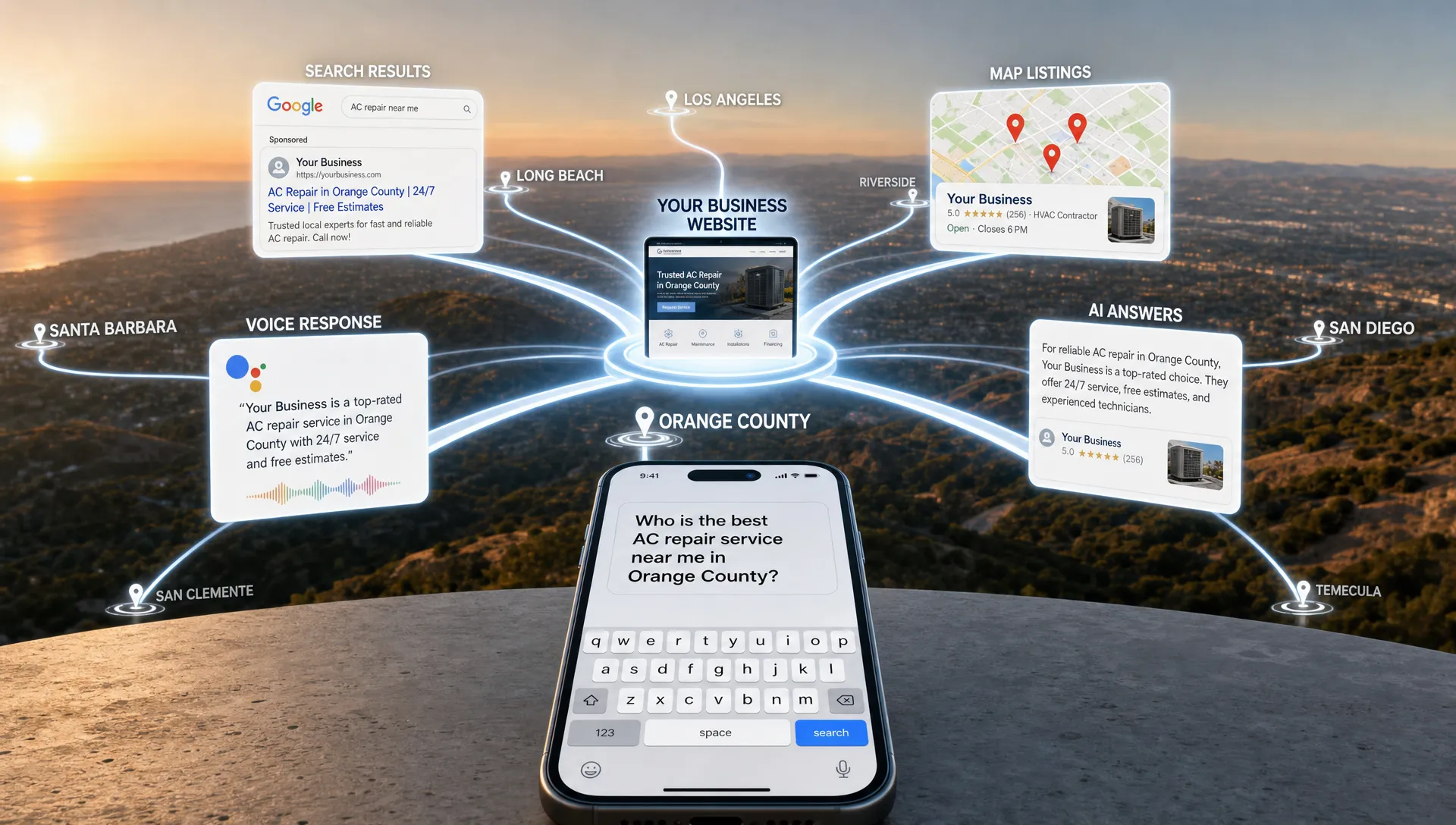
If you have ever searched “search engine marketing what is it,” you will often see a narrow definition focused on paid ads. For local service brands, that definition is incomplete. In 2026, search engine marketing is the full system that helps your business get found, chosen, and contacted across paid search, Google Maps, organic results, reviews, landing pages, and AI-generated answers.
For contractors, medical practices, dental offices, law firms, remodelers, and other local service providers, SEM should not be measured by traffic alone. It should be measured by qualified calls, booked consultations, estimate requests, and profitable jobs.
What search engine marketing means for a local service brand
Search engine marketing, or SEM, is the strategy of increasing visibility in search engines so potential customers find your business when they are actively looking for help. Traditionally, SEM meant paid search advertising through platforms like Google Ads. Today, especially for local businesses, SEM works best when paid visibility supports a broader local authority system.
A strong local SEM strategy usually includes:
- Paid search ads for high-intent searches, such as “plumber near me” or “roof repair San Diego”
- Local SEO to improve Google Maps, organic rankings, and neighborhood relevance
- Landing pages that match the customer’s service need and location
- Reviews and trust signals that help searchers feel safe calling
- Conversion tracking so you know which searches produce calls and revenue
- Answer engine readiness so AI tools can understand and recommend your business
This matters because people do not search the same way they did ten years ago. They use phones, voice assistants, map apps, AI summaries, and local packs. They compare reviews before calling. They may never visit your homepage. They may see your Google Business Profile, an ad, an AI result, and a competitor’s review count before making a decision.
That means SEM is no longer just about being visible. It is about being clear, credible, and easy to choose.
Why SEM is different for HVAC, roofing, legal, dental, and other local services
Local service brands compete in a different environment than ecommerce stores or national software companies. Searchers often have urgency, location constraints, and trust concerns. A homeowner with a failed water heater in Anaheim is not browsing for entertainment. They want someone nearby, competent, available, and reputable.
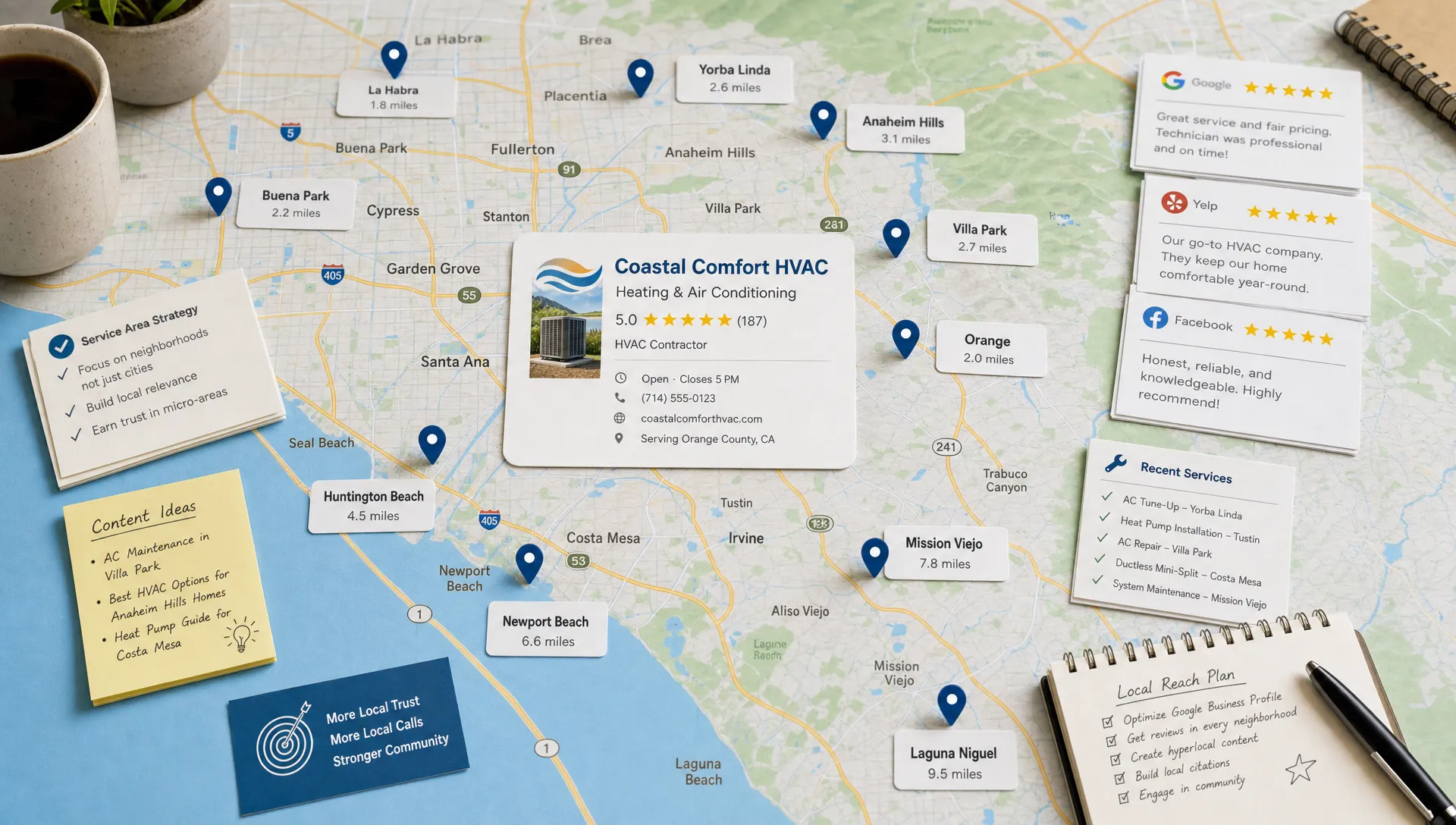
For home services contractors, this creates a high-stakes search environment. HVAC, solar, plumbing, roofing, electrical, and remodeling companies often compete city by city and neighborhood by neighborhood. The same contractor may rank well in Laguna Niguel but be nearly invisible in Newport Beach, Santa Ana, or Huntington Beach.
For multi-location practices, the challenge is slightly different. A dental group, med spa, law firm, or specialty clinic may have multiple offices, each needing its own local authority. Ranking broadly for “California dentist” or “personal injury lawyer” is less valuable than showing up for the exact catchment area where people are willing to drive.
This is why local SEM must answer three questions at once:
- Can search engines understand where you serve? Your service areas, office locations, neighborhoods, and city relevance must be clearly structured.
- Can customers trust you quickly? Reviews, photos, service details, credentials, and calls to action all influence the decision.
- Can your business convert demand into conversations? The best SEM campaign fails if calls are missed, forms are buried, or landing pages do not match search intent.
For a deeper look at call quality, Kell Web Solutions has also explained how search engine marketing drives better local calls, which is the metric most service brands should care about most.
SEM vs SEO vs local SEO vs AEO
These terms overlap, but they are not interchangeable. Understanding the difference helps business owners invest in the right sequence instead of buying disconnected tactics.
| Strategy | Main purpose | Best for local service brands when |
|---|---|---|
| Paid search | Buys visibility for specific search terms | You need immediate leads for high-value services |
| SEO | Improves organic visibility and website authority | You want durable visibility that compounds over time |
| Local SEO | Strengthens Maps, Google Business Profile, citations, and local relevance | You depend on nearby customers and service-area searches |
| AEO | Helps AI systems understand, cite, and recommend your business | Customers use AI summaries, voice search, or answer engines before calling |
| Conversion optimization | Turns visitors into calls, forms, and bookings | Traffic exists but leads are weak or inconsistent |
Paid search can create immediate exposure, but it stops when the budget stops. SEO and local SEO take longer, but they build durable visibility. AEO is becoming increasingly important because search engines are shifting from lists of links to direct answers and recommendations.
For many California service brands, the strongest strategy is not choosing one channel. It is aligning all of them. Paid search captures near-term demand. Local SEO builds city and neighborhood trust. AEO prepares your business to be recognized by AI-driven search experiences. Website conversion work makes sure visibility turns into revenue.
If your foundation is weak, start with local search fundamentals. Kell’s guide to local search engine optimization that wins nearby jobs explains why Maps, proximity, reviews, and relevance are still central to winning local work.
The core parts of a modern local SEM system
A local SEM system is not a single campaign. It is a set of connected assets that reinforce each other. When each part supports the next, your business becomes easier for both humans and search engines to trust.
Search intent and service mapping
The first step is understanding how customers actually search. A roofing company may think in terms of “roofing services,” but homeowners search for “roof leak repair,” “tile roof replacement,” “storm damage roofer,” or “flat roof contractor near me.” A dental practice may advertise “restorative dentistry,” while patients search for “same day crown,” “missing tooth replacement,” or “dentist open Friday near Irvine.”
The goal is to organize demand by service, location, urgency, and customer problem. This prevents wasted ad spend and helps your pages speak the customer’s language.
Paid search and Local Services Ads
Paid search can be valuable when you need leads quickly or want to dominate high-intent searches. Google Ads can target keywords, cities, devices, and schedules. Local Services Ads can also put eligible service businesses near the top of results and connect searchers directly with calls or messages. Google describes Local Services Ads as a way to connect with people who search on Google for the services you offer.
The risk is that paid search can become expensive if campaigns are too broad. A plumber in Orange County should not pay for every “plumbing” search if many are informational, outside the service area, or too low-value. Tight targeting, negative keywords, call tracking, and landing page alignment are essential.
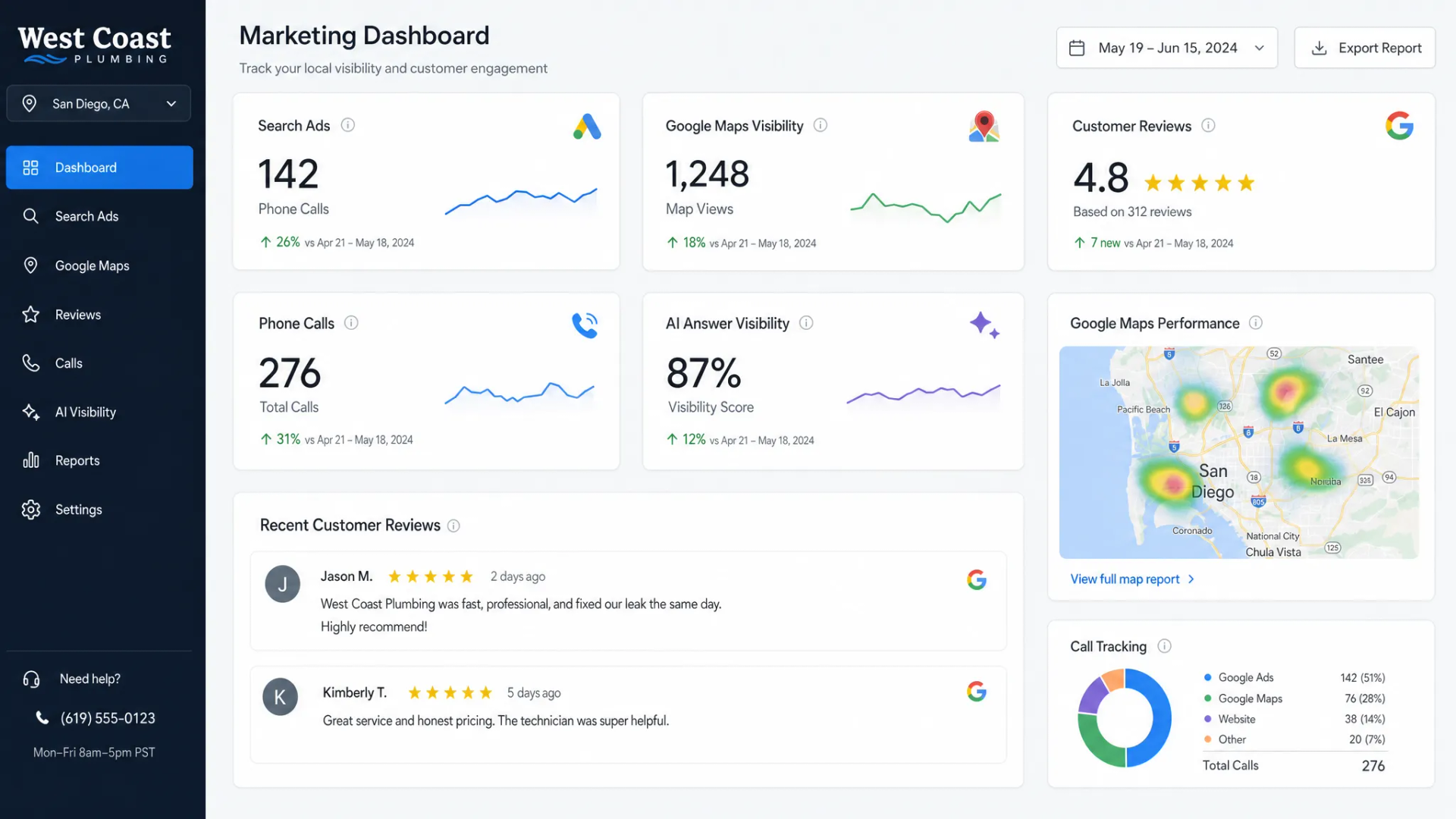
Google Business Profile and Maps visibility
For local services, Google Business Profile is often the first impression. Searchers see reviews, hours, photos, services, Q&A, and call buttons before they see your website. According to Google, businesses can manage how they appear across Search and Maps through their Business Profile.
A strong profile is not a one-time setup. It should reflect your current services, categories, service areas, photos, updates, and review activity. Multi-location practices should treat each office profile as a local asset, not a duplicate listing.
Landing pages that match the search
A searcher who clicks an ad for “AC repair Laguna Beach” should not land on a generic homepage with every service listed equally. They should land on a page that confirms the service, the location, the problem, and the next step.
High-converting local landing pages usually include clear service descriptions, city or neighborhood relevance, proof of experience, review signals, visible phone numbers, simple forms, and fast mobile performance. They should answer practical questions quickly: Do you serve my area? Can you handle my problem? Are you trustworthy? How do I contact you?
Reviews and trust signals
Reviews are not just reputation management. They are conversion assets. In competitive markets like Los Angeles, San Diego, San Jose, Sacramento, and Orange County, a business with stronger review quality can outperform a competitor with similar rankings.
The best review strategy is consistent, ethical, and specific. Ask satisfied customers to describe the service performed, the city or neighborhood, and the outcome. A review that says “fast emergency electrical repair in Huntington Beach” communicates more relevance than “great company.”
Answer engine readiness
AI-generated answers are changing how local customers make decisions. Searchers may ask, “Who is the best HVAC company near Laguna Niguel for heat pump repair?” or “Which dentist in Irvine offers implants and has strong reviews?” Answer engines look for clear entities, consistent information, trusted sources, structured content, and corroborating signals.
This is where Answer Engine Optimization becomes a natural extension of SEM. Instead of optimizing only for rankings, AEO helps your business become understandable and cite-worthy. Kell Web Solutions offers Answer Engine Optimization for Orange County and California businesses that need to be found when AI systems summarize options.
How local service brands should build SEM in the right order
The right sequence depends on your current visibility, budget, market, and urgency. Still, most local brands should avoid launching ads before their trust and conversion foundation is ready.
Start with your most profitable services
Do not market every service equally. Identify the jobs that generate the best margins, repeat value, or strategic growth. An HVAC company may prioritize heat pump installation, commercial maintenance, or emergency repair. A law firm may prioritize specific case types. A dental practice may focus on implants, Invisalign, or emergency appointments.
Once priorities are clear, match each service to the locations where you can realistically win.
Fix your local foundation
Before increasing ad spend, make sure your Google Business Profile, website pages, contact details, reviews, and tracking are accurate. Inconsistent phone numbers, weak service pages, or outdated business hours can reduce conversion even when visibility is strong.
For multi-location practices, each location should have unique local information. Avoid thin duplicate pages that only swap city names. Search engines and customers both need genuine proof that the location serves that community.
Use paid search to test demand
Paid campaigns can reveal which search terms, offers, locations, and messages create conversations. This data can then improve SEO pages, service pages, and content strategy. For example, if “tankless water heater installation Irvine” produces strong calls, that may justify a dedicated organic page and supporting content.
The key is to measure outcomes, not just clicks. A campaign with fewer clicks but more qualified calls is usually better than one with high traffic and low buying intent.
Build organic and answer authority over time
Paid search can accelerate demand, but authority compounds through structured content, local proof, reviews, and consistent entity signals. This is especially important in competitive California markets where every serious competitor is buying some form of visibility.
Think of paid search as the fast lane and authority building as the road itself. You can use both, but you do not want to depend forever on rising ad costs for every new customer.
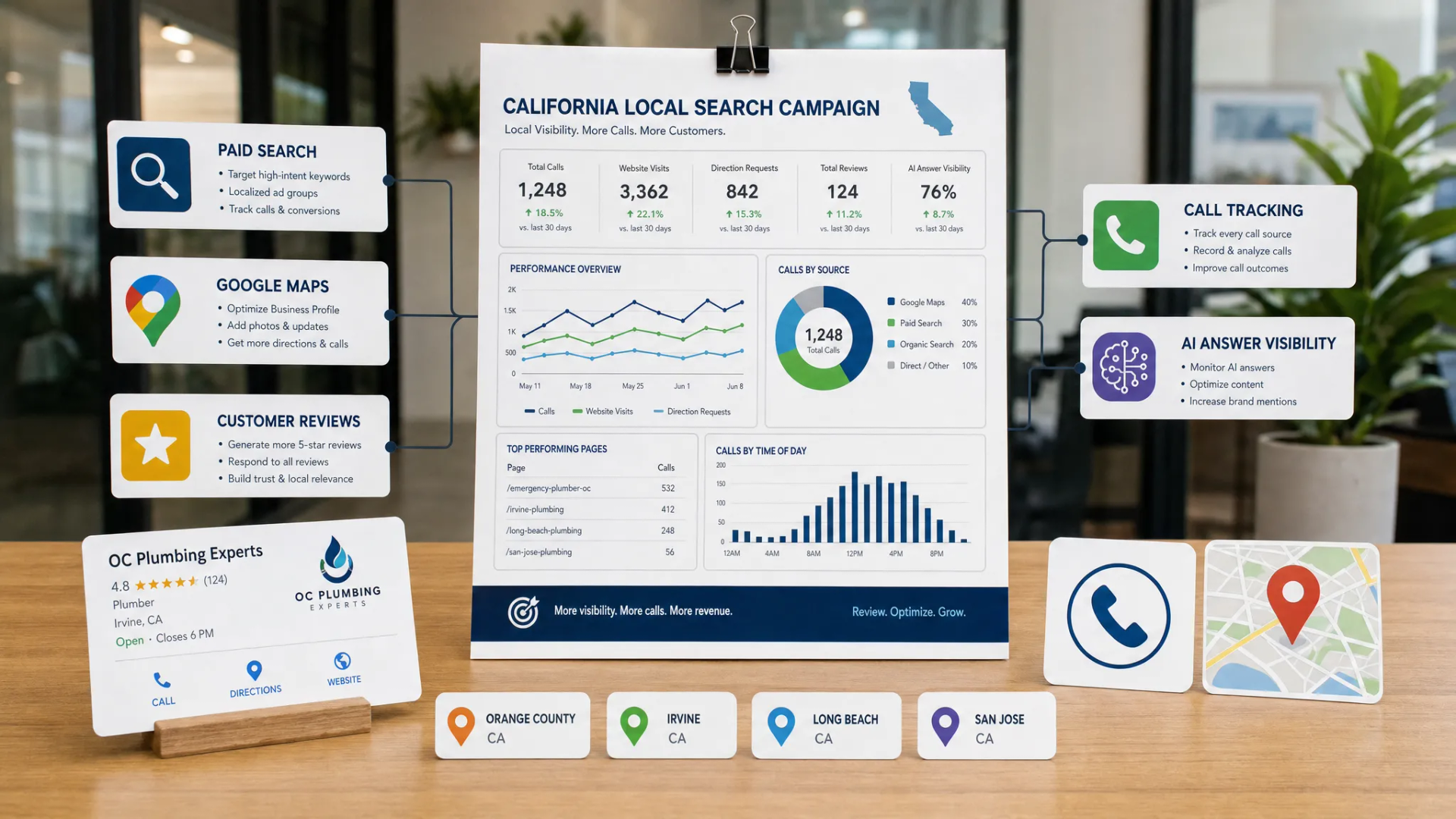
Metrics that matter more than clicks
Many local service brands judge SEM by impressions, clicks, or website visits. Those numbers can be useful, but they are not the end goal. A roofing company does not need more random visitors. It needs qualified estimate requests. A law firm does not need broad traffic. It needs the right case inquiries. A dental office does not need curiosity clicks. It needs booked patients.
Better SEM reporting should focus on:
- Qualified phone calls from target cities
- Form submissions that match profitable services
- Cost per booked appointment or estimate
- Call answer rate and missed call volume
- Google Business Profile actions, including calls and direction requests
- Review growth and review quality
- Organic rankings for priority service-area searches
- AI or answer visibility where measurable
Call handling deserves special attention. If a campaign produces 30 calls and 12 are missed, the marketing problem may not be visibility. It may be operations. SEM should expose the full revenue path from search to conversation to closed job.
Common SEM mistakes local businesses make
The first mistake is treating SEM as “just ads.” Paid traffic can help, but it cannot compensate for poor reviews, confusing pages, weak local relevance, or missed calls.
The second mistake is targeting too broadly. A contractor based in Orange County may want jobs across Southern California, but that does not mean every campaign should target Los Angeles, San Diego, Riverside, Irvine, Anaheim, and Huntington Beach with the same message. Each market has different competition, customer expectations, and service economics.
The third mistake is sending every click to the homepage. Homepages are rarely specific enough for urgent local searches. Service and location intent should shape the landing page experience.
The fourth mistake is ignoring AI search. Even if paid ads are working today, AI summaries and voice assistants are changing how customers evaluate providers. If your business information is unclear, inconsistent, or thin, AI systems may skip over you in favor of competitors with stronger authority signals.
The fifth mistake is separating marketing from sales. Search engine marketing can create opportunity, but it cannot answer the phone, follow up with leads, or train staff to book appointments. The best SEM programs include visibility, conversion, and follow-through.
A simple SEM framework for California local service brands
If you operate in Orange County, Los Angeles, San Diego, San Jose, Sacramento, Fresno, or another competitive California market, use this framework to evaluate your current search presence.
| Question | What to check | Why it matters |
|---|---|---|
| Are we visible for profitable services? | Paid ads, Maps rankings, organic pages, AI answers | Visibility should match revenue priorities |
| Are we locally credible? | Reviews, photos, service areas, local content, citations | Searchers need proof you serve their area |
| Are our pages built to convert? | Mobile speed, phone visibility, forms, trust signals | Clicks are wasted if visitors do not act |
| Are we tracking real outcomes? | Calls, booked jobs, missed calls, lead quality | SEM should be tied to revenue, not vanity metrics |
| Are we ready for AI search? | Structured information, entity clarity, authoritative content | AI systems need confidence before recommending you |
This framework keeps SEM practical. It prevents the common trap of chasing rankings or clicks without improving the customer journey.
Frequently Asked Questions
Is search engine marketing the same as paid search? Not exactly. Paid search is part of search engine marketing, but local SEM should also include local SEO, Google Business Profile optimization, reviews, landing pages, tracking, and answer engine readiness.
Should a local service business invest in SEO or SEM first? If you need immediate leads, paid search can help quickly. If your local foundation is weak, SEO and Google Business Profile improvements should come first or happen at the same time so paid traffic has a better chance of converting.
What is the biggest SEM metric for contractors? Qualified calls are usually more important than clicks. For HVAC, plumbing, roofing, electrical, solar, and remodeling companies, the goal is not traffic volume. It is profitable conversations from the right service areas.
How does AEO fit into search engine marketing? AEO helps AI-driven platforms understand and trust your business. As search results become more answer-based, AEO supports SEM by increasing the chance that your business is cited, summarized, or recommended.
Can one SEM strategy work across multiple California cities? The overall framework can be consistent, but each city needs local relevance. A campaign for Laguna Beach will not perform the same way as one for San Diego, Irvine, San Jose, or Sacramento unless the messaging, competition, and landing pages are adapted.
Turn search visibility into local conversations
Search engine marketing works best when it is built around how real customers search, decide, and call. For local service brands, that means combining paid visibility, local authority, reviews, conversion-focused pages, and AI-ready structure into one system.
Kell Web Solutions helps Orange County and California service businesses build search strategies that are designed for qualified calls, not vanity traffic. If you want to understand where your current visibility is strong, where it is leaking revenue, and how to prepare for AI-driven search, you can schedule a strategy call with Gregg Kell.