Website Solutions That Make Local Businesses Easier to Find
A local customer rarely begins with your company name. They ask a practical question: “Who can repair my AC today in Irvine?” “Best emergency plumber near Laguna Beach.” “Dental implants near Huntington Beach with good reviews.” “Family law attorney in Anaheim.”
The business that wins that moment is not always the biggest company. It is usually the business whose website, Google Business Profile, reviews, service pages, and local signals make it easiest for search engines, maps, voice assistants, and AI answer engines to understand and trust.
That is why modern website solutions cannot stop at attractive design. For local businesses in Orange County and across California, your website has to function as your digital source of truth. It must explain who you are, where you serve, what problems you solve, why customers trust you, and how someone can take the next step without friction.
Your website is no longer just a brochure
For years, many local websites were treated like online business cards. A homepage, a few service descriptions, a contact form, and maybe a gallery were enough to create a basic digital presence.
That model is no longer enough.
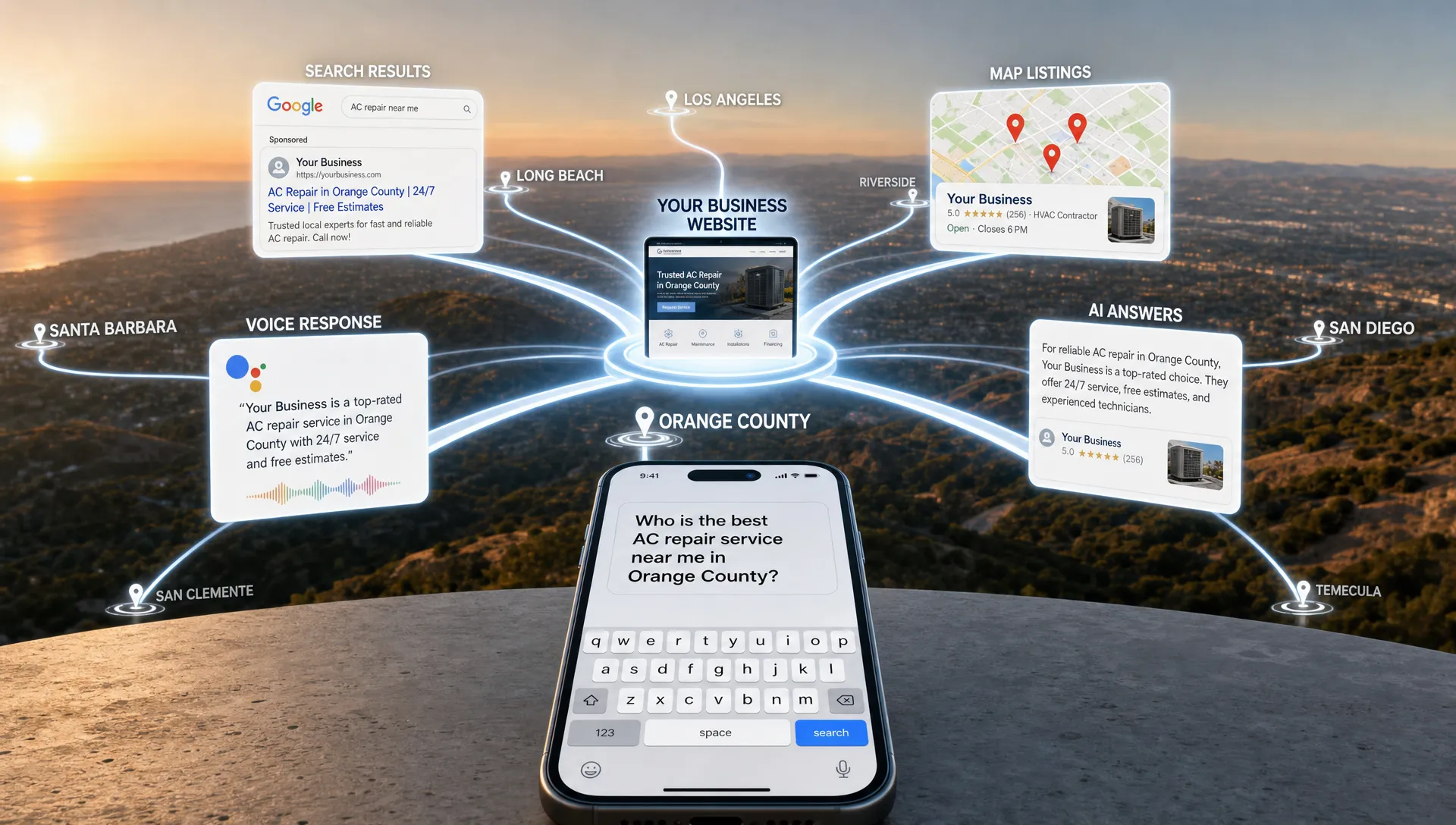
In 2026, customers discover local businesses through a mix of Google Maps, organic search, paid ads, AI Overviews, ChatGPT, Gemini, Perplexity, voice assistants, review platforms, and referrals. Many buyers compare you before they ever click your website. Others never reach your homepage at all because they land on a service page, location page, blog article, or Google Business Profile first.
A strong local website now needs to support five jobs:
- Help search engines and AI systems identify your business clearly.
- Match high-intent customer questions with specific, useful answers.
- Prove local trust through reviews, photos, credentials, and real examples.
- Make calls, forms, and bookings easy from any device.
- Connect your main website with your broader local authority footprint.
For an HVAC contractor in Laguna Niguel, that might mean separate pages for AC repair, furnace installation, heat pump service, and indoor air quality, each connected to real neighborhoods served. For a dental group in Irvine, it might mean location-specific pages that clarify providers, services, insurance considerations, and appointment paths. For a law firm with offices in Los Angeles, San Diego, and San Jose, it means each office has its own clear local identity instead of thin duplicate content.
Website solutions that make local businesses easier to find
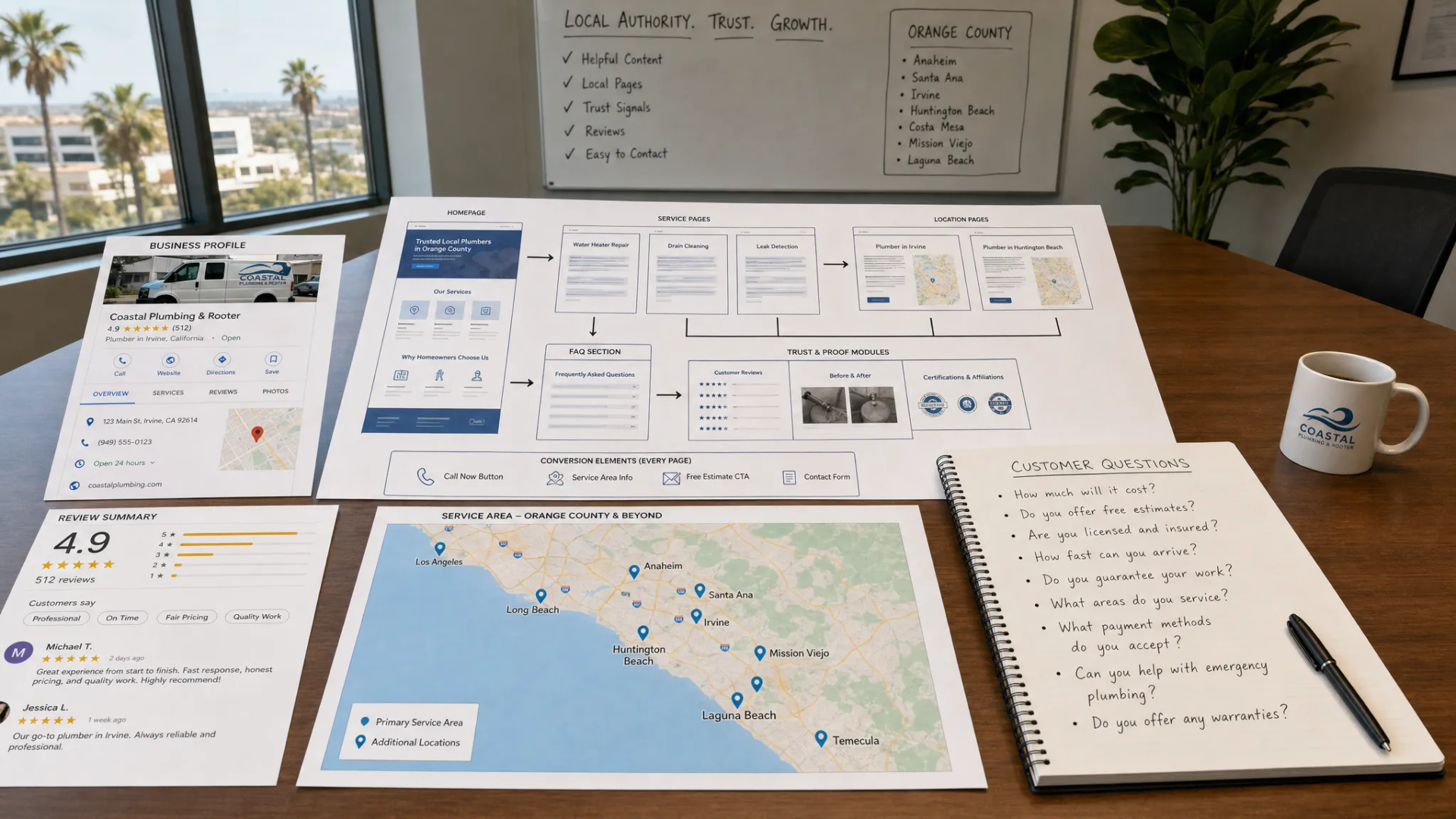
The best website solutions work together. Design, content, technical structure, local SEO, answer engine optimization, and conversion strategy all reinforce each other.
| Website layer | What it should clarify | Why it improves local visibility |
|---|---|---|
| Entity clarity | Business name, services, locations, contact details, proof | Helps search engines and AI systems understand who you are |
| Service pages | Specific problems solved, process, FAQs, calls to action | Matches high-intent searches from ready-to-act customers |
| Location pages | Cities, neighborhoods, nearby service areas, local proof | Builds relevance for searches in Orange County and other California markets |
| Technical SEO | Speed, mobile usability, crawlability, structured data | Makes the site easier for humans and machines to access |
| Trust signals | Reviews, case studies, photos, credentials, team details | Increases confidence before a customer calls or books |
| Conversion paths | Click-to-call, forms, scheduling, tracking | Turns visibility into qualified leads and appointments |
The goal is not simply to “rank higher.” The goal is to become easier to find, easier to understand, and easier to choose.
Start with entity clarity: Who are you, really?
Search engines and AI systems evaluate your business as an entity, not just a collection of keywords. That means your website should clearly and consistently explain the basics:
- Your official business name.
- Your primary services.
- Your physical or service-area location.
- Your phone number and contact paths.
- Your areas served.
- Your team, credentials, experience, and differentiators.
- Your relationship to reviews, projects, clients, and local communities.
This sounds simple, but many local websites create confusion. A contractor may use one business name on the website, another on the Google Business Profile, and a third variation in citations. A professional practice may list attorneys or doctors without tying them clearly to office locations and service areas. A multi-location company may have one generic “locations” page without enough unique detail for each market.
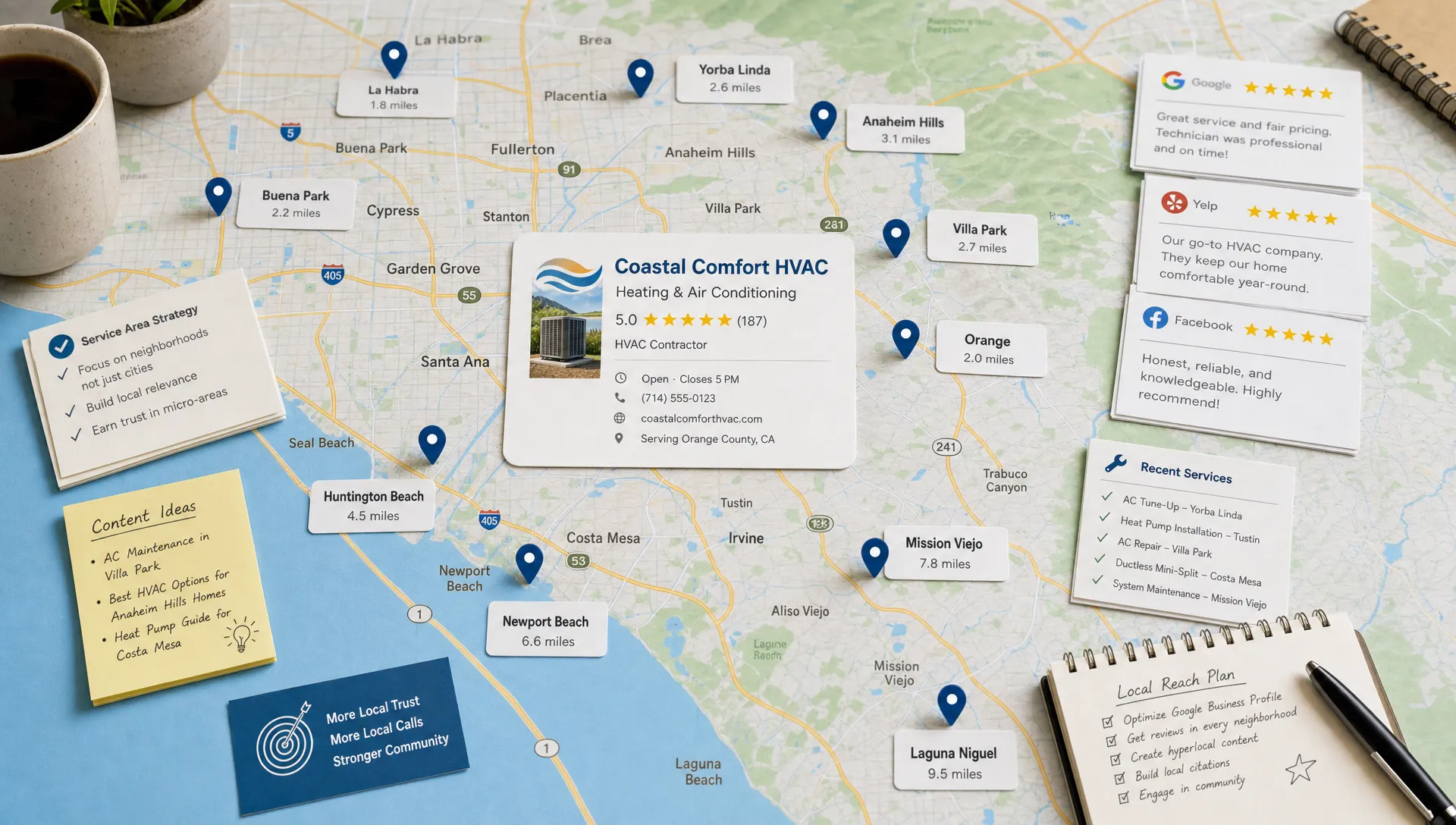
For Orange County businesses, specificity matters. “Serving Southern California” is broad. “Serving Laguna Beach, Laguna Niguel, Dana Point, Newport Beach, Irvine, and surrounding Orange County communities” gives both customers and search systems a clearer map.
If your business operates statewide, the same principle applies. A solar company targeting San Diego, Riverside, Fresno, Sacramento, and San Jose should not rely on one generic California page. Each market has different competitors, customer questions, permitting considerations, weather patterns, and buying triggers.
Build service pages around real customer intent
A weak service page says, “We offer plumbing services. Call us today.” A strong service page answers the questions a customer has before making a call.
For home services contractors, those questions often include:
- Do you handle emergencies?
- What areas do you serve?
- What types of systems or materials do you work with?
- How soon can someone come out?
- What are the signs I need repair versus replacement?
- What should I expect during the appointment?
- Do you have local reviews or project examples?
For medical, dental, and legal practices, the questions may be different:
- Which provider or attorney handles this issue?
- What happens during the first consultation or appointment?
- What documents or information should I bring?
- Which office location is closest to me?
- Do you serve clients in my city or neighborhood?
- What makes your practice credible in this specialty?
The page should not be overloaded with generic marketing language. It should be useful, direct, and structured in a way that supports both human readers and AI extraction.
A good local service page usually includes a clear headline, a concise summary, service-area details, common problems, your process, proof points, FAQs, and a strong call to action. When done well, this helps your business show up for searches like “roof leak repair Huntington Beach,” “AC tune-up Irvine,” “probate lawyer Orange County,” or “dentist near Santa Ana accepting new patients.”
Create local pages that are actually local
Location pages can be powerful, but only when they are built with care. A page that swaps out city names while repeating the same text over and over does not build trust. It can also make your brand look careless.
A useful location page should explain why your business is relevant to that specific community. For example, a roofing company in Anaheim might discuss common roofing materials in the area, seasonal leak risks, nearby service coverage, local project examples, and testimonials from customers in surrounding neighborhoods. A law firm in San Jose might clarify the office location, practice areas available there, consultation process, parking or accessibility notes, and attorney experience tied to that market.
For California businesses, this becomes especially important because competition varies dramatically by city. Irvine, Newport Beach, Santa Ana, Los Angeles, San Diego, San Francisco, Sacramento, Fresno, and Bakersfield each have different local search landscapes. A website that treats every market the same will struggle to establish strong neighborhood-level relevance.
This is where local SEO and answer engine optimization begin to overlap. The page should be written for the customer, but structured so machines can identify the service, location, expertise, and next action.
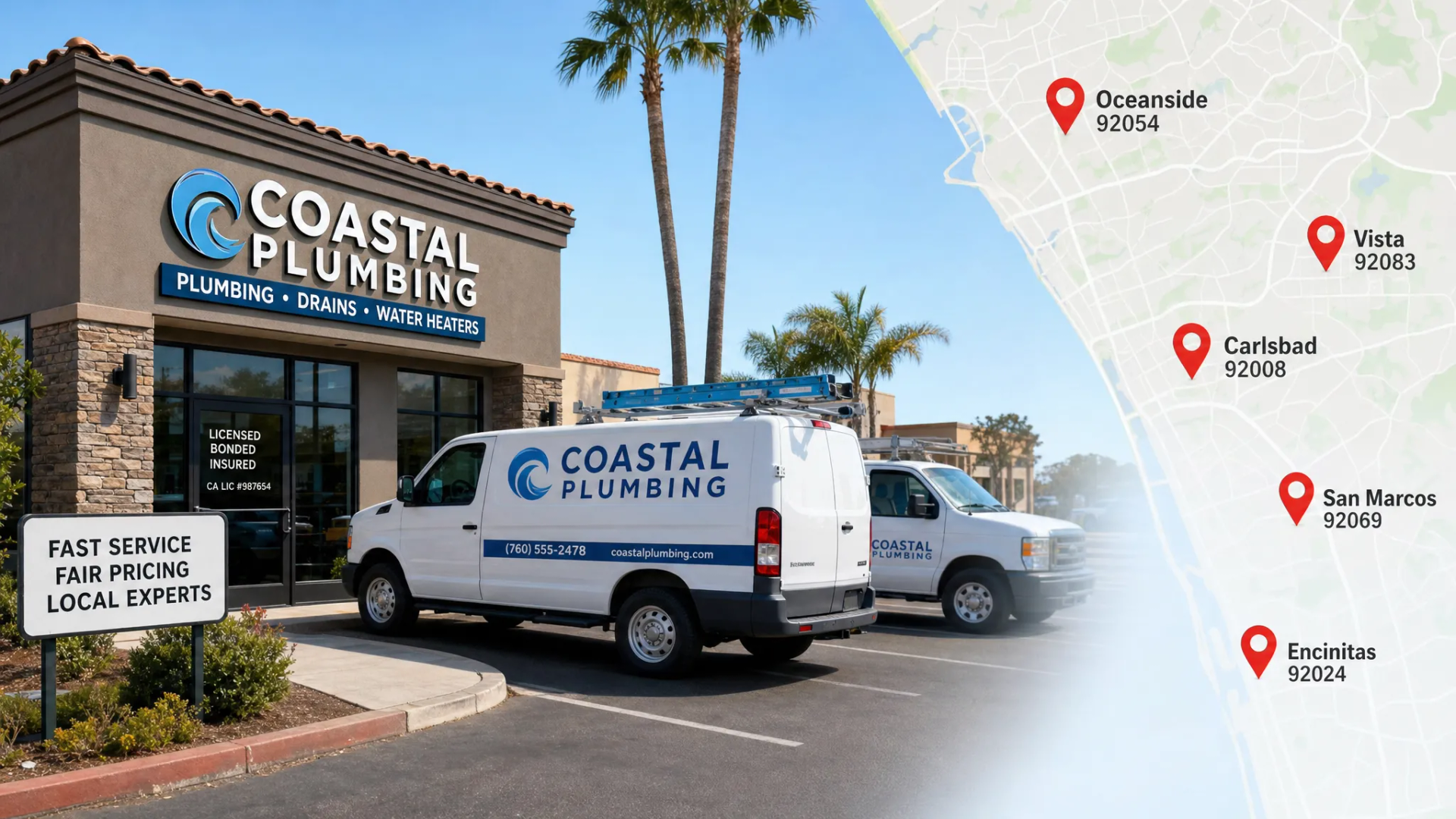
Make the website easy for machines to read
Modern visibility depends on machine readability. If AI systems, search crawlers, and local platforms cannot interpret your site cleanly, your business may be overlooked even if your services are excellent.
Technical website solutions that support findability include:
- Clean page structure with descriptive headings.
- Fast loading on mobile devices.
- Clear internal linking between services, locations, and supporting content.
- Accurate title tags and meta descriptions.
- Proper indexation so important pages can be crawled.
- Structured data such as LocalBusiness, Service, FAQ, Review, and Organization markup where appropriate.
- Consistent NAP details across the website and local listings.
Structured data is not a magic ranking trick. It is a clarity tool. It helps search engines understand what your content represents. For example, a properly structured emergency plumbing page can clarify the business, service type, service area, phone number, and frequently asked questions.
For AI-era visibility, clarity is the advantage. A vague website forces systems to guess. A well-structured website reduces ambiguity.
Use trust proof that customers and AI can verify
Local customers want proof before they call. Search engines and AI systems also look for signals that your business is legitimate, established, and relevant.
Trust-building website elements include recent reviews, customer testimonials, project photos, before-and-after examples, case studies, awards, certifications, team bios, media mentions, and clear contact information. These should not be hidden on one page. They should appear naturally across the site where they support decisions.
For example, an HVAC repair page can feature reviews specifically about fast response times, clean workmanship, or successful repairs. A dental implant page can include provider credentials, patient education, and relevant testimonials. A legal practice area page can highlight attorney experience, consultation expectations, and client-centered process details without making unsupported guarantees.
Video can also strengthen trust when it is done professionally. A contractor might show a walkthrough of a completed remodel. A medical practice might introduce providers and explain what new patients can expect. A professional services firm might use a short brand film to humanize its expertise. For inspiration on how video can present a business visually, see these cinematic business promo and showreel examples from filmmaker Ami Bornstein.
The key is authenticity. Real proof from real work is far more persuasive than generic stock imagery and vague claims.
Connect your website to your Google Business Profile
Your website and Google Business Profile should reinforce each other. When they conflict, local visibility suffers.
For a local service business, the website should support the categories, services, locations, photos, and business information listed in the profile. Your service pages should align with your actual service menu. Your location pages should align with real offices or legitimate service areas. Your reviews should reflect the same customer experience described on your site.
This matters because Google’s local results are influenced by relevance, distance, and prominence. A well-built website strengthens relevance by clarifying services and locations. Reviews and local authority strengthen prominence. Accurate location information supports distance matching.
Kell Web Solutions addresses this foundation through Local SEO Mastery, which includes Google Business Profile optimization, local content, citation management, and ongoing visibility work for defined service areas.
Add answer-ready content for AI search and voice search
Customers increasingly ask complete questions, not just keyword fragments. They ask things like:
- “How do I know if my AC compressor is failing?”
- “Who replaces old electrical panels in Orange County?”
- “What should I ask before hiring a roofing contractor in Irvine?”
- “When should I call a probate attorney in California?”
- “What is the difference between a dental crown and an implant?”
Answer-ready content helps your business appear when search engines and AI platforms summarize information. This does not mean writing shallow FAQ pages for every possible query. It means creating helpful pages and articles that answer the questions your best customers already ask.
Strong answer-ready content is usually:
- Specific enough to be useful.
- Clear enough to be quoted or summarized.
- Connected to a relevant service page.
- Written in natural language.
- Supported by local context and business expertise.
This is the core idea behind Answer Engine Optimization. Traditional SEO focuses heavily on rankings and clicks. AEO focuses on helping AI-driven platforms understand, trust, and select your business as the answer when customers ask buying-intent questions.
For local companies, this distinction is important. If a homeowner asks a voice assistant for the best emergency HVAC company nearby, the winning business is not necessarily the one with the longest blog post. It is the one with the clearest authority signals, local relevance, reviews, structured information, and conversion path.
Do not ignore conversion: Visibility must become calls
A website can be easy to find and still fail if it is hard to contact the business.
Local customers are often impatient. If they are dealing with a broken AC system, roof leak, electrical issue, legal deadline, or dental pain, they do not want to hunt for a phone number. The site should make action obvious.
High-converting local websites typically include:
- A visible phone number on every page.
- Mobile click-to-call buttons.
- Short forms that ask only what is necessary.
- Appointment or consultation options when appropriate.
- Clear calls to action based on urgency.
- Trust reminders near conversion points.
- Tracking that distinguishes calls, forms, and booked appointments.
For contractors, the primary conversion may be a phone call or estimate request. For professional practices, it may be a consultation, appointment, or intake form. For multi-location organizations, routing matters. A visitor from San Francisco should not be forced through the same generic path as someone in Orange County if the service, office, or intake team differs.
Kell Web Solutions also offers Profit Accelerator, a managed AI outreach system designed to help fill calendars with qualified, pre-warmed conversations. That type of system works best when the website is already clear, credible, and aligned with the customer journey.
Expand authority beyond one website when the market is competitive
In competitive California markets, one website may not create enough local signal on its own. This is especially true for contractors competing across multiple neighborhoods or cities.
A roofing company trying to win in Irvine, Costa Mesa, Newport Beach, and Anaheim needs more than a homepage that says “serving all of Orange County.” A plumbing company in San Diego or an HVAC provider in Sacramento may need a deeper local footprint to support visibility across service areas.
This is where distributed local authority can help. Instead of relying only on one main website, businesses can build supporting assets that strengthen neighborhood relevance, answer specific local questions, and point authority back to the main brand.
Kell Web Solutions’ Hyperlocal Authority Builder is designed around this concept for home services businesses. It combines local authority assets, researched content, and review-driven trust signals to help contractors become more visible at the neighborhood level.
The principle is simple: if customers search locally and AI systems evaluate local authority, your digital footprint should reflect the markets you actually want to win.
A 90-day plan to make your local website easier to find
Improving findability does not require rebuilding everything at once. Most local businesses can make meaningful progress by focusing on the right sequence.
| Timeline | Focus | Practical actions |
|---|---|---|
| Days 1 to 30 | Clarity and technical cleanup | Audit service pages, contact details, Google Business Profile alignment, mobile speed, crawlability, and top conversion paths |
| Days 31 to 60 | High-intent content | Improve core service pages, build or rewrite priority location pages, add FAQs, strengthen internal links, and add trust proof |
| Days 61 to 90 | Authority and measurement | Publish local answer-ready content, improve review integration, add structured data, track calls and forms, and identify next markets to expand |
The most important step is choosing priorities based on revenue. A contractor should start with the services that produce profitable jobs. A law firm should start with the practice areas that generate qualified consultations. A dental group should start with treatments and locations where demand and capacity align.
Avoid the temptation to publish dozens of thin pages quickly. Quality, specificity, and proof matter more than volume.
Common mistakes that make local businesses harder to find
Many local websites fail because of avoidable issues. The business may be excellent, but the site does not communicate that excellence clearly.
Common problems include generic service pages, inconsistent contact information, slow mobile performance, buried phone numbers, duplicate location content, missing reviews, no structured data, unclear service areas, outdated photos, and blogs that answer broad questions but never connect to local buying intent.
Another major mistake is separating design from search strategy. A beautiful website that search engines cannot understand will underperform. A keyword-heavy website that customers do not trust will also underperform. The strongest websites combine design, findability, proof, and conversion into one system.
That is the difference between having a website and having a local growth asset.
How Kell Web Solutions helps California businesses get found
Kell Web Solutions is based in Orange County and has supported local marketing for more than 20 years. The company works with home services contractors, multi-location practices, and California businesses that depend on being found in specific cities and neighborhoods.
The approach starts with understanding how customers actually ask for help, then aligning the website, local SEO, answer engine optimization, content, and authority signals around those real questions. For some businesses, the right move is foundational local SEO. For others, it is AEO, hyperlocal authority building, or a stronger conversion system. And in some cases, the honest answer is that a business needs website clarity before investing in more advanced visibility campaigns.
If your company serves Orange County, Los Angeles, San Diego, San Jose, Sacramento, Fresno, or another competitive California market, your website should do more than exist. It should help the right customers find you, trust you, and contact you.
Frequently Asked Questions
What are website solutions for local businesses? Website solutions for local businesses include web design, service page strategy, location pages, technical SEO, structured data, local content, review integration, Google Business Profile alignment, and conversion improvements that help customers find and contact the business.
How does a website help with local search visibility? A website helps local search visibility by clarifying what the business does, where it operates, which services it offers, and why customers trust it. Search engines use that information alongside reviews, local listings, proximity, and authority signals.
Do local businesses still need a website if they have a Google Business Profile? Yes. A Google Business Profile is important, but your website gives search engines and customers deeper proof. It supports service detail, location relevance, FAQs, case studies, team information, and conversion paths that a profile alone cannot fully provide.
What is the difference between SEO and AEO for a local website? SEO helps your site rank in traditional search results. AEO helps your business become understandable and trustworthy enough to be selected or cited by AI answer engines, voice assistants, and AI-powered search experiences.
How often should a local business update its website? A local business should review key pages at least quarterly and update service details, reviews, photos, FAQs, team information, and location content whenever something changes. Competitive markets may require more frequent content and authority updates.
What should contractors prioritize first? Contractors should start with profitable service pages, accurate service-area information, mobile click-to-call performance, reviews, project proof, and Google Business Profile alignment. These usually have the most direct impact on calls and estimate requests.
Make your website easier to find, understand, and choose
If your local website is not generating the calls, consultations, or booked jobs you expected, the problem may not be traffic alone. It may be clarity, trust, structure, or conversion.
Kell Web Solutions helps California businesses build website and visibility systems for the way customers search now, including local SEO, Answer Engine Optimization, hyperlocal authority, and managed lead generation support.
To discuss whether your website is helping or hiding your business, contact Kell Web Solutions at (949) 575-8553 or explore the Answer Engine Optimization service to see how your business can become easier for customers and AI systems to find.