Search Engine Optimization Information Local Businesses Need
Search engine optimization information is only useful when it helps a local business win better calls, appointments, and jobs. For a contractor, medical practice, dental office, law firm, or multi-location professional service, SEO is not an abstract marketing channel. It is the system that helps nearby buyers understand who you are, where you serve, what you do best, and why they should trust you before they call.
That system has changed. A few years ago, local SEO mostly meant ranking a website page and keeping a Google Business Profile active. In 2026, your business also needs to be clear enough for Google Maps, AI Overviews, voice assistants, ChatGPT-style answer engines, and local directories to interpret you correctly. If those systems cannot confidently understand your business, they are less likely to surface you when someone asks, “best HVAC repair near Irvine,” “emergency plumber Laguna Niguel,” or “dental implant consultation in San Jose.”
The good news is that local SEO is still manageable when you focus on the right information. You do not need to chase every algorithm update. You need to build a digital presence that is accurate, locally relevant, trusted, and easy for both people and machines to understand.
Local SEO is no longer just about keywords
Keywords still matter, but they are no longer the whole game. A local customer rarely thinks in SEO terms. They think in problems, urgency, location, and trust.
A homeowner in Huntington Beach may search for “AC not cooling upstairs.” A property manager in Sacramento may ask a voice assistant for “commercial electrician open now.” A patient in Laguna Beach may compare “best dentist for veneers near me.” Each query has a different level of urgency, value, and conversion potential.
Search engines now evaluate far more than whether a page repeats a phrase. Google’s own local ranking documentation explains that local results are influenced by relevance, distance, and prominence. In practice, that means your business must prove three things clearly:
- You provide the exact service the customer wants.
- You serve the location where the customer needs help.
- You have enough credibility to be a safe recommendation.
That is why the most important search engine optimization information for local businesses is not a list of random keywords. It is a clear picture of how customers search, how Google understands your entity, and which trust signals make you the obvious local choice.
The SEO information every local business should know
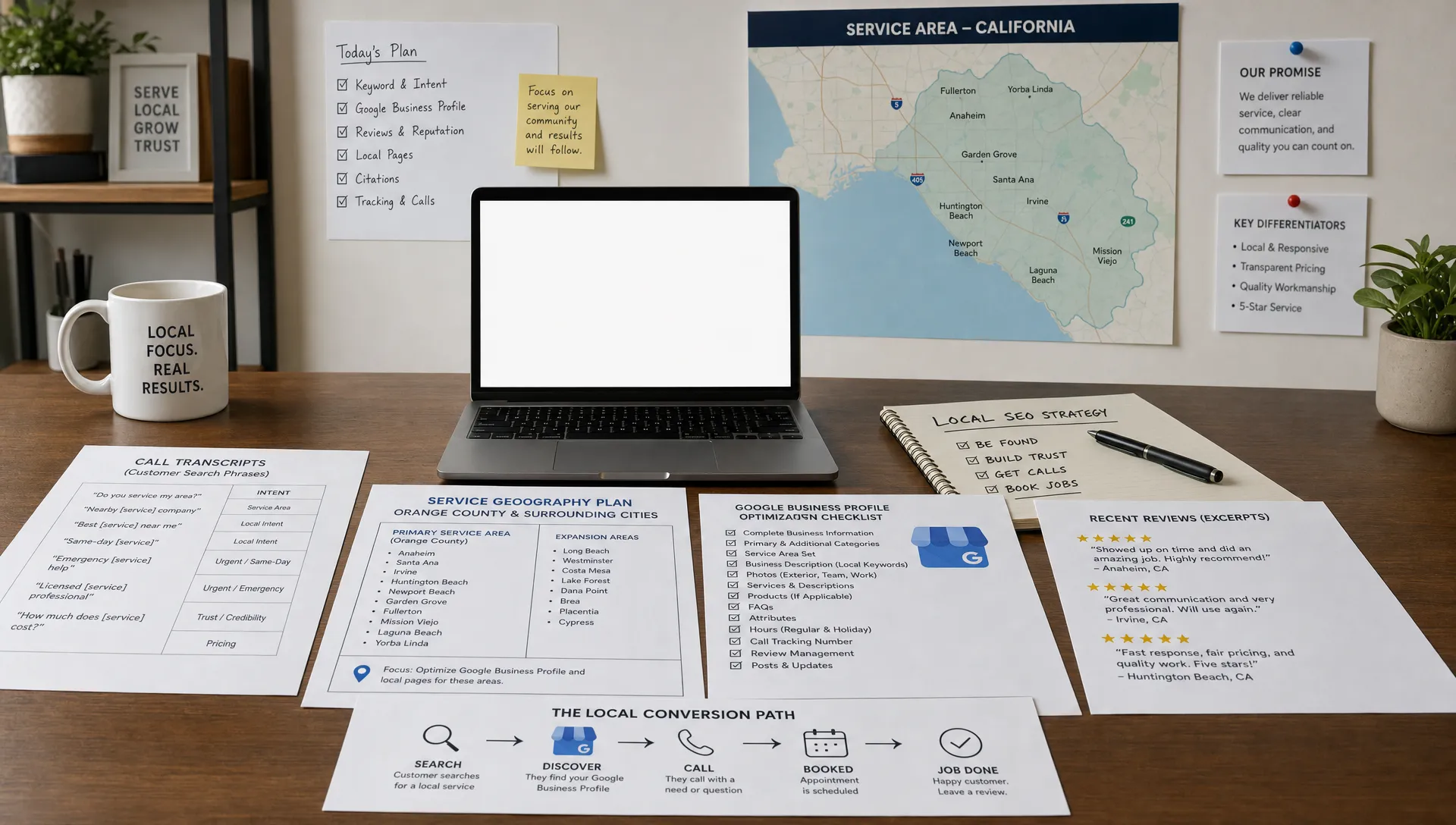
Local SEO becomes easier when you stop treating it as a mystery and start treating it as business intelligence. The information below should guide your website, Google Business Profile, content, review strategy, and answer engine visibility.
How customers describe the problem
Your best SEO ideas often come from real conversations, not keyword tools alone. Listen to the language customers use on phone calls, estimate requests, emails, intake forms, and reviews.
For home services, customers often describe symptoms before services. They search for “water heater leaking,” “roof tiles blown off,” “breaker keeps tripping,” or “solar panels not producing.” For professional practices, people may search by concern, outcome, insurance, neighborhood, or urgency.
Your website should reflect both expert terminology and customer language. A roofing company can have a “roof repair” service page, but it should also answer questions about leaks, missing shingles, storm damage, tile cracks, and inspection timelines. This gives search engines more context and gives buyers more confidence.
Which cities and neighborhoods actually produce revenue
Local SEO should not target geography randomly. A contractor based in Orange County may want visibility in Laguna Niguel, Irvine, Newport Beach, Anaheim, and Huntington Beach, but not every city produces the same job value or close rate.
Before expanding content across California markets, identify the locations that matter most. For a remodeling firm, a few high-value neighborhoods may outperform a broader county-wide approach. For a multi-location dental group, each office may need its own neighborhood catchment strategy. For a law firm, the strongest opportunities may cluster near courts, business districts, or affluent suburbs.
This is where local SEO becomes more strategic than simply adding city names to pages. Each geography needs a reason to exist in your content. If you want more jobs in Irvine, San Diego, San Jose, Fresno, or Sacramento, your online presence should show real service relevance for that market.
Whether your business entity is clear
A business entity is the machine-readable identity of your company. It includes your name, address, phone number, categories, services, locations, staff, credentials, reviews, content, and mentions across the web.
When this information is inconsistent, search systems hesitate. If your Google Business Profile lists one category, your website emphasizes another, and directories show outdated phone numbers, you create uncertainty. AI-driven search makes this even more important because answer engines prefer sources that are consistent, well-structured, and easy to verify.
Your entity information should be consistent across your website, Google Business Profile, citations, social profiles, review platforms, and local content. This is foundational, not optional.
What your Google Business Profile proves
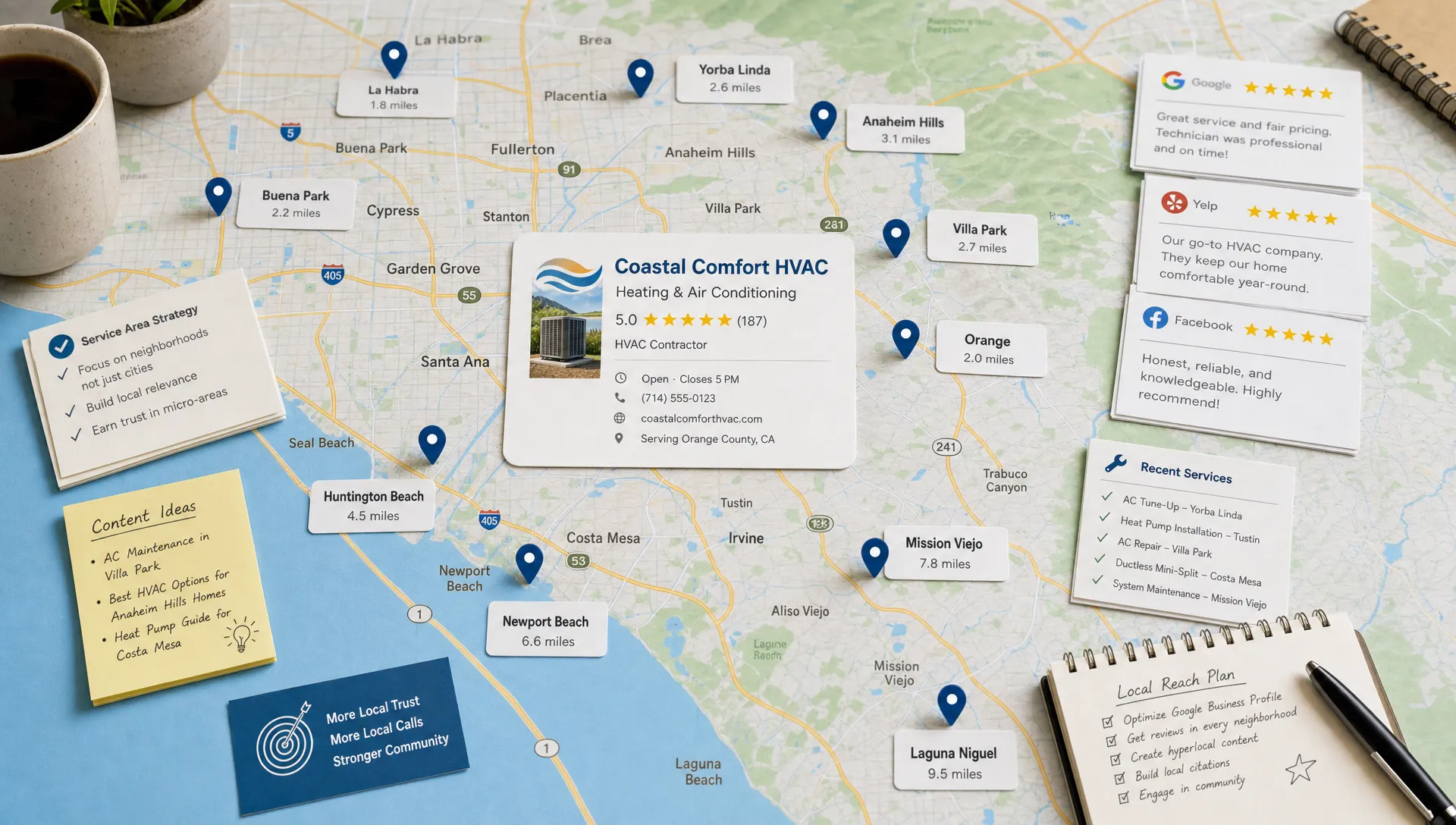
For many local buyers, your Google Business Profile is the first impression. It may be seen before your website, especially on mobile searches and map results.
A strong profile does more than list your address. It reinforces categories, services, service areas, hours, photos, reviews, updates, and call options. It also sends engagement signals when users click, call, request directions, read reviews, or visit your site.
If your profile is thin, outdated, or inconsistent with your website, you weaken both local search visibility and customer trust. A profile for an HVAC company in Santa Ana, for example, should clearly support the services and nearby areas that company wants to win. A multi-location medical practice should make each office distinct, complete, and aligned with the correct services.
Which pages answer buyer questions
Google’s SEO Starter Guide emphasizes creating helpful, reliable content for users. For local businesses, that means your pages should answer the questions people ask before they call.
A service page should not simply say, “We provide plumbing services in Orange County.” It should explain what problems you solve, what areas you serve, what the customer can expect, what makes your team credible, and how someone can take the next step.
Good local pages often include:
- Specific services and situations handled.
- Local service areas and nearby communities.
- Trust proof such as reviews, licenses, experience, or project examples.
- Clear calls to call, book, or request an estimate.
- Helpful answers to common buyer objections.
If your website has traffic but few calls, the issue may not be rankings. It may be that your pages are not answering the right questions at the right moment.
How reviews support visibility and conversion
Reviews are not just social proof. They help search engines and buyers understand what your business is known for.
A steady pattern of specific, credible reviews can reinforce your services, locations, responsiveness, professionalism, and outcomes. A review that says “they fixed our AC in Laguna Niguel the same day” is more informative than a generic “great company.” Both can help, but detailed reviews provide richer context.
Local businesses should monitor review quantity, quality, recency, and themes. If reviews repeatedly mention emergency response, clean work, fair pricing, or a specific neighborhood, those themes can support both conversion and local relevance.
A practical SEO information checklist for local businesses
The table below summarizes the core information a local business should collect, review, and improve regularly.
| SEO Information Category | What to Review | Why It Matters | Practical Local Action |
|---|---|---|---|
| Customer search intent | Real phrases from calls, forms, reviews, and sales conversations | Reveals how buyers describe problems before they know the solution | Add natural question-based content to service pages and FAQs |
| Service geography | Cities, neighborhoods, and zip codes that produce profitable jobs | Prevents wasted effort on low-value locations | Prioritize pages and profiles around your best markets |
| Google Business Profile | Categories, services, photos, reviews, hours, posts, and service areas | Influences map visibility and first impressions | Keep the profile complete, accurate, and active |
| Website clarity | Service pages, location pages, calls to action, and trust proof | Helps visitors and search engines understand your authority | Make every key page answer who, what, where, why, and next step |
| Entity consistency | Name, address, phone, categories, schema, citations, and profiles | Reduces confusion across search and AI systems | Audit listings and align information across major platforms |
| Review signals | Recency, rating, response quality, and review content themes | Supports trust, relevance, and conversion | Ask consistently and respond professionally |
| Conversion performance | Calls, booked consultations, form fills, and lead quality | Shows whether SEO is producing business value | Track outcomes, not just traffic or rankings |
How this applies in Orange County and across California
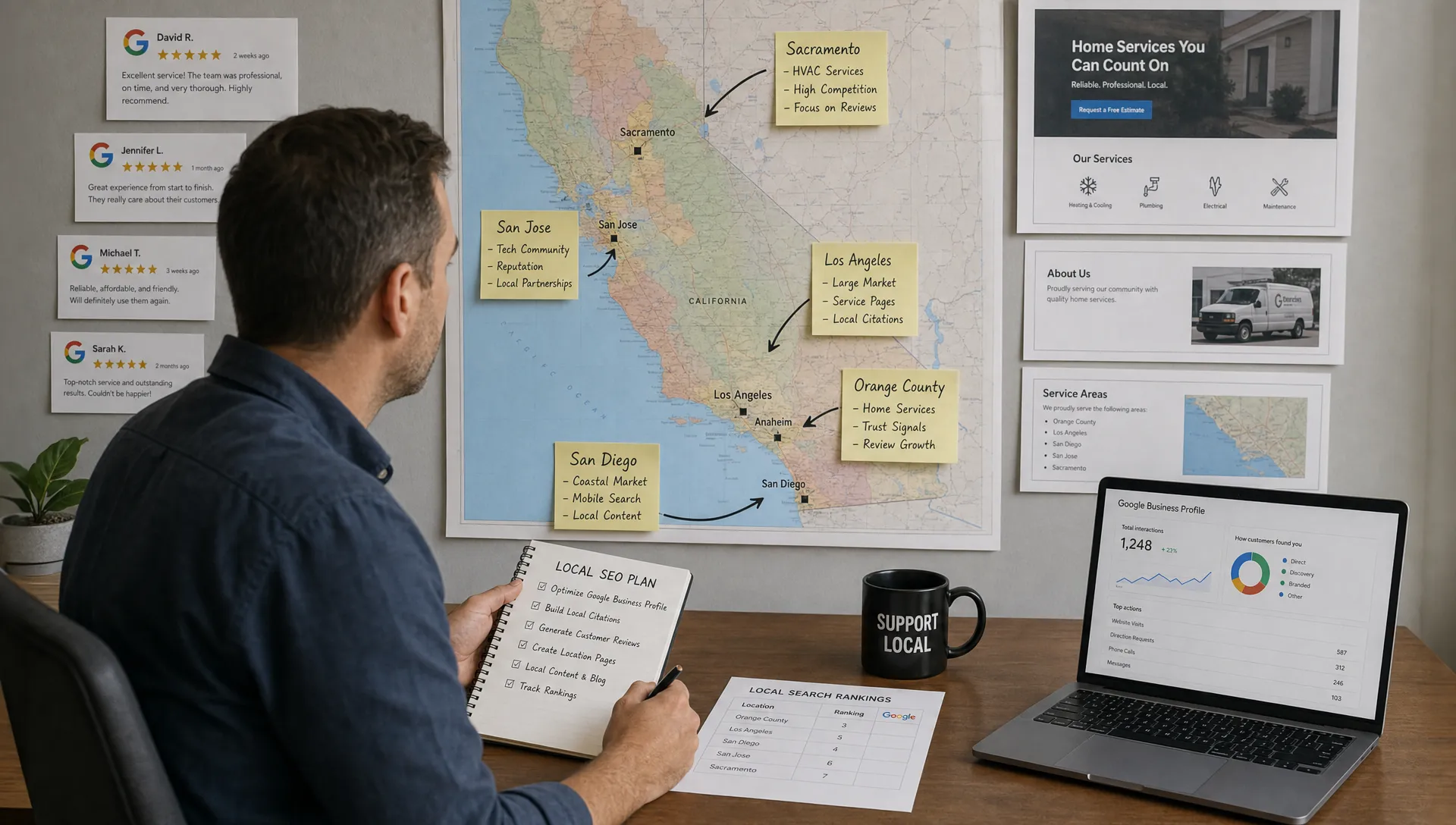
Local competition changes by market. A strategy that works in Laguna Beach may need adjustment in Los Angeles, San Diego, San Jose, or the Inland Empire.
In Orange County, buyers often compare reputation, response speed, and neighborhood familiarity. A contractor serving Laguna Niguel, Irvine, Newport Beach, and Huntington Beach needs content that feels local without becoming repetitive. Thin city pages that swap one place name for another rarely build trust.
In Los Angeles and San Diego, density and competition create a different challenge. A broad “Los Angeles plumber” strategy may be too general, while neighborhood-specific authority can capture more realistic demand. The same logic applies to professional practices competing in defined patient or client catchments.
In Northern California markets such as San Jose, San Francisco, Oakland, and Sunnyvale, search behavior may include more research before purchase. Tech-savvy buyers often compare credentials, reviews, process, pricing expectations, and speed. Content must be both technically clear and locally relevant.
In Central and Inland California markets such as Fresno, Sacramento, Bakersfield, Stockton, Riverside, and San Bernardino, businesses may have more room to build authority if they act early. Strong entity consistency, service-area clarity, and useful local content can create durable visibility before competitors catch up.
For a deeper look at how neighborhood visibility turns into booked work, Kell Web Solutions explains the practical mechanics in its guide to local search engine optimization that wins nearby jobs.
What changes when AI answers come first
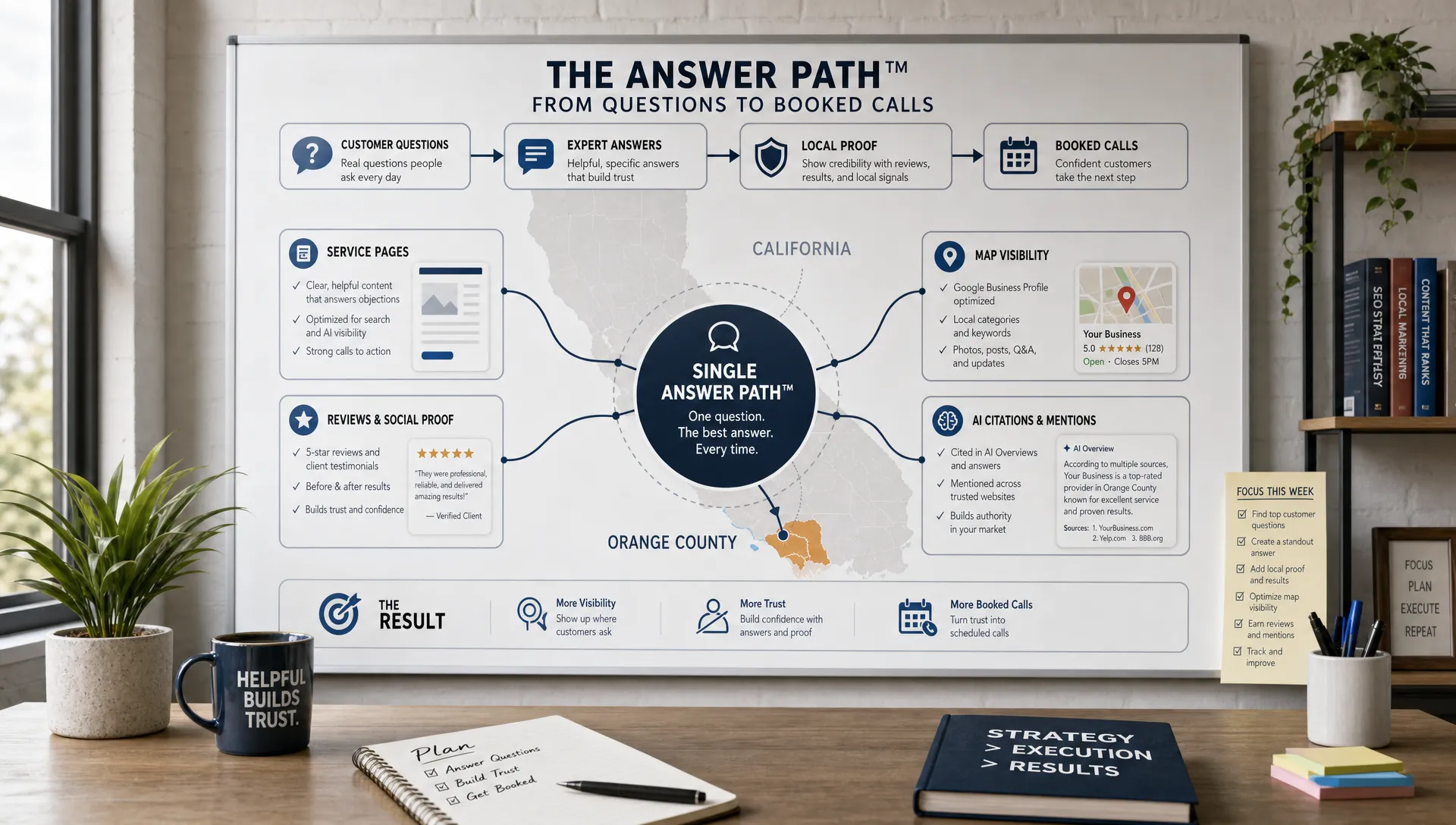
Search results are increasingly answer-driven. Customers may not click through ten blue links before deciding who to call. They may see an AI summary, ask a voice assistant, scan Google Maps, or compare snippets from multiple sources.
That means your business needs to be more than ranked. It needs to be understood.
Answer engines look for clear entities, trustworthy sources, structured information, and content that directly answers questions. If your website hides key information, uses vague language, or lacks proof, AI systems have less reason to cite or recommend you.
This is especially important for high-intent local searches. When someone asks, “Who is the best roofer near me for a tile roof leak?” an answer engine needs to understand service type, location, specialization, proof, and availability. The business with the clearest authority signals has an advantage.
Traditional SEO and answer engine optimization now overlap. Local businesses still need strong pages, profiles, reviews, and citations. But they also need content and structure that help AI systems identify them as a reliable answer. Kell Solutions’ approach to Answer Engine Optimization focuses on making a business easier for AI-driven platforms, Google AI results, and voice assistants to understand and trust.
Common SEO mistakes that cost local businesses calls
Many local businesses do some SEO work but miss the information that makes the work effective. The most common mistakes are not always technical. They are often strategic.
One mistake is targeting too many cities with too little substance. A page for “roof repair Irvine” should not be a duplicate of a page for “roof repair Anaheim” with only the city name changed. If the content does not explain local relevance, it may not help buyers or search systems.
Another mistake is treating Google Business Profile as a one-time setup. Profiles need ongoing attention. Photos, services, hours, posts, reviews, and responses all contribute to how complete and trustworthy the business appears.
A third mistake is tracking rankings without tracking calls. A keyword ranking is useful, but a qualified phone call is more important. If rankings improve but lead quality does not, the strategy may be attracting the wrong intent or sending visitors to weak pages.
Local businesses also lose ground when they ignore conversion. A slow website, vague call to action, hidden phone number, weak mobile layout, or generic service page can waste hard-earned visibility. SEO should not stop when someone lands on the site. It should guide them toward a confident next step.
Finally, many businesses wait until visibility declines before investing in authority. That is risky in competitive California markets. SEO compounds over time, especially when content, reviews, local profiles, and entity signals are maintained consistently. This is why durable visibility remains valuable even as search changes, a point explored further in Kell’s article on why search engine optimization for business still matters.
How to turn SEO information into action
The best local SEO strategy starts with a simple operating rhythm. You do not need to overhaul everything at once. You need a consistent way to identify gaps and improve the signals that matter.
Start by reviewing your most valuable services and locations. Which jobs are most profitable? Which cities produce the best customers? Which services do you want more of this quarter? This helps you avoid wasting content on low-priority topics.
Next, compare your website and Google Business Profile against those priorities. If emergency HVAC repair in Irvine is a priority, your pages, profile categories, service descriptions, reviews, and calls to action should all support that goal.
Then audit your proof. Do your reviews mention the services and locations you want to win? Do your pages show experience, credentials, project examples, process clarity, and local familiarity? Buyers need reassurance before they call, and search systems use trust signals to evaluate prominence.
Finally, measure what matters. Traffic is useful, but local businesses should pay close attention to calls, form fills, booked appointments, close rates, and job value. The purpose of SEO is not to look busy in analytics. It is to create profitable local demand.
Frequently Asked Questions
What is the most important search engine optimization information for a local business? The most important information is how your ideal customers search, which services and locations produce revenue, whether your business information is consistent, and which pages or profiles convert visitors into calls.
Does a local business still need SEO if it has a Google Business Profile? Yes. A Google Business Profile is important, but it works best when supported by a clear website, consistent citations, helpful content, strong reviews, and accurate entity information across the web.
How is local SEO different from regular SEO? Local SEO focuses on visibility for location-based searches, map results, service areas, reviews, proximity, and local trust. Regular SEO may target broader informational or national queries without the same emphasis on geography.
How often should local SEO information be reviewed? Important information such as Google Business Profile accuracy, reviews, calls, lead quality, and priority locations should be reviewed monthly. Website content and broader strategy should be reviewed at least quarterly.
Do AI search results change local SEO strategy? Yes. AI search makes clarity, authority, structured information, and direct answers more important. Businesses need to be easy for both people and answer engines to understand, verify, and recommend.
Build local visibility that turns into confident calls
If your business depends on local calls, appointments, or estimate requests, the right SEO information can show you exactly where visibility is breaking down. It can also reveal where stronger content, reviews, profiles, and answer-ready structure can create a durable advantage.
Kell Web Solutions helps Orange County and California businesses connect local SEO, Answer Engine Optimization, and conversion-focused strategy so search visibility turns into real revenue opportunities. If you want to understand where your business stands today and what needs to improve next, schedule a strategy conversation with Kell Solutions.