Website Advertising That Turns Visits Into Qualified Calls
Traffic is not the win. A ringing phone with the right person on the other end is the win.
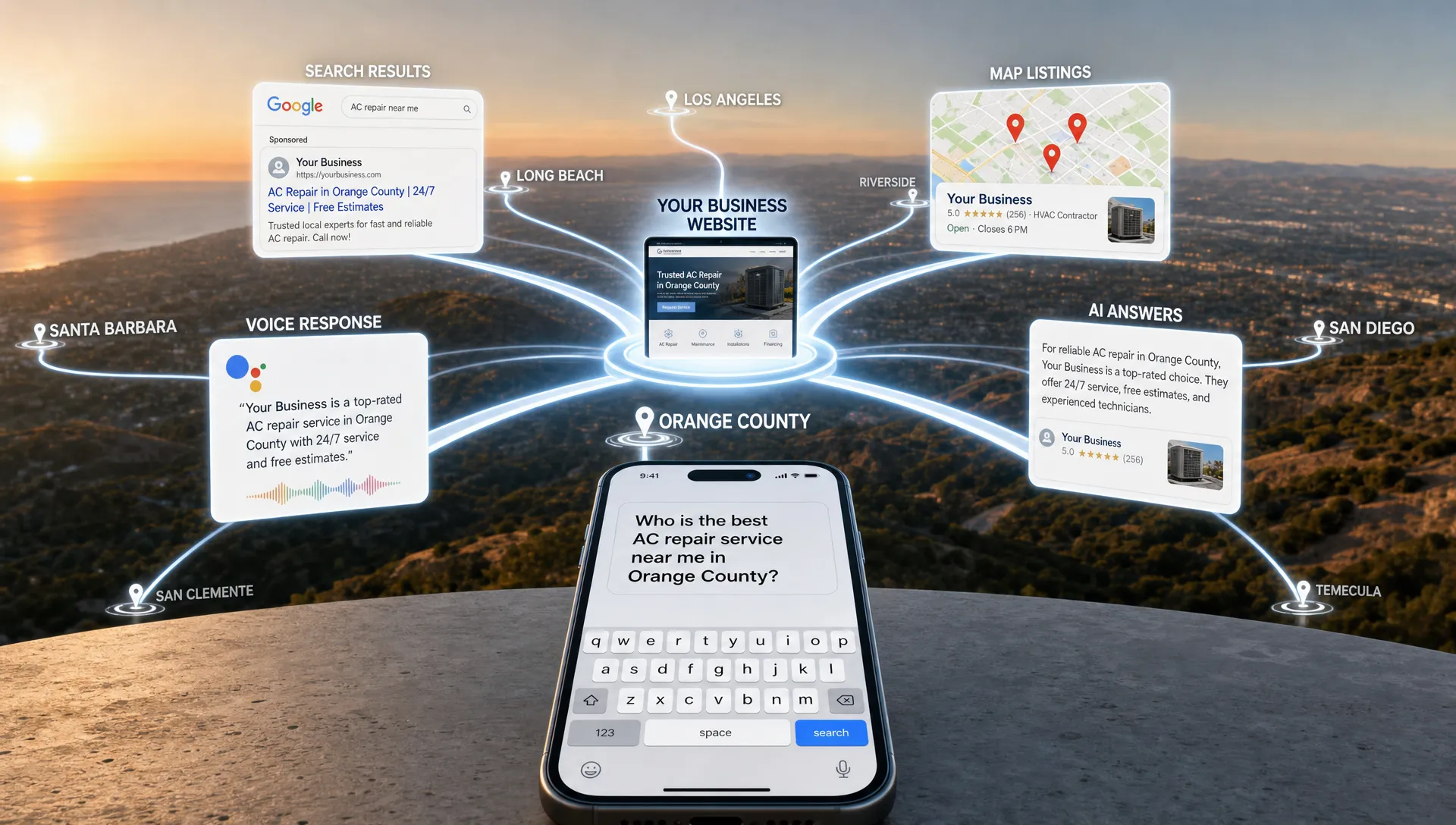
For California contractors and multi-location professional practices, website advertising has changed. Buying clicks is no longer enough, especially when AI answers, map results, Local Services Ads, and voice assistants can intercept the customer before they ever browse a traditional website. The businesses that grow are the ones that connect every visit to a clear next action: call, schedule, request an estimate, or start a qualified consultation.
That means your website cannot function like a digital brochure. It has to work like a call-generation system, built around intent, trust, geography, and fast response.
What website advertising should mean in 2026
Website advertising is often treated as traffic generation. A business runs Google Ads, posts on social media, optimizes a Google Business Profile, publishes a few service pages, and hopes the phone rings. That approach leaves too much to chance.
A stronger definition is this: website advertising is the complete system that attracts the right local visitor, proves you are the right choice, and makes the next call feel obvious.
For an HVAC company in Irvine, that may mean a visitor searching for same-day AC repair lands on a page that speaks directly to their city, urgency, equipment problem, and trust concerns. For a dental group in San Jose, it may mean a prospective patient comparing providers sees credentials, locations, accepted services, reviews, and a clear consultation path without having to dig.
The difference between a visit and a qualified call usually comes down to four questions:
- Does the page match the visitor's exact problem?
- Does the visitor believe you serve their city or neighborhood?
- Does the page prove enough trust before asking for action?
- Does the call path remove friction and qualify the opportunity?
When those pieces line up, traffic becomes revenue potential. When they do not, more advertising often just creates more waste.
Why website visits fail to become qualified calls
Most businesses do not have a traffic problem first. They have an intent and conversion problem. They attract visitors who are researching, browsing, outside the service area, comparing prices only, or uncertain whether the company handles their specific need.
The website then makes the problem worse by giving every visitor the same page, the same generic message, and the same vague call to action.
| Conversion gap | What visitors experience | Better website advertising fix |
|---|---|---|
| Generic landing pages | The page says services are available but does not match the searcher's city, urgency, or job type | Build focused pages for high-value services and priority locations |
| Weak trust proof | Visitors cannot quickly verify reviews, credentials, experience, or local relevance | Place reviews, proof points, project examples, and local signals near calls to action |
| Poor call visibility | The phone number is hard to find, especially on mobile | Use prominent click-to-call buttons, sticky mobile CTAs, and clear next-step copy |
| Unqualified inquiries | The site invites everyone to call without clarifying fit | Add qualifying cues such as service area, project type, emergency availability, and consultation expectations |
| Missed follow-up | Calls, forms, and chats are not tracked or answered consistently | Measure call source, missed calls, booked outcomes, and response speed |
| AI visibility gaps | Answer engines and voice assistants do not clearly understand the business | Strengthen entity signals, structured data, FAQs, and authority content |
A visitor who needs a roof repair in Huntington Beach should not land on a broad home page that talks about quality craftsmanship in general terms. A family searching for an orthodontist near a specific Irvine neighborhood should not have to guess which location is closest or whether the practice offers the treatment they need.
The more specific the visitor's problem, the more specific the advertising experience must be.
The call-first framework for website advertising
A call-first advertising system does not begin with a budget. It begins with the customer journey.
Before spending more on ads, a business should know which calls are most valuable, which locations produce the best jobs or clients, which questions prospects ask before calling, and which trust barriers stop people from taking action. This is especially important in Orange County, Los Angeles, San Diego, San Jose, Fresno, Sacramento, and other competitive California markets where local intent can change block by block.
Match the promise to the page
Every ad, search result, GBP post, social post, or AI citation makes a promise. The landing page must deliver on that promise immediately.
If the ad says emergency plumbing in Anaheim, the page should not open with a generic company history. It should confirm emergency plumbing, Anaheim coverage, response expectations, proof of trust, and the fastest way to call. If the search result is about estate planning consultation in Laguna Niguel, the page should address consultation fit, attorney credentials, local relevance, and the next step.
Strong pages answer the visitor's silent objections before the phone rings:
- Can this company solve my exact problem?
- Do they serve my area?
- Are they credible enough to call?
- What happens after I call?
- Will this be worth my time?
That is not just copywriting. It is conversion strategy.
Build one page for one decision
A common mistake is sending every campaign to the same home page. The home page has a job, but it is rarely the best destination for high-intent advertising.
A better structure uses focused landing pages by service, city, and decision stage. For example, an HVAC company may need separate experiences for AC repair, heat pump installation, indoor air quality, and maintenance plans. A legal or medical practice may need pages for each practice area, each location, and each major patient or client concern.
The point is not to create thin doorway pages. The point is to create useful, locally relevant pages that help real people decide faster.
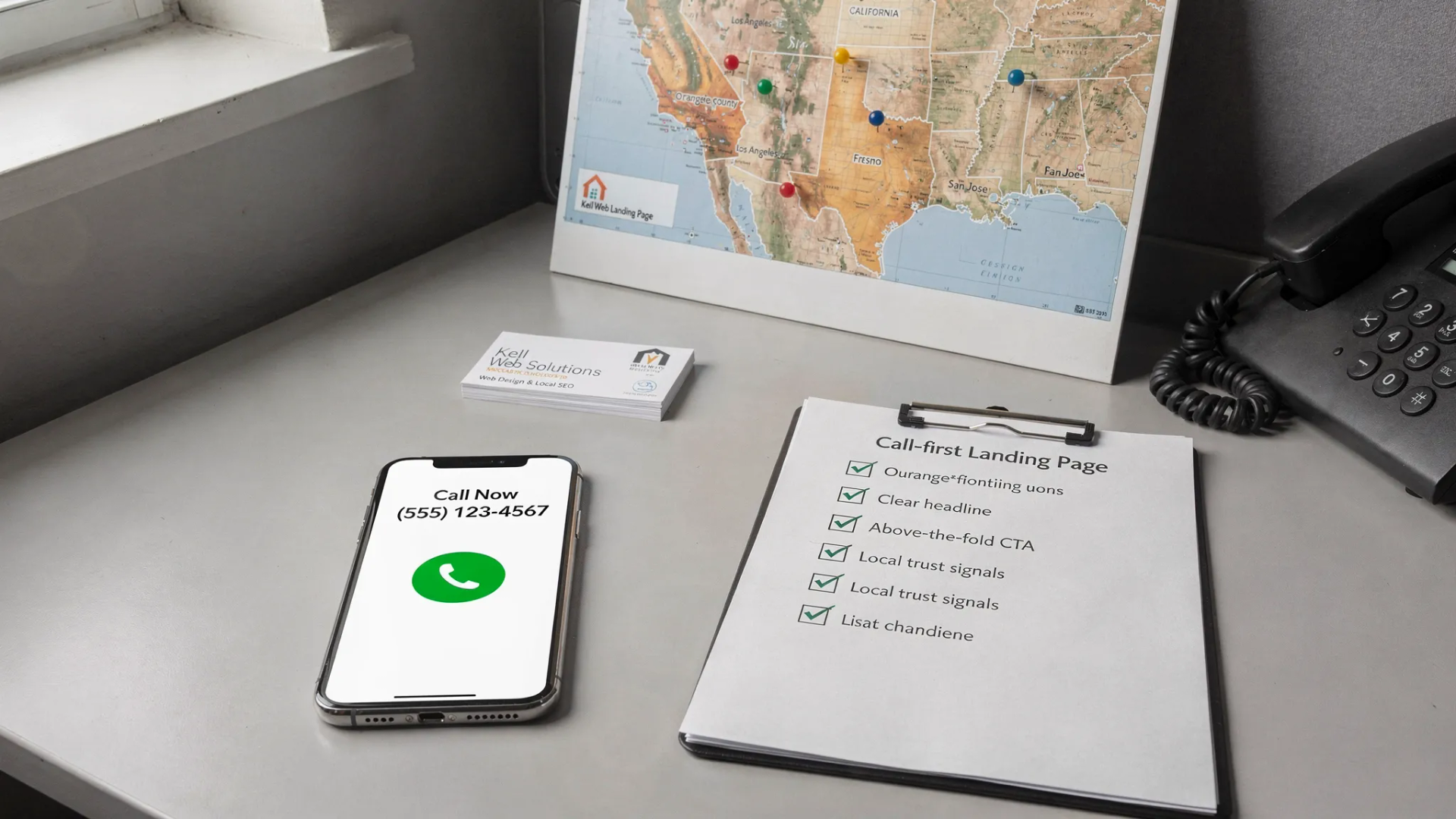
A good call-focused page usually includes a clear headline, visible phone number, local service confirmation, proof of results or experience, common questions, risk reducers, and a direct next step. It should also load quickly and work flawlessly on mobile, because many high-intent local calls happen from a phone in the moment of need.
Put trust before the call button
Visitors do not call simply because a button exists. They call because they believe the business is safe, credible, and relevant.
For home services contractors, trust can come from local reviews, project photos, technician professionalism, service guarantees, financing information, licensing references, and neighborhood-specific experience. For medical, dental, and legal practices, trust may come from provider bios, credentials, patient or client testimonials, office photos, clear intake expectations, and privacy-conscious messaging.
Trust signals work best when they appear near decision points. A review widget hidden at the bottom of a page helps less than a concise review summary near the phone CTA. A license badge on an about page helps less than local proof placed where the visitor is deciding whether to call.
This is where website advertising and reputation marketing meet. Ads create attention. Proof converts attention into action.
Make the website answer-engine ready
A growing share of discovery now happens through AI summaries, voice assistants, and answer engines. These systems look for clear entities, consistent facts, structured information, and authoritative sources. If they cannot understand what your business does, where it operates, and why it is credible, your visibility can weaken even if your website looks good to humans.
Kell Web Solutions' Answer Engine Optimization focuses on making a business easier for AI-driven platforms to understand, trust, and recommend. That includes clarifying services, locations, expertise, FAQs, schema, and authority signals across the business's digital footprint.
If you want a diagnostic view of how AI assistants mention and summarize your brand, an AI visibility platform can help identify blind spots across tools like ChatGPT, Gemini, Claude, and Perplexity.
For local businesses, this matters because AI visibility is no longer separate from call generation. If an answer engine recommends a competitor when a homeowner asks who to call for AC repair in Irvine, that is a lost opportunity before your website ever loads.
Close the loop with call capture and qualification
The final step is the one many campaigns ignore: what happens when the phone rings.
A call-first website needs tracking that connects traffic source to call quality. It should show which campaigns, pages, locations, and keywords produce real opportunities, not just form fills or pageviews. It should also reveal missed calls, repeat callers, call duration, booked appointments, and revenue where possible.
The goal is not only more calls. The goal is more qualified calls that match your service area, job type, availability, and revenue model.
How to qualify calls before the phone rings
The best websites do some qualification before a prospect ever speaks to your team. That does not mean creating barriers. It means setting expectations so the right people feel more confident calling and the wrong-fit inquiries self-select out.
| Qualification signal | Home services example | Professional practice example | Website element |
|---|---|---|---|
| Location fit | Serves Laguna Beach, Irvine, Anaheim, Huntington Beach, and nearby cities | Offices in Orange County, San Jose, or Los Angeles with location-specific intake | Service area sections and location pages |
| Problem fit | AC not cooling, roof leak, panel upgrade, bathroom remodel | Dental implants, family law consultation, estate planning, specialty care | Service-specific landing pages |
| Urgency | Same-day repair, emergency service, scheduled estimate | New patient appointment, urgent legal consultation, follow-up evaluation | Clear CTA language and intake expectations |
| Decision stage | Ready for estimate, comparing contractors, planning a project | Ready to consult, researching options, comparing providers | Page copy for research and ready-to-call visitors |
| Trust requirement | Reviews, project photos, warranties, local experience | Credentials, testimonials, provider bios, privacy assurances | Proof blocks near CTAs |
| Value fit | Repair versus replacement, premium remodel, maintenance plan | Self-pay, insurance, retainer, consultation type | Transparent scope guidance without overpromising |
This approach improves both sides of the call. Prospects know they are in the right place. Your team spends less time sorting through weak inquiries. Advertising data becomes more useful because you can see which traffic sources produce conversations worth pursuing.
The California local layer: why geography changes conversion
A single California marketing message rarely works everywhere.
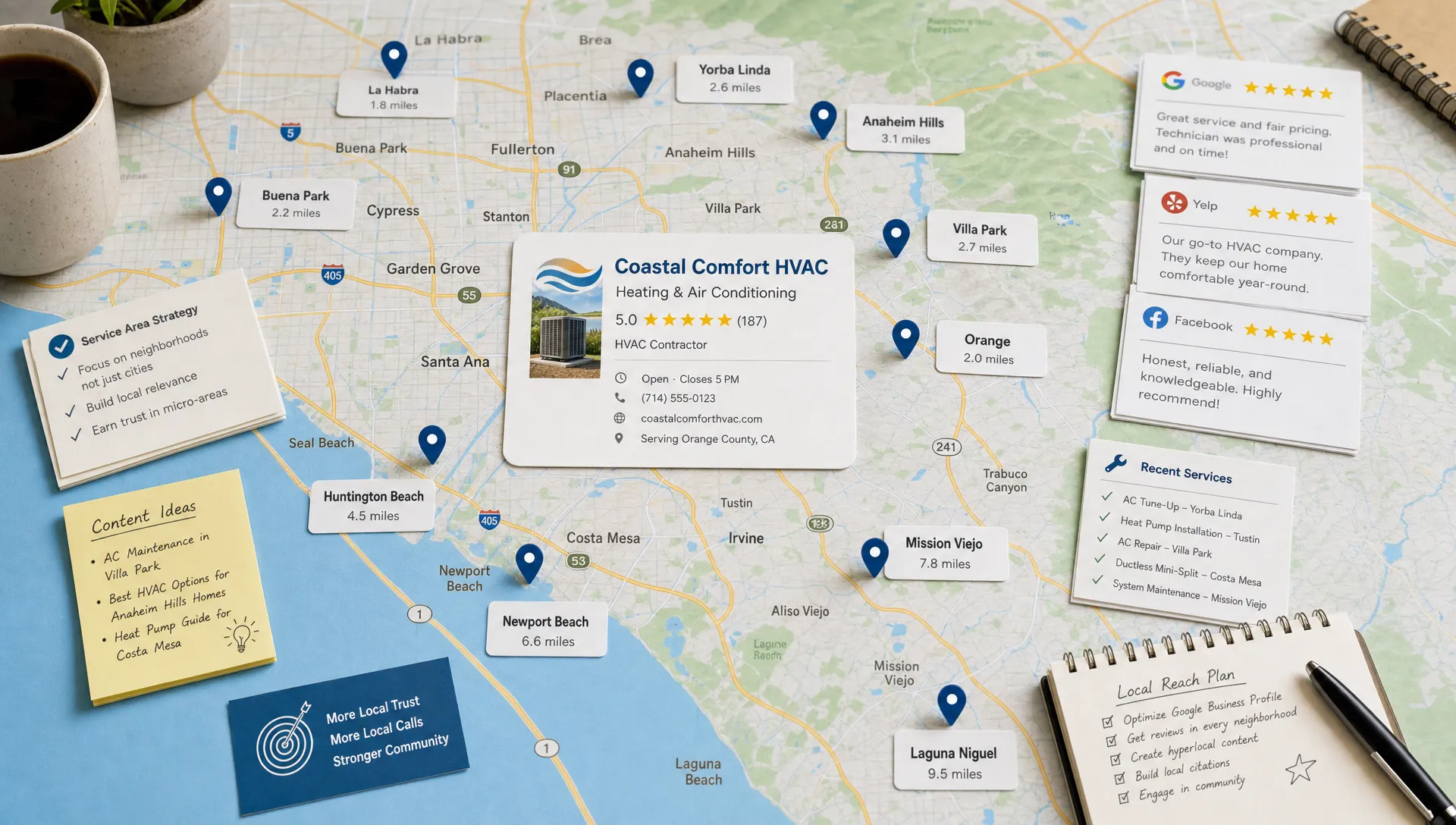
Orange County alone contains very different buyer expectations. A Newport Coast homeowner evaluating a luxury HVAC replacement may respond to premium positioning, quiet equipment, indoor air quality, and white-glove service. A Santa Ana property manager may care more about response time, documentation, and multi-unit reliability. A Laguna Beach homeowner may want proof that the contractor understands coastal conditions and local property constraints.
The same is true across the state. Los Angeles campaigns may require neighborhood-level segmentation. San Diego service pages may need to account for coastal and inland differences. San Jose and San Francisco professional practices often compete in dense, high-research markets. Fresno, Sacramento, Bakersfield, Stockton, and Riverside campaigns may depend on a mix of local trust, affordability, and fast access.
This is why local website advertising should be built around real service territories, not just city names pasted into duplicate pages.
Kell Web Solutions' Local SEO Mastery supports the foundational pieces that make local campaigns stronger, including Google Business Profile optimization, citation consistency, localized content, and map visibility. For contractors that need deeper neighborhood-level authority, the Hyperlocal Authority Builder is designed to build a broader footprint of local authority assets around priority markets.
The strategic point is simple: if your revenue depends on where customers are located, your advertising must prove local relevance before asking for the call.
Paid ads, SEO, AEO, and outreach should work as one system
Many businesses treat marketing channels as separate vendors or separate tasks. Paid ads are managed in one place. SEO happens somewhere else. The website sits mostly unchanged. Reviews are handled only when someone remembers. Outbound prospecting is disconnected from inbound demand.
That creates leakage.
A better model aligns every channel around the same revenue goal: qualified conversations.
Paid search can capture urgent demand. Local SEO can build durable visibility in the map pack and organic results. AEO can improve how AI systems understand and recommend the business. Retargeting can bring back visitors who were not ready to call. Strong landing pages can convert traffic from every source. Managed outreach can create conversations with ideal prospects who may not be actively searching yet.
For businesses that want to add qualified, pre-warmed conversations beyond inbound traffic, Kell Web Solutions' Profit Accelerator offers a managed AI outreach system built around prospecting, personalized outreach, follow-up, and booking support.
The key is sequencing. If the website cannot convert, more traffic exposes the weakness. If the website converts but the business is invisible locally, the funnel starves. If calls are coming in but not answered or qualified, revenue slips away at the finish line.
Website advertising works best when all parts of the system are measured together.
Metrics that reveal whether website advertising is working
Pageviews can be useful, but they do not pay the bills. A contractor or professional practice should measure advertising by movement toward real conversations and booked outcomes.
| Metric | Why it matters | Question to ask |
|---|---|---|
| Call conversion rate | Shows whether visits become phone actions | Which pages produce calls at the highest rate? |
| Qualified call percentage | Separates useful calls from noise | How many callers match our service, location, and revenue criteria? |
| Booked appointment rate | Connects marketing to calendar outcomes | How many qualified calls become estimates, consultations, or visits? |
| Cost per qualified call | Gives a clearer view than cost per click | Which channels produce calls worth paying for? |
| Missed call rate | Reveals operational leakage | Are we losing leads after advertising worked? |
| Location-level performance | Shows which cities and neighborhoods convert | Where should we increase or reduce spend? |
| AI and answer visibility | Shows whether AI platforms understand the brand | Are we appearing when customers ask answer-based questions? |
| Revenue from calls | Connects marketing to business growth | Which campaigns produce profitable jobs or clients? |
The most important shift is from traffic reporting to decision reporting. A useful marketing report should help a business owner decide what to fix, scale, pause, or expand.
If a page gets traffic but no calls, the offer, proof, or CTA may be weak. If a page gets calls but few are qualified, the targeting or page copy may be too broad. If qualified calls are high but booked appointments are low, the issue may be intake, availability, pricing expectations, or follow-up.
A 30-day sprint to turn more visits into qualified calls
You do not have to rebuild everything at once. A focused 30-day sprint can uncover the biggest leaks and create a cleaner path from visit to call.
| Timeframe | Focus | Practical improvements |
|---|---|---|
| Days 1 to 7 | Diagnose traffic and call quality | Review top landing pages, call sources, missed calls, service-area mismatches, and weak CTAs |
| Days 8 to 14 | Fix high-intent pages | Improve headlines, mobile phone visibility, local proof, service specificity, FAQs, and trust placement |
| Days 15 to 21 | Strengthen tracking and qualification | Add call tracking, define qualified call criteria, review intake scripts, and connect calls to booked outcomes |
| Days 22 to 30 | Expand authority and AI readiness | Add structured FAQs, refine service and location clarity, improve internal links, and identify local authority gaps |
This sprint often reveals whether the business needs more advertising, better conversion assets, stronger local visibility, or improved call handling. Sometimes the fastest growth does not come from raising ad spend. It comes from fixing the points where qualified visitors are already slipping away.
What a high-converting call page should include
While every industry is different, the structure of a strong call page is surprisingly consistent. It should quickly tell the visitor where they are, why the business is relevant, what problem is solved, what proof supports the claim, and what to do next.
For contractors, this may include service-specific photos, cities served, review highlights, repair versus replacement guidance, emergency or scheduling expectations, and a prominent call button. For professional practices, it may include provider credentials, location details, consultation process, privacy reassurance, and content that explains the service without overwhelming the visitor.
The page should also avoid common conversion killers: vague headlines, stock-heavy visuals, slow load times, hidden phone numbers, generic service copy, duplicate location pages, and CTAs that do not match the visitor's urgency.
A ready-to-call visitor does not want to solve a puzzle. They want confidence.
Frequently Asked Questions
What is website advertising? Website advertising is the complete process of attracting visitors to your website and converting them into business opportunities. For local businesses, that includes paid ads, local SEO, AEO, landing pages, trust signals, call tracking, and follow-up.
How do I get more qualified calls from website traffic? Start by matching each high-intent visitor to a specific service and location page. Add local proof, reviews, clear call buttons, qualification cues, and tracking that shows which pages and campaigns produce real booked opportunities.
Is website advertising different from SEO? Yes. SEO helps your business earn visibility in search results, while website advertising is broader. It includes paid traffic, organic visibility, landing page conversion, AI visibility, local proof, and call handling.
Should contractors still run paid ads if they invest in local SEO? In many cases, yes. Paid ads can capture immediate demand, while local SEO and AEO build longer-term authority. The key is making sure paid traffic goes to pages that convert and that call quality is measured.
Can AEO help generate phone calls? AEO can support call generation by making your business easier for AI-driven platforms, voice assistants, and answer engines to understand and recommend. That matters when customers ask for the best local provider instead of browsing search results manually.
Does this strategy work for professional practices? Yes. Medical, dental, and legal practices also depend on local trust, clear service pages, strong proof, and frictionless scheduling. The qualification criteria are different, but the conversion principles are similar.
Turn your website into a qualified-call engine
If your website gets visits but not enough qualified calls, the answer is not always more traffic. You may need a clearer advertising path, stronger local authority, better trust signals, AI-ready structure, and call tracking that shows what is really working.
Kell Web Solutions helps Orange County and California businesses build durable visibility that converts, from Laguna Beach and Laguna Niguel to Irvine, Anaheim, Los Angeles, San Diego, San Jose, Sacramento, Fresno, and beyond.
If you are ready to turn website advertising into qualified conversations, call Kell Web Solutions at (949) 575-8553 or (949) 620-5355 to discuss your next growth step.