Local Search Marketing Tips That Help Contractors Win More
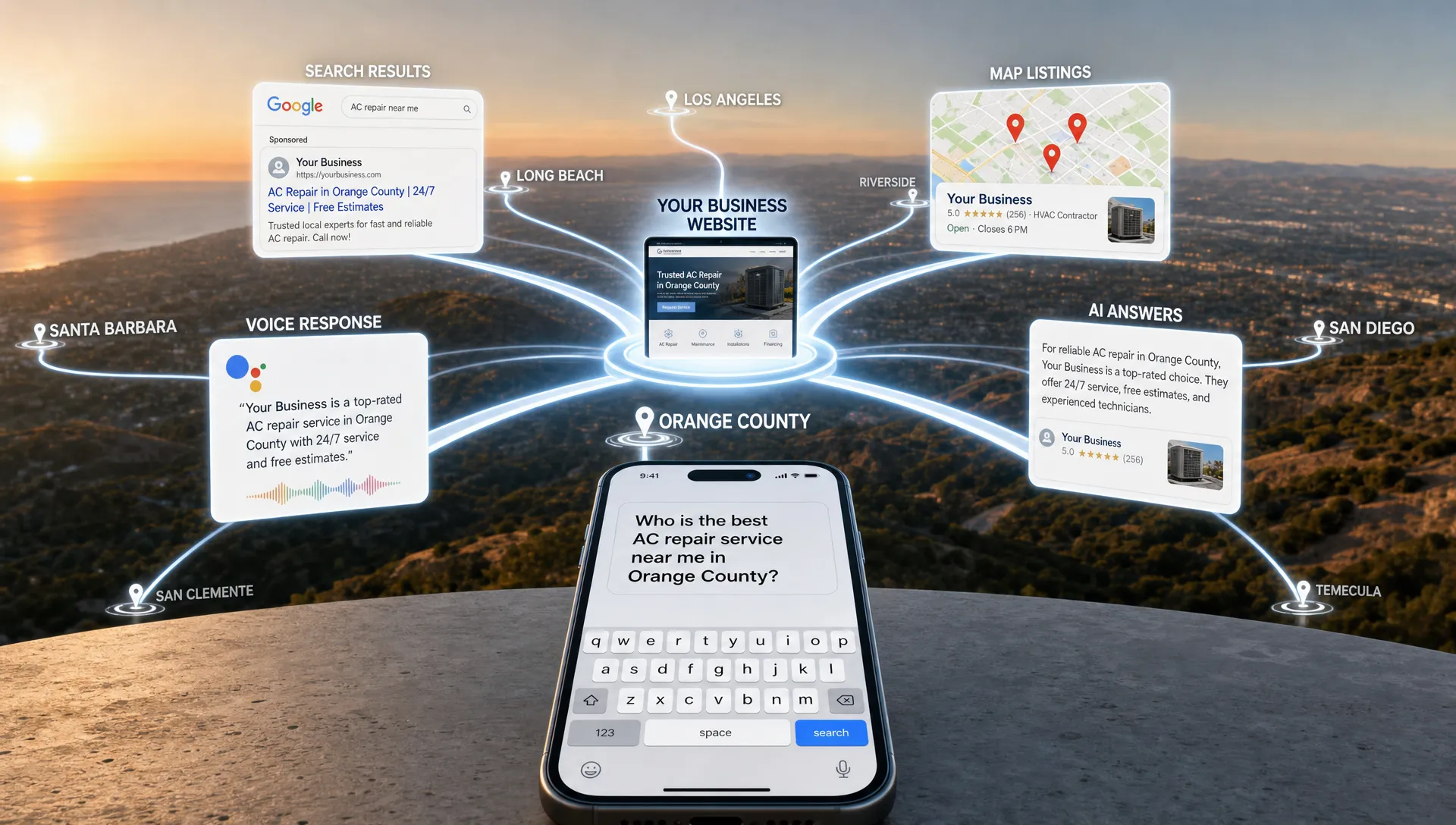
Local search marketing is no longer just about getting a contractor website to rank for “plumber near me” or “HVAC repair Orange County.” Those searches still matter, but the path from search to booked job has changed.
Homeowners now compare contractors across Google Maps, AI answers, review snippets, local ads, neighborhood pages, voice assistants, and business profiles before they ever fill out a form. In competitive California markets like Laguna Beach, Irvine, San Diego, San Jose, Sacramento, and Los Angeles, the contractor who wins is usually the one that looks closest, clearest, and most trustworthy at the exact moment the customer is ready to act.
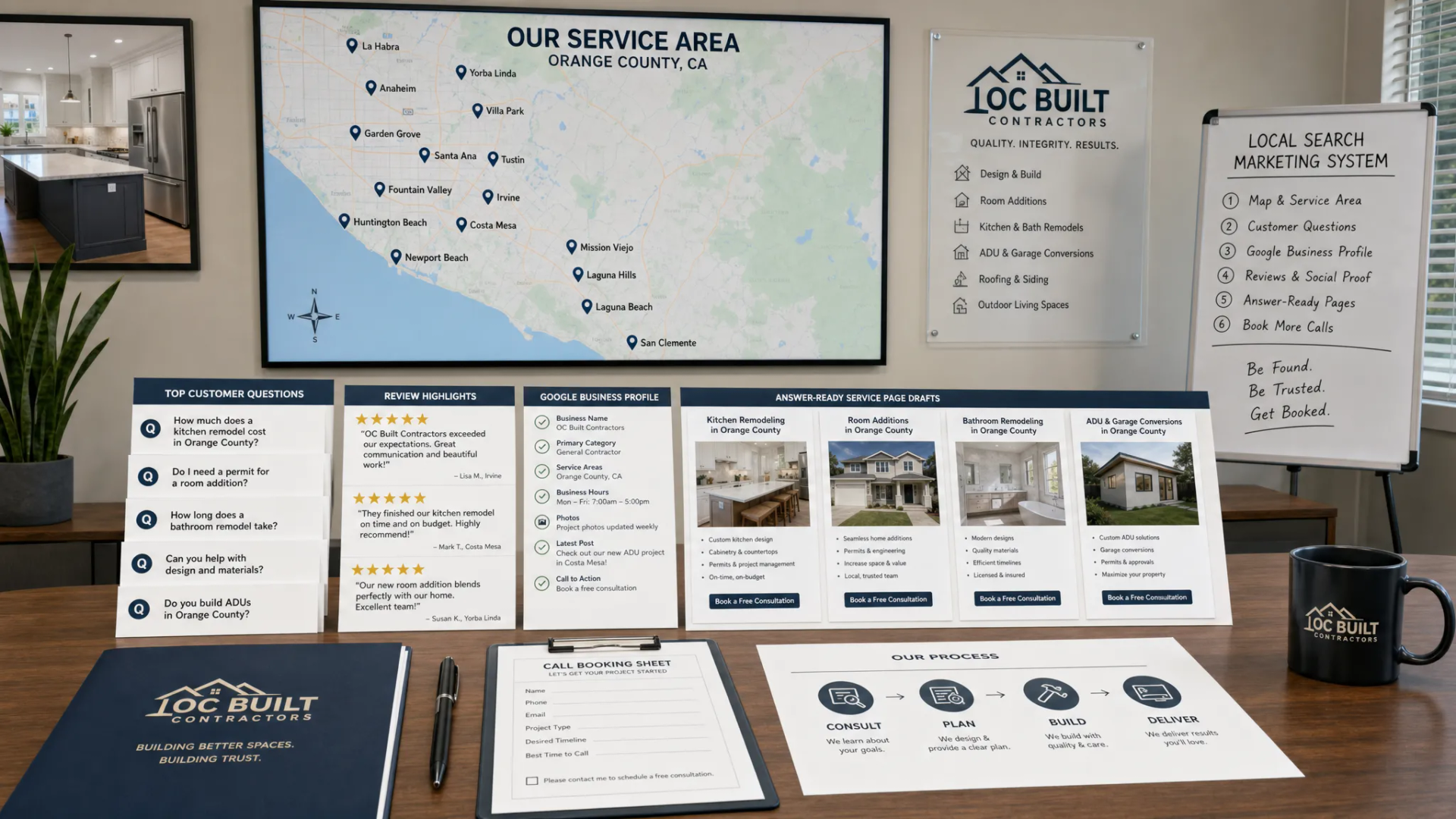
The good news is that local search marketing is not mysterious. It is a practical system. When your Google Business Profile, website, reviews, service pages, citations, and answer-ready content all say the same thing, search engines and customers have fewer reasons to hesitate.
What local search marketing means for contractors
For contractors, local search marketing is the work of making your company visible and convincing across every local discovery point where a homeowner might look for help. It includes local SEO, Google Business Profile optimization, map visibility, review generation, service-area content, paid search when appropriate, and increasingly, Answer Engine Optimization for AI-driven results.
Google explains that local results are influenced mainly by relevance, distance, and prominence in its local ranking documentation. Contractors should treat those three factors as a simple operating framework.
| Local ranking factor | What it means for a contractor | How to improve it |
|---|---|---|
| Relevance | Google understands what jobs you do | Accurate categories, service pages, clear copy, photos, FAQs |
| Distance | Google understands where you work | Service areas, city pages, localized proof, consistent address data |
| Prominence | Google trusts that you are a known provider | Reviews, citations, backlinks, brand mentions, strong content |
A contractor does not need to be the biggest company in California to win local search. But the business does need to be easy to understand, easy to verify, and easy to contact.
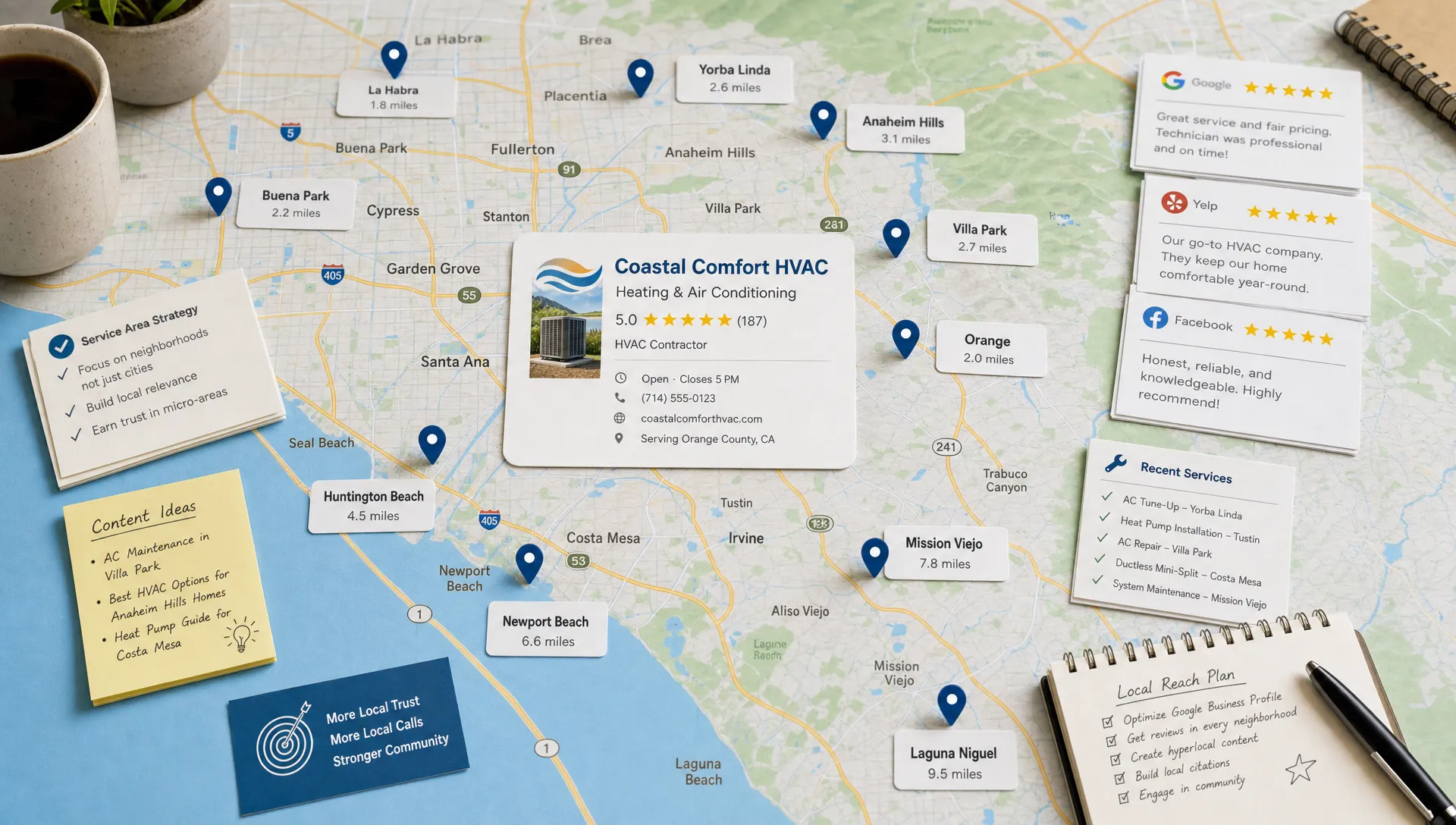
Start with a profitable service-area map
Many contractors make the same mistake: they chase broad keywords before deciding which jobs and cities actually matter. “Roofing Orange County” may sound valuable, but if your best-margin jobs are roof replacements in Irvine, Laguna Niguel, Huntington Beach, and Mission Viejo, your local search marketing should reflect that.
Before updating a website or writing another blog post, build a simple service-area map. List your most profitable services, the cities you want more calls from, and the neighborhoods where you can respond quickly.
Ask these questions before choosing keywords or content topics:
- Which services produce the best revenue and margins?
- Which cities or neighborhoods are close enough for fast response?
- Where do we already have reviews, photos, projects, or customer stories?
- Which search terms show urgent intent, such as repair, replacement, installation, inspection, estimate, or emergency?
This prevents wasted effort. A plumbing company in Laguna Niguel may not need to compete across all of Los Angeles County. A solar contractor expanding into San Diego may need proof-based pages for specific communities before chasing statewide visibility. A Bay Area electrical contractor may need content that explains permits, panels, EV chargers, and older home upgrades by city.
Local search gets easier when geography, services, and business goals are aligned.
Turn your Google Business Profile into a call-generation asset
Your Google Business Profile is often the first impression, especially on mobile. It may appear before your website, before your ads, and before a homeowner reads your carefully written service page.
For contractors, an effective profile should answer four questions fast: What do you do, where do you work, can you be trusted, and how does someone contact you?
Make sure the basics are complete and accurate. Your business name, phone number, website, hours, categories, services, and service areas should match the rest of your online presence. If you are a service-area business that visits customers and does not serve customers at your business address, follow Google’s guidelines for how that information should appear.
Then go beyond the basics. Add real project photos, not only stock images. Use photos of completed HVAC installs, roofing jobs, remodels, solar arrays, panel upgrades, or jobsite crews where appropriate. Post updates about seasonal services, safety checks, maintenance reminders, and city-specific availability.
A contractor profile should also include clear services. Do not rely on one broad category to explain everything. If you handle AC repair, furnace replacement, ductwork, heat pump installation, indoor air quality, or emergency service, the profile and website should support those distinctions.
Build service pages around customer questions, not just keywords
A strong contractor service page does more than repeat a keyword. It helps a homeowner decide whether your company is the right call.
For example, a weak page says, “We provide professional HVAC repair in Irvine.” A stronger page explains the symptoms you fix, the systems you service, the neighborhoods you cover, the questions homeowners ask before booking, and what happens after they call.
The page should feel like a helpful conversation with a qualified contractor. Search engines can then extract clearer information, and homeowners feel less uncertainty.
| Page element | Why it matters | Contractor example |
|---|---|---|
| Clear service headline | Confirms the exact job | AC repair in Laguna Niguel |
| Local context | Shows real area relevance | Coastal humidity, older homes, HOA expectations |
| Common problems | Matches homeowner language | Warm air, short cycling, leaking unit, high energy bills |
| Trust signals | Reduces hesitation | Reviews, project photos, years in business, licensing notes where applicable |
| Process explanation | Sets expectations | Call, diagnose, explain options, perform repair, follow up |
| FAQ section | Helps search and conversions | Cost factors, timing, emergency availability, service area |
| Strong call to action | Converts intent into contact | Call for service, request an estimate, schedule an inspection |
If you want a deeper framework for turning location and service intent into booked jobs, Kell Web Solutions has a practical guide on local search engine optimization that wins nearby jobs.

Use reviews as both ranking fuel and sales proof
Reviews are not just reputation management. They are one of the strongest conversion assets a contractor has.
A homeowner choosing between three plumbers or roofers may not know how to evaluate technical quality. They look for signals: recent reviews, specific job details, owner responses, local place names, before-and-after photos, and whether past customers describe the exact problem they have.
The best review strategy is simple and consistent. Ask after a successful job, make the request easy, and never pressure customers to say something fake or exaggerated. Specific reviews are more useful than generic praise.
A review that says “Great company” is nice. A review that says “They repaired our AC in Mission Viejo during a heat wave, explained the capacitor issue, and had the system running the same afternoon” is far more valuable.
Contractors should also respond to reviews. Thank happy customers by referencing the type of work performed, without revealing private details. Respond professionally to negative reviews and show that your company takes service seriously. Those responses are visible trust signals.
Create answer-first content for AI, voice, and zero-click search
Local search marketing in 2026 must account for the fact that many customers do not browse ten blue links anymore. They ask questions and expect answers.
A homeowner might ask:
- “Who repairs tankless water heaters near Huntington Beach?”
- “How much does a roof inspection cost in Irvine?”
- “Best electrician for EV charger installation in San Jose?”
- “Emergency AC repair near me open now?”
AI summaries, voice assistants, and map results may respond before the user visits a website. That means your business needs content that is structured clearly enough for machines to understand and trustworthy enough for people to act on.
Answer-first content usually includes concise explanations, local relevance, service details, FAQs, schema markup, and consistent entity information across the web. It does not mean stuffing pages with question keywords. It means becoming the clearest source for the questions your best customers already ask.
For contractors preparing for this shift, Answer Engine Optimization helps structure a business so AI-driven platforms can understand, trust, and recommend it when users ask local service questions.
Match content to the urgency of the job
Not every contractor search has the same intent. Someone searching “emergency plumber near me” is not behaving like someone searching “best bathroom remodel ideas in Newport Beach.” Your local search marketing should separate urgent repair intent from research-heavy project intent.
| Search intent | Customer mindset | Best content asset | Best call to action |
|---|---|---|---|
| Emergency repair | Needs help now | GBP, emergency service page, paid search if profitable | Call now |
| Planned replacement | Comparing options | Service page, cost guide, reviews, project photos | Request estimate |
| Large project | Researching trust and fit | Portfolio page, city page, case study, FAQs | Schedule consultation |
| Maintenance | Looking for prevention | Seasonal blog post, checklist, GBP post | Book tune-up |
| Local comparison | Choosing among providers | Review-rich location page, authority content | Talk to a local expert |
This is where many contractors lose money. They send all searchers to the homepage or run ads to broad pages that do not match the customer’s urgency. A better system pairs the search intent with the right landing page and the right next step.
Make your website easy to convert on mobile
Most local contractor searches happen in moments of need, and many happen on phones. If your website is slow, confusing, or hard to contact from a mobile device, local visibility will not turn into revenue.
Contractor websites should prioritize speed, clarity, and calls. The phone number should be easy to tap. Service areas should be clear. Forms should be short. Trust signals should appear before the visitor has to scroll too far. Each major service page should make it obvious what to do next.
Design also affects how search engines and AI systems interpret your business. Clean structure, descriptive headings, logical internal links, schema markup, and consistent service information help both people and machines understand what you offer.
A good local website does not need to be flashy. It needs to answer fast, prove trust, and make contacting you frictionless. For more on that connection, see how web design and search engine optimisation work together to convert.
Build local proof in every market you serve
California contractors face different local search challenges depending on the market.
Orange County searches often carry high trust expectations. Homeowners in Laguna Beach, Newport Beach, Irvine, and Laguna Niguel may look closely at reviews, project quality, professionalism, and whether your brand feels established.
Los Angeles and San Diego searches are dense and competitive. City-level pages may not be specific enough. Contractors often need neighborhood-level proof, fast response messaging, and careful paid search targeting to avoid wasting budget.
Bay Area searches in San Jose, San Francisco, Oakland, and Sunnyvale often involve research-heavy customers. They may compare technical explanations, energy efficiency claims, EV readiness, smart home integration, and contractor credentials before calling.
Central and Inland California markets like Fresno, Sacramento, Bakersfield, Stockton, Riverside, and San Bernardino can reward clear service-area coverage, availability, affordability signals, and practical education.
The principle is the same in every region: do not publish generic city pages that could apply anywhere. Add local proof wherever you can. Mention real service considerations, show relevant projects, answer local questions, and align your reviews with the communities you want to win.
Use paid search carefully, not as a substitute for trust
Paid search can help contractors generate calls quickly, especially for emergency and high-value services. But paid traffic becomes expensive when the business lacks local trust signals, strong landing pages, or a clear follow-up process.
Before increasing ad spend, check whether the basics are strong. Does the landing page match the ad? Is the phone number easy to tap? Are reviews visible? Is the service area clear? Does the page explain why someone should call you instead of the next contractor?
Paid search works best when it amplifies a trustworthy local presence. It should not carry the entire business. If your company uses ads, the goal is not simply more calls. The goal is better calls from people in the right cities who need the right services and are ready to move forward.
For a closer look at that side of the strategy, Kell’s article on how search engine marketing drives better local calls explains how intent, location, trust, and conversion work together.
Track booked jobs, not just rankings
Rankings matter, but they are not the final score. Contractors win when local search turns into qualified calls, booked estimates, completed jobs, and repeat customers.
Track the metrics that connect visibility to revenue:
| Metric | Why it matters |
|---|---|
| Calls from Google Business Profile | Shows map and mobile demand |
| Calls from service pages | Reveals which pages create action |
| Form submissions by city | Shows which markets are responding |
| Booked appointment rate | Separates lead volume from lead quality |
| Close rate by source | Shows which channels produce profitable work |
| Review velocity | Measures trust growth over time |
| Missed calls | Reveals hidden revenue leaks |
Missed calls are especially costly for contractors. A homeowner with a leak, broken AC, electrical issue, or roof problem may simply call the next company. If you record calls for training or tracking, make sure your process complies with applicable California consent rules.
The contractor who measures only rankings may celebrate the wrong wins. The contractor who measures calls, booked appointments, and job value can make smarter marketing decisions.
A simple weekly local search marketing routine
Local search does not improve only because of one big campaign. It improves when small actions compound.
A practical weekly routine could include:
- Add new job photos to your Google Business Profile.
- Request reviews from completed jobs while the experience is still fresh.
- Respond to all new reviews with professional, specific replies.
- Check your top service pages for outdated information.
- Publish or update one answer-first piece of content tied to a real customer question.
- Review calls and form leads to identify missed opportunities.
- Confirm that business information is consistent across major profiles and directories.
The contractors who win locally are not always doing more marketing. They are doing the right things consistently, in the right places, for the right cities.
Frequently Asked Questions
What is local search marketing for contractors? Local search marketing is the process of helping a contracting business appear, earn trust, and generate calls in local search results, Google Maps, review platforms, paid search, and AI-driven answer results.
How long does local search marketing take to work? Some improvements, such as profile updates and better conversion paths, can help quickly. Organic visibility, reviews, local authority, and answer engine trust usually compound over months, especially in competitive California markets.
Is Google Business Profile more important than a contractor website? Both matter. Your Google Business Profile often creates the first impression, but your website gives search engines and customers deeper proof about services, locations, expertise, and trust.
Should contractors create pages for every city they serve? Not automatically. Create city or neighborhood pages only when you can make them useful, specific, and supported by real service relevance. Thin, duplicate location pages can weaken trust instead of building it.
How does AI search affect local contractors? AI search increases the importance of clear answers, consistent business information, strong reviews, structured content, and local authority. Contractors need to be easy for both people and machines to understand.
Win more local jobs with a stronger search system
Contractors do not need random marketing activity. They need a local search system that helps homeowners find them, trust them, and call them when it matters.
If your HVAC, roofing, plumbing, electrical, solar, remodeling, medical, dental, or legal business depends on local visibility in Orange County or across California, Kell Web Solutions can help you build a stronger foundation for search, maps, and AI-driven discovery.
Start by exploring Kell Web Solutions or call (949) 575-8553 to discuss how your business can become the obvious local choice in the markets you want to win.