How to Use Your Website for Marketing That Brings Leads
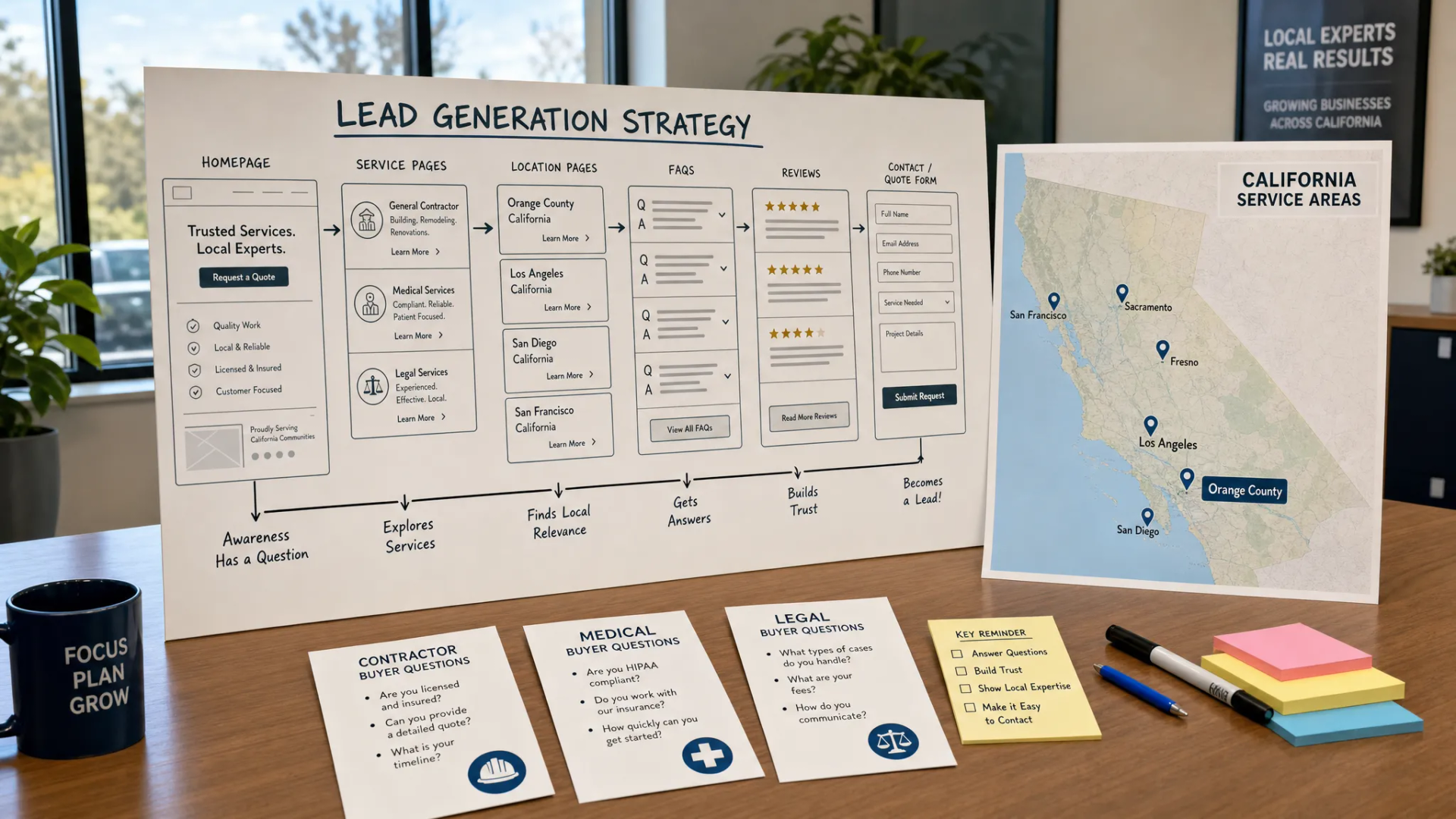
Your website should not be a digital brochure. For a contractor, medical practice, law firm, dental group, or other local service business, it should work like a lead-producing sales asset that answers buyer questions, proves trust, and makes the next step obvious.
That is especially true in California markets where competition changes block by block. A homeowner in Irvine searching for an emergency HVAC repair is not behaving like a commercial property manager in San Diego. A patient in Laguna Niguel comparing dental implant providers is not searching the same way as a legal client in San Jose. If your website treats every visitor the same, it leaves qualified leads behind.
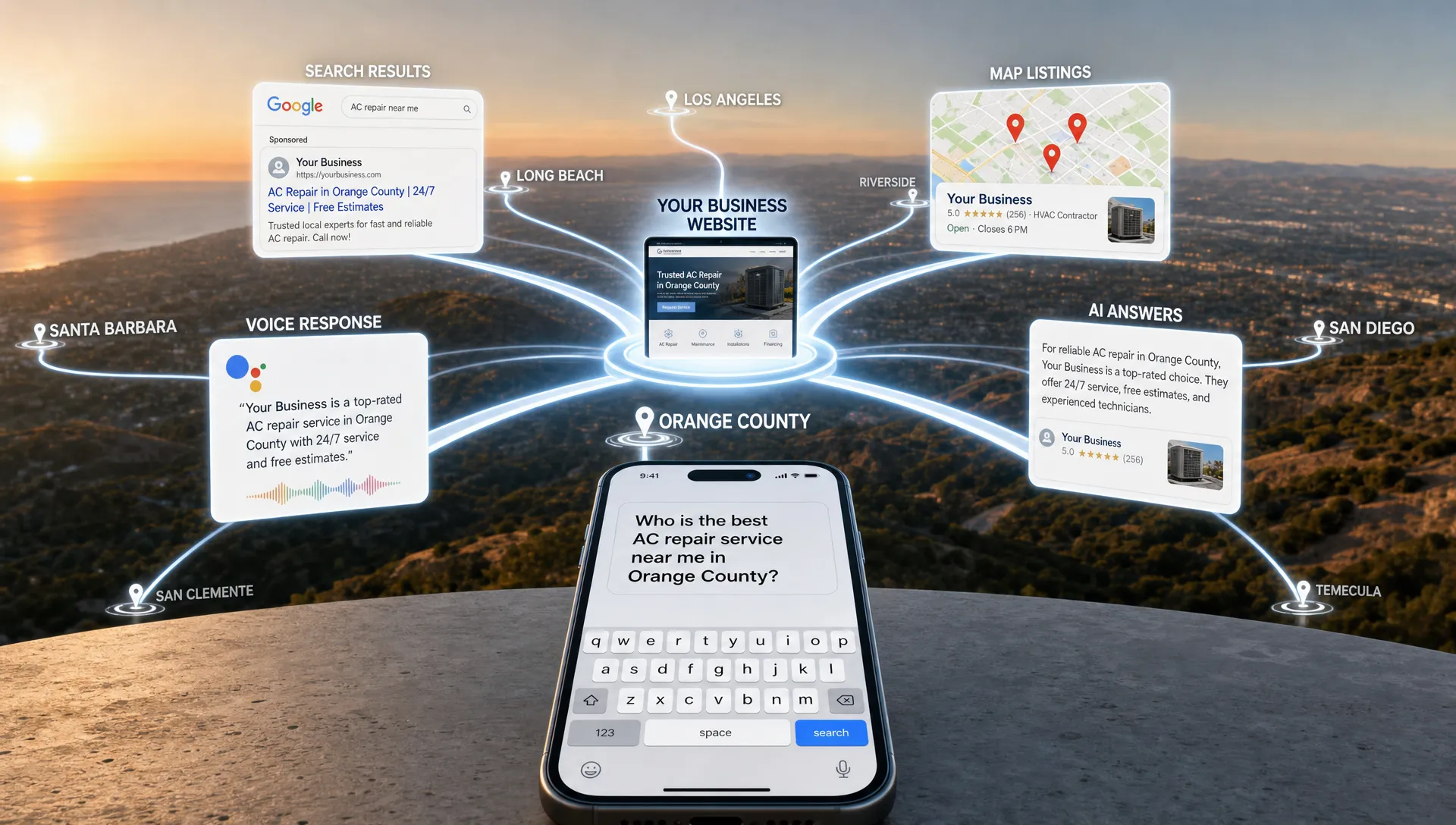
When people talk about using the web for marketing, they often jump straight to ads, social media, or SEO tactics. Those can help, but your website is still the center of the system. It is where search engines, AI answer engines, referral partners, and potential customers look to confirm that you are credible, local, and ready to solve the problem.
Here is how to use your website for marketing that brings leads instead of just traffic.
Start With Lead Strategy, Not Website Design
Before changing colors, headlines, layouts, or plugins, define what a good lead actually means for your business.
For an Orange County roofing company, a good lead might be a homeowner asking for a roof replacement estimate in Laguna Beach, Newport Beach, or Mission Viejo. For a multi-location dental group, it might be a patient requesting a consultation within 10 miles of a specific office. For a legal firm, it may be a qualified intake call in a practice area where the firm can profitably serve the client.
A lead-focused website starts with three decisions:
- Which services are most valuable? Promote the work that drives profit, not just the services that are easiest to list.
- Which locations matter most? Prioritize the neighborhoods, cities, and catchment areas where you want more business.
- Which customer questions signal buying intent? Build pages around the questions people ask right before they call, book, or request a quote.
This is where your website becomes part of a larger strategy. If you have not already mapped your audience, offer, and channels, a structured guide to creating a marketing plan that drives results can help you clarify what your website should actually accomplish.
Design matters, but design should serve the lead path. A beautiful site that does not explain your value, prove your local relevance, or ask for the conversion is not a marketing asset. It is decoration.
Build Pages Around High-Intent Searches
The fastest way to make a website more useful for lead generation is to stop relying on one generic services page.
Local buyers search with specifics. They type or say things like “AC repair near me,” “roof replacement Irvine,” “emergency plumber Anaheim,” “dental implants Laguna Niguel,” or “business attorney San Jose.” AI search tools and voice assistants also interpret these queries by matching service, location, credibility, and relevance.
That means your website needs focused pages that align with how people search and how they make decisions.
| Page type | Best use | Example for contractors | Example for professional practices |
|---|---|---|---|
| Core service page | Explain a major revenue service | HVAC replacement | Dental implants |
| City page | Prove relevance in a service area | Plumbing in Huntington Beach | Family law attorney in Irvine |
| Problem page | Match urgent or symptom-based searches | Why is my AC blowing warm air? | What to do after a workplace injury |
| Comparison page | Help visitors evaluate options | Repair vs. replace a roof | Invisalign vs. braces |
| Trust page | Remove hesitation before contact | Reviews and completed projects | Case approach, credentials, and testimonials |
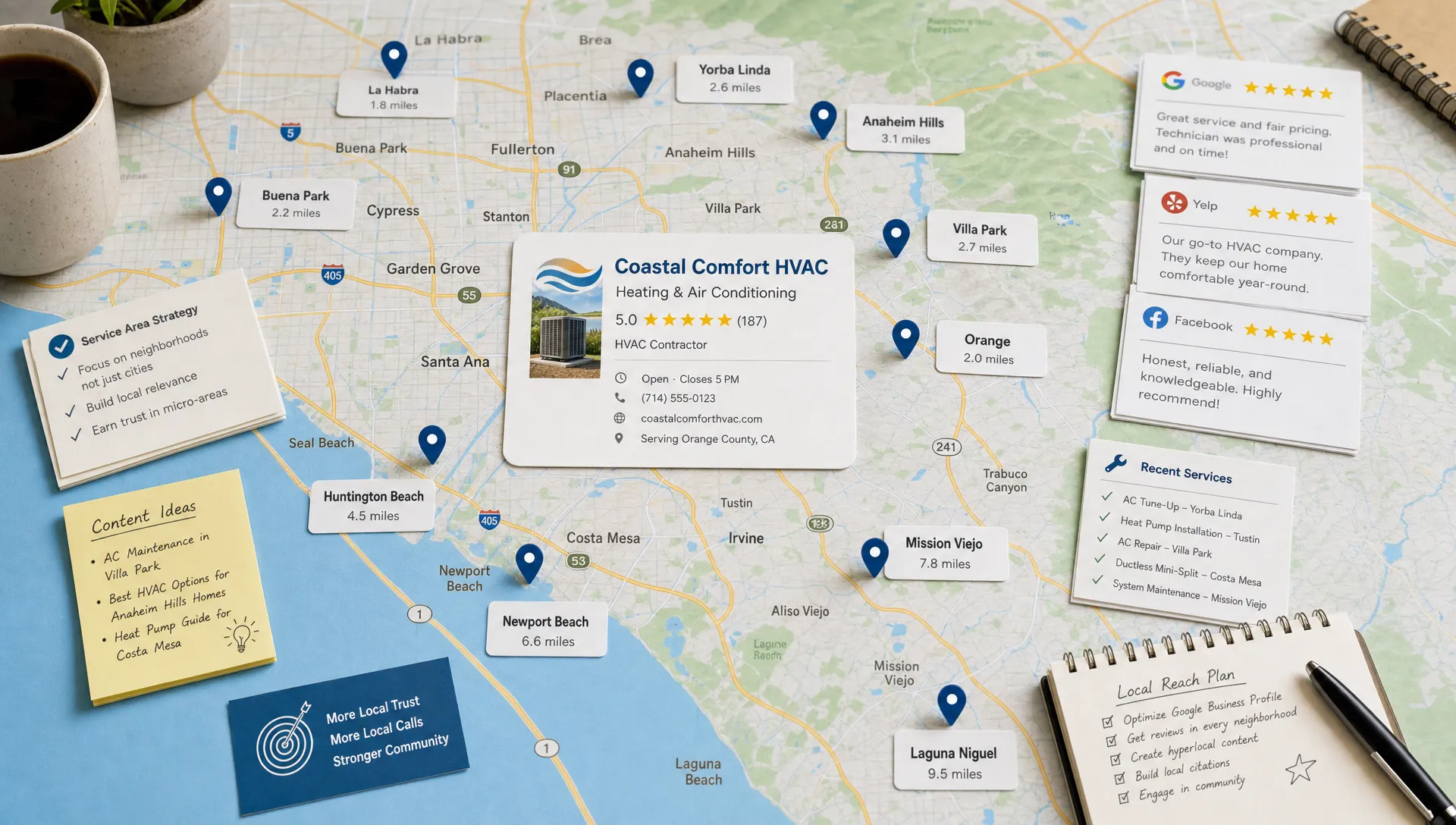
For California businesses, this page strategy should reflect real geography. A contractor serving Orange County may need pages for Irvine, Anaheim, Costa Mesa, Huntington Beach, Laguna Niguel, and Mission Viejo. A practice expanding across Northern California may need separate location signals for San Jose, Oakland, Fremont, Sunnyvale, and San Mateo. The point is not to create thin duplicate pages. The point is to build genuinely useful local pages that explain your experience, service area, process, and proof in each market.
Each important service and location page should answer a simple question: “Why should someone in this specific place trust this specific company for this specific problem?”
Write Copy That Answers Before the Visitor Calls
A lead-producing website does not force visitors to hunt for basic information. It anticipates objections and answers them clearly.
For home services, visitors usually want to know if you serve their area, how quickly you can respond, what types of work you handle, whether you are licensed or insured, what the process looks like, and how to request an estimate. For medical, dental, and legal practices, visitors want to understand expertise, privacy, credentials, intake steps, insurance or payment expectations, and what happens after they submit a form.
Strong website copy should include:
- Clear service descriptions written in plain English
- Local references that show you understand the market
- Trust signals such as reviews, credentials, associations, photos, or project examples
- Calls to action that match the page intent
- FAQs based on real customer questions
- A simple explanation of what happens after someone contacts you
Google’s own guidance emphasizes creating helpful, reliable, people-first content. That principle also applies to AI answer engines. If your website provides clear, specific, trustworthy answers, it becomes easier for both people and machines to understand why your business should be considered.
Avoid vague phrases like “best service,” “top quality,” and “customer satisfaction is our priority” unless you support them with evidence. Specifics convert better. Instead of saying “we offer fast service,” say which areas you serve, how scheduling works, and what a customer should do in an urgent situation.
Make Conversion Paths Obvious on Every Page
Traffic does not become revenue unless visitors know what to do next.
Every key page should have one primary conversion goal. For contractors, that might be “Request an Estimate” or “Call for Service.” For a dental or medical practice, it might be “Schedule a Consultation.” For a law firm, it might be “Request a Case Review.” The wording should match the buyer’s comfort level and the seriousness of the decision.
The strongest conversion paths are simple, repeated, and easy to use on mobile. Your phone number should be clickable. Forms should ask only for information you need to start the conversation. Appointment or consultation buttons should be visible without making the visitor scroll forever.
A good lead-generating page usually includes a call to action near the top, a second one after the proof section, and another near the bottom after FAQs or process details. This is not aggressive when done well. It is helpful, because different visitors become ready at different moments.
The technical side matters too. Slow pages, confusing navigation, broken forms, poor mobile layouts, and weak page structure all reduce lead flow. If you want a deeper look at the relationship between site structure, local search, and conversions, Kell Web Solutions has a practical breakdown of how web design and search engine optimization must work together.

Treat Your Website as the Source of Truth for Search and AI
In 2026, your website is not only for human visitors. It is also a source that search engines, map results, AI summaries, and answer platforms use to understand your business.
This is why a modern marketing website needs more than keywords. It needs entity clarity. In simple terms, your website should make it obvious who you are, what you do, where you serve, why you are credible, and how customers can take action.
Important trust and clarity signals include:
- Consistent business name, address, phone number, and service areas
- Clear descriptions of services and specialties
- Location-specific pages with useful local context
- Review and testimonial signals where appropriate
- Structured data such as LocalBusiness, Service, FAQ, or Review schema when applicable
- Internal links that help visitors and crawlers understand your most important pages
This is where Answer Engine Optimization becomes increasingly important. Traditional SEO tries to help your site rank for search results. AEO helps structure your digital presence so AI-driven platforms can understand, trust, and potentially recommend your business when users ask questions. For companies competing in Orange County and across California, Kell’s Answer Engine Optimization service is built around that shift from ranking for keywords to being selected as the answer.
For a local business, this can be the difference between being one of many blue links and being the company a search tool summarizes, cites, or surfaces when someone asks for a recommendation.
Create Content That Pulls in Problem-Aware Leads
Blog posts, guides, and resource pages can bring leads when they are tied to real buying questions. They fail when they are written only to “post something new.”
A useful content strategy starts by listening to sales calls, estimate requests, intake forms, and customer objections. What do people ask before they trust you? What problems are they trying to understand before they hire someone? What local conditions affect the decision?
For home services, strong content topics might include:
- “How long does an HVAC system last in coastal Orange County?”
- “What causes slab leaks in Southern California homes?”
- “When should a San Diego homeowner replace instead of repair a roof?”
- “How much solar capacity does a typical Inland Empire home need?”
For professional practices, strong topics might include:
- “What should I bring to my first estate planning consultation?”
- “How do I choose a pediatric dentist near Irvine?”
- “What happens during a personal injury case review?”
- “How do multi-location medical practices serve patients across Los Angeles County?”
The best content does not just attract clicks. It moves the right visitor one step closer to contacting you. That means each article should naturally connect to a relevant service page, location page, consultation form, or phone call option.
Use Local Proof to Build Confidence
People trust businesses that feel familiar and proven. That is why local proof is so valuable.
A general contractor in Laguna Beach should not look like a generic national website. A plumbing company serving Anaheim and Santa Ana should show that it understands local homes, permitting realities, common property types, and response expectations. A professional practice with offices in Sacramento, Fresno, and San Francisco should make each location feel real, not copied from a template.
Local proof can include project photos, service-area references, testimonials, case examples, staff bios, community involvement, media mentions, and location-specific FAQs. For regulated industries such as healthcare and law, proof must also respect compliance requirements, but it should still help visitors understand experience and trustworthiness.
Reviews are especially powerful when they are placed near decision points. Do not hide every testimonial on one page. Add relevant snippets to service pages, city pages, and contact pages where visitors are deciding whether to reach out.
Connect the Website to Follow-Up
A website can generate a lead, but follow-up turns that lead into revenue. Many businesses lose opportunities because forms go unanswered, calls are missed, or prospects receive a slow generic reply.
Your website should connect to a practical lead handling process. At minimum, every form submission should trigger a notification to the right person, a confirmation to the prospect, and a clear next step. Calls should be tracked when possible. Missed calls should be reviewed. Appointment requests should be followed up quickly.
The goal is to reduce friction between interest and conversation. A homeowner with a broken AC in Riverside will not wait long. A patient comparing providers in Irvine may contact three offices. A business owner looking for legal advice in San Jose may choose the firm that responds with the most clarity.
Use your website analytics and lead tracking to understand what is working. Do not measure success only by traffic. Measure whether the traffic produces conversations.
| Metric | What it tells you | Why it matters |
|---|---|---|
| Calls from website | How many visitors choose immediate contact | Critical for urgent local services |
| Form submissions | How many visitors request quotes or consultations | Useful for considered purchases |
| Conversion rate by page | Which pages turn visitors into leads | Helps prioritize improvements |
| Lead source | Where qualified leads came from | Guides marketing budget decisions |
| Missed call rate | How many opportunities were lost after interest | Protects revenue already generated |
| Service-area performance | Which cities produce leads | Helps refine local content and SEO |
This is where many businesses discover that they do not need more traffic first. They need better pages, clearer offers, stronger proof, and faster follow-up.
Keep Improving Based on Real Lead Behavior
A lead-producing website is never truly finished. Markets change. Search behavior changes. AI answer engines change. Competitors update their pages. Customer questions evolve.
Review your website performance every month and look for patterns. Which pages bring calls? Which pages get traffic but no leads? Which service areas are underperforming? Which questions keep coming up in sales conversations but are not answered on the site?
Then improve one layer at a time. Rewrite weak service pages. Add FAQs based on real objections. Strengthen calls to action. Add local proof. Improve internal links. Refresh outdated content. Test shorter forms. Update location pages when your service area or office footprint changes.
For California businesses competing in crowded markets such as Orange County, Los Angeles, San Diego, San Jose, Sacramento, and Fresno, this ongoing improvement is not optional. It is how your website stays visible, trusted, and useful as the search landscape shifts.
Frequently Asked Questions
How can I use my website for marketing if I already get referrals? Referrals still need validation. Many referred prospects visit your website before calling. A strong site confirms your credibility, explains your services, and makes it easy for the referral to become a booked conversation.
What pages does a lead-generating website need first? Start with a clear homepage, core service pages, location or service-area pages, an about page, testimonials or proof, FAQs, and a contact page. Then add problem-based content that answers high-intent questions.
Is SEO still important if AI search is changing results? Yes, but SEO should now work alongside AEO. Your website still needs crawlable pages, local relevance, useful content, and technical quality, but it also needs clear entity signals that help AI systems understand and trust your business.
How often should a local business update its website? Review performance monthly and update important pages whenever services, locations, pricing guidance, team information, reviews, or customer questions change. In competitive markets, regular improvement is better than a redesign every few years.
What is the biggest mistake businesses make with website leads? The biggest mistake is treating the website as a one-time design project instead of a marketing system. A site must attract the right visitors, answer their questions, create trust, prompt action, and connect to fast follow-up.
Turn Your Website Into a Lead System
If your website looks professional but does not bring enough calls, consultations, or estimate requests, the problem may not be traffic alone. It may be unclear positioning, weak local authority, missing conversion paths, or a site that is not ready for AI-driven search.
Kell Web Solutions helps Orange County and California businesses turn digital visibility into real conversations. If you serve local customers in places like Laguna Beach, Laguna Niguel, Irvine, Anaheim, Los Angeles, San Diego, San Jose, Sacramento, or Fresno, your website should work as a durable marketing asset, not a passive online brochure.
To discuss how your website can bring more qualified leads, book a strategy call with Kell Web Solutions or call (949) 575-8553.