Internet Advertising Mistakes Local Businesses Should Avoid

If you run a roofing company in Irvine, an HVAC business in Anaheim, a dental group in San Diego, or a law firm with offices across Orange County, internet advertising can feel both essential and frustrating. You can spend money, generate clicks, and still wonder why the phone is not ringing with the right prospects.
The problem is rarely that advertising “doesn’t work.” The problem is that local businesses often buy visibility before they have built the strategy, tracking, trust signals, and follow-up systems needed to turn visibility into revenue.
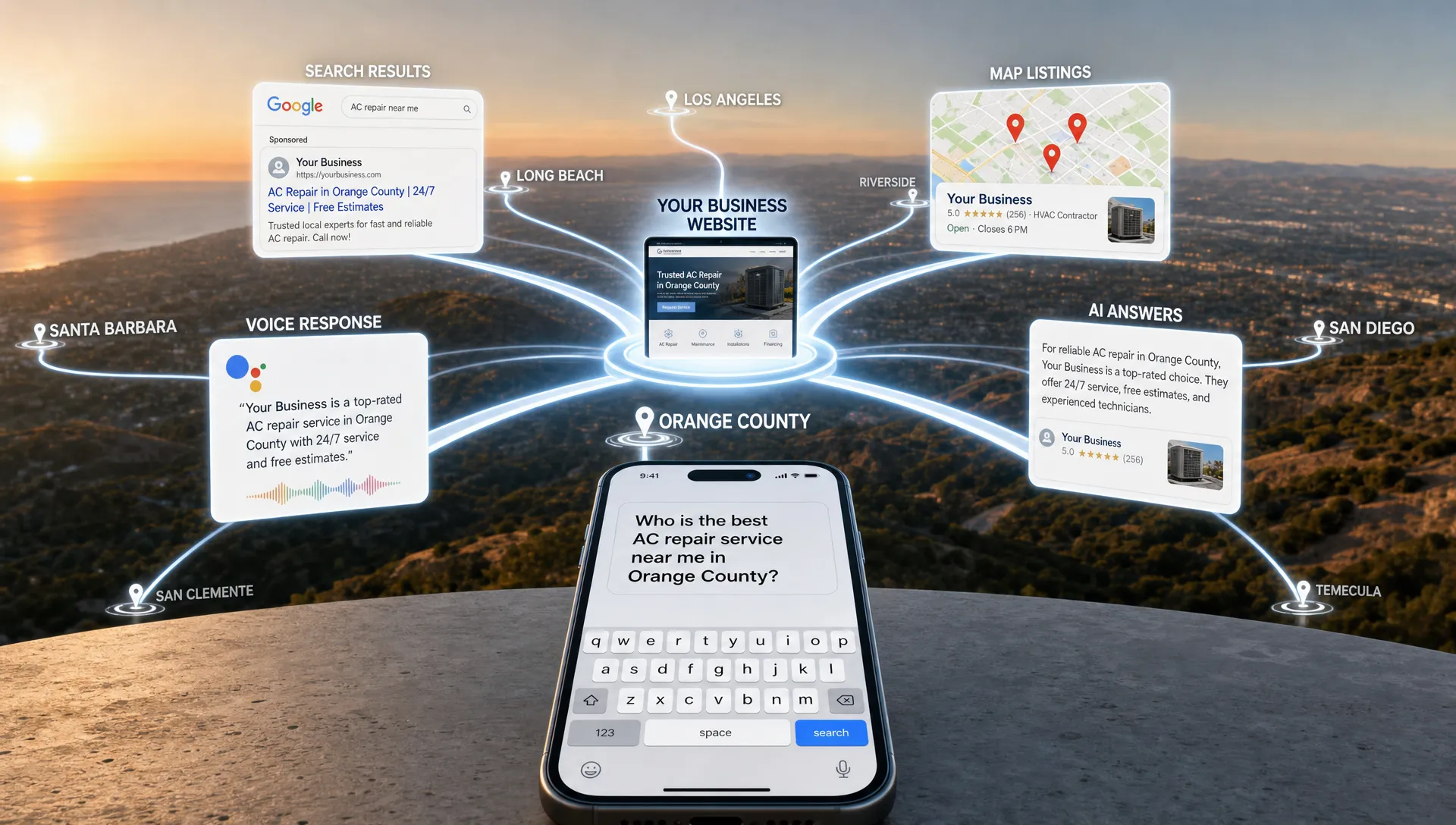
In 2026, the margin for error is smaller. Search results are more crowded. AI Overviews and voice assistants answer more questions before a user visits a website. Paid lead costs in competitive categories keep rising. For local contractors and multi-location professional practices, avoiding the wrong moves is just as important as choosing the right channels.

Why local internet advertising fails even when clicks look good
Most local advertising campaigns are judged too early and too narrowly. A contractor sees impressions and clicks. A medical practice sees form fills. A law firm sees “leads.” But those numbers do not reveal whether the campaign produced profitable calls, qualified consultations, or repeatable growth.
Local advertising has a different job than national brand advertising. It must connect a specific buyer, in a specific geography, with a specific need, at the exact moment they are ready to act. Someone searching for “emergency AC repair Laguna Niguel” has a different intent than someone searching for “best heat pump brands.” A patient looking for “dentist near Irvine Spectrum” behaves differently than someone comparing cosmetic dentistry options across Orange County.
That is why internet advertising for local businesses must be built around three fundamentals: profitable intent, local trust, and fast response. Miss any one of those and the budget leaks.
Mistake 1: Launching ads before defining a profitable outcome
The first mistake is starting with platforms instead of business math. Too many campaigns begin with questions like “Should we run Google Ads or Facebook Ads?” when the better question is “What type of call or appointment can we profitably buy?”
A plumbing company may be able to pay more for a slab leak call than a minor faucet repair. A remodeler may value a design-build consultation far more than a handyman-style inquiry. A dental practice may want implant consultations, not general cleaning requests. If all leads are treated the same, the campaign will optimize toward volume instead of value.
Before spending, define the business outcome clearly. Identify the highest-value services, the ideal service areas, the minimum acceptable job size, and the maximum cost per booked opportunity. This turns advertising from a guessing game into a controlled acquisition system.
Mistake 2: Targeting too much geography at once
California is not one market. Orange County alone contains very different buyer expectations in Laguna Beach, Newport Coast, Santa Ana, Irvine, Anaheim, and Huntington Beach. The same is true across Los Angeles, San Diego, San Jose, Sacramento, Fresno, and the Inland Empire.
A common internet advertising mistake is drawing a wide radius around a business and assuming the platform will figure it out. The result is often wasted spend in cities that are too far away, neighborhoods that do not match the offer, or areas where the business lacks local proof.
For home services contractors, geography affects dispatch time, job profitability, and close rate. For professional practices, geography affects convenience, insurance fit, referral patterns, and trust. A multi-location medical or legal practice should not run the same generic ad for every city. Each location needs its own message, proof points, and conversion path.
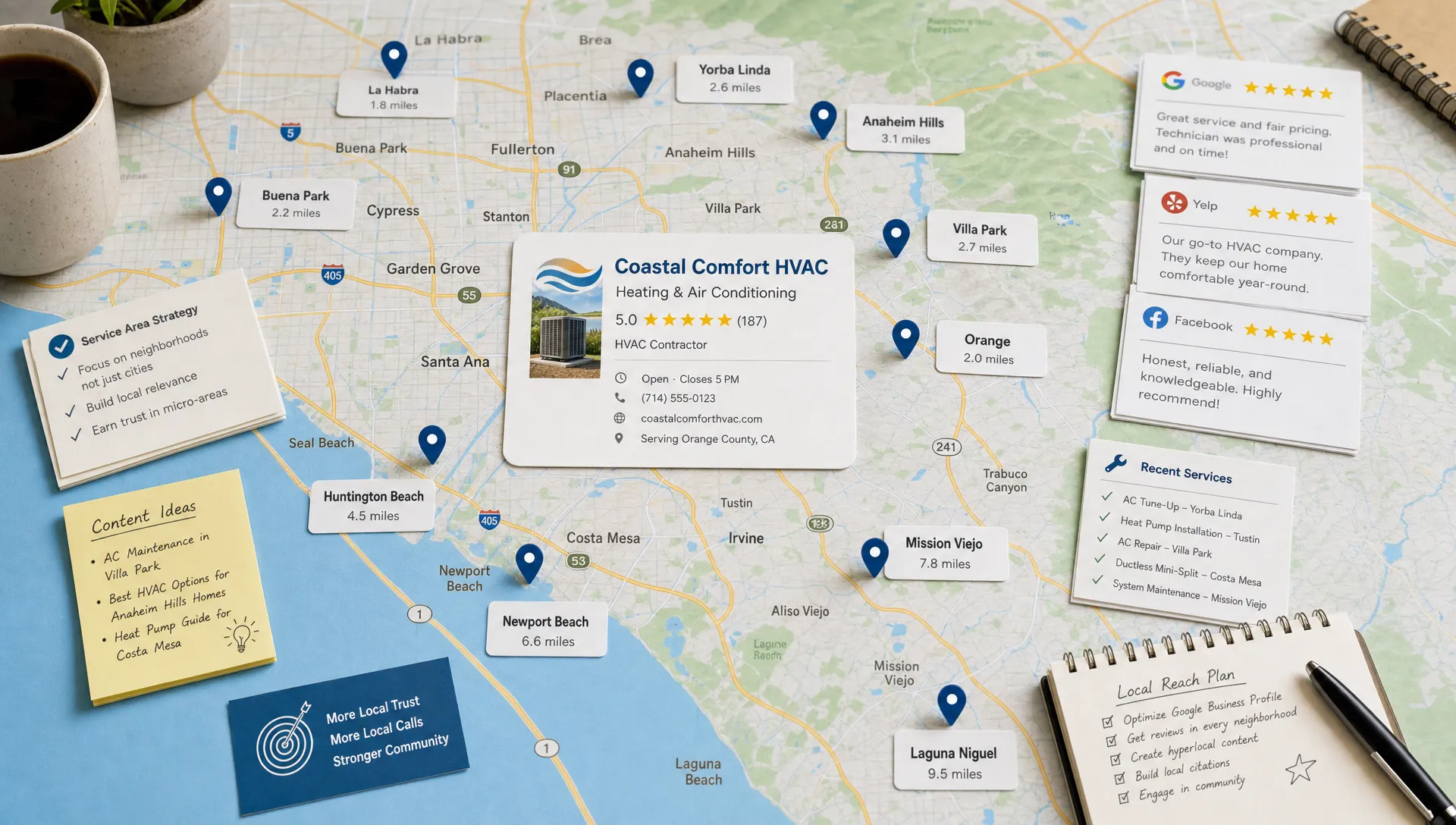
A smarter approach is to build campaigns around priority zones. Start with the cities and neighborhoods where your close rate, reputation, and operational capacity are strongest. Then expand outward once tracking confirms profitable demand.
Mistake 3: Sending paid traffic to a weak homepage
A homepage is usually built for general introduction. Paid traffic needs a direct answer. If someone clicks an ad for “roof repair in Huntington Beach,” they should land on a page that confirms roof repair, Huntington Beach service, relevant proof, and a clear next step.
Weak landing pages usually have the same symptoms. They load slowly, make visitors hunt for phone numbers, use generic stock language, and fail to answer the questions that determine whether someone calls. For contractors, those questions often include service area, response time, project type, financing options, warranties, and proof of similar work. For professional practices, they may include credentials, locations, appointment availability, specialties, insurance guidance, and what happens after the first inquiry.
A landing page does not need to be flashy. It needs to be specific, trustworthy, fast, mobile-friendly, and easy to act on. The page should match the ad promise, the search intent, and the local market.
Mistake 4: Treating local trust as separate from advertising
Paid ads can put your name in front of someone. They cannot force trust. That trust is built through reviews, local content, Google Business Profile quality, consistent listings, photos, case examples, and recognizable community relevance.
This matters because local buyers rarely make decisions from one touchpoint. A homeowner may click an ad, check reviews, scan your Google Business Profile, ask an AI assistant, visit your website, and then call. A prospective patient or legal client may compare several firms before filling out a form.
If your advertising looks strong but your local presence looks thin, the campaign will underperform. Internet advertising works best when it is supported by a strong local search foundation. Kell Web Solutions’ Local SEO Mastery is designed around that foundation, including Google Business Profile optimization, location-targeted content, citation consistency, and ongoing local visibility work.
Mistake 5: Measuring leads instead of booked revenue
A form fill is not a customer. A call is not always qualified. A booked appointment is not always revenue. Local businesses waste money when they stop measurement at the easiest number to count.
A better reporting system follows the path from impression to closed business. At minimum, campaigns should track which channel produced the inquiry, which city it came from, which service was requested, whether the call was answered, whether the prospect was qualified, whether an appointment was booked, and whether the job or case became revenue.
Here is a simple way to compare weak advertising measurement with stronger local revenue measurement:
| Advertising mistake | What it usually looks like | Better approach | Metric that matters |
|---|---|---|---|
| Optimizing for clicks | Campaigns chase cheap traffic | Optimize for high-intent calls and appointments | Cost per qualified opportunity |
| Broad city targeting | Ads run across every nearby city | Prioritize profitable service zones | Revenue by city or neighborhood |
| Generic landing pages | One page serves every ad | Match page to service and location intent | Conversion rate by landing page |
| No call outcome tracking | Every call is counted as a lead | Track answered, qualified, booked, and closed calls | Booked call rate and close rate |
| Ignoring local trust | Ads run without review or GBP support | Strengthen reviews, proof, and local content | Conversion rate from local visitors |
This kind of tracking does not just prove ROI. It shows where the real bottleneck is. Sometimes the issue is not the ad. It is the landing page, phone handling, offer, follow-up, or city targeting.
Mistake 6: Letting missed calls erase the ad budget
For local service businesses, speed matters. A homeowner with a broken AC system or a burst pipe is not waiting three days for a reply. A legal client seeking urgent guidance may contact the firm that responds first with clarity and confidence.
Many campaigns fail after the click because nobody answers, the front desk is overwhelmed, voicemail goes unchecked, or follow-up is inconsistent. That means the business pays for demand but does not capture it.
This is especially costly in home services. If an ad generates a high-intent call from a nearby customer and that call is missed, the prospect often contacts the next provider immediately. The advertising platform may still report a lead, but the business receives no revenue.
Local businesses should audit call handling before scaling ad spend. Review call recordings, missed call logs, response times, after-hours coverage, and booking scripts. If your team cannot reliably convert inquiries, increasing the advertising budget will amplify the leak.
For companies that need qualified conversations added to the calendar, Kell Web Solutions’ Profit Accelerator focuses on intelligent prospecting, personalized outreach, persistent follow-up, and booking qualified conversations without manual prospecting.
Mistake 7: Using generic creative and copy that could fit any competitor
Local buyers need a reason to choose you. “Quality service,” “trusted experts,” and “free estimates” are not enough because every competitor says the same thing.
Strong advertising copy answers the buyer’s real decision questions. Why should a homeowner trust your HVAC company in Laguna Niguel? Why should a patient choose your Irvine dental office instead of another one five minutes away? Why should a business owner call your Orange County law firm rather than a national directory listing?
Specificity wins. Mention the service, the local context, the type of customer served, and the proof that supports your claim. That proof may include years in business, specialized expertise, neighborhood experience, review themes, before-and-after project examples, or clear process explanations. Only use claims you can support.
Professional practices should be especially careful. Ad copy must be persuasive without overpromising outcomes. Contractors should also avoid exaggerated claims that are not backed by evidence. Clear, truthful positioning builds more durable trust than hype.
Mistake 8: Automating campaigns without human oversight
AI tools can help marketers move faster, test more ideas, and reduce production bottlenecks. For ecommerce brands, platforms offering AI-powered marketing workflows can streamline campaign ideas, creative assets, publishing, and performance learnings across channels.
Local businesses can also benefit from AI-assisted advertising, but automation should not replace judgment. A roofing contractor, dental practice, or law firm operates in a trust-sensitive environment. Location accuracy, service details, compliance, tone, and claims all matter.
The mistake is assuming AI-generated campaigns are automatically ready to publish. They are not. AI can create a starting point, but a human should verify the offer, local language, service area, compliance risks, brand voice, and conversion path. The best results come from combining automation with experienced local strategy.
Mistake 9: Depending on paid ads while ignoring answer engines
Traditional internet advertising focuses on buying attention. But local discovery is shifting toward answer-driven experiences. Google AI results, voice assistants, ChatGPT-style tools, and other answer engines increasingly shape which businesses are considered credible before a user ever clicks an ad.
This creates a new risk. A business may pay for traffic while AI-generated answers recommend competitors with stronger entity signals, clearer content, better reviews, or more consistent local authority. In that environment, paid ads alone are not enough.
Local businesses need websites and content that clearly explain who they are, where they serve, what they do, and why they can be trusted. Service pages, FAQs, structured data, review signals, and location-specific authority all help machines understand the business. This is where Answer Engine Optimization becomes important. AEO focuses on being selected as the answer, not just appearing somewhere in a list of links.
For contractors competing across neighborhoods, a distributed local authority strategy can also help reinforce relevance beyond one main website. Kell Web Solutions’ Hyperlocal Authority Builder is built for businesses that need neighborhood-level visibility and stronger local entity signals.
Mistake 10: Scaling before fixing the conversion system
The fastest way to waste money is to scale a campaign before the system is ready. More budget will not fix unclear offers, slow pages, weak reviews, bad tracking, poor phone handling, or unfocused targeting.
Before increasing spend, local businesses should run a conversion audit. Look at the entire path from search to sale. Does the ad match the landing page? Does the page match the caller’s urgency? Is the phone answered? Are inquiries tagged by source and city? Are reviews current? Are follow-ups documented? Are booked jobs tied back to campaign cost?
Once those pieces are working, scaling becomes safer. The business is not just buying more clicks. It is investing in a repeatable revenue engine.
A practical 30-day cleanup plan
If your internet advertising is active but inconsistent, do not start by changing everything. Start by finding the leaks.
In the first week, define your top services, best locations, and acceptable cost per qualified opportunity. In the second week, review landing pages and phone handling. In the third week, clean up tracking so you can see source, city, service, and outcome. In the fourth week, refine ad copy, pause wasteful locations, and strengthen local trust signals such as reviews, Google Business Profile content, and relevant service-area pages.
This process gives you a clearer answer to the question that matters most: which advertising dollars are creating real opportunities, and which are only creating activity?
Frequently Asked Questions
What is the biggest internet advertising mistake local businesses make? The biggest mistake is buying traffic before defining what a profitable lead looks like. Local businesses should know their best services, target cities, close rates, and acceptable cost per booked opportunity before scaling ad spend.
Should local businesses use paid ads or local SEO? Most competitive local businesses need both. Paid ads can create immediate visibility, while local SEO and AEO build durable authority that supports trust, organic discovery, and AI-driven recommendations.
Why do my ads get clicks but not calls? Common reasons include weak landing pages, poor mobile experience, broad targeting, unclear offers, low review trust, slow response times, or traffic from people outside your ideal service area.
How does AI change internet advertising for local companies? AI changes how customers discover and compare businesses. Ads still matter, but businesses also need clear entity signals, structured content, reviews, and answer-ready pages so AI systems can understand and recommend them.
What should contractors and professional practices track beyond leads? Track qualified calls, booked appointments, city or neighborhood, service requested, call answer rate, close rate, job value, and revenue by channel. Those numbers reveal whether advertising is producing business or just activity.
Turn advertising from expense into a revenue system
Internet advertising should not feel like gambling. For local contractors and multi-location professional practices, the winning formula is clear: target the right geography, promote the right services, support every ad with local trust, answer quickly, track real outcomes, and build authority for both search engines and answer engines.
Kell Web Solutions helps Orange County and California businesses connect advertising, local SEO, AEO, and qualified outreach into a safer growth system. If your campaigns are producing clicks but not enough booked calls, explore Answer Engine Optimization, Local SEO Mastery, or the Profit Accelerator to build a stronger path from visibility to revenue.