How to Pick the Right Agency for SEO in 2026
Choosing an agency for SEO in 2026 is not just a marketing decision. For a contractor, medical group, dental practice, law firm, or multi-location service business, it can determine whether high-intent local customers find you, trust you, and call you before they ever compare three competitors.
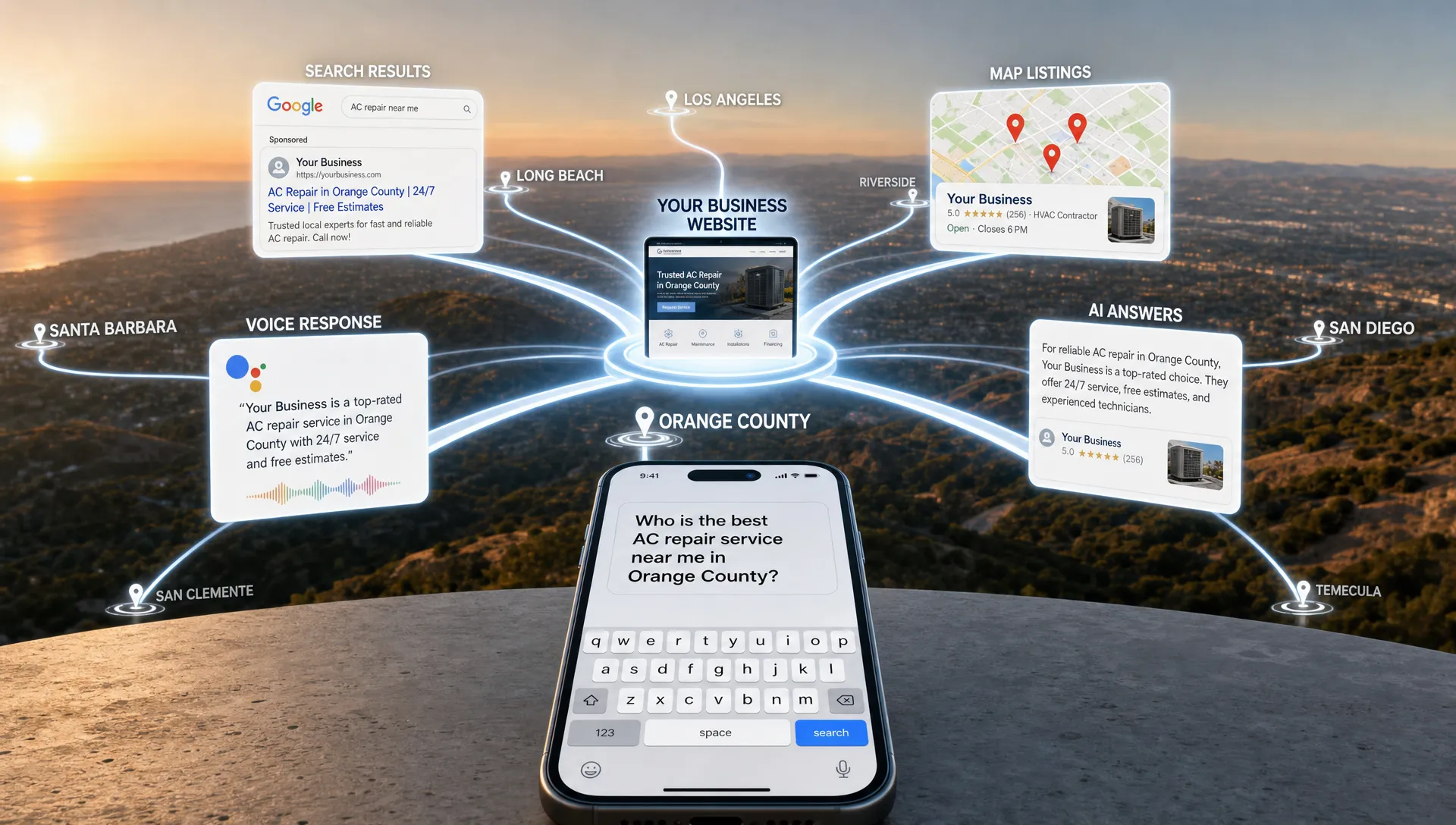
The challenge is that SEO has changed. Your prospects are still using Google, but they are also seeing Google Maps results, AI-generated summaries, voice assistant answers, review snippets, Local Services Ads, directory results, and recommendations from tools like ChatGPT and Perplexity. A modern agency for SEO has to understand all of those discovery paths, not just traditional blue-link rankings.
That matters even more in California markets. Orange County, Los Angeles, San Diego, San Jose, Sacramento, Fresno, and the Inland Empire all have dense local competition. A plumber in Irvine, a roofer in Anaheim, an HVAC company in Laguna Niguel, and a dental practice in San Jose may all need SEO, but they do not need the exact same strategy.
Why picking an SEO agency is different in 2026
In the past, many businesses chose an SEO provider by asking one question: can you rank us on page one? That question is no longer enough.
Ranking still matters, but search visibility now includes the map pack, Google Business Profile results, AI Overviews, featured snippets, review platforms, local directories, answer engines, and conversion paths from mobile search. If your agency only reports keyword movement, it may miss the bigger question: are more qualified local buyers finding and contacting your business?
Google Search Central continues to emphasize helpful, reliable, people-first content. That means thin city pages, generic AI-written blogs, and keyword-stuffed service pages are not a durable strategy. The best agencies build content around the real questions customers ask before they call, then support that content with technical clarity, local trust signals, reviews, and strong conversion design.
If you want a deeper foundation before evaluating proposals, Kell Web Solutions has a companion guide on what search engine optimization really means in 2026. The short version is this: SEO is now a system for visibility, trust, and conversion across the places where people and machines look for answers.
Start by defining what winning means for your business
Before you compare agencies, define the business outcome you actually want. More traffic is not always the answer. More low-quality calls can waste your staff’s time. More rankings in low-value cities may not move revenue.
For a home services contractor, winning may mean more booked repair calls in Laguna Beach, more replacement estimates in Huntington Beach, or more commercial service inquiries in Irvine. For a professional practice, it may mean more qualified consultations within a specific driving radius of each office.
Build a simple local revenue map before you talk to agencies:
- Your highest-margin services
- Your most important cities, neighborhoods, and service areas
- Your current best lead sources
- Your seasonal demand patterns
- Your average close rate by service type
- Your call handling and appointment booking process
A good agency will ask about these details early. A weak agency will jump straight into rankings, backlinks, or blog volume without understanding how your business actually makes money.
The 9-point scorecard for choosing an agency for SEO
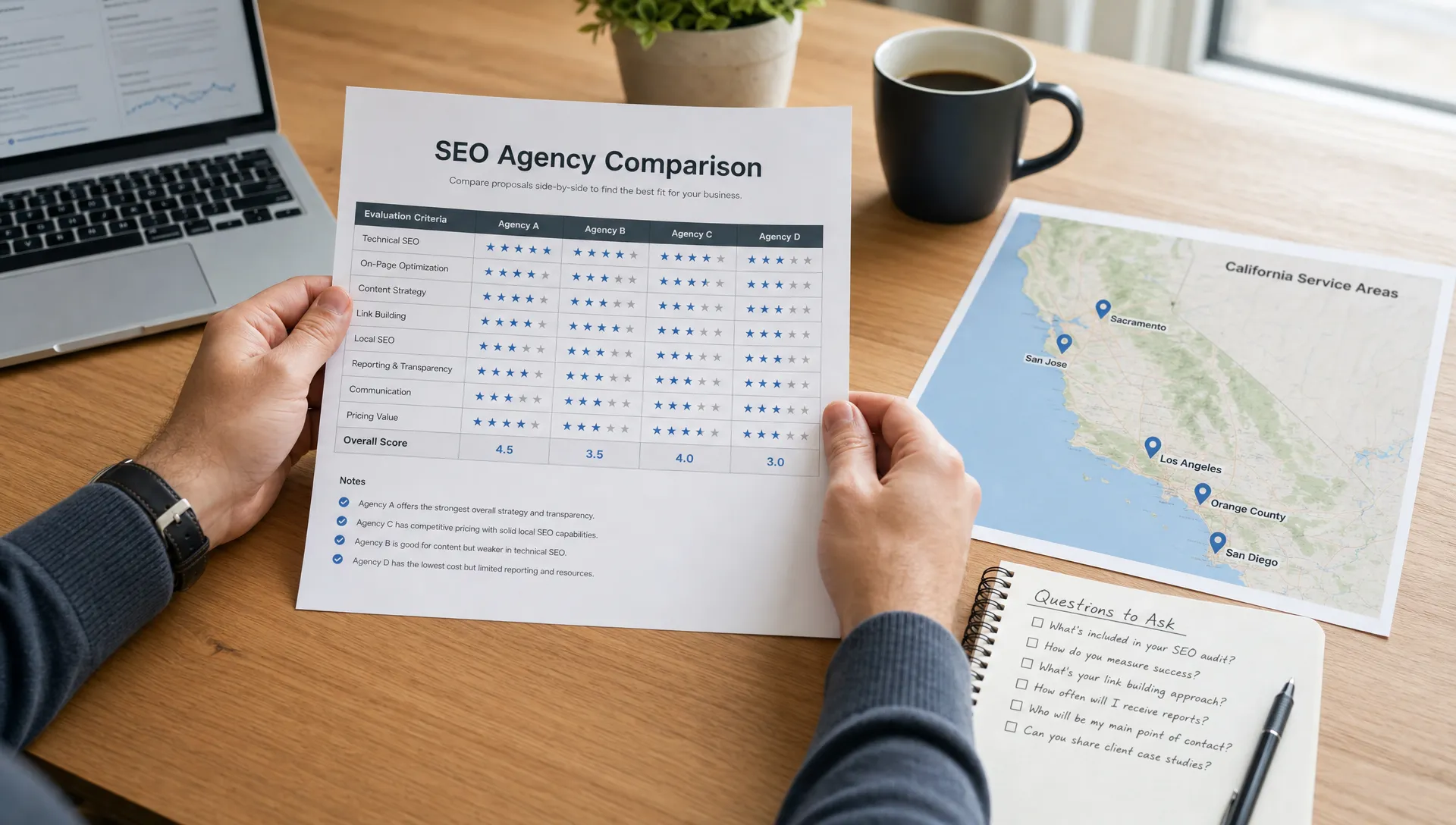
Use the following scorecard when you review proposals. You do not need every agency to be perfect in every category, but you should be concerned if an agency cannot explain how its work connects to local visibility, trust, and qualified calls.
Because AI answers increasingly influence local discovery, it is also worth understanding how answer engine optimization wins local calls in 2026 before you sign a contract.
| Evaluation area | What a strong agency should explain | Red flag |
|---|---|---|
| Local market knowledge | How strategy changes by city, neighborhood, competition, and service type | Same package for every business in every market |
| Revenue alignment | How SEO activity connects to calls, forms, appointments, and booked jobs | Reports focus only on impressions and traffic |
| Google Business Profile strategy | How the agency optimizes services, categories, photos, posts, reviews, and local relevance | Treats GBP as a one-time setup task |
| Technical SEO | How site structure, indexing, speed, mobile UX, schema, and crawlability will be improved | Cannot explain what technical work is included |
| Content strategy | How content will answer real customer questions and support buying decisions | Promises a fixed number of generic blog posts |
| AEO and AI visibility | How the business will become easier for answer engines to understand and trust | Says AI search does not matter or guarantees AI citations |
| Review and reputation signals | How reviews will be requested, displayed, and used ethically | Suggests fake reviews or review gating |
| Reporting | How performance will be measured by visibility, lead quality, and conversion | Sends automated dashboards with no interpretation |
| Transparency | Who owns the website, content, accounts, tracking, and data | Uses private tactics you cannot inspect |
Technical competence is especially important in 2026. Google’s documentation on structured data explains that structured formats can help search engines better understand page content. Schema markup alone will not make a weak business rank, but clear technical signals make it easier for search systems to interpret your services, locations, reviews, and expertise.
What a strong first 90 days should look like
A serious SEO engagement does not start with random blog posts. It starts with measurement, access, cleanup, and strategy. The first 90 days should create the foundation for compounding results.
| Timeframe | What should happen | What you should expect to see |
|---|---|---|
| First 30 days | Access review, analytics setup, call tracking review, technical audit, GBP audit, competitor analysis, local visibility baseline | Clear priorities, not vague promises |
| Days 31 to 60 | Site structure fixes, core page optimization, GBP improvements, citation cleanup, conversion path improvements | Better clarity for users and search engines |
| Days 61 to 90 | Service-area content, review strategy, internal linking, schema refinement, early performance analysis | Leading indicators such as better local visibility and cleaner tracking |
SEO is not instant, but the agency’s work should be visible early. You should know what has been changed, why it was changed, and how those changes support future rankings, AI visibility, and local conversions.
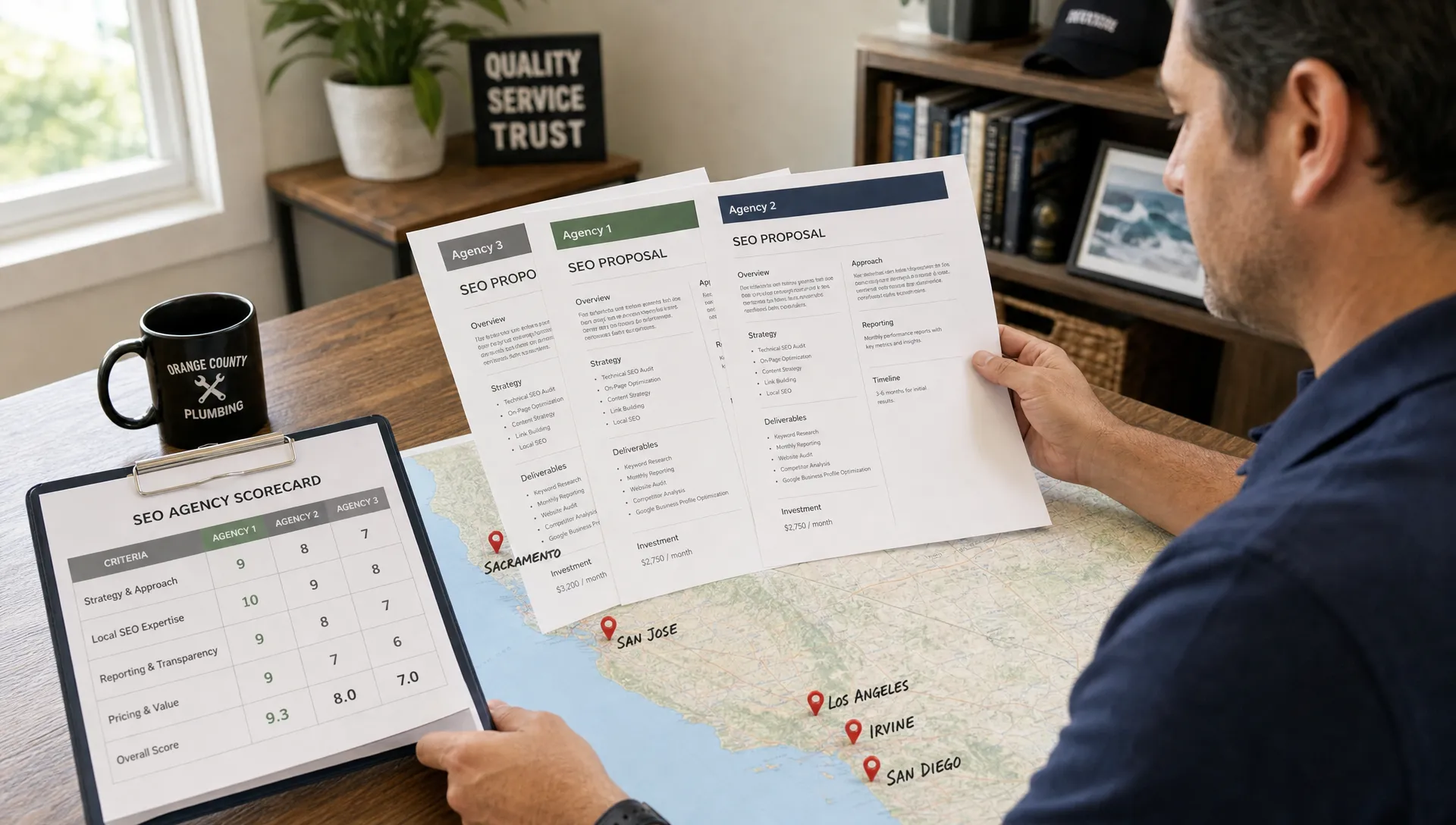
California geography should shape the strategy
A California SEO strategy should not treat every market the same. Search behavior, competition, trust signals, and customer expectations vary by region.
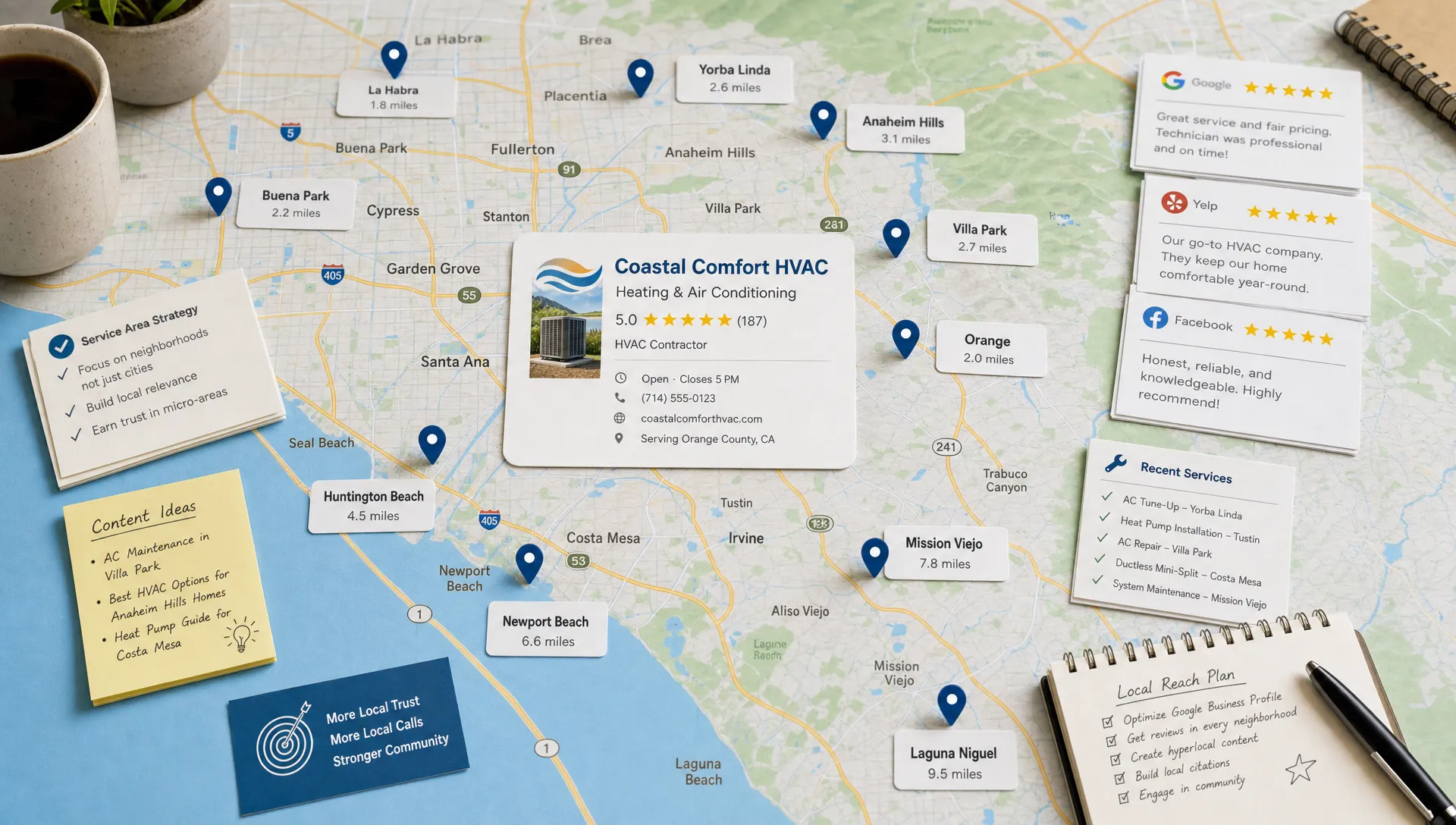
In Orange County, a business may need strong neighborhood relevance across Laguna Beach, Laguna Niguel, Irvine, Anaheim, Newport Beach, Huntington Beach, and Santa Ana. Customers often compare reputation, proximity, response time, and perceived professionalism before calling. For high-value home services and professional practices, polished local pages and strong reviews can make a measurable difference.
In Los Angeles and San Diego, scale and neighborhood specificity matter. A general Los Angeles service page may be too broad to compete. The agency should know how to build relevance around actual service zones, not just city names.
In Northern California markets like San Jose, San Francisco, Oakland, Fremont, and Sunnyvale, professional practices and tech-adjacent businesses often face highly informed buyers. Content needs to be precise, credible, and useful, not generic.
In Central and Inland California cities such as Fresno, Sacramento, Bakersfield, Stockton, Riverside, San Bernardino, Ontario, and Rancho Cucamonga, SEO often supports territory expansion. The agency should be able to prioritize markets based on demand, competition, and operational capacity rather than simply creating pages for every city at once.
Red flags that should make you pause
Not every SEO agency is risky, but some sales promises should trigger caution. Be especially careful when an agency leads with shortcuts instead of strategy.
- Guaranteed number one rankings in a fixed timeframe
- No discussion of calls, booked jobs, or lead quality
- Blog packages with no customer research behind them
- Hidden backlinks, private networks, or tactics the agency refuses to explain
- No plan for Google Business Profile optimization
- No review strategy or an unethical review strategy
- No ownership clarity for website assets, content, domains, analytics, or ad accounts
- Reports that look impressive but do not explain business impact
Review practices deserve special attention. The FTC’s guidance on endorsements and reviews makes clear that businesses must avoid deceptive review practices. A legitimate agency should help you earn and showcase real customer feedback, not manufacture trust.
Questions to ask before signing an SEO contract
The best way to choose an agency is to ask practical questions and listen for clear, specific answers. If the agency cannot explain its process in plain English, it may not have a strong process.
- Which services and cities should we prioritize first, and why?
- What are the biggest visibility gaps you see right now?
- How will you improve our Google Business Profile?
- What technical issues need to be fixed before content scales?
- How will you decide what content to create?
- How do you measure call quality and appointment value?
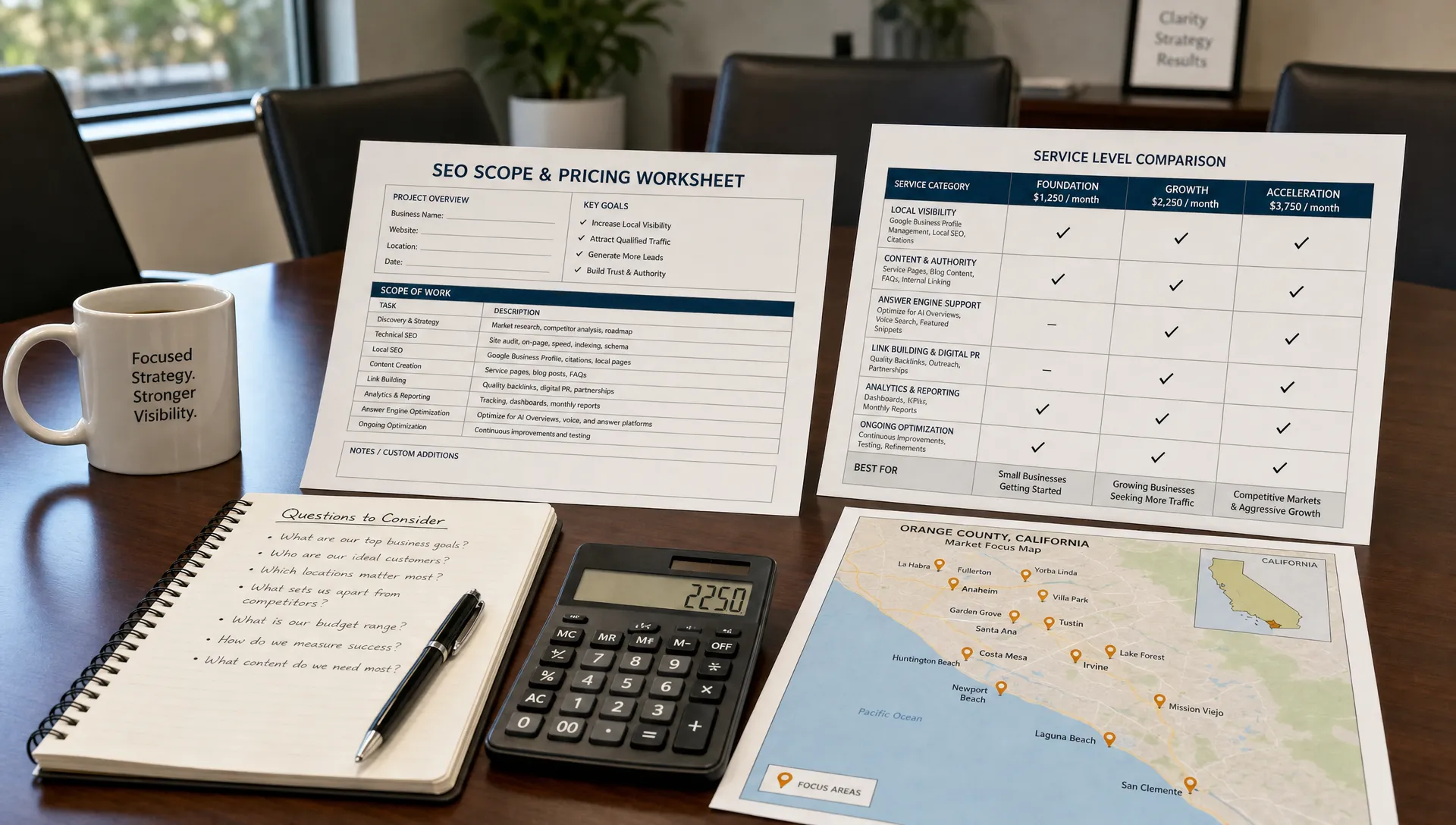
- What work is included each month?
- Who owns the content, website changes, data, and accounts?
- What can you influence, and what can no agency honestly guarantee?
You are not looking for magical answers. You are looking for judgment. A capable agency will tell you what it knows, what it needs to investigate, and where SEO may or may not be the best investment.
Boutique agency or larger firm: which is better?
There is no universal answer. A large agency may be the right fit for a national brand, a complex enterprise website, or a company that needs many departments working at scale. A boutique agency can be a better fit when senior strategy, local market knowledge, and direct accountability matter more than a large account team.
For Orange County contractors and multi-location professional practices, the deciding factor is often not agency size. It is whether the people guiding the strategy understand local buyer behavior and can connect search visibility to revenue.
If you are comparing SEO support as part of a broader marketing decision, the same principles apply when you choose marketing firms that actually grow local revenue. Strategy, execution, tracking, and accountability need to work together.
The final decision framework
When you narrow your options, pick the agency that can answer three questions clearly.
First, how do our best customers search, ask, compare, and decide? Second, how will search engines and AI systems understand that we are a credible local answer? Third, how will more visibility turn into calls, consultations, booked jobs, or new patients?
If an agency can explain those three things in a way that reflects your market, your services, and your revenue model, you may have a serious partner. If it only sells rankings, links, or content volume, keep looking.
Frequently Asked Questions
What is the first thing I should ask an agency for SEO? Ask how the agency connects SEO work to revenue. A strong answer should include local visibility, Google Business Profile performance, conversion paths, call tracking, content quality, and lead quality, not just rankings.
Should I choose an Orange County SEO agency or a national agency? Choose based on fit, not location alone. For Orange County and California service businesses, local market knowledge can be a major advantage, especially when strategy depends on neighborhoods, service areas, reviews, and call intent.
How long does SEO take in 2026? Foundational improvements can begin within the first 30 to 90 days, but durable local SEO growth often takes several months. Competitive markets and multi-location campaigns may require longer timelines. Be cautious of any agency that guarantees instant results.
Do I still need SEO if AI answers are changing search? Yes. AI visibility usually depends on the same trust signals that support strong SEO: clear content, consistent business information, credible reviews, structured data, local authority, and a well-organized website.
What is the biggest red flag when hiring an SEO agency? The biggest red flag is a guarantee that ignores your competition, website condition, local market, and operational realities. Real agencies can commit to process, transparency, and disciplined execution, but they cannot control every search result.
Ready to evaluate your search visibility?
If you are a California contractor, professional practice, or local service brand comparing agencies, Kell Web Solutions can help you understand where your visibility stands and what kind of strategy makes sense for your market.
For an Orange County-based perspective on SEO, local visibility, and answer engine readiness, book a strategy call with Kell Web Solutions. Bring your questions, your priority cities, and your growth goals, and leave with a clearer view of what the right SEO partner should actually do for your business.