Ranking Search in 2026: What Local Businesses Must Do Now
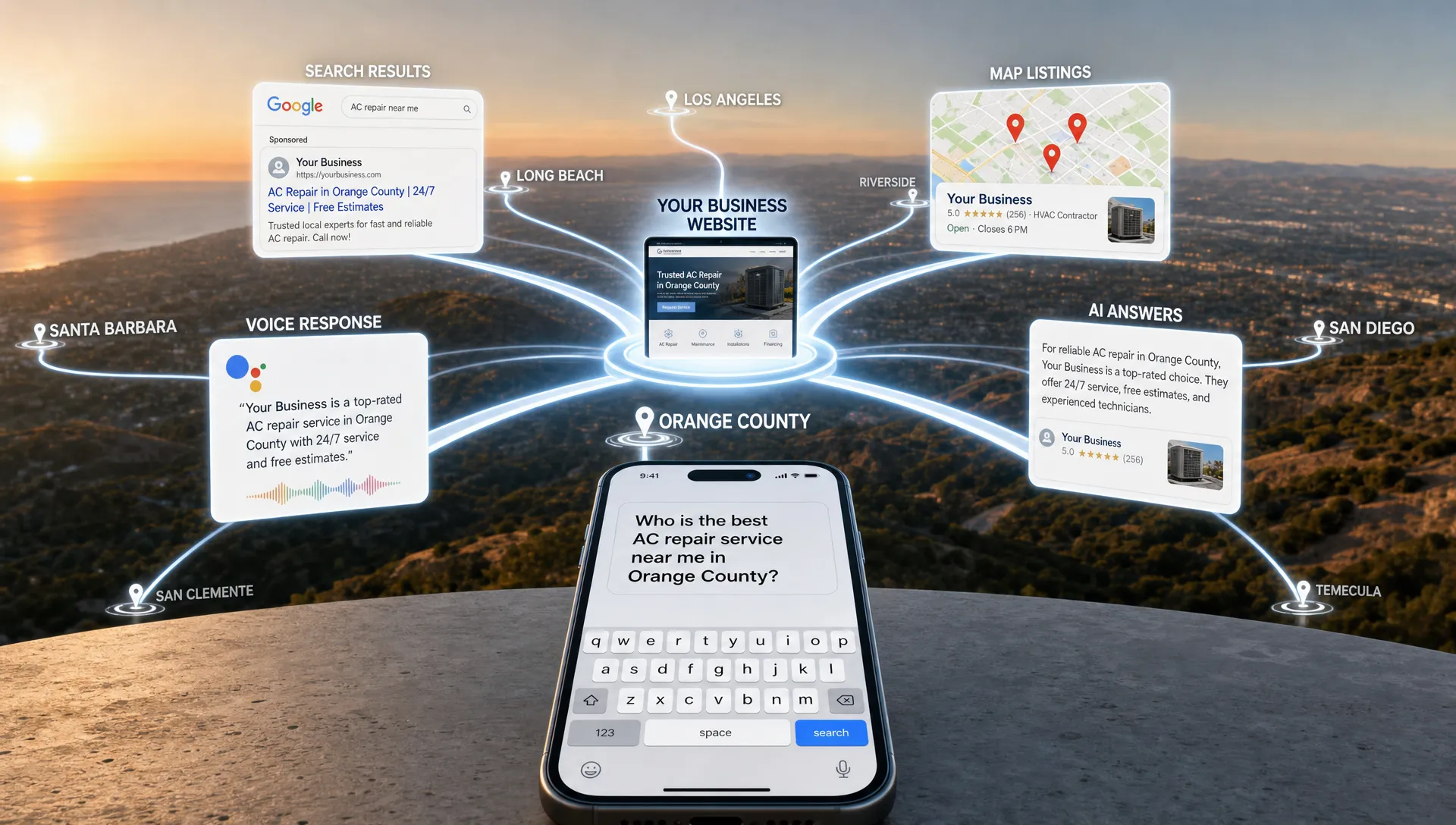
Ranking search in 2026 is no longer a single contest for ten blue links. For a local HVAC contractor in Irvine, a roofer in Huntington Beach, a dental group in San Diego, or a law firm with offices across Orange County, visibility now happens across Google Maps, AI Overviews, voice assistants, directory ecosystems, review platforms, and answer engines.
That shift changes the job. You are not simply trying to rank a page. You are trying to become the trusted local answer when a buyer asks who can solve this problem near me, who has proof, who is open, who serves this neighborhood, and who should I call now.
The good news is that local businesses can still win. The playbook is just more structured, more evidence-driven, and more local than traditional SEO ever was.
What ranking search means in 2026
In 2026, ranking search means being discoverable, understandable, and credible across every system that helps a customer choose a provider. Search engines still matter, but they are now part of a larger retrieval environment where AI systems summarize, recommend, and route attention.
For California businesses that depend on local demand, this is especially important. A homeowner in Laguna Niguel may ask Google for emergency AC repair. A patient in San Jose may ask an AI assistant for the best dental implant specialist nearby. A property manager in Los Angeles may compare electricians without clicking through more than one or two sites.
Your business needs to be visible in all of those moments.
| Search surface | What customers see | What your business must prove |
|---|---|---|
| Google Maps and Local Pack | Nearby providers, ratings, hours, photos, calls | Relevance, distance, prominence, reviews, complete profile data |
| Organic search results | Service pages, blog posts, local guides | Helpful content, technical quality, local intent match |
| AI Overviews and answer engines | Summarized recommendations and cited sources | Clear expertise, structured information, trustworthy entity signals |
| Voice assistants | One or a few spoken answers | Concise answers, accurate business data, strong local authority |
| Review and citation platforms | Reputation and third-party validation | Consistent NAP, verified reviews, category alignment |
The businesses that win are not always the biggest. They are the clearest, most consistent, and most verifiable.
Why local businesses cannot wait
Local search used to reward businesses that built a decent website, added city keywords, and earned a few backlinks. That foundation still matters, but it is no longer enough by itself.
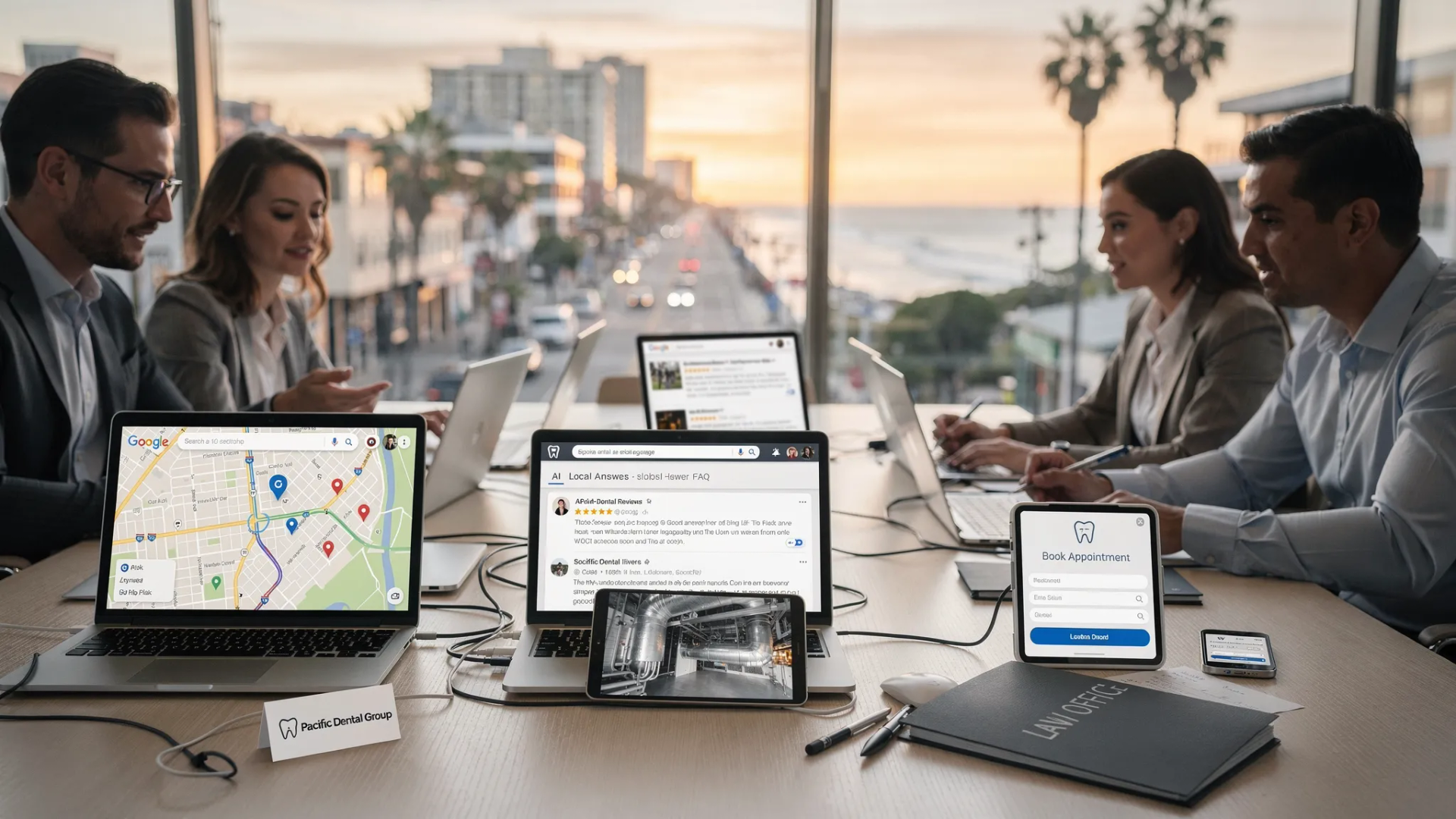
AI-driven search is compressing the buyer journey. A prospect may get a summary, compare three providers, read reviews, and call without browsing five websites. For home services contractors, that means fewer chances to recover from weak visibility. For multi-location medical, dental, and legal practices, it means every office location must prove its own authority at the neighborhood level.
Google also continues to emphasize local relevance. Its guidance on how to improve local ranking on Google highlights relevance, distance, and prominence as core factors. In plain English, Google wants to know what you do, where you do it, and whether the market appears to trust you.
If you need a broader refresher on the basics, this practical guide to local search visibility and référencement local covers foundational elements like Google Business Profile optimization, geographic keywords, reviews, mobile readiness, and citations.
The difference in 2026 is that those basics now feed AI systems too. If your data is incomplete, inconsistent, or thin, answer engines have less reason to choose you.
1. Build a clean local entity before chasing rankings
A local entity is the complete digital identity of your business. It includes your name, address, phone number, service categories, owner information, reviews, service areas, website content, structured data, citations, and third-party mentions.
If those signals conflict, search systems hesitate. If they align, your business becomes easier to trust.
Start with the essentials:
- Use one consistent business name, address, and phone number across your website, Google Business Profile, major directories, social profiles, and industry platforms.
- Choose accurate primary and secondary categories for each location.
- Build service pages that clearly state what you do, who you serve, and where you work.
- Add real proof, including project examples, credentials, team information, customer reviews, and location-specific experience.
- Use structured data such as LocalBusiness, Service, FAQ, Review, and Organization schema where appropriate.
For example, an Orange County plumbing company should not simply say it serves Southern California. It should clearly explain its service areas, emergency availability, plumbing specialties, license and insurance context where applicable, and why its team is relevant to neighborhoods such as Laguna Beach, Newport Beach, Irvine, Anaheim, and Santa Ana.
For a professional practice, each location should have a distinct page with its address, providers, practice areas, appointment details, nearby landmarks, patient or client expectations, and locally relevant FAQs.
2. Build content around the questions buyers actually ask
Traditional SEO often starts with keywords. Answer-ready search starts with questions.
The best local content in 2026 addresses real decision moments. These are the questions buyers ask before they call, book, or request an estimate. A roofer may need to answer questions about storm damage, tile roofs, insurance documentation, and city permitting. A dental practice may need to answer questions about implant costs, recovery timelines, sedation options, and who is a good candidate.
This is where Answer Engine Optimization becomes critical. AEO structures your website and content so AI-driven platforms can understand, trust, and recommend your business when people ask specific questions.
| Buyer question type | Example local query | Content your site should provide |
|---|---|---|
| Problem-aware | Why is my AC blowing warm air in Irvine? | Diagnostic guide, urgency signals, service explanation |
| Cost-aware | How much does roof repair cost in Orange County? | Pricing factors, ranges when appropriate, inspection process |
| Trust-aware | Who is the best plumber near Laguna Beach for emergency leaks? | Proof, reviews, service-area relevance, response process |
| Comparison-aware | Dentist vs oral surgeon for implants in San Diego | Educational comparison, referral guidance, appointment next step |
| Timing-aware | How fast can an electrician come out in Anaheim? | Availability, dispatch process, emergency service details |
A strong answer-ready page usually includes a direct answer near the top, supporting details, local context, proof, FAQs, and a clear next step. The goal is not to write longer content for its own sake. The goal is to make your expertise easy for both humans and machines to retrieve.
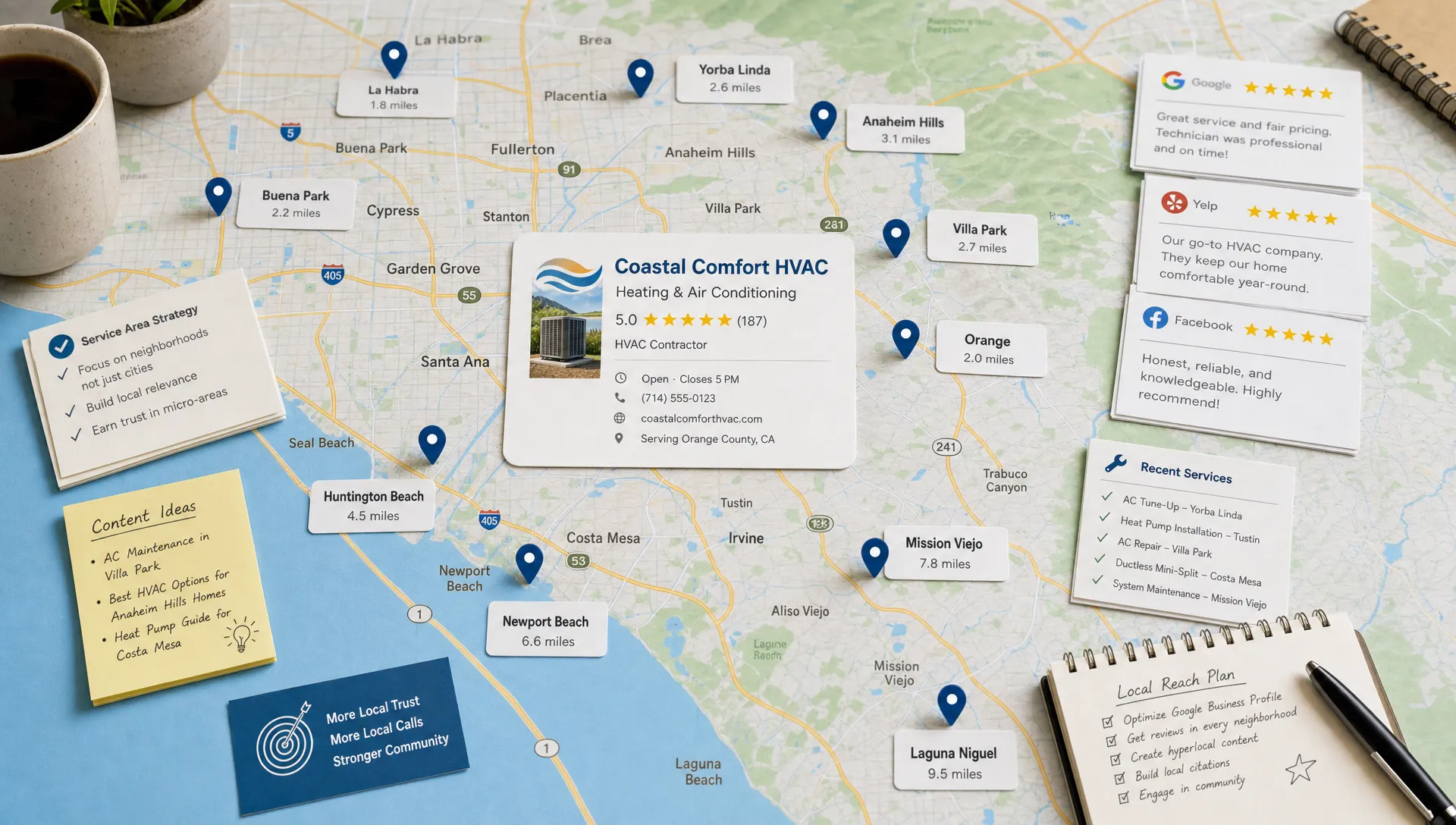
3. Win the neighborhood, not just the city
City-level SEO is crowded. County-level SEO is even harder. In 2026, the strongest local strategies often focus on neighborhood-level authority.
This matters in Orange County, where search intent can vary dramatically between Laguna Beach, Laguna Niguel, Newport Coast, Irvine, Huntington Beach, Anaheim, and Santa Ana. It also matters statewide in competitive California markets such as Los Angeles, San Diego, San Jose, San Francisco, Oakland, Fresno, Sacramento, Bakersfield, Riverside, and Long Beach.
A hyperlocal strategy does not mean creating thin doorway pages that swap one city name for another. That approach creates clutter, not authority. Instead, each local asset should contain useful, specific information that a resident or business owner in that area would recognize as relevant.
For home services, useful hyperlocal content may reference property types, climate patterns, local building considerations, neighborhood service needs, and common seasonal issues. For medical, dental, and legal practices, it may explain commute patterns, nearby communities served, appointment logistics, language needs, or location-specific service demand.
Kell Web Solutions approaches this through distributed local authority, including the Hyperlocal Authority Builder, which is designed to help businesses build neighborhood-level visibility signals rather than relying on one website alone.
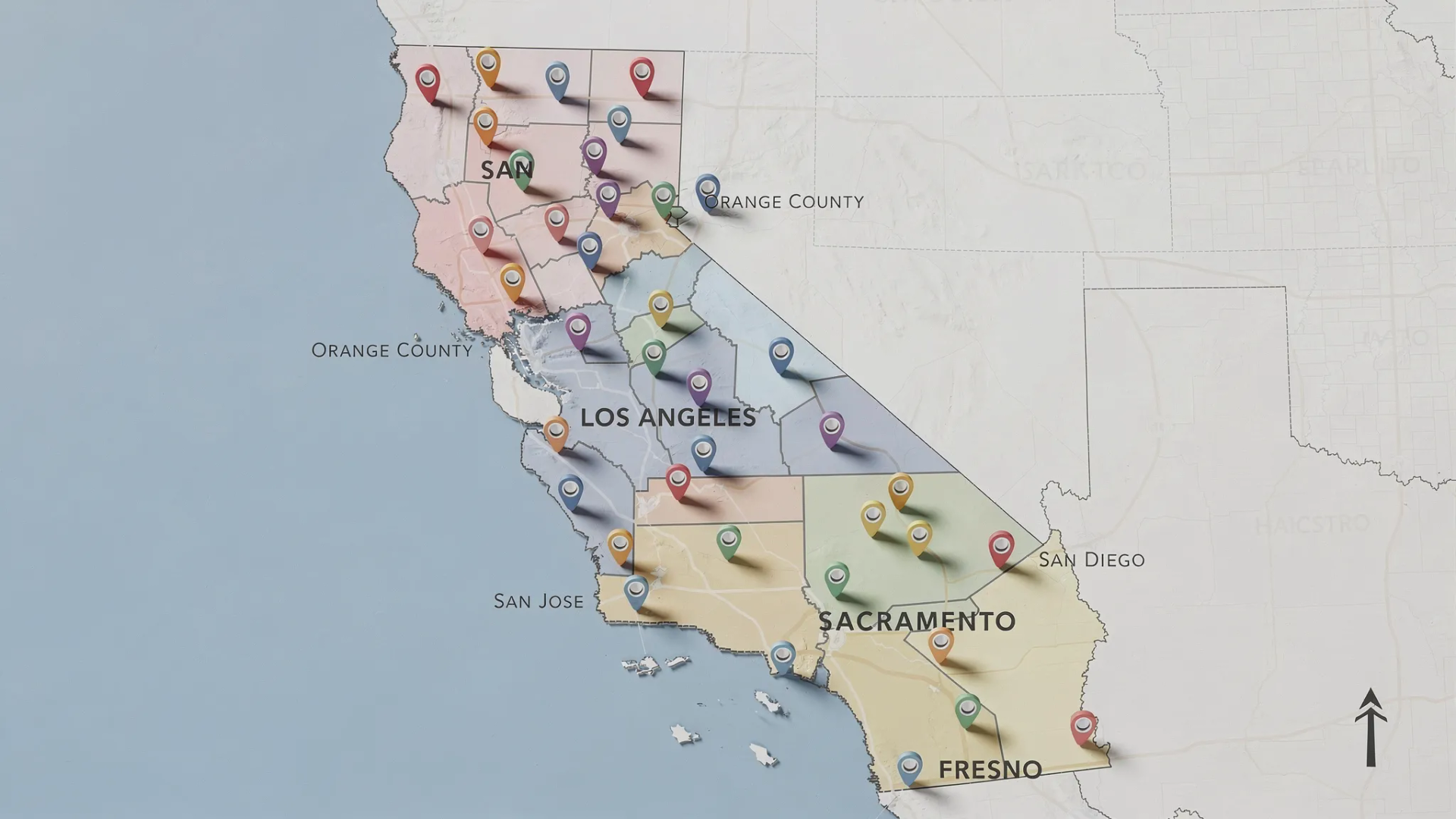
4. Treat reviews as search assets, not just social proof
Reviews influence buyer confidence, but they also help search systems understand prominence. A business with steady, detailed, recent reviews gives Google, AI tools, and customers more evidence to work with.
In 2026, the quality of review signals matters more than raw volume alone. A five-star rating with vague comments is helpful, but a detailed review that mentions the service, city, problem, outcome, and customer experience is far more useful.
A good review system should be ethical, consistent, and easy for customers. Ask after successful jobs or appointments. Make the request simple. Never buy reviews. Never pressure customers to write only positive feedback. Respond to reviews in a way that is professional, specific, and locally aware.
For example, a natural response might thank the customer for trusting the team with a water heater replacement in Laguna Niguel and mention that the company is glad the same-day repair solved the issue. That kind of response helps future customers and reinforces service-area relevance without sounding forced.
5. Make your website machine-readable and conversion-ready
Your website is still the home base of your authority. The problem is that many local websites are designed only for human browsing, not for AI interpretation.
A 2026-ready website should make the business easy to parse. Search engines and AI crawlers should be able to identify who you are, what you do, where you operate, why you are credible, and what action a customer should take next.
Important technical and content elements include clear service navigation, crawlable pages, fast mobile performance, internal links between related services and locations, structured data, descriptive headings, helpful FAQs, visible contact information, and consistent entity language across the site.
Some advanced businesses are also preparing for agentic discovery with assets such as
llms.txt
, enhanced JSON-LD, and clearly organized authority pages. These elements should not be treated as magic ranking buttons. They are part of a broader effort to make your business easier for AI systems to understand and cite.
A contractor website should not hide critical service details behind vague copy. A professional practice should not force users to dig for office locations, provider information, appointment options, or specialty details. Clarity is now a competitive advantage.
6. Measure the right things, not just keyword positions
Ranking reports still have value, but they do not tell the whole story. A business can rank lower for a traditional keyword while gaining more calls from Maps, AI answers, branded searches, and neighborhood-specific content.
In 2026, local businesses need a broader measurement model.
| Old measurement habit | Better 2026 metric | Why it matters |
|---|---|---|
| Track a few keyword rankings | Track visibility by service, city, and question | Buyers search in many different ways |
| Watch total website traffic | Measure qualified calls, forms, bookings, and direction requests | Revenue matters more than visits |
| Count reviews | Track review velocity, detail, recency, and response quality | Stronger reviews improve trust and prominence |
| Report impressions only | Track calls and booked conversations by source | Visibility must convert into revenue |
| Ignore AI answers | Monitor Share of Answer across target prompts | AI recommendations can influence demand before a click |
Share of Answer is especially important for businesses that want to be found in AI-driven discovery. It asks a practical question: when someone asks an AI tool about your service in your market, how often is your brand mentioned, cited, or recommended?
That metric is not a replacement for local SEO reporting. It is the missing layer that helps you understand whether your authority is visible in the retrieval economy.
7. Protect the revenue after visibility creates demand
Getting found is only half the job. If a high-intent prospect calls and nobody answers, the ranking win is wasted.
This is especially true for urgent home services. A homeowner with a leaking pipe, failed AC system, electrical issue, or roof problem is not waiting days for a reply. They call the next credible provider. Professional practices face the same issue when prospective patients or clients cannot quickly book, confirm availability, or get basic questions answered.
Local businesses should audit the full conversion path:
- Can mobile users call in one tap?
- Are service pages clear enough to create confidence?
- Are calls answered during peak demand windows?
- Are missed calls followed up quickly?
- Are leads qualified and routed to the right person?
- Are appointment requests tracked back to the source?
For businesses that need a more predictable pipeline beyond inbound search, Kell Web Solutions also offers Profit Accelerator, a managed AI outreach system designed to help fill calendars with qualified, pre-warmed conversations.
A practical 90-day plan for ranking search in 2026
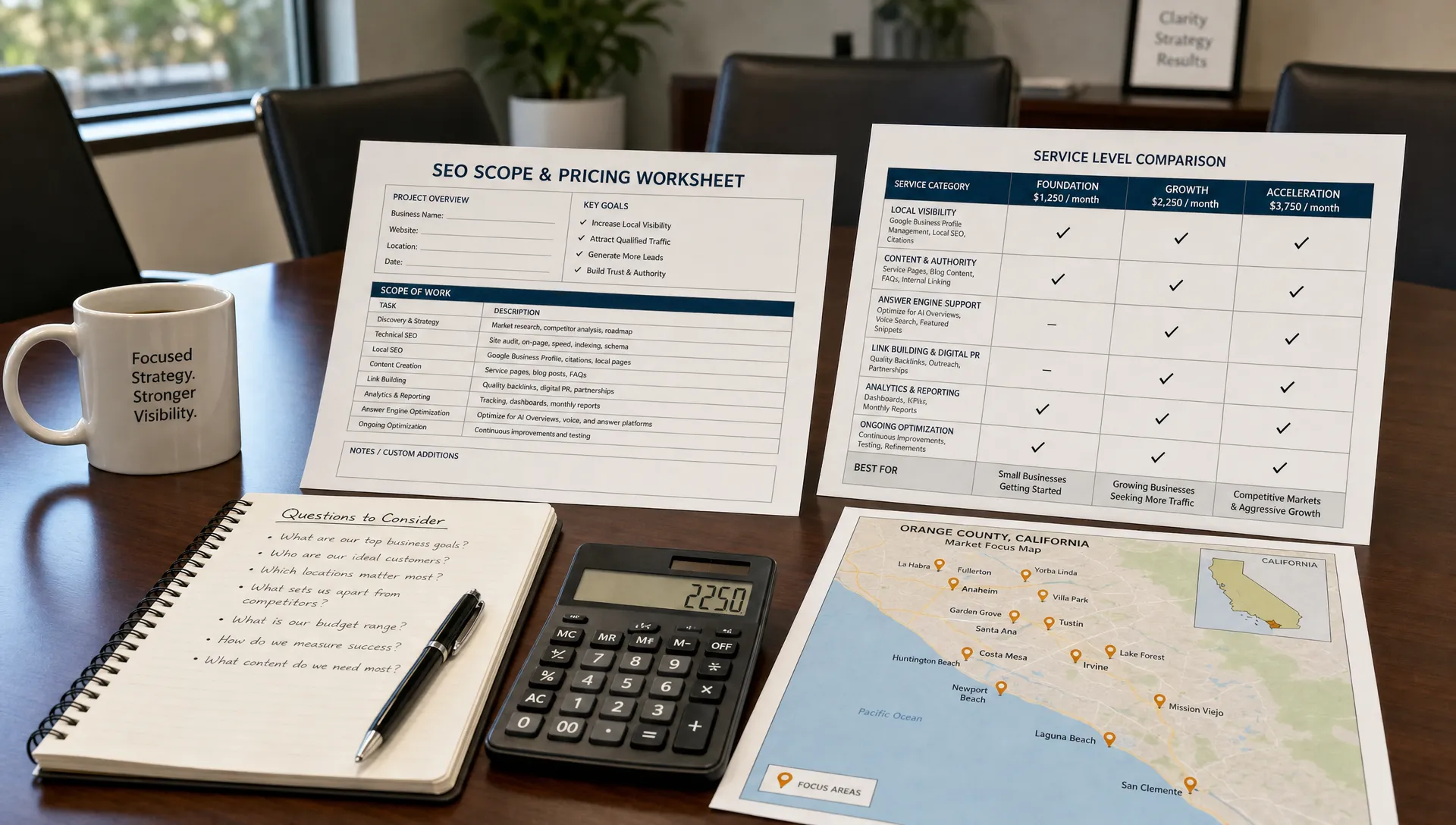
You do not need to rebuild everything at once. The smartest approach is to strengthen the foundation first, then expand authority, then measure and refine.
| Timeline | Priority | What to do | Expected outcome |
|---|---|---|---|
| Days 1 to 15 | Entity audit | Check NAP consistency, Google Business Profile data, categories, citations, and location pages | Cleaner local identity |
| Days 16 to 30 | Website clarity | Improve service pages, contact paths, headings, internal links, and trust signals | Better crawlability and conversions |
| Days 31 to 45 | Answer-ready content | Publish FAQs and service pages based on real customer questions | More AI-friendly relevance |
| Days 46 to 60 | Review system | Build a steady, ethical review request and response process | Stronger prominence and trust |
| Days 61 to 75 | Hyperlocal expansion | Create genuinely useful neighborhood or city content | Wider local authority footprint |
| Days 76 to 90 | Measurement upgrade | Track calls, bookings, Maps actions, AI mentions, and Share of Answer | Clearer revenue attribution |
The businesses that follow this sequence usually avoid the biggest mistake in local marketing: paying for more traffic before fixing the authority and conversion systems that turn visibility into revenue.
Common mistakes that hold local businesses back
Many local companies are not invisible because they lack effort. They are invisible because their effort is scattered.
The most common mistakes include publishing generic city pages, ignoring Google Business Profile details, treating reviews as an afterthought, using inconsistent business information across directories, relying only on paid ads, and measuring success only by ranking position.
Another common mistake is separating SEO, content, web design, reviews, and call handling into disconnected projects. In 2026, these pieces influence each other. A strong local page helps search visibility. Strong reviews improve trust. Clear calls to action improve conversions. Structured content helps AI systems interpret expertise.
Fast response turns intent into booked revenue.
Local search success is no longer about isolated tactics. It is about building a system.
Frequently Asked Questions
What does ranking search mean for a local business in 2026? Ranking search now means being visible across Google results, Maps, AI Overviews, voice assistants, review platforms, and answer engines. It is less about one keyword position and more about whether your business is selected as a trusted local answer.
Is traditional SEO still important? Yes. Technical SEO, content quality, local pages, backlinks, and Google Business Profile optimization still matter. The difference is that these elements now need to support AI understanding, local entity trust, and answer-ready visibility.
How can contractors compete with larger companies in AI search? Contractors can compete by building stronger hyperlocal authority. Detailed service-area content, consistent citations, credible reviews, project proof, structured data, and fast lead response can help a focused local contractor outperform larger but less relevant competitors in specific neighborhoods.
Do multi-location practices need separate pages for each office? Yes. Each office should have a clear, useful location page with accurate contact details, providers or team information, services, appointment guidance, local context, reviews when available, and structured data. Thin duplicate pages are not enough.
How soon can a business see improvement? Foundational fixes can improve clarity quickly, but durable local authority usually compounds over months. A practical 90-day plan can clean up entity signals, improve content, strengthen reviews, and establish better tracking, but competitive markets require ongoing work.
Make 2026 the year your business becomes the answer
Ranking search in 2026 is about more than being found. It is about being trusted, cited, selected, called, and booked.
Kell Web Solutions helps Orange County and California businesses adapt to this new environment with local SEO, Answer Engine Optimization, hyperlocal authority building, and revenue-focused growth systems. Based in Laguna Beach and serving markets across California, Kell Web Solutions brings more than two decades of local digital marketing experience to businesses that depend on neighborhood-level visibility.
If you want to know whether your business is ready for AI-driven local search, start with a strategy conversation. Book a call at calendly.com/gregg_kell/book-a-strategy-call or explore Kell Web Solutions at kellsolutions.com.