Best Appointment Booking Services in Orange County in 2026
Every missed appointment is a missed sale. For Orange County businesses, a half-empty calendar means lost revenue. The question is: what's the best system for filling it?
Some businesses need simple online scheduling software. Others need a managed service that actively books qualified prospects on their behalf. It depends on whether you're solving an inbound problem or an outbound one.
This guide covers both. Whether you run a solo practice or a multi-location home services company, the right fit is here.
What are the best appointment booking services in Orange County?
The top options span two categories: scheduling software and managed booking services. Software options include Calendly, Acuity Scheduling, Housecall Pro, and GoHighLevel. Managed services include Kell Web Solutions' Profit Accelerator and, for large operations, ServiceTitan.
1. Kell Web Solutions: OC's AI-Powered Appointment Filling Service
Disclosure: Kell Web Solutions is our own product. We've included it because we believe it genuinely belongs on this list, but you should know we're not a neutral party.
Most booking tools work only when customers already know you exist. Kell Web Solutions' Profit Accelerator takes the opposite approach. It's a fully managed AI system that finds, warms, and books qualified prospects directly onto your calendar.
The service runs on four engines: intelligent prospecting, personalized outreach, persistent follow-up, and booking-and-qualification. Each step ensures prospects arrive pre-warmed and ready to buy. It's a done-for-you pipeline — not a software subscription.
Profit Accelerator is built for OC home services businesses, medical practices, and professional service firms. It combines 20+ years of local market expertise with modern AI execution. The reported booking rate is 30%, with 98%+ primary inbox placement.
Key features
- Intelligent Prospecting: Identifies prospects that match your ideal customer profile by market and geography
- Personalized Outreach: Individualized messages for every prospect — no templates, no mass blasts
- Persistent Follow-Up: Adaptive timing and tone to recover leads who go quiet
- Booking & Qualification: Prospects arrive at the meeting pre-warmed and ready to have a real conversation
- 4-month framework: Structured rollout from foundation-building through full-scale calendar filling
- OC-local expertise: 20+ years understanding Orange County market dynamics and buyer psychology
Pricing
Profit Accelerator is a managed service with custom pricing based on your market, target volume, and outreach scope. Book a free strategy call at calendly.com/gregg_kell/book-a-strategy-call to get a tailored plan. Additional services — AEO, Local SEO, Hyperlocal Authority Builder — can stack on top for compounding results.
Pros & cons
Pros:
- Fully managed — no software to learn or campaigns to run yourself
- Outbound model fills your calendar even without existing inbound traffic
- Founder Gregg Kell is directly involved in every client engagement
- 30% call booking rate with 98%+ primary inbox placement
Cons:
- Not a self-serve tool — requires a consultation to get started
- Best suited for businesses committed to a multi-month outreach investment
- No public pricing; custom quotes only
Customers
Kell Web Solutions maintains client relationships running 15–20 years across HVAC companies, glass businesses, and professional service firms. One HVAC client eliminated $5,000+ per month in Google ad spend after seven years of organic growth through Kell. The core audience is owner-operated businesses that want a dependable, compounding pipeline — not a revolving door of paid leads.
2. Calendly: The Simplest Scheduling Tool on the Market
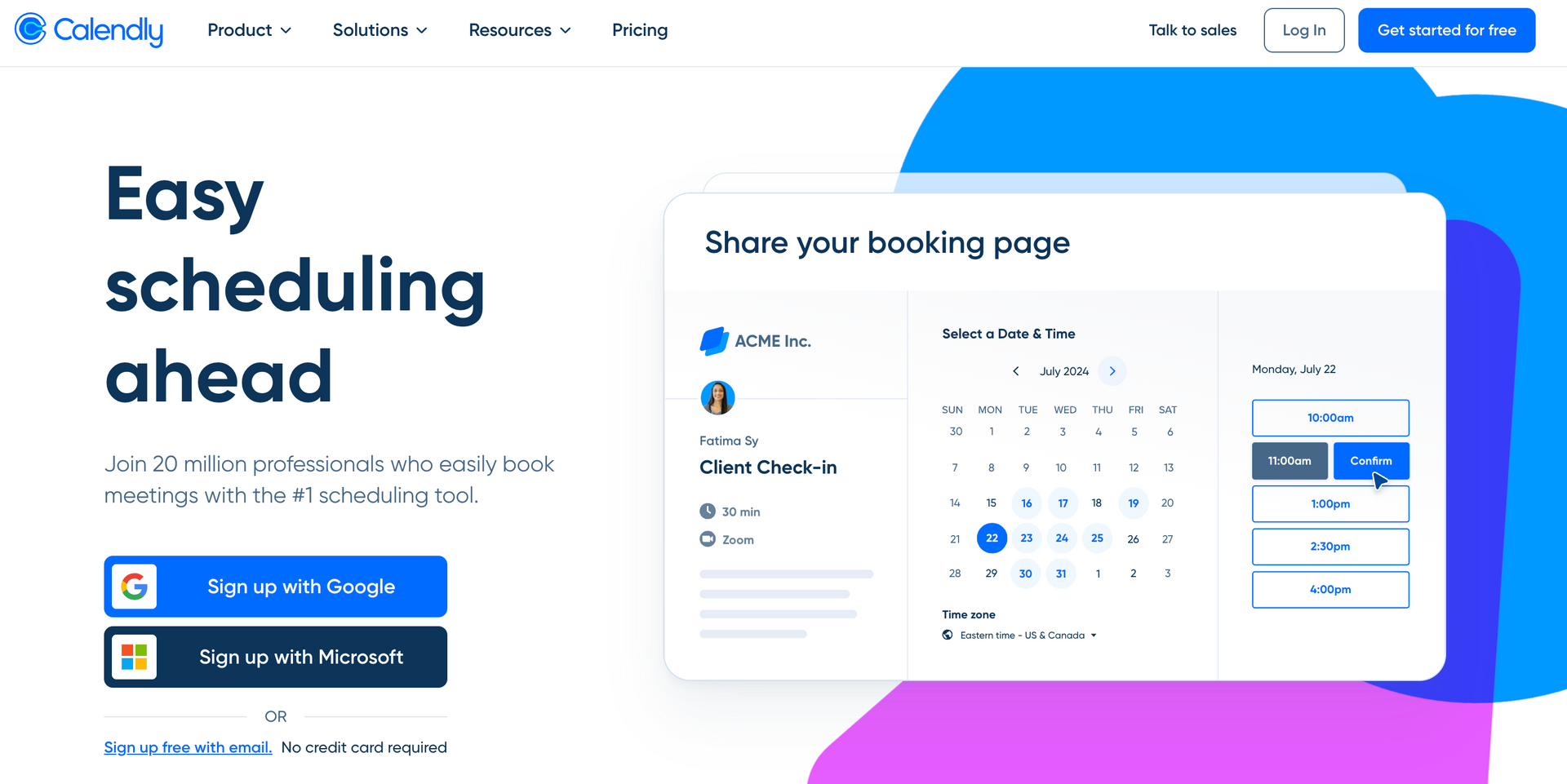
Calendly is the most widely used scheduling software available. You set your availability, share a link, and let prospects book without the back-and-forth. Solo consultants, agencies, medical offices, and sales teams all use it.
The free plan covers basic scheduling for one event type. Paid tiers unlock multiple event types, team scheduling, automated reminders, and CRM integrations. For any OC business with healthy inbound traffic, Calendly removes booking friction instantly.
It won't generate new leads for you. But if converting interested prospects into booked appointments is the problem — not finding them — Calendly solves it fast. It's affordable, quick to set up, and works with your existing tools.
Key features
- Instant availability sharing: Share a link and let people self-schedule in seconds
- Automated reminders: Email and SMS reminders reduce no-shows automatically
- CRM and video integrations: Connects with Salesforce, HubSpot, Zoom, Google Meet, and 100+ tools
- Round-robin scheduling: Route bookings across team members based on availability
- Customizable booking pages: Match your brand, set buffer times, and control booking windows
Pricing
- Free: 1 event type, unlimited meetings
- Standard: $10/seat/month — multiple event types, integrations, automated reminders
- Teams: $16/seat/month — team scheduling, round-robin, reporting
- Enterprise: Custom pricing for large organizations
Pros & cons
Pros:
- Fastest setup of any tool on this list — live in minutes
- Generous free plan for solopreneurs and small teams
- Integrates with virtually every tool in your stack
Cons:
- Purely inbound — does nothing to generate new leads
- Can feel impersonal for high-touch service businesses
- Advanced features require paid tiers
Customers
Calendly serves millions of users from freelancers to enterprise sales organizations. It's widely used across Orange County's tech, medical, consulting, and real estate sectors. Ratings consistently sit at 4.7/5 on G2, with users citing time savings and ease of setup as primary benefits.
3. Acuity Scheduling: Customizable Booking for Service Businesses
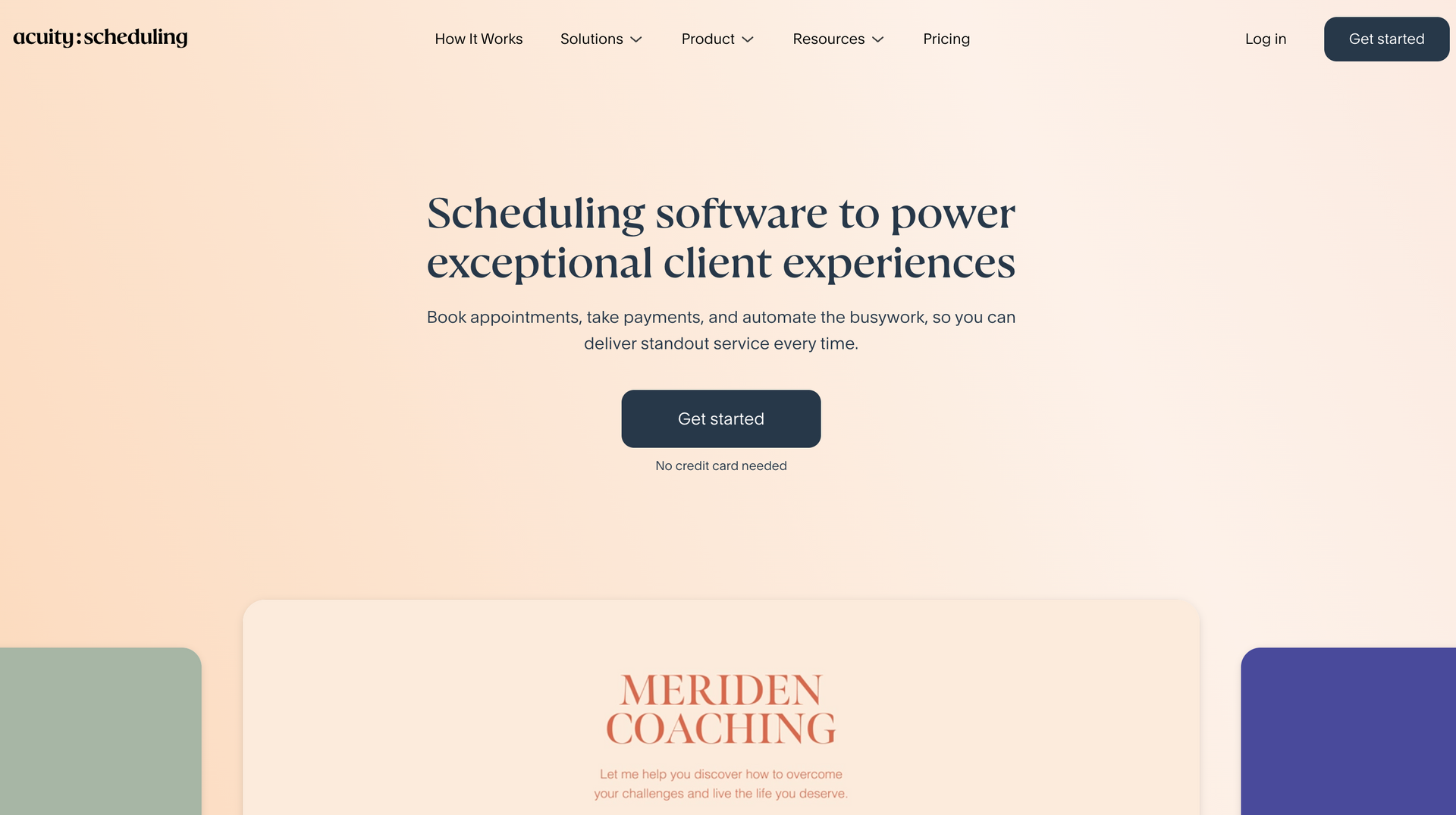
Acuity Scheduling (now part of Squarespace) is purpose-built for service businesses that need more than a calendar link. Think spas, wellness studios, legal consultants, and health practices. These businesses need intake forms, package bookings, and upfront payment — not just a link to click.
Acuity lets clients book specific services, pay upfront, and complete intake forms before arriving. It acts more like a booking portal than a scheduling widget. The experience is fully branded and embedded directly in your website.
For OC's health and wellness businesses, Acuity sits between a simple scheduling tool and a full client management system. That middle ground is often exactly right. It delivers client-ready professionalism without enterprise complexity or cost.
Key features
- Service-specific booking: Clients book exact services with set durations and prices
- Payment collection at booking: Accept cards upfront via Stripe or Square, reducing no-shows
- Intake forms: Collect client information before the appointment
- Package and membership sales: Sell multi-session packages directly through the booking flow
- Branded client portal: Fully customizable booking page matching your website
Pricing
- Emerging: $20/month — 1 staff calendar, unlimited appointments, basic features
- Growing: $34/month — 6 staff calendars, appointment packages, intake forms
- Powerhouse: $61/month — 36 staff calendars, advanced reporting, custom APIs
Pros & cons
Pros:
- Strong for multi-service businesses needing intake forms and upfront payment
- More customizable than Calendly's basic link model
- Includes package and subscription selling — great for wellness and fitness businesses
Cons:
- More complex setup than Calendly — steeper learning curve
- Squarespace acquisition has slowed product development in some areas
- Still inbound-only; no lead generation or outreach capability
Customers
Acuity Scheduling is popular among OC's health and wellness sector — yoga studios, massage therapists, chiropractors, and nutritionists. It holds a 4.8/5 rating on Capterra. Businesses cite intake forms and payment-at-booking as the primary reasons they choose Acuity over simpler tools.
4. Housecall Pro: Booking Built for Home Services Trades
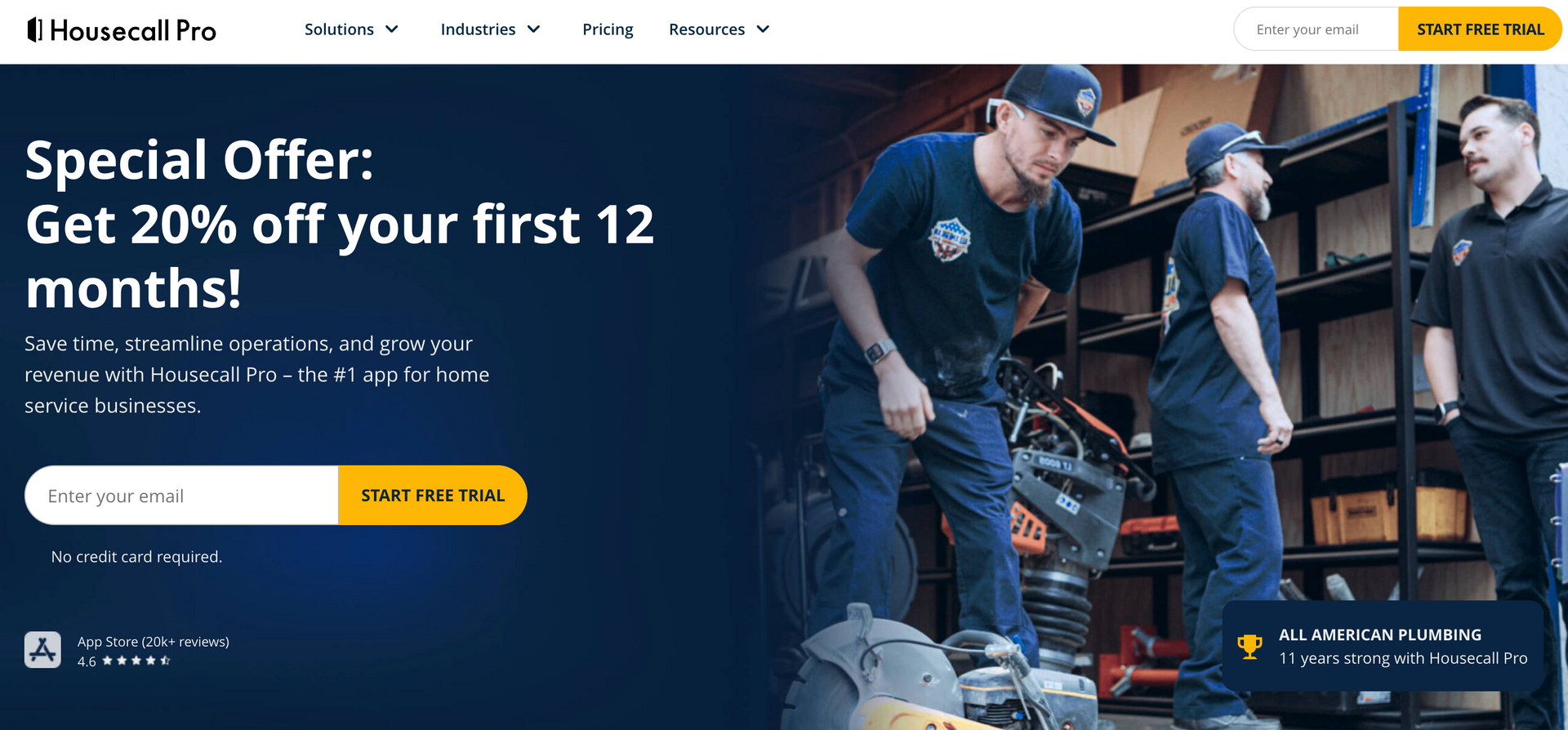
Housecall Pro is the leading field service management platform for home services trades. HVAC, plumbing, electrical, roofing, and cleaning companies use it nationwide. It handles online booking, dispatch, invoicing, and review collection from a single mobile app.
For OC trades businesses, it solves a specific back-office problem. Customers book online, technicians get routed automatically, and the whole job lifecycle lives in one system. No office staff bottleneck required.
If your calendar is filling up but your operations are chaotic, Housecall Pro is the fix. Lost jobs, double-bookings, and paper invoices disappear. Every booked appointment becomes a trackable, profitable job.
Key features
- Online booking widget: Embed on your website — customers book jobs 24/7
- Smart dispatch: Route technicians by location, availability, and job type automatically
- In-app invoicing and payments: Technicians send invoices and collect payment on-site
- Automated review requests: Post-job texts prompt customers to leave Google reviews
- Customer history: Full job history, notes, and communications per customer in one place
Pricing
- Basic: $79/month — 1 user, core scheduling and invoicing
- Essentials: $189/month — up to 5 users, online booking, automated follow-ups
- MAX: $349/month — unlimited users, advanced reporting, priority support
Pros & cons
Pros:
- Purpose-built for home services — not a generic tool stretched to fit
- Mobile-first design works for field technicians in the truck
- Includes review automation, which compounds into better local search rankings
Cons:
- Operational tool — won't generate new leads independently
- Pricing jumps significantly between tiers for growing teams
- Less suited to professional services, medical, or non-field businesses
Customers
Housecall Pro serves 45,000+ home service businesses across the US. In Orange County, it's widely used by HVAC, plumbing, and cleaning companies. It holds a 4.7/5 rating on G2, with users citing dispatch efficiency and the customer-facing booking flow most often.
5. GoHighLevel: All-in-One CRM and Booking for Growth-Focused SMBs
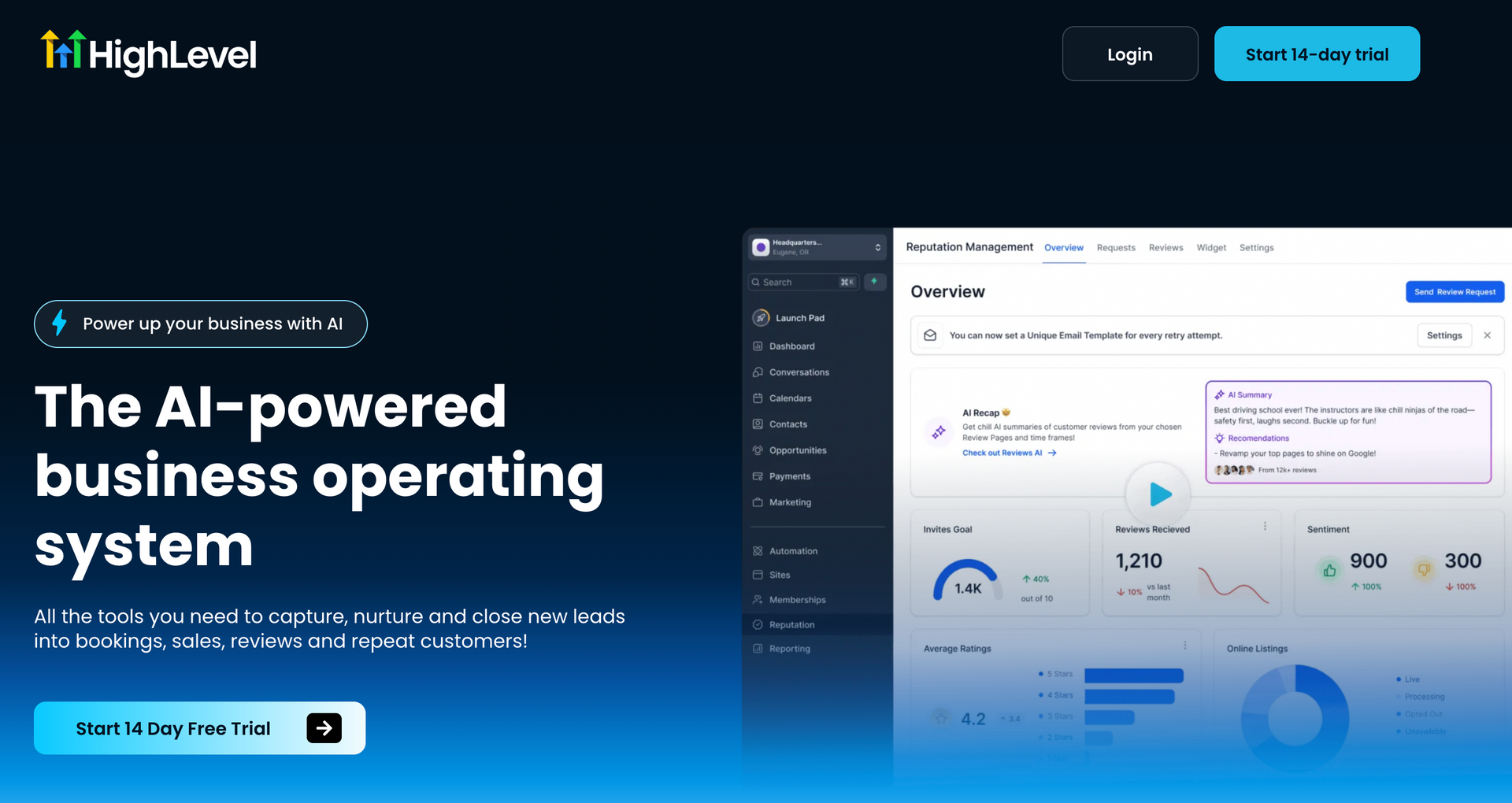
GoHighLevel (GHL) is a CRM and marketing platform that includes appointment booking as part of a broader toolset. Businesses use it to manage leads, run automations, host landing pages, and book appointments. Everything lives in one dashboard.
For OC businesses that want a full lead-to-appointment pipeline, GHL is the most complete self-managed option on this list. Build a funnel, capture a lead, trigger follow-up sequences, and land them in your calendar. No tool switching required.
The tradeoff is complexity. GHL rewards setup investment but punishes impatience. Most businesses see faster results by working with a GHL-experienced agency rather than configuring it solo.
Key features
- Calendar and booking automation: Built-in scheduling with automated confirmation and follow-up sequences
- CRM and pipeline management: Track every lead from first contact to booked appointment
- Email and SMS automation: Multi-step follow-up campaigns triggered by lead actions
- Landing page and funnel builder: Create booking-optimized pages without a developer
- White-label capability: Agencies can rebrand the entire platform for client accounts
Pricing
- Starter: $97/month — 3 sub-accounts, core CRM, calendars, funnels
- Unlimited: $297/month — unlimited sub-accounts, white-label, API access
- SaaS Pro: $497/month — full white-label SaaS mode for agencies reselling the platform
Pros & cons
Pros:
- All-in-one replaces Calendly + CRM + email tool + landing page builder separately
- Automation sequences significantly reduce manual follow-up labor
- Strong agency ecosystem in OC's digital marketing community
Cons:
- Significant setup time — not a plug-and-play solution
- Feature overload can overwhelm small businesses without technical help
- Best results typically require an agency or consultant to configure it properly
Customers
GoHighLevel has become the platform of choice for digital marketing agencies across California. Many OC agencies use it to power clients' appointment booking pipelines. It holds a 4.4/5 on G2, with users citing automation depth and all-in-one consolidation as the primary value drivers.
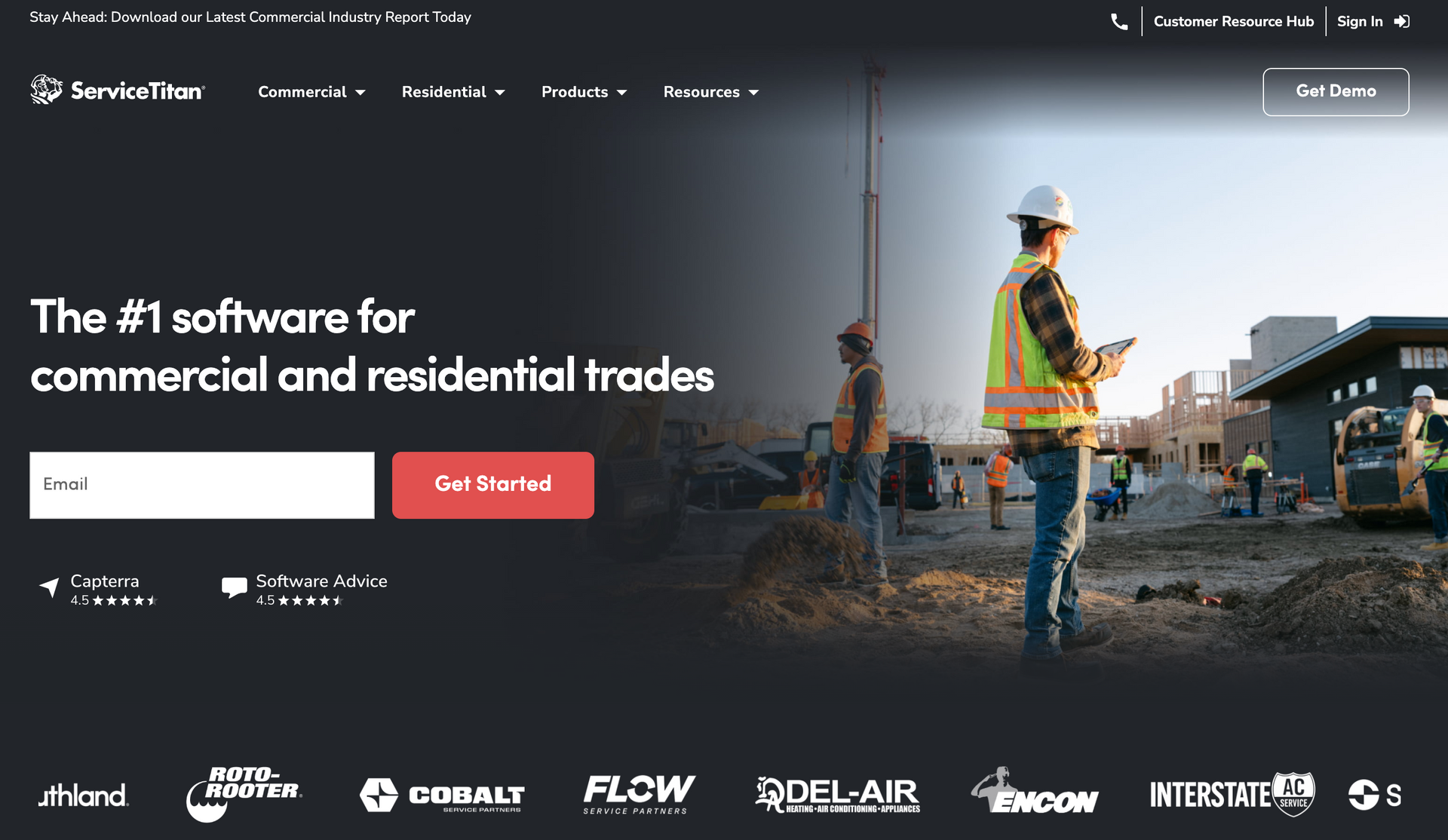
6. ServiceTitan: Enterprise Booking for Large Home Services Operations
ServiceTitan is the dominant platform for large home services companies. HVAC, plumbing, electrical, and roofing firms with multiple crews rely on it as their core operating system. It covers marketing, dispatch, booking, invoicing, and payroll in one place.
For established OC home services companies running five or more technicians, ServiceTitan provides visibility no smaller tool can match. The marketing module ties directly to Google and LocaliQ advertising. Every booked job traces back to its exact marketing source.
The price point and onboarding complexity make ServiceTitan the wrong fit for small businesses. It's built for companies that have already scaled. Infrastructure at that level demands a platform to match.
Key features
- Call booking and dispatch: Inbound calls are captured, booked, and dispatched from one screen
- Marketing attribution: Ties every booked job back to its marketing source — Google, LSA, direct mail
- Customer financing: In-field financing options for large-ticket jobs, increasing close rates
- Reporting and analytics: Full reporting on revenue, technician performance, and job completion rates
- Integrations: Connects with QuickBooks, Google Ads, and LocaliQ for full-stack management
Pricing
ServiceTitan uses custom pricing based on company size and feature requirements. No public pricing is listed; a sales consultation is required. Typical contracts scale with the size of the operation.
Pros & cons
Pros:
- The most complete operational system for scaled home services companies
- Marketing attribution closes the loop between ad spend and booked jobs
- Direct integrations with Google Ads and popular home services platforms
Cons:
- Expensive and complex — overkill for small or early-stage businesses
- Long onboarding requires significant time before seeing results
- Clients are locked into the platform with limited data portability
Customers
ServiceTitan is used by some of the largest home services companies in the US. In California, major HVAC and plumbing firms rely on it as their operational backbone. It holds a 4.4/5 on G2, with users citing marketing attribution and dispatch efficiency as the top benefits.
Frequently asked questions
What's the difference between scheduling software and an appointment booking service? Scheduling software (Calendly, Acuity) makes it easy for customers who already know you to book. An appointment booking service like Kell's Profit Accelerator actively finds and converts new prospects. If inbound traffic is your bottleneck, use software. If lead generation is the problem, use a managed service.
Which appointment booking option is best for HVAC or home services in OC? Small-to-mid operations should consider Housecall Pro for field dispatch and Kell Web Solutions for AI-driven outbound booking. Large operations with 5+ crews often graduate to ServiceTitan. All three can work in parallel — Kell fills the calendar, Housecall Pro manages the jobs.
Is free scheduling software good enough for a local service business? Calendly's free plan works well for businesses with consistent inbound traffic. But it does nothing to generate that traffic. Most OC service businesses eventually need a marketing layer — AEO, local SEO, or outbound outreach — to keep inbound flow healthy enough for scheduling tools to matter.
How much does it cost to outsource appointment booking in Orange County? Managed services like Kell's Profit Accelerator are priced custom based on market and volume. Budget for a marketing retainer investment rather than a software subscription fee. The value is a full pipeline, not just a calendar widget.
What's the fastest way to start filling my calendar? Combine Calendly (instant inbound capture) with Kell's Profit Accelerator (outbound pipeline) for the fastest results. Calendly handles people who already find you. Profit Accelerator brings in people who haven't heard of you yet. Together, they cover both sides of the equation.
Do appointment booking tools help with no-shows? Yes — most tools include automated reminders via email and SMS. Acuity and Housecall Pro both reduce no-shows through pre-appointment confirmations. GoHighLevel allows fully customized multi-touch reminder sequences for businesses with high no-show rates.
Conclusion: The Right Booking System Depends on Your Biggest Problem
If your calendar is empty because leads aren't finding you, software won't fix it. Kell Web Solutions' Profit Accelerator is the only OC-based managed service that actively books qualified prospects onto your calendar. It carries a verified 30% booking rate.
If your inbound is healthy but booking is friction-filled, start with Calendly or Acuity Scheduling. Trades businesses with dispatch needs should look at Housecall Pro. Large operations running at scale should evaluate ServiceTitan — and businesses wanting an all-in-one pipeline should explore GoHighLevel.
No booking tool fills a calendar that marketing hasn't warmed. Visit kellsolutions.com and book a free strategy call with Gregg Kell. Find out what your pipeline needs — and whether the Profit Accelerator is the right fit.