How to Get More Google Reviews Without Risky Tactics

More Google reviews can increase trust before a prospect ever calls you. For local businesses in Orange County, they can also support local SEO, improve conversion rates, and help customers choose you over a competitor across the street.
But there is a line you do not want to cross. Buying reviews, filtering out unhappy customers, offering rewards, or asking employees to pose as customers can create serious reputation damage. Worse, it can violate platform rules and consumer protection expectations.
The good news: you do not need risky tactics to build a stronger Google review profile. You need a repeatable, compliant process that asks the right way, at the right time, and makes leaving honest feedback easy.
Why Google Reviews Matter for Local Visibility
Google reviews influence two critical parts of local growth: discovery and trust.
On the discovery side, Google has stated that review count and score can factor into local ranking through the broader concept of prominence. In its guidance on how to improve local ranking on Google, Google explains that more reviews and positive ratings can improve a business’s local ranking.
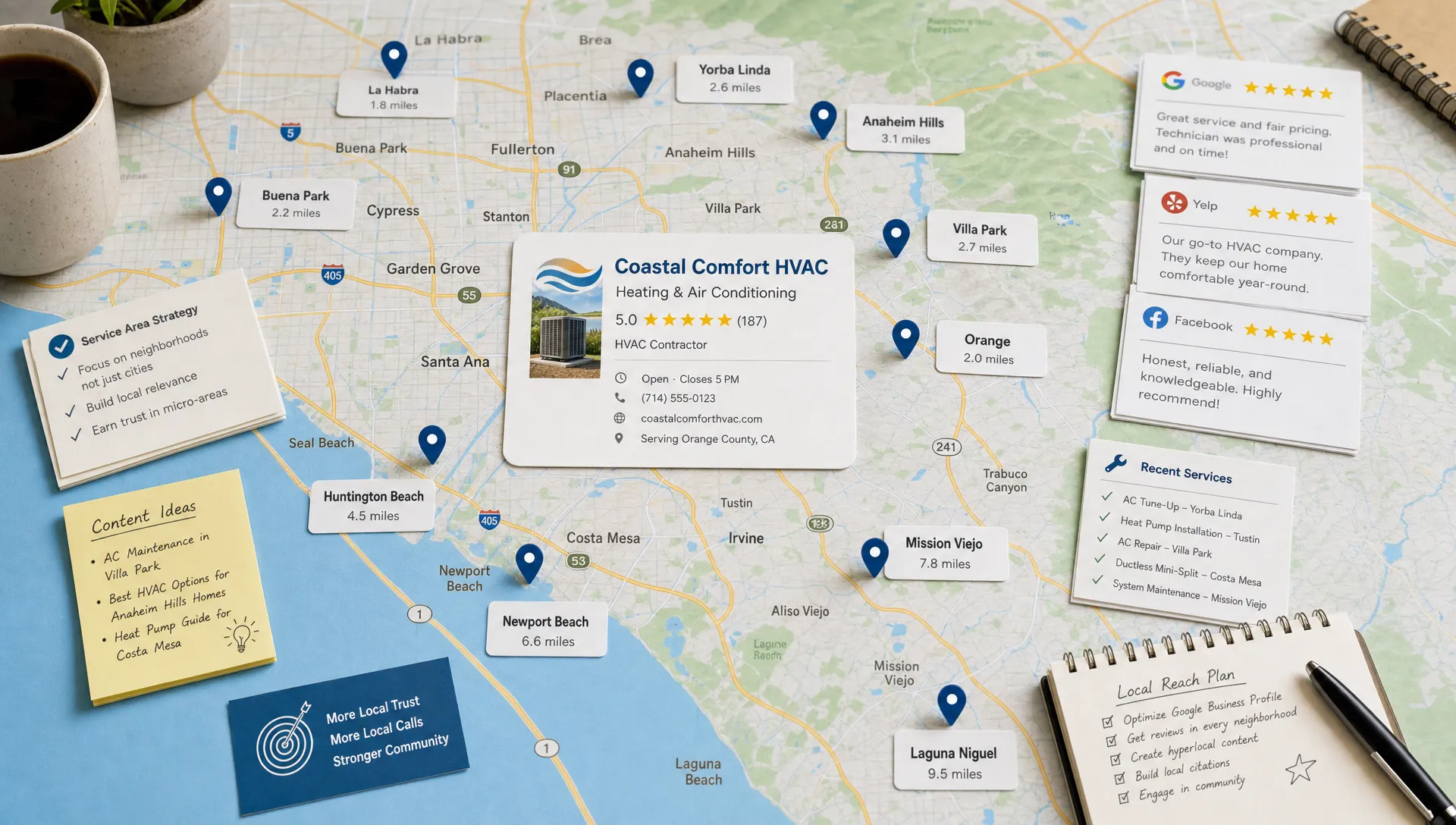
On the trust side, reviews give prospects evidence that real customers have had real experiences with your company. This matters even more in competitive local markets such as Irvine, Newport Beach, Anaheim, Huntington Beach, Laguna Beach, and other Orange County service areas where customers often compare multiple providers before calling.
Reviews also play a growing role in answer engine optimization. AI-driven search experiences and local recommendation systems tend to reward businesses that have clear, consistent, verifiable trust signals across the web. A healthy Google review profile is one of those signals.
What Counts as a Risky Google Review Tactic?
Before building a safer review system, it helps to define what to avoid.
Google’s own guidance on getting Google reviews says businesses can ask customers for reviews, but they should not offer incentives, discourage negative reviews, or selectively solicit only positive reviews. The FTC Endorsement Guides also emphasize that endorsements must be truthful and not misleading.
Here is a practical comparison:
| Review tactic | Safe or risky? | Why it matters |
|---|---|---|
| Asking every real customer for honest feedback | Safe | This encourages authentic reviews without filtering sentiment. |
| Sending a direct Google review link after service | Safe | This reduces friction while still allowing honest feedback. |
| Offering a discount, gift card, or prize for a review | Risky | Incentives can violate Google guidance and may create misleading endorsements. |
| Asking only happy customers to review you | Risky | This is selective solicitation and can be viewed as review gating. |
| Buying reviews or using fake accounts | High risk | Fake engagement can lead to removal, loss of trust, and possible legal exposure. |
| Having employees or family members review the business as customers | Risky | Reviews should reflect genuine customer experiences. |
| Responding professionally to all reviews | Safe | Thoughtful replies improve trust and show accountability. |
A safe review strategy is simple: ask real customers for honest feedback, never pressure them, and never manipulate the outcome.
Step 1: Make Your Google Business Profile Review-Ready
If your profile looks incomplete, outdated, or inconsistent, customers may hesitate before reviewing you. A strong Google Business Profile gives people confidence that they are reviewing the correct business.
Start with the basics. Confirm that your business name, address, phone number, website, hours, primary category, service areas, and appointment links are accurate. Add current photos where relevant, especially if you operate a storefront, showroom, office, service vehicle fleet, or completed project portfolio.
Your profile should also match your website and other local listings. Inconsistent contact information can confuse customers and weaken local search confidence. This is especially important for home service businesses, medical offices, law firms, restaurants, contractors, and professional service providers competing in multiple Orange County cities.
If your profile is not fully optimized, asking for more reviews is like sending traffic to a landing page that is not ready to convert. Fix the foundation first.
Step 2: Ask at the Moment of Highest Satisfaction
The best time to request a Google review is when the customer has just experienced a positive outcome.
For a home service company, that might be right after a repair is completed and the customer says, “Thank you, that was fast.” For a dental office, it may be after a smooth appointment. For a professional services firm, it may be after a successful project milestone.
Timing matters because customers are busy. If you wait two weeks, the emotional connection fades and your request becomes just another message in their inbox.
A good rule: ask within 24 hours of a successful interaction, ideally the same day. The request should be polite, brief, and clear that the customer is welcome to share their honest experience.
Step 3: Ask Everyone, Not Just the Happy Customers
This is where many businesses accidentally create risk.
It may feel logical to ask only your happiest customers for reviews. But Google specifically warns against selectively soliciting positive reviews. This practice is often called review gating, especially when a business first asks customers to rate their experience privately and then only sends satisfied customers to Google.
A safer approach is to ask all legitimate customers using neutral language.
Instead of saying, “If you had a 5-star experience, please leave us a review,” say, “We would appreciate your honest feedback about your experience.”
That small wording change matters. It protects authenticity and helps you build a more credible review profile over time.
Step 4: Use a Direct Review Link and QR Code
Customers are more likely to leave a review when the process is easy.
Google Business Profile allows businesses to share a direct review link. You can include that link in follow-up emails, text messages, printed cards, invoices, receipts, and post-service messages.
For in-person businesses, QR codes can work well when used properly. Place a QR code on a checkout counter, service handoff card, lobby sign, or thank-you card. The QR code should point directly to your Google review form.

Keep the request neutral. Avoid wording that pressures the customer to leave a positive review or implies a reward.
Step 5: Give Your Team Simple Review Request Scripts
Your employees should not have to improvise. A short, compliant script helps your team ask naturally and consistently.
Here are a few examples you can adapt.
In-person request
“Thank you for choosing us today. If you have a minute, we would appreciate your honest feedback on Google. It helps other local customers understand what it is like to work with us.”
Email request
Subject: Thank you for choosing us
“Hi [First Name], thank you for trusting us with [service/project]. We would appreciate your honest feedback about your experience. If you would like to share a Google review, you can use this link: [Review Link]. Thank you again for your business.”
SMS request
“Hi [First Name], thank you for choosing [Business Name]. We would appreciate your honest feedback on Google: [Review Link]. Thanks again.”
Follow-up request
“Hi [First Name], just checking in to make sure everything went smoothly. If you have not already, we would be grateful for your honest Google review here: [Review Link].”
Notice what these examples do not include. They do not ask for 5 stars. They do not offer an incentive. They do not discourage negative feedback. They simply make it easy for real customers to share their experience.
Step 6: Build Review Requests Into Your Operations
The businesses with the most consistent review growth do not rely on memory. They build review requests into their process.
For example, a contractor might send a request after the job is marked complete. A medical office might send it after an appointment. A restaurant might use a table card or receipt prompt. A B2B company might ask after a successful onboarding, launch, or renewal.
The key is to connect the request to a natural customer journey moment. This keeps the ask relevant and reduces the chance that it feels random or pushy.
A simple monthly review system might track:
- Number of completed customer interactions
- Number of review requests sent
- Number of new Google reviews received
- Average rating trend
- Response rate to positive and negative reviews
- Common themes in customer feedback
Do not obsess over perfection. Focus on consistency. A steady stream of authentic reviews usually looks more natural and credible than sudden bursts of reviews after months of silence.
Step 7: Respond to Every Google Review
Getting more Google reviews is only half the strategy. Responding to reviews is where you show future customers how your business communicates.
For positive reviews, thank the customer and mention something specific if appropriate. Avoid copying and pasting the same response every time. Generic replies look automated and impersonal.
For negative reviews, stay calm and professional. Do not argue. Do not reveal private customer information. A good response acknowledges the concern, shows that you take feedback seriously, and invites the customer to continue the conversation offline.
Example response to a positive review:
“Thank you, Maria. We appreciate you choosing our team and are glad the appointment went smoothly. We look forward to helping you again.”
Example response to a negative review:
“Thank you for sharing your feedback. We are sorry to hear that your experience did not meet expectations. Please contact our office so we can better understand what happened and work toward a resolution.”
Your responses are public. A thoughtful response can soften the impact of a negative review and may even increase trust with future customers.
Step 8: Use Negative Feedback to Improve the Business
No business wants negative reviews, but they can be valuable.
Patterns in reviews often reveal operational issues that traditional reporting misses. Customers may mention slow response times, confusing scheduling, unclear pricing, inconsistent communication, or missed follow-ups. Those comments can guide better training, better web copy, better customer service processes, and better expectation-setting.
For local SEO and AEO, this matters because trust is not just about stars. It is about the substance behind the reviews. If customers repeatedly praise your punctuality, professionalism, cleanup, communication, or expertise, those details create a richer reputation footprint.
That language can also inform your website content. If real customers keep asking the same questions or praising the same strengths, those themes may deserve dedicated service page sections, FAQs, or local content.
Step 9: Avoid “Review Campaign” Thinking
Many businesses treat reviews like a one-time campaign. They push hard for two weeks, get a few reviews, then stop.
That approach is less effective than building review generation into the customer experience. Google reviews should be part of your ongoing local visibility system, not a panic button you press when a competitor passes you in the map pack.
A sustainable process is better for three reasons.
First, it creates a natural review velocity. Second, it gives you ongoing customer insight. Third, it helps your business build authority over time, which supports local SEO and answer engine optimization.
If your Orange County business wants long-term visibility, you need more than reviews. You need a connected system that includes a strong website, optimized local pages, accurate listings, useful content, technical SEO, and trust signals that reinforce each other.
That is where a structured local SEO and AEO strategy can turn customer feedback into measurable visibility gains.
Common Mistakes That Keep Businesses From Getting Reviews
Sometimes the problem is not that customers are unwilling to leave reviews. The problem is that the business makes the process unclear.
One common mistake is asking too late. Another is using a long, complicated email with multiple links. Some businesses bury the review request under a customer satisfaction survey, which creates extra friction. Others ask in a way that sounds desperate or transactional.
The best request is simple, timely, and respectful.
Another mistake is ignoring reviews after they arrive. If customers see that you never respond, they may assume their feedback does not matter. Responding also gives future prospects more context about your professionalism.
Finally, do not let fear of negative reviews stop you from asking. If you serve enough customers, occasional criticism is normal. A perfect rating with few reviews can look less believable than a strong rating with detailed, authentic feedback.
A Safe Google Review System You Can Start This Week
You do not need a complicated platform to begin. Start with a simple operating rhythm.
Once that system works, you can improve it with automation, CRM integrations, staff accountability, and deeper local SEO strategy. Just make sure automation never becomes manipulation. The request should still be honest, neutral, and directed to real customers.
Frequently Asked Questions
Can I ask customers for Google reviews? Yes. Google allows businesses to ask customers for reviews, as long as the request is not misleading, incentivized, or selectively aimed only at positive feedback.
Can I offer a discount or gift card for a Google review? This is risky and should be avoided. Google advises businesses not to offer incentives for reviews, and incentives can create consumer trust and compliance problems.
What is review gating? Review gating is the practice of filtering customers before asking for a public review, such as sending only happy customers to Google while directing unhappy customers somewhere else. This can violate Google’s guidance.
How often should I ask for reviews? Ask consistently after real customer interactions. For many local businesses, the best timing is the same day or within 24 hours of a completed service, appointment, purchase, or project milestone.
Should I respond to negative Google reviews? Yes. Respond professionally, acknowledge the concern, avoid private details, and invite the customer to continue the conversation offline. Future customers often judge your response as much as the review itself.
Do Google reviews help with local SEO? Yes, reviews can support local visibility. Google states that review count and score can factor into local ranking, especially as part of overall prominence.
Build a Review Strategy That Supports Long-Term Visibility
More Google reviews can help your business earn trust, improve local search performance, and convert more prospects into calls. But shortcuts are not worth the risk.
The safest path is also the most durable: deliver a strong customer experience, ask every real customer for honest feedback, make the review process easy, respond professionally, and use feedback to improve.
Kell Web Solutions helps Orange County businesses strengthen digital visibility through Answer Engine Optimization, local SEO, web design, and long-term authority building. If you want your review strategy to support real search visibility instead of creating compliance headaches, explore our Orange County SEO services, read more about reputation marketing strategies, or connect with Kell Web Solutions to build a safer growth plan.