Orange County Marketing Strategies to Repair a Bad Reputation

Gregg Kell • July 15, 2025

Why Your Business Reputation Matters More Than Ever in Orange County

A single tweet, review, or news story can now surface on Google within minutes-and linger for years. Because 68% of all online experiences begin in a search engine and 90% of shoppers avoid businesses with bad reputations, perception management is no longer optional-it is core marketing in Orange County..

The stakes are even higher for service-based companies in today's hyper-competitive markets, like Mission Viejo and Newport Beach. From the coastal communities of Laguna Beach and San Clemente to the busy corridors of Irvine, Los Angeles, and San Diego, word-of-mouth travels at the speed of Wi-Fi. Whether you own a boutique agency, a popular restaurant, a local shop, or a medical practice, one unanswered complaint or a string of negative reviews can send prospects straight to a rival.

The five tactics you'll read below work because they address every place reputation lives: what you say (communication), what others say (reviews), what Google shows (SEO), how you interact (social media), and who you really are (culture). Master all five and you can transform a public headache into long-term brand equity-and new revenue.

Quick Reference: Top 5 Reputation Repair Strategies in Orange County CA

  1. Proactive Communication
  2. Online Feedback Management
  3. SEO Content Creation
  4. Social Media Engagement
  5. Internal Culture Focus

Warren Buffett put it best: "It takes 20 years to build a reputation and five minutes to ruin it." Ready to make the next five minutes count?

First, Assess the Damage and Acknowledge the Issue

person using magnifying glass to examine online reviews on computer screen

Before you fix a leak, you look for every drip. Do the same with your brand:

  • Set up free Google Alerts for your company name, products, executives, and common misspellings.
  • Manually scan the first three pages of Google, major review sites, social channels, and Reddit forums.
  • Use social-listening tools (like Brand24 or Sprout Social) to analyze sentiment trends. Are the complaints isolated incidents about slow service, or do they point to a deeper, systemic issue with your product, pricing, or customer support? Understanding the 'what' and 'why' is critical before you can formulate an effective response.

Once you know what's wrong, own it. Publish a short statement that:

  1. Acknowledges real customer pain.
  2. States the exact action you're taking.
  3. Gives a clear timeline for follow-up.

Transparency turns critics into coaches and keeps rumors from filling the silence. Internal analysis of Kell Solutions client accounts indicates that businesses that acknowledge issues within 24 hours often see up to 35% fewer negative reviews over the following 60 days, though individual results will vary.

A 5-Step Action Plan

checklist showing 5 steps for reputation repair

Think of these five moves as interlocking gears-each one makes the others spin faster:

  1. Speak first and truthfully.
  2. Answer every review.
  3. Flood Google with helpful, optimized content.
  4. Hold real conversations on the social channels your buyers use most.
  5. Fix the root cause inside your company so you don't repeat the cycle.

Based on aggregated client case studies at Kell Solutions, organizations that implement all five steps together often recover roughly twice as fast as those that tackle them piecemeal; however, timelines vary by industry and issue severity. Below, we break each tactic into practical, step-by-step plays you can run this week-no massive budget required.

1. Master Proactive and Transparent Communication

Silence looks guilty; speed looks confident. Within 24 hours of bad news:

  • Release a concise, jargon-free statement.
  • Explain what happened, how you'll solve it, and when you'll report back.
  • Keep updates flowing (weekly until stable, then monthly).

According to the Transparency ROI Study, 73% of consumers pay more to companies that are open about operations. Transparency isn't spin-it's profit.

2. Actively Manage and Respond to Orange County Online Feedback

  • Respond within 24 hours; speed shows you care.
  • Personalize every reply-name the issue, apologize once, offer a fix.
  • Invite happy customers to share reviews (65% will if you simply ask).

When 89% of consumers favour companies that answer all reviews, skipping even one response is like leaving your phone ringing in the lobby. Need help keeping up? Our AI voice agents ensure every call is answered, logged, and escalated 24/7-often preventing negative reviews before they begin. Learn more in the AI Customer Service Guide.

For extra mileage, turn five-star reviews into micro-case studies on your website. A short paragraph plus a headshot adds social proof and fresh content that Google loves.

3. Control the Narrative with SEO

search engine results page showing positive content ranking

People rarely click page two of Google. Fill page one with assets you own:

  • Blog posts and FAQs optimized for "[Your Company] reviews".
  • Short videos answering top objections.
  • Press releases about awards, hires, or community work.
  • Guest articles on trusted industry sites (backlinks boost credibility).

Track rankings monthly. Consistent publishing over 3-6 months usually pushes older negative links below visibility.

Pro tip for local businesses: dominate local search by including geo-targeted keywords. If your service area covers multiple cities-say, Los Angeles, Orange County, Irvine, or Oceanside-use phrases like "top-rated HVAC repair in Newport Beach," "best AI phone agent in Laguna Beach," or "trusted accountant near Santa Monica." This strategy helps you rank for high-intent searches from customers close to home-where your reputation matters most.

4. Leverage Social Media for Engagement and Trust-Building

Pick the two platforms where your buyers hang out and go all-in:

  • LinkedIn for thought-leadership posts and employee spotlights.
  • Facebook/Instagram for behind-the-scenes stories and live Q&A.

Respond to every mention-yes, even the grumpy ones. Genuine conversation signals you're listening and learning. Many businesses drive traffic from social media to their website or phone lines. Ensure that journey is seamless. If a social media post prompts a user to call, a Kell Solutions AI voice agent can capture that lead instantly, even if it's outside business hours, reinforcing the positive interaction. For trend ideas, scan our Top Social Media Trends for 2025.

Don't underestimate short-form video. A 30-second clip of your founder apologizing and outlining next steps can humanize your brand faster than a 600-word press release.

5. Rebuild from the Inside Out

Reputation sticks when culture clicks. Start internally:

  • Survey employees anonymously; fix recurring pain points.
  • Publish clear company values and link reviews to them.
  • Launch one visible CSR project that aligns with those values.

Engaged staff become your loudest advocates; disengaged staff leak problems online. Track Glassdoor scores and staff turnover-both are early warning lights.

Kell Solutions recommends a quarterly "culture sprint": one week each quarter dedicated to team feedback, training, and celebration. The result is fewer surprises and a workforce ready to champion your brand.

Long-Term Orange County Reputation Maintenance

healthy growing plant symbolizing well-maintained reputation

  1. Monitor continuously: set weekly sentiment digests and quarterly deep-dives.
  2. Enforce brand consistency: Your brand should have the same tone and messaging on the phone, in emails, and across social media. An AI voice agent is a powerful tool for this, as it delivers your pre-approved, perfectly on-brand script to every single caller, every time.
  3. Prepare a one-page crisis plan: roles, contacts, and a three-sentence holding statement ready to go.
  4. Invest in training: empower frontline staff to resolve issues without delay.
  5. Celebrate wins publicly: share milestones, awards, and community impact.

Great reputations aren't built once-they're gardened. Keep watering yours.

Frequently Asked Questions

How long will recovery take for Orange Count firms?
Most firms see noticeable lift in 3-6 months and full rebound within 12-24 months, depending on issue severity and effort consistency.

Can I delete negative content?
Rarely. Focus on rebutting false claims, requesting removals that break platform rules, and outranking the rest with helpful content.

Should I ever ignore a bad comment?
No. Silence looks indifferent. A brief, respectful reply is your chance to show values in action.

Is reputation repair expensive?
Not necessarily. Many fixes-like faster review responses-cost nothing but time. Tools such as Kell Solutions' VoiceGenie AI start below the price of one missed lead per month, making proactive service surprisingly affordable.

Conclusion: Turn Crisis into Growth

Handled quickly and honestly, a reputation hiccup can become your biggest branding lesson. Follow the five steps, measure progress monthly, and keep your culture healthy-the best PR is satisfied customers and employees.

About the Author

Gregg Kell is a seasoned digital marketing strategist and founder of Kell Solutions, helping professional service firms grow through innovative AI-powered solutions like VoiceGenie AI. With over 20 years of experience in web development, lead generation, and business automation, Gregg is passionate about helping small businesses maximize growth and profitability through cutting-edge technologies.

When he's not helping businesses boost their bottom line, Gregg enjoys life by the beach in Laguna Beach, California, with his wife Debbie, celebrating over 40 years of marriage and entrepreneurial trips.

Explore More from Gregg:

VoiceGenie AI Demo
Missed Call ROI Calculator
VoiceGenie AI Pricing
June 22, 2026
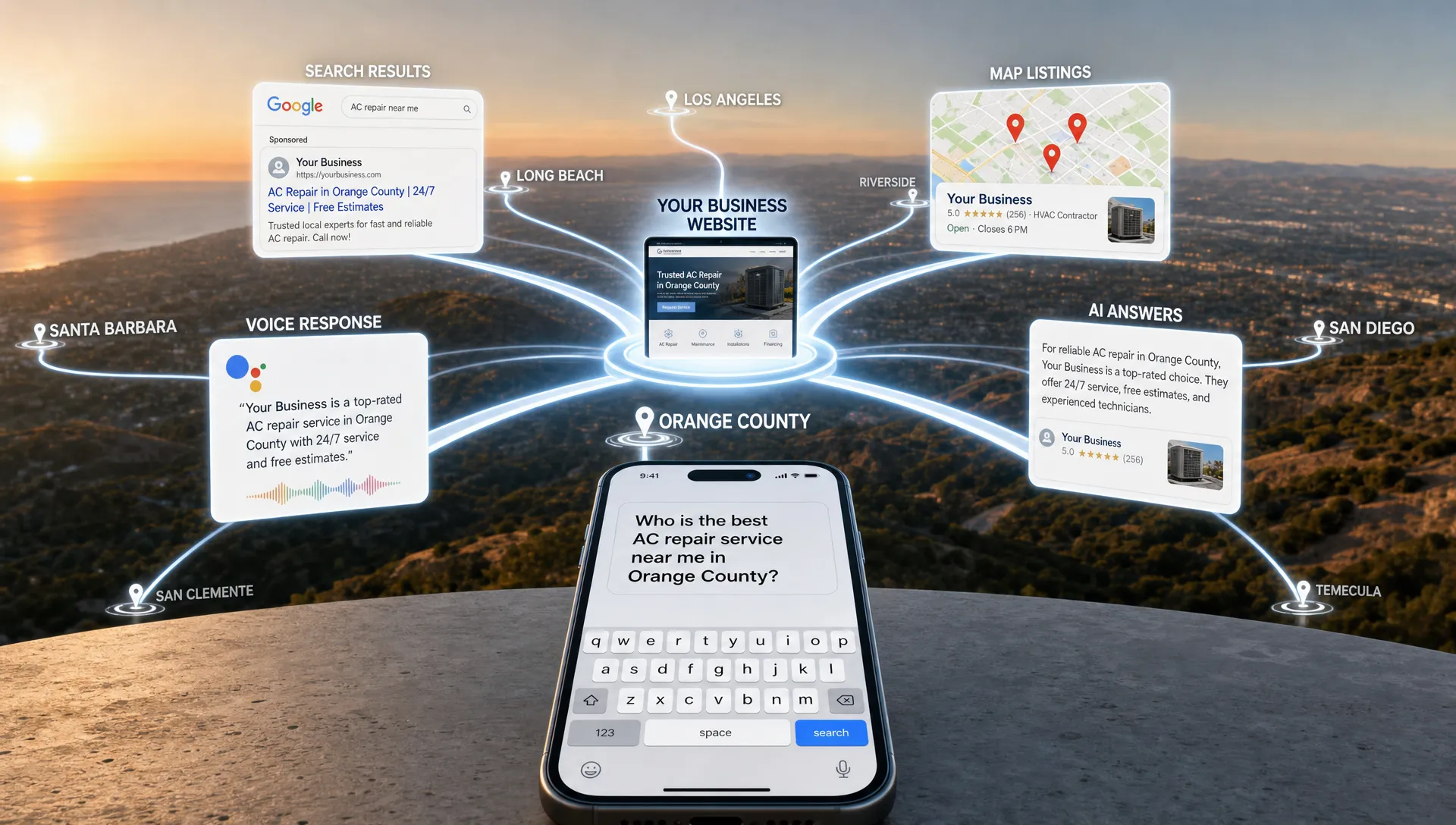
 A homeowner in Laguna Niguel types “emergency AC repair near me.” A patient in Irvine asks Google for “best dentist open Friday.” A property manager in San Jose searches “roof leak repair commercial building.” In each case, the search engine is not simply matching words on a page. It is deciding which local business is relevant, close enough, trusted enough, and clear enough to recommend. That is the real working of search engine optimization for local business. SEO helps search engines understand your company, connect your services to real buyer intent, and present your business when someone nearby is ready to call, book, or request an estimate. For California contractors and multi-location professional practices, this matters because the search results page is no longer just ten blue links. It includes map packs, Google Business Profiles, reviews, AI summaries, paid ads, “people also ask” questions, voice results, and local service panels. If your business is not structured correctly, you may be invisible even when your services are exactly what the customer needs. How Search Engines Work Before a Customer Ever Calls Search engines perform three core jobs: discover information, understand it, and rank it for a specific question. Local SEO improves each of those jobs so your business becomes easier to find and easier to trust.
June 22, 2026
 Search engine optimization used to mean getting a website to rank higher in Google. That definition is no longer wrong, but it is incomplete. In 2026, search engine optimization means making your business easy for search engines, AI systems, map results, voice assistants, and real customers to understand, trust, and choose. Rankings still matter, but they are only one part of the job. The real question is whether your business becomes the obvious answer when a buyer asks for help. For an Orange County HVAC contractor, that might mean showing up when a homeowner in Irvine asks why the AC is blowing warm air. For a Laguna Niguel dental group, it might mean being trusted when someone searches for emergency dental care nearby. For a San Jose law firm or a San Diego remodeler, it might mean being visible across Google Maps, AI Overviews, local service searches, and answer engines before the prospect ever clicks through to a website. That is the new reality of SEO in 2026. The short definition of search engine optimization in 2026 Search engine optimization is the process of building a clear, credible, and technically accessible digital presence so the right customers can find and trust your business at the exact moment they need it. That means your website, Google Business Profile, reviews, local citations, structured data, content, service pages, and off-site authority all need to tell the same story. A modern search engine should be able to answer five basic questions about your business without confusion: Who are you? What services do you provide? Where do you provide them? Why should customers trust you? What should a qualified prospect do next? If any of those answers are unclear, incomplete, or inconsistent, search systems have less confidence in your business. In competitive California markets such as Orange County, Los Angeles, San Diego, San Jose, Sacramento, Fresno, and Irvine, that lack of confidence can quietly turn into lost calls. Why the old SEO definition is too small The fundamentals of SEO still matter. Google’s own SEO Starter Guide still emphasizes crawlable pages, useful content, descriptive titles, good site structure, and links that help users and search engines understand a site. But the way customers interact with search has changed. People no longer only type short keywords and scan ten blue links. They ask full questions. They use voice search. They compare providers in maps. They read reviews before calling. They see AI-generated summaries before they ever visit a website. That means SEO has expanded from ranking pages to managing digital trust. Search is now answer-driven A homeowner might search for best roofer near Huntington Beach after storm damage. Google may show a map pack, reviews, AI-generated guidance, local business profiles, and service pages. The winning company is not always the one with the most keyword repetition. It is the one that provides the clearest, most trustworthy answer across every surface. Search is now entity-driven Search systems need to understand your business as an entity, not just a collection of keywords. Your company name, service categories, founder information, address, service areas, reviews, schema markup, social profiles, and third-party mentions all help define who you are. For local businesses, entity clarity is especially important. If your plumbing company serves Laguna Beach, Dana Point, San Clemente, and Newport Beach, that geographic relationship should be clear across your site and supporting assets. Search is now proof-driven Search engines and AI systems look for signals that support trust. Reviews, credentials, project examples, case studies, service-area consistency, industry expertise, and helpful content all matter. For professional practices, this can include attorney profiles, dentist bios, medical credentials, office locations, appointment information, and clear explanations of services.
June 22, 2026
 For Orange County brands, Google is no longer just a search box. It is a local decision engine that compares your website, Google Business Profile, reviews, service pages, citations, photos, structured data, and brand authority before deciding whether you deserve visibility. That is why google engine optimization should be treated as a broader discipline than traditional SEO. The goal is not only to rank for a keyword. The goal is to become the clearest, most trusted, locally relevant answer when someone in Irvine, Laguna Niguel, Newport Beach, Anaheim, Huntington Beach, Santa Ana, or nearby cities needs help now. For home service contractors, that might mean being visible when a homeowner asks, “Who fixes AC near me today?” For a dental group, law firm, or medical practice, it might mean showing up when a prospective patient or client asks for the best specialist near their neighborhood. In both cases, Google rewards clarity, proximity, proof, and usefulness. What Google Engine Optimization Means in 2026 Traditional SEO focused heavily on rankings, keywords, backlinks, and website content. Those still matter. But Google’s ecosystem now includes organic search results, local map results, Google Business Profiles, reviews, AI-generated summaries, image results, voice queries, and zero-click answers. Google engine optimization is the process of improving every signal Google uses to understand and recommend your brand. It connects technical SEO, local SEO, content strategy, reputation, conversion design, and Answer Engine Optimization into one system.
June 18, 2026
 Orange County is crowded with capable contractors. A homeowner in Irvine can compare five HVAC companies before lunch. A property manager in Newport Beach can ask Google, ChatGPT, or a voice assistant for a plumber without ever visiting a website. A remodeler in Laguna Beach may be judged by reviews, photos, and local proof before the first call happens. That is why local marketing for contractors has to be more precise than generic advertising. You are not trying to reach everyone in California. You are trying to become the obvious, trusted choice when someone nearby needs your exact service, in your exact service area, right now. For Orange County contractors, the best marketing ideas connect three things: local search visibility, neighborhood-level trust, and fast conversion into calls or estimate requests. Google’s local ranking guidance centers on relevance, distance, and prominence, and those same principles now influence how AI-driven search tools interpret which businesses deserve to be recommended.
June 18, 2026
The San Francisco Bay Area runs on booked meetings. From SoMa tech startups to Oakland professional services firms, growth depends on a full calendar. But most businesses waste more time chasing appointments than closing them.  The Bay Area's competitive market makes this worse. Prospects get dozens of outreach messages daily. Generic cold emails land in spam. Inbound alone rarely keeps a calendar full. You need a system — or an agency — that cuts through the noise. This guide covers the six best appointment booking agencies serving the San Francisco Bay Area. What are the best appointment booking agencies in the San Francisco area? The top options span two distinct models. Managed outreach services — like Kell Web Solutions — actively prospect and book qualified leads on your behalf. B2B appointment setting agencies use human SDRs and AI to book meetings for enterprise and growth-stage companies.
June 15, 2026
 A marketing firm can make a dashboard look busy. That is not the same as growing local revenue. For an Orange County contractor, revenue means booked HVAC jobs in Irvine, emergency plumbing calls in Huntington Beach, roof replacement estimates in Anaheim, and remodel consultations in Laguna Niguel. For a multi-location dental, medical, or legal practice, it means the right prospects choosing the right office within the right neighborhood catchment. That is why choosing between marketing firms in 2026 requires a different scorecard. Rankings still matter. Ads still matter. Websites still matter. But local buyers now move through Google Maps, AI Overviews, voice assistants, reviews, directory profiles, neighborhood content, and referral signals before they ever fill out a form. The right firm does not just “do marketing.” It builds a system that turns local intent into confident calls, consultations, and booked work. Below is a practical framework for choosing a marketing partner that is accountable to revenue, not vanity metrics. Start by defining what “local revenue growth” means Before you talk to agencies, define the business outcome you actually need. Too many local businesses start with a vague request like “we need SEO” or “we need more leads.” A stronger starting point is: “We need more qualified calls from homeowners in Newport Beach for high-margin HVAC replacement jobs,” or “We need more booked consultations for our Irvine and San Diego offices.” That distinction changes everything. A generic campaign might chase traffic from anywhere. A revenue-focused local campaign identifies the service lines, cities, neighborhoods, customer questions, and conversion paths that produce profitable work. Use a simple scorecard like this when evaluating proposals: