
The Importance of Business Marketing: Why Every Professional Services Firm Needs a Solid Strategy

Gregg Kell • October 7, 2024

In today’s competitive landscape, a well-defined and robust marketing strategy is essential for the growth and success of any professional services firm. Whether you run a law practice, accounting agency, financial consultancy, or other service-oriented business, having a strategic marketing plan is crucial to generating awareness, connecting with your target audience, and driving new client appointments. This article explores why business marketing is crucial for success, highlights different types of marketing strategies, and introduces how solutions like ApptFlow 30 can transform lead generation and client acquisition for professional services firms.


Why Business Marketing is Crucial for Growth and Success

Marketing is not just about promoting services—it’s about creating a meaningful connection between a business and its target audience. A well-executed marketing strategy serves as a roadmap, guiding a firm through every stage of the client journey, from awareness to conversion and loyalty. Here’s why marketing is vital for every professional services business:


Increases Visibility and Brand Awareness
Without effective marketing, even the best services remain unnoticed. Marketing helps firms get noticed by creating visibility in the market. Techniques such as search engine optimization (SEO), social media marketing, and content marketing increase brand exposure, helping professional services firms reach a wider audience.


Builds Trust and Credibility
Marketing helps position a firm as a leader in its industry. Consistently providing valuable information and engaging content builds trust and credibility, making your firm a go-to resource for potential clients. Establishing a strong brand presence through marketing efforts helps differentiate your firm from its competitors.


Generates Leads and Drives Sales
Marketing strategies are designed to attract potential clients and guide them through the sales funnel. From generating initial interest to converting prospects into clients, marketing plays a critical role in creating and nurturing leads. Solutions like ApptFlow 30 can be particularly effective for professional services firms looking to generate high-quality leads and increase the number of client appointments.


Helps Understand and Engage Your Audience
Through market research and analytics, marketing provides businesses with insights into client behavior, preferences, and pain points. This understanding enables firms to craft personalized messages and campaigns that resonate with their target audience, fostering deeper engagement.


Drives Business Growth and Sustainability
A solid marketing strategy fuels business growth by increasing client acquisition and retention. By constantly refining marketing efforts and adapting to changing market conditions, professional services firms can maintain a steady growth trajectory, ensuring long-term success and sustainability.


Different Types of Marketing Strategies

A comprehensive marketing strategy often includes a blend of various types of marketing. Depending on a business’s goals, target audience, and industry, different strategies may be employed. Here are some of the primary types of marketing strategies that professional services firms can use:


Digital Marketing
Digital marketing encompasses all marketing efforts that use electronic devices or the internet. It includes strategies like:

  • Search Engine Optimization (SEO): Optimizing a website to rank higher in search engine results, driving organic traffic.
  • Pay-Per-Click Advertising (PPC): Using paid ads to appear in search results or on social media platforms, targeting specific audiences.
  • Content Marketing: Creating and sharing valuable content such as blog posts, videos, and infographics to attract and engage an audience.
  • Social Media Marketing: Leveraging platforms like LinkedIn, Facebook, and Instagram to promote services, engage with clients, and build brand presence.
  • Email Marketing: Sending targeted emails to prospects and clients to nurture leads, promote services, or share company news.

Digital marketing strategies allow for precise targeting, measurable results, and cost-effective campaigns, making them ideal for professional services firms looking to expand their online presence.


Traditional Marketing
Traditional marketing refers to the use of offline channels to reach an audience. This includes:

  • Print Advertising: Newspapers, magazines, and brochures.
  • Broadcast Advertising: Television and radio commercials.
  • Direct Mail: Postcards, letters, or catalogs sent directly to prospects.
  • Outdoor Advertising: Billboards, banners, and posters.

While traditional marketing methods may not have the same level of targeting or measurability as digital methods, they are still effective for reaching local audiences and building brand recognition.


Relationship Marketing
Relationship marketing focuses on building long-term relationships with clients rather than just making a one-time sale. It involves:

  • Client Loyalty Programs: Offering rewards or discounts to encourage repeat business.
  • Personalized Communication: Sending personalized messages based on client preferences and behaviors.
  • Client Feedback and Engagement: Actively seeking and responding to client feedback to improve services and strengthen relationships.

Relationship marketing is particularly valuable for professional services firms, where building trust and loyalty can lead to higher client retention rates and referrals.


Integrating ApptFlow 30 into Your Marketing Strategy

For professional services firms looking to maximize client appointments, solutions like ApptFlow 30 offer a transformative way to streamline client acquisition. ApptFlow 30 provides a pay-per-appointment model, ensuring that you only pay for verified client appointments. This means that your firm can focus on delivering services rather than worrying about lead generation inefficiencies.


Here’s how ApptFlow 30 can enhance your marketing strategy:

  • Guaranteed Client Appointments: ApptFlow 30 offers a pay-per-appointment model, which means you only pay for verified, pre-qualified appointments, eliminating wasted marketing expenses.
  • Improved Conversion Rates: With a focus on generating high-quality appointments, ApptFlow 30 helps firms convert more leads into actual clients.
  • Streamlined Follow-Up Systems: By automating follow-ups through SMS, email, and call sequences, it ensures that no lead falls through the cracks.

Integrating ApptFlow 30 into your marketing strategy not only drives more client appointments but also provides peace of mind knowing that you’re investing in guaranteed outcomes.


Creating a marketing plan that drives results for professional services firms involves understanding your target audience, crafting a compelling value proposition, selecting the right marketing channels, and measuring success with KPIs. By integrating solutions like ApptFlow 30, you can take your marketing strategy to the next level, ensuring a steady flow of high-quality client appointments and business growth. With a well-executed plan, your firm can attract more clients, build a strong reputation, and achieve long-term success.

Ready to take your professional services firm to the next level? Learn how ApptFlow 30 can generate 30 new client appointments in just 30 days—or you don’t pay! Visit https://kellsol.com or call Gregg at 909-693-3815 to schedule your consultation and start growing your business now.
June 22, 2026
 A homeowner in Laguna Niguel types “emergency AC repair near me.” A patient in Irvine asks Google for “best dentist open Friday.” A property manager in San Jose searches “roof leak repair commercial building.” In each case, the search engine is not simply matching words on a page. It is deciding which local business is relevant, close enough, trusted enough, and clear enough to recommend. That is the real working of search engine optimization for local business. SEO helps search engines understand your company, connect your services to real buyer intent, and present your business when someone nearby is ready to call, book, or request an estimate. For California contractors and multi-location professional practices, this matters because the search results page is no longer just ten blue links. It includes map packs, Google Business Profiles, reviews, AI summaries, paid ads, “people also ask” questions, voice results, and local service panels. If your business is not structured correctly, you may be invisible even when your services are exactly what the customer needs. How Search Engines Work Before a Customer Ever Calls Search engines perform three core jobs: discover information, understand it, and rank it for a specific question. Local SEO improves each of those jobs so your business becomes easier to find and easier to trust.
June 22, 2026
 Search engine optimization used to mean getting a website to rank higher in Google. That definition is no longer wrong, but it is incomplete. In 2026, search engine optimization means making your business easy for search engines, AI systems, map results, voice assistants, and real customers to understand, trust, and choose. Rankings still matter, but they are only one part of the job. The real question is whether your business becomes the obvious answer when a buyer asks for help. For an Orange County HVAC contractor, that might mean showing up when a homeowner in Irvine asks why the AC is blowing warm air. For a Laguna Niguel dental group, it might mean being trusted when someone searches for emergency dental care nearby. For a San Jose law firm or a San Diego remodeler, it might mean being visible across Google Maps, AI Overviews, local service searches, and answer engines before the prospect ever clicks through to a website. That is the new reality of SEO in 2026. The short definition of search engine optimization in 2026 Search engine optimization is the process of building a clear, credible, and technically accessible digital presence so the right customers can find and trust your business at the exact moment they need it. That means your website, Google Business Profile, reviews, local citations, structured data, content, service pages, and off-site authority all need to tell the same story. A modern search engine should be able to answer five basic questions about your business without confusion: Who are you? What services do you provide? Where do you provide them? Why should customers trust you? What should a qualified prospect do next? If any of those answers are unclear, incomplete, or inconsistent, search systems have less confidence in your business. In competitive California markets such as Orange County, Los Angeles, San Diego, San Jose, Sacramento, Fresno, and Irvine, that lack of confidence can quietly turn into lost calls. Why the old SEO definition is too small The fundamentals of SEO still matter. Google’s own SEO Starter Guide still emphasizes crawlable pages, useful content, descriptive titles, good site structure, and links that help users and search engines understand a site. But the way customers interact with search has changed. People no longer only type short keywords and scan ten blue links. They ask full questions. They use voice search. They compare providers in maps. They read reviews before calling. They see AI-generated summaries before they ever visit a website. That means SEO has expanded from ranking pages to managing digital trust. Search is now answer-driven A homeowner might search for best roofer near Huntington Beach after storm damage. Google may show a map pack, reviews, AI-generated guidance, local business profiles, and service pages. The winning company is not always the one with the most keyword repetition. It is the one that provides the clearest, most trustworthy answer across every surface. Search is now entity-driven Search systems need to understand your business as an entity, not just a collection of keywords. Your company name, service categories, founder information, address, service areas, reviews, schema markup, social profiles, and third-party mentions all help define who you are. For local businesses, entity clarity is especially important. If your plumbing company serves Laguna Beach, Dana Point, San Clemente, and Newport Beach, that geographic relationship should be clear across your site and supporting assets. Search is now proof-driven Search engines and AI systems look for signals that support trust. Reviews, credentials, project examples, case studies, service-area consistency, industry expertise, and helpful content all matter. For professional practices, this can include attorney profiles, dentist bios, medical credentials, office locations, appointment information, and clear explanations of services.
June 22, 2026
 For Orange County brands, Google is no longer just a search box. It is a local decision engine that compares your website, Google Business Profile, reviews, service pages, citations, photos, structured data, and brand authority before deciding whether you deserve visibility. That is why google engine optimization should be treated as a broader discipline than traditional SEO. The goal is not only to rank for a keyword. The goal is to become the clearest, most trusted, locally relevant answer when someone in Irvine, Laguna Niguel, Newport Beach, Anaheim, Huntington Beach, Santa Ana, or nearby cities needs help now. For home service contractors, that might mean being visible when a homeowner asks, “Who fixes AC near me today?” For a dental group, law firm, or medical practice, it might mean showing up when a prospective patient or client asks for the best specialist near their neighborhood. In both cases, Google rewards clarity, proximity, proof, and usefulness. What Google Engine Optimization Means in 2026 Traditional SEO focused heavily on rankings, keywords, backlinks, and website content. Those still matter. But Google’s ecosystem now includes organic search results, local map results, Google Business Profiles, reviews, AI-generated summaries, image results, voice queries, and zero-click answers. Google engine optimization is the process of improving every signal Google uses to understand and recommend your brand. It connects technical SEO, local SEO, content strategy, reputation, conversion design, and Answer Engine Optimization into one system.
June 18, 2026
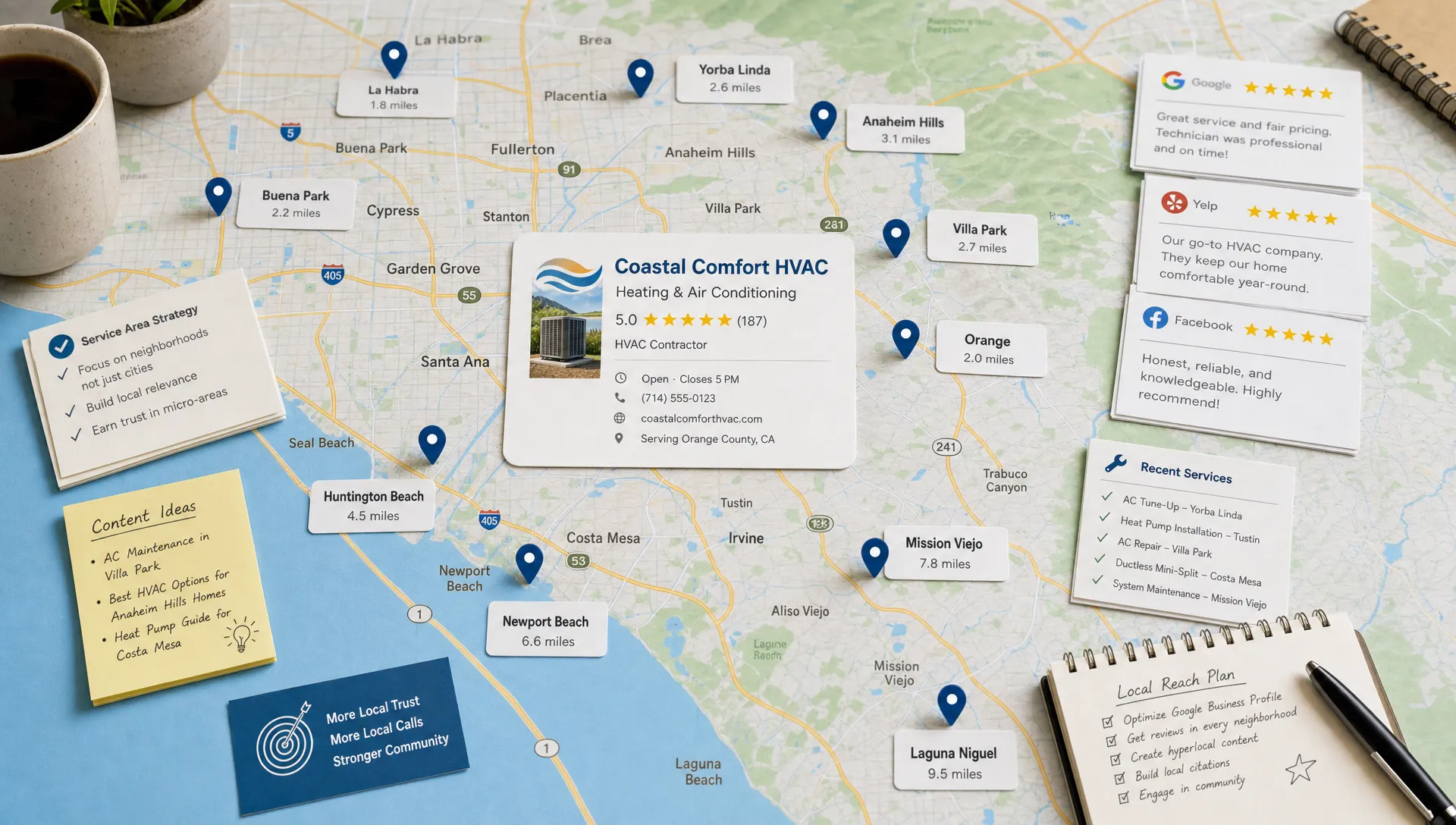
 Orange County is crowded with capable contractors. A homeowner in Irvine can compare five HVAC companies before lunch. A property manager in Newport Beach can ask Google, ChatGPT, or a voice assistant for a plumber without ever visiting a website. A remodeler in Laguna Beach may be judged by reviews, photos, and local proof before the first call happens. That is why local marketing for contractors has to be more precise than generic advertising. You are not trying to reach everyone in California. You are trying to become the obvious, trusted choice when someone nearby needs your exact service, in your exact service area, right now. For Orange County contractors, the best marketing ideas connect three things: local search visibility, neighborhood-level trust, and fast conversion into calls or estimate requests. Google’s local ranking guidance centers on relevance, distance, and prominence, and those same principles now influence how AI-driven search tools interpret which businesses deserve to be recommended.
June 18, 2026
The San Francisco Bay Area runs on booked meetings. From SoMa tech startups to Oakland professional services firms, growth depends on a full calendar. But most businesses waste more time chasing appointments than closing them.  The Bay Area's competitive market makes this worse. Prospects get dozens of outreach messages daily. Generic cold emails land in spam. Inbound alone rarely keeps a calendar full. You need a system — or an agency — that cuts through the noise. This guide covers the six best appointment booking agencies serving the San Francisco Bay Area. What are the best appointment booking agencies in the San Francisco area? The top options span two distinct models. Managed outreach services — like Kell Web Solutions — actively prospect and book qualified leads on your behalf. B2B appointment setting agencies use human SDRs and AI to book meetings for enterprise and growth-stage companies.
June 15, 2026
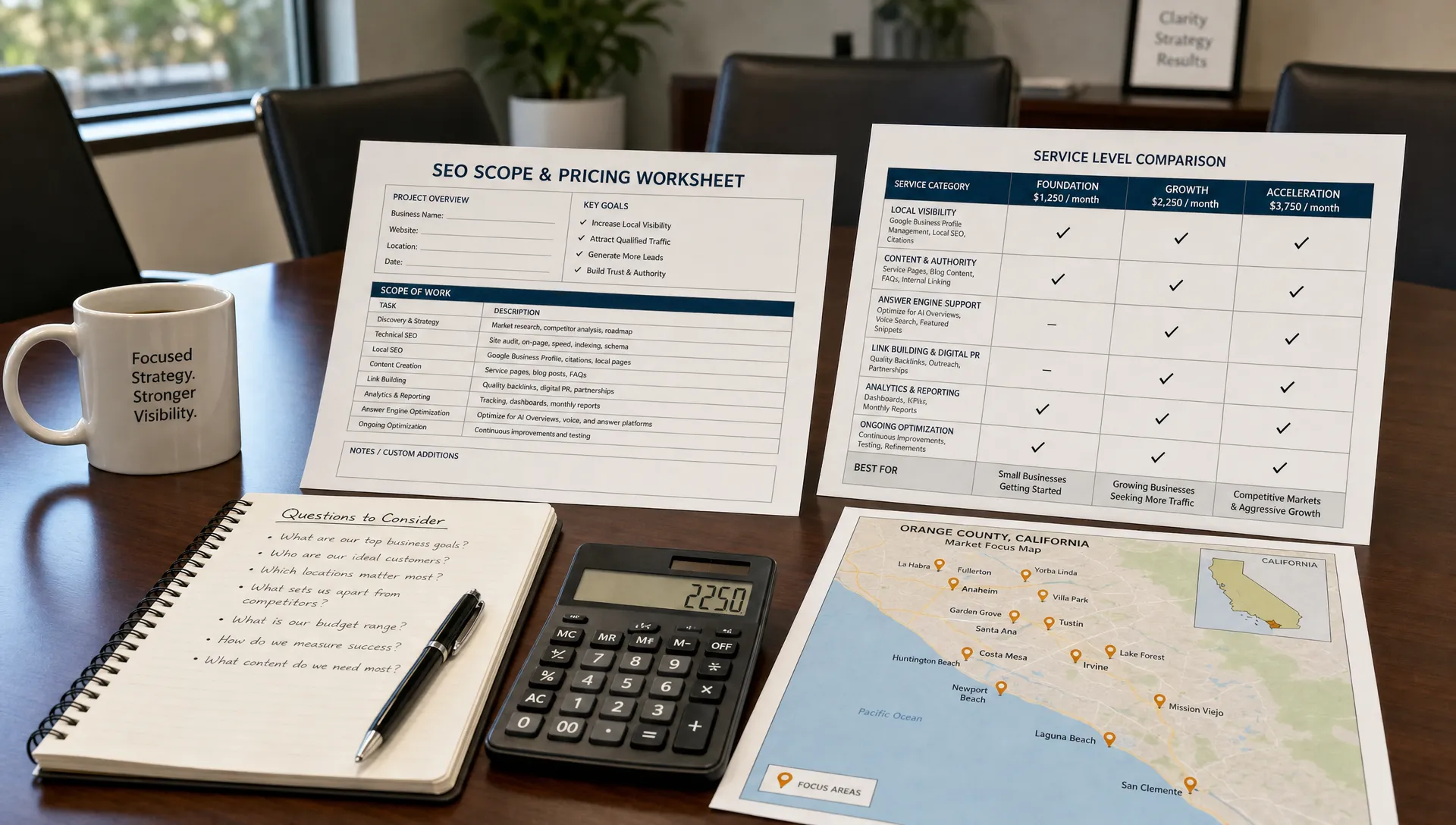
 A marketing firm can make a dashboard look busy. That is not the same as growing local revenue. For an Orange County contractor, revenue means booked HVAC jobs in Irvine, emergency plumbing calls in Huntington Beach, roof replacement estimates in Anaheim, and remodel consultations in Laguna Niguel. For a multi-location dental, medical, or legal practice, it means the right prospects choosing the right office within the right neighborhood catchment. That is why choosing between marketing firms in 2026 requires a different scorecard. Rankings still matter. Ads still matter. Websites still matter. But local buyers now move through Google Maps, AI Overviews, voice assistants, reviews, directory profiles, neighborhood content, and referral signals before they ever fill out a form. The right firm does not just “do marketing.” It builds a system that turns local intent into confident calls, consultations, and booked work. Below is a practical framework for choosing a marketing partner that is accountable to revenue, not vanity metrics. Start by defining what “local revenue growth” means Before you talk to agencies, define the business outcome you actually need. Too many local businesses start with a vague request like “we need SEO” or “we need more leads.” A stronger starting point is: “We need more qualified calls from homeowners in Newport Beach for high-margin HVAC replacement jobs,” or “We need more booked consultations for our Irvine and San Diego offices.” That distinction changes everything. A generic campaign might chase traffic from anywhere. A revenue-focused local campaign identifies the service lines, cities, neighborhoods, customer questions, and conversion paths that produce profitable work. Use a simple scorecard like this when evaluating proposals: