Laguna Beach Home Services Business Local SEO 2025 Guide & Tips
How the AI-Induced Traffic Decline is Affecting Orange County Home Services Contractors and What You Can Do About It
Article At-A-Glance
- Laguna Beach home services businesses can increase local visibility by up to 70% with neighborhood-specific SEO strategies
- The Google Map Pack drives 80% of service calls in the Laguna Beach area, making it essential to optimize your Google Business Profile
- Voice search optimization is now critical, with over half of Laguna Beach searches happening through voice assistants
- Hyper-local content strategies focusing on specific neighborhoods like North Laguna, Woods Cove, and Bluebird Canyon yield higher conversion rates
- Kell Solutions helps Laguna Beach service providers implement targeted local SEO strategies that deliver measurable results
Local search has become the lifeline for Laguna Beach home service businesses. Whether you're a plumber, electrician, landscaper, or house cleaner, your visibility in local search results directly impacts your revenue and growth potential in 2025.
Dominate Your Local Market: What's Inside This Guide
This comprehensive guide cuts through the noise to deliver actionable strategies specifically tailored for Laguna Beach home service providers. You'll discover how to leverage local SEO to outrank competitors, capture more leads, and grow your business in one of California's most competitive service markets. Kell Solutions has helped dozens of local businesses transform their digital presence with these exact strategies—turning search visibility into a predictable source of high-quality leads.
Why Local SEO Will Make or Break Laguna Beach Home Service Businesses in 2025
The digital landscape for home service providers has fundamentally changed. Today, 97% of consumers search online for local services before making a call, and 86% use Google Maps to find nearby businesses. This shift has created both opportunity and risk for Laguna Beach service companies.
The Unique Challenges of Ranking in Affluent Coastal Communities
Laguna Beach presents distinctive SEO challenges that don't exist in other markets. The affluent demographic expects exceptional online experiences that match the premium services they seek. High-end homeowners in areas like Emerald Bay and Three Arch Bay research extensively before making service decisions, comparing multiple providers and reading reviews in detail.
Competition in the Laguna Beach service sector has intensified dramatically. National franchises with substantial marketing budgets have entered the market, while established local businesses continue to strengthen their digital presence. This saturation means generic SEO approaches that worked five years ago now fail to generate meaningful results.
How Laguna Beach Homeowners Search for Services Has Changed
The search behavior of Laguna Beach residents has evolved significantly. Homeowners now use hyper-specific search terms that include neighborhood names, service types, and urgency indicators. Instead of simply searching "plumber Laguna Beach," they're asking "emergency plumber near Top of the World neighborhood available now."
Mobile search dominates the landscape, with 78% of Laguna Beach service inquiries coming from smartphones. This creates a need for lightning-fast, mobile-optimized websites that deliver instant information. Voice search has also risen dramatically, with 52% of local searches now happening through smart speakers, phones, and in-vehicle systems.
Expectations for immediate response have never been higher. The typical Laguna Beach homeowner will contact only the top 2-3 service providers they find, and they expect responses within minutes, not hours. This places enormous importance on showing up prominently in local search results. For home service providers in Laguna Beach, optimizing on-page SEO for local ranking is crucial to meet these expectations.
- 86% of Laguna Beach homeowners check Google reviews before contacting a service provider
- 73% won't consider businesses with ratings below 4.2 stars
- 69% use neighborhood-specific terms in their searches
- 58% expect same-day service for non-emergency requests
- 47% will pay premium rates for highly-rated service providers
The Cost of Invisibility: What Happens When Competitors Outrank You
The financial impact of poor local search visibility is substantial and immediate. When your business fails to appear in the top local results, you essentially become invisible to potential customers. Providers ranking beyond the third position see inquiry volumes drop by 70% compared to those in the top three spots.
This invisibility creates a downward spiral that's difficult to reverse. Fewer calls mean fewer opportunities to generate reviews, which further weakens your rankings. Meanwhile, competitors who maintain strong local visibility continue gaining momentum, widening the gap. For the average Laguna Beach home service business, dropping out of the top local results can cost $5,000-$15,000 in monthly revenue.
Master the Google Map Pack: Your #1 Lead Generation Tool
The Google Map Pack (the block of three local business listings displayed prominently in search results) has become the single most valuable lead generation asset for Laguna Beach service providers. These coveted positions drive the vast majority of new service inquiries, especially for urgent needs like plumbing emergencies, electrical issues, or lock-out situations.
Why 80% of Laguna Beach Service Calls Come from the Top 3 Map Results
The psychology behind this phenomenon is straightforward: trust and convenience. When homeowners see businesses displayed prominently in Google's Map Pack, they perceive them as vetted and trusted by both Google and their community. The prominent display of star ratings, review counts, and business information creates immediate credibility.
Location proximity plays a crucial role in Map Pack rankings, especially for urgent service needs. Google's algorithm intelligently prioritizes businesses that can realistically service the customer's location quickly. This creates an opportunity for businesses that properly optimize their service areas in Google Business Profile.
The 5 Critical Google Business Profile Optimizations to Make Today
Maximizing your visibility in the Map Pack requires meticulous optimization of your Google Business Profile (GBP). Start with category selection—choose one primary category that best represents your core service, then add relevant secondary categories. For Laguna Beach businesses, being specific matters tremendously.
Comprehensive business information is non-negotiable. Include your exact service hours, specifying if they differ for emergency calls. Add high-quality photos showing your team in Laguna Beach neighborhoods, showcasing completed projects with neighborhood landmarks visible when possible. Update your business description to include specific service areas within Laguna Beach such as "serving North Laguna, South Laguna, and Bluebird Canyon."
Most critically, activate and utilize all available GBP features. Set up appointment booking, add your services list with descriptions and pricing where applicable, and create Google Posts weekly highlighting recent work in specific Laguna Beach neighborhoods. These active engagement signals tell Google your business is responsive and relevant to local searches.
How to Dominate Specific Neighborhoods with Geo-Targeted Content
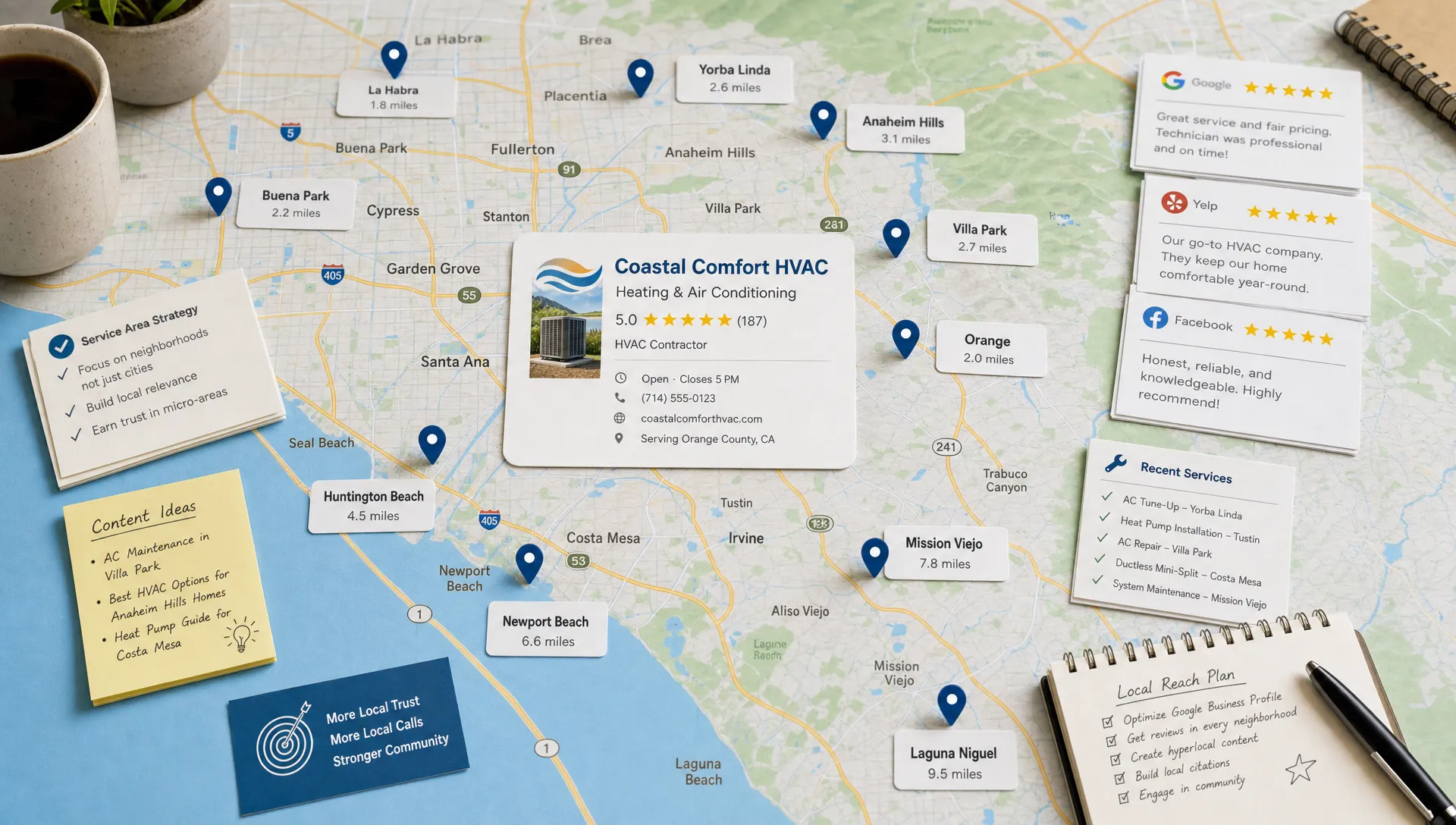
The key to standing out in Laguna Beach's competitive service landscape is neighborhood-specific targeting. Create dedicated content for each major neighborhood—North Laguna, South Laguna, Top of the World, Woods Cove, and others. This approach aligns perfectly with how residents search, often including their specific neighborhood in queries.
Develop neighborhood service pages addressing unique challenges in each area. For example, homes in Bluebird Canyon often face specific drainage issues during rainy seasons, while beachfront properties in Victoria Beach require specialized maintenance against salt air corrosion. By acknowledging these location-specific concerns, you signal genuine local expertise.
Review Management Tactics that Boost Rankings and Conversions
Reviews have become the cornerstone of local SEO success, particularly in discerning markets like Laguna Beach. Implement a systematic review generation strategy rather than hoping for occasional feedback. After completing service, send an automated text or email with your Google review link, ideally within 24 hours while satisfaction is highest.
The quality of reviews matters as much as quantity. Train your team to politely request specific mentions of the neighborhood where service was provided, the particular service performed, and any standout aspects of the experience. These keyword-rich reviews significantly boost your relevance for specific search queries.
Never leave reviews unanswered, whether positive or negative. Respond promptly to all feedback, addressing the customer by name and referencing specific details from their review. For negative reviews, take ownership, offer solutions, and provide contact information to resolve issues offline. This demonstrates accountability that resonates strongly with Laguna Beach's quality-focused residents.
Voice Search Optimization: The 2025 Game-Changer
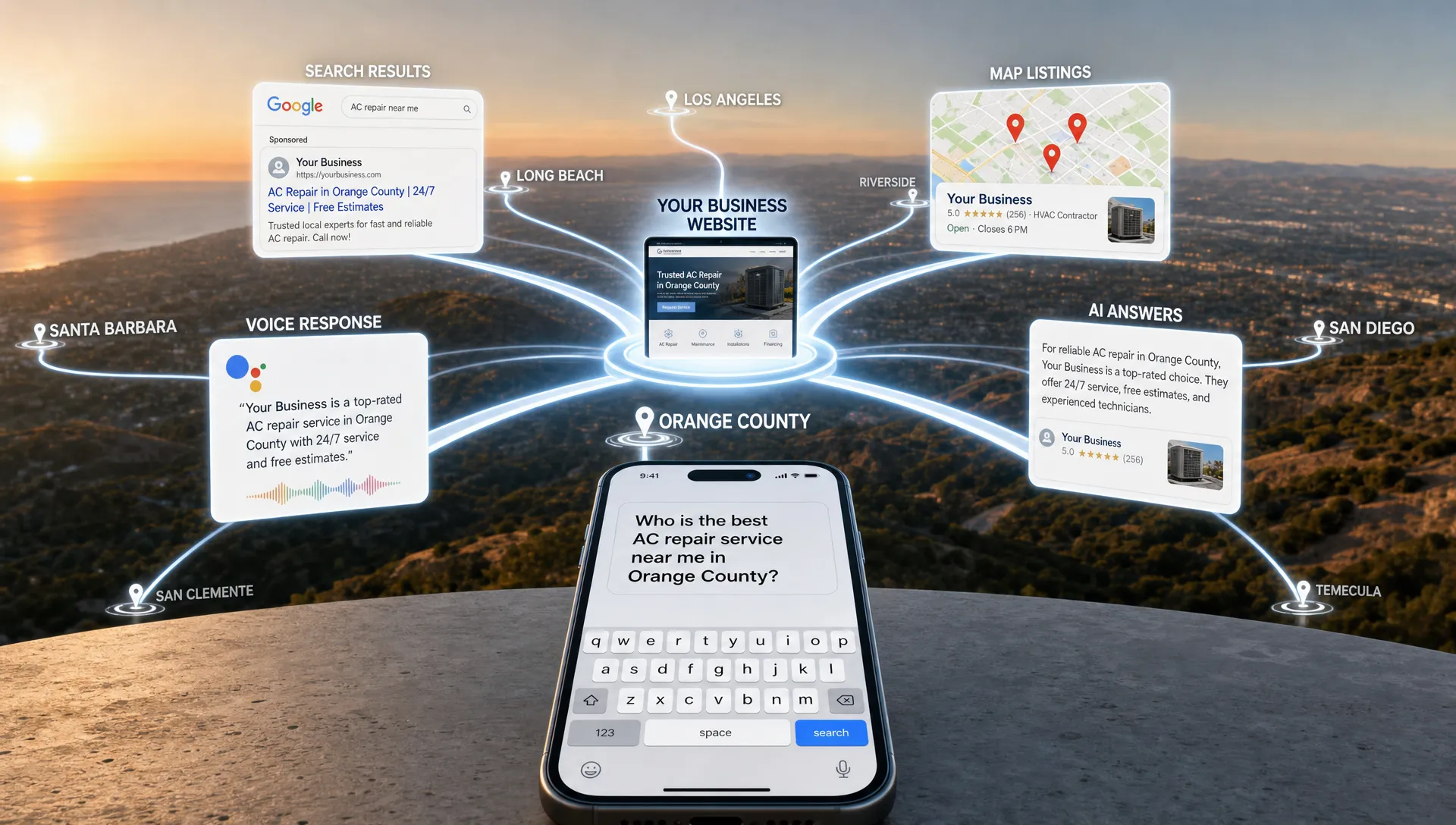
Voice search has fundamentally transformed how Laguna Beach residents find local services. With smart speakers in over 65% of Laguna Beach homes and voice assistants integrated into nearly every smartphone and vehicle, optimizing for voice queries is no longer optional—it's essential for survival.
The shift to voice search dramatically changes keyword strategy. Voice queries are typically longer, more conversational, and often phrased as questions. Instead of typing "emergency plumber Laguna Beach," homeowners are asking "Who's the best emergency plumber near me in North Laguna that's open now?" Your content must align with these natural language patterns.
Why Half of All Laguna Beach Searches Now Happen by Voice
Voice search adoption in Laguna Beach has outpaced national averages, driven by the area's tech-savvy, affluent demographic. The convenience factor is particularly relevant for home service needs, as homeowners often discover issues while their hands are occupied (dealing with a leak, inspecting damage, etc.). In these moments, voice search becomes the default discovery method.
Location-based relevance is amplified in voice search, with proximity playing an even greater role than in traditional search. Voice assistants prioritize "near me" results more aggressively, making proper location settings and service area specifications in your Google Business Profile absolutely critical for capturing these queries.
Conversational Keywords that Capture "Near Me" Searches
Developing a conversational keyword strategy requires understanding how Laguna Beach residents naturally speak about home service needs. Conduct recorded interviews with current customers about how they discovered your business, then analyze the transcripts for natural language patterns. These genuine phrases often differ dramatically from how businesses describe their own services.
Integrate question-based keywords throughout your website, particularly in headers, meta descriptions, and opening paragraphs. Questions like "How quickly can I get a plumber in Top of the World Laguna Beach?" or "What's the cost to repair an electrical panel in South Laguna?" align perfectly with voice search patterns. Create FAQ sections addressing these specific questions with concise, direct answers.
Local modifiers are essential for every primary keyword. Instead of optimizing for "window repair," target "window repair in Three Arch Bay" or "emergency window replacement Laguna Canyon." This hyper-local approach connects directly with voice search algorithms that prioritize specific location relevance.
How to Structure Content for Featured Snippets and Voice Answers
Voice assistants typically deliver just one answer to queries, pulling from Google's featured snippets when available. Structuring your content to win these coveted positions requires a deliberate approach. Begin key service pages with a concise, direct answer to the primary question the page addresses. For example, "Emergency plumbing service in North Laguna is available within 30 minutes from ABC Plumbing, 24 hours a day, 7 days a week."
Format your content for easy parsing by search engines. Use proper heading hierarchy with H2s and H3s that contain question-based keywords. Include bulleted or numbered lists for process-oriented information like "Steps to prepare for HVAC maintenance in Laguna Beach" or "What to do while waiting for an emergency electrician in Woods Cove." These structured elements are disproportionately likely to be selected as voice search answers.
Build a Hyper-Local Authority Network
Establishing genuine authority in specific Laguna Beach neighborhoods requires a multi-faceted approach that goes beyond basic SEO tactics. Successful service providers build comprehensive networks of digital assets, citations, and community connections that collectively signal deep local expertise to search engines.
Neighborhood-Specific Landing Pages that Convert
Create dedicated landing pages for each major Laguna Beach neighborhood you serve, optimized for both search visibility and conversion. These pages should address neighborhood-specific service needs, challenges, and solutions. For Three Arch Bay, discuss coastal maintenance issues; for Top of the World, address hillside property considerations; for downtown areas, highlight historical home expertise.
Include genuine before-and-after project photos from each neighborhood, properly tagged with location data and descriptive alt text. Feature testimonials specifically from residents of that neighborhood, mentioning street names when possible (e.g., "Jane on Glenneyre Street"). This hyper-local content creates immediate trust with prospects who recognize familiar locations and neighbors.
Conversion elements must be neighborhood-tailored as well. Offer neighborhood-specific promotions like "Free drain inspection for South Laguna residents this month" or "10% discount for Emerald Bay homeowners." Include maps showing your proximity to that specific neighborhood and emphasize rapid response times based on your location.
Local Citation Strategy for Maximum Visibility
Consistent citation building across relevant platforms reinforces your local authority. Beyond the obvious directories like Yelp and Angi, identify industry-specific and Laguna Beach-specific citation sources. Ensure your business information (NAP - Name, Address, Phone) remains identical across all platforms to avoid confusing search algorithms.
Target Laguna Beach-specific directories including the Laguna Beach Chamber of Commerce, NextDoor neighborhood groups, and local community boards. Many Laguna neighborhoods maintain their own websites and business directories, such as the South Laguna Civic Association or the Top of the World Neighborhood Association. Securing listings in these hyper-local resources provides powerful relevance signals to search engines.
For each citation, maximize the use of available fields. Upload high-quality images, complete service descriptions, select appropriate categories, and include your service area details. When possible, mention specific Laguna Beach neighborhoods you serve in the business description fields.
How to Create Community Partnerships that Generate Backlinks
Authentic community involvement creates natural backlink opportunities that pure SEO tactics cannot replicate. Partner with Laguna Beach community organizations, sponsor local events, or participate in neighborhood improvement projects. These activities often result in mentions on community websites, local news coverage, and social media exposure that includes valuable backlinks.
Develop relationships with complementary service providers who aren't direct competitors. A plumber might partner with electricians, painters, and remodelers to create a referral network. These partnerships often lead to website mentions and backlinks that carry high relevance in Google's eyes, as they come from related local businesses.
Create genuinely useful resources specific to Laguna Beach homes. Develop guides like "Preparing Your Laguna Beach Home for Wildfire Season" or "Preventing Salt Air Corrosion in Coastal Properties." Share these resources with neighborhood associations, local real estate offices, and community groups, who often link to valuable content from their websites.
Content Calendar: Seasonal Service Topics for Laguna Beach Homes
Laguna Beach homes face unique seasonal challenges that create perfect content opportunities. Develop a 12-month content calendar addressing specific seasonal needs: winter rainy season preparation in November, wildfire prevention in summer months, salt air maintenance in spring, and post-tourist season cleanup in fall. Publishing timely, relevant content positions your business as proactive and knowledgeable.
Schedule content to align with Laguna Beach community events and seasonal patterns. Create guides for home preparation before major events like the Pageant of the Masters, Sawdust Festival, or winter holiday home tours. This timing maximizes relevance and search interest while demonstrating your understanding of the local community calendar.
Mobile-First Design Elements for Laguna Beach Service Sites
The affluent Laguna Beach market demands exceptional mobile experiences. In 2025, over 80% of local service searches happen on mobile devices, often in urgent situations. Your website must load in under three seconds, display properly on all screen sizes, and provide immediate access to critical information and contact options.
Speed Optimization for Impatient Mobile Users
Site speed directly impacts both rankings and conversions for Laguna Beach service businesses. Implement aggressive image compression, leverage browser caching, and minimize code bloat to achieve sub-three-second loading times. Each additional second of load time increases bounce rates by 20%, particularly for mobile users with urgent service needs.
Consider implementing Accelerated Mobile Pages (AMP) for key service pages and blog content. While somewhat controversial in the broader SEO community, AMP still provides advantages for service businesses targeting immediate-need scenarios. The lightning-fast loading of AMP pages reduces friction for stressed homeowners dealing with urgent situations like water leaks or electrical failures.
Regular speed testing should become part of your monthly maintenance routine. Use Google's PageSpeed Insights and compare your results against top-ranking competitors in the Laguna Beach market. Pay particular attention to First Contentful Paint and Largest Contentful Paint metrics, which directly impact user perception of site speed.
Click-to-Call and Maps Integration Best Practices
Prominent, sticky click-to-call buttons should appear on every page of your mobile site, ideally in a fixed position that remains accessible as users scroll. For emergency services, implement a distinct, attention-grabbing emergency call button with different styling to distinguish it from standard inquiries.
Integrate Google Maps with neighborhood-specific markers showing your service coverage. Rather than a single map on your contact page, include neighborhood-specific maps on each service area landing page. Configure these maps to open the native maps application when tapped, allowing customers to immediately get directions to your location or visualize your proximity to their home.
Schema Markup for Rich Local Results
Implement comprehensive LocalBusiness schema markup to provide search engines with detailed structured data about your services. This markup should include your service areas with specific Laguna Beach neighborhood names, business hours with special notations for emergency availability, and service categories with detailed descriptions.
Extend your schema implementation to include Review markup for testimonials, Service markup for specific offerings, and FAQ markup for common questions. This structured data helps search engines understand your content more precisely and often results in enhanced search listings with star ratings, service highlights, and other attention-grabbing elements.
Measure What Matters: Local SEO Analytics for 2025
Effective measurement separates systematic SEO success from random luck. Establish baseline metrics before implementing new strategies, then track progress with discipline. For Laguna Beach service businesses, certain metrics carry significantly more weight than others in predicting business outcomes.
The 3 KPIs Every Laguna Beach Service Provider Should Track
First, track Map Pack visibility for your top 20 service+location keyword combinations. Your position in the Map Pack for terms like "emergency plumber Top of the World" or "AC repair South Laguna" directly correlates with call volume. Monitor these positions weekly, noting any patterns or shifts that coincide with your optimization efforts or competitor activities.
Second, measure phone call volume and quality by source. Implement call tracking with unique phone numbers for different marketing channels to identify which aspects of your SEO strategy generate actual customer inquiries. Further categorize these calls by service type, neighborhood, and conversion to paying jobs to understand the true value of different traffic sources.
Third, track neighborhood-specific conversion rates from website visits to inquiries. Set up goal tracking in Google Analytics to measure which neighborhood landing pages generate the highest engagement and conversion rates. This data often reveals surprising insights about which areas respond best to your messaging and service offerings.
Tools to Monitor Local Rank Position by Neighborhood
Standard rank tracking tools often fall short for neighborhood-specific monitoring. Implement a specialized local rank tracking solution that allows you to monitor positions for specific keyword+neighborhood combinations from various points within Laguna Beach. This granular approach reveals how your visibility varies across different parts of the city, often uncovering opportunities in underserved neighborhoods. For home service providers in Laguna Beach—contractors, plumbers, and more—understanding local ranking is crucial, as detailed in this guide to optimizing on-page SEO for local ranking.
Supplement automated tracking with manual searches performed on mobile devices in target neighborhoods. This hands-on approach reveals how your business appears in real-world scenarios, including any location-based advantages or disadvantages that automated tools might miss. Perform these manual checks monthly from at least five key locations throughout Laguna Beach.
Call Tracking and Conversion Attribution Systems
Implement dynamic call tracking that assigns unique phone numbers to different traffic sources, allowing precise attribution of which SEO efforts generate actual calls. Advanced systems can even track which specific keywords triggered the search that led to the call, providing invaluable data for optimization efforts. This level of attribution helps Laguna Beach service businesses allocate resources to the highest-performing channels.
Beyond basic call tracking, implement conversation intelligence tools that record and analyze calls (with proper disclosure). These systems can identify which neighborhood keywords callers mention, which services they request most frequently, and even assess the quality of your team's call handling. This intelligence helps refine both your SEO strategy and your customer service approach. For more insights, explore how voice search and conversational keywords are reshaping local SEO in 2025.
Your 90-Day Laguna Beach SEO Implementation Plan
Success requires systematic implementation rather than random tactics. Follow this structured 90-day plan to transform your Laguna Beach service business's local visibility, starting with fundamental optimizations and progressing to advanced strategies that build sustainable competitive advantage. For home service providers in Laguna Beach, consider optimizing on-page SEO to enhance your local ranking.
Week 1-4: Foundation Building
Begin with comprehensive Google Business Profile optimization. Update all information, add neighborhood-specific service areas, upload geo-tagged photos from recent projects in different Laguna Beach neighborhoods, and implement a review request system. Simultaneously audit and correct your website's technical foundation—fixing mobile usability issues, improving page speed, and implementing proper schema markup for local businesses. Conduct keyword research specifically targeting neighborhood + service combinations unique to Laguna Beach.
Month 2: Content Creation and Citation Development
Develop neighborhood-specific landing pages for the five most valuable Laguna Beach areas for your business. Each page should address unique service needs of that neighborhood, feature testimonials from local residents, and include area-specific photos and service offerings. This is also the time to optimize for conversational keywords and voice search patterns.
Build out your citation network with consistent NAP information across major platforms. Begin with general directories like Google, Yelp and Bing, then expand to industry-specific directories and finally to Laguna Beach-specific local resources. Ensure all citations include proper business categories, service area specifications, and complete business descriptions.
Initiate a content calendar focusing on seasonal topics relevant to Laguna Beach homeowners. Create at least four cornerstone content pieces addressing major home service needs specific to coastal Orange County properties. Optimize this content for featured snippets by providing clear, direct answers to common questions in a structured format.
Month 3: Review Generation and Technical Optimization
Implement an aggressive review generation campaign, focusing on recently completed projects in underrepresented neighborhoods. Train your team to specifically request mentions of location and service details in reviews. Develop a systematic approach to review response that addresses the customer by name and references specific details of their project.
Complete technical SEO refinements including mobile speed optimization, schema markup implementation, and structured data verification. Implement tracking systems for calls, form submissions, and other conversion actions, with attribution data to identify which channels and keywords drive actual business. Conduct competitor analysis to identify gaps and opportunities in your SEO strategy compared to top-ranking Laguna Beach competitors.
Take Action Now to Secure Your Market Position
The Laguna Beach home service market is becoming more competitive every month. Each day without a strong local SEO strategy means lost opportunities and market share. Begin implementing these strategies immediately to establish neighborhood authority and capture high-intent local searches before your competitors strengthen their positions. Kell Solutions specializes in helping Laguna Beach home service providers develop and implement comprehensive local SEO strategies that deliver measurable business growth.
Frequently Asked Questions
Home service business owners in Laguna Beach consistently ask important questions about local SEO implementation. These answers address the most common concerns and provide practical guidance for businesses at various stages of their local search optimization journey.
The following questions reflect real inquiries from Laguna Beach service providers and offer straightforward, actionable advice specific to the unique challenges of this market.
How long does it take to see results from local SEO in Laguna Beach?
Most Laguna Beach service businesses begin seeing measurable improvements in local visibility within 4-6 weeks of implementing comprehensive optimization strategies. Initial gains typically appear in the form of improved Map Pack positions for less competitive neighborhood-specific terms. Call volume increases generally follow within 2-3 weeks of achieving top-three Map Pack positions.
Full results, including dominance for high-competition keywords and substantial increases in qualified leads, typically require 3-6 months of consistent effort. Businesses that aggressively implement all recommendations—especially review generation and neighborhood-specific content development—tend to see results on the shorter end of this timeline. Patience and persistence are essential, as local SEO is a cumulative process where each optimization builds upon previous efforts.
Do I need different strategies for different neighborhoods in Laguna Beach?
Yes, neighborhood-specific strategies are essential in Laguna Beach due to its distinct microcommunities with unique characteristics and service needs. North Laguna homeowners often seek different services than those in Three Arch Bay or Top of the World. Creating neighborhood-specific landing pages, gathering reviews mentioning specific locations, and developing content addressing unique local challenges significantly outperforms generic city-wide approaches.
How much should a home service business invest in local SEO monthly?
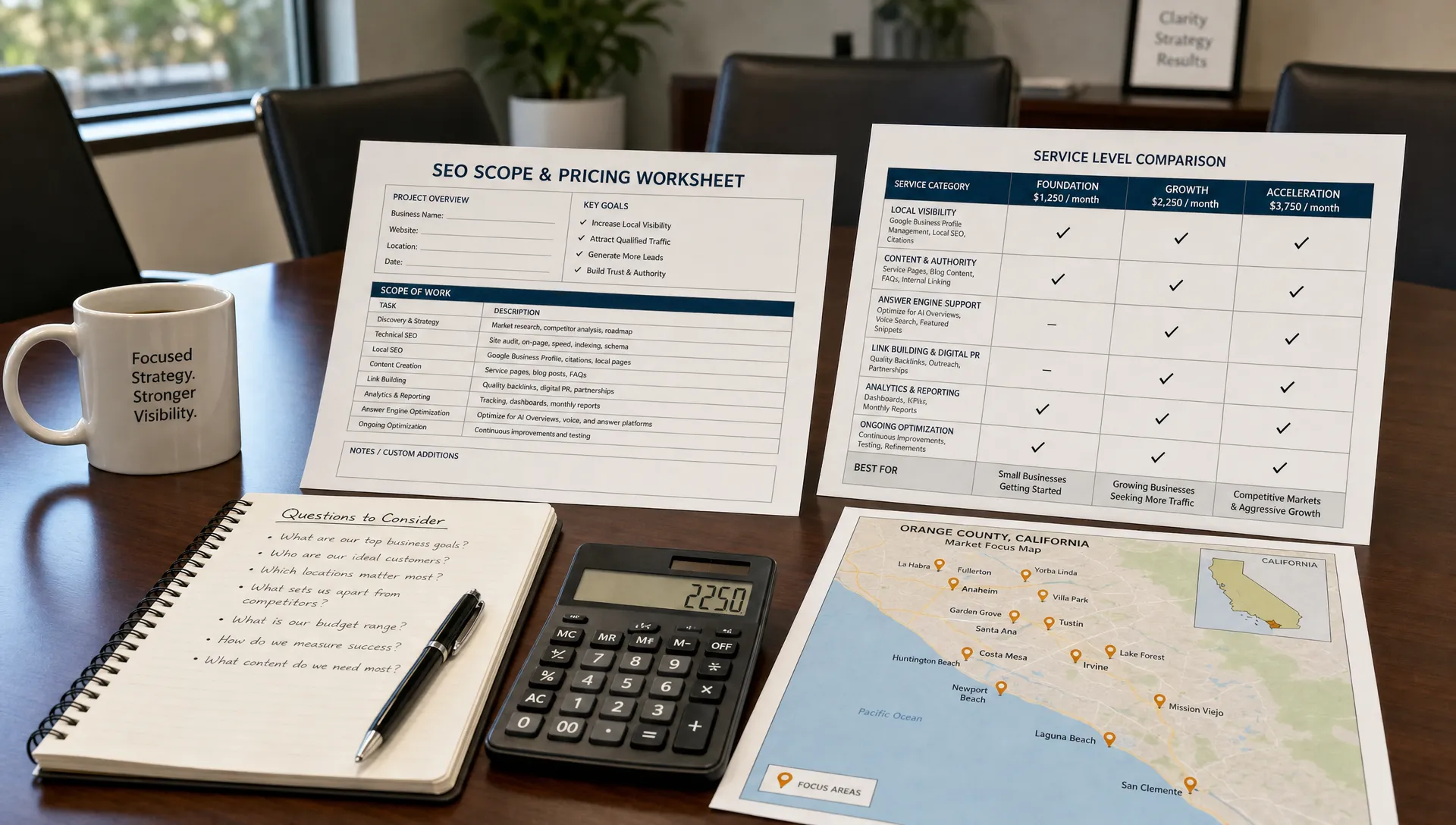
Effective local SEO for Laguna Beach home service businesses typically requires an investment of $1,500-$3,000 monthly, depending on competition level and growth goals. This investment covers ongoing optimization, content creation, citation management, review generation, and performance tracking. Businesses in highly competitive sectors like plumbing or HVAC may need to position at the higher end of this range, while specialized services with less competition might succeed with more modest investments.
Can I handle Laguna Beach local SEO myself or should I hire a professional?
While basic local SEO elements can be implemented in-house, most successful Laguna Beach service businesses partner with specialists for optimal results. The complexity of neighborhood-specific optimization, technical implementation requirements, and the need for specialized tools often make professional assistance the more cost-effective approach. Many businesses adopt a hybrid model where internal staff handle routine tasks like photo uploads and review responses, while specialists manage technical optimization, content strategy, and competitive analysis.
Consider your available time and technical expertise realistically. Local SEO requires consistent effort and specialized knowledge that many busy service business owners struggle to maintain alongside their operational responsibilities. If you choose to handle SEO internally, invest in proper training and set aside dedicated time weekly for implementation and monitoring.
Even with in-house implementation, periodic professional audits (quarterly or bi-annually) can identify opportunities and correct issues before they impact your visibility. This balanced approach often provides the best return on investment for growing service businesses.
How do I outrank national franchises that have moved into the Laguna Beach market?
Competing successfully against national franchises requires leveraging your local advantage through hyper-specific neighborhood targeting. While franchises typically focus on city-level optimization, independent businesses can dominate specific neighborhoods by creating highly relevant content, gathering location-specific reviews, and demonstrating authentic community involvement that franchises rarely match.
Emphasize your local roots and community connections in all content. Feature team members who live in Laguna Beach, highlight your involvement in community events, and showcase projects in recognizable local settings. Create content addressing highly specific local challenges that generic franchise websites typically overlook—like dealing with coastal corrosion in Woods Cove homes or proper drainage solutions for Top of the World properties.