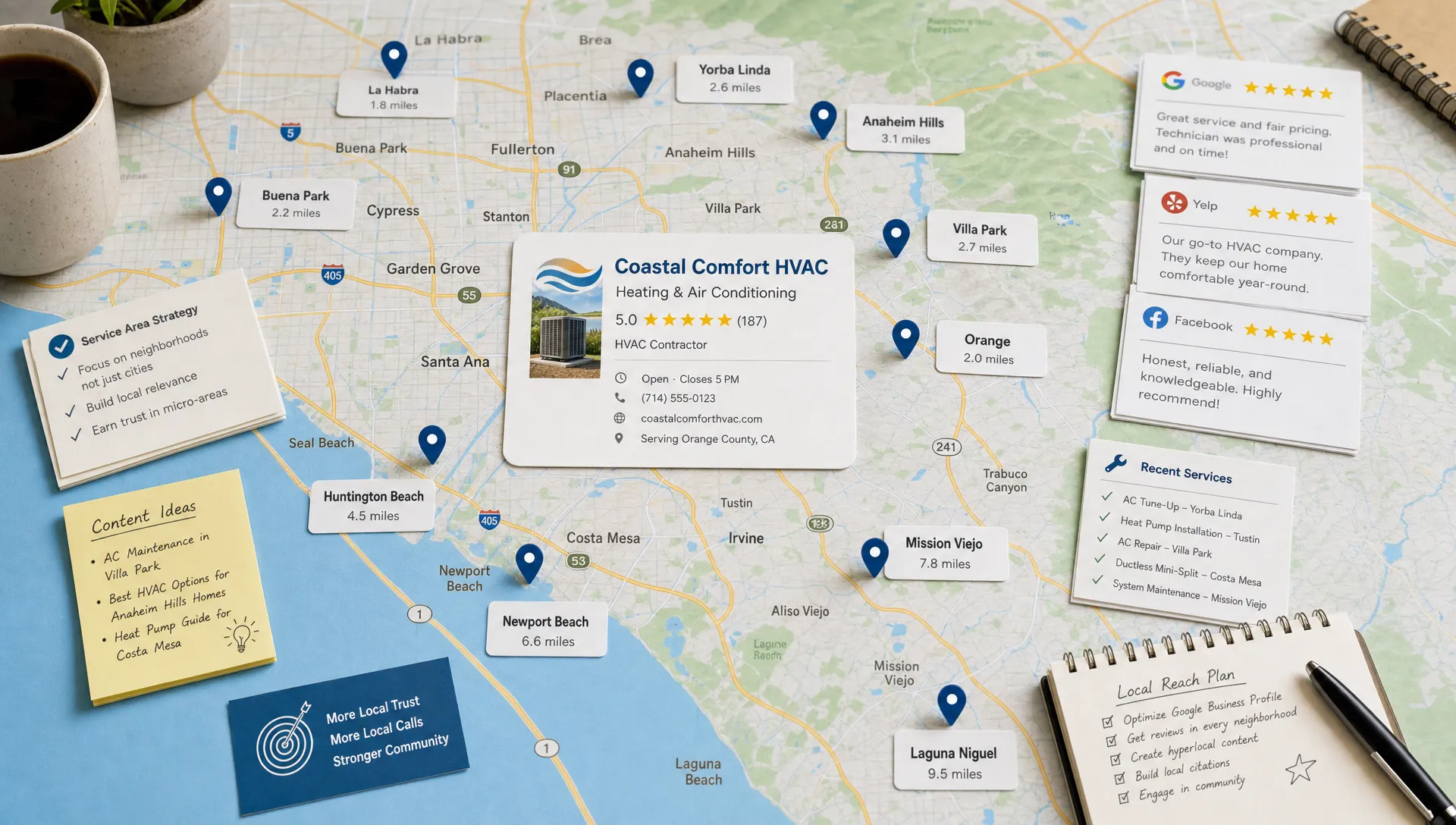
Top Luxury HVAC Contractors Newport Beach: Google Maps Ranking Tips

Gregg Kell • August 31, 2025

Unlock Google Maps ranking secrets for Newport Beach’s most prestigious HVAC contractors—attract elite clients with unrivaled visibility and digital authority.
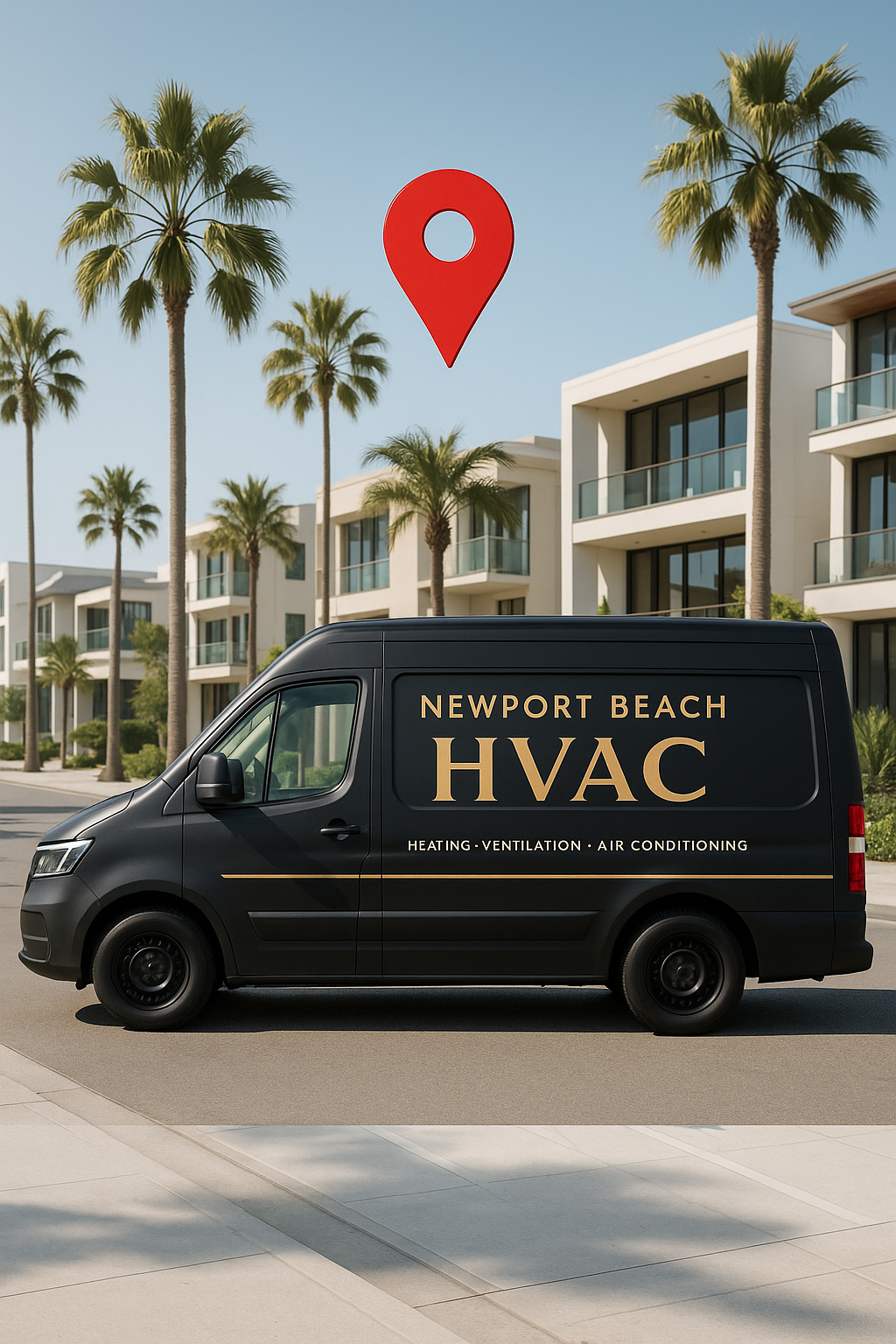
Top Luxury Condos with high end HVAC

Key Takeaways

  • Google Maps visibility is critical for luxury HVAC contractors in Newport Beach, often generating more qualified leads than traditional organic search results
  • Complete business profile optimization with luxury-focused keywords and high-end project imagery significantly improves map pack visibility
  • Consistent NAP (Name, Address, Phone) information across all online directories creates trust signals that boost local rankings
  • Authentic reviews from affluent Newport Beach neighborhoods serve as powerful social proof and ranking factors
  • Neighborhood-specific content targeting exclusive areas like Crystal Cove and Balboa Island helps establish hyper-local authority


The difference between thriving and merely surviving in Newport Beach's competitive luxury HVAC market often comes down to Google Maps visibility. When affluent homeowners need immediate climate solutions for their multi-million dollar properties, they rarely scroll past the top three map listings.


Kell Solutions helps luxury HVAC contractors dominate local search by implementing proven Google Maps optimization strategies that attract high-value clients. Our research shows that contractors appearing in the coveted "map pack" receive up to 70% more engagement from qualified prospects than those relying solely on traditional organic rankings.

The Newport Beach luxury HVAC landscape demands excellence at every customer touchpoint. From cooling systems for coastal mansions to specialized climate control for wine cellars and smart home integration, contractors serving this affluent market must demonstrate both technical expertise and white-glove service standards. Google Maps serves as the perfect showcase for these differentiators—if optimized correctly.


Article-at-a-Glance

This comprehensive guide reveals the exact Google Maps optimization strategies employed by Newport Beach's top HVAC contractors. We'll examine how premium positioning in local search results directly correlates with capturing high-ticket installations and service contracts in Newport's most exclusive communities. You'll discover actionable techniques for enhancing your Maps presence, managing your reputation, and creating neighborhood-specific content that resonates with affluent homeowners.


By implementing these proven tactics, your luxury HVAC business can gain prominence in local search results, outrank competitors, and consistently attract the type of discerning clients willing to invest in premium comfort solutions. The strategies outlined here represent years of research into what actually works in Newport Beach's unique market.


Let's explore how to position your HVAC business as the premier choice for Newport Beach's most discriminating homeowners through strategic Google Maps optimization.


Why Newport Beach Luxury HVAC Contractors Need Google Maps Visibility

  • Google Maps results appear above organic listings for local searches, capturing immediate attention
  • High-intent homeowners specifically seeking nearby HVAC services frequently use map-based searches
  • The map pack format showcases reviews, ratings, and business photos—all critical trust factors for luxury clients
  • Phone calls can be made directly from Google Maps listings, eliminating friction in the contact process
  • Visibility in Newport Beach's most affluent neighborhoods is algorithmically determined by Maps-specific ranking factors


Newport Beach's affluent homeowners have unique expectations when selecting HVAC contractors. They're not just seeking functional heating and cooling—they demand seamless experiences, aesthetic integration with designer interiors, and systems that complement their coastal lifestyle. When these homeowners search for "luxury HVAC contractors Newport Beach," Google Maps results create the critical first impression that either qualifies or disqualifies your business.


Recent data reveals that 76% of consumers who conduct a local search on their smartphone visit a business within 24 hours, and 28% of these searches result in a purchase. For high-ticket HVAC services, this translates to substantial revenue opportunities from Maps visibility alone. The proximity-based nature of Google Maps also means you're competing primarily against other Newport Beach contractors rather than larger regional players without a local presence. Google Maps is essential for local service businesses in competitive markets like Newport Beach, because it enhances local visibility and drives more foot traffic to your business.

The visual nature of Maps listings provides additional advantages for luxury contractors. Your five-star rating appears prominently alongside professional images of your high-end installations, creating immediate credibility. This visual validation is particularly important in Newport Beach's luxury market, where aesthetics and attention to detail matter tremendously.


Another compelling reason to prioritize Maps optimization: the changing search landscape. As voice search continues growing, Google increasingly pulls answers from local results. Contractors with strong Maps presence are positioned to capture this emerging search traffic from homeowners using Alexa, Siri, and Google Assistant to find immediate HVAC solutions.


5 Critical Google Maps Ranking Factors for High-End HVAC Services

Google's local algorithm evaluates numerous factors when determining which HVAC contractors deserve premium placement in Newport Beach search results. While Google doesn't publicly disclose its exact ranking formula, extensive research and testing have identified five factors that consistently influence Maps positioning for luxury service providers.


1. Complete Business Profile Optimization for Luxury Positioning

Your Google Business Profile serves as the foundation for Maps visibility. Unlike standard HVAC contractors, luxury providers must carefully craft each element to signal premium positioning. This begins with selecting precise business categories (primary: HVAC Contractor; secondary options: Air Conditioning Contractor, Heating Contractor) and extends to your business description, where terms like "custom climate solutions," "designer integration," and "Newport Beach estates" should appear naturally. Hours of operation should reflect availability for emergency service—a critical consideration for high-end clients who expect immediate response.


Top-performing Newport Beach contractors regularly update their profiles with new photos showcasing premium installations in recognizable luxury communities. These visual assets should highlight not just equipment, but thoughtful integration with architectural elements and evidence of meticulous workmanship. The attributes section must be completely filled out, indicating services like "smart home integration," "custom ductwork design," and "premium brands offered."


2. Verified NAP Consistency Across Premium Directories

NAP consistency—ensuring your Name, Address, and Phone number appear identically across all online platforms—creates critical trust signals that boost Google Maps rankings. This extends beyond general directories to premium listings that influence affluent Newport Beach homeowners. Your business information should be identically formatted on platforms like Houzz, Angie's List Premium, BBB, and the Newport Beach Chamber of Commerce directory. Even minor inconsistencies, such as using "Street" versus "St." or different phone formats, can dilute your local authority and negatively impact Maps positioning.


3. High-Quality Reviews from Affluent Neighborhoods

Reviews serve as powerful social proof and significantly influence Google's local ranking algorithm. For luxury HVAC contractors, the quality, quantity, and geographic origin of reviews directly impact Maps visibility. Google's algorithm gives additional weight to reviews from users physically located in upscale Newport Beach neighborhoods when determining local relevance. This creates a strategic advantage for contractors who systematically cultivate reviews from clients in areas like Pelican Hill, Harbor Ridge, and Cameo Shores.

The content of these reviews matters tremendously. Top-ranked contractors have reviews mentioning specific Newport Beach neighborhoods, luxury home features ("wine cellar cooling," "smart home integration"), and premium service attributes ("white-glove service," "attention to detail"). These keyword-rich reviews essentially function as organic content that strengthens your local relevance for luxury-oriented searches.


4. Geo-Targeted Content for Newport Beach Communities

Google increasingly evaluates on-site content when determining Maps rankings. Contractors dominating Newport Beach search results maintain location-specific landing pages for different luxury communities. These pages must include natural mentions of neighborhoods, landmarks, and local climate considerations rather than awkward keyword stuffing. For example, discussing how coastal salt air affects HVAC equipment maintenance in specific Newport neighborhoods demonstrates hyper-local expertise that algorithms reward.


Content should address unique concerns of luxury homeowners in each area, such as preserving ocean views in Crystal Cove installations or noise considerations for rooftop systems in densely developed Balboa Island properties. This geo-specific approach signals to Google that you're not just an HVAC contractor who happens to work in Newport Beach, but a true local authority with community-specific expertise.


5. Mobile Response Times and User Experience Signals

Google tracks how users interact with your Maps listing, with particular emphasis on mobile engagement patterns. When prospective clients click your phone number directly from Maps results, answer quickly. Repeated unanswered calls create negative user experience signals that can diminish your ranking position. Similarly, if users frequently return to search results after visiting your website (known as "pogo-sticking"), Google interprets this as dissatisfaction and may adjust your visibility accordingly.


The most successful Newport Beach contractors maintain websites with lightning-fast load times, intuitive mobile navigation, and prominent contact options. Their service areas are clearly defined with interactive maps highlighting luxury neighborhoods served. These technical optimizations create positive user experience signals that reinforce your Maps positioning and convert more high-value leads.


Profile Optimization Secrets of Top Newport Beach HVAC Contractors

Your Google Business Profile functions as your digital storefront for luxury clients. Beyond basic completion, Newport Beach's leading contractors implement several advanced optimization tactics that collectively enhance Maps prominence.


Business Category Selection Strategy

While your primary category should be "HVAC Contractor," strategic use of secondary categories creates additional ranking opportunities. Successful Newport Beach contractors carefully select specific secondary categories like "Air Conditioning Contractor," "Heating Contractor," and "Ventilation Contractor" rather than general options like "Home Service Contractor." This targeted approach helps you appear in more specific searches and signals specialization rather than general handyman services – a crucial distinction in the luxury market.


Some contractors make the mistake of adding too many unrelated categories in an attempt to expand visibility. This actually dilutes relevance and can trigger algorithmic penalties. The most effective strategy focuses on 3-4 highly relevant categories that precisely match your core services.


Luxury Service Keywords That Trigger Map Pack Results

Strategic keyword placement throughout your profile creates powerful relevance signals. Top performers include luxury-specific terminology naturally within their business descriptions, service lists, and photo captions. Terms like "custom climate solutions," "premium HVAC brands," "estate cooling systems," and "Newport Beach luxury homes" should appear contextually throughout your profile.


The Q&A section of your Google Business Profile presents another optimization opportunity often overlooked by competitors. By proactively posting and answering questions containing strategic keywords, you can control this content rather than leaving it to random user contributions. Questions like "What premium HVAC brands do you install in Newport Beach estates?" or "Do you offer custom climate zoning for larger Newport Coast homes?" create additional keyword-rich content that strengthens your luxury positioning.


Case Study: HG Home Services Google Profile Performance
After implementing strategic luxury keyword optimization throughout their Google Business Profile, HG Home Services saw a 43% increase in Maps visibility for high-intent search terms and a 67% increase in direct calls from affluent Newport Beach neighborhoods. Their systematic approach to profile enhancement included bi-weekly photo updates showcasing premium installations, regular posting of customer testimonials highlighting luxury service attributes, and targeted responses to every review using neighborhood-specific terminology.


High-End Project Photos That Convert Wealthy Clients

Visual assets dramatically influence click-through rates from Maps results. Leading Newport Beach contractors maintain a curated portfolio of high-resolution images showcasing their most impressive projects. These aren't just equipment photos but carefully composed shots highlighting architectural integration, designer collaborations, and attention to aesthetic details. Photos should be properly geo-tagged with Newport Beach locations and include descriptive file names containing target keywords before uploading.

The strategic sequence of photos matters as well. The first 3-5 images receive the most visibility, so these should feature your most visually striking installations in recognizable luxury settings. Including occasional photos of uniformed technicians in branded vehicles creates trust signals that reinforce your professional image. Some contractors effectively use before/after comparison photos of complex installations in distinctive Newport Beach architectural styles.


Review Management Techniques That Boost Local Rankings

Review signals account for approximately 15% of Google's local ranking algorithm, according to industry research. Beyond simple star ratings, how you acquire, respond to, and leverage reviews creates powerful differentiation in Newport Beach's competitive HVAC market. The most successful contractors implement systematic review generation and management processes rather than leaving this critical ranking factor to chance.


How to Ask Affluent Clients for Google Reviews

Wealthy clients respond differently to review requests than average consumers. Direct solicitation can feel transactional and inappropriate in luxury service relationships. Instead, top Newport Beach contractors frame review requests as an opportunity for clients to share their experience with neighbors considering similar upgrades. This community-focused approach resonates with affluent homeowners who value their social standing and influence.


Timing these requests strategically enhances success rates. The optimal window occurs immediately after project completion when satisfaction is highest, but before the novelty of the improvement fades. Multi-step follow-up processes work best: an in-person mention during the final walkthrough, followed by a personalized email containing a direct link to your Google review form, and finally a tasteful text reminder if needed.


 The actual content of reviews significantly influences their impact on rankings. When appropriate, guide clients toward mentioning specific aspects of their experience that include valuable keywords. For example, "We recently had HG Home Services install a multi-zone Carrier system in our Crystal Cove home, and the attention to detail was exceptional" creates more ranking power than generic praise. Some contractors successfully use review templates that prompt clients to mention location, specific services, and luxury-specific benefits.


Responding to Reviews for Maximum SEO Impact

Every review—positive or negative—deserves a thoughtful, personalized response that incorporates strategic keywords. Top-performing contractors understand that these responses aren't just for the original reviewer but for all potential clients and Google's algorithm. Responses should thank clients by name, reference their specific neighborhood or project, mention relevant services, and include a natural call to action for future needs. This creates additional keyword-rich content that strengthens local relevance signals without appearing manipulative.


Handling Negative Reviews Without Hurting Rankings

In Newport Beach's luxury market, even a single negative review can significantly impact conversion rates. When these occur, successful contractors respond promptly (within hours, not days), acknowledge the client's concerns without defensiveness, take the conversation offline by providing direct contact information, and follow up publicly once resolution is achieved. This approach demonstrates accountability while preventing public escalation that could damage reputation. After resolution, many clients will either update their review or add a positive comment about how their concerns were addressed.


Using Review Content to Signal Luxury Service Quality

The language within reviews provides powerful signals about your market positioning. Reviews mentioning "premium," "exceptional craftsmanship," "attention to detail," and similar terminology help Google associate your business with luxury service attributes. Some Newport Beach contractors subtly encourage these descriptors by using them consistently in their own communications and marketing materials, which clients then naturally mirror in reviews.


Strategic highlighting of reviews that mention specific premium brands, custom solutions, or service in exclusive neighborhoods amplifies their impact. Google allows businesses to select which reviews appear first on their profile, creating an opportunity to showcase the most keyword-rich, luxury-focused feedback. This curation strategy ensures that both potential clients and search algorithms encounter strong luxury positioning signals immediately upon viewing your profile.


Neighborhood-Specific Content Creation for Newport Beach

Creating geo-targeted content that resonates with specific Newport Beach neighborhoods significantly enhances your Maps visibility. Google's algorithm increasingly rewards businesses that demonstrate detailed local knowledge rather than generic service descriptions. The most successful luxury HVAC contractors maintain dedicated landing pages for each premium neighborhood they service.


These pages should address the unique architectural styles, climate considerations, and HVAC preferences common in each area. For example, homes in Newport Coast often feature expansive glass walls requiring specialized cooling solutions, while Balboa Island properties frequently need space-efficient systems due to limited mechanical rooms. Highlighting your familiarity with these neighborhood-specific challenges signals expertise that both clients and algorithms value.


Crystal Cove and Newport Coast Content Strategies

Crystal Cove and Newport Coast represent some of Newport Beach's most exclusive communities, with distinctive estates demanding specialized HVAC approaches. Content for these areas should emphasize your experience with large-scale systems, multi-zone control capabilities, and integration with smart home technologies common in newer luxury developments. Mentioning specific streets, landmarks, or community features creates powerful local relevance signals that boost Maps rankings.


Case studies featuring (with permission) recognizable properties in these communities can be particularly effective. These should detail the unique challenges presented, customized solutions implemented, and specific outcomes achieved. Including quotes from homeowners mentioning their neighborhood creates additional geo-relevance while building social proof. Some contractors successfully incorporate aerial photography showing completed projects within recognizable Crystal Cove or Newport Coast settings, further strengthening location signals.


Balboa Island and Peninsula Targeting Approaches

Balboa Island and the Peninsula present different challenges with their historic homes, limited installation space, and proximity to salt air. Content for these areas should highlight your expertise with retrofit solutions that preserve architectural integrity while delivering modern performance. Mentioning specific considerations like minimizing rooftop visibility from neighboring properties or protecting equipment from marine environments demonstrates hyper-local knowledge.


Creating content that references annual community events like the Balboa Island Parade or Christmas Boat Parade establishes authentic local connections. Some successful contractors include brief neighborhood histories or interesting facts that demonstrate genuine community involvement beyond service provision. This approach transforms standard service pages into valuable local resources that attract both visitor engagement and algorithmic attention.


Corona del Mar Service Area Optimization

Corona del Mar's mix of older cottages and modernized luxury homes requires content addressing both preservation and cutting-edge installations. Successful HVAC contractors highlight their ability to design systems for challenging spaces common in this area, such as homes built into hillsides or with split-level configurations. Referencing local landmarks like Inspiration Point or Sherman Library Gardens within content creates additional neighborhood relevance.


Some leading contractors develop seasonal content specifically for Corona del Mar, addressing issues like managing humidity during May Gray/June Gloom periods or optimizing systems for entertaining during Newport's summer festival season. This timely, location-specific approach signals both relevance and authenticity that algorithms increasingly prioritize in local search results.


Local Citation Building for Luxury HVAC Services

Citations—mentions of your business name, address, and phone number on external websites—create powerful trust signals that influence Google Maps rankings. For luxury HVAC contractors, the quality of these citations matters far more than quantity. Strategic placement on authoritative local and industry-specific platforms signals credibility to both potential clients and search algorithms.

The most successful Newport Beach contractors maintain comprehensive citation profiles across three categories: general business directories, industry-specific platforms, and local Newport Beach resources. This multi-layered approach creates a robust foundation of trust signals that support strong Maps positioning while generating additional referral opportunities from these platforms themselves.

Premium Business Directories Worth Your Investment

While basic citations on platforms like Yelp and Yellow Pages are essential, luxury HVAC contractors should prioritize premium directories that wealthy homeowners actually consult. Houzz, Angie's List Premium, Better Business Bureau, and HomeAdvisor Pro connect you with qualified prospects while creating authoritative citation signals. Enhanced listings on these platforms should include comprehensive service descriptions, high-resolution project photos, and verification of proper licensing for Newport Beach operations.


Each platform requires a slightly different approach to maximize impact. On Houzz, showcase your most visually striking installations with professional photography and detailed project descriptions mentioning Newport Beach neighborhoods. For BBB profiles, emphasize your longevity serving Newport Beach's luxury market and highlight any specific accreditations relevant to high-end HVAC work. This tailored approach to each platform maximizes both referral potential and citation value.


How to Get Listed in Newport Beach Community Resources

Local citations carry exceptional weight in Google's evaluation of neighborhood relevance. The Newport Beach Chamber of Commerce directory, Newport Beach Association of Realtors vendor list, and Newport Harbor High School business sponsor program all create powerful local authority signals. Membership in exclusive groups like the Newport Beach Foundation or sponsorship of community events like the Newport Beach Film Festival also generate valuable citations that competitors often overlook.


Some contractors successfully develop relationships with luxury real estate agencies and interior designers who maintain preferred vendor lists on their websites. These industry-adjacent citations are particularly valuable because they connect you with clients during home purchase or renovation processes—prime opportunities for HVAC upgrades. The neighborhood specificity of these citations creates precise geographic relevance that algorithms highly value.


Industry-Specific Citation Opportunities

Specialized industry directories like ACCA (Air Conditioning Contractors of America), NATE (North American Technician Excellence), and manufacturer dealer locators create authoritative citation signals that reinforce your technical expertise. These platforms are particularly valuable for luxury contractors because they verify professional credentials that affluent clients often research before contacting service providers. Listings should highlight your certification levels, specialized training for premium systems, and specific experience with high-end equipment brands popular in Newport Beach.


Measuring and Tracking Your Google Maps Performance

Systematic performance tracking separates leading Newport Beach HVAC contractors from those struggling for visibility. Without proper measurement, optimization efforts become guesswork rather than strategic improvement. Effective tracking encompasses multiple metrics that collectively reveal how prospective clients discover, evaluate, and engage with your Maps presence.


The most successful contractors implement weekly performance reviews that identify emerging trends, competitive shifts, and optimization opportunities. This disciplined approach transforms Google Maps from a passive directory listing into an active lead generation asset that consistently delivers high-value opportunities from Newport Beach's most desirable neighborhoods.


Essential Google Business Profile Metrics to Monitor

Google's Business Profile Insights provides valuable data about how clients interact with your listing. Key metrics include total views (how many people saw your listing), search queries (exact terms used to find you), and customer actions (calls, website visits, direction requests). Tracking these metrics over time reveals which optimization efforts actually improve performance and which neighborhoods generate the most engagement.


Advanced contractors segment this data by neighborhood and service type to identify specific opportunities. For example, discovering that "luxury home HVAC Newport Coast" drives substantial engagement might prompt creation of neighborhood-specific content addressing this exact need. Similarly, noticing that photo views spike after adding project images from a particular community indicates which visual assets resonate most effectively with prospective clients.


Tools for Tracking Local Ranking Changes

Several specialized tools help monitor your Maps position for critical search terms across different Newport Beach neighborhoods. BrightLocal, Whitespark, and GeoRanker allow you to track daily ranking fluctuations for terms like "luxury HVAC Newport Beach" or "premium air conditioning Corona del Mar" from various geographic locations. This granular tracking reveals whether your visibility varies by neighborhood—critical information for contractors targeting affluent areas.

The most effective approach combines automated tracking with periodic manual searches. Performing searches from different Newport Beach locations using various devices provides real-world verification of what prospective clients actually see. Some contractors systematically conduct searches from client properties in target neighborhoods to precisely understand their visibility in these specific areas.


Competitor Analysis Techniques for Newport Beach HVAC

Understanding your competitors' Maps strategies reveals both opportunities and threats in the Newport Beach market. Regular analysis of top-ranked contractors reveals which tactics drive their success and which weaknesses you might exploit. Start by identifying which competitors consistently appear for your target keywords across different neighborhoods, then systematically analyze their profiles, reviews, and content strategies.


Look specifically for review velocity (how frequently they receive new feedback), content freshness (how often they post updates), and photo engagement (which images generate the most interaction). Some successful contractors create detailed spreadsheets tracking these metrics across their top five competitors, creating a comprehensive competitive intelligence resource. This systematic approach transforms competitor research from casual observation into strategic advantage.


Google Maps Optimization Timeline and Expected Results

Google Maps optimization for luxury HVAC contractors is a progressive process rather than a one-time effort. Understanding the typical timeline helps establish realistic expectations and appropriate resource allocation. While specific results vary based on current positioning, competitive landscape, and implementation quality, most Newport Beach contractors see improvements following a predictable pattern.


The initial foundation phase typically requires 4-6 weeks of intensive profile optimization, citation building, and content development. Most contractors see modest improvements during this period, primarily for less competitive neighborhood-specific terms. The growth phase follows over months 2-4, with accelerating visibility as review signals strengthen and content authority builds. By months 5-6, contractors implementing comprehensive strategies typically achieve stable positioning for their primary target keywords, though ongoing maintenance remains essential for preserving these gains against competitive challenges.


Frequently Asked Questions

Throughout our work with Newport Beach HVAC contractors, certain questions consistently arise regarding Google Maps optimization. The following responses address these common concerns with specific guidance for luxury service providers targeting affluent neighborhoods. While general principles apply across markets, these answers reflect the unique considerations of Newport Beach's premium HVAC landscape.


How long does it take for a luxury HVAC contractor to improve Google Maps rankings?

Most Newport Beach HVAC contractors see initial ranking improvements within 4-8 weeks of implementing comprehensive optimization strategies. However, achieving stable positioning for competitive luxury terms typically requires 3-6 months of consistent effort. The timeline varies based on your starting position, the strength of competing contractors, and how aggressively you implement recommended optimizations. Neighborhood-specific terms often show faster improvement than general "Newport Beach luxury HVAC" searches, creating opportunities for quick wins while building toward broader visibility.


Should Newport Beach HVAC contractors focus more on organic SEO or Google Maps optimization?

For luxury HVAC services in Newport Beach, Google Maps optimization typically delivers faster returns on investment than traditional organic SEO. Local service searches increasingly trigger map results above organic listings, particularly on mobile devices where affluent clients often search. Additionally, Maps results provide immediate access to your phone number, reviews, and photos—critical conversion elements for high-end prospects. The most effective approach integrates both strategies, using organic content to strengthen Maps relevance while capturing traffic from broader informational searches that don't trigger local results.


What photos convert best for high-end HVAC services on Google Maps?

Our analysis of high-performing Newport Beach HVAC contractors reveals that project photos showcasing integration with luxury architectural elements generate the highest engagement. Before/after comparisons of concealed installation in custom homes perform particularly well, as do images featuring recognizable Newport Beach properties (with client permission). Equipment-only photos generally underperform unless they showcase truly distinctive premium systems.


The optimal photo strategy includes a mix of exterior property shots establishing neighborhood context, elegant equipment integration demonstrating aesthetic sensitivity, uniformed technicians conveying professionalism, and occasional team photos building personal connection. This diverse visual portfolio addresses different client priorities while creating a comprehensive impression of luxury service capability.


How can I optimize my service areas without having physical locations in every Newport Beach neighborhood?

Google's service-area business features allow HVAC contractors to indicate coverage of multiple Newport Beach neighborhoods without requiring physical locations in each area. The most effective approach combines proper service area configuration in your Google Business Profile with neighborhood-specific content on your website. Create dedicated landing pages for each primary target area (Crystal Cove, Balboa Island, Corona del Mar, etc.) with detailed content addressing specific local considerations.


Some contractors successfully establish neighborhood presence by highlighting completed projects in these areas through regular Google Posts featuring specific locations. Others develop neighborhood-specific offers or maintenance programs that create authentic connections to these communities without requiring physical storefronts.


Expert Insight: "The most successful Newport Beach HVAC contractors we work with maintain digital 'proof of presence' in exclusive neighborhoods through strategic content, targeted reviews, and project documentation. This creates algorithmic association with these areas that's often stronger than competitors with physical locations but limited digital neighborhood relevance." — Keith Flores, Google Maps Optimization Specialist


Strategic partnerships with complementary luxury service providers in target neighborhoods can also strengthen geographic relevance. Collaborative content with high-end Newport Beach interior designers, builders, or real estate agencies creates additional neighborhood association signals that algorithms recognize when determining local relevance.


Finally, encourage satisfied clients to mention their specific neighborhood when leaving reviews. This creates powerful geographic signals that influence Maps visibility for neighborhood-specific searches without requiring physical locations in these areas.


Is it worth hiring a local SEO specialist specifically for Google Maps ranking in Newport Beach?

For luxury HVAC contractors targeting Newport Beach's affluent market, specialized local SEO expertise typically delivers substantial return on investment. The highly competitive nature of premium service rankings, combined with the significant lifetime value of luxury clients, justifies professional optimization. Local specialists familiar with Newport Beach's unique neighborhood dynamics, competitive landscape, and affluent client expectations can implement targeted strategies that general SEO practitioners might miss.


The most effective specialists combine technical optimization skills with genuine understanding of luxury market positioning. They should demonstrate proven success with other premium service businesses in Newport Beach rather than generic local SEO experience. Their approach should emphasize quality signals appropriate for upscale positioning rather than volume-focused tactics that might undermine luxury brand perception.


For HVAC contractors serious about dominating Newport Beach's luxury market, Kell Solutions provides specialized Google Maps optimization services tailored to premium service providers. Our proven strategies have helped numerous contractors achieve and maintain top positions in Newport Beach's most desirable neighborhoods.

August 31, 2026
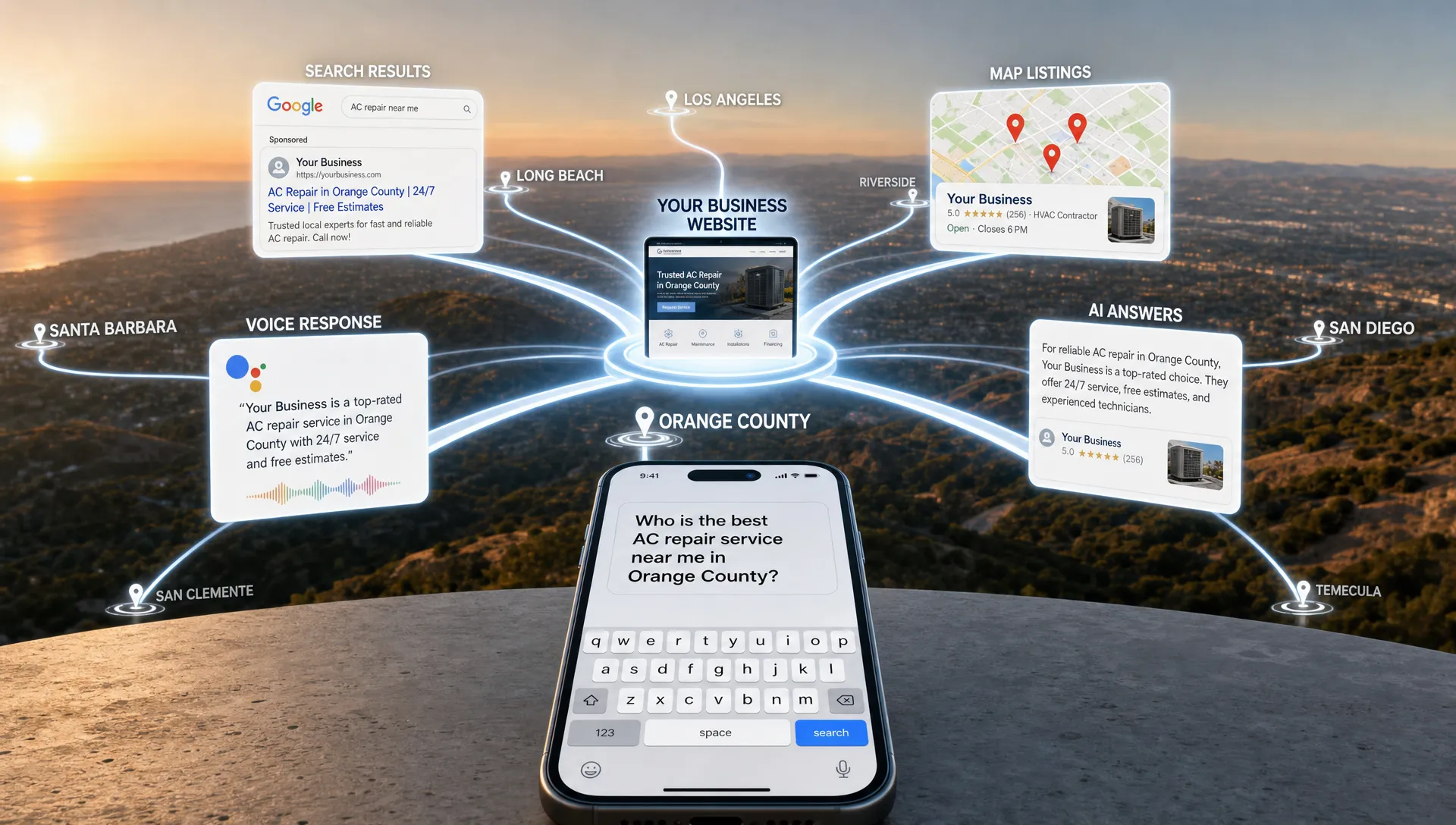
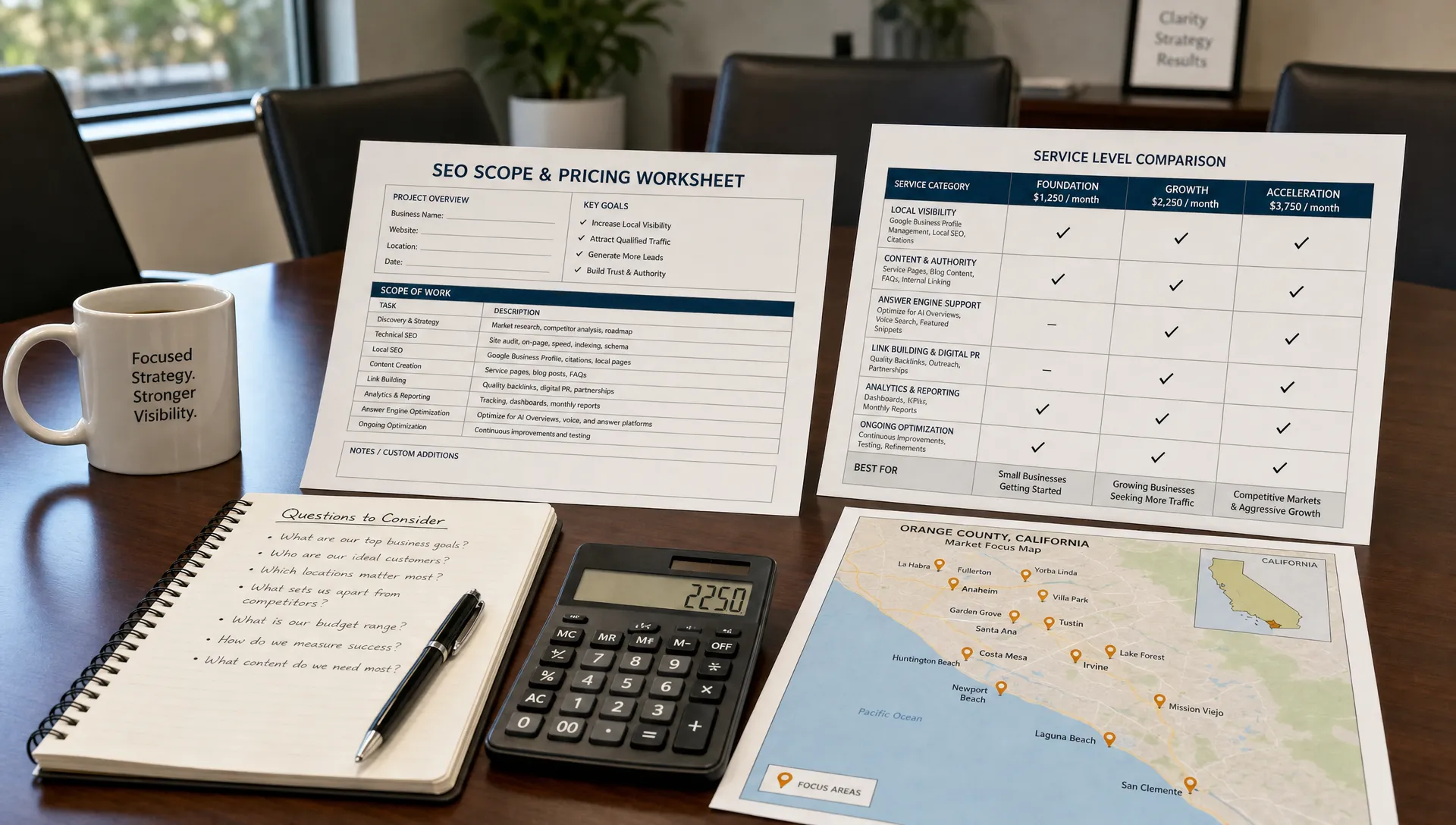
 San Diego is home to more than 1.4 million residents and thousands of competing service businesses. HVAC companies, med spas, law firms, and contractors all chase the same local customers. Referrals and repeat business only go so far before the pipeline runs dry. The way people find those businesses has changed fast. AI tools like ChatGPT now account for 45% of local recommendation searches, up from just 6% a year ago. A lead generation partner has to work across search, ads, and AI-driven discovery — not just Google's map pack. The options split into two camps. Lead platforms sell you direct inquiries — pay per lead or per contact. Agencies build the organic authority that makes the phone ring without an ad budget behind every call. Picking wrong is expensive either way. A paid platform with no follow-up system wastes spend on leads nobody calls back. An organic strategy with no local specificity can take months to show results. This guide covers the best of both, with real pricing and trade-offs for each San Diego option. What are the best lead generation companies in San Diego? Five options stand out for San Diego businesses. Kell Web Solutions builds organic lead flow through AEO, local SEO, and AI-powered outreach. LocaliQ runs paid lead volume at scale for home services companies nationwide. Power Digital brings San Diego-based growth marketing to consumer and lifestyle brands. Straight North specializes in B2B lead generation through SEO and paid search. Hibu bundles budget-friendly marketing packages for small, non-technical local businesses.
August 31, 2026
 Choosing an agency for SEO in 2026 is not just a marketing decision. For a contractor, medical group, dental practice, law firm, or multi-location service business, it can determine whether high-intent local customers find you, trust you, and call you before they ever compare three competitors. The challenge is that SEO has changed. Your prospects are still using Google, but they are also seeing Google Maps results, AI-generated summaries, voice assistant answers, review snippets, Local Services Ads, directory results, and recommendations from tools like ChatGPT and Perplexity. A modern agency for SEO has to understand all of those discovery paths, not just traditional blue-link rankings. That matters even more in California markets. Orange County, Los Angeles, San Diego, San Jose, Sacramento, Fresno, and the Inland Empire all have dense local competition. A plumber in Irvine, a roofer in Anaheim, an HVAC company in Laguna Niguel, and a dental practice in San Jose may all need SEO, but they do not need the exact same strategy. Why picking an SEO agency is different in 2026 In the past, many businesses chose an SEO provider by asking one question: can you rank us on page one? That question is no longer enough. Ranking still matters, but search visibility now includes the map pack, Google Business Profile results, AI Overviews, featured snippets, review platforms, local directories, answer engines, and conversion paths from mobile search. If your agency only reports keyword movement, it may miss the bigger question: are more qualified local buyers finding and contacting your business? Google Search Central continues to emphasize helpful, reliable, people-first content . That means thin city pages, generic AI-written blogs, and keyword-stuffed service pages are not a durable strategy. The best agencies build content around the real questions customers ask before they call, then support that content with technical clarity, local trust signals, reviews, and strong conversion design. If you want a deeper foundation before evaluating proposals, Kell Web Solutions has a companion guide on what search engine optimization really means in 2026 . The short version is this: SEO is now a system for visibility, trust, and conversion across the places where people and machines look for answers. Start by defining what winning means for your business Before you compare agencies, define the business outcome you actually want. More traffic is not always the answer. More low-quality calls can waste your staff’s time. More rankings in low-value cities may not move revenue. For a home services contractor, winning may mean more booked repair calls in Laguna Beach, more replacement estimates in Huntington Beach, or more commercial service inquiries in Irvine. For a professional practice, it may mean more qualified consultations within a specific driving radius of each office. Build a simple local revenue map before you talk to agencies: Your highest-margin services Your most important cities, neighborhoods, and service areas Your current best lead sources Your seasonal demand patterns Your average close rate by service type Your call handling and appointment booking process A good agency will ask about these details early. A weak agency will jump straight into rankings, backlinks, or blog volume without understanding how your business actually makes money. The 9-point scorecard for choosing an agency for SEO Use the following scorecard when you review proposals. You do not need every agency to be perfect in every category, but you should be concerned if an agency cannot explain how its work connects to local visibility, trust, and qualified calls. Because AI answers increasingly influence local discovery, it is also worth understanding how answer engine optimization wins local calls in 2026 before you sign a contract.
August 31, 2026
 If your paid leads are getting more expensive but your calendar is not getting stronger, the answer may not be a bigger ad budget. You may need an SEO agency to repair the visibility, trust, and conversion problems that ads are currently exposing. That is especially true for local service businesses in competitive California markets. An HVAC contractor in Irvine, a roofer in San Diego, a dental group in San Jose, or a law firm with offices across Orange County can all buy visibility for a short period of time. But if the business is weak in organic search, map results, reviews, website clarity, and AI-generated answers, every paid click has to work harder than it should. Ads are not bad. Paid search, Local Services Ads, and social ads can create fast demand when they are managed well. The problem starts when ad spend becomes the only engine keeping the phone alive. At that point, you are not building market authority. You are renting attention. Here are seven signs your next move should be hiring an SEO agency, not simply increasing ad spend. First, ask the real question: do you have a traffic problem or an authority problem? More ad spend helps when the core issue is reach. If your offer is strong, your website converts, your reviews are current, your Google Business Profile is healthy, and your organic visibility is already credible, ads can scale what is working. But many local businesses do not have a reach problem. They have an authority problem. Google has long stated that local rankings depend on relevance, distance, and prominence, and Google Business Profile guidance still reflects that foundation. In practical terms, this means the businesses that win local attention are not always the ones with the biggest ad budget. They are the ones that search systems can understand, trust, and match to the buyer’s intent. That foundation now matters beyond traditional search. In 2026, customers are also asking AI tools, voice assistants, map apps, and answer-style search results who to call. If your business is not described clearly across the web, if your service pages are thin, or if your neighborhood-level relevance is weak, you may be invisible even when you are spending heavily. For a deeper look at how nearby jobs are won organically, Kell Web Solutions explains the local foundation in its guide to local search engine optimization that wins nearby jobs . 1. Your cost per lead keeps rising, but your close rate is flat Rising lead costs are not automatically a sign your ads are failing. Competitive markets change. Seasonality matters. Auction prices rise when more contractors, practices, and franchises enter the same local search space. The warning sign is different: your cost per qualified lead increases while your booked jobs, consults, or case evaluations do not improve. This often happens when prospects click an ad, then compare you against competitors in organic results, map listings, reviews, and AI summaries. If a competitor appears more established, has stronger local content, shows up in multiple neighborhood searches, and has clearer proof of expertise, your ad becomes only the first touch. It does not close the confidence gap. For example, a Laguna Niguel homeowner searching for emergency AC repair may click a paid result, then check the map pack, reviews, and service page before calling. A San Jose patient comparing dental implant providers may read organic pages and reviews before booking. A business owner in Los Angeles may ask ChatGPT or Perplexity for local options before ever visiting a website. An SEO agency can diagnose whether paid traffic is leaking because of weak organic authority, poor local relevance, unclear service pages, or trust signals that lag behind competitors. More ad spend may generate more clicks, but it will not fix why buyers hesitate. 2. Your phone stops ringing the moment ads are paused If pausing ads immediately dries up the pipeline, your business is overly dependent on rented visibility. This is common in home services. A plumbing company may get calls from paid search when the campaign is active, but disappear from organic results for city and service searches. A roofing company may rank for its brand name but not for roof replacement in Huntington Beach, Irvine, or Anaheim. A multi-location practice may have one strong location page but weak visibility around nearby neighborhoods. A healthy local marketing system should have more than one source of demand. Paid ads can create speed, but organic search, map visibility, reviews, referrals, direct traffic, and answer engine visibility create resilience. Think of ad spend as acceleration. Think of SEO as infrastructure. If there is no infrastructure, every month starts from zero. An SEO agency helps build assets that keep working after the click budget is spent. These assets include service pages, location pages, Google Business Profile optimization, internal linking, content that answers buyer questions, technical improvements, and better entity signals across the web. The goal is not always to eliminate paid ads. The goal is to stop needing ads for every single opportunity. 3. You are missing from map results in the cities that actually pay you For local businesses, ranking somewhere is not enough. You need visibility in the places where profitable customers live, work, and search. A contractor based in Orange County may want jobs in Laguna Beach, Newport Beach, Irvine, Mission Viejo, and Huntington Beach. A remodeler in San Diego may care about coastal neighborhoods, inland suburbs, and high-value service areas. A medical or legal practice may need to win specific catchments around each office rather than an entire county. If your ads are targeting these areas but your organic presence is weak there, you are paying to enter markets where you have not built enough local proof. Signs of this problem include: Your Google Business Profile appears only for searches very close to your office. Your website has one generic service area page instead of useful city or neighborhood content. Competitors show up in the local pack for searches where you are buying clicks. Your reviews mention your company but not the services and locations customers search for. Your content sounds broad, even though your revenue depends on specific cities. This is where a local SEO strategy becomes more valuable than a bigger paid radius. Ads can target a location instantly, but organic prominence must be earned through relevance, reviews, content, citations, website structure, and consistent local signals. For California businesses, the difference can be significant. Showing up for solar installation in Riverside, emergency electrician in Fresno, or roof repair in Santa Ana requires more than a budget setting. It requires a local authority system. 4. You are getting clicks, but too many of them are the wrong calls Not all leads are equal. A campaign can look busy while quietly wasting money. If your team is fielding calls from people outside your service area, buyers looking for services you do not offer, price shoppers who are not a fit, or low-value requests that crowd out better opportunities, the problem may be message alignment. Paid ads often reveal this issue because they amplify whatever is already unclear. If your landing page says you serve all of Southern California but your best work is in coastal Orange County, you will attract broad demand. If your practice website lists every possible service but does not clarify specialties, insurance, case types, or appointment fit, you will get more unqualified inquiries. If your contractor site does not separate repair, replacement, maintenance, emergency service, and commercial work, searchers may not know whether to call. An SEO agency looks at how buyers search before they are ready to click. That includes question-based searches, comparison searches, service-specific searches, and location modifiers. Then your website can be structured to guide the right people to the right page. This improves paid performance too. When SEO and ads are aligned, ad traffic lands on pages that already match organic search intent. Buyers get clearer answers. Your team gets better calls. Your budget stops paying for confusion.
August 31, 2026
 Choosing an internet marketing agency in Orange County is no longer a simple question of who can “get you on Google.” For contractors, medical practices, dental groups, law firms, and other local service businesses, the right agency must help you win across Google Maps, organic search, reviews, paid visibility, AI answers, and the phone call that follows. That matters because Orange County is not a one-size-fits-all market. A plumbing company in Anaheim competes differently than a remodeler in Laguna Beach, an HVAC contractor in Irvine, or a dental group with offices in Huntington Beach, Santa Ana, and Mission Viejo. The agency you choose should understand those local differences and translate them into qualified appointments, not just website traffic. Below is a practical framework for evaluating an internet marketing agency in Orange County, especially if your revenue depends on local search, neighborhood trust, and high-intent leads. Start with the business outcome, not the marketing channel Many business owners begin by asking, “Do we need SEO, ads, social media, or a new website?” A better first question is, “What must marketing make happen for the business?” For a home services contractor, the outcome might be more booked service calls in profitable neighborhoods. For a law firm, it may be more consultations from a specific practice area. For a dental or medical group, it might be new patients within a tight driving radius around each office. A strong agency will ask about: Your highest-margin services Your ideal service areas Your current lead sources Your close rate and call handling process Seasonal demand patterns Whether you need immediate leads, long-term authority, or both If an agency jumps straight into a package without understanding your revenue model, that is a warning sign. The right plan for a roofer in San Clemente will not look exactly like the right plan for a multi-location dental practice in Irvine and Newport Beach. Look for Orange County market knowledge A national agency can run generic campaigns, but local market knowledge often determines whether those campaigns turn into profitable calls. Orange County contains coastal luxury markets, dense urban corridors, planned suburban communities, and highly competitive service areas within just a few miles of each other. For example, Laguna Beach searches often carry different expectations than searches in Anaheim, Santa Ana, or Garden Grove. Irvine and Newport Beach buyers may do more comparison research before contacting a provider. Huntington Beach, Costa Mesa, and Mission Viejo may require different content angles, review strategies, and service-area targeting. An experienced Orange County agency should be able to explain how it approaches location intent. That includes city pages, Google Business Profile optimization, neighborhood-level content, reviews, and the trust signals that help both search engines and buyers understand why your business is relevant in a specific area. If local SEO is a major part of your decision, review what a complete local strategy should include in this guide to Orange County SEO services . It gives you a useful baseline before you compare proposals. Make sure the agency understands AI search and answer engines Traditional SEO still matters, but it is no longer the whole picture. People now ask longer, more specific questions through Google AI results, ChatGPT, Perplexity, Gemini, and voice assistants. Instead of typing “roofer Orange County,” a homeowner may ask, “Who is the best roof repair company near Laguna Niguel for a tile roof leak?” That shift changes what your digital presence needs to do. Search engines and AI systems must be able to understand your business as a clear entity, connect your services to your geography, and verify your authority from multiple trusted signals. This is where Answer Engine Optimization, often called AEO, becomes important. AEO is not a replacement for SEO. It is an evolution of visibility strategy that focuses on whether your business can be selected, cited, or recommended as a trusted answer. When evaluating an agency, ask how it handles: Structured service and location information Clear expertise signals on your website Schema markup and machine-readable content Review and reputation signals Content that answers real buyer questions Consistency across your website, business profiles, citations, and supporting assets If the agency still talks only about keyword density and backlinks, it may not be prepared for how buyers are finding local businesses in 2026. Kell Web Solutions explains this shift in its approach to Answer Engine Optimization , which is especially relevant for businesses that need to be understood by both people and AI systems. Evaluate the agency’s local SEO fundamentals Even the most advanced AI search strategy will underperform if the local SEO basics are weak. Google states that local rankings are influenced by relevance, distance, and prominence, which means your business must be clearly matched to the search, geographically appropriate, and trusted enough to appear prominently. Google’s own guidance on improving local ranking is a useful reference point. A qualified internet marketing agency should have a process for improving all three areas. Relevance comes from accurate service descriptions, optimized pages, content that matches customer questions, and a well-maintained Google Business Profile. Distance is influenced by the searcher’s location and your business or service area, but smart local content can help clarify the neighborhoods and cities you serve. Prominence comes from reviews, citations, links, brand mentions, and real-world authority. Ask the agency to show how it will improve your visibility in Google Maps, organic search, and localized AI results. For many Orange County businesses, especially contractors and professional practices, map visibility can be as valuable as traditional rankings. Check whether the website is built to convert, not just rank A website that gets traffic but fails to generate calls is not a marketing asset. It is a leak in the revenue system. Your agency should evaluate the website from the customer’s point of view. Can visitors immediately understand what you do, where you serve, why you are credible, and how to contact you? Are calls and forms easy to use on mobile devices? Are service pages specific enough to answer buyer concerns? Do pages load quickly? Are reviews and proof visible at the right moments? For home services companies, conversion details can be especially important. Emergency repair pages, seasonal service pages, and city-specific pages should make it easy for a homeowner to take action. For medical, dental, and legal practices, the website must build confidence before the visitor ever calls. A polished design is helpful, but clarity is more important than decoration. The best agency will talk about messaging, trust, calls to action, mobile usability, and follow-up, not just colors and layouts. Use a scorecard to compare agencies objectively Agency proposals can be difficult to compare because each one uses different language. A simple scorecard helps you separate strategy from salesmanship.
August 21, 2026
 Is your website invisible to the AI your prospective clients are using to vet you? It's a fair question, and most Orange County business owners can't answer it. They've never actually asked ChatGPT or Perplexity what it says about their firm. Search used to mean links you could rank. Now it's a conversation, and AI decides who gets mentioned. G2's newest B2B buyer research found 51% of B2B buyers now start with AI chatbots, not Google. That's up from just 29% eleven months earlier — a massive swing in under a year. This isn't a fringe prediction anymore. Gartner projects that traditional search volume will drop 25% by 2026. That decline comes directly from AI chatbots replacing search queries. Gartner calls these tools "substitute answer engines." That shift didn't stay contained to software. Agencies, law firms, and medical practices are now researched by AI before a human ever visits. If you're not part of that conversation, you're not just losing clicks. You're losing the mention entirely. Owners in this position usually notice the symptom before they understand the cause. Referral volume looks fine, the website still gets occasional traffic, but new inbound inquiries have quietly slowed. That's often the first sign the AI conversation about your category is already happening — without you in it. This matters more for B2B and professional service firms than most businesses. Home services companies can still win a call through pure proximity. A law firm or consultancy has no such fallback once an AI shortlist forms without them. The gap between having a website and being an answer "Most OC businesses are losing leads because their brand is missing from AI-generated 'best-of' lists and conversational search results. We bridge the gap between their website and the LLM's understanding of their authority." — Gregg Kell, Founder, Kell Web Solutions There's a specific failure behind that quote, and it deserves a name. Call it the AI citation authority gap. It's the distance between what your website says about your firm and what a model actually believes. That belief surfaces the moment a prospect actually asks. A website is a document. An AI answer is a judgment. Google could always be tricked with the right keywords in the right places. Answer engines don't work that way. They synthesize an opinion from everything they can find about you. Then they decide whether you're worth mentioning by name. That's a much higher bar than ranking. Most Orange County B2B firms have never been measured against it. Nobody built a scorecard for this until recently. What AI platforms actually reward HubSpot's 2026 AEO research frames AI citation as consensus, not ranking. Answer engines don't crawl your site and stop. They cross-reference it against everything else they can find. That includes directories, review platforms, press mentions, and forums. Then they look for agreement across all of it. Entity consistency matters most. Does your name, address, pricing, and services match everywhere online? Inconsistent facts across your site and listings suppress citations. Structured content matters second. Clear headers and schema markup help a model extract facts accurately. Direct, answer-first writing helps too. Third is agentic readiness. That means machine-readable infrastructure like llms.txt and JSON-LD. It tells an AI crawler exactly who you are, instead of making it guess. Here's the uncomfortable part. A page outside Google's top five can still win the AI answer. That happens whenever it most directly answers what the user asked. Ranking and citation are no longer the same contest. Firms optimized purely for the old contest are flying blind in the new one. Prompts to AI look nothing like old search queries. That same research found average ChatGPT prompts run 23 words long. A typical Google search is just 3.37 words. Five signs your firm already has a citation authority gap Most owners can self-diagnose this in about ten minutes, before spending a dollar on any agency. A few patterns show up again and again among Orange County B2B and professional service firms that haven't looked yet. You've never checked. You've never typed your own category and city into ChatGPT to see who it names instead of you. Most owners assume they'd show up — most haven't checked. Your NAP data doesn't match. Name, phone, address, and services should read identically across your site, your GBP, and directories. No schema markup. Your site has no structured data, so a model has to guess facts it could otherwise extract with certainty. Thin third-party proof. Your only credibility signal is a handful of Google reviews — no press coverage, comparison articles, or industry citations backing you up. A competitor got there first. If a rival has invested in AEO and you haven't, the model already picked a side. It will keep recommending that side until your signals catch up. Any single one of these is fixable in an afternoon. Stacked together, they're what quietly kills a shortlist spot. None of these five signs require expensive tools. They require ten honest minutes and a willingness to look. See your firm the way a machine sees it, not the way you'd describe it. Why this hits professional service firms harder Home services businesses feel this shift through missed emergency calls. B2B and professional service firms feel it earlier — in the shortlist itself. That happens well before a prospect ever picks up the phone. Orange County agencies are already repositioning around this This shift isn't hypothetical in Orange County. Costa Mesa-based Intero Digital now sells a named "GEO" service. Irvine's Directive Consulting markets its own "DiscoverabilityOS" platform for exactly this problem. Neither is warning you the shift is coming. Both are already selling the fix to whoever notices first. That's the real cost of waiting to check your own visibility. Kell is positioned differently from both of them. AEO isn't a bolted-on service line here — it's the whole business. That focus is a meaningful difference in this comparison. Forrester's Buyers' Journey research found 92% of B2B buyers start with a vendor already in mind. 41% already have one preferred vendor before formal evaluation even begins. That preference used to form through referrals and conference badges. Now it increasingly forms through a five-second exchange with a chatbot. That compression makes the gap dangerous for OC's B2B and professional firms. Legal, accounting, consulting, and marketing firms sell trust before anything else. So do multi-location medical and dental practices. A prospect might ask an AI model, "Who's the best marketing agency in Orange County?" The model vouches for whichever firm it can verify, not necessarily the one that deserves it most. Picture a mid-size Irvine consulting firm with twenty years of results. Its website is a static page with no structured data. A three-year-old competitor next door has clean schema and real press mentions. Today, the newer firm is more likely to get named. Track record stopped being self-evident once AI started making the introductions. The risk compounds because AI doesn't just fail to mention you. It actively promotes whoever it trusts instead — often a competitor you didn't know was in the running. A 680-million-citation analysis found 73% of B2B buyers now use AI tools like ChatGPT and Perplexity. Yet only 22% of marketers track how their brand shows up. That 51-point spread is the citation authority gap, measured industry-wide. Every mention has a winner and a loser The G2 research above carries a second finding worth sitting with. Sixty-nine percent of B2B buyers switched vendors based on what a chatbot recommended. A third bought from a vendor they'd never heard of before. Read that again as a business owner, not a marketer. Every AI-driven recommendation is a zero-sum event. When a model can't verify your firm, it doesn't leave the answer blank. It cites the competitor whose signals were clear enough to trust. You don't just miss a lead — you hand it over. You hand it to whoever closed their own authority gap first. Trust signals matter here too. In the same G2 survey, 45% of buyers trusted review-site citations most. AEO isn't just a website exercise — it's an off-site reputation audit. Professional service firms have their own version of this signal. Certifications, bar admissions, and awards belong in structured markup, not just a page footer. A model can't cite credentials it can't parse. Multi-location medical, dental, and legal practices face an extra layer here. A model asked about a specific neighborhood has to pick one location to name. Practices with one strong "flagship" listing often lose their satellite offices. Those locations vanish from AI answers even when service quality is identical. Where to start if you want to check this yourself Before hiring anyone, run this audit yourself. Open ChatGPT and Perplexity and ask what a prospect would ask. Try your service, your city, and "who's the best." Read the answer closely. Note whether you appear, how you're described, and who appears instead. Next, pull up your Google Business Profile and your website's contact page. Add any directory listing you can find. Compare all three, line by line. From there, HubSpot's schema markup guide is a solid starting point. It adds the structured data most answer engines look for. It won't close the full gap alone, but it's the baseline everything else builds on. This isn't a one-time fix, either. Entity signals drift as directories update and content ages. Most firms recheck this audit every quarter. Closing the gap: what becoming an AI-cited authority actually requires Kell Web Solutions built its AEO service around exactly this problem. It's the same shift founder Gregg Kell has tracked for two decades in Orange County. The goal isn't to chase another ranking algorithm. It's to become the entity an AI model trusts enough to name. Kell's philosophy leans into durability on purpose. The goal is compounding authority, not a short-term ranking spike. Spikes fade the moment an algorithm updates — entities don't. Founder Gregg Kell wrote a book on exactly this problem. It's called "The Invisible Expert," and it's downloadable from Kell's site. That background shapes the whole AEO methodology. That work breaks into three outcomes worth understanding first. First, recognition: AI platforms need to identify your firm as an authority. Not a generic entry in a directory. Second, citation: earning a real mention when a prospect asks a local question. That's the exact moment an AI model is trying to answer. Third, protection: building signals strong enough that competitors can't quietly displace you. That displacement often happens in a recommendation you never see. Kell's AEO service runs a five-step process to get there. It maps how customers phrase questions, then audits current AI visibility. From there it restructures the site and builds durable authority signals. It's sold in three tiers, from AEO Essentials up through AEO Elite . Elite layers in advanced schema and full agentic-readiness infrastructure. Pricing here is published, not hidden behind a "contact us" form. AEO Essentials starts at $500 setup plus $500 a month. AEO Elite runs $1,000 setup plus $2,500 a month. Multi-location practices often pair that work with Local SEO Mastery. It keeps every branch's citation data consistent — the exact weak point above. It's smaller and more foundational, and it often comes first. Scale is deliberately part of the pitch, too. Larger agencies often bolt AI-search language onto existing SEO retainers. They tend to route clients to account teams instead of founders. Kell stays boutique on purpose. AEO clients work directly with founders Gregg and Debbie Kell. That's a real difference while the strategy is still evolving monthly. Kell also integrates with GetAiRefs' Share of Answer scoring. That measures how often a client is actually cited across target queries. It turns "are we visible to AI" from a guess into a tracked number. For more on how the click itself is changing, see Kell's piece on when AI takes the click . None of this replaces good client work or a strong reputation. It translates that reputation into a form AI platforms can verify. Then it repeats that back to a prospect who's never heard of you. What it looks like when the gap closes Closing this gap looks different from a typical SEO win. Rankings might not move at all in the short term. Citations do — inside ChatGPT, inside Perplexity, inside Google's AI Overviews. A prospect asks the same question they always asked. This time, your firm is part of the answer. That's the entire goal of AEO, stated plainly. Frequently asked questions What does it mean to be a "cited entity" rather than just an indexed website? An indexed website simply exists in a search engine's database. A cited entity is different — it's a business an AI model trusts enough to name. That happens unprompted, without the user searching for you by name. Can a well-designed website still be invisible to ChatGPT or Perplexity? Yes, and it happens constantly. Visual design has no bearing on whether a model trusts your entity signals. A beautiful site with inconsistent data and no schema can still be invisible. How is this different from just ranking low on Google? Ranking low means you're on page three of a shrinking results list. Being outside the citation set is worse. The AI answer was generated and delivered without your firm ever entering consideration. How do B2B and professional service firms specifically get displaced by AI recommendations? A prospect asks an AI model to compare options in your category. The model surfaces whichever firms have the clearest, most corroborated entity signals. That's often a smaller competitor with sharper AEO work, not the more established firm. What is a "Share of Answer" score? It's a metric tracking how often your business is cited across defined AI queries. Think of it like share of voice, but for AI answers. Kell Web Solutions tracks this through its GetAiRefs integration. How long does it take to close an AI citation authority gap? There's no universal timeline. It depends on how fragmented your current entity signals are across the web. Most engagements show measurable gains within a few months. Authority compounds the longer your signals stay consistent. The bottom line The businesses winning the next decade of Orange County search won't necessarily be the ones with the biggest ad budgets. They'll be the ones an AI model trusts enough to recommend without being asked twice. That's the shift Orange County can't afford to ignore. That trust doesn't build itself, and it doesn't show up in a standard SEO report. It has to be engineered deliberately, tracked, and defended as competitors start doing the same work. For agency owners and professional practices watching referrals slow with no clear explanation, this gap is very often the reason. Stop wondering why the leads have gone quiet. Find out exactly how your brand appears to the machines making these decisions. A short strategy call is enough to see where the gap sits. Claim Your AI Visibility Audit before a competitor closes their gap first.
August 21, 2026
Digital marketing, SEO, and local growth are no longer separate conversations. For a local contractor, medical group, dental office, or law firm, digital SEO is the system that helps the right nearby customer find you, understand why you are credible, and take the next step before a competitor wins the call. That matters more in 2026 because local buyers are not only typing short keywords into Google. They are asking map apps, voice assistants, AI answer engines, and review platforms for recommendations. A homeowner in Irvine might ask who can repair an AC unit today.  A family in San Diego might compare dental providers near a specific neighborhood. A property owner in Anaheim might ask which roofing company handles tile roofs and insurance documentation. Your business has to be understandable in all of those moments. Digital SEO, when done well, is not about chasing rankings for vanity. It is about creating a reliable growth path from visibility to trust to calls, consultations, estimates, and booked work. Digital SEO is not a new label for old SEO Traditional SEO still matters. Search engines need crawlable pages, clear titles, relevant content, internal links, fast loading experiences, and technically sound websites. Google still publishes basic expectations through Google Search Essentials , and local businesses ignore those fundamentals at their own risk. But digital SEO for local growth is broader than classic keyword optimization. It connects five parts of your online presence: Your website, including service pages, location pages, schema, calls to action, and proof Your Google Business Profile, including categories, services, reviews, photos, updates, and accurate NAP information Your content, including answers to the real questions customers ask before they call Your reputation signals, including reviews, testimonials, case examples, and consistency across the web Your answer readiness, meaning how clearly AI systems and search engines can identify your business as a trusted local entity In other words, digital SEO is not just helping people find a page. It is helping search systems and customers understand your business well enough to choose you. For a local company in Orange County, that can mean the difference between being one more name in a crowded search result and becoming the obvious answer for a specific service in Laguna Beach, Laguna Niguel, Irvine, Huntington Beach, Anaheim, or Santa Ana. Why local growth depends on being understood Local customers do not search in neat keyword lists. They search with urgency, context, and uncertainty. A homeowner does not simply search for HVAC. They ask whether a unit can be repaired, how fast someone can arrive, whether the company serves their neighborhood, how much experience the company has with their system, and whether other local customers trust them. A patient does not simply search for dentist. They compare insurance, location, reviews, specialties, appointment availability, and whether the practice feels credible. That is why local SEO cannot stop at ranking a homepage. Your digital presence has to answer the unstated questions behind the search: