Orange County's New SEO Secret: Zero Net Cost Authority Building for Home Service Pros
Orange County Contractors’ Proven Blueprint for Zero Cost SEO Authority, Voice Search Domination, and AI-Driven Local Lead Generation
Key Takeaways
- Orange County contractors can leverage zero net cost SEO strategies to transform missed calls into sustainable marketing budgets while building lasting online authority.
- Traditional SEO is becoming obsolete with Google AI Overviews now appearing in 40.2% of local business searches, fundamentally changing visibility for home service businesses.
- Contractors implementing zero net cost authority building are booking 8-12 additional jobs monthly within the first quarter through improved lead capture and AI-resistant strategies.
- The convergence of zero net cost marketing and Generative Engine Optimization creates an unprecedented opportunity while competitors struggle with costs reaching $60+ per call.
- Kell Solutions' Zero Net Cost Hyper Local Authority Builder offers Orange County contractors a framework to dominate both traditional search results and emerging AI platforms.
The Hidden SEO Crisis Facing Orange County Home Service Businesses
There's a seismic shift happening in how Orange County homeowners find contractors, and most business owners don't even realize it. Behind the scenes, artificial intelligence has quietly revolutionized search, creating an existential threat for home service providers still relying on traditional SEO strategies.
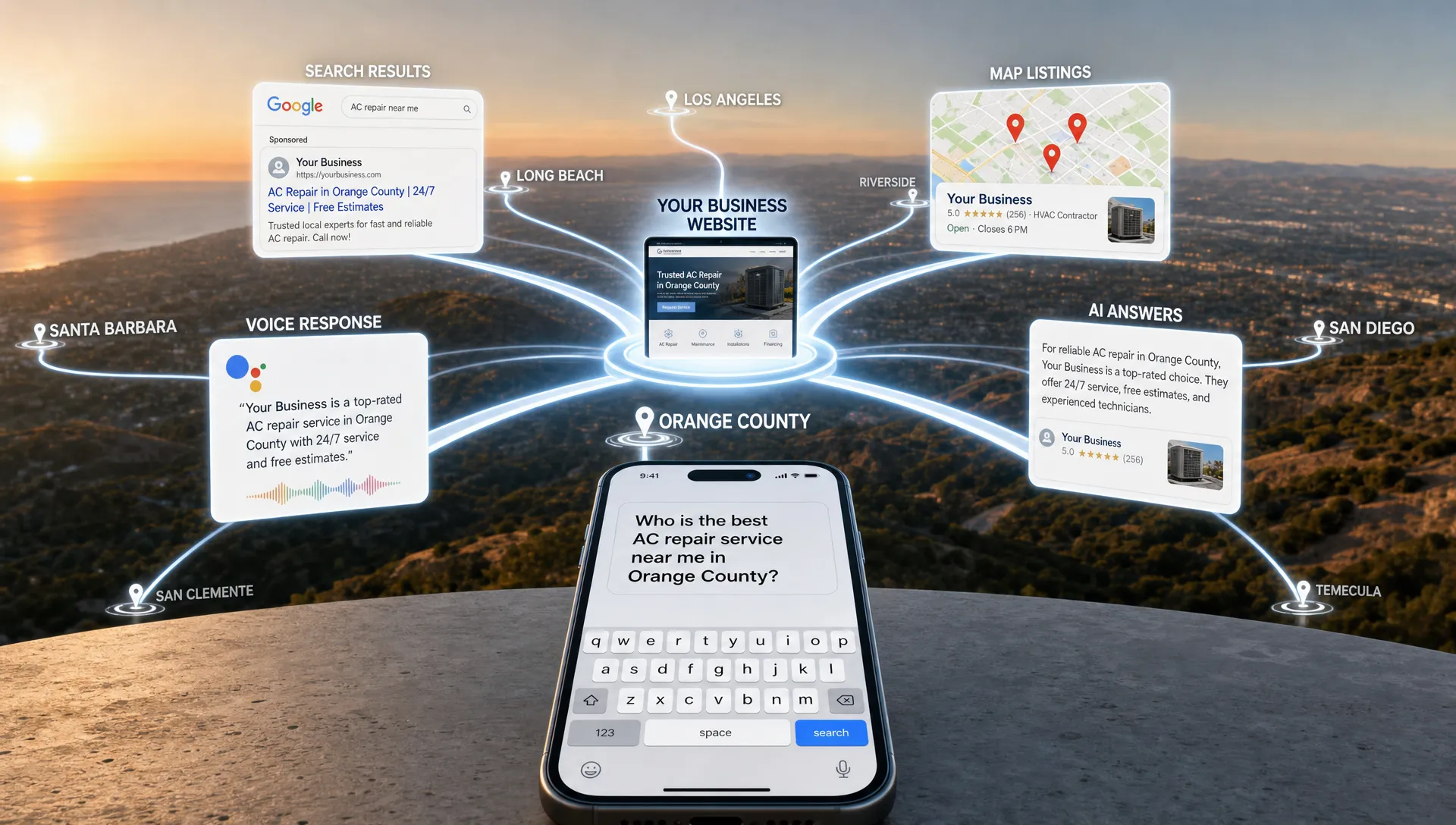
When a homeowner in Newport Beach or Irvine needs an emergency plumber, they're increasingly turning to AI assistants like Google's Search Generative Experience (SGE) or ChatGPT. These tools don't just display search results—they directly answer questions and make recommendations, often bypassing contractor websites entirely. For local businesses, this represents both unprecedented danger and opportunity.
The data paints a concerning picture: traditional organic search traffic is down 15% year-over-year across all industries, while 40.2% of local business searches now display AI-generated overviews rather than traditional website links. In this rapidly evolving landscape, contractors who adapt quickly to these changes stand to capture significant market share while their competitors struggle with diminishing returns on conventional marketing investments.
Why Traditional SEO No Longer Works for Local Contractors
The playbook that built successful contractor businesses online for the past decade is rapidly becoming obsolete. Traditional SEO focused on optimizing websites with keywords, building backlinks, and climbing search rankings. Today, those strategies alone leave businesses increasingly invisible to potential customers.
Rising Local Services Ad Costs (Now $60+ Per Call)
Google's Local Services Ads (LSA) program once offered contractors an affordable way to appear at the top of search results. Now, these same ads routinely cost $60 or more per qualified call in competitive Orange County markets. The math has become unsustainable—with typical conversion rates, contractors often pay $180-300 to acquire a single customer through paid channels.
This cost inflation has created a critical breaking point for many home service businesses. When marketing expenses consume 15-20% of revenue, profitability suffers dramatically. What makes this situation particularly concerning is that these costs represent perpetual expenses rather than investments—stop paying, and the visibility immediately disappears. For more insights, explore the strategic shift from expensive ads to self-funding authority systems that many businesses are adopting.
AI Search Engines Bypassing Contractor Websites
The most dramatic shift in local search is how AI-powered search engines now bypass traditional websites altogether. When homeowners ask questions like "Who's the best plumber in Anaheim?" or "How much should HVAC replacement cost in Irvine?", they're increasingly presented with direct answers extracted from various sources rather than website links.
Google's AI Overviews appear on billions of searches every month—covering at least 13% of all search results pages. For Orange County contractors, this fundamentally changes the visibility equation. Traditional websites optimized for keywords alone are frequently ignored by AI systems that prioritize content demonstrating expertise, experience, authority, and trustworthiness (E-E-A-T).
The AI Visibility Crisis in Numbers:
• 40.2% of local business searches now display AI Overviews
• 85% of missed calls never call back
• 15% year-over-year decline in traditional search traffic
• 60% of emergency service opportunities missed by contractors not optimized for voice search
15% Drop in Traditional Search Traffic
Even more concerning for Orange County contractors is the documented 15% drop in traditional search traffic. This decline isn't temporary—it represents a fundamental shift in consumer behavior as homeowners increasingly rely on AI assistants and voice search to find local services.
The contractors who continue investing exclusively in traditional SEO tactics are effectively trying to optimize for a shrinking audience. Meanwhile, forward-thinking home service businesses are redirecting their strategies toward building AI-resistant authority that works across both traditional and emerging search platforms.
This market disruption creates an unprecedented opportunity for agile local businesses ready to adapt. While competitors struggle with declining visibility and rising costs, contractors who implement AI-proof authority building systems are capturing more leads at significantly lower acquisition costs.
Zero Net Cost Authority Building: The New Competitive Edge
Zero net cost authority building represents a paradigm shift in how Orange County contractors approach online visibility. Unlike traditional marketing that functions as a perpetual expense, this approach transforms marketing from a cost center into a self-funding asset that appreciates over time.
The foundation of this strategy lies in systematic lead capture improvement combined with referral generation systems that offset initial investments. By implementing proper tracking, Orange County contractors discover that they're missing 30-40% of potential revenue opportunities through inefficient lead handling alone. Recapturing these missed opportunities creates the funding mechanism that powers ongoing authority building.
How Authority Building Differs From Traditional SEO
Traditional SEO focuses on manipulating signals to improve website rankings for specific keywords. Authority building instead creates a comprehensive digital presence that demonstrates expertise and reliability across multiple platforms and formats. This distinction becomes critical in an AI-dominated search landscape where algorithms increasingly evaluate businesses on their overall credibility rather than keyword optimization alone.
The most effective authority building systems combine on-site optimization with distributed content networks that reinforce expertise across the web. When AI engines like Google's SGE evaluate a contractor's authority, they consider signals from dozens of sources beyond the primary website. Contractors who systematically build this distributed authority network become virtually unbeatable in both traditional and AI-driven search environments.
The Referral-Based Funding Model That Eliminates Marketing Costs
The "zero net cost" component comes from implementing systematic referral generation that offsets initial marketing investments. Data shows that satisfied customers in Orange County will provide an average of 2.7 referrals when prompted through properly timed, automated systems. Each referral represents new business acquired at zero marginal cost, effectively transforming marketing from an expense into a self-funding engine.
Systematic tracking reveals that Orange County contractors using complete zero net cost packages book 8-12 additional jobs monthly within the first quarter. This increase stems from improved lead capture, better local search visibility, and AI engine citations that establish authority. The compounding effect means that by month six, many contractors achieve completely self-funding marketing systems that continue generating leads with no additional investment.
Building Digital Assets That Appreciate vs. Ads That Disappear
Perhaps the most powerful distinction between zero net cost authority building and traditional marketing lies in the longevity of the investment. Paid advertising disappears the moment you stop funding it. Authority assets, conversely, continue working for years with minimal maintenance, creating compounding returns on the initial investment.
Forward-thinking Orange County contractors are building comprehensive authority networks that include owned media (websites, blogs), earned media (reviews, testimonials), and shared media (social proof, community engagement). These assets form a protective moat around their businesses that becomes increasingly difficult for competitors to overcome, regardless of how much they spend on advertising.
5 Core Components of AI-Proof Local Authority
1. Geo-Targeted Feeder Websites
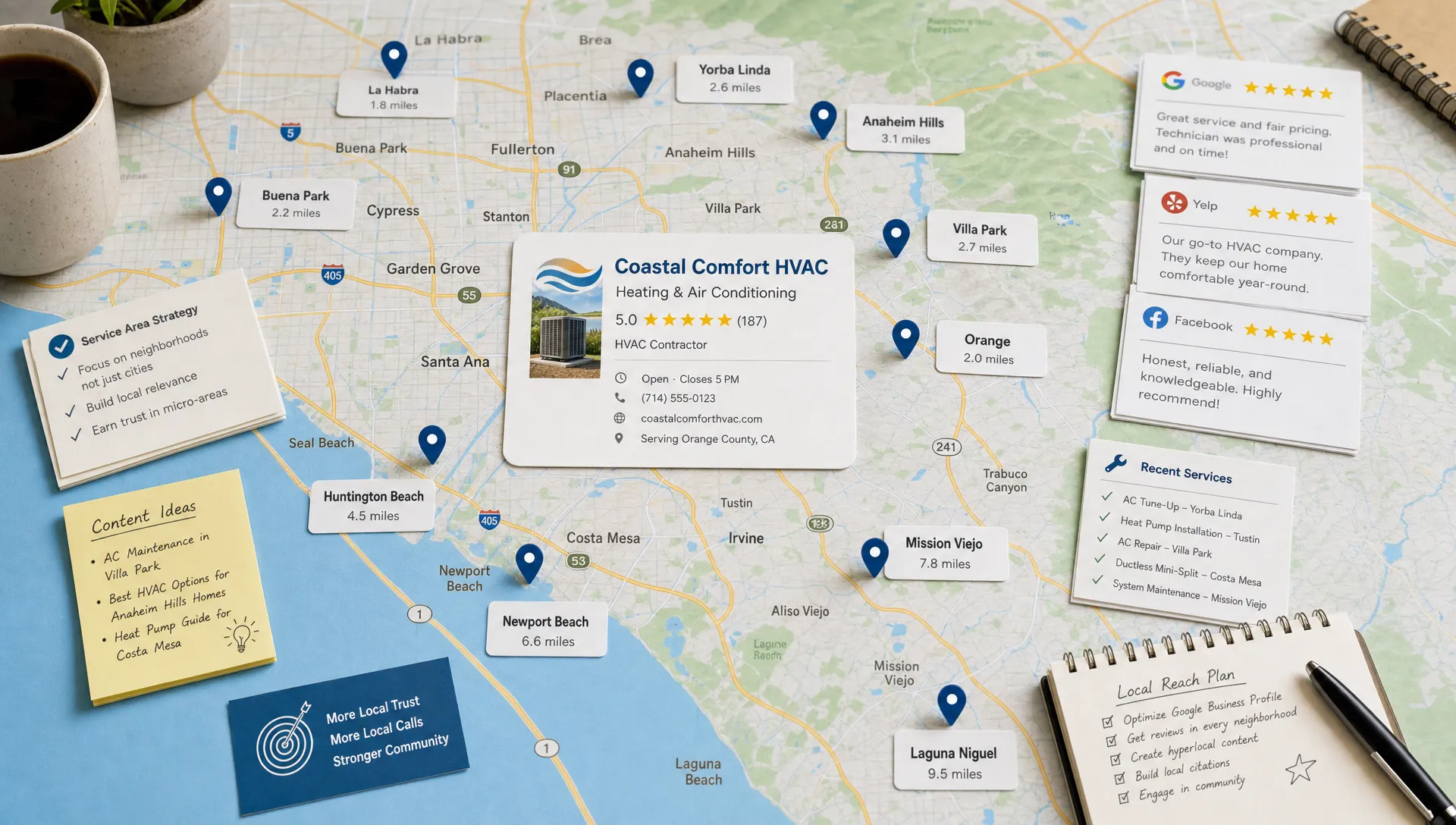
Geo-targeted feeder websites represent specialized digital assets that target specific service areas or neighborhoods throughout Orange County. Unlike traditional service pages, these micro-sites address hyperlocal concerns and considerations that differ between communities like Newport Beach, Anaheim, or Irvine.
These feeder sites serve multiple strategic purposes in the authority building ecosystem. They create additional digital real estate that can rank for location-specific search terms, they provide citation opportunities for AI engines looking for community-specific expertise, and they capture traffic that might otherwise go to competitors focusing solely on broad geographic terms.
The most effective implementation connects these feeder sites through a hub-and-spoke model, where the main contractor website serves as the authoritative center while neighborhood-specific sites address granular concerns. This architecture creates multiple entry points for potential customers while reinforcing the business's overall authority across Orange County.
2. Hyperlocal Content Creation
Hyperlocal content represents the most effective defense against AI search disruption. This content strategy focuses on creating highly specific, community-oriented information that addresses unique homeowner concerns while positioning contractors as local experts. Instead of generic service descriptions, effective hyperlocal content anticipates and answers specific questions that Orange County homeowners ask AI assistants, establishing the contractor as the authoritative local source.
3. Voice Search Optimization
Voice search has fundamentally changed how emergency services are discovered. When an Irvine homeowner has a burst pipe at 2 AM, they're likely to ask Siri or Google Assistant for immediate help rather than typing a search query. Contractors who optimize for these conversational queries capture high-value emergency service calls that competitors miss.
Effective voice search optimization requires understanding the natural language patterns used in different Orange County communities. The questions a Newport Beach homeowner asks about air conditioning repair differ significantly from those in Santa Ana, both in terminology and context. Contractors who systematically map and address these conversational patterns across their digital assets establish themselves as the default emergency option in their service areas.
4. Review Management Systems
Reviews have evolved from a nice-to-have marketing element to a critical authority signal that directly impacts AI engine recommendations. Modern review management systems go beyond passive collection to implement systematic review generation, strategic response protocols, and sentiment analysis that identifies opportunities to improve service delivery. The most effective systems create a continuous feedback loop that both enhances visibility and provides actionable business intelligence.
5. Structured Data Implementation
Structured data has become the critical bridge between traditional websites and AI search engines. By implementing comprehensive schema markup, contractors provide AI systems with machine-readable information about their services, service areas, pricing models, and expertise credentials. This technical implementation dramatically increases the likelihood of being featured in AI Overviews and voice search results.
Orange County contractors must implement LocalBusiness schema, Service schema, and Review schema at minimum to ensure AI engines can accurately extract and cite their information. Those who extend structured data implementation to include FAQ schema, HowTo schema, and ProfessionalService schema establish themselves as comprehensive information sources that AI engines preferentially cite when answering homeowner questions.
The Math Behind Zero Net Cost Marketing
Understanding the financial mechanics behind zero net cost SEO reveals why this approach is revolutionizing how Orange County contractors approach marketing. Traditional marketing operates as a continuous expense that drains resources, while zero net cost authority building transforms these expenses into self-funding assets through systematic referral generation and missed opportunity capture.
The math is compelling: for every 10 calls a contractor receives, approximately 3-4 represent missed opportunities due to inefficient handling, poor follow-up, or inadequate systems. By recapturing just these missed opportunities, contractors generate enough additional revenue to fund comprehensive authority building systems. The remaining growth comes through improved visibility and strategic referral generation.
Traditional Marketing Costs for Orange County Contractors
The status quo for Orange County home service businesses typically involves allocating 10-15% of revenue to marketing expenses that never stop. This creates a perpetual cost center that drains profits without building lasting assets. In competitive markets like Newport Beach or Irvine, contractors often pay $60+ per qualified call through Google's Local Services Ads, with similar costs for traditional PPC campaigns.
This traditional approach means that acquiring a single new customer often costs $180-300 when factoring in typical conversion rates. For services with average ticket values under $1,000, these acquisition costs make profitability nearly impossible. Even worse, these expenses represent temporary visibility that disappears the moment funding stops.
Value Recovery Through Missed Call Capture
The foundation of zero net cost marketing begins with systematic tracking and improvement of lead handling processes. Comprehensive analysis reveals that 85% of missed calls never call back, representing a massive revenue leak for most contractors. By implementing dedicated systems to capture, follow up, and convert these previously lost opportunities, contractors generate immediate revenue that funds ongoing authority building.
This recovery mechanism provides the initial financial engine that powers the transition from traditional marketing to authority building. For many contractors, this step alone generates enough additional revenue to completely offset their marketing investments within 60-90 days. The systematic approach ensures that this isn't a one-time improvement but a continuous optimization process.
How 3 Referrals Creates Complete Cost Elimination
The final component that achieves true zero net cost status comes through systematic referral generation. Data from Orange County contractors reveals that satisfied customers will provide an average of 2.7 referrals when prompted through properly structured systems. Since these referrals have a 60% higher conversion rate than standard leads and zero acquisition cost, they represent pure profit potential.
With a properly implemented referral system, just three completed jobs typically generate enough additional business to completely offset ongoing authority building investments. This creates a self-perpetuating cycle where each new customer funds the acquisition of future customers through referral generation rather than additional marketing expenses.
Implementation Timeline: First 90 Days to Authority
Month 1: Foundation Building
The first 30 days focus on establishing the technical infrastructure and systems necessary for sustainable authority building. This begins with comprehensive tracking implementation to identify missed opportunities, followed by optimization of Google Business Profile listings and structured data implementation. The initial phase also includes setting up systematic review generation processes and creating the core content framework that will power ongoing authority growth.
Most contractors see immediate improvements during this foundation phase as simple optimization efforts capture previously missed opportunities. These quick wins provide both confidence in the approach and initial funding for more comprehensive authority building activities. By the end of month one, contractors typically recover 30-40% of previously missed leads through improved systems alone.
Month 2: Authority Expansion
The second month focuses on expanding digital footprint through strategic content creation and distribution across multiple platforms. This includes launching geo-targeted feeder websites for key Orange County communities, implementing voice search optimization for emergency services, and establishing the citation network that reinforces local authority. Systematic review generation begins producing consistent social proof while AI-optimized content starts appearing in search engine knowledge panels.
By mid-month two, most contractors begin seeing significant improvements in visibility across both traditional search and AI-powered platforms. The referral generation systems activate during this phase, creating the initial feedback loop that will eventually achieve zero net cost status. Enhanced tracking provides clear ROI measurement to guide ongoing optimization efforts.
Month 3: Referral Activation
The third month focuses on activating and optimizing the referral generation systems that create true zero net cost status. This includes implementing automated follow-up sequences, customer satisfaction monitoring, and strategic incentive programs that encourage satisfied customers to become advocates.
- Automated review solicitation at optimal timing points
- Satisfaction-triggered referral requests
- Community partnership activation for citation building
- AI-optimized content distribution across owned platforms
- Hyperlocal content expansion for remaining service areas
By the end of month three, most contractors achieve or approach zero net cost status as referral generation begins offsetting ongoing investments. The compounding effects of authority building become evident as visibility improves across both traditional search results and AI-powered platforms like Google's SGE.
This 90-day implementation timeline provides sufficient runway for Google's algorithms to process and validate the authority signals being created. The strategic sequencing ensures that each phase builds upon previous work while generating enough immediate returns to fund ongoing investments. Learn more about how Orange County contractors are adapting to these changes.
Case Study: Newport Beach HVAC Company's Transformation
A Newport Beach HVAC contractor facing rising marketing costs and declining lead quality provides a compelling illustration of zero net cost authority building in action. Before implementation, this established company was spending $12,000 monthly on Google Ads and Local Services Ads while experiencing a 23% year-over-year decline in organic visibility. Call tracking revealed they were converting just 42% of incoming leads to appointments, with no systematic follow-up for missed opportunities.
Within 90 days of implementing zero net cost authority building, their results transformed dramatically. Lead handling improvements alone increased their appointment setting rate to 68%, generating an additional $42,000 in monthly revenue from previously missed opportunities. Their systematic review generation produced 47 new five-star reviews, dramatically improving their visibility in local map results. Most importantly, their referral activation system began generating 11-14 additional high-quality leads monthly with zero acquisition cost, completely offsetting their ongoing authority building investment by month four.
Your Next Steps to Dominate Local Search
The transformation from traditional marketing to zero net cost authority building represents the most significant opportunity in Orange County contractor marketing today. While competitors struggle with rising costs and declining visibility, forward-thinking contractors can implement systems that eliminate marketing expenses while building appreciating digital assets. To explore how Kell Solutions' Zero Net Cost Hyper Local Authority Builder can transform your Orange County contracting business, schedule a personalized assessment to identify your specific opportunity gaps.
Frequently Asked Questions
As more Orange County contractors discover the power of zero net cost authority building, several common questions emerge about implementation, timelines, and compatibility with different business models. The following section addresses the most frequent concerns while providing practical guidance for contractors considering this approach.
These insights come from working with dozens of successful home service businesses throughout Orange County, from large HVAC companies to specialized plumbing contractors and remodelers. The principles apply across service categories, though specific implementation details may vary based on your unique business model.
How is zero net cost SEO different from free SEO services?
"Free SEO" typically means low-quality, templated work performed by agencies looking to upsell premium services. Zero net cost authority building is fundamentally different – it represents comprehensive, high-quality implementation that pays for itself through systematic opportunity capture and referral generation. Rather than cutting corners on quality, this approach focuses on creating self-funding systems that eliminate ongoing expenses, similar to the strategic shift in Orange County's contractor landscape.
The key distinction lies in the business model. Free SEO services provide minimal value while positioning for upsells. Zero net cost authority building delivers premium implementation while creating the financial mechanisms that offset these investments through improved lead capture and systematic referral generation. The end result is superior performance without the ongoing expense drain of traditional marketing approaches.
How long does it take to see results from authority building?
Most Orange County contractors see three distinct phases of results: immediate improvements from opportunity capture systems within 2-4 weeks, visibility enhancements across traditional search and local maps within 30-45 days, and zero net cost achievement through referral generation within 90-120 days. This progressive timeline ensures continuous improvement while generating enough immediate returns to fund ongoing implementation.
Will this work for any home service business in Orange County?
Zero net cost authority building works for established home service businesses with average ticket values of $500+ that currently receive at least 20 monthly incoming leads. The approach scales effectively across plumbing, HVAC, electrical, roofing, remodeling, and other specialty trades throughout Orange County. The key requirement is having enough existing customer flow to optimize lead capture and activate referral generation systems – startups typically need to establish initial customer flow before zero net cost status becomes achievable.
What happens if I can't generate 3 referrals?
Referral generation capability varies based on service quality, customer satisfaction, and implementation thoroughness. Contractors who struggle with referral generation typically have underlying service delivery issues that must be addressed. The systematic approach identifies these barriers through customer satisfaction tracking and provides remediation strategies that improve both service delivery and referral generation capability.
Even without optimal referral generation, most contractors still achieve significant ROI through improved lead capture and conversion systems alone. These components typically recover enough previously missed revenue to justify ongoing investments, with referral generation representing the final component that achieves true zero net cost status.
How does authority building protect against future AI search updates?
Authority building focuses on establishing fundamental trust and expertise signals that transcend specific algorithm implementations. By demonstrating comprehensive knowledge, local relevance, and customer satisfaction across multiple platforms, contractors create resilient digital assets that perform well regardless of how search engines evolve. This approach aligns perfectly with Google's stated E-E-A-T guidelines (Experience, Expertise, Authority, and Trust) that form the foundation of both current and future search algorithms.
The distributed nature of proper authority building provides natural protection against single-platform algorithm changes. While competitors who focus exclusively on manipulating specific ranking factors face constant volatility, authority-focused contractors build stable, appreciation digital assets that perform consistently across platforms and algorithm updates.
The landscape of search marketing has fundamentally shifted in 2025, and Orange County contractors are at the forefront of this transformation. With innovative strategies and a focus on self-funding authority systems, they are moving away from traditional, expensive advertising methods. This shift not only reduces costs but also builds a more sustainable business model for the future.