Future of Digital Marketing and E-commerce in 2025

Gregg Kell • October 10, 2024

By 2025, digital marketing and e-commerce will look vastly different than they do today, as new technologies and consumer behaviors reshape the landscape. Businesses are leveraging advancements in big data, predictive analytics, AI, and immersive technologies to deliver highly personalized experiences and connect with consumers in ways that were previously unimaginable. With the rise of new digital channels and an ever-growing online consumer base, the future of digital marketing and e-commerce will be defined by precision, personalization, and an emphasis on authentic engagement.


Use of Big Data and Predictive Analytics in Marketing


In 2025, data will be the backbone of all successful digital marketing strategies. Companies are investing heavily in big data and predictive analytics to better understand consumer behavior and anticipate future trends. By analyzing vast amounts of data from multiple sources—including website interactions, purchase histories, and social media engagement—marketers can uncover patterns and gain insights that help them make more informed decisions.


Predictive analytics enables businesses to identify potential leads, segment their audience more accurately, and tailor marketing campaigns based on predicted customer actions. For example, using predictive models, e-commerce platforms can forecast which products are likely to trend during specific seasons, allowing them to optimize inventory and marketing efforts accordingly. Predictive analytics also helps companies manage customer churn by identifying customers at risk of leaving and targeting them with personalized retention strategies.


This data-driven approach allows for real-time marketing, where campaigns can be adjusted instantly based on the latest consumer behaviors and preferences, resulting in more effective targeting and increased return on investment (ROI).


Personalized Customer Experiences through Digital Channels


Personalization will be at the forefront of digital marketing and e-commerce strategies in 2025. Consumers expect brands to understand their needs and preferences and deliver experiences that are tailored specifically to them. Advanced AI and machine learning technologies are enabling companies to create hyper-personalized experiences across multiple digital channels.


For instance, AI-driven recommendation engines can analyze user behavior to suggest products, services, or content that align with individual tastes. This level of personalization extends to email marketing, where dynamic content adapts to each recipient, ensuring that every message feels unique and relevant. Similarly, chatbots and virtual assistants are becoming more sophisticated, providing personalized support and product recommendations based on customer interactions and preferences.


Personalized experiences are not limited to online interactions. With the rise of augmented reality (AR) and virtual reality (VR), businesses can offer immersive shopping experiences that allow customers to virtually try on products, explore virtual showrooms, or customize products in real-time. These technologies bridge the gap between digital and physical shopping, making online shopping more engaging and enjoyable.


Role of Social Media and Influencer Marketing in Business Growth


Social media and influencer marketing will continue to play a crucial role in business growth in 2025. Social platforms are not just channels for brand promotion—they are powerful marketplaces where consumers discover new products, engage with content, and make purchases. Platforms like Instagram, TikTok, and YouTube have integrated shopping features, allowing users to buy products directly from posts or livestreams, making social commerce a key driver of e-commerce growth.


Influencer marketing, in particular, is evolving. Instead of relying solely on celebrity influencers, brands are collaborating with micro and nano-influencers who have smaller but highly engaged and niche audiences. This shift enables businesses to reach specific consumer segments more authentically. Influencers are also leveraging advanced analytics to better understand their audience and measure campaign performance, ensuring that brand collaborations are impactful and aligned with business objectives.


By 2025, the future of digital marketing and e-commerce will be shaped by the strategic use of big data, predictive analytics, and AI to deliver personalized customer experiences and drive business growth. Social media and influencer marketing will continue to evolve, providing brands with new ways to engage consumers and expand their reach. As technology advances and consumer expectations grow, businesses that embrace these trends and focus on authenticity, innovation, and personalization will be best positioned to succeed in the dynamic world of digital commerce.


FAQs


1. How is predictive analytics used in digital marketing?
Predictive analytics helps businesses forecast consumer behavior, optimize campaigns, and identify trends, leading to more effective targeting and increased ROI.


2. Why is personalization important in digital marketing?
Personalization ensures that marketing messages and experiences are relevant to individual consumers, enhancing engagement, satisfaction, and loyalty.


3. How are social media platforms driving e-commerce growth?
Social media platforms have integrated shopping features, making it easy for users to discover products, engage with content, and make purchases directly within the apps.


4. What is the role of influencers in digital marketing in 2025?
Influencers, particularly micro and nano-influencers, are key partners for brands seeking to reach niche audiences authentically, driving engagement and conversions.


5. How do AR and VR contribute to e-commerce?
AR and VR offer immersive shopping experiences, allowing customers to virtually try products or explore virtual showrooms, bridging the gap between online and in-store shopping.

June 18, 2026
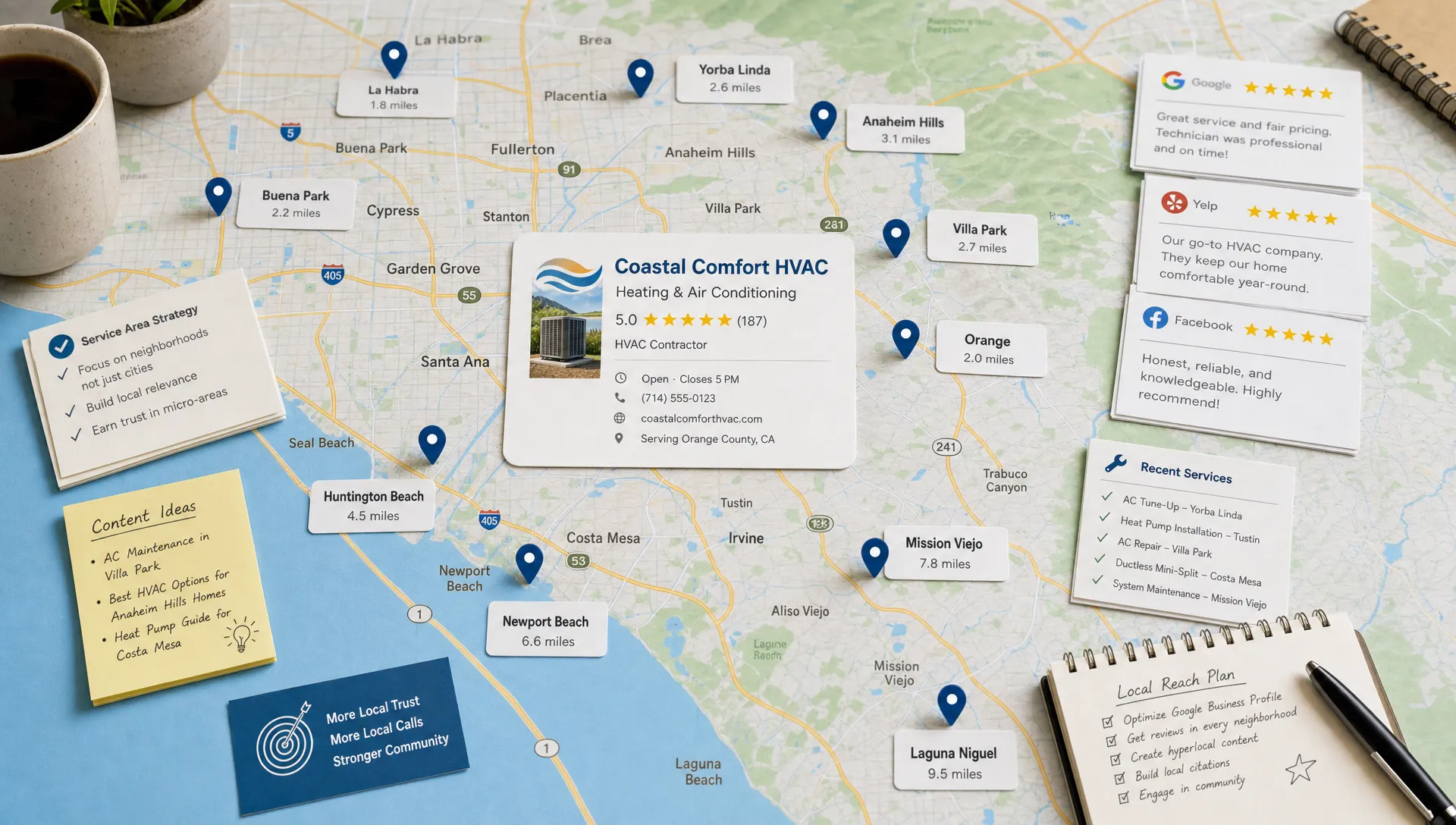
 Orange County is crowded with capable contractors. A homeowner in Irvine can compare five HVAC companies before lunch. A property manager in Newport Beach can ask Google, ChatGPT, or a voice assistant for a plumber without ever visiting a website. A remodeler in Laguna Beach may be judged by reviews, photos, and local proof before the first call happens. That is why local marketing for contractors has to be more precise than generic advertising. You are not trying to reach everyone in California. You are trying to become the obvious, trusted choice when someone nearby needs your exact service, in your exact service area, right now. For Orange County contractors, the best marketing ideas connect three things: local search visibility, neighborhood-level trust, and fast conversion into calls or estimate requests. Google’s local ranking guidance centers on relevance, distance, and prominence, and those same principles now influence how AI-driven search tools interpret which businesses deserve to be recommended.
June 18, 2026
The San Francisco Bay Area runs on booked meetings. From SoMa tech startups to Oakland professional services firms, growth depends on a full calendar. But most businesses waste more time chasing appointments than closing them.  The Bay Area's competitive market makes this worse. Prospects get dozens of outreach messages daily. Generic cold emails land in spam. Inbound alone rarely keeps a calendar full. You need a system — or an agency — that cuts through the noise. This guide covers the six best appointment booking agencies serving the San Francisco Bay Area. What are the best appointment booking agencies in the San Francisco area? The top options span two distinct models. Managed outreach services — like Kell Web Solutions — actively prospect and book qualified leads on your behalf. B2B appointment setting agencies use human SDRs and AI to book meetings for enterprise and growth-stage companies.
June 15, 2026
 A marketing firm can make a dashboard look busy. That is not the same as growing local revenue. For an Orange County contractor, revenue means booked HVAC jobs in Irvine, emergency plumbing calls in Huntington Beach, roof replacement estimates in Anaheim, and remodel consultations in Laguna Niguel. For a multi-location dental, medical, or legal practice, it means the right prospects choosing the right office within the right neighborhood catchment. That is why choosing between marketing firms in 2026 requires a different scorecard. Rankings still matter. Ads still matter. Websites still matter. But local buyers now move through Google Maps, AI Overviews, voice assistants, reviews, directory profiles, neighborhood content, and referral signals before they ever fill out a form. The right firm does not just “do marketing.” It builds a system that turns local intent into confident calls, consultations, and booked work. Below is a practical framework for choosing a marketing partner that is accountable to revenue, not vanity metrics. Start by defining what “local revenue growth” means Before you talk to agencies, define the business outcome you actually need. Too many local businesses start with a vague request like “we need SEO” or “we need more leads.” A stronger starting point is: “We need more qualified calls from homeowners in Newport Beach for high-margin HVAC replacement jobs,” or “We need more booked consultations for our Irvine and San Diego offices.” That distinction changes everything. A generic campaign might chase traffic from anywhere. A revenue-focused local campaign identifies the service lines, cities, neighborhoods, customer questions, and conversion paths that produce profitable work. Use a simple scorecard like this when evaluating proposals:
June 15, 2026
 A lower cost per lead can look good in a report and still hurt your business. If the phone rings with price shoppers outside your service area, renters who cannot approve the work, or patients and clients who do not match your intake criteria, the campaign is not efficient. It is simply cheaper noise. For California contractors and multi-location professional practices, the better goal is lowering cost per qualified lead . That means your digital advertising is not just generating clicks, calls, and forms. It is producing real opportunities: service calls, estimates, consultations, and appointments that fit your market, your margins, and your capacity. In Orange County, Los Angeles, San Diego, San Jose, Sacramento, and other competitive California markets, paid media costs can rise quickly because so many businesses are bidding on the same urgent local intent. The solution is not always to spend less. It is to make every dollar more selective, better tracked, and better supported by trust signals before the prospect ever calls. Start With the Metric That Actually Matters Cost per qualified lead is different from cost per lead. A generic lead is anyone who fills out a form, calls, chats, or books a slot. A qualified lead is someone who matches your service area, service type, urgency, budget range, and next-step criteria. The basic formula is simple: Cost per qualified lead = total ad spend ÷ number of qualified leads But the discipline behind the number is where most campaigns fail. If your ad platform counts every form fill as a conversion, it will optimize toward volume. If you teach the system which leads became booked estimates, consults, or revenue opportunities, it can optimize toward quality.
June 12, 2026
 Traffic is not the win. A ringing phone with the right person on the other end is the win. For California contractors and multi-location professional practices, website advertising has changed. Buying clicks is no longer enough, especially when AI answers, map results, Local Services Ads, and voice assistants can intercept the customer before they ever browse a traditional website. The businesses that grow are the ones that connect every visit to a clear next action: call, schedule, request an estimate, or start a qualified consultation. That means your website cannot function like a digital brochure. It has to work like a call-generation system, built around intent, trust, geography, and fast response. What website advertising should mean in 2026 Website advertising is often treated as traffic generation. A business runs Google Ads, posts on social media, optimizes a Google Business Profile, publishes a few service pages, and hopes the phone rings. That approach leaves too much to chance. A stronger definition is this: website advertising is the complete system that attracts the right local visitor, proves you are the right choice, and makes the next call feel obvious. For an HVAC company in Irvine, that may mean a visitor searching for same-day AC repair lands on a page that speaks directly to their city, urgency, equipment problem, and trust concerns. For a dental group in San Jose, it may mean a prospective patient comparing providers sees credentials, locations, accepted services, reviews, and a clear consultation path without having to dig. The difference between a visit and a qualified call usually comes down to four questions: Does the page match the visitor's exact problem? Does the visitor believe you serve their city or neighborhood? Does the page prove enough trust before asking for action? Does the call path remove friction and qualify the opportunity? When those pieces line up, traffic becomes revenue potential. When they do not, more advertising often just creates more waste. Why website visits fail to become qualified calls Most businesses do not have a traffic problem first. They have an intent and conversion problem. They attract visitors who are researching, browsing, outside the service area, comparing prices only, or uncertain whether the company handles their specific need. The website then makes the problem worse by giving every visitor the same page, the same generic message, and the same vague call to action.
June 12, 2026
 If you run a roofing company in Irvine, an HVAC business in Anaheim, a dental group in San Diego, or a law firm with offices across Orange County, internet advertising can feel both essential and frustrating. You can spend money, generate clicks, and still wonder why the phone is not ringing with the right prospects. The problem is rarely that advertising “doesn’t work.” The problem is that local businesses often buy visibility before they have built the strategy, tracking, trust signals, and follow-up systems needed to turn visibility into revenue. In 2026, the margin for error is smaller. Search results are more crowded. AI Overviews and voice assistants answer more questions before a user visits a website. Paid lead costs in competitive categories keep rising. For local contractors and multi-location professional practices, avoiding the wrong moves is just as important as choosing the right channels.