
Common Business Marketing Mistakes and How to Avoid Them for Professional Services Firms

Gregg Kell • October 7, 2024

In the competitive world of professional services, having a strategic marketing plan is essential for sustainable growth and long-term success. Whether you’re an accounting firm, legal consultancy, or specialized service provider, effectively reaching your target audience requires a precise and well-thought-out approach. Unfortunately, many professional services firms fall into common marketing pitfalls that can lead to wasted resources, missed opportunities, and underperformance.

In this blog post, we’ll explore some of the most frequent marketing mistakes made by professional services firms and provide actionable insights on how to avoid them. We’ll also introduce how solutions like ApptFlow 30—a service offered by Kell Web Solutions—can transform your marketing strategy by ensuring your investment is focused on what truly matters: high-quality, pre-qualified client appointments.


Mistake #1: Lack of Clear Marketing Goals and Objectives

One of the most common mistakes made by professional services firms is failing to set clear, measurable marketing goals and objectives. Often, companies invest in marketing without a well-defined plan, resulting in fragmented efforts that do not deliver the desired outcomes.

Why It’s a Problem: Without specific goals, it’s challenging to track progress or determine if your marketing strategy is effective. This can lead to confusion, frustration, and uncertainty about whether your investment is driving a positive return.

How to Avoid It: Begin by defining SMART goals—Specific, Measurable, Achievable, Relevant, and Time-bound. For example, instead of setting a vague goal like “increase client engagement,” set a goal such as “increase new client inquiries by 30% within the next six months.” This clarity will help you focus on what truly matters and enable you to measure your progress effectively.

Pro Tip: If your primary goal is to secure more client appointments, consider using a service like ApptFlow 30. ApptFlow 30 guarantees a set number of high-quality appointments within a defined period—such as 30 new client appointments in 30 days—giving you clear targets to work towards and ensuring that your marketing efforts result in meaningful client interactions.


Mistake #2: Inadequate Tracking and Analytics

Many professional services firms invest in marketing without properly tracking the performance of their campaigns. This results in a lack of understanding about what’s working and what’s not, making it difficult to optimize strategies and maximize results.

Why It’s a Problem: Inadequate tracking means you’re essentially operating blind. Without clear data, you can’t measure your return on investment (ROI), identify what strategies are most effective, or make data-driven decisions to improve outcomes.

How to Avoid It: Set up comprehensive tracking for all your marketing channels. Use tools like Google Analytics to monitor website traffic, track leads, and analyze user behavior. For paid ads, implement conversion tracking to measure how many leads turn into booked appointments or client consultations. Regularly review performance metrics and adjust strategies accordingly.

Pro Tip: ApptFlow 30 provides detailed reporting and analytics on each booked appointment, giving you a clear view of your ROI and enabling you to optimize your strategies for better results. With this data at your fingertips, you can make informed decisions to refine your marketing approach and drive sustainable growth.


Mistake #3: Relying Too Heavily on One Marketing Channel

It’s common for professional services firms to rely heavily on a single marketing channel, especially if it has delivered results in the past. However, depending too much on one channel, whether it’s email marketing, social media, or pay-per-click (PPC) advertising—can be risky.

Why It’s a Problem: Marketing channels evolve over time. Algorithm changes, increased competition, or shifts in user behavior can suddenly make a once-effective channel less productive. Over-dependence on one channel also limits your reach and prevents you from connecting with clients who may prefer other platforms.

How to Avoid It: Diversify your marketing strategy by using a mix of channels. Combine SEO, content marketing, PPC, social media, and email marketing to maximize your reach and effectiveness. A multi-channel approach ensures that if one channel underperforms, you have others to rely on, thus maintaining a consistent flow of leads.

Pro Tip: ApptFlow 30 helps reduce reliance on anyone marketing channel by providing a pay-per-appointment model. Instead of just paying for clicks or impressions, you pay for guaranteed client appointments, ensuring that your marketing investment is utilized effectively and delivering tangible results.


Mistake #4: Neglecting Online Reputation Management

Your online reputation is a crucial factor in attracting new clients and establishing credibility in the professional services industry. Many firms underestimate the influence of client reviews, testimonials, and feedback on their brand image and client acquisition.

Why It’s a Problem: A single negative review or a lack of positive online presence can deter potential clients from choosing your services. Prospective clients often research providers online before booking appointments, and a poor reputation can make it challenging to compete in the market.

How to Avoid It: Actively manage your online reputation by encouraging satisfied clients to leave reviews on platforms like Google, LinkedIn, and other industry-specific review sites. Respond promptly and professionally to both positive and negative feedback. Use testimonials and case studies to showcase your expertise and build trust with potential clients.

Pro Tip: ApptFlow 30 includes automated follow-up sequences that ensure no opportunity to collect valuable client feedback is missing. By systematically gathering positive reviews and addressing concerns, you can enhance your online reputation and create a stronger brand presence.


Mistake #5: Failing to Adapt to Market and Industry Changes

The professional services industry is constantly evolving. Client preferences, marketing trends, and competitive dynamics can shift quickly, making it crucial for firms to stay informed and agile in their marketing strategies.

Why It’s a Problem: Relying on the same marketing strategies year after year can lead to diminishing returns as new trends emerge and old ones lose relevance. Firms that fail to adapt may find themselves outpaced by more innovative competitors who are quicker to respond to changes in the market.

How to Avoid It: Continuously evaluate your marketing plan and be willing to experiment with new approaches. Stay informed about industry trends, attend conferences, participate in webinars, and network with other professionals to gain insights and remain ahead of the curve.

Pro Tip: By partnering with ApptFlow 30, you gain access to a team that stays up to date with the latest client acquisition strategies and industry trends. This enables your firm to remain competitive in a rapidly changing market and ensures that your marketing strategy evolves along with the industry.


 Mistake #6: Focusing Only on Short-Term Results

While it’s important to see immediate returns on your marketing investments, focusing solely on short-term gains can limit your firm’s growth potential. Many professional services firms concentrate on driving quick results, such as filling short-term appointments, without considering long-term brand building or client relationships.

Why It’s a Problem: A short-term focus can lead to aggressive marketing tactics that may alienate potential clients or damage your brand reputation. It also prevents you from building a sustainable client base and nurturing long-term relationships that can lead to higher client lifetime value (CLV).

How to Avoid It: Balance your marketing strategy by setting both short-term and long-term goals. Focus on strategies that build brand awareness, foster client loyalty, and position your firm as a trusted authority in your field. This includes content marketing, community engagement, and educational campaigns that provide ongoing value to your audience.

Pro Tip: ApptFlow 30 not only focuses on delivering short-term client appointments but also helps you build a strong foundation for long-term success by providing consistent, high-quality leads that align with your firm’s growth objectives.


Avoiding these common marketing mistakes can help your professional services firm achieve better results and sustained growth. By setting clear goals, tracking performance, diversifying your marketing efforts, managing your reputation, and staying adaptable, you can optimize your marketing strategy, reduce inefficiencies, and focus on delivering exceptional service while growing your practice.

To learn more about how ApptFlow 30 can support your marketing efforts and help you secure high-quality client appointments, visit Kell Web Solutions. With a well-rounded and strategic approach, your firm will be better positioned to attract more clients, improve ROI, and thrive in the competitive professional services industry.
 

June 22, 2026
 A homeowner in Laguna Niguel types “emergency AC repair near me.” A patient in Irvine asks Google for “best dentist open Friday.” A property manager in San Jose searches “roof leak repair commercial building.” In each case, the search engine is not simply matching words on a page. It is deciding which local business is relevant, close enough, trusted enough, and clear enough to recommend. That is the real working of search engine optimization for local business. SEO helps search engines understand your company, connect your services to real buyer intent, and present your business when someone nearby is ready to call, book, or request an estimate. For California contractors and multi-location professional practices, this matters because the search results page is no longer just ten blue links. It includes map packs, Google Business Profiles, reviews, AI summaries, paid ads, “people also ask” questions, voice results, and local service panels. If your business is not structured correctly, you may be invisible even when your services are exactly what the customer needs. How Search Engines Work Before a Customer Ever Calls Search engines perform three core jobs: discover information, understand it, and rank it for a specific question. Local SEO improves each of those jobs so your business becomes easier to find and easier to trust.
June 22, 2026
 Search engine optimization used to mean getting a website to rank higher in Google. That definition is no longer wrong, but it is incomplete. In 2026, search engine optimization means making your business easy for search engines, AI systems, map results, voice assistants, and real customers to understand, trust, and choose. Rankings still matter, but they are only one part of the job. The real question is whether your business becomes the obvious answer when a buyer asks for help. For an Orange County HVAC contractor, that might mean showing up when a homeowner in Irvine asks why the AC is blowing warm air. For a Laguna Niguel dental group, it might mean being trusted when someone searches for emergency dental care nearby. For a San Jose law firm or a San Diego remodeler, it might mean being visible across Google Maps, AI Overviews, local service searches, and answer engines before the prospect ever clicks through to a website. That is the new reality of SEO in 2026. The short definition of search engine optimization in 2026 Search engine optimization is the process of building a clear, credible, and technically accessible digital presence so the right customers can find and trust your business at the exact moment they need it. That means your website, Google Business Profile, reviews, local citations, structured data, content, service pages, and off-site authority all need to tell the same story. A modern search engine should be able to answer five basic questions about your business without confusion: Who are you? What services do you provide? Where do you provide them? Why should customers trust you? What should a qualified prospect do next? If any of those answers are unclear, incomplete, or inconsistent, search systems have less confidence in your business. In competitive California markets such as Orange County, Los Angeles, San Diego, San Jose, Sacramento, Fresno, and Irvine, that lack of confidence can quietly turn into lost calls. Why the old SEO definition is too small The fundamentals of SEO still matter. Google’s own SEO Starter Guide still emphasizes crawlable pages, useful content, descriptive titles, good site structure, and links that help users and search engines understand a site. But the way customers interact with search has changed. People no longer only type short keywords and scan ten blue links. They ask full questions. They use voice search. They compare providers in maps. They read reviews before calling. They see AI-generated summaries before they ever visit a website. That means SEO has expanded from ranking pages to managing digital trust. Search is now answer-driven A homeowner might search for best roofer near Huntington Beach after storm damage. Google may show a map pack, reviews, AI-generated guidance, local business profiles, and service pages. The winning company is not always the one with the most keyword repetition. It is the one that provides the clearest, most trustworthy answer across every surface. Search is now entity-driven Search systems need to understand your business as an entity, not just a collection of keywords. Your company name, service categories, founder information, address, service areas, reviews, schema markup, social profiles, and third-party mentions all help define who you are. For local businesses, entity clarity is especially important. If your plumbing company serves Laguna Beach, Dana Point, San Clemente, and Newport Beach, that geographic relationship should be clear across your site and supporting assets. Search is now proof-driven Search engines and AI systems look for signals that support trust. Reviews, credentials, project examples, case studies, service-area consistency, industry expertise, and helpful content all matter. For professional practices, this can include attorney profiles, dentist bios, medical credentials, office locations, appointment information, and clear explanations of services.
June 22, 2026
 For Orange County brands, Google is no longer just a search box. It is a local decision engine that compares your website, Google Business Profile, reviews, service pages, citations, photos, structured data, and brand authority before deciding whether you deserve visibility. That is why google engine optimization should be treated as a broader discipline than traditional SEO. The goal is not only to rank for a keyword. The goal is to become the clearest, most trusted, locally relevant answer when someone in Irvine, Laguna Niguel, Newport Beach, Anaheim, Huntington Beach, Santa Ana, or nearby cities needs help now. For home service contractors, that might mean being visible when a homeowner asks, “Who fixes AC near me today?” For a dental group, law firm, or medical practice, it might mean showing up when a prospective patient or client asks for the best specialist near their neighborhood. In both cases, Google rewards clarity, proximity, proof, and usefulness. What Google Engine Optimization Means in 2026 Traditional SEO focused heavily on rankings, keywords, backlinks, and website content. Those still matter. But Google’s ecosystem now includes organic search results, local map results, Google Business Profiles, reviews, AI-generated summaries, image results, voice queries, and zero-click answers. Google engine optimization is the process of improving every signal Google uses to understand and recommend your brand. It connects technical SEO, local SEO, content strategy, reputation, conversion design, and Answer Engine Optimization into one system.
June 18, 2026
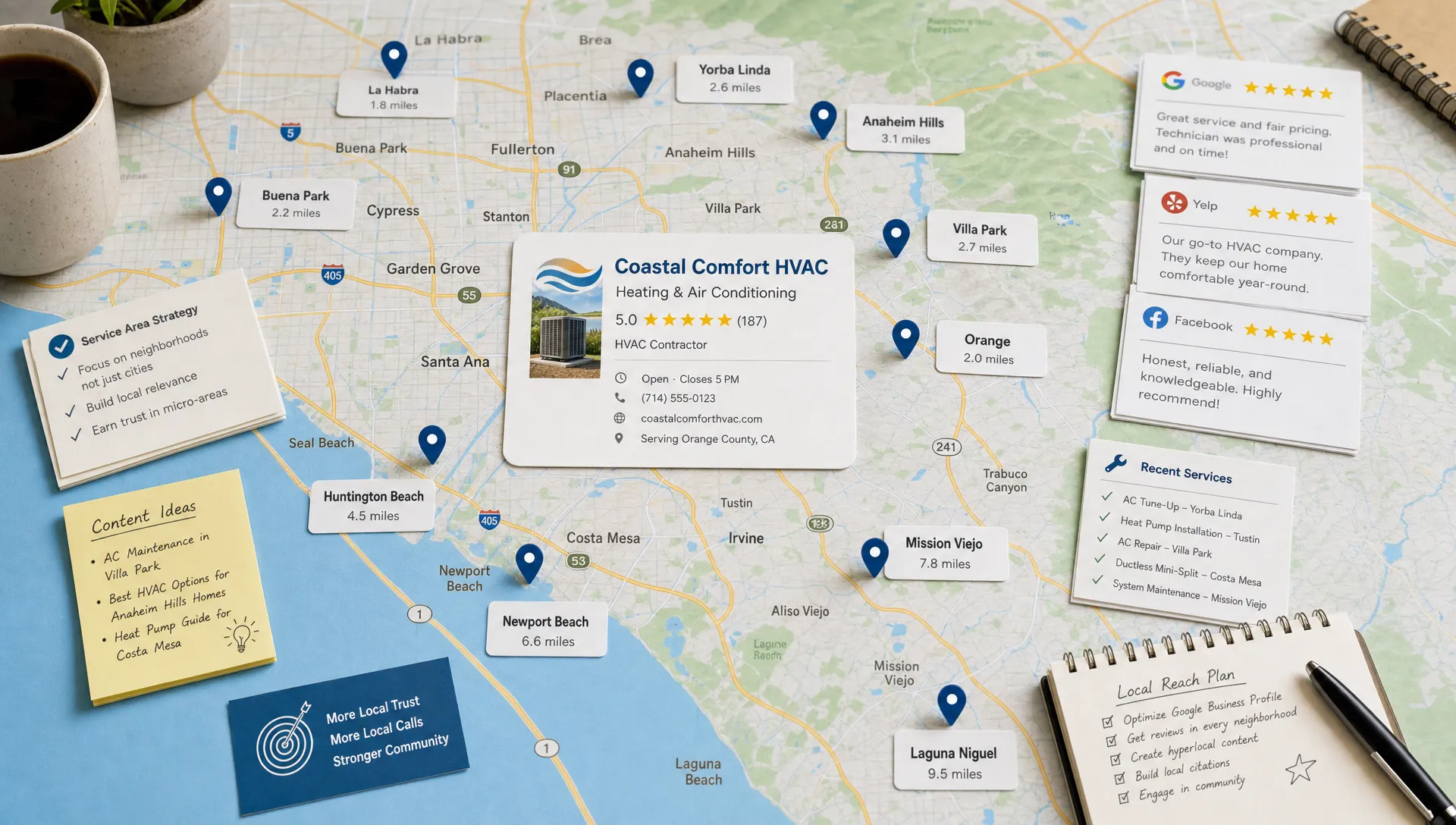
 Orange County is crowded with capable contractors. A homeowner in Irvine can compare five HVAC companies before lunch. A property manager in Newport Beach can ask Google, ChatGPT, or a voice assistant for a plumber without ever visiting a website. A remodeler in Laguna Beach may be judged by reviews, photos, and local proof before the first call happens. That is why local marketing for contractors has to be more precise than generic advertising. You are not trying to reach everyone in California. You are trying to become the obvious, trusted choice when someone nearby needs your exact service, in your exact service area, right now. For Orange County contractors, the best marketing ideas connect three things: local search visibility, neighborhood-level trust, and fast conversion into calls or estimate requests. Google’s local ranking guidance centers on relevance, distance, and prominence, and those same principles now influence how AI-driven search tools interpret which businesses deserve to be recommended.
June 18, 2026
The San Francisco Bay Area runs on booked meetings. From SoMa tech startups to Oakland professional services firms, growth depends on a full calendar. But most businesses waste more time chasing appointments than closing them.  The Bay Area's competitive market makes this worse. Prospects get dozens of outreach messages daily. Generic cold emails land in spam. Inbound alone rarely keeps a calendar full. You need a system — or an agency — that cuts through the noise. This guide covers the six best appointment booking agencies serving the San Francisco Bay Area. What are the best appointment booking agencies in the San Francisco area? The top options span two distinct models. Managed outreach services — like Kell Web Solutions — actively prospect and book qualified leads on your behalf. B2B appointment setting agencies use human SDRs and AI to book meetings for enterprise and growth-stage companies.
June 15, 2026
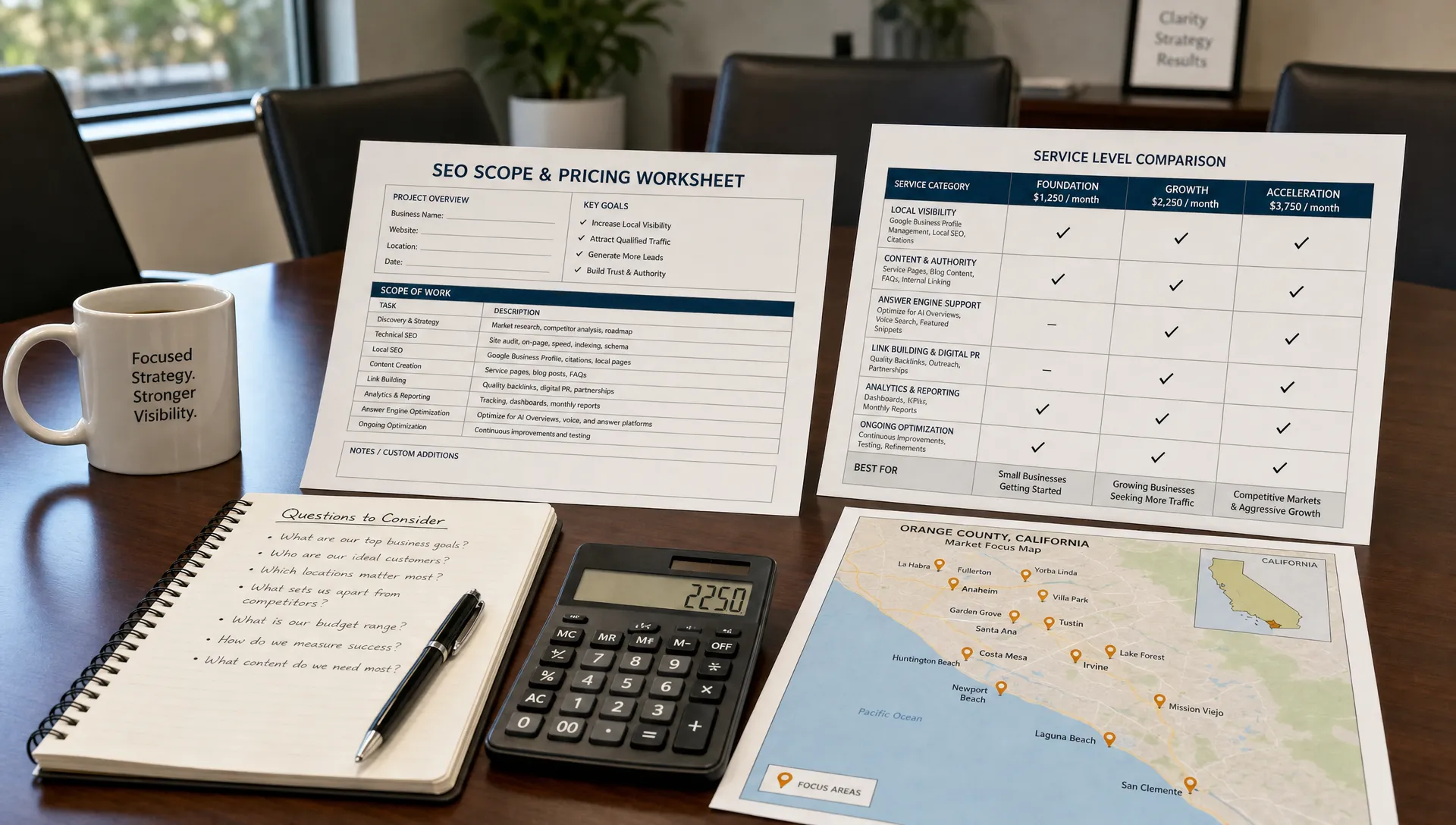
 A marketing firm can make a dashboard look busy. That is not the same as growing local revenue. For an Orange County contractor, revenue means booked HVAC jobs in Irvine, emergency plumbing calls in Huntington Beach, roof replacement estimates in Anaheim, and remodel consultations in Laguna Niguel. For a multi-location dental, medical, or legal practice, it means the right prospects choosing the right office within the right neighborhood catchment. That is why choosing between marketing firms in 2026 requires a different scorecard. Rankings still matter. Ads still matter. Websites still matter. But local buyers now move through Google Maps, AI Overviews, voice assistants, reviews, directory profiles, neighborhood content, and referral signals before they ever fill out a form. The right firm does not just “do marketing.” It builds a system that turns local intent into confident calls, consultations, and booked work. Below is a practical framework for choosing a marketing partner that is accountable to revenue, not vanity metrics. Start by defining what “local revenue growth” means Before you talk to agencies, define the business outcome you actually need. Too many local businesses start with a vague request like “we need SEO” or “we need more leads.” A stronger starting point is: “We need more qualified calls from homeowners in Newport Beach for high-margin HVAC replacement jobs,” or “We need more booked consultations for our Irvine and San Diego offices.” That distinction changes everything. A generic campaign might chase traffic from anywhere. A revenue-focused local campaign identifies the service lines, cities, neighborhoods, customer questions, and conversion paths that produce profitable work. Use a simple scorecard like this when evaluating proposals: