AI and the Future of Customer Experience: Empowering Businesses to Deliver Hyper-Personalized Journeys

Debbie Kell • October 13, 2024

As the digital landscape rapidly evolves, customer expectations are also shifting. Consumers no longer settle for one-size-fits-all solutions. They crave personalized, seamless experiences that are tailored to their unique needs and preferences. At the heart of this transformation is Artificial Intelligence (AI). AI, once perceived as a futuristic technology, has now become essential for businesses, particularly in the realm of Customer Experience (CX). By leveraging AI, companies can reimagine their CX strategies, delivering hyper-personalized journeys, enhancing customer support, and building stronger relationships with their customers.


AI: The New Frontier in Customer Experience

Artificial intelligence is revolutionizing the way businesses interact with their customers. Through machine learning and predictive analytics, companies can process massive amounts of data in real-time, gaining deep insights into customer behavior. This data-driven approach allows businesses to tailor their products, services, and communications to meet the specific needs of their customers.


AI enables real-time, actionable responses that strengthen relationships between brands and consumers. For instance, when a customer interacts with a website or app, AI can predict what they need next—whether it’s a product recommendation or a quick resolution to a problem—fostering a more personalized experience.


Automating Routine Tasks with AI

One of AI’s most significant advantages is its ability to automate routine tasks, allowing businesses to operate more efficiently while enhancing the customer experience. Tasks like routing customer queries, personalizing advertising, and optimizing marketing messages can be handled by AI tools, freeing up human agents to focus on more complex, empathy-driven interactions.


This automation leads to faster, more accurate responses, improving customer satisfaction. For example, a company can use AI to automatically sort incoming customer inquiries, ensuring that simple questions are answered by a chatbot while more complicated issues are directed to a human representative.


Hyper-Personalization at Scale: A Key AI Capability

One of the most transformative aspects of AI in CX is its ability to deliver hyper-personalized experiences at scale. Customers today expect brands to understand their individual preferences and deliver relevant, tailored solutions. AI makes this possible by analyzing behavior across various touchpoints, including browsing history, past purchases, and engagement patterns.


Personalized Product Recommendations

For example, AI-powered recommendation engines can suggest products or services based on a customer’s previous interactions, making them feel understood and valued. Personalized marketing messages driven by AI also lead to higher engagement, as customers are more likely to interact with content that resonates with their needs.


A notable example of this is Netflix, which uses AI to offer personalized content recommendations. By analyzing users’ viewing habits, Netflix suggests shows and movies that align with each user’s preferences, significantly boosting engagement and reducing churn. This level of personalization has played a major role in Netflix's success, allowing it to dominate the streaming industry.


AI-Powered Chatbots and Virtual Assistants

AI-powered chatbots and virtual voice assistants are now integral to delivering a modern customer experience. These tools provide 24/7 customer support, offering instant responses to routine questions and inquiries. With advancements in natural language processing (NLP), chatbots are becoming more sophisticated, able to handle increasingly complex conversations and understand customer intent.


Enhancing Customer Support

For businesses, AI-driven chatbots significantly improve operational efficiency while reducing the need for human agents to handle basic inquiries. For instance, an AI-powered chatbot can assist customers with frequently asked questions, guide them through troubleshooting processes, or help them navigate a company’s website.


When the situation becomes more complex, the AI can seamlessly transfer the conversation to a human representative. This hybrid approach ensures that customers receive the best possible support, with AI handling routine tasks and human agents providing personalized service when needed.


Predictive Analytics for Proactive Customer Care

AI isn’t just about reacting to customer queries—it’s also about anticipating their needs before they arise. Predictive analytics allows businesses to forecast customer behavior, such as when a customer is likely to churn or when they might require additional support. This proactive approach helps companies address potential issues before they escalate, improving customer retention and satisfaction.


Next-Best-Action Recommendations

AI-driven predictive analytics can also provide “next-best-action” recommendations. For example, after a customer makes a purchase, AI can suggest complementary products or services, increasing the likelihood of repeat business. These insights enable companies to stay one step ahead, ensuring that they’re always offering relevant and timely solutions to their customers.


Balancing Automation and the Human Touch

While AI offers numerous benefits in terms of efficiency and personalization, it’s crucial for businesses to maintain a balance between automation and human interaction. Automation is excellent for handling data-driven tasks, but human empathy and emotional intelligence remain irreplaceable, especially when dealing with complex or sensitive customer issues.


When Human Agents Are Essential

Human agents excel at building emotional connections with customers, which is essential in situations that require a personal touch. For instance, a customer facing a frustrating technical issue or a sensitive billing problem will appreciate the empathy and understanding that only a human can provide.


The best CX strategies combine the strengths of AI and human agents. By automating repetitive tasks, AI allows human agents to focus on delivering high-quality, personalized support when it’s needed most. This balance ensures that customers receive both the efficiency of AI and the empathy of human interaction, leading to higher overall satisfaction.


Challenges and Ethical Considerations in AI-Driven CX

While AI brings tremendous potential for improving CX, it also presents certain challenges, particularly when it comes to data privacy and ethical use. AI systems rely heavily on customer data to deliver personalized experiences, making it essential for businesses to handle this data responsibly.


Data Privacy and Security

Businesses must comply with data privacy regulations and ensure that their customers’ personal information is protected. Transparency is also key—companies should inform customers about how their data is being used and provide options for opting out if desired.


Avoiding Bias in AI Algorithms

Another concern is the potential for bias in AI algorithms. If not carefully monitored, AI can inadvertently reinforce biases or deliver unfair outcomes. For instance, an AI tool designed to recommend products might favor one group of customers over another, leading to unequal treatment. To prevent these issues, companies must implement ethical AI practices and continuously evaluate the fairness of their AI systems.


The Future of AI in Customer Experience

Looking ahead, AI’s role in CX will continue to grow, enabling businesses to deliver even more personalized, efficient, and proactive customer interactions. The key to success will be balancing the power of AI with the emotional intelligence of human agents, ensuring that customers receive the best of both worlds.


Enhancing Personalization and Automation

In the future, AI will allow businesses to anticipate customer needs more accurately, offering personalized solutions before issues even arise. Predictive analytics will continue to improve, allowing companies to intervene at the right moment with targeted offers or assistance.


By blending AI-driven insights with human engagement, businesses can create a customer experience that is both highly efficient and deeply personalized. This combination of technology and human touch will help companies build stronger, more loyal relationships with their customers, ensuring long-term success in an increasingly competitive marketplace.
June 18, 2026
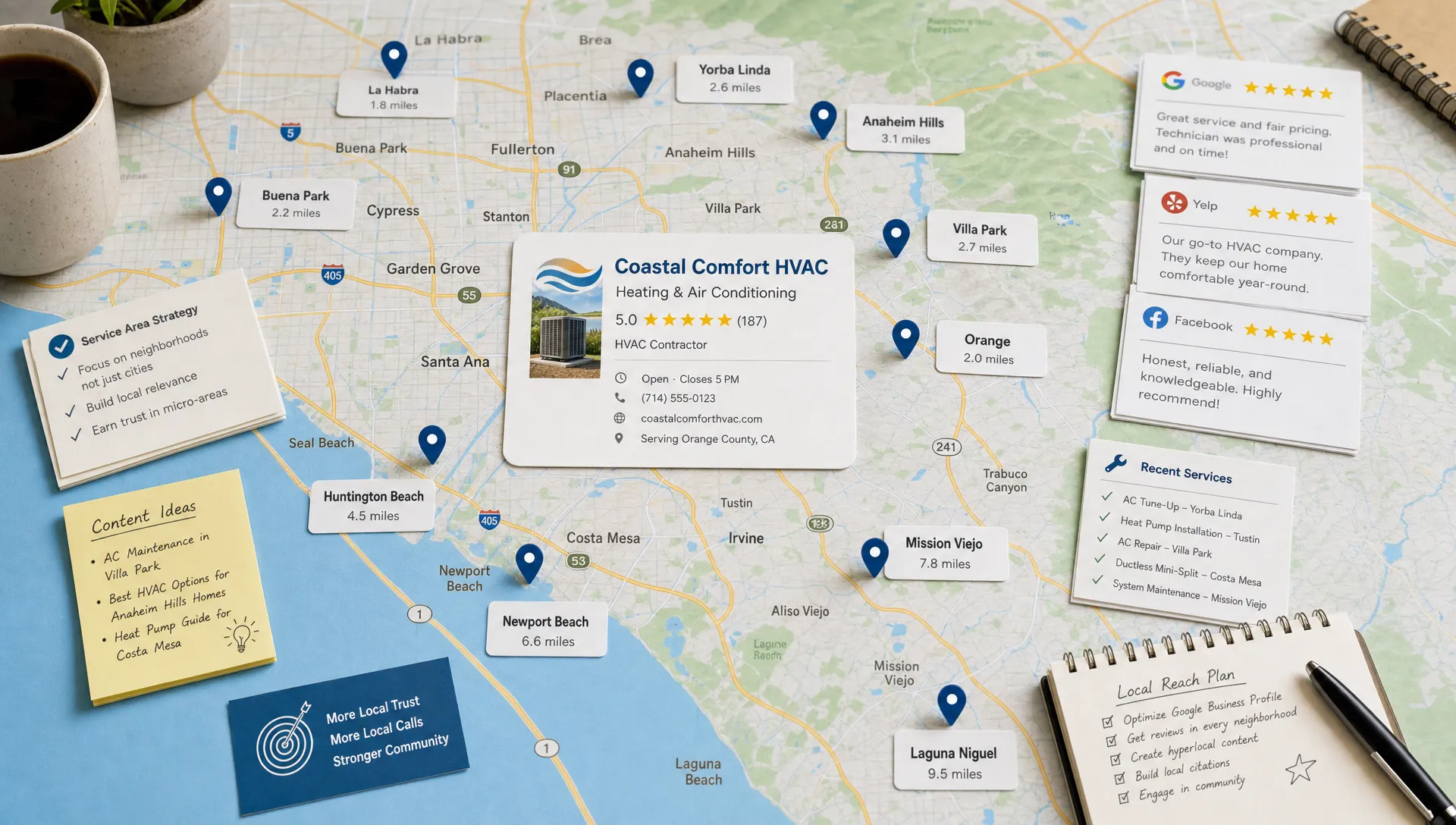
 Orange County is crowded with capable contractors. A homeowner in Irvine can compare five HVAC companies before lunch. A property manager in Newport Beach can ask Google, ChatGPT, or a voice assistant for a plumber without ever visiting a website. A remodeler in Laguna Beach may be judged by reviews, photos, and local proof before the first call happens. That is why local marketing for contractors has to be more precise than generic advertising. You are not trying to reach everyone in California. You are trying to become the obvious, trusted choice when someone nearby needs your exact service, in your exact service area, right now. For Orange County contractors, the best marketing ideas connect three things: local search visibility, neighborhood-level trust, and fast conversion into calls or estimate requests. Google’s local ranking guidance centers on relevance, distance, and prominence, and those same principles now influence how AI-driven search tools interpret which businesses deserve to be recommended.
June 18, 2026
The San Francisco Bay Area runs on booked meetings. From SoMa tech startups to Oakland professional services firms, growth depends on a full calendar. But most businesses waste more time chasing appointments than closing them.  The Bay Area's competitive market makes this worse. Prospects get dozens of outreach messages daily. Generic cold emails land in spam. Inbound alone rarely keeps a calendar full. You need a system — or an agency — that cuts through the noise. This guide covers the six best appointment booking agencies serving the San Francisco Bay Area. What are the best appointment booking agencies in the San Francisco area? The top options span two distinct models. Managed outreach services — like Kell Web Solutions — actively prospect and book qualified leads on your behalf. B2B appointment setting agencies use human SDRs and AI to book meetings for enterprise and growth-stage companies.
June 15, 2026
 A marketing firm can make a dashboard look busy. That is not the same as growing local revenue. For an Orange County contractor, revenue means booked HVAC jobs in Irvine, emergency plumbing calls in Huntington Beach, roof replacement estimates in Anaheim, and remodel consultations in Laguna Niguel. For a multi-location dental, medical, or legal practice, it means the right prospects choosing the right office within the right neighborhood catchment. That is why choosing between marketing firms in 2026 requires a different scorecard. Rankings still matter. Ads still matter. Websites still matter. But local buyers now move through Google Maps, AI Overviews, voice assistants, reviews, directory profiles, neighborhood content, and referral signals before they ever fill out a form. The right firm does not just “do marketing.” It builds a system that turns local intent into confident calls, consultations, and booked work. Below is a practical framework for choosing a marketing partner that is accountable to revenue, not vanity metrics. Start by defining what “local revenue growth” means Before you talk to agencies, define the business outcome you actually need. Too many local businesses start with a vague request like “we need SEO” or “we need more leads.” A stronger starting point is: “We need more qualified calls from homeowners in Newport Beach for high-margin HVAC replacement jobs,” or “We need more booked consultations for our Irvine and San Diego offices.” That distinction changes everything. A generic campaign might chase traffic from anywhere. A revenue-focused local campaign identifies the service lines, cities, neighborhoods, customer questions, and conversion paths that produce profitable work. Use a simple scorecard like this when evaluating proposals:
June 15, 2026
 A lower cost per lead can look good in a report and still hurt your business. If the phone rings with price shoppers outside your service area, renters who cannot approve the work, or patients and clients who do not match your intake criteria, the campaign is not efficient. It is simply cheaper noise. For California contractors and multi-location professional practices, the better goal is lowering cost per qualified lead . That means your digital advertising is not just generating clicks, calls, and forms. It is producing real opportunities: service calls, estimates, consultations, and appointments that fit your market, your margins, and your capacity. In Orange County, Los Angeles, San Diego, San Jose, Sacramento, and other competitive California markets, paid media costs can rise quickly because so many businesses are bidding on the same urgent local intent. The solution is not always to spend less. It is to make every dollar more selective, better tracked, and better supported by trust signals before the prospect ever calls. Start With the Metric That Actually Matters Cost per qualified lead is different from cost per lead. A generic lead is anyone who fills out a form, calls, chats, or books a slot. A qualified lead is someone who matches your service area, service type, urgency, budget range, and next-step criteria. The basic formula is simple: Cost per qualified lead = total ad spend ÷ number of qualified leads But the discipline behind the number is where most campaigns fail. If your ad platform counts every form fill as a conversion, it will optimize toward volume. If you teach the system which leads became booked estimates, consults, or revenue opportunities, it can optimize toward quality.
June 12, 2026
 Traffic is not the win. A ringing phone with the right person on the other end is the win. For California contractors and multi-location professional practices, website advertising has changed. Buying clicks is no longer enough, especially when AI answers, map results, Local Services Ads, and voice assistants can intercept the customer before they ever browse a traditional website. The businesses that grow are the ones that connect every visit to a clear next action: call, schedule, request an estimate, or start a qualified consultation. That means your website cannot function like a digital brochure. It has to work like a call-generation system, built around intent, trust, geography, and fast response. What website advertising should mean in 2026 Website advertising is often treated as traffic generation. A business runs Google Ads, posts on social media, optimizes a Google Business Profile, publishes a few service pages, and hopes the phone rings. That approach leaves too much to chance. A stronger definition is this: website advertising is the complete system that attracts the right local visitor, proves you are the right choice, and makes the next call feel obvious. For an HVAC company in Irvine, that may mean a visitor searching for same-day AC repair lands on a page that speaks directly to their city, urgency, equipment problem, and trust concerns. For a dental group in San Jose, it may mean a prospective patient comparing providers sees credentials, locations, accepted services, reviews, and a clear consultation path without having to dig. The difference between a visit and a qualified call usually comes down to four questions: Does the page match the visitor's exact problem? Does the visitor believe you serve their city or neighborhood? Does the page prove enough trust before asking for action? Does the call path remove friction and qualify the opportunity? When those pieces line up, traffic becomes revenue potential. When they do not, more advertising often just creates more waste. Why website visits fail to become qualified calls Most businesses do not have a traffic problem first. They have an intent and conversion problem. They attract visitors who are researching, browsing, outside the service area, comparing prices only, or uncertain whether the company handles their specific need. The website then makes the problem worse by giving every visitor the same page, the same generic message, and the same vague call to action.
June 12, 2026
 If you run a roofing company in Irvine, an HVAC business in Anaheim, a dental group in San Diego, or a law firm with offices across Orange County, internet advertising can feel both essential and frustrating. You can spend money, generate clicks, and still wonder why the phone is not ringing with the right prospects. The problem is rarely that advertising “doesn’t work.” The problem is that local businesses often buy visibility before they have built the strategy, tracking, trust signals, and follow-up systems needed to turn visibility into revenue. In 2026, the margin for error is smaller. Search results are more crowded. AI Overviews and voice assistants answer more questions before a user visits a website. Paid lead costs in competitive categories keep rising. For local contractors and multi-location professional practices, avoiding the wrong moves is just as important as choosing the right channels.