Digital Transformation in the Hottest Industries of 2025

Gregg Kell • October 10, 2024

The rapid pace of digital transformation is redefining industries across the globe, enabling businesses to innovate, adapt, and thrive in an increasingly technology-driven world. By 2025, some of the most exciting advancements will be seen in sectors such as healthcare, manufacturing, and retail. The integration of advanced technologies like artificial intelligence (AI), the Internet of Things (IoT), and cloud computing is not only enhancing operational efficiency but also reshaping customer experiences and creating new opportunities for growth.


Technology in Healthcare: Telemedicine and Health Analytics


One of the industries most profoundly impacted by digital transformation is healthcare. The adoption of telemedicine has surged, allowing patients to consult with doctors remotely through video calls and secure messaging platforms. This shift has made healthcare more accessible, particularly for those living in remote or underserved areas. Telemedicine also reduces the burden on healthcare facilities, freeing up resources for more critical cases.


In addition to telemedicine, health analytics is playing a pivotal role in modern healthcare. With the help of AI and machine learning, healthcare providers can now analyze patient data to predict disease outcomes, customize treatment plans, and even prevent potential health crises before they occur. Wearable devices and IoT sensors are enabling real-time monitoring of patient vitals, ensuring timely intervention and reducing hospital readmission rates. This focus on data-driven healthcare is transforming the way providers approach patient care, making it more proactive and personalized.


Technological Advancements in Manufacturing and Automation


Manufacturing is another industry witnessing a significant digital transformation. The rise of smart factories, where machinery and equipment are connected through IoT networks, is driving higher levels of automation and efficiency. Technologies such as robotics, 3D printing, and machine learning are enabling manufacturers to optimize production processes, minimize waste, and respond to changes in demand more flexibly.


Automation is also reducing the need for manual labor in repetitive and dangerous tasks, improving safety and productivity. Furthermore, advancements in supply chain management are streamlining logistics and inventory management, resulting in shorter lead times and lower costs. Predictive maintenance, powered by AI, allows manufacturers to foresee equipment failures and perform timely repairs, preventing costly downtimes and extending the lifespan of machinery. As a result, digital transformation is reshaping manufacturing into a more agile, responsive, and cost-efficient industry.


Impact of Technology on Retail: E-commerce and Omnichannel Strategies


The retail industry is no stranger to digital disruption, but by 2025, it’s expected to embrace even more technological advancements. E-commerce continues to grow exponentially, with online sales accounting for a significant share of total retail revenue. To stay competitive, retailers are adopting omnichannel strategies that seamlessly integrate online and offline experiences. This includes options like Buy Online, Pick Up In-Store (BOPIS), curbside pickup, and same-day delivery, which cater to evolving consumer preferences.


Retailers are also leveraging AI-driven analytics to gain deeper insights into customer behavior, enabling personalized marketing and product recommendations. In-store technologies, such as smart shelves, interactive displays, and cashier-less checkout systems, are enhancing the shopping experience and reducing friction at every stage of the customer journey. These innovations are empowering retailers to provide more engaging, convenient, and efficient services, ultimately driving customer satisfaction and loyalty.


Digital transformation is rapidly altering the landscape of key industries, with healthcare, manufacturing, and retail at the forefront of this evolution. From the rise of telemedicine and health analytics in healthcare to automation and smart factories in manufacturing, and the adoption of omnichannel strategies in retail, technology is enabling these sectors to operate more efficiently and deliver enhanced experiences.


As we move towards 2025, businesses must continue to embrace these advancements to remain competitive and capitalize on the new opportunities that digital transformation brings.


FAQs


1. How is telemedicine changing healthcare delivery?
Telemedicine allows patients to consult with healthcare providers remotely, making medical care more accessible and reducing the strain on physical healthcare facilities.


2. What technologies are driving automation in manufacturing?
Technologies like IoT, robotics, machine learning, and 3D printing are enabling higher levels of automation, optimizing production processes, and minimizing waste in manufacturing.


3. What is an omnichannel strategy in retail?
An omnichannel strategy integrates multiple shopping channels (online and offline) to provide a cohesive and seamless customer experience, such as offering options like BOPIS and curbside pickup.


4. How does AI improve customer experience in retail?
AI enables retailers to analyze customer behavior and preferences, allowing for personalized marketing, product recommendations, and improved in-store and online experiences.


5. What are the benefits of predictive maintenance in manufacturing?
Predictive maintenance helps manufacturers predict equipment failures, perform timely repairs, and reduce costly downtimes, enhancing overall operational efficiency.
June 22, 2026
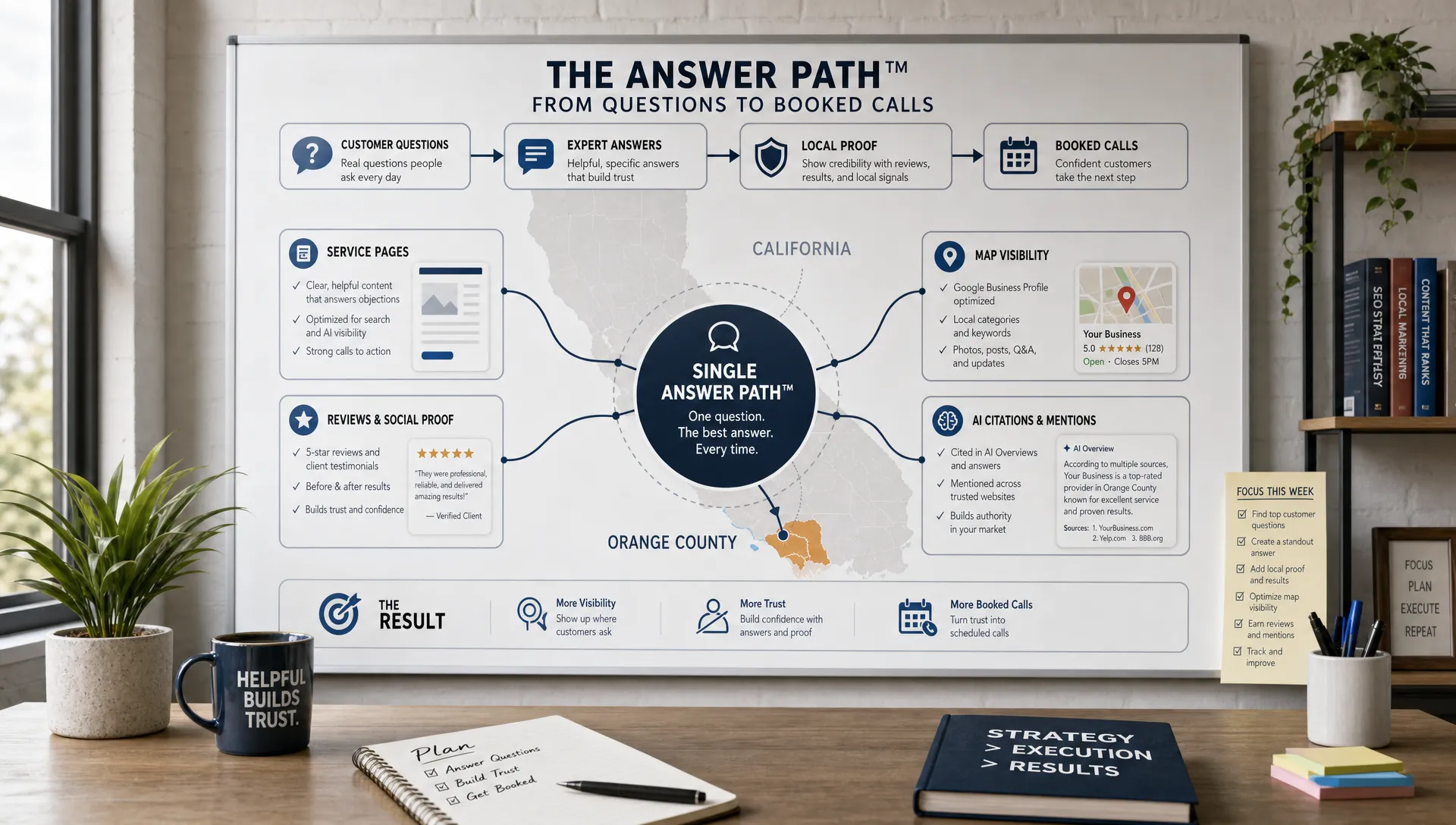
 A homeowner in Laguna Niguel types “emergency AC repair near me.” A patient in Irvine asks Google for “best dentist open Friday.” A property manager in San Jose searches “roof leak repair commercial building.” In each case, the search engine is not simply matching words on a page. It is deciding which local business is relevant, close enough, trusted enough, and clear enough to recommend. That is the real working of search engine optimization for local business. SEO helps search engines understand your company, connect your services to real buyer intent, and present your business when someone nearby is ready to call, book, or request an estimate. For California contractors and multi-location professional practices, this matters because the search results page is no longer just ten blue links. It includes map packs, Google Business Profiles, reviews, AI summaries, paid ads, “people also ask” questions, voice results, and local service panels. If your business is not structured correctly, you may be invisible even when your services are exactly what the customer needs. How Search Engines Work Before a Customer Ever Calls Search engines perform three core jobs: discover information, understand it, and rank it for a specific question. Local SEO improves each of those jobs so your business becomes easier to find and easier to trust.
June 22, 2026
 Search engine optimization used to mean getting a website to rank higher in Google. That definition is no longer wrong, but it is incomplete. In 2026, search engine optimization means making your business easy for search engines, AI systems, map results, voice assistants, and real customers to understand, trust, and choose. Rankings still matter, but they are only one part of the job. The real question is whether your business becomes the obvious answer when a buyer asks for help. For an Orange County HVAC contractor, that might mean showing up when a homeowner in Irvine asks why the AC is blowing warm air. For a Laguna Niguel dental group, it might mean being trusted when someone searches for emergency dental care nearby. For a San Jose law firm or a San Diego remodeler, it might mean being visible across Google Maps, AI Overviews, local service searches, and answer engines before the prospect ever clicks through to a website. That is the new reality of SEO in 2026. The short definition of search engine optimization in 2026 Search engine optimization is the process of building a clear, credible, and technically accessible digital presence so the right customers can find and trust your business at the exact moment they need it. That means your website, Google Business Profile, reviews, local citations, structured data, content, service pages, and off-site authority all need to tell the same story. A modern search engine should be able to answer five basic questions about your business without confusion: Who are you? What services do you provide? Where do you provide them? Why should customers trust you? What should a qualified prospect do next? If any of those answers are unclear, incomplete, or inconsistent, search systems have less confidence in your business. In competitive California markets such as Orange County, Los Angeles, San Diego, San Jose, Sacramento, Fresno, and Irvine, that lack of confidence can quietly turn into lost calls. Why the old SEO definition is too small The fundamentals of SEO still matter. Google’s own SEO Starter Guide still emphasizes crawlable pages, useful content, descriptive titles, good site structure, and links that help users and search engines understand a site. But the way customers interact with search has changed. People no longer only type short keywords and scan ten blue links. They ask full questions. They use voice search. They compare providers in maps. They read reviews before calling. They see AI-generated summaries before they ever visit a website. That means SEO has expanded from ranking pages to managing digital trust. Search is now answer-driven A homeowner might search for best roofer near Huntington Beach after storm damage. Google may show a map pack, reviews, AI-generated guidance, local business profiles, and service pages. The winning company is not always the one with the most keyword repetition. It is the one that provides the clearest, most trustworthy answer across every surface. Search is now entity-driven Search systems need to understand your business as an entity, not just a collection of keywords. Your company name, service categories, founder information, address, service areas, reviews, schema markup, social profiles, and third-party mentions all help define who you are. For local businesses, entity clarity is especially important. If your plumbing company serves Laguna Beach, Dana Point, San Clemente, and Newport Beach, that geographic relationship should be clear across your site and supporting assets. Search is now proof-driven Search engines and AI systems look for signals that support trust. Reviews, credentials, project examples, case studies, service-area consistency, industry expertise, and helpful content all matter. For professional practices, this can include attorney profiles, dentist bios, medical credentials, office locations, appointment information, and clear explanations of services.
June 22, 2026
 For Orange County brands, Google is no longer just a search box. It is a local decision engine that compares your website, Google Business Profile, reviews, service pages, citations, photos, structured data, and brand authority before deciding whether you deserve visibility. That is why google engine optimization should be treated as a broader discipline than traditional SEO. The goal is not only to rank for a keyword. The goal is to become the clearest, most trusted, locally relevant answer when someone in Irvine, Laguna Niguel, Newport Beach, Anaheim, Huntington Beach, Santa Ana, or nearby cities needs help now. For home service contractors, that might mean being visible when a homeowner asks, “Who fixes AC near me today?” For a dental group, law firm, or medical practice, it might mean showing up when a prospective patient or client asks for the best specialist near their neighborhood. In both cases, Google rewards clarity, proximity, proof, and usefulness. What Google Engine Optimization Means in 2026 Traditional SEO focused heavily on rankings, keywords, backlinks, and website content. Those still matter. But Google’s ecosystem now includes organic search results, local map results, Google Business Profiles, reviews, AI-generated summaries, image results, voice queries, and zero-click answers. Google engine optimization is the process of improving every signal Google uses to understand and recommend your brand. It connects technical SEO, local SEO, content strategy, reputation, conversion design, and Answer Engine Optimization into one system.
June 18, 2026
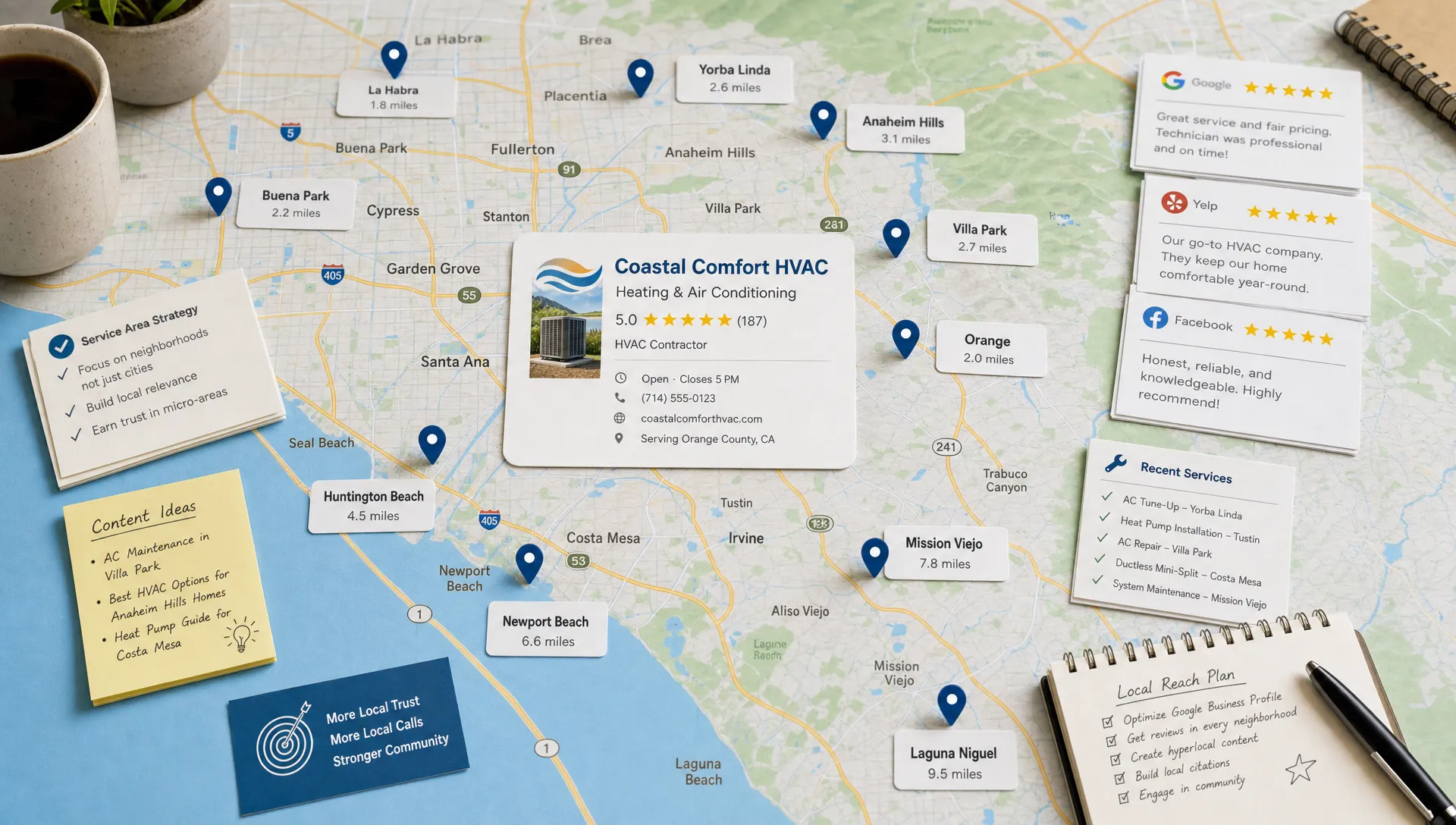
 Orange County is crowded with capable contractors. A homeowner in Irvine can compare five HVAC companies before lunch. A property manager in Newport Beach can ask Google, ChatGPT, or a voice assistant for a plumber without ever visiting a website. A remodeler in Laguna Beach may be judged by reviews, photos, and local proof before the first call happens. That is why local marketing for contractors has to be more precise than generic advertising. You are not trying to reach everyone in California. You are trying to become the obvious, trusted choice when someone nearby needs your exact service, in your exact service area, right now. For Orange County contractors, the best marketing ideas connect three things: local search visibility, neighborhood-level trust, and fast conversion into calls or estimate requests. Google’s local ranking guidance centers on relevance, distance, and prominence, and those same principles now influence how AI-driven search tools interpret which businesses deserve to be recommended.
June 18, 2026
The San Francisco Bay Area runs on booked meetings. From SoMa tech startups to Oakland professional services firms, growth depends on a full calendar. But most businesses waste more time chasing appointments than closing them.  The Bay Area's competitive market makes this worse. Prospects get dozens of outreach messages daily. Generic cold emails land in spam. Inbound alone rarely keeps a calendar full. You need a system — or an agency — that cuts through the noise. This guide covers the six best appointment booking agencies serving the San Francisco Bay Area. What are the best appointment booking agencies in the San Francisco area? The top options span two distinct models. Managed outreach services — like Kell Web Solutions — actively prospect and book qualified leads on your behalf. B2B appointment setting agencies use human SDRs and AI to book meetings for enterprise and growth-stage companies.
June 15, 2026
 A marketing firm can make a dashboard look busy. That is not the same as growing local revenue. For an Orange County contractor, revenue means booked HVAC jobs in Irvine, emergency plumbing calls in Huntington Beach, roof replacement estimates in Anaheim, and remodel consultations in Laguna Niguel. For a multi-location dental, medical, or legal practice, it means the right prospects choosing the right office within the right neighborhood catchment. That is why choosing between marketing firms in 2026 requires a different scorecard. Rankings still matter. Ads still matter. Websites still matter. But local buyers now move through Google Maps, AI Overviews, voice assistants, reviews, directory profiles, neighborhood content, and referral signals before they ever fill out a form. The right firm does not just “do marketing.” It builds a system that turns local intent into confident calls, consultations, and booked work. Below is a practical framework for choosing a marketing partner that is accountable to revenue, not vanity metrics. Start by defining what “local revenue growth” means Before you talk to agencies, define the business outcome you actually need. Too many local businesses start with a vague request like “we need SEO” or “we need more leads.” A stronger starting point is: “We need more qualified calls from homeowners in Newport Beach for high-margin HVAC replacement jobs,” or “We need more booked consultations for our Irvine and San Diego offices.” That distinction changes everything. A generic campaign might chase traffic from anywhere. A revenue-focused local campaign identifies the service lines, cities, neighborhoods, customer questions, and conversion paths that produce profitable work. Use a simple scorecard like this when evaluating proposals: