What is an AI agent?

Gregg Kell • December 19, 2024

What Are AI Agents and Why Are They Game-Changers?

A close up of a robot wearing sunglasses and headphones.

In the age of artificial intelligence, the emergence of AI agents is transforming the way businesses and individuals handle daily tasks. Unlike traditional AI chatbots that only answer questions, AI agents take it a step further by actively performing tasks on behalf of their users. From streamlining business operations to personalizing user experiences, AI agents promise to revolutionize efficiency and productivity.

Major tech players like OpenAI, Microsoft, Google, and Salesforce are racing to develop advanced AI agents that redefine how we interact with technology. With applications in industries such as healthcare, robotics, gaming, and beyond, AI agents are paving the way for a new era of automation and innovation.


Understanding AI Agents: A Definition

AI agents are technological tools designed to learn about a specific environment and execute tasks or solve problems based on simple human prompts. They range from basic systems like smart thermostats to sophisticated platforms capable of planning transcontinental business trips. These tools operate by perceiving their environment, making decisions, and taking action to achieve defined goals.


The Evolution of AI Agents: From Simple to Advanced

1. Simple Reflex Agents

A smart thermostat is a perfect example of a reflex agent. It perceives temperature changes and responds accordingly by adjusting the heat. These decisions are simple and based only on the agent’s immediate perceptions.

2. Goal-Based Agents

Think of a Roomba vacuum cleaner. It maps out a room, detects dirt, and takes specific actions to clean. Its singular goal—a spotless floor—guides its every move.

3. Utility-Based Agents

Modern AI agents operate with a utility-based framework. They weigh risks and benefits, prioritize conflicting goals, and make decisions tailored to user preferences. This level of sophistication allows them to handle complex scenarios and deliver results aligned with user expectations.


How AI Agents Work: Decisions in Action

Unlike chatbots, which are limited to responding with text, AI agents actively perform tasks. For example, Google’s Project Mariner showcases an AI agent that plans meals by adding grocery items to an online shopping cart, even suggesting substitutes for unavailable ingredients. While humans still finalize decisions, the agent simplifies the entire process up to that point.


The Key Features of AI Agents

1. Autonomy

AI agents can operate independently for extended periods, reducing the need for constant monitoring.

2. Adaptability

They can transfer skills across domains, tackling new challenges and adapting to unforeseen obstacles.

3. Advanced Problem-Solving

AI agents analyze situations, evaluate multiple options, and execute optimal solutions tailored to user needs.


Real-World Applications of AI Agents

  • Healthcare: Automating administrative tasks and assisting in patient care.
  • Business Operations: Scheduling, email management, and data analysis.
  • E-Commerce: Personalized shopping experiences and inventory management.
  • Robotics: Enhancing automation in manufacturing and logistics.


Are AI Agents Worth the Risks?

As with any technological advancement, AI agents come with potential risks. Users must weigh the benefits of efficiency against concerns about privacy and security.


Key Considerations:

  • Data Privacy: AI agents often require access to sensitive information, such as emails and calendars. Users must assess how much data they are comfortable sharing.
  • Decision-Making Errors: While developers include safeguards to keep humans in the loop, there is always a chance of errors or biased decisions.
  • Cybersecurity Risks: A breach in an AI agent’s system could expose personal or financial information.


By implementing robust safeguards, technology companies aim to address these risks while enhancing user trust and adoption.


The Future of AI Agents: A Path to Artificial General Intelligence?

The ultimate goal for many AI researchers is to achieve artificial general intelligence (AGI)—a system capable of performing tasks across multiple domains with human-level proficiency. Current AI agents are considered "narrow AI," excelling in specific tasks but lacking versatility. However, advancements in AI agent technology bring us closer to realizing the vision of AGI.


Conclusion: Are You Ready for the AI Agent Revolution?

AI agents are reshaping the way we live and work by taking automation to unprecedented levels. From managing daily routines to driving business innovation, these tools offer immense potential for improving efficiency and productivity. As the technology continues to evolve, the question isn’t whether AI agents will transform our lives, but how quickly we’ll embrace them.


Stay ahead of the curve with Kell Web Solutions—your trusted partner in leveraging AI-driven solutions for business growth. Explore more insights on AI and technology at KellSolutions.com/blog.

July 13, 2026
 A homeowner with a leaking roof, a broken AC unit, or an electrical problem is not casually browsing. They are trying to answer one urgent question: “Can I trust this contractor in my area?” That is why every contractor needs a local website that does more than look professional. It has to prove credibility, show local relevance, answer buyer questions, and make the next step easy. Your website is no longer just an online brochure. It is your digital trust center. For contractors in Orange County, Los Angeles, San Diego, San Jose, Sacramento, and other competitive California markets, trust is often the difference between a visitor who calls and a visitor who keeps comparing. A polished ad may get attention. A Google Business Profile may start the search. But your website is where many customers decide whether you are the safe choice. The contractor trust gap is real Contracting is a high-trust business. Customers are letting your team into their home, approving work that may cost hundreds or thousands of dollars, and hoping the job is done safely and correctly. That creates a different level of scrutiny than buying a simple product online. Before a homeowner calls, they are often checking: Whether your company looks established and legitimate Whether you serve their city or neighborhood Whether you handle their exact problem Whether your reviews and project examples feel believable Whether your contact process is simple and low-friction A weak local website creates doubt at the exact moment you need confidence. If your site is outdated, vague, slow, or missing local proof, prospects may assume your service is the same. This is especially true in California, where local competition can be intense. An HVAC company in Irvine, a roofer in Huntington Beach, a plumber in Anaheim, and an electrician in San Jose may all compete against large lead marketplaces, paid ads, map pack listings, and AI-generated answers. The contractors who win are not always the cheapest. They are often the easiest to trust. A local website gives customers a reason to choose you A contractor’s website should answer the questions a homeowner is already asking internally. It should not force them to dig, guess, or call just to understand basic information. At a minimum, your local website should make five things clear. 1. Who you are Customers want to know there are real people behind the business. Show your company name, location, leadership, team, history, and values. If you are family-owned, locally operated, licensed, insured, certified, or highly experienced, say so clearly. Generic wording like “we provide quality service” does not build much trust on its own. Specificity does. “Serving Laguna Niguel homeowners since 2008” is stronger than “your trusted local contractor.” 2. Where you work A local website needs clear geographic signals. That means your city, county, nearby service areas, and neighborhood references should be easy to find. For example, an Orange County contractor may serve Laguna Beach, Laguna Niguel, Dana Point, Mission Viejo, Irvine, Newport Beach, and Costa Mesa. A Bay Area contractor may need pages or sections for San Jose, Sunnyvale, Santa Clara, Fremont, and Oakland. A Central California contractor may target Fresno, Bakersfield, Stockton, Modesto, or Sacramento. The goal is not to stuff city names onto every page. The goal is to show that you actually understand the local market. 3. What problems you solve Homeowners usually search by problem, not by your internal service category. They may search for “AC not cooling,” “roof leak near chimney,” “panel upgrade electrician,” “tankless water heater installation,” or “bathroom remodel contractor near me.” Your website should connect your services to these real problems. A strong service page explains symptoms, options, process, timing, and what the customer should do next. 4. Why people trust you Trust signals should be visible, not hidden. Reviews, testimonials, project photos, awards, certifications, before-and-after examples, and community involvement all help reduce uncertainty. This is not limited to U.S. contractors. A strong example of trust-focused local presentation can be seen on this local contractor website , which highlights service area, customer satisfaction, company background, and proof elements in a way that helps visitors quickly understand why the business is credible. 5. How to take the next step Once a customer feels ready, your site should make action obvious. Phone numbers, quote forms, scheduling links, emergency contact options, and service-area confirmation should be easy to access on mobile. A contractor website that builds trust should not make visitors hunt for a phone number.
July 13, 2026
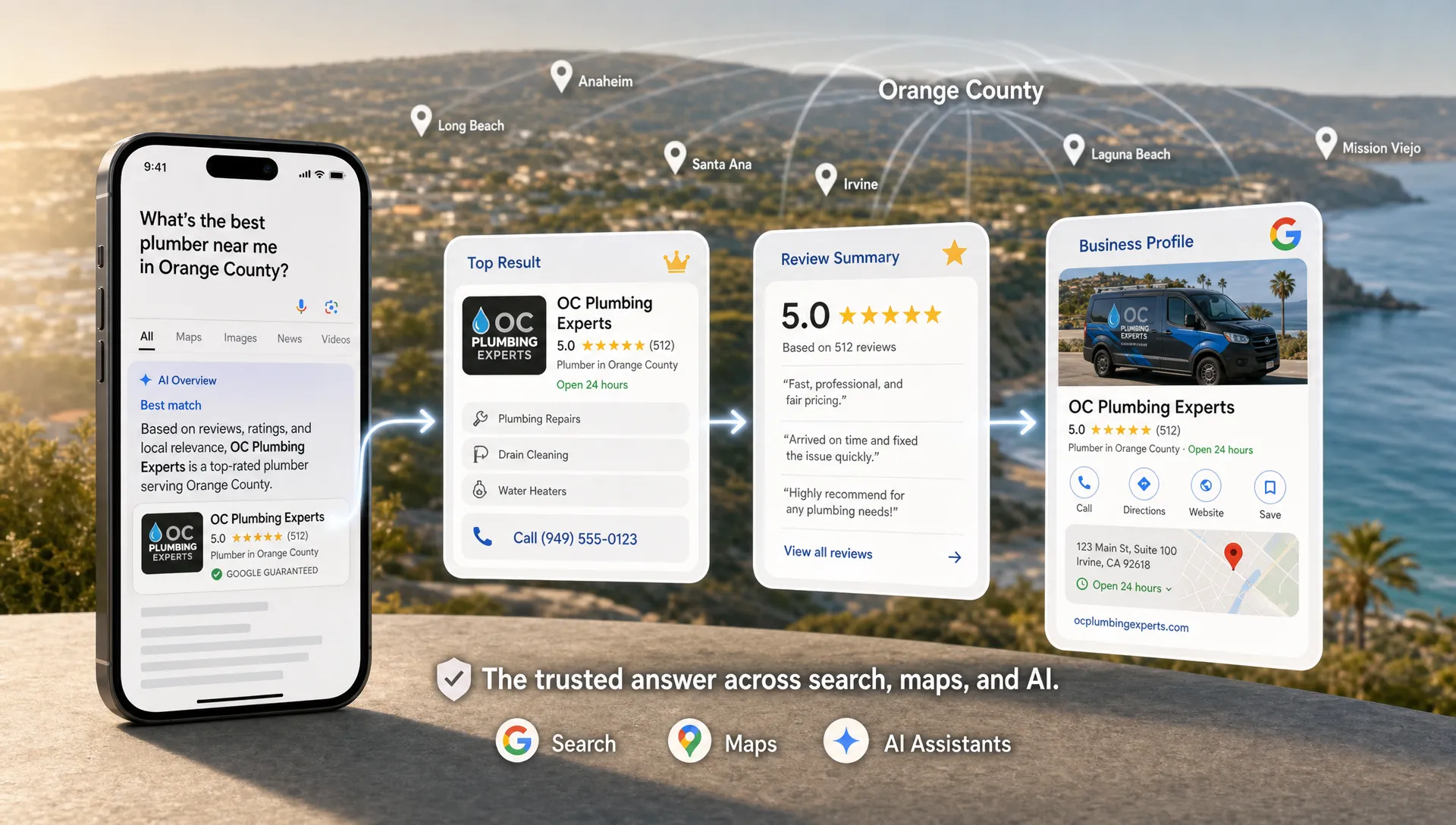
 Search optimization used to mean one primary goal: rank a web page high enough to earn the click. That still matters, but it is no longer the whole game for local businesses. Today, a homeowner in Laguna Beach may ask Google for the best HVAC company for a same-day repair, scan the map pack, listen to a voice assistant, or read an AI Overview without ever visiting ten websites. For California contractors, medical groups, dental practices, and law firms, the new question is not only, 'Can people find us?' It is, 'Can search systems understand us well enough to recommend us when the customer is ready to call?' That is why modern search optimization must work across three connected surfaces: AI Overviews, Google Maps, and voice search . Each one uses different signals, but they all reward the same foundation: clear entity information, local authority, trusted proof, and content that answers real customer questions. Why Search Optimization Has Changed AI-driven search has changed the path from question to call. Instead of typing a short keyword and comparing links, users now ask complete questions such as: Who repairs tankless water heaters near Irvine after hours? What is the best roofing company in Huntington Beach for tile roof leaks? Which dentist near San Jose handles emergency appointments? How much does an electrical panel upgrade cost in Orange County? These searches are more conversational, more local, and often more urgent. Google, voice assistants, and AI answer engines try to summarize the best answer, not just display a list of matching pages. For service businesses, this creates both risk and opportunity. If your business information is vague, inconsistent, or thin, AI systems have little reason to cite you. If your digital presence is structured, locally specific, and supported by reviews and proof, you can become the answer customers hear, see, and call. The Three Search Surfaces You Need to Win AI Overviews, Maps, and voice search overlap, but they are not identical. A strong search optimization strategy understands how each surface works and builds signals that support all three.
June 22, 2026
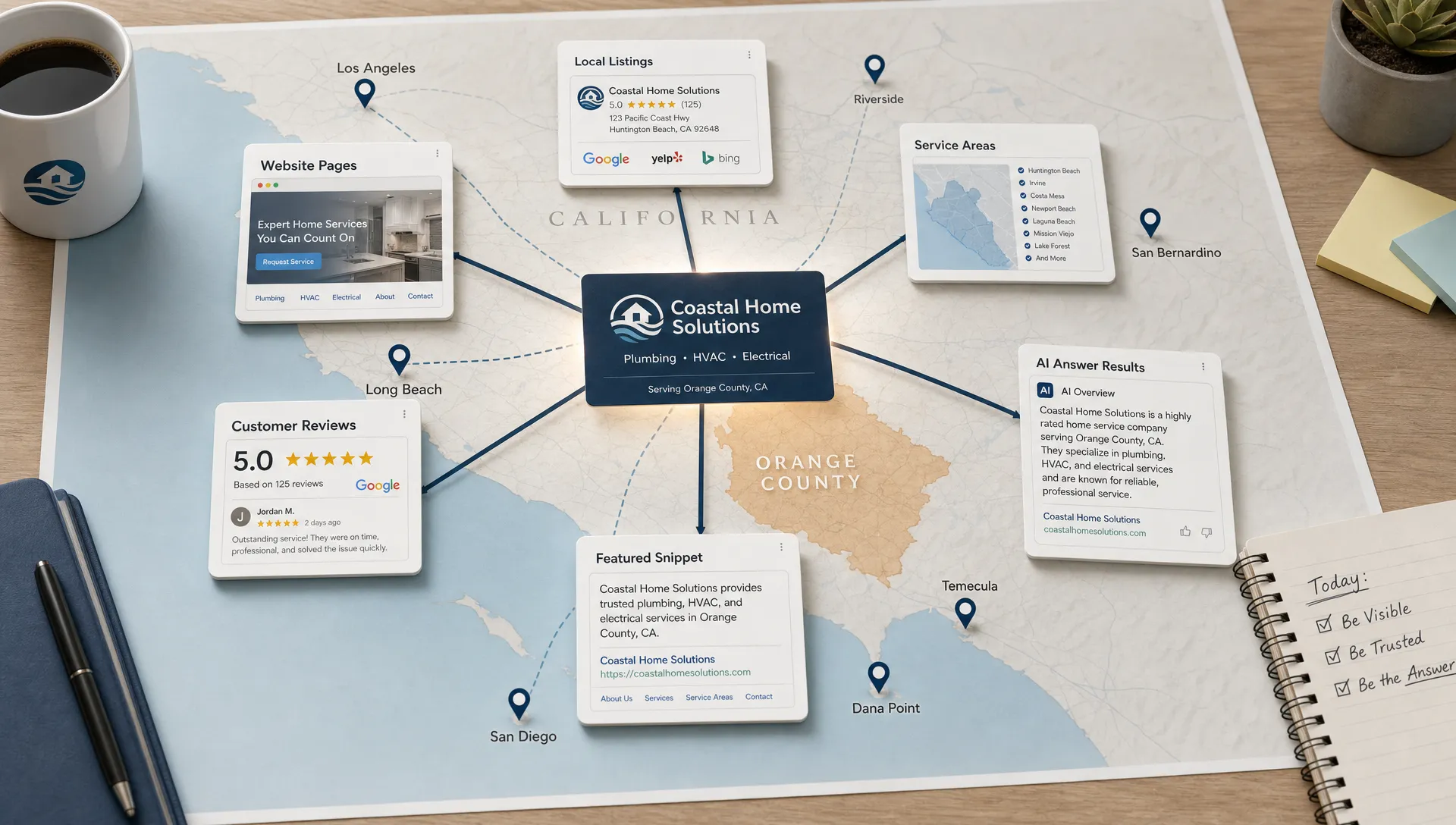
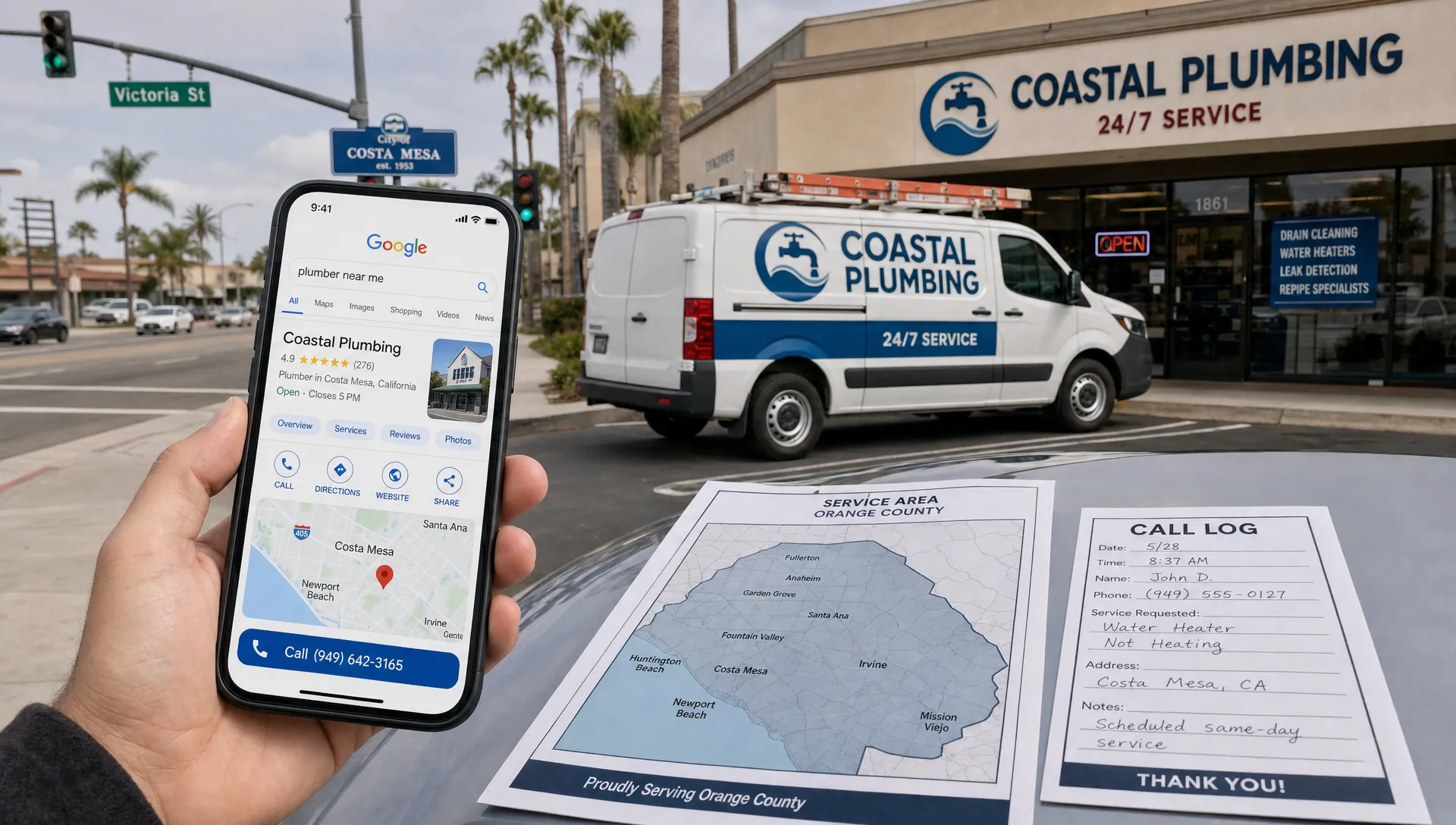
 A homeowner in Laguna Niguel types “emergency AC repair near me.” A patient in Irvine asks Google for “best dentist open Friday.” A property manager in San Jose searches “roof leak repair commercial building.” In each case, the search engine is not simply matching words on a page. It is deciding which local business is relevant, close enough, trusted enough, and clear enough to recommend. That is the real working of search engine optimization for local business. SEO helps search engines understand your company, connect your services to real buyer intent, and present your business when someone nearby is ready to call, book, or request an estimate. For California contractors and multi-location professional practices, this matters because the search results page is no longer just ten blue links. It includes map packs, Google Business Profiles, reviews, AI summaries, paid ads, “people also ask” questions, voice results, and local service panels. If your business is not structured correctly, you may be invisible even when your services are exactly what the customer needs. How Search Engines Work Before a Customer Ever Calls Search engines perform three core jobs: discover information, understand it, and rank it for a specific question. Local SEO improves each of those jobs so your business becomes easier to find and easier to trust.
June 22, 2026
 Search engine optimization used to mean getting a website to rank higher in Google. That definition is no longer wrong, but it is incomplete. In 2026, search engine optimization means making your business easy for search engines, AI systems, map results, voice assistants, and real customers to understand, trust, and choose. Rankings still matter, but they are only one part of the job. The real question is whether your business becomes the obvious answer when a buyer asks for help. For an Orange County HVAC contractor, that might mean showing up when a homeowner in Irvine asks why the AC is blowing warm air. For a Laguna Niguel dental group, it might mean being trusted when someone searches for emergency dental care nearby. For a San Jose law firm or a San Diego remodeler, it might mean being visible across Google Maps, AI Overviews, local service searches, and answer engines before the prospect ever clicks through to a website. That is the new reality of SEO in 2026. The short definition of search engine optimization in 2026 Search engine optimization is the process of building a clear, credible, and technically accessible digital presence so the right customers can find and trust your business at the exact moment they need it. That means your website, Google Business Profile, reviews, local citations, structured data, content, service pages, and off-site authority all need to tell the same story. A modern search engine should be able to answer five basic questions about your business without confusion: Who are you? What services do you provide? Where do you provide them? Why should customers trust you? What should a qualified prospect do next? If any of those answers are unclear, incomplete, or inconsistent, search systems have less confidence in your business. In competitive California markets such as Orange County, Los Angeles, San Diego, San Jose, Sacramento, Fresno, and Irvine, that lack of confidence can quietly turn into lost calls. Why the old SEO definition is too small The fundamentals of SEO still matter. Google’s own SEO Starter Guide still emphasizes crawlable pages, useful content, descriptive titles, good site structure, and links that help users and search engines understand a site. But the way customers interact with search has changed. People no longer only type short keywords and scan ten blue links. They ask full questions. They use voice search. They compare providers in maps. They read reviews before calling. They see AI-generated summaries before they ever visit a website. That means SEO has expanded from ranking pages to managing digital trust. Search is now answer-driven A homeowner might search for best roofer near Huntington Beach after storm damage. Google may show a map pack, reviews, AI-generated guidance, local business profiles, and service pages. The winning company is not always the one with the most keyword repetition. It is the one that provides the clearest, most trustworthy answer across every surface. Search is now entity-driven Search systems need to understand your business as an entity, not just a collection of keywords. Your company name, service categories, founder information, address, service areas, reviews, schema markup, social profiles, and third-party mentions all help define who you are. For local businesses, entity clarity is especially important. If your plumbing company serves Laguna Beach, Dana Point, San Clemente, and Newport Beach, that geographic relationship should be clear across your site and supporting assets. Search is now proof-driven Search engines and AI systems look for signals that support trust. Reviews, credentials, project examples, case studies, service-area consistency, industry expertise, and helpful content all matter. For professional practices, this can include attorney profiles, dentist bios, medical credentials, office locations, appointment information, and clear explanations of services.
June 22, 2026
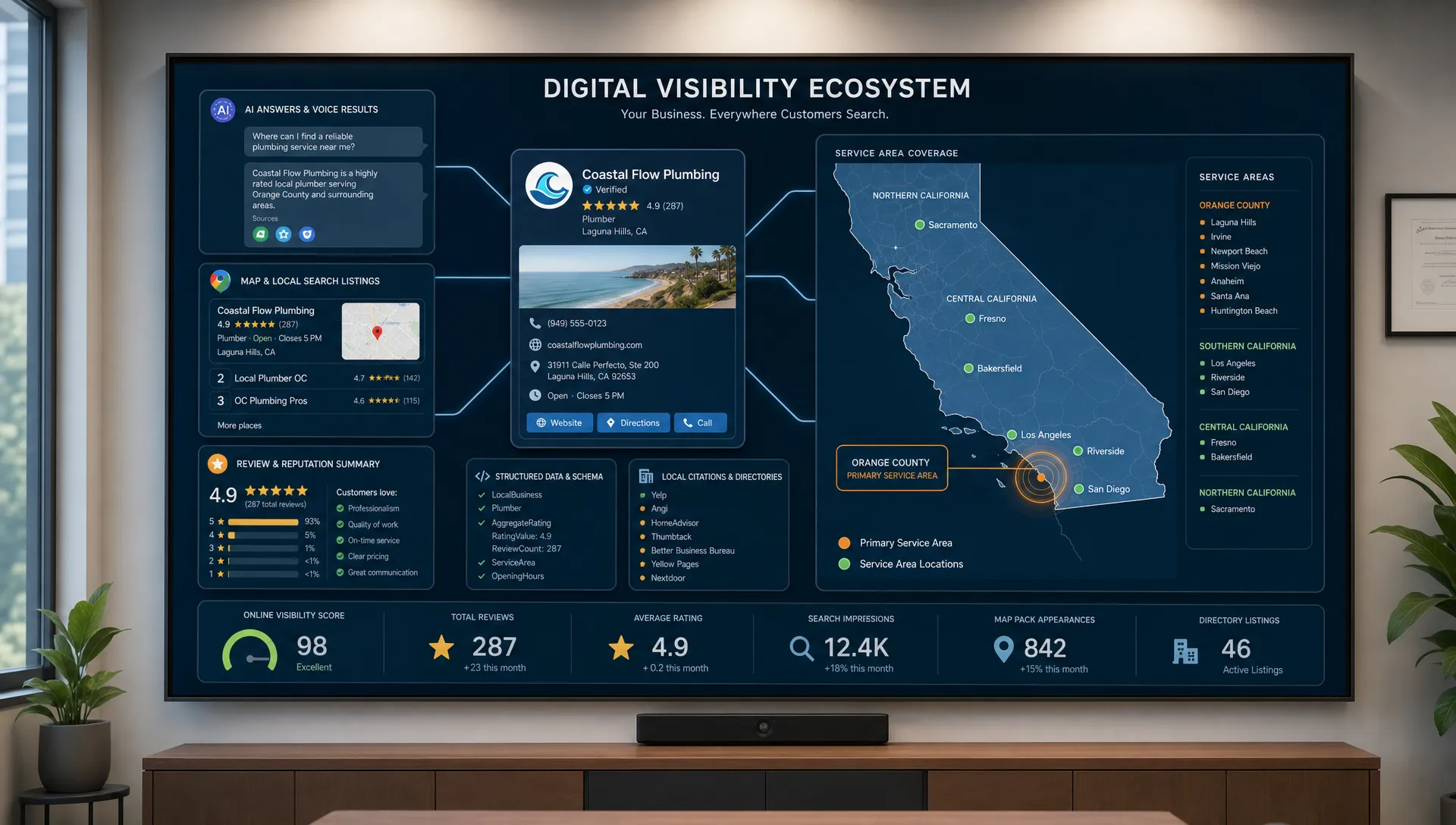
 For Orange County brands, Google is no longer just a search box. It is a local decision engine that compares your website, Google Business Profile, reviews, service pages, citations, photos, structured data, and brand authority before deciding whether you deserve visibility. That is why google engine optimization should be treated as a broader discipline than traditional SEO. The goal is not only to rank for a keyword. The goal is to become the clearest, most trusted, locally relevant answer when someone in Irvine, Laguna Niguel, Newport Beach, Anaheim, Huntington Beach, Santa Ana, or nearby cities needs help now. For home service contractors, that might mean being visible when a homeowner asks, “Who fixes AC near me today?” For a dental group, law firm, or medical practice, it might mean showing up when a prospective patient or client asks for the best specialist near their neighborhood. In both cases, Google rewards clarity, proximity, proof, and usefulness. What Google Engine Optimization Means in 2026 Traditional SEO focused heavily on rankings, keywords, backlinks, and website content. Those still matter. But Google’s ecosystem now includes organic search results, local map results, Google Business Profiles, reviews, AI-generated summaries, image results, voice queries, and zero-click answers. Google engine optimization is the process of improving every signal Google uses to understand and recommend your brand. It connects technical SEO, local SEO, content strategy, reputation, conversion design, and Answer Engine Optimization into one system.
June 18, 2026
 Orange County is crowded with capable contractors. A homeowner in Irvine can compare five HVAC companies before lunch. A property manager in Newport Beach can ask Google, ChatGPT, or a voice assistant for a plumber without ever visiting a website. A remodeler in Laguna Beach may be judged by reviews, photos, and local proof before the first call happens. That is why local marketing for contractors has to be more precise than generic advertising. You are not trying to reach everyone in California. You are trying to become the obvious, trusted choice when someone nearby needs your exact service, in your exact service area, right now. For Orange County contractors, the best marketing ideas connect three things: local search visibility, neighborhood-level trust, and fast conversion into calls or estimate requests. Google’s local ranking guidance centers on relevance, distance, and prominence, and those same principles now influence how AI-driven search tools interpret which businesses deserve to be recommended.